GENETICS
1-Eenjamin A.P.(2003) Genetics A Conceptual
Approach .W.H .Freeman and Com. New York.
P:709.
2-Robert J.B.(2005).Genetics analysis and principles
2nd Ed.McGraw Hill.New York.P:842.
3-Daniel L. Hartl .,and Elizabeth W. Jones.(1998). Genetics: Principles and
Analysis . Fourth Edition. Jones and Bartlett
publishers.USA.pp:1367 .
4- Essentials of Genetics (2011).http://www.nature.com/scitable/ebooks
5-Rooney D. (2001) Human Cytogenetics: Constitutional Analysis: A
Practical
Approach 3rd Edition. 3rd
Edition, Oxford University Press.
6-Peter D., Turnpenny A., Sian E., (2007) Emery's Elements of Medical
Genetics. 14th
Edition, Amsterdam: Elsevier.
GENETICS
Genetics: The science of heredity and variation.
Heredity: Resemblance among individuals related by
descent; transmission of traits from parents
to offspring.
Variation: In biology, the occurrence of differences
among the individuals of the same species.
Gene:Basic unit of biological information; specific segments
of DNA composed of distinctive sets of nucleotide pairs
in a discrete region of a chromosome that encodes
a particular protein;a coding locus.
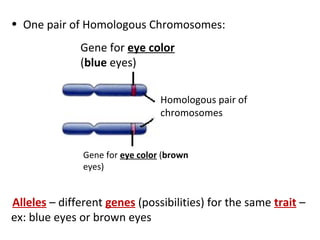
Alleles: Alternative forms of a single gene.
Gene for eye color
(blue eyes)
Gene for eye color (brown
eyes)
Homologous pair of
chromosomes
• One pair of Homologous Chromosomes:
Alleles – different genes (possibilities) for the same trait –
ex: blue eyes or brown eyes
• Genome:All of the chromosomes and DNA
sequences that an
• organism can possess.(the human
genome size ~3,200,000,000 bp)(No.of genes
~35,000).
• Chromosomes: Nucleoprotein bodies ,which are
dark-staining with basic dyes
.Microscopically observable in the cell
during cell division. They carry the
genes that are arranged in linear order
.Each species has a characteristic
chromosome number.
F1: The first filial generation. The first generation
of
descent from a given mating.
Recombination: The observed new combinations of
traits different from those combinations
exhibited by the parents.
Character: One of the many details of structure,
form, substance, or function that
make up an individual organism.
Phenotype: Characteristic of an individual observed
or discernible by other means (i.e. color
blindness or blood type in humans).
Genotype: The genetic composition of an
individual, especially in terms of the alleles for
particular genes(i.e. Tt or tt) .
• Genetic characters are controlled by unit
factors in pairs.
• In other words, genes are present in two
associated copies in diploid organisms.
• For example, TT plants have two alleles for
tallness, tt plants have two alleles for
dwarfism.
MutationMutation::
- Variations in DNA sequence (substitutions,Variations in DNA sequence (substitutions,
deletions, etc) that are present at a frequency lowerdeletions, etc) that are present at a frequency lower
than 1% in a population.than 1% in a population.
- Can produce a gain of function or a loss of function.Can produce a gain of function or a loss of function.
PolymorphismPolymorphism::
- Variations in DNA sequence (substitutions,Variations in DNA sequence (substitutions,
deletions, insertion, etc) that are present at adeletions, insertion, etc) that are present at a
frequency 1% or greater than 1% in a population.frequency 1% or greater than 1% in a population.
- Have a WEAK EFFECT or NO EFFECT at all.Have a WEAK EFFECT or NO EFFECT at all.
A little more basic terminology
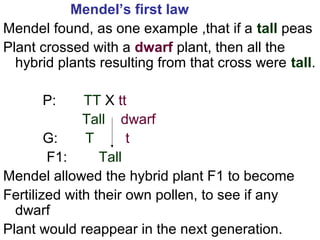
Mendel’s first law
Mendel found, as one example ,that if a tall peas
Plant crossed with a dwarf plant, then all the
hybrid plants resulting from that cross were tall.
P: TT X tt
Tall dwarf
G: T t
F1: Tall
Mendel allowed the hybrid plant F1 to become
Fertilized with their own pollen, to see if any
dwarf
Plant would reappear in the next generation.
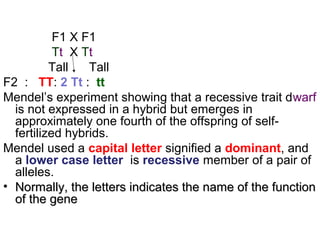
F1 X F1
Tt X Tt
Tall Tall
F2 : TT: 2 Tt : tt
Mendel’s experiment showing that a recessive trait dwarf
is not expressed in a hybrid but emerges in
approximately one fourth of the offspring of self-
fertilized hybrids.
Mendel used a capital letter signified a dominant, and
a lower case letter is recessive member of a pair of
alleles.
• Normally, the letters indicates the name of the functionNormally, the letters indicates the name of the function
of the geneof the gene
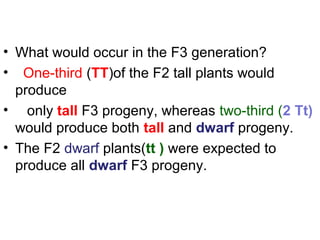
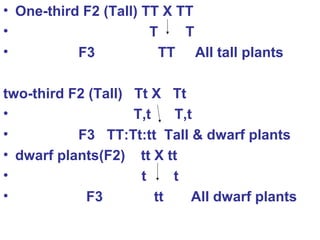
• What would occur in the F3 generation?
• One-third (TT)of the F2 tall plants would
produce
• only tall F3 progeny, whereas two-third (2 Tt)
would produce both tall and dwarf progeny.
• The F2 dwarf plants(tt ) were expected to
produce all dwarf F3 progeny.
• One-third F2 (Tall) TT X TT
• T T
• F3 TT All tall plants
two-third F2 (Tall) Tt X Tt
• T,t T,t
• F3 TT:Tt:tt Tall & dwarf plants
• dwarf plants(F2) tt X tt
• t t
• F3 tt All dwarf plants
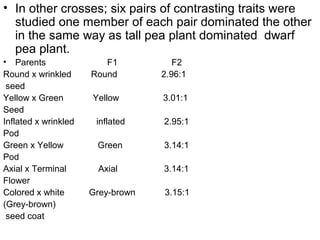
• In other crosses; six pairs of contrasting traits were
studied one member of each pair dominated the other
in the same way as tall pea plant dominated dwarf
pea plant.
• Parents F1 F2
Round x wrinkled Round 2.96:1
seed
Yellow x Green Yellow 3.01:1
Seed
Inflated x wrinkled inflated 2.95:1
Pod
Green x Yellow Green 3.14:1
Pod
Axial x Terminal Axial 3.14:1
Flower
Colored x white Grey-brown 3.15:1
(Grey-brown)
seed coat
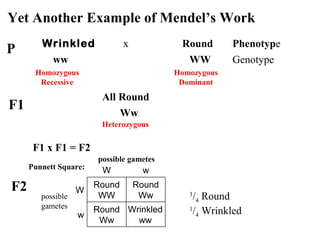
Wrinkled
P Roundx
F1
All Round
Phenotype
Yet Another Example of Mendel’s Work
F1 x F1 = F2
F2 3
/4 Round
1
/4 Wrinkled
ww WW
Ww
Genotype
Homozygous
Recessive
Homozygous
Dominant
Heterozygous
Wrinkled
ww
Round
Ww
w
Round
Ww
Round
WW
W
wWPunnett Square:
possible
gametes
possible gametes
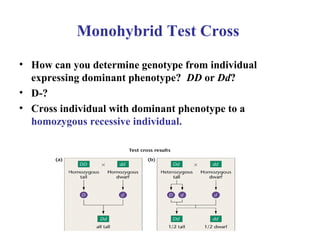
Monohybrid Test Cross
• How can you determine genotype from individual
expressing dominant phenotype? DD or Dd?
• D-?
• Cross individual with dominant phenotype to a
homozygous recessive individual.
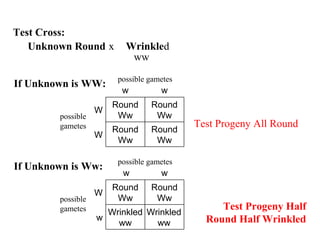
Unknown Round Wrinkledx
ww
Round
Ww
Round
Ww
W
Round
Ww
Round
Ww
W
ww
possible
gametes
possible gametes
Test Cross:
If Unknown is WW:
Wrinkled
ww
Wrinkled
ww
w
Round
Ww
Round
Ww
W
ww
possible
gametes
possible gametes
If Unknown is Ww:
Test Progeny All Round
Test Progeny Half
Round Half Wrinkled
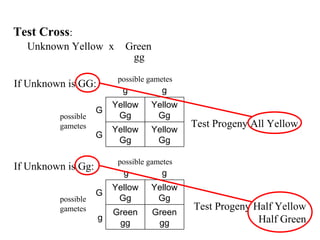
Unknown Yellow Greenx
gg
Yellow
Gg
Yellow
Gg
G
Yellow
Gg
Yellow
Gg
G
gg
possible
gametes
possible gametes
Test Cross:
If Unknown is GG:
Green
gg
Green
gg
g
Yellow
Gg
Yellow
Gg
G
gg
possible
gametes
possible gametes
If Unknown is Gg:
Test Progeny All Yellow
Test Progeny Half Yellow
Half Green
• Mendel’s conclusions
• A gene for height has two alleles, one for tall
and one for dwarf. The allele for tall behaves
as dominant, whereas that for dwarf is
recessive. Similarly for the other six traits.
• DominantDominant: An allele which is expressed: An allele which is expressed
(masks the other).(masks the other).
• RecessiveRecessive: An allele which is present but: An allele which is present but
remains unexpressed (masked)remains unexpressed (masked)
• *During meiosis the members of each pair of allele
separate and distributed to different sex cells or
gametes, thus they occur in different offspring.
• In other words, when sperm and eggs are
formed, one of each allelic pair is randomly
distributed to each gamete.
• For example, a Tt plant makes pollen or eggs, each
randomly receives either the T allele or the t allele.
• This principle of segregation
*(Mendel’s first law or law of segregation).
• Note//
• Zygot or individual organism carrying two units
of allele DD,dd are homozygous(Homo means
the same). Both alleles for a trait are the same.Both alleles for a trait are the same.
• Zygot or individual organism carrying two
alleles Dd are heterozygous (hetero means
different) or the organism's alleles for a trait arethe organism's alleles for a trait are
different.different.
• The previous crosses called monohybrid crosses.
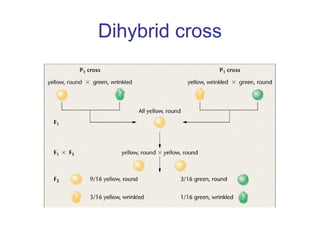
• In dihybrid cross:Mendel allowed plants that were
hybrid in two characters to self-pollinate.
• Since yellow and round are dominant,
Let G = yellow, g = green, W = round, w = wrinkled.
P: yellow Round X green wrinkled
seed seed
GGWW ggww
G: GW gw
F1: GgWw
yellow Round
F1 X F1
GgWw X GgWw
Dihybrid cross
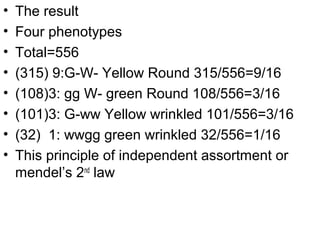
• The result
• Four phenotypes
• Total=556
• (315) 9:G-W- Yellow Round 315/556=9/16
• (108)3: gg W- green Round 108/556=3/16
• (101)3: G-ww Yellow wrinkled 101/556=3/16
• (32) 1: wwgg green wrinkled 32/556=1/16
• This principle of independent assortment or
mendel’s 2nd
law
• During gamete formation, segregating pairs of unit
factors assort independently.
• In other words, segregation of 2 alleles at one genetic
locus has no effect on the segregation of 2 alleles at
another locus (unless linked).
• For example, the assortment of yellow and green alleles
has no effect on the assortment of round and wrinkled
alleles.
• Mendel recognized this as the result of two
monohybrid crosses ,each expected to result in
a 3:1 ratio, operating together.
• The product of the two monohybrid ratios(3:1)2
• Or(3+1)2
was equal to the dihybrid ratio
• (3+1)2
=9+3+3+1
• This is agree with the law of probability:
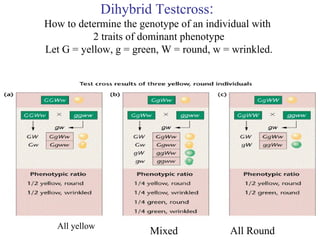
Dihybrid Testcross:
How to determine the genotype of an individual with
2 traits of dominant phenotype
Let G = yellow, g = green, W = round, w = wrinkled.
All yellow
Mixed All Round
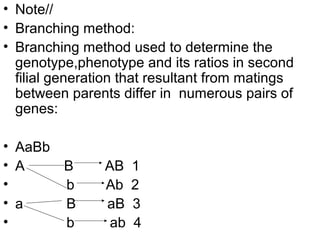
• Note//
• Branching method:
• Branching method used to determine the
genotype,phenotype and its ratios in second
filial generation that resultant from matings
between parents differ in numerous pairs of
genes:
• AaBb
• A B AB 1
• b Ab 2
• a B aB 3
• b ab 4
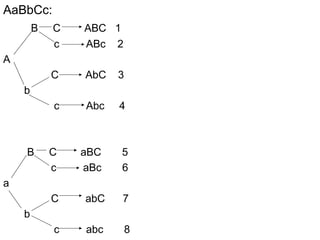
AaBbCc:
B C ABC 1
c ABc 2
A
C AbC 3
b
c Abc 4
B C aBC 5
c aBc 6
a
C abC 7
b
c abc 8
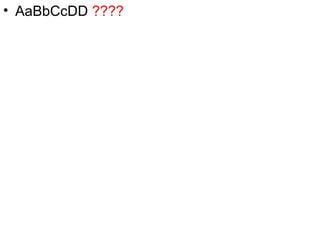
• AaBbCcDD ????
Mothods of genetics study
• 1-Planned breeding: Such as Mendelian’s
• experiments on pea plant
or other genetic experiments to forming a
hybrid by cross-pollination of plants or by
mating animals of different types.
• 2-Pedigree analysis: (A table or diagram
representing the ancestral history of an
individual).
• **In man one cannot make genetic experiments
in the same sense as one can in plants,
insects, or animals.
•
Table or diagram are used to study the
inheritance of genes in humans. It is also useful
when studying any population when progeny data
from several generations is limited. Pedigree
analysis is also useful when studying species
with a long generation time.
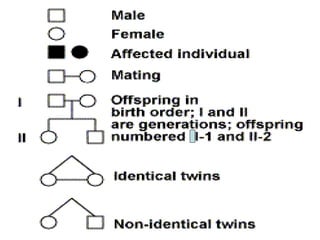
A series of symbols are used to represent
different aspects of a pedigree.
• *** In pedigrees it is conventional to symbolize
females by circles (o ) and males by
• squares(□).
• □ o designates a consanguineous
• Roman numerals to the left or right of the diagram indicate the
generations
Once phenotypic data is collected from
several generations and the pedigree is
drawn, careful analysis will allow you to
determine whether the trait is dominant or
recessive.
The following is the
pedigree of a trait controlled
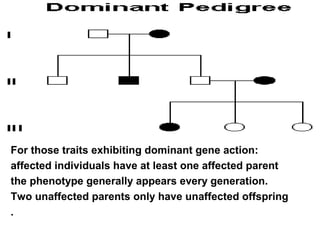
by dominant gene action
For those traits exhibiting dominant gene action:
affected individuals have at least one affected parent
the phenotype generally appears every generation.
Two unaffected parents only have unaffected offspring
.
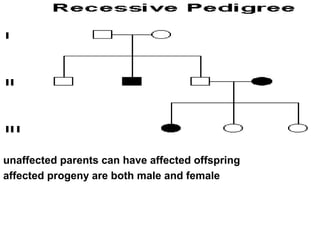
The following is the
pedigree of a trait contolled
by recessive gene action.
unaffected parents can have affected offspring
affected progeny are both male and female
Models of inheritance
• The classical Mendelian ratios,such as 3:1
, 9:3:3:1 ,do not by any means occur in all
crosses.
• Phenotype ratios are modified in various
ways, although the fundamental laws of
the transmission of heredity remain the
same.
Complete dominance
• In complete dominance the phenotype of
heterozygous organisms are similar to that of
homozygous organisms(AA similar to the Aa in
phenotype) in spite of presence of recessive allele
in heterozygous but its function absent.
• Example:In human teeth,dentinogenesis
imperfecta.
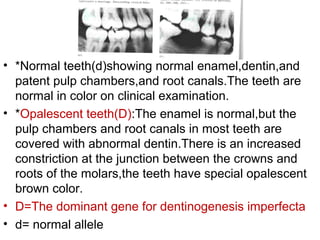
• Dental radiographs of normal teeth compare with
those of a patient with opalescent dentin
• *Normal teeth(d)showing normal enamel,dentin,and
patent pulp chambers,and root canals.The teeth are
normal in color on clinical examination.
• *Opalescent teeth(D):The enamel is normal,but the
pulp chambers and root canals in most teeth are
covered with abnormal dentin.There is an increased
constriction at the junction between the crowns and
roots of the molars,the teeth have special opalescent
brown color.
• D=The dominant gene for dentinogenesis imperfecta
• d= normal allele
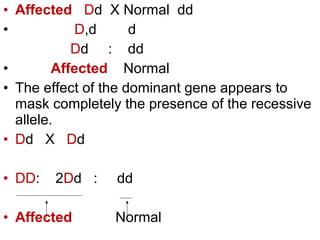
• Affected Dd X Normal dd
• D,d d
Dd : dd
• Affected Normal
• The effect of the dominant gene appears to
mask completely the presence of the recessive
allele.
• Dd X Dd
• DD: 2Dd : dd
• Affected Normal
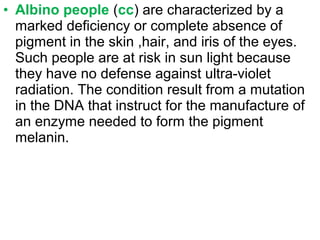
• Albino people (cc) are characterized by a
marked deficiency or complete absence of
pigment in the skin ,hair, and iris of the eyes.
Such people are at risk in sun light because
they have no defense against ultra-violet
radiation. The condition result from a mutation
in the DNA that instruct for the manufacture of
an enzyme needed to form the pigment
melanin.
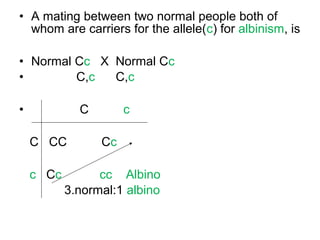
• A mating between two normal people both of
whom are carriers for the allele(c) for albinism, is
• Normal Cc X Normal Cc
• C,c C,c
• C c
C CC Cc
c Cc cc Albino
3.normal:1 albino
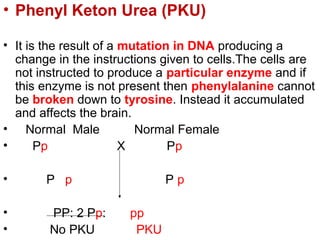
• Phenyl Keton Urea (PKU)
• It is the result of a mutation in DNA producing a
change in the instructions given to cells.The cells are
not instructed to produce a particular enzyme and if
this enzyme is not present then phenylalanine cannot
be broken down to tyrosine. Instead it accumulated
and affects the brain.
• Normal Male Normal Female
• Pp X Pp
• P p P p
• PP: 2 Pp: pp
• No PKU PKU
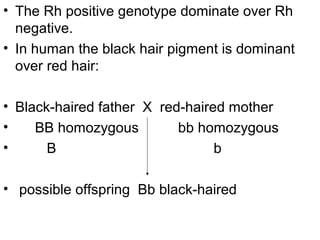
• The Rh positive genotype dominate over Rh
negative.
• In human the black hair pigment is dominant
over red hair:
• Black-haired father X red-haired mother
• BB homozygous bb homozygous
• B b
• possible offspring Bb black-haired
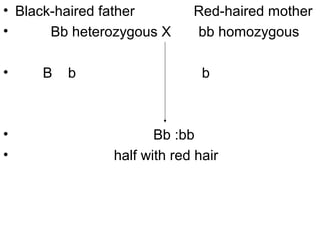
• Black-haired father Red-haired mother
• Bb heterozygous X bb homozygous
• B b b
• Bb :bb
• half with red hair
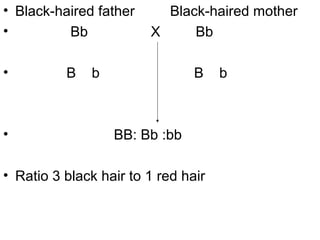
• Black-haired father Black-haired mother
• Bb X Bb
• B b B b
• BB: Bb :bb
• Ratio 3 black hair to 1 red hair
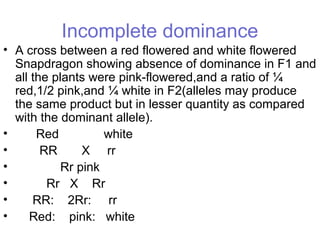
Incomplete dominance
• A cross between a red flowered and white flowered
Snapdragon showing absence of dominance in F1 and
all the plants were pink-flowered,and a ratio of ¼
red,1/2 pink,and ¼ white in F2(alleles may produce
the same product but in lesser quantity as compared
with the dominant allele).
• Red white
• RR X rr
• Rr pink
• Rr X Rr
• RR: 2Rr: rr
• Red: pink: white
• The alleles R and r produce red and white
colors respectively.Since neither allele is
dominant.
• Also the inheritance of plumage color in
Andalusian fowls crosses of black with white
produce only blue-gray progeny in F1.These
when bred together,produce in F2,1/4 black,1/2
blue-gray and ¼ white color.
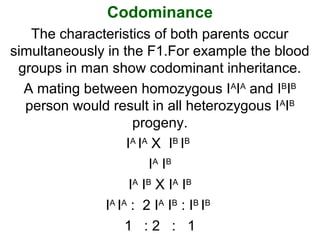
Codominance
The characteristics of both parents occur
simultaneously in the F1.For example the blood
groups in man show codominant inheritance.
A mating between homozygous IA
IA
and IB
IB
person would result in all heterozygous IA
IB
progeny.
IA
IA
X IB
IB
IA
IB
IA
IB
X IA
IB
IA
IA
: 2 IA
IB
: IB
IB
1 : 2 : 1
Overdominance
The phenotype of a heterozygote measured
quantitatively is not always equal or intermediate to
that of the homozygotes.
****The term overdominance has been used for
characteristics concerned with biological”fitness”
such as size,productivity and viability.
• Example: in Drosophila the white-eyes
gene (w) in hetrozygous condition (w+
/w)
causes a marked increase in the amount
of certain fluorescent pigments over both
the white and wild-type homozygotes.
• Note:
• Dominance of a trait does not imply that its
possessors are healthier or more vigorous than
the recessives. There is no constant relation
between dominance or recessiveness of a
character and its usefulness or harmfulness.
• .
• There are many fatal diseases in man and
other organisms are inherited in accordance
with mendel’s laws. Some of these diseases
are due to dominant genes, whereas the
normal ,healthy state is conditioned by the
recessive alleles of these genes
• Again some diseases are due to homozygosis
for recessive genes and the normal state to the
corresponding dominant.Also there is no
relation between dominance of a gene and its
frequency, a gene,dominant or recessive may
have any frequency,from very high to very low ,
• for example,that in a population, most
persons have blue eyes but some have
brown eyes. It would not be legitimate to
conclude that blue eye color is dominant
to brown. In fact, the opposite happens to
be the case.
Lethal gene
• Genes may affect viability as well as the
visible traits of an organism.
• Some organisms have lower viabilities than
the wild type, and detrimental physiological
effects are apparently associated with the
genes involved.
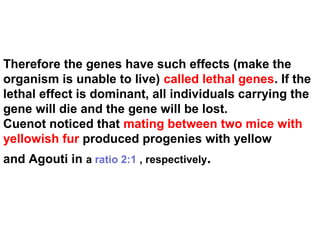
Therefore the genes have such effects (make the
organism is unable to live) called lethal genes. If the
lethal effect is dominant, all individuals carrying the
gene will die and the gene will be lost.
Cuenot noticed that mating between two mice with
yellowish fur produced progenies with yellow
and Agouti in a ratio 2:1 , respectively.
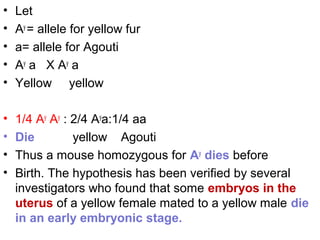
• Let
• Ay
= allele for yellow fur
• a= allele for Agouti
• Ay
a X Ay
a
• Yellow yellow
• 1/4 Ay
Ay
: 2/4 Ay
a:1/4 aa
• Die yellow Agouti
• Thus a mouse homozygous for Ay
dies before
• Birth. The hypothesis has been verified by several
investigators who found that some embryos in the
uterus of a yellow female mated to a yellow male die
in an early embryonic stage.
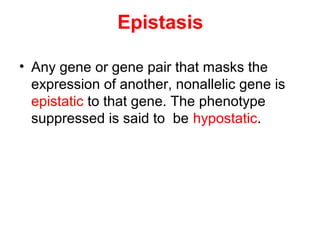
Epistasis
• Any gene or gene pair that masks the
expression of another, nonallelic gene is
epistatic to that gene. The phenotype
suppressed is said to be hypostatic.
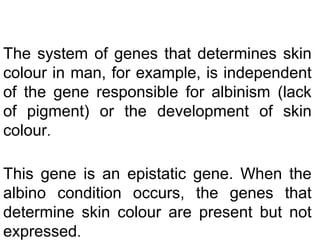
The system of genes that determines skin
colour in man, for example, is independent
of the gene responsible for albinism (lack
of pigment) or the development of skin
colour.
This gene is an epistatic gene. When the
albino condition occurs, the genes that
determine skin colour are present but not
expressed.
Different genes contribute to the steps
needed to make P from a precursor
molecule. In order to get to P, all these
steps have to be fully functional. If there is a
mutation in one of these genes, the reaction
cannot take place and the phenotype or P is
affected.
Multiple Alleles
• An allele is a specific form or sequence of
nucleotide-pairs of a given gene, many and
possibly all genes can change in several or in
many different ways.
• These changes give rise to several alternative
states or variants of the gene, which are called
multiple alleles.
• (When more than two different forms of a given
gene exist in a species, they are referred to as
multiple alleles)
• Multiple Alleles :Three or more
alternative alleles that represent the same
locus in a given pair of chromosomes.
The ABO blood system
• This is a controlled by a tri-allelic gene. IA,
IB,
and
Io
.
• The alleles control the production of antigenes
on the surface of the red blood cells.
• Two of the alleles are codominant to one
another and both are dominant over the third.
• AlleleIA
produces antigen A
• AlleleIB
produces antigen B
• AlleleIo
produces no antigen
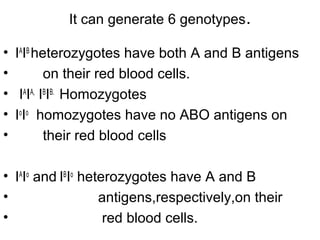
It can generate 6 genotypes.
• IA
IB
heterozygotes have both A and B antigens
• on their red blood cells.
• IA
IA,
IB
IB.
Homozygotes
• Io
Io
homozygotes have no ABO antigens on
• their red blood cells
• IA
Io
and IB
Io
heterozygotes have A and B
• antigens,respectively,on their
• red blood cells.
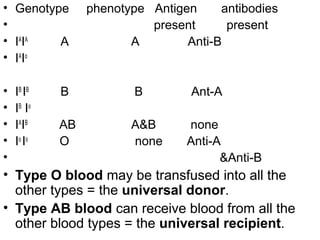
• Genotype phenotype Antigen antibodies
• present present
• IA
IA
A A Anti-B
• IA
Io
• IB
IB
B B Ant-A
• IB
Io
• IA
IB
AB A&B none
• Io
Io
O none Anti-A
• &Anti-B
• Type O blood may be transfused into all the
other types = the universal donor.
• Type AB blood can receive blood from all the
other blood types = the universal recipient.
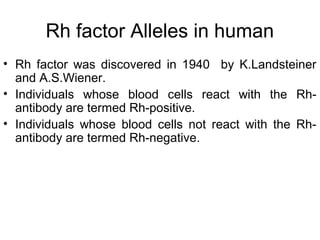
Rh factor Alleles in human
• Rh factor was discovered in 1940 by K.Landsteiner
and A.S.Wiener.
• Individuals whose blood cells react with the Rh-
antibody are termed Rh-positive.
• Individuals whose blood cells not react with the Rh-
antibody are termed Rh-negative.
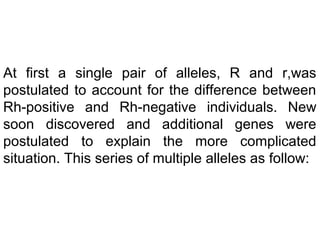
At first a single pair of alleles, R and r,was
postulated to account for the difference between
Rh-positive and Rh-negative individuals. New
soon discovered and additional genes were
postulated to explain the more complicated
situation. This series of multiple alleles as follow:
• R1,
R2
,Ro
,Rz
,r,r˝,r ΄,ry.
• The Rh blood type:
• Rh1,
Rh2
,Rho
,Rhz
,rh,rh˝,rh΄,rhy
• Note:
• The number of different genotypes possible in diploid
organisms is ,of course, a function of the number of
alleles that exist for any given gene.
• If n is the number of alleles of a gene, the number of
different genotypes possible is
• [n(n+1)]/2 .Thus with two alleles:
• [2(2+1)]/2=3 or three possible genotypes .
• With four alleles [4(4+1)]/2 =10 or ten possible
genotypes .
Pleiotropism
• We have seen from previous studies that
many characters are determined not by single
genes but by cooperation, or interaction, of
several or many genes.
• **In some cases;
• influesnce
• One gene more than one trait
• When an gene cause changes in two or more
parts or characters that are not obviously
related, the gene is called pleiotropic or is said
to have multiple effects.
• Even though a structural gene may have
many end effects it has only one primary
function, that of producing one polypeptide,
this polypeptide may give rise to different
expressions at the phenotypic level.
• Example:
• The Hbβs
allele provides a classic example of
pleiotropy. It not only causes hemolytic anemia
• (in the homozygous state) but also results in
increased resistance to one type of malaria,that
caused by the parasite plasmodium falciparum.
• Because the increased resistance to falciparum
Malaria occurs in HbβA
Hbβs
heterozygotes,such
heterozygous individuals have a selective
advantage in geographical regions where this
type of malaria is prevalent.
• The Sickle-cell allele also has pleiotropic
effects on the development of many tissues
and organs such as bones ,the lungs, the
kidneys, the spleen, and the heart.
• Heterozygotes for the allele for Sickle-cell
anemia are more resistant to falciparum
malaria.
• Sickle-shaped corpuscles that clog the
capillaries thus interfering with circulation and
depriving the cells in the body of oxygen.
Sex-linkage in human
• In the previous genetic examples, the sex
of the parents was not specified, because
the previous traits are determined by
genes located on the autosomal
chromosomes (all chromosomes other
than X or Y) .If a trait is determined by a
gene located on the X chromosome is
referred to as X-linked or sex –linked trait.
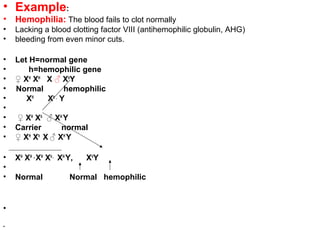
• Example:
• Hemophilia: The blood fails to clot normally
• Lacking a blood clotting factor VIII (antihemophilic globulin, AHG)
• bleeding from even minor cuts.
• Let H=normal gene
• h=hemophilic gene
• ♀ XH
XH
X ♂ Xh
Y
• Normal hemophilic
• XH
Xh ,
Y
•
• ♀ XH
Xh
♂ XH
Y
• Carrier normal
• ♀ XH
Xh
X ♂ XH
Y
• XH
XH ,,
XH
Xh ,
XH
Y, Xh
Y
•
• Normal Normal hemophilic
•
•
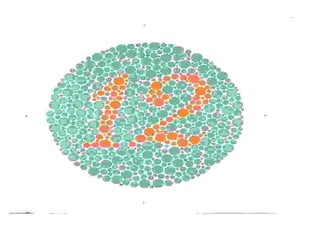
• Color blindness
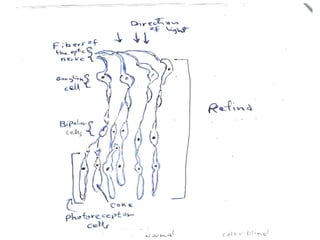
• Color vision is produced by specific receptors
called cones in the retina of eyes. (cone: short
light receptors in the retina of vertebrates that
are sensitive to bright light and function in color
vision).
• There are three types of cones that respond to
the colors; Red, green, and blue, respectively.
• This selectivity is due to a slightly different
pigment in each type of cone.
• The gene that codes for the pigment in the blue
cones is located on an autosomal chromosome
(chromosome No:7).
• The genes for the red and green cones are
located on the X-chromosome.
• In the most common form of red –green color
blindness ,the gene for green cones is
defective so that green cannot be distinguished
from red.
• In a less-common form of this disorder the
gene for the red cones is defective ,so that red
cannot be distinguished from green.
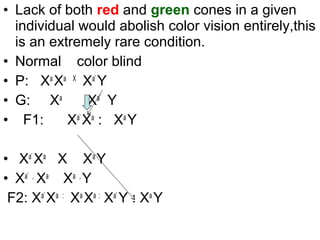
• Lack of both red and green cones in a given
individual would abolish color vision entirely,this
is an extremely rare condition.
• Normal color blind
• P: Xa
Xa X
Xa’
Y
• G: Xa
Xa’
Y
• F1: Xa’
Xa
: Xa
Y
• Xa’
Xa
X Xa
Y
• Xa’ ,
Xa
Xa ,
Y
F2: Xa’
Xa :
Xa
Xa :
Xa’
Y : Xa
Y
• Note:
• An inherited characteristic was observed in a
father but not any of his children, either male
or female, and then would reappear in males of
the next generation, this type of inheritance
called crisscross inheritance.
Y chromosome linkage in man
• Some genes are located on Y chromosome
such as the gene responsible for hairy pinna
this trait present in male only and inherited from
father to sons directly.
Sex-Influenced dominance
• Dominance of alleles may differ in heterozygotes
of the two sexes. Gene products of
heterozygotes in the two sexes may be
influenced differentially by sex hormones.
• Example:
• Autosomal genes responsible for horns in some
breeds of sheep, these genes may behave
differently in the presence of the male and
female sex hormones.
• A mong Dorset sheep,both sexes are
horned ,and the gene for the horned condition
is homozygous (h+
h+
).
• In Suffolk sheep,neither sex is horned and the
genotype is (hh).
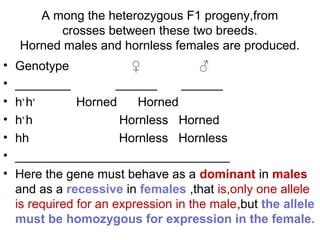
A mong the heterozygous F1 progeny,from
crosses between these two breeds.
Horned males and hornless females are produced.
• Genotype ♀ ♂
• ________ ______ ______
• h+
h+
Horned Horned
• h+
h Hornless Horned
• hh Hornless Hornless
• _______________________________
• Here the gene must behave as a dominant in males
and as a recessive in females ,that is,only one allele
is required for an expression in the male,but the allele
must be homozygous for expression in the female.
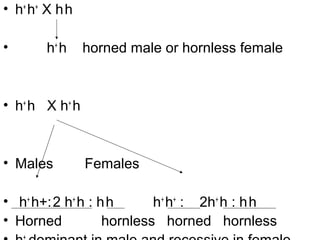
• h+
h+
X hh
• h+
h horned male or hornless female
• h+
h X h+
h
• Males Females
• h+
h+:2 h+
h : hh h+
h+
: 2h+
h : hh
• Horned hornless horned hornless
In humans:
1-white forelock.
2-absence of upper lateral incisor teeth.
3-a particular of enlargement of the terminal
joints
of the fingers.
4-premature pattern baldness.
All these characters have been reported to follow
this mode of inheritance.
b+
dominant in male and responsible for baldness
in case of homozygous b+
b+
or heterozygous b+
b,
whereas it is a recessive in female,and the
• Note:
• Frequency of baldness in the infertile
male equal the frequency of baldness
in the female according to the presence
of hormones.
• Sex-Limited Gene
• A trait that appears in only one sex is
called sex-limited
Sex hormones are apparently limiting
factors in the expressions of some genes.
• Examples are cases of sex limited
expression which might include genes
affecting breast size, and milk
production in mammals, are limited to
females

genetics introduction - models of inheritance

  • 1.
  • 2.
    1-Eenjamin A.P.(2003) GeneticsA Conceptual Approach .W.H .Freeman and Com. New York. P:709. 2-Robert J.B.(2005).Genetics analysis and principles 2nd Ed.McGraw Hill.New York.P:842. 3-Daniel L. Hartl .,and Elizabeth W. Jones.(1998). Genetics: Principles and Analysis . Fourth Edition. Jones and Bartlett publishers.USA.pp:1367 . 4- Essentials of Genetics (2011).http://www.nature.com/scitable/ebooks 5-Rooney D. (2001) Human Cytogenetics: Constitutional Analysis: A Practical Approach 3rd Edition. 3rd Edition, Oxford University Press. 6-Peter D., Turnpenny A., Sian E., (2007) Emery's Elements of Medical Genetics. 14th Edition, Amsterdam: Elsevier.
  • 3.
    GENETICS Genetics: The scienceof heredity and variation. Heredity: Resemblance among individuals related by descent; transmission of traits from parents to offspring. Variation: In biology, the occurrence of differences among the individuals of the same species. Gene:Basic unit of biological information; specific segments of DNA composed of distinctive sets of nucleotide pairs in a discrete region of a chromosome that encodes a particular protein;a coding locus. Alleles: Alternative forms of a single gene.
  • 4.
    Gene for eyecolor (blue eyes) Gene for eye color (brown eyes) Homologous pair of chromosomes • One pair of Homologous Chromosomes: Alleles – different genes (possibilities) for the same trait – ex: blue eyes or brown eyes
  • 5.
    • Genome:All ofthe chromosomes and DNA sequences that an • organism can possess.(the human genome size ~3,200,000,000 bp)(No.of genes ~35,000). • Chromosomes: Nucleoprotein bodies ,which are dark-staining with basic dyes .Microscopically observable in the cell during cell division. They carry the genes that are arranged in linear order .Each species has a characteristic chromosome number.
  • 6.
    F1: The firstfilial generation. The first generation of descent from a given mating.
  • 7.
    Recombination: The observednew combinations of traits different from those combinations exhibited by the parents. Character: One of the many details of structure, form, substance, or function that make up an individual organism. Phenotype: Characteristic of an individual observed or discernible by other means (i.e. color blindness or blood type in humans).
  • 9.
    Genotype: The geneticcomposition of an individual, especially in terms of the alleles for particular genes(i.e. Tt or tt) . • Genetic characters are controlled by unit factors in pairs. • In other words, genes are present in two associated copies in diploid organisms. • For example, TT plants have two alleles for tallness, tt plants have two alleles for dwarfism.
  • 10.
    MutationMutation:: - Variations inDNA sequence (substitutions,Variations in DNA sequence (substitutions, deletions, etc) that are present at a frequency lowerdeletions, etc) that are present at a frequency lower than 1% in a population.than 1% in a population. - Can produce a gain of function or a loss of function.Can produce a gain of function or a loss of function. PolymorphismPolymorphism:: - Variations in DNA sequence (substitutions,Variations in DNA sequence (substitutions, deletions, insertion, etc) that are present at adeletions, insertion, etc) that are present at a frequency 1% or greater than 1% in a population.frequency 1% or greater than 1% in a population. - Have a WEAK EFFECT or NO EFFECT at all.Have a WEAK EFFECT or NO EFFECT at all. A little more basic terminology
  • 11.
    Mendel’s first law Mendelfound, as one example ,that if a tall peas Plant crossed with a dwarf plant, then all the hybrid plants resulting from that cross were tall. P: TT X tt Tall dwarf G: T t F1: Tall Mendel allowed the hybrid plant F1 to become Fertilized with their own pollen, to see if any dwarf Plant would reappear in the next generation.
  • 12.
    F1 X F1 TtX Tt Tall Tall F2 : TT: 2 Tt : tt Mendel’s experiment showing that a recessive trait dwarf is not expressed in a hybrid but emerges in approximately one fourth of the offspring of self- fertilized hybrids. Mendel used a capital letter signified a dominant, and a lower case letter is recessive member of a pair of alleles. • Normally, the letters indicates the name of the functionNormally, the letters indicates the name of the function of the geneof the gene
  • 13.
    • What wouldoccur in the F3 generation? • One-third (TT)of the F2 tall plants would produce • only tall F3 progeny, whereas two-third (2 Tt) would produce both tall and dwarf progeny. • The F2 dwarf plants(tt ) were expected to produce all dwarf F3 progeny.
  • 14.
    • One-third F2(Tall) TT X TT • T T • F3 TT All tall plants two-third F2 (Tall) Tt X Tt • T,t T,t • F3 TT:Tt:tt Tall & dwarf plants • dwarf plants(F2) tt X tt • t t • F3 tt All dwarf plants
  • 15.
    • In othercrosses; six pairs of contrasting traits were studied one member of each pair dominated the other in the same way as tall pea plant dominated dwarf pea plant. • Parents F1 F2 Round x wrinkled Round 2.96:1 seed Yellow x Green Yellow 3.01:1 Seed Inflated x wrinkled inflated 2.95:1 Pod Green x Yellow Green 3.14:1 Pod Axial x Terminal Axial 3.14:1 Flower Colored x white Grey-brown 3.15:1 (Grey-brown) seed coat
  • 16.
    Wrinkled P Roundx F1 All Round Phenotype YetAnother Example of Mendel’s Work F1 x F1 = F2 F2 3 /4 Round 1 /4 Wrinkled ww WW Ww Genotype Homozygous Recessive Homozygous Dominant Heterozygous Wrinkled ww Round Ww w Round Ww Round WW W wWPunnett Square: possible gametes possible gametes
  • 17.
    Monohybrid Test Cross •How can you determine genotype from individual expressing dominant phenotype? DD or Dd? • D-? • Cross individual with dominant phenotype to a homozygous recessive individual.
  • 18.
    Unknown Round Wrinkledx ww Round Ww Round Ww W Round Ww Round Ww W ww possible gametes possiblegametes Test Cross: If Unknown is WW: Wrinkled ww Wrinkled ww w Round Ww Round Ww W ww possible gametes possible gametes If Unknown is Ww: Test Progeny All Round Test Progeny Half Round Half Wrinkled
  • 19.
    Unknown Yellow Greenx gg Yellow Gg Yellow Gg G Yellow Gg Yellow Gg G gg possible gametes possiblegametes Test Cross: If Unknown is GG: Green gg Green gg g Yellow Gg Yellow Gg G gg possible gametes possible gametes If Unknown is Gg: Test Progeny All Yellow Test Progeny Half Yellow Half Green
  • 20.
    • Mendel’s conclusions •A gene for height has two alleles, one for tall and one for dwarf. The allele for tall behaves as dominant, whereas that for dwarf is recessive. Similarly for the other six traits. • DominantDominant: An allele which is expressed: An allele which is expressed (masks the other).(masks the other). • RecessiveRecessive: An allele which is present but: An allele which is present but remains unexpressed (masked)remains unexpressed (masked)
  • 21.
    • *During meiosisthe members of each pair of allele separate and distributed to different sex cells or gametes, thus they occur in different offspring. • In other words, when sperm and eggs are formed, one of each allelic pair is randomly distributed to each gamete. • For example, a Tt plant makes pollen or eggs, each randomly receives either the T allele or the t allele. • This principle of segregation *(Mendel’s first law or law of segregation).
  • 22.
    • Note// • Zygotor individual organism carrying two units of allele DD,dd are homozygous(Homo means the same). Both alleles for a trait are the same.Both alleles for a trait are the same. • Zygot or individual organism carrying two alleles Dd are heterozygous (hetero means different) or the organism's alleles for a trait arethe organism's alleles for a trait are different.different.
  • 23.
    • The previouscrosses called monohybrid crosses. • In dihybrid cross:Mendel allowed plants that were hybrid in two characters to self-pollinate. • Since yellow and round are dominant, Let G = yellow, g = green, W = round, w = wrinkled. P: yellow Round X green wrinkled seed seed GGWW ggww G: GW gw F1: GgWw yellow Round F1 X F1 GgWw X GgWw
  • 24.
  • 25.
    • The result •Four phenotypes • Total=556 • (315) 9:G-W- Yellow Round 315/556=9/16 • (108)3: gg W- green Round 108/556=3/16 • (101)3: G-ww Yellow wrinkled 101/556=3/16 • (32) 1: wwgg green wrinkled 32/556=1/16 • This principle of independent assortment or mendel’s 2nd law
  • 26.
    • During gameteformation, segregating pairs of unit factors assort independently. • In other words, segregation of 2 alleles at one genetic locus has no effect on the segregation of 2 alleles at another locus (unless linked). • For example, the assortment of yellow and green alleles has no effect on the assortment of round and wrinkled alleles.
  • 27.
    • Mendel recognizedthis as the result of two monohybrid crosses ,each expected to result in a 3:1 ratio, operating together. • The product of the two monohybrid ratios(3:1)2 • Or(3+1)2 was equal to the dihybrid ratio • (3+1)2 =9+3+3+1 • This is agree with the law of probability:
  • 28.
    Dihybrid Testcross: How todetermine the genotype of an individual with 2 traits of dominant phenotype Let G = yellow, g = green, W = round, w = wrinkled. All yellow Mixed All Round
  • 29.
    • Note// • Branchingmethod: • Branching method used to determine the genotype,phenotype and its ratios in second filial generation that resultant from matings between parents differ in numerous pairs of genes: • AaBb • A B AB 1 • b Ab 2 • a B aB 3 • b ab 4
  • 30.
    AaBbCc: B C ABC1 c ABc 2 A C AbC 3 b c Abc 4 B C aBC 5 c aBc 6 a C abC 7 b c abc 8
  • 31.
  • 32.
    Mothods of geneticsstudy • 1-Planned breeding: Such as Mendelian’s • experiments on pea plant or other genetic experiments to forming a hybrid by cross-pollination of plants or by mating animals of different types. • 2-Pedigree analysis: (A table or diagram representing the ancestral history of an individual). • **In man one cannot make genetic experiments in the same sense as one can in plants, insects, or animals. •
  • 33.
    Table or diagramare used to study the inheritance of genes in humans. It is also useful when studying any population when progeny data from several generations is limited. Pedigree analysis is also useful when studying species with a long generation time. A series of symbols are used to represent different aspects of a pedigree.
  • 34.
    • *** Inpedigrees it is conventional to symbolize females by circles (o ) and males by • squares(□). • □ o designates a consanguineous • Roman numerals to the left or right of the diagram indicate the generations
  • 36.
    Once phenotypic datais collected from several generations and the pedigree is drawn, careful analysis will allow you to determine whether the trait is dominant or recessive.
  • 37.
    The following isthe pedigree of a trait controlled by dominant gene action
  • 38.
    For those traitsexhibiting dominant gene action: affected individuals have at least one affected parent the phenotype generally appears every generation. Two unaffected parents only have unaffected offspring .
  • 39.
    The following isthe pedigree of a trait contolled by recessive gene action.
  • 40.
    unaffected parents canhave affected offspring affected progeny are both male and female
  • 41.
    Models of inheritance •The classical Mendelian ratios,such as 3:1 , 9:3:3:1 ,do not by any means occur in all crosses. • Phenotype ratios are modified in various ways, although the fundamental laws of the transmission of heredity remain the same.
  • 42.
    Complete dominance • Incomplete dominance the phenotype of heterozygous organisms are similar to that of homozygous organisms(AA similar to the Aa in phenotype) in spite of presence of recessive allele in heterozygous but its function absent. • Example:In human teeth,dentinogenesis imperfecta. • Dental radiographs of normal teeth compare with those of a patient with opalescent dentin
  • 43.
    • *Normal teeth(d)showingnormal enamel,dentin,and patent pulp chambers,and root canals.The teeth are normal in color on clinical examination. • *Opalescent teeth(D):The enamel is normal,but the pulp chambers and root canals in most teeth are covered with abnormal dentin.There is an increased constriction at the junction between the crowns and roots of the molars,the teeth have special opalescent brown color. • D=The dominant gene for dentinogenesis imperfecta • d= normal allele
  • 44.
    • Affected DdX Normal dd • D,d d Dd : dd • Affected Normal • The effect of the dominant gene appears to mask completely the presence of the recessive allele. • Dd X Dd • DD: 2Dd : dd • Affected Normal
  • 45.
    • Albino people(cc) are characterized by a marked deficiency or complete absence of pigment in the skin ,hair, and iris of the eyes. Such people are at risk in sun light because they have no defense against ultra-violet radiation. The condition result from a mutation in the DNA that instruct for the manufacture of an enzyme needed to form the pigment melanin.
  • 46.
    • A matingbetween two normal people both of whom are carriers for the allele(c) for albinism, is • Normal Cc X Normal Cc • C,c C,c • C c C CC Cc c Cc cc Albino 3.normal:1 albino
  • 47.
    • Phenyl KetonUrea (PKU) • It is the result of a mutation in DNA producing a change in the instructions given to cells.The cells are not instructed to produce a particular enzyme and if this enzyme is not present then phenylalanine cannot be broken down to tyrosine. Instead it accumulated and affects the brain. • Normal Male Normal Female • Pp X Pp • P p P p • PP: 2 Pp: pp • No PKU PKU
  • 48.
    • The Rhpositive genotype dominate over Rh negative. • In human the black hair pigment is dominant over red hair: • Black-haired father X red-haired mother • BB homozygous bb homozygous • B b • possible offspring Bb black-haired
  • 49.
    • Black-haired fatherRed-haired mother • Bb heterozygous X bb homozygous • B b b • Bb :bb • half with red hair
  • 50.
    • Black-haired fatherBlack-haired mother • Bb X Bb • B b B b • BB: Bb :bb • Ratio 3 black hair to 1 red hair
  • 51.
    Incomplete dominance • Across between a red flowered and white flowered Snapdragon showing absence of dominance in F1 and all the plants were pink-flowered,and a ratio of ¼ red,1/2 pink,and ¼ white in F2(alleles may produce the same product but in lesser quantity as compared with the dominant allele). • Red white • RR X rr • Rr pink • Rr X Rr • RR: 2Rr: rr • Red: pink: white
  • 52.
    • The allelesR and r produce red and white colors respectively.Since neither allele is dominant. • Also the inheritance of plumage color in Andalusian fowls crosses of black with white produce only blue-gray progeny in F1.These when bred together,produce in F2,1/4 black,1/2 blue-gray and ¼ white color.
  • 53.
    Codominance The characteristics ofboth parents occur simultaneously in the F1.For example the blood groups in man show codominant inheritance. A mating between homozygous IA IA and IB IB person would result in all heterozygous IA IB progeny. IA IA X IB IB IA IB IA IB X IA IB IA IA : 2 IA IB : IB IB 1 : 2 : 1
  • 54.
    Overdominance The phenotype ofa heterozygote measured quantitatively is not always equal or intermediate to that of the homozygotes. ****The term overdominance has been used for characteristics concerned with biological”fitness” such as size,productivity and viability.
  • 55.
    • Example: inDrosophila the white-eyes gene (w) in hetrozygous condition (w+ /w) causes a marked increase in the amount of certain fluorescent pigments over both the white and wild-type homozygotes.
  • 56.
    • Note: • Dominanceof a trait does not imply that its possessors are healthier or more vigorous than the recessives. There is no constant relation between dominance or recessiveness of a character and its usefulness or harmfulness. • .
  • 57.
    • There aremany fatal diseases in man and other organisms are inherited in accordance with mendel’s laws. Some of these diseases are due to dominant genes, whereas the normal ,healthy state is conditioned by the recessive alleles of these genes • Again some diseases are due to homozygosis for recessive genes and the normal state to the corresponding dominant.Also there is no relation between dominance of a gene and its frequency, a gene,dominant or recessive may have any frequency,from very high to very low ,
  • 58.
    • for example,thatin a population, most persons have blue eyes but some have brown eyes. It would not be legitimate to conclude that blue eye color is dominant to brown. In fact, the opposite happens to be the case.
  • 59.
    Lethal gene • Genesmay affect viability as well as the visible traits of an organism. • Some organisms have lower viabilities than the wild type, and detrimental physiological effects are apparently associated with the genes involved.
  • 60.
    Therefore the geneshave such effects (make the organism is unable to live) called lethal genes. If the lethal effect is dominant, all individuals carrying the gene will die and the gene will be lost. Cuenot noticed that mating between two mice with yellowish fur produced progenies with yellow and Agouti in a ratio 2:1 , respectively.
  • 61.
    • Let • Ay =allele for yellow fur • a= allele for Agouti • Ay a X Ay a • Yellow yellow • 1/4 Ay Ay : 2/4 Ay a:1/4 aa • Die yellow Agouti • Thus a mouse homozygous for Ay dies before • Birth. The hypothesis has been verified by several investigators who found that some embryos in the uterus of a yellow female mated to a yellow male die in an early embryonic stage.
  • 62.
    Epistasis • Any geneor gene pair that masks the expression of another, nonallelic gene is epistatic to that gene. The phenotype suppressed is said to be hypostatic.
  • 63.
    The system ofgenes that determines skin colour in man, for example, is independent of the gene responsible for albinism (lack of pigment) or the development of skin colour. This gene is an epistatic gene. When the albino condition occurs, the genes that determine skin colour are present but not expressed.
  • 64.
    Different genes contributeto the steps needed to make P from a precursor molecule. In order to get to P, all these steps have to be fully functional. If there is a mutation in one of these genes, the reaction cannot take place and the phenotype or P is affected.
  • 65.
    Multiple Alleles • Anallele is a specific form or sequence of nucleotide-pairs of a given gene, many and possibly all genes can change in several or in many different ways. • These changes give rise to several alternative states or variants of the gene, which are called multiple alleles. • (When more than two different forms of a given gene exist in a species, they are referred to as multiple alleles)
  • 66.
    • Multiple Alleles:Three or more alternative alleles that represent the same locus in a given pair of chromosomes.
  • 67.
    The ABO bloodsystem • This is a controlled by a tri-allelic gene. IA, IB, and Io . • The alleles control the production of antigenes on the surface of the red blood cells. • Two of the alleles are codominant to one another and both are dominant over the third. • AlleleIA produces antigen A • AlleleIB produces antigen B • AlleleIo produces no antigen
  • 68.
    It can generate6 genotypes. • IA IB heterozygotes have both A and B antigens • on their red blood cells. • IA IA, IB IB. Homozygotes • Io Io homozygotes have no ABO antigens on • their red blood cells • IA Io and IB Io heterozygotes have A and B • antigens,respectively,on their • red blood cells.
  • 69.
    • Genotype phenotypeAntigen antibodies • present present • IA IA A A Anti-B • IA Io • IB IB B B Ant-A • IB Io • IA IB AB A&B none • Io Io O none Anti-A • &Anti-B • Type O blood may be transfused into all the other types = the universal donor. • Type AB blood can receive blood from all the other blood types = the universal recipient.
  • 70.
    Rh factor Allelesin human • Rh factor was discovered in 1940 by K.Landsteiner and A.S.Wiener. • Individuals whose blood cells react with the Rh- antibody are termed Rh-positive. • Individuals whose blood cells not react with the Rh- antibody are termed Rh-negative.
  • 71.
    At first asingle pair of alleles, R and r,was postulated to account for the difference between Rh-positive and Rh-negative individuals. New soon discovered and additional genes were postulated to explain the more complicated situation. This series of multiple alleles as follow:
  • 72.
    • R1, R2 ,Ro ,Rz ,r,r˝,r ΄,ry. •The Rh blood type: • Rh1, Rh2 ,Rho ,Rhz ,rh,rh˝,rh΄,rhy • Note: • The number of different genotypes possible in diploid organisms is ,of course, a function of the number of alleles that exist for any given gene. • If n is the number of alleles of a gene, the number of different genotypes possible is • [n(n+1)]/2 .Thus with two alleles: • [2(2+1)]/2=3 or three possible genotypes . • With four alleles [4(4+1)]/2 =10 or ten possible genotypes .
  • 73.
    Pleiotropism • We haveseen from previous studies that many characters are determined not by single genes but by cooperation, or interaction, of several or many genes. • **In some cases; • influesnce • One gene more than one trait • When an gene cause changes in two or more parts or characters that are not obviously related, the gene is called pleiotropic or is said to have multiple effects.
  • 74.
    • Even thougha structural gene may have many end effects it has only one primary function, that of producing one polypeptide, this polypeptide may give rise to different expressions at the phenotypic level.
  • 75.
    • Example: • TheHbβs allele provides a classic example of pleiotropy. It not only causes hemolytic anemia • (in the homozygous state) but also results in increased resistance to one type of malaria,that caused by the parasite plasmodium falciparum. • Because the increased resistance to falciparum Malaria occurs in HbβA Hbβs heterozygotes,such heterozygous individuals have a selective advantage in geographical regions where this type of malaria is prevalent.
  • 76.
    • The Sickle-cellallele also has pleiotropic effects on the development of many tissues and organs such as bones ,the lungs, the kidneys, the spleen, and the heart. • Heterozygotes for the allele for Sickle-cell anemia are more resistant to falciparum malaria. • Sickle-shaped corpuscles that clog the capillaries thus interfering with circulation and depriving the cells in the body of oxygen.
  • 77.
    Sex-linkage in human •In the previous genetic examples, the sex of the parents was not specified, because the previous traits are determined by genes located on the autosomal chromosomes (all chromosomes other than X or Y) .If a trait is determined by a gene located on the X chromosome is referred to as X-linked or sex –linked trait.
  • 78.
    • Example: • Hemophilia:The blood fails to clot normally • Lacking a blood clotting factor VIII (antihemophilic globulin, AHG) • bleeding from even minor cuts. • Let H=normal gene • h=hemophilic gene • ♀ XH XH X ♂ Xh Y • Normal hemophilic • XH Xh , Y • • ♀ XH Xh ♂ XH Y • Carrier normal • ♀ XH Xh X ♂ XH Y • XH XH ,, XH Xh , XH Y, Xh Y • • Normal Normal hemophilic • •
  • 79.
    • Color blindness •Color vision is produced by specific receptors called cones in the retina of eyes. (cone: short light receptors in the retina of vertebrates that are sensitive to bright light and function in color vision). • There are three types of cones that respond to the colors; Red, green, and blue, respectively. • This selectivity is due to a slightly different pigment in each type of cone.
  • 81.
    • The genethat codes for the pigment in the blue cones is located on an autosomal chromosome (chromosome No:7). • The genes for the red and green cones are located on the X-chromosome. • In the most common form of red –green color blindness ,the gene for green cones is defective so that green cannot be distinguished from red. • In a less-common form of this disorder the gene for the red cones is defective ,so that red cannot be distinguished from green.
  • 82.
    • Lack ofboth red and green cones in a given individual would abolish color vision entirely,this is an extremely rare condition. • Normal color blind • P: Xa Xa X Xa’ Y • G: Xa Xa’ Y • F1: Xa’ Xa : Xa Y • Xa’ Xa X Xa Y • Xa’ , Xa Xa , Y F2: Xa’ Xa : Xa Xa : Xa’ Y : Xa Y
  • 83.
    • Note: • Aninherited characteristic was observed in a father but not any of his children, either male or female, and then would reappear in males of the next generation, this type of inheritance called crisscross inheritance.
  • 84.
    Y chromosome linkagein man • Some genes are located on Y chromosome such as the gene responsible for hairy pinna this trait present in male only and inherited from father to sons directly.
  • 85.
    Sex-Influenced dominance • Dominanceof alleles may differ in heterozygotes of the two sexes. Gene products of heterozygotes in the two sexes may be influenced differentially by sex hormones. • Example: • Autosomal genes responsible for horns in some breeds of sheep, these genes may behave differently in the presence of the male and female sex hormones.
  • 86.
    • A mongDorset sheep,both sexes are horned ,and the gene for the horned condition is homozygous (h+ h+ ). • In Suffolk sheep,neither sex is horned and the genotype is (hh).
  • 87.
    A mong theheterozygous F1 progeny,from crosses between these two breeds. Horned males and hornless females are produced. • Genotype ♀ ♂ • ________ ______ ______ • h+ h+ Horned Horned • h+ h Hornless Horned • hh Hornless Hornless • _______________________________ • Here the gene must behave as a dominant in males and as a recessive in females ,that is,only one allele is required for an expression in the male,but the allele must be homozygous for expression in the female.
  • 88.
    • h+ h+ X hh •h+ h horned male or hornless female • h+ h X h+ h • Males Females • h+ h+:2 h+ h : hh h+ h+ : 2h+ h : hh • Horned hornless horned hornless
  • 89.
    In humans: 1-white forelock. 2-absenceof upper lateral incisor teeth. 3-a particular of enlargement of the terminal joints of the fingers. 4-premature pattern baldness. All these characters have been reported to follow this mode of inheritance. b+ dominant in male and responsible for baldness in case of homozygous b+ b+ or heterozygous b+ b, whereas it is a recessive in female,and the
  • 90.
    • Note: • Frequencyof baldness in the infertile male equal the frequency of baldness in the female according to the presence of hormones.
  • 91.
    • Sex-Limited Gene •A trait that appears in only one sex is called sex-limited
  • 92.
    Sex hormones areapparently limiting factors in the expressions of some genes. • Examples are cases of sex limited expression which might include genes affecting breast size, and milk production in mammals, are limited to females