6-1:Amplifier Operation: Thebiasing of a transistor is purely a dc
operation to establish a Q-point about which variations in current and
voltage can occur in response to an ac input signal
AC Quantities
ac and dc quantities are usually
represented by capital letters with a change
in the subscripts
dc quantities: capital non-italic
subscripts like IB, IC, IE, VC, VE, VCE
ac quantities: small italic subscripts,
for example, Ic, Ie, Ib, Vc, and Vce
ac quantities may be represented in rms,
average, peak, peak to peak. rms values
will be used unless otherwise stated.
Chapter 6:BJT Amplifiers
ac instantaneous quantities are represented by small letters with
Lowercase small italic subscripts like ic, ie, ib, vc, and vce
Resistance is also identified with a small letter of small subscript when
analyzed from an ac standpoint.
instantaneous
Representation of Vce
2.
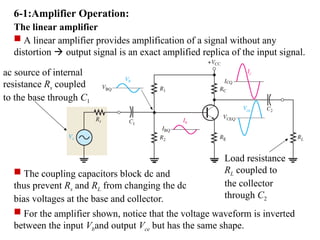
The linear amplifier
A linear amplifier provides amplification of a signal without any
distortion output signal is an exact amplified replica of the input signal.
ac source of internal
resistance Rs coupled
to the base through C1
Load resistance
RL coupled to
the collector
through C2
The coupling capacitors block dc and
thus prevent Rs and RL from changing the dc
bias voltages at the base and collector.
For the amplifier shown, notice that the voltage waveform is inverted
between the input Vband output Vce but has the same shape.
6-1:Amplifier Operation:
3.
AC Load Line
6-1:AmplifierOperation:
Operation of the linear amplifier can be illustrated using an ac load line as
shown.
The ac load line is different than the dc load line because a capacitor
looks open to dc but effectively acts as a short to ac the collector resistor
RC appears to be in parallel with the load resistor RL.
4.
6-1:Amplifier Operation:
Example: a)Determine the resulting peak-to-peak values of collector
current and collector-to-emitter voltage from the graph. b) What are the dc
Q-point values
collector current varying
from 4 mA to 6 mA
collector current has peak-
to-peak value of 2 mA
(Ic = 2 mA)
And Vce = 1 V
a)
b)
IBQ = 50 μA
ICQ = 5mA
VCEQ = 1.5V
5.
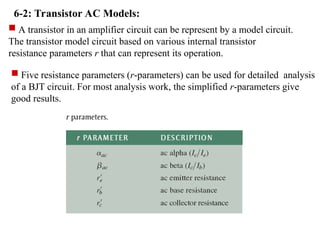
6-2: Transistor ACModels:
A transistor in an amplifier circuit can be represent by a model circuit.
The transistor model circuit based on various internal transistor
resistance parameters r that can represent its operation.
Five resistance parameters (r-parameters) can be used for detailed analysis
of a BJT circuit. For most analysis work, the simplified r-parameters give
good results.
6.
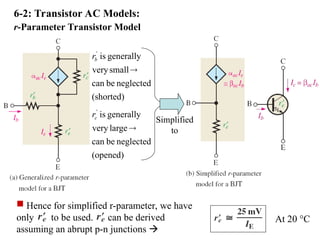
6-2: Transistor ACModels:
r-Parameter Transistor Model
(shorted)
neglected
be
can
small
very
generally
is
'
b
r
(opened)
neglected
be
can
large
very
generally
is
'
c
r
Simplified
to
Hence for simplified r-parameter, we have
only to be used. can be derived
assuming an abrupt p-n junctions
At 20 °C
7.
6-2: Transistor ACModels:
For the simplified r-parameter, we have only to be considered. can
be derived assuming an abrupt p-n junctions
At 20 °C
Determining by a Formula
Example: Determine the of a transistor that is operating with a dc
emitter current of 2 mA.
8.
6-3: The Common-EmitterAmplifier
In the common-emitter (CE) amplifier, the input signal is applied to the
base and the inverted output is taken from the collector. The emitter or
ground is common to ac signals (Vin and Vout) as shown. CE amplifiers has
high voltage gain and high current gain.
A common-emitter amplifier with voltage-divider bias and coupling capacitors C1
and C3 on the input and output and a bypass capacitor, C2, from emitter to ground.
Output voltage has a 180° phase difference from input voltage.
9.
6-3: The Common-EmitterAmplifier
DC analysis
Considering CE amplifier circuit above, dc analysis can be done by
removing the coupling and bypass capacitors. Capacitors appear open with
dc connected only we will have the voltage divider bias circuit shown.
Using thevenin equivalent for bias circuit (see Ch. 5)
RIN(base) > 10 R2 stiff voltage divider
10.
6-3: The Common-EmitterAmplifier
AC analysis
Ac equivalent circuit can be developed by considering:
1- The capacitors are replaced by effective shorts because their values
are selected so that the capacitive resistance XC is negligible at the signal
frequency and can be considered to be 0 Ω.
* Note that C2 must be large enough so that XC2
is very small compared to RE ( )
At given frequency. XC can be calculated using the relation
2- The dc source is replaced by ground. No ac voltage can be developed
across it so it appears as an ac short. This is why a dc source is called an
ac ground. the ac equivalent circuit for CE amplifier is
11.
6-3: The Common-EmitterAmplifier
AC analysis: input and output resistances
the total input resistance for voltage divider bias circuit for the input ac
voltage is
Where Rin(base) for ac is
the output resistance for voltage divider bias circuit is the resistance
looking in at the collector
Rs is series with Rin(tot)
Hence when RL is capacitively coupled with the circuit, The total
output resistance (ac resistance Rc seen by the collector) is RC||RL
also
12.
6-3: The Common-EmitterAmplifier
AC analysis: Voltage gain
ac equivalent circuit for the bias circuit capacitively coupled with RL is
With no load, the voltage gain for ac voltage is (see Ch. 4)
If C2 is removed
13.
6-3: The Common-EmitterAmplifier
AC analysis: Voltage gain
With load resistance RL ac resistance seen by the collector is Rc=RC||RL
If C2 is removed
To get the overall gain of the amplifier from the source voltage to
collector, the attenuation (reduction in signal voltage) of the input circuit
must be included.
The overall voltage gain of the amplifier
Reciprocal of the attenuation
14.
6-3: The Common-EmitterAmplifier
AC analysis: Example: for the amplifier shown below, calculate (a) the
signal voltage at the base (Vb), (b) the minimum value for the emitter
bypass capacitor, C2, if the amplifier must operate over a frequency range
from 200 Hz to 10 kHz., (c) Calculate the base-to-collector voltage gain of
the amplifier (without and with C2) if there is no load resistor, (d) If a load
resistor of 5kΩ is added at Vout, calculate the voltage gain (include C2), and
(e) the overall voltage gain if C2 and RL are included (e) the signal voltage
at the collector
15.
6-3: The Common-EmitterAmplifier
AC analysis: Example – continued.
The Ac equivalent circuit of above circuit
is shown in the figure below
(a) From above dc analysis IE = 3.8 mA
hence
(b) The XC of the bypass capacitor, C2, should be at least ten times less than RE.
16.
6-3: The Common-EmitterAmplifier
AC analysis: Example – continued from previous
(c) Without C2
With C2
(d)
(e)
94
127
10
44
.
7
'
v
s
b
v A
V
V
A
The overall voltage gain is (C2 and RL are included)
(f) The signal voltage at the collector Vc
V
mV
mV
V
A
V
V
V
A s
v
c
s
c
v 94
.
0
940
)
10
(
94
'
'
With RL and C2
included
17.
6-3: The Common-EmitterAmplifier
AC analysis: Addition of Swamping Resistor.
voltage gain is essentially depends on specially when RE is bypassed by
C2. Since changes with temperature the voltage gain becomes unstable.
On the other hand, removing C2 cause the gain to go to its lowest value.
Hence we can add a swamping resistor (RE1) to reduce the effect of
Greater gain stability can be achieved and the gain will be lower as a result.
The voltage gain for the circuit shown becomes:
If = 20 Ω for the transistor
(if RE1 > 10 )
and
READ CAREFULLY EXAMPLE 6-8 page 272
18.
6-3: The Common-EmitterAmplifier
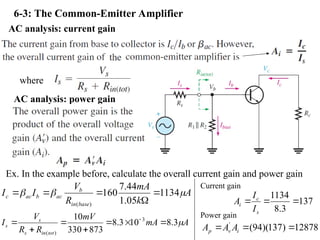
AC analysis: current gain
where
AC analysis: power gain
Ex. In the example before, calculate the overall current gain and power gain
A
k
mA
R
V
I
I
base
in
b
ac
b
ac
c
1134
05
.
1
44
.
7
160
)
(
A
mA
mV
R
R
V
I
tot
in
s
s
s
3
.
8
10
3
.
8
873
330
10 3
)
(
137
3
.
8
1134
s
c
i
I
I
A
12878
)
137
)(
94
(
'
i
v
p A
A
A
Current gain
Power gain
19.
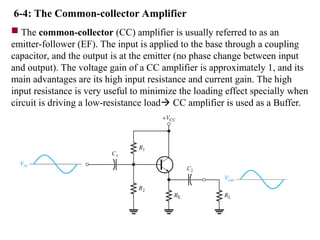
6-4: The Common-collectorAmplifier
The common-collector (CC) amplifier is usually referred to as an
emitter-follower (EF). The input is applied to the base through a coupling
capacitor, and the output is at the emitter (no phase change between input
and output). The voltage gain of a CC amplifier is approximately 1, and its
main advantages are its high input resistance and current gain. The high
input resistance is very useful to minimize the loading effect specially when
circuit is driving a low-resistance load CC amplifier is used as a Buffer.
20.
6-4: The Common-collectorAmplifier
Voltage Gain
The voltage gain is usually can be calculated with the
help of ac equivalent for input and output voltage shown.
)
(base
in
b
b
in R
I
V
V
and
Therefore the voltage gain
If Re>> , which is the Usual case
21.
6-4: The Common-collectorAmplifier
Input Resistance
For ac the total input resistance is
Where
Output Resistance
Current Gain
Power Gain
since Power gain
If Re>>
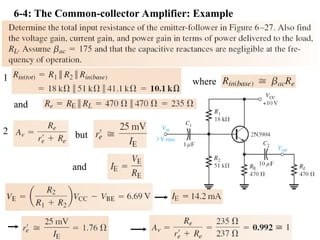
6-4: The Common-collectorAmplifier: Example
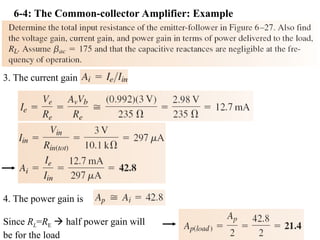
3. The current gain
4. The power gain is
Since RL=RE half power gain will
be for the load
24.
6-4: The Common-collectorAmplifier: Example
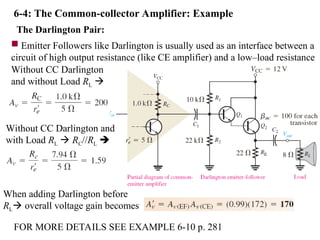
The Darlington Pair:
A Darlington pair is two transistors connected as shown (with common
collector). The Darlington pail highly increase the input resistance better
circuit (better Buffer) specially when using low-load resistance. The two
transistors act as one “super ” transistor. Darlington transistors are
available in a single package. Notice there are two diode drops from base to
emitter
(assuming RE >> )
With Darlington pair we have
better buffering (barrier between input
and output) in addition to high current
gain
25.
6-4: The Common-collectorAmplifier: Example
The Darlington Pair:
Emitter Followers like Darlington is usually used as an interface between a
circuit of high output resistance (like CE amplifier) and a low–load resistance
Without CC Darlington
and without Load RL
Without CC Darlington and
with Load RL RC//RL
When adding Darlington before
RL overall voltage gain becomes
FOR MORE DETAILS SEE EXAMPLE 6-10 p. 281
26.
6-4: The Common-BaseAmplifier
The common-base (CB) amplifier provides high voltage gain with a
maximum current gain of 1. Since it has a low input resistance.
A typical common-base amplifier is shown in figure below. The base is
the common terminal and is at ac ground because of capacitor C2. The
input signal is capacitively coupled to the emitter. The output is
capacitively coupled from the collector to a load resistor.
27.
6-4: The Common-BaseAmplifier
Voltage Gain
Input Resistance
Output Resistance:
Current Gain:
Power Gain:
28.
6-4: Multistage amplifiers
Two or more amplifiers can be connected in a cascaded arrangement
with the output of one amplifier driving the input of the next. The basic
purpose of a multistage arrangement is to increase the overall voltage gain
The overall voltage gain, , of cascaded amplifiers, as shown in the
figure, is the product of the individual voltage gains.
Also amplifier voltage gain is often expressed in decibels (dB) as follows:
This is particularly useful in multistage systems because the overall
voltage gain in dB is the sum of the individual voltage gains in dB.
6-4: Multistage amplifiers:Capacitively coupled
Two-stage capacitively coupled amplifier is shown in Figure below.
Notice that both stages are identical common-emitter amplifiers with the
output of the first stage capacitively coupled to the input of the second
stage. Capacitive coupling prevents the dc bias of one stage from affecting
that of the other
The DC biasing is same for both stages and is identical for common
emitter dc biasing discussed before (VB, VE, VC, IB, IE, IC, and VCE)
31.
6-4: Multistage amplifiers:Capacitively coupled
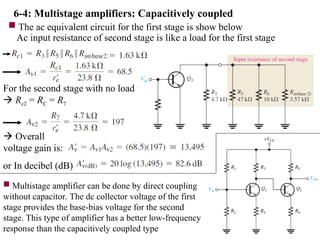
The ac equivalent circuit for the first stage is show below
Ac input resistance of second stage is like a load for the first stage
For the second stage with no load
Rc2 = RC = R7
Overall
voltage gain is:
or In decibel (dB)
Multistage amplifier can be done by direct coupling
without capacitor. The dc collector voltage of the first
stage provides the base-bias voltage for the second
stage. This type of amplifier has a better low-frequency
response than the capacitively coupled type