Cloning techniques (Golden Gate, TOPO and SLIC)
By: Shahnam Azizi
Department of Biotechnology, Faculty of
Agriculture, Azarbaijan Shahid madani
University, Tabriz, Iran
Spring 2018
Contents
Introduction to DNA cloning
Important characteristic of vectors
Common cloning technique list
Description of three important cloning techniques
I. TOPO Cloning
II. Sequence and Ligation Independent Cloning (SLIC)
III. Golden Gate Cloning
2
DNA cloning
DNA cloning is the process of making
multiple, identical copies of a particular
piece of DNA
Different type of vectors , with variety of
features, can be used for this strategy (DNA
cloning)
Selection of cloning technique is commonly
based on speed, cost, availability of starting
materials or just personal preference
3
Vectors
Vectors were the first DNA tools used in genetic
engineering, and continue to be cornerstones of
this technology
Common to all engineered vectors are an origin
of replication, a multicloning site, and a
selectable marker
The purpose of a vector which transfers genetic
information to another cell is typically to isolate,
multiply, or express the insert in the target cell
4
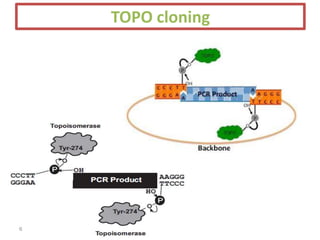
Common cloning technique
Restriction Cloning
Golden Gate Cloning
TOPO Cloning
Sequence and Ligation Independent Cloning (SLIC)
Gateway Cloning
CcdB-The Toxic Key to Efficient Cloning
Gibson Cloning
5
TOPO cloning
6
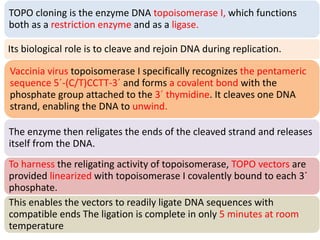
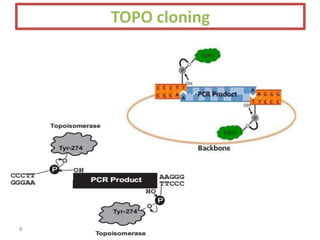
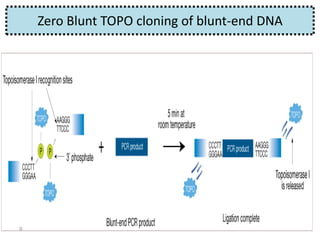
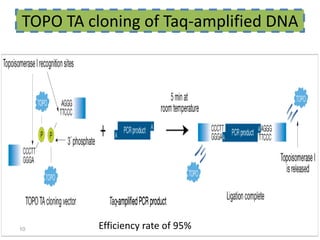
TOPO cloning is the enzyme DNA topoisomerase I, which functions
both as a restriction enzyme and as a ligase.
Its biological role is to cleave and rejoin DNA during replication.
Vaccinia virus topoisomerase I specifically recognizes the pentameric
sequence 5´-(C/T)CCTT-3´ and forms a covalent bond with the
phosphate group attached to the 3´ thymidine. It cleaves one DNA
strand, enabling the DNA to unwind.
The enzyme then religates the ends of the cleaved strand and releases
itself from the DNA.
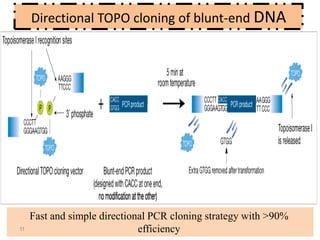
To harness the religating activity of topoisomerase, TOPO vectors are
provided linearized with topoisomerase I covalently bound to each 3´
phosphate.
This enables the vectors to readily ligate DNA sequences with
compatible ends The ligation is complete in only 5 minutes at room
temperature7
TOPO cloning
8
Zero Blunt TOPO cloning of blunt-end DNA
9
TOPO TA cloning of Taq-amplified DNA
Efficiency rate of 95%10
Directional TOPO cloning of blunt-end DNA
Fast and simple directional PCR cloning strategy with >90%
efficiency11
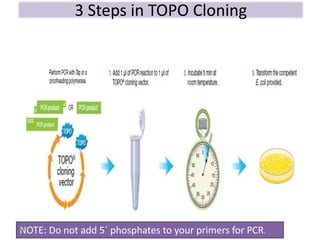
3 Steps in TOPO Cloning
NOTE: Do not add 5´ phosphates to your primers for PCR.12
SEQUENCE AND LIGATION-INDEPENDENT CLONING (SLIC)
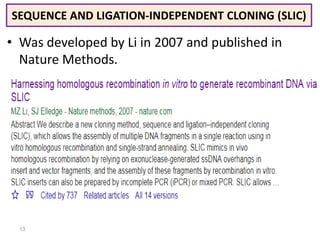
• Was developed by Li in 2007 and published in
Nature Methods.
13
SEQUENCE AND LIGATION-INDEPENDENT CLONING (SLIC)
Simple
Cost-effective
Time-saving
Versatile
Highly efficient and directional cloning can be achieved by direct
bacterial transformation 2.5 min after mixing any linearized vector,
insert(s) prepared by PCR, and T4 DNA polymerase in a tube at room
temperature
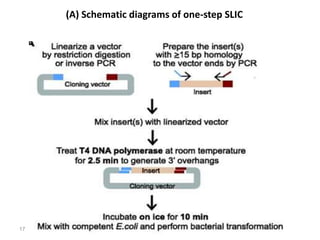
One-step sequence- and ligation-independent cloning (SLIC) is a
14
SEQUENCE AND LIGATION-INDEPENDENT CLONING (SLIC)
If cloning methods had personalities, SLIC (sequence- and
ligation-independent cloning) would be a true rebel
Unlike other forms of cloning, SLIC does not require
restriction enzymes or a ligase
Ligation-independent cloning (LIC) is based on the 3′-to-5′
exonuclease activity of T4 DNA polymerase (not ligase)
One-step SLIC utilizes only T4 DNA polymerase
15
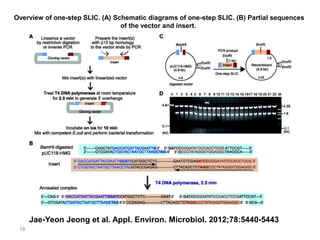
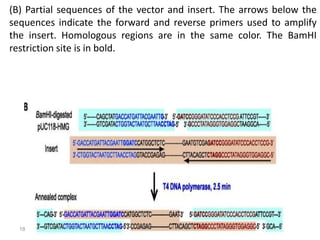
Overview of one-step SLIC. (A) Schematic diagrams of one-step SLIC. (B) Partial sequences
of the vector and insert.
Jae-Yeon Jeong et al. Appl. Environ. Microbiol. 2012;78:5440-5443
16
(A) Schematic diagrams of one-step SLIC
17
(B) Partial sequences of the vector and insert. The arrows below the
sequences indicate the forward and reverse primers used to amplify
the insert. Homologous regions are in the same color. The BamHI
restriction site is in bold.
18
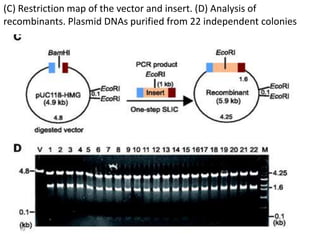
(C) Restriction map of the vector and insert. (D) Analysis of
recombinants. Plasmid DNAs purified from 22 independent colonies
19
GOLDEN GATE CLONING (Golden Gate assembly)
20
 First discovered in 1996
Main components of this cloning technique are
• Type IIs restriction enzymes
• T4 DNA ligase
 As digestion and ligation can be done in one 30-minute
reaction.
 It make seamless (scarless) assembly of DNA fragments
 reaction is essentially irreversible
GOLDEN GATE CLONING (Golden Gate assembly)
21
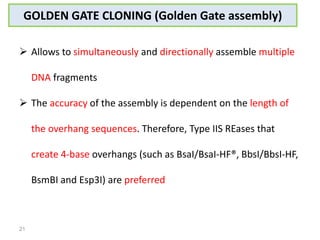
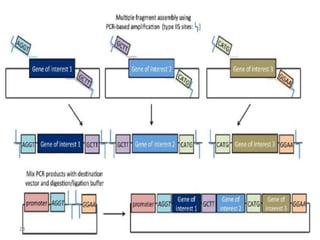
 Allows to simultaneously and directionally assemble multiple
DNA fragments
 The accuracy of the assembly is dependent on the length of
the overhang sequences. Therefore, Type IIS REases that
create 4-base overhangs (such as BsaI/BsaI-HF®, BbsI/BbsI-HF,
BsmBI and Esp3I) are preferred
Type IIS Restriction Enzymes
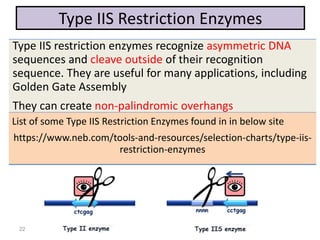
Type IIS restriction enzymes recognize asymmetric DNA
sequences and cleave outside of their recognition
sequence. They are useful for many applications, including
Golden Gate Assembly
They can create non-palindromic overhangs
List of some Type IIS Restriction Enzymes found in in below site
https://www.neb.com/tools-and-resources/selection-charts/type-iis-
restriction-enzymes
22
Golden gate cloning protocol
23
24
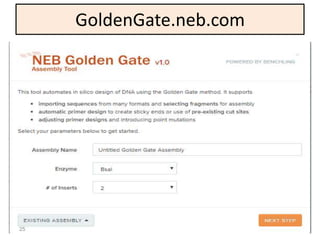
GoldenGate.neb.com
25
Advantages of Golden Gate Cloning
Scalability (the capacity to be changed in size or
scale)
Unique 4 base overhangs can be used to assemble
multiple fragments - up to 10 fragments are
commonly assembled in a single reaction (scalability)
Less expensive than many commercial cloning
methods
26
Advantages of Golden Gate Cloning
Overhangs specify the desired order of fragments
The popular Gateway cloning system produces constructs with an attB
recombination scar encoding eight amino acids, but Golden Gate
assembly can be designed to be scarless
Golden Gate Assembly has been widely used in the construction of
custom-specific TALENs for in vivo gene editing
27
Disadvantages of Golden Gate Cloning
• Golden Gate cloning is not 100% sequence-
independent: to avoid undesired digestion, the Type
IIS site used must not be present within the
fragments you seek to assemble
One way to work around this is to “domesticate” your
fragment:
PCR-based amplification can be used to create silent
point mutations at internal recognition sites thus
eliminating these from your gene of interest
 Another important consideration is the design of
flanking overhangs. Although there are theoretically
256 distinct flanking sequences, sequences that
differ by only one base may result in unintended
ligation products.
28
References
• Cermak, Tomas, et al. “Efficient design and assembly of custom TALEN and other TAL effector-based
constructs for DNA targeting.” Nucleic acids research (2011): gkr218. PubMed PMID: 21493687.
• Engler, Carola, and Sylvestre Marillonnet. “Golden gate cloning.” DNA Cloning and Assembly Methods
(2014): 119-131. PubMed PMID: 24395361.
• Engler, Carola, Romy Kandzia, and Sylvestre Marillonnet. “A one pot, one step, precision cloning
method with high throughput capability.” PloS one 3.11 (2008): e3647. PubMed PMID: 18985154.
• https://bitesizebio.com
• Lee, Jae H., et al. “Sequential amplification of cloned DNA as tandem multimers using class-IIS
restriction enzymes.” Genetic analysis: biomolecular engineering 13.6 (1996): 139-145.
• Li, Mamie Z., and Stephen J. Elledge. “Harnessing homologous recombination in vitro to generate
recombinant DNA via SLIC.” Nature methods 4.3 (2007): 251-256. PubMed PMID: 17293868.
• Li, Mamie Z., and Stephen J. Elledge. “SLIC: a method for sequence-and ligation-independent
cloning.” Gene Synthesis: Methods and Protocols (2012): 51-59. PubMed PMID: 22328425.
• Novel approach to molecular cloning and polynucleotide synthesis using vaccinia DNA
topoisomerase. Shuman S. J Biol Chem. 1994 Dec 23;269(51):32678-84. PubMed PMID: 7798275.
• Shuman S. “Recombination mediated by vaccinia virus DNA topoisomerase I in Escherichia coli is
sequence specific.” Proc Natl Acad Sci U S A. 1991 Nov 15;88(22):10104-8. PubMed PMID: 1658796.
PubMed Central PMCID: PMC52876.
29

Common cloning technique

  • 1.
    Cloning techniques (GoldenGate, TOPO and SLIC) By: Shahnam Azizi Department of Biotechnology, Faculty of Agriculture, Azarbaijan Shahid madani University, Tabriz, Iran Spring 2018
  • 2.
    Contents Introduction to DNAcloning Important characteristic of vectors Common cloning technique list Description of three important cloning techniques I. TOPO Cloning II. Sequence and Ligation Independent Cloning (SLIC) III. Golden Gate Cloning 2
  • 3.
    DNA cloning DNA cloningis the process of making multiple, identical copies of a particular piece of DNA Different type of vectors , with variety of features, can be used for this strategy (DNA cloning) Selection of cloning technique is commonly based on speed, cost, availability of starting materials or just personal preference 3
  • 4.
    Vectors Vectors were thefirst DNA tools used in genetic engineering, and continue to be cornerstones of this technology Common to all engineered vectors are an origin of replication, a multicloning site, and a selectable marker The purpose of a vector which transfers genetic information to another cell is typically to isolate, multiply, or express the insert in the target cell 4
  • 5.
    Common cloning technique RestrictionCloning Golden Gate Cloning TOPO Cloning Sequence and Ligation Independent Cloning (SLIC) Gateway Cloning CcdB-The Toxic Key to Efficient Cloning Gibson Cloning 5
  • 6.
  • 7.
    TOPO cloning isthe enzyme DNA topoisomerase I, which functions both as a restriction enzyme and as a ligase. Its biological role is to cleave and rejoin DNA during replication. Vaccinia virus topoisomerase I specifically recognizes the pentameric sequence 5´-(C/T)CCTT-3´ and forms a covalent bond with the phosphate group attached to the 3´ thymidine. It cleaves one DNA strand, enabling the DNA to unwind. The enzyme then religates the ends of the cleaved strand and releases itself from the DNA. To harness the religating activity of topoisomerase, TOPO vectors are provided linearized with topoisomerase I covalently bound to each 3´ phosphate. This enables the vectors to readily ligate DNA sequences with compatible ends The ligation is complete in only 5 minutes at room temperature7
  • 8.
  • 9.
    Zero Blunt TOPOcloning of blunt-end DNA 9
  • 10.
    TOPO TA cloningof Taq-amplified DNA Efficiency rate of 95%10
  • 11.
    Directional TOPO cloningof blunt-end DNA Fast and simple directional PCR cloning strategy with >90% efficiency11
  • 12.
    3 Steps inTOPO Cloning NOTE: Do not add 5´ phosphates to your primers for PCR.12
  • 13.
    SEQUENCE AND LIGATION-INDEPENDENTCLONING (SLIC) • Was developed by Li in 2007 and published in Nature Methods. 13
  • 14.
    SEQUENCE AND LIGATION-INDEPENDENTCLONING (SLIC) Simple Cost-effective Time-saving Versatile Highly efficient and directional cloning can be achieved by direct bacterial transformation 2.5 min after mixing any linearized vector, insert(s) prepared by PCR, and T4 DNA polymerase in a tube at room temperature One-step sequence- and ligation-independent cloning (SLIC) is a 14
  • 15.
    SEQUENCE AND LIGATION-INDEPENDENTCLONING (SLIC) If cloning methods had personalities, SLIC (sequence- and ligation-independent cloning) would be a true rebel Unlike other forms of cloning, SLIC does not require restriction enzymes or a ligase Ligation-independent cloning (LIC) is based on the 3′-to-5′ exonuclease activity of T4 DNA polymerase (not ligase) One-step SLIC utilizes only T4 DNA polymerase 15
  • 16.
    Overview of one-stepSLIC. (A) Schematic diagrams of one-step SLIC. (B) Partial sequences of the vector and insert. Jae-Yeon Jeong et al. Appl. Environ. Microbiol. 2012;78:5440-5443 16
  • 17.
    (A) Schematic diagramsof one-step SLIC 17
  • 18.
    (B) Partial sequencesof the vector and insert. The arrows below the sequences indicate the forward and reverse primers used to amplify the insert. Homologous regions are in the same color. The BamHI restriction site is in bold. 18
  • 19.
    (C) Restriction mapof the vector and insert. (D) Analysis of recombinants. Plasmid DNAs purified from 22 independent colonies 19
  • 20.
    GOLDEN GATE CLONING(Golden Gate assembly) 20  First discovered in 1996 Main components of this cloning technique are • Type IIs restriction enzymes • T4 DNA ligase  As digestion and ligation can be done in one 30-minute reaction.  It make seamless (scarless) assembly of DNA fragments  reaction is essentially irreversible
  • 21.
    GOLDEN GATE CLONING(Golden Gate assembly) 21  Allows to simultaneously and directionally assemble multiple DNA fragments  The accuracy of the assembly is dependent on the length of the overhang sequences. Therefore, Type IIS REases that create 4-base overhangs (such as BsaI/BsaI-HF®, BbsI/BbsI-HF, BsmBI and Esp3I) are preferred
  • 22.
    Type IIS RestrictionEnzymes Type IIS restriction enzymes recognize asymmetric DNA sequences and cleave outside of their recognition sequence. They are useful for many applications, including Golden Gate Assembly They can create non-palindromic overhangs List of some Type IIS Restriction Enzymes found in in below site https://www.neb.com/tools-and-resources/selection-charts/type-iis- restriction-enzymes 22
  • 23.
  • 24.
  • 25.
  • 26.
    Advantages of GoldenGate Cloning Scalability (the capacity to be changed in size or scale) Unique 4 base overhangs can be used to assemble multiple fragments - up to 10 fragments are commonly assembled in a single reaction (scalability) Less expensive than many commercial cloning methods 26
  • 27.
    Advantages of GoldenGate Cloning Overhangs specify the desired order of fragments The popular Gateway cloning system produces constructs with an attB recombination scar encoding eight amino acids, but Golden Gate assembly can be designed to be scarless Golden Gate Assembly has been widely used in the construction of custom-specific TALENs for in vivo gene editing 27
  • 28.
    Disadvantages of GoldenGate Cloning • Golden Gate cloning is not 100% sequence- independent: to avoid undesired digestion, the Type IIS site used must not be present within the fragments you seek to assemble One way to work around this is to “domesticate” your fragment: PCR-based amplification can be used to create silent point mutations at internal recognition sites thus eliminating these from your gene of interest  Another important consideration is the design of flanking overhangs. Although there are theoretically 256 distinct flanking sequences, sequences that differ by only one base may result in unintended ligation products. 28
  • 29.
    References • Cermak, Tomas,et al. “Efficient design and assembly of custom TALEN and other TAL effector-based constructs for DNA targeting.” Nucleic acids research (2011): gkr218. PubMed PMID: 21493687. • Engler, Carola, and Sylvestre Marillonnet. “Golden gate cloning.” DNA Cloning and Assembly Methods (2014): 119-131. PubMed PMID: 24395361. • Engler, Carola, Romy Kandzia, and Sylvestre Marillonnet. “A one pot, one step, precision cloning method with high throughput capability.” PloS one 3.11 (2008): e3647. PubMed PMID: 18985154. • https://bitesizebio.com • Lee, Jae H., et al. “Sequential amplification of cloned DNA as tandem multimers using class-IIS restriction enzymes.” Genetic analysis: biomolecular engineering 13.6 (1996): 139-145. • Li, Mamie Z., and Stephen J. Elledge. “Harnessing homologous recombination in vitro to generate recombinant DNA via SLIC.” Nature methods 4.3 (2007): 251-256. PubMed PMID: 17293868. • Li, Mamie Z., and Stephen J. Elledge. “SLIC: a method for sequence-and ligation-independent cloning.” Gene Synthesis: Methods and Protocols (2012): 51-59. PubMed PMID: 22328425. • Novel approach to molecular cloning and polynucleotide synthesis using vaccinia DNA topoisomerase. Shuman S. J Biol Chem. 1994 Dec 23;269(51):32678-84. PubMed PMID: 7798275. • Shuman S. “Recombination mediated by vaccinia virus DNA topoisomerase I in Escherichia coli is sequence specific.” Proc Natl Acad Sci U S A. 1991 Nov 15;88(22):10104-8. PubMed PMID: 1658796. PubMed Central PMCID: PMC52876. 29

Editor's Notes

  • #12 PCR products are directionally cloned by addition of 5’-CACC to the upstream primer hence the downstream primer does not contain this terminal sequence and the PCR product is incubated with TOPO- activated pET vector in which one end contains a 3’ overhang GTGG whereby annealing to CACC whilst the topoisomerase catalyses the formation of phosphodiester link
  • #17 Overview of one-step SLIC. (A) Schematic diagrams of one-step SLIC. (B) Partial sequences of the vector and insert. The arrows below the sequences indicate the forward and reverse primers used to amplify the insert. Homologous regions are in the same color. The BamHI restriction site is in bold. (C) Restriction map of the vector and insert. (D) Analysis of recombinants. Plasmid DNAs purified from 22 independent colonies (numbered 1 to 22) derived from Fig. 2A (from a sample treated for 2.5 min) were digested with EcoRI and analyzed on an agarose gel. The EcoRI-digested vector used as a control (lane V) yields 4.8- and 0.1-kb fragments, while the correctly recombined clone yields 4.25-, 1.6-, and 0.1-kb fragments. Lane M, molecular size markers.
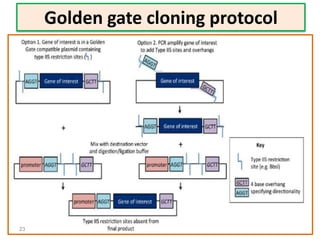
  • #24 The cloning scheme is as follows: the gene of interest is designed with Type IIS sites (such as BsaI or BbsI) that are located on the outside of the cleavage site. As a result, these sites are eliminated by digestion/ligation and do not appear in the final construct. The destination vector contains sites with complementary overhangs that direct assembly of the final ligation product. As shown below, a fragment with 5’ overhang TGGA and 3’ overhang TCCG can be ligated into a vector containing those overhangs. Entry DNA overhangs may be present in the original plasmid (Option 1) or added using PCR-based amplification (Option 2).