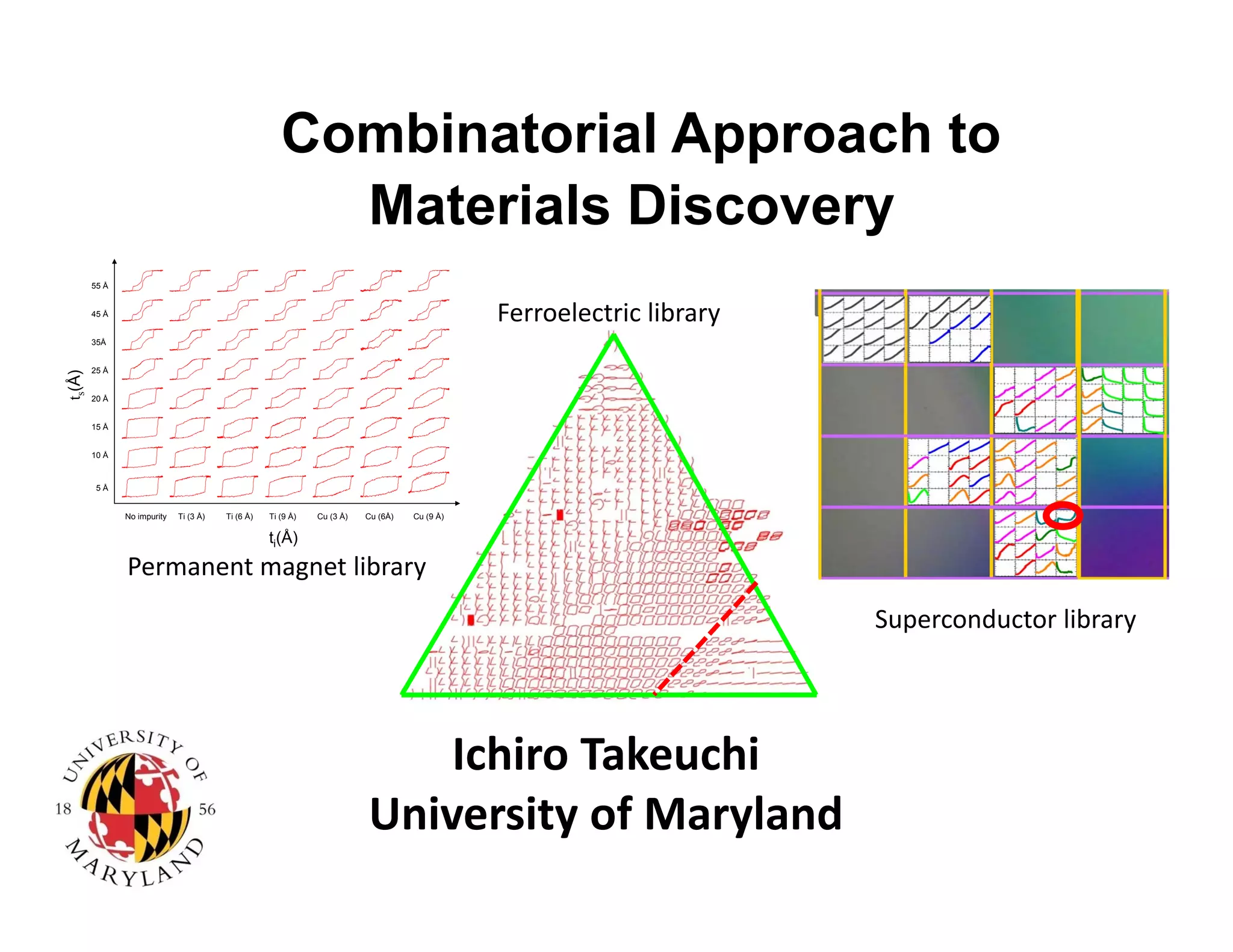


No impurity Ti (3 Å) Ti (6 Å) Ti (9 Å) Cu (3 Å) Cu (6Å) Cu (9 Å)
5 Å
10 Å
15 Å
20 Å
25 Å
35Å
45 Å
55 Å
ti(Å)
ts(Å)
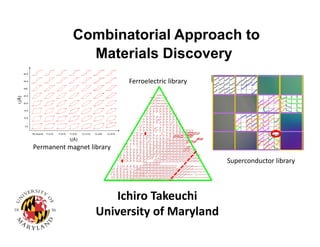
Permanent magnet library
Ferroelectric library
Superconductor library 
Ichiro Takeuchi
University of Maryland
Combinatorial Approach to
Materials Discovery
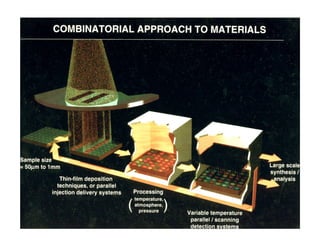
• Introduction to the combinatorial approach:
brief history, tools and strategies
• Integrated materials discovery engine
• Recent examples: combinatorial search of
rare-earth-free permanent magnets;
superconductors
Outline
University of Maryland
Tieren Gao
Sean Fackler
Kui Jin
R. Greene
SLAC
A. Mehta
US DOE, ONR, AFOSR
Support
Acknowledgement
Duke University
S. Curtarolo
Ames Lab
M. J. Kramer
NIST
A. G. Kusne
M. Green
Chemical &
Engineering
News,
August 2001
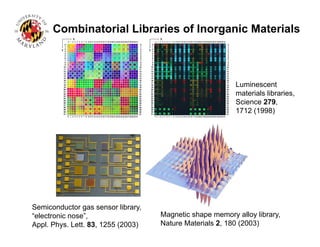
Combinatorial Libraries of Inorganic Materials
Luminescent
materials libraries,
Science 279,
1712 (1998)
Semiconductor gas sensor library,
“electronic nose”,
Appl. Phys. Lett. 83, 1255 (2003)
Magnetic shape memory alloy library,
Nature Materials 2, 180 (2003)
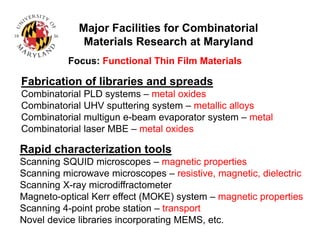
Fabrication of libraries and spreads
Combinatorial PLD systems – metal oxides
Combinatorial UHV sputtering system – metallic alloys
Combinatorial multigun e-beam evaporator system – metal
Combinatorial laser MBE – metal oxides
Rapid characterization tools
Scanning SQUID microscopes – magnetic properties
Scanning microwave microscopes – resistive, magnetic, dielectric
Scanning X-ray microdiffractometer
Magneto-optical Kerr effect (MOKE) system – magnetic properties
Scanning 4-point probe station – transport
Novel device libraries incorporating MEMS, etc.
Major Facilities for Combinatorial
Materials Research at Maryland
Focus: Functional Thin Film Materials
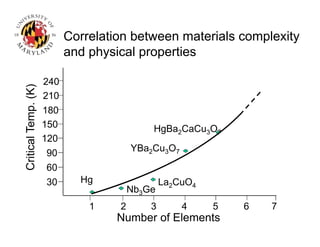
Correlation between materials complexity
and physical properties
Hg
Nb3Ge
La2CuO4
YBa2Cu3O7
HgBa2CaCu3O7
CriticalTemp.(K)
30
60
90
120
150
180
210
240
1
Number of Elements
2 3 4 5 6 7
1
IA
2
IIA
3
IIIB
4
IVB
5
VB
6
VIB
7
VIIB
8
VIII
9
VIII
10
VIII
11
IB
12
IIB
13
IIIA
14
IVA
15
VA
16
VIA
17
VIIA
18
0
H1
He2
Li
3
Be
4
B
5
C
6
N
7
O
8
F
9
Ne
10
Na
11
Mg
12
Al
13
Si
14
P
15
S
16
Cl
17
Ar
18
K
19
Ca
20
Sc
21
Ti
22
V
23
Cr
24
Mn
25
Fe
26
Co
27
Ni
28
Cu
29
Zn
30
Ga
31
Ge
32
As
33
Se
34
Br
35
Kr
36
Rb
37
Sr
38
Y
39
Zr
40
Nb
41
Mo
42
Tc
43
Ru
44
Rh
45
Pd
46
Ag
47
Cd
48
In
49
Sn
50
Sb
51
Te
52
I
53
Xe
54
Cs
55
Ba
56
La
57
Hf
72
Ta
73
W
74
Re
75
Os
76
Ir
77
Pt
78
Au
79
Hg
80
Tl
81
Pb
82
Bi
83
Po
84
At
85
Rn
86
Fr
87
Ra
88
Ac
89
Unq
104
Unp
105
Unh
106
Uns
107
Uno
108
Une
109
Uun
110
Ce
58
Pr
59
Nd
60
Pm
61
Sm
62
Eu
63
Gd
64
Tb
65
Dy
66
Ho
67
Er
68
Tm
69
Yb
70
Lu
71
Th
90
Pa
91
U
92
Np
93
Pu
94
Am
95
Cm
96
Bk
97
Cf
98
Es
99
Fm
100
Md
101
No
102
Lr
103
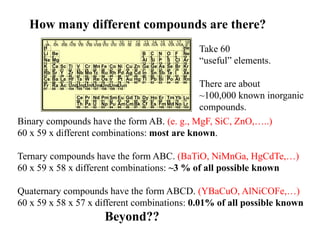
Binary compounds have the form AB. (e. g., MgF, SiC, ZnO,…..)
60 x 59 x different combinations: most are known.
Ternary compounds have the form ABC. (BaTiO, NiMnGa, HgCdTe,…)
60 x 59 x 58 x different combinations: ~3 % of all possible known
Quaternary compounds have the form ABCD. (YBaCuO, AlNiCOFe,…)
60 x 59 x 58 x 57 x different combinations: 0.01% of all possible known
Beyond??
How many different compounds are there?
Take 60
“useful” elements.
There are about
~100,000 known inorganic
compounds.
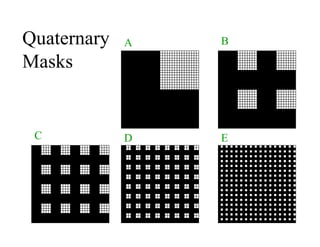
Quaternary
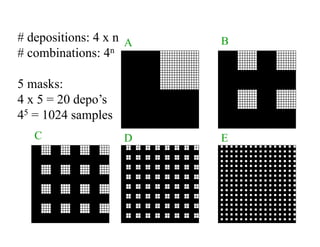
Masks
A B
C ED
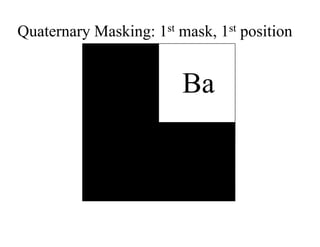
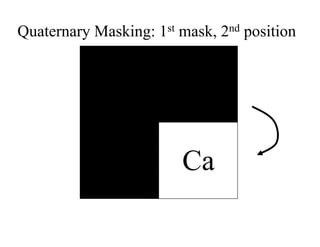
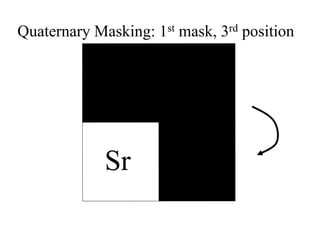
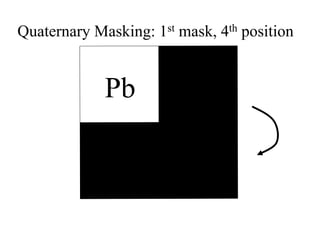
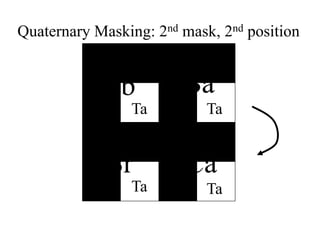
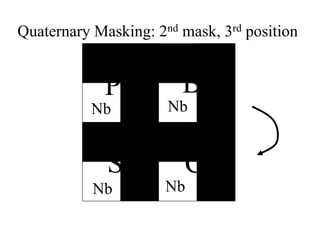
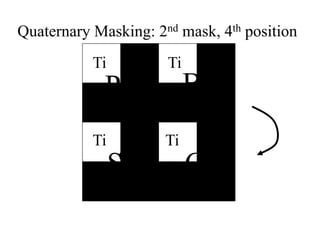
Quaternary Masking
Ba
Quaternary Masking: 1st mask, 1st position
Ca
Quaternary Masking: 1st mask, 2nd position
Sr
Quaternary Masking: 1st mask, 3rd position
Pb
Quaternary Masking: 1st mask, 4th position
BaPb
Sr Ca
Ba
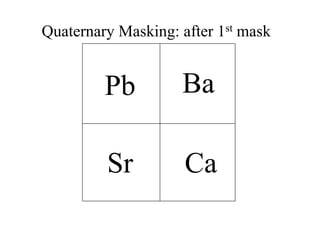
Quaternary Masking: after 1st mask
BaPb
Sr Ca
Ba
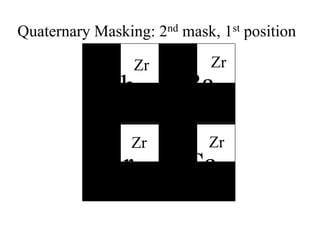
Zr
Zr
Zr
Zr
Quaternary Masking: 2nd mask, 1st position
BaPb
Sr Ca
Ba
Ta
Ta
Ta
Ta
Quaternary Masking: 2nd mask, 2nd position
BaPb
Sr Ca
Ba
Nb
Nb Nb
Nb
Quaternary Masking: 2nd mask, 3rd position
BaPb
Sr Ca
Ba
Ti
Ti Ti
Ti
Quaternary Masking: 2nd mask, 4th position
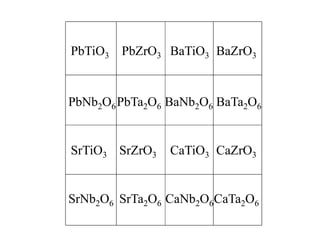
BaZrO3
CaNb2O6
CaTiO3
BaNb2O6
BaTiO3
CaTa2O6
CaZrO3
BaTa2O6PbTa2O6
PbZrO3PbTiO3
PbNb2O6
SrTiO3
SrNb2O6 SrTa2O6
SrZrO3
A B
C ED
# depositions: 4 x n
# combinations: 4n
5 masks:
4 x 5 = 20 depo’s
45 = 1024 samples
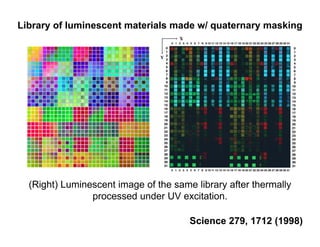
(Right) Luminescent image of the same library after thermally
processed under UV excitation.
Science 279, 1712 (1998)
Library of luminescent materials made w/ quaternary masking
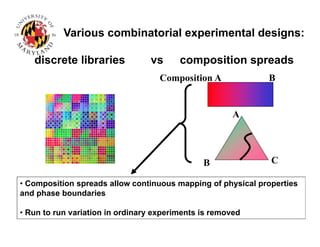
Various combinatorial experimental designs:
discrete libraries vs composition spreads
Composition A B
B
A
C
• Composition spreads allow continuous mapping of physical properties
and phase boundaries
• Run to run variation in ordinary experiments is removed
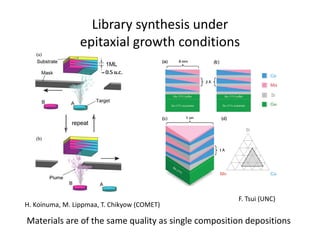
Library synthesis under 
epitaxial growth conditions
F. Tsui (UNC)
H. Koinuma, M. Lippmaa, T. Chikyow (COMET) 
Materials are of the same quality as single composition depositions
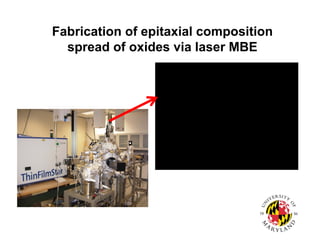
Fabrication of epitaxial composition
spread of oxides via laser MBE
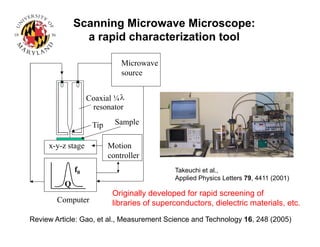
Takeuchi et al.,
Applied Physics Letters 79, 4411 (2001)
Scanning Microwave Microscope:
a rapid characterization tool
Originally developed for rapid screening of
libraries of superconductors, dielectric materials, etc.
SampleTip
Coaxial ¼
resonator
x-y-z stage Motion
controller
Computer
f0
Q
Microwave
source
Review Article: Gao, et al., Measurement Science and Technology 16, 248 (2005)
-250
-200
-150
-100
-50
0
50
100
150
200
880 890 900 910 920 930 940 950 960 970
Magnetic field (Oe)
FMRsignal(arb.unit)
2.45 GHz
SrTiO3
BaTiO3
CaTiO3
500
400
100
300
0
200

r
Different physical properties can be mapped using
an existing microwave microscope
Dielectric constant mapping
of a (Ba,Sr,Ca)TiO3 pseudo-
ternary library at 1 GHz
Appl. Phys. Lett. 74, 1165 (1999)
Ferromagnetic resonance (FMR)
signal taken at a spot
Dielectric
property
Magnetic property
(spin resonance)
composition plot
Mode/materials
[reference]
Physical parameter/
phenomenon
Spatial
resolution
Dielectric [12-14] Complex dielectric
constant
100 nm
Metal [13] Impedance/resistivity 100 nm
Non-linear
dielectric [15,18]
Non-linear dielectric
constant
1 nm
FMR Ferromagnetic
resonance
100 nm*
STM-ESR Electron
spin resonance
Atomic
resolution
Capabilities of Multiscale Microwave Microscope
Mapping of various physical properties can be obtained
at macroscopic scale (~ 1 cm) down to the listed spatial resolution
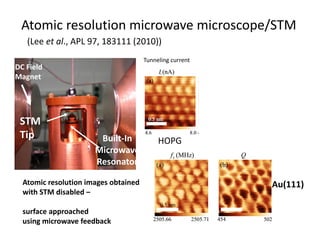
Atomic resolution microwave microscope/STM
Tunneling current       resonant f
HOPG
Au(111)Atomic resolution images obtained 
with STM disabled –
surface approached
using microwave feedback
DC Field
Magnet
STM 
Tip Built‐In
Microwave  
Resonator
(2.5 GHz)
(Lee et al., APL 97, 183111 (2010))
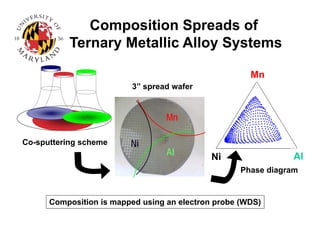
Composition Spreads of
Ternary Metallic Alloy Systems
Co-sputtering scheme Ni
Mn
Al
3” spread wafer
Ni Al
Mn
Phase diagram
Composition is mapped using an electron probe (WDS)
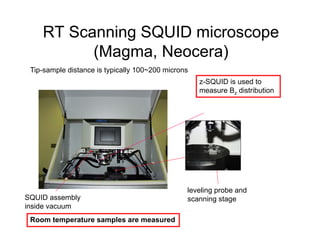
RT Scanning SQUID microscope
(Magma, Neocera)
SQUID assembly
inside vacuum
leveling probe and
scanning stage
Room temperature samples are measured
z-SQUID is used to
measure Bz distribution
Tip-sample distance is typically 100~200 microns
15 20 25 30 35 40 45 50
60
50
40
30
20
col
row
-2.50e+007 0.00e+000 2.50e+007
rho1_25_x
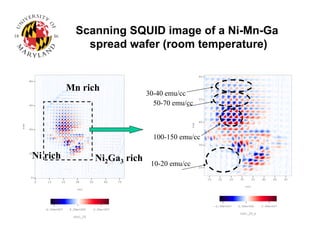
100-150 emu/cc
50-70 emu/cc
30-40 emu/cc
10-20 emu/cc
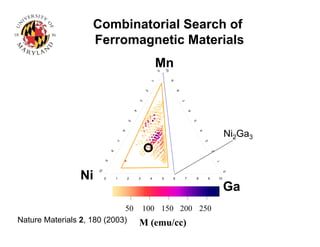
Scanning SQUID image of a Ni-Mn-Ga
spread wafer (room temperature)
0 13 25 38 50 63 75
80
60
40
20
0
col
row
-2.50e+007 0.00e+000 2.50e+007
rho1_25
Mn rich
Ni rich Ni2Ga3 rich
Combinatorial Search of
Ferromagnetic Materials
Ga
Ni 0 1 2 3 4 5 6 7 8 9 10
Mn
50 100 150 200 250
M (emu/cc)
Ni2Ga3
Nature Materials 2, 180 (2003)
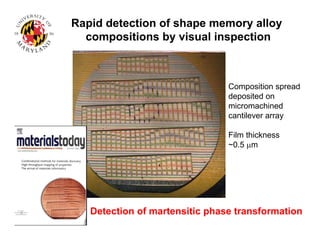
Rapid detection of shape memory alloy
compositions by visual inspection
Composition spread
deposited on
micromachined
cantilever array
Film thickness
~0.5 m
Detection of martensitic phase transformation
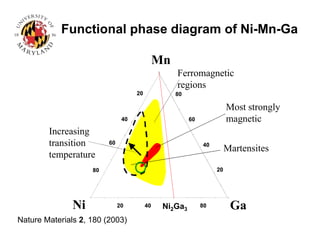
Functional phase diagram of Ni-Mn-Ga
20 40 80
20
40
60
80
60
80
20
Mn
40
20 40 80
20
40
60
80
Ni
60
80
20
40
Ni2Ga3 Ga
Increasing
transition
temperature
Ferromagnetic
regions
Most strongly
magnetic
Martensites
Nature Materials 2, 180 (2003)
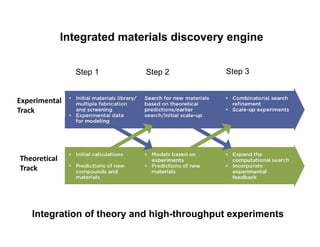
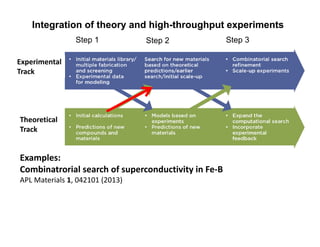
Integration of theory and high-throughput experiments
Step 2 Step 3Step 1
Integrated materials discovery engine
Experimental
Track
Theoretical
Track
Step 2 Step 3Step 1
Experimental
Track
Theoretical
Track
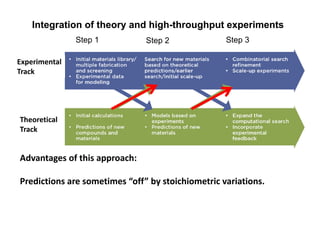
Advantages of this approach: 
Predictions are sometimes “off” by stoichiometric variations.
Integration of theory and high-throughput experiments
Step 2 Step 3Step 1
Experimental
Track
Theoretical
Track
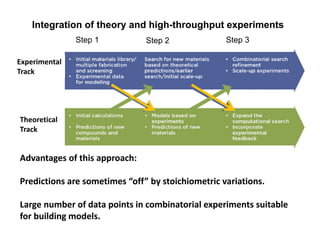
Advantages of this approach: 
Predictions are sometimes “off” by stoichiometric variations.
Large number of data points in combinatorial experiments suitable 
for building models. 
Integration of theory and high-throughput experiments
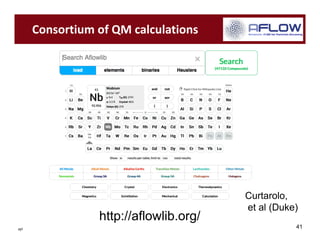
Consortium of QM calculations
41api
http://aflowlib.org/
Curtarolo,
et al (Duke)
Step 2 Step 3Step 1
Experimental
Track
Theoretical
Track
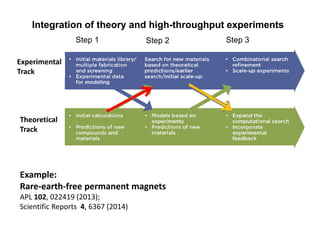
Example:
Rare‐earth‐free permanent magnets
APL 102, 022419 (2013);
Scientific Reports  4, 6367 (2014) 
Integration of theory and high-throughput experiments
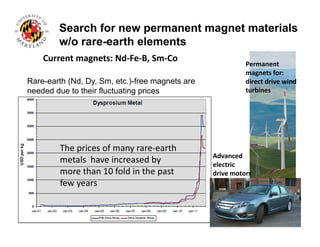
Rare-earth (Nd, Dy, Sm, etc.)-free magnets are
needed due to their fluctuating prices
Search for new permanent magnet materials
w/o rare-earth elements
The prices of many rare‐earth 
metals  have increased by 
more than 10 fold in the past 
few years
Permanent 
magnets for: 
direct drive wind 
turbines
Current magnets: Nd‐Fe‐B, Sm‐Co
Advanced 
electric 
drive motors
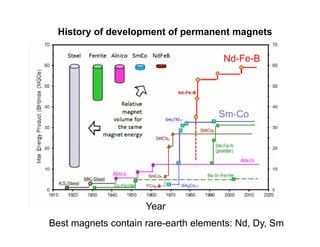
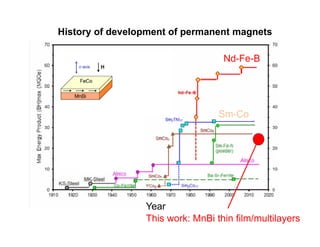
History of development of permanent magnets
Best magnets contain rare-earth elements: Nd, Dy, Sm
Nd-Fe-B
Sm-Co
Year
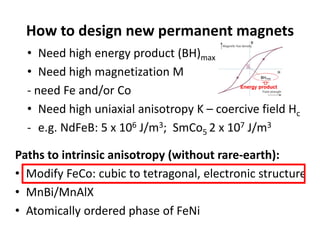
How to design new permanent magnets
• Need high energy product (BH)max
• Need high magnetization M 
‐ need Fe and/or Co
• Need high uniaxial anisotropy K – coercive field Hc
‐ e.g. NdFeB: 5 x 106 J/m3;  SmCo5 2 x 107 J/m3
Paths to intrinsic anisotropy (without rare‐earth):
• Modify FeCo: cubic to tetragonal, electronic structure
• MnBi/MnAlX
• Atomically ordered phase of FeNi
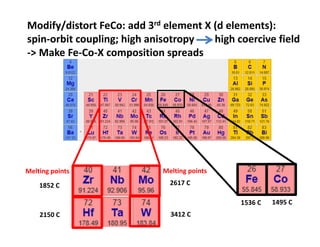
Modify/distort FeCo: add 3rd element X (d elements):
spin‐orbit coupling; high anisotropy        high coercive field
‐> Make Fe‐Co‐X composition spreads
1852 C
2150 C 3412 C
2617 C
Melting points Melting points
1536 C 1495 C
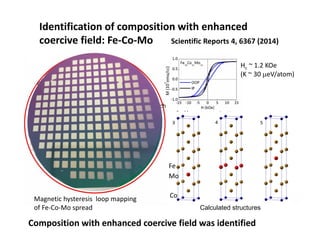
Identification of composition with enhanced 
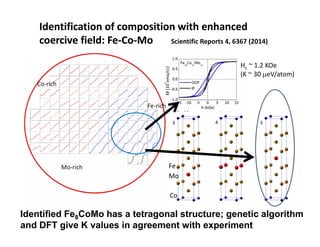
coercive field: Fe‐Co‐Mo       Scientific Reports 4, 6367 (2014)
Composition with enhanced coercive field was identified  
Magnetic hysteresis  loop mapping 
of Fe‐Co‐Mo spread
Hc ~ 1.2 KOe
(K ~ 30 eV/atom)
Hc mapping
Grouping of 
structures 
based on 
synchrotron 
diffraction
Fe
Mo
Co
Calculated structures
Hc ~ 1.2 KOe
(K ~ 30 eV/atom)
Hc mapping
Grouping of 
structures 
based on 
synchrotron 
diffraction
Fe
Mo
Co
Identification of composition with enhanced 
coercive field: Fe‐Co‐Mo
Identification of composition with enhanced 
coercive field: Fe‐Co‐Mo       Scientific Reports 4, 6367 (2014)
Identified Fe8CoMo has a tetragonal structure; genetic algorithm
and DFT give K values in agreement with experiment
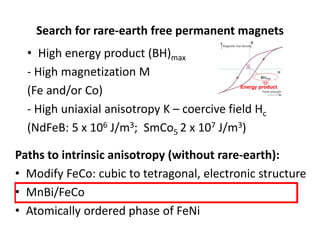
Search for rare‐earth free permanent magnets
• High energy product (BH)max
‐ High magnetization M 
(Fe and/or Co)
‐ High uniaxial anisotropy K – coercive field Hc
(NdFeB: 5 x 106 J/m3;  SmCo5 2 x 107 J/m3)
Paths to intrinsic anisotropy (without rare‐earth):
• Modify FeCo: cubic to tetragonal, electronic structure
• MnBi/FeCo
• Atomically ordered phase of FeNi
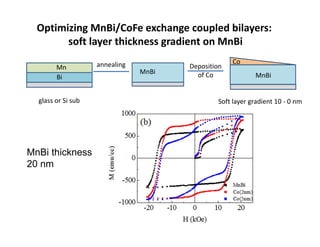
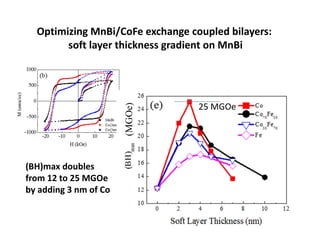
Optimizing MnBi/CoFe exchange coupled bilayers: 
soft layer thickness gradient on MnBi
Bi
Mn annealing
MnBi
Co
MnBi
Deposition 
of Co
Soft layer gradient 10 ‐ 0 nmglass or Si sub
MnBi thickness
20 nm
(BH)max doubles 
from 12 to 25 MGOe 
by adding 3 nm of Co 
(MGOe)
25 MGOe
Optimizing MnBi/CoFe exchange coupled bilayers: 
soft layer thickness gradient on MnBi
History of development of permanent magnets
Nd-Fe-B
Sm-Co
Year
This work: MnBi thin film/multilayers
Step 2 Step 3Step 1
Experimental
Track
Theoretical
Track
Examples: 
Combinatrorial search of superconductivity in Fe‐B
APL Materials 1, 042101 (2013)
Integration of theory and high-throughput experiments
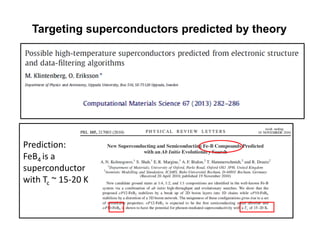
Targeting superconductors predicted by theory
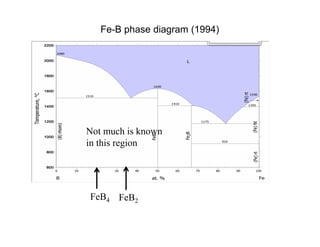
Prediction:
FeB4 is a 
superconductor 
with Tc ~ 15‐20 K
Fe-B phase diagram (1994)
FeB2FeB4
Not much is known
in this region
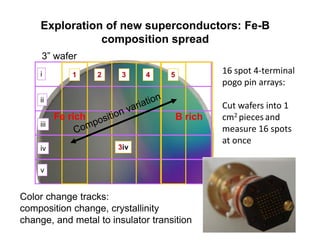
Exploration of new superconductors: Fe-B
composition spread
3” wafer
Fe rich B rich
16 spot 4‐terminal 
pogo pin arrays:
Cut wafers into 1 
cm2 pieces and 
measure 16 spots 
at once
Color change tracks:
composition change, crystallinity
change, and metal to insulator transition
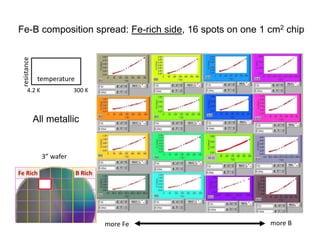
Fe-B composition spread: Fe-rich side, 16 spots on one 1 cm2 chip
Ch 113” wafer
more Bmore Fe
temperature
resistance
4.2 K 300 K
All metallic
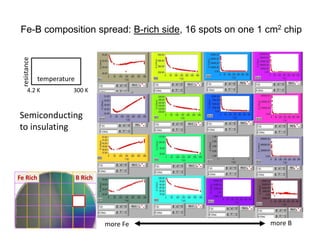
Semiconducting 
to insulating
more Bmore Fe
temperature
resistance
4.2 K 300 K
Fe-B composition spread: B-rich side, 16 spots on one 1 cm2 chip
Ch 11
Ch 3
Ch 13
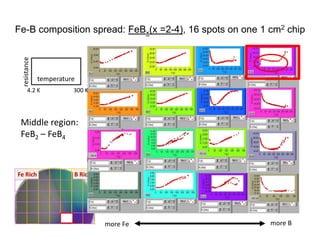
Middle region:
FeB2 – FeB4
more Bmore Fe
temperature
resistance
4.2 K 300 K
Fe-B composition spread: FeBx(x =2-4), 16 spots on one 1 cm2 chip
FeBx: we have found the superconductor
Susceptibility
shows  diamagnetism
Bc2(T)= Bc2(0)[1-(T/Tc)2]/ [1+(T/Tc)2]
gives Bc2(0) = 2 T
-> Type II BCS superconductor
Partial R drop
~ 10 K?
Superconducting phase was detected in 2 spread wafers
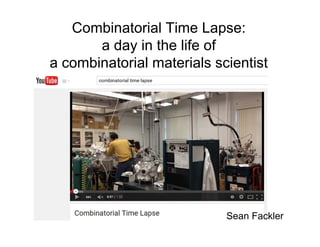
Combinatorial Time Lapse:
a day in the life of
a combinatorial materials scientist
Sean Fackler
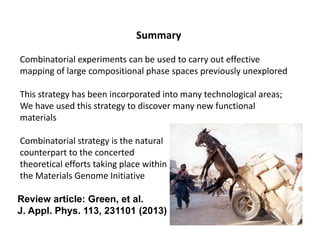
Summary
Combinatorial experiments can be used to carry out effective 
mapping of large compositional phase spaces previously unexplored
This strategy has been incorporated into many technological areas; 
We have used this strategy to discover many new functional 
materials
Combinatorial strategy is the natural 
counterpart to the concerted 
theoretical efforts taking place within 
the Materials Genome Initiative
Review article: Green, et al.
J. Appl. Phys. 113, 231101 (2013)

Combinatorial approach to materials discovery.