Extreme UV (EUV)
lithography
1
OUTLINE
1. Electromagnetic spectrum
2. Introduction
3. Why EUV lithography?
4. Sources of 13nm EUV
5. Working
6. Optics for EUVL
7. Importance of EUVL
8. Applications
9. Defects 2
Electromagnetic spectrum
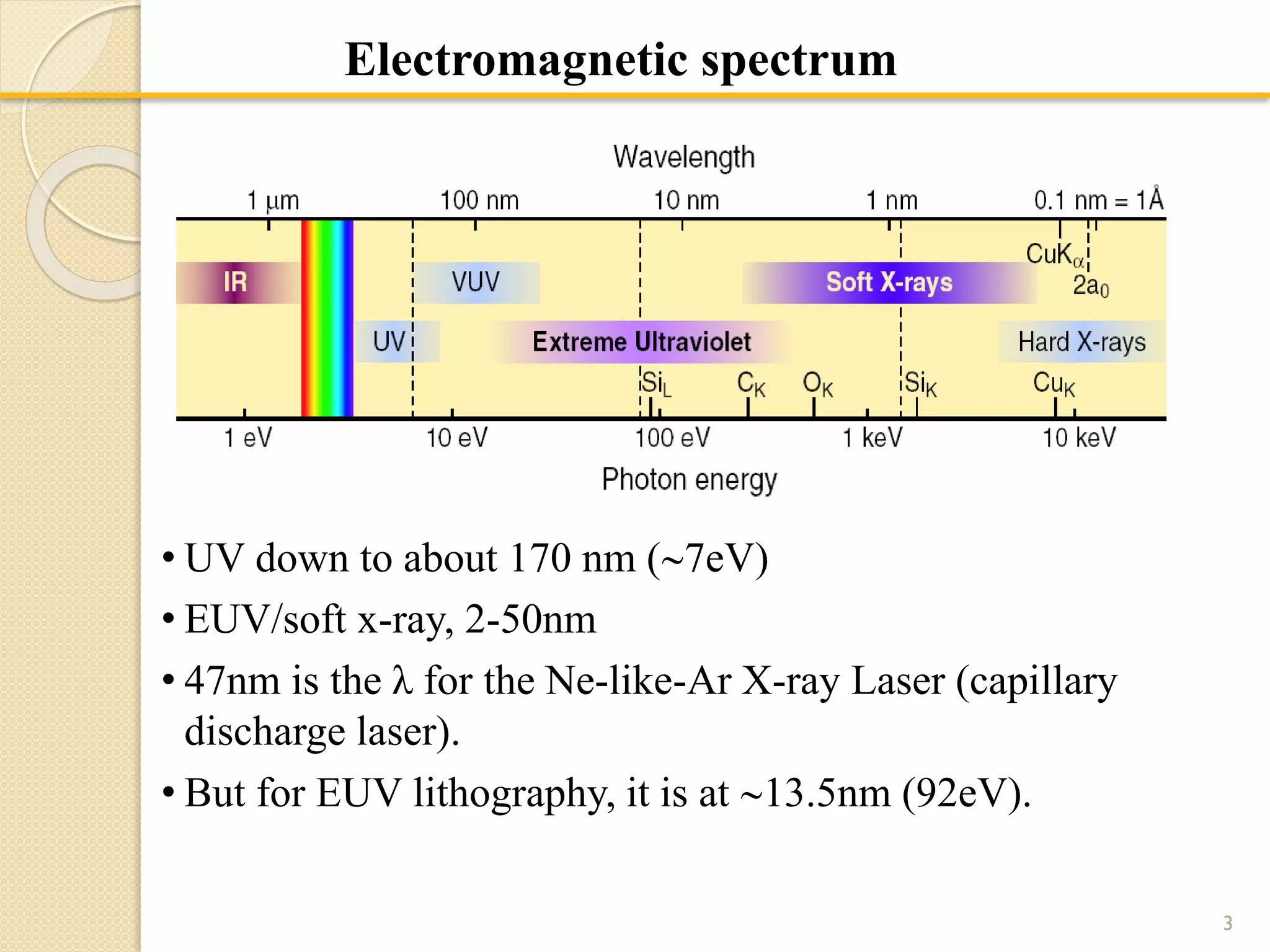
• UV down to about 170 nm (7eV)
• EUV/soft x-ray, 2-50nm
• 47nm is the λ for the Ne-like-Ar X-ray Laser (capillary
discharge laser).
• But for EUV lithography, it is at 13.5nm (92eV).
3
EUV Lithography-An Introduction
 Since the 1970s, the semiconductor industry has strived to
shrink the cost and size of circuit patterns printed onto
computer chips, doubling the number of transistors on a
computer’s central processing unit (CPU) every two years.
 The introduction of extreme ultraviolet (EUV) lithography,
printing chips using 13-nm-wavelength light, opens the
way to future generations of smaller, faster, and cheaper
semiconductors. In this way, EUVL is one technology
vying to replace the optical lithography.
 EUV lithography relies on specialized lenses made of
curved mirrors with reflective coatings called multilayers
to print patterns with high resolution. One special flat
mirror called a mask is particularly sensitive to even the
smallest imperfections.
4
Why EUV lithography?
• Shorter  gives higher resolution.
• No need of resolution enhancement
techniques.
• Relax the requirement for NA.
• For EUV lithography, =13.5nm where
efficient “lens” (reflected mirror) exists.
5
EUV An extension of Optical
lithography
 Uses very short wavelength 13.5nm of light
 13.5nm radiations absorbed by all materials
 All optics are reflective
 Uses reflective mask
 Vaccum operation
 Unique source for EUV light
6
Sources of 13nm EUV
 Light sources must match the wavelengths at which Mo/Si multi-layers
have high reflectivity.
 The only viable source for 13.5nm photons is a hot and dense plasma.
 Powerful plasma: temperature of up to 200,000o
C, atoms ionized up to
+20 state.
 Emit photons by (e - ion) recombination and de-excitation of the ions.
 Plasma must be pulsed: pulse length in pico- to nanosecond range.
 Plasma is produced by powerful pulsed laser or electric arc (discharge) of
up to 60,000A peak current.
7
Laser Produced Plasma (LPP)
plasma
laserlaser pulse (ns)
target
100m
Discharge Produced Plasma (DPP)
(or Sn vapor)
• EUV radiation is strongly absorbed in virtually all materials, even gases, so
EUV imaging must be carried out in a near vacuum.
• There is no refractive lenses usable - EUVL imaging systems are entirely
reflective.
EUV lithography :Working
• But EUV reflectivity of individual materials at near-
normal incidence is very low, so distributed Bragg
reflectors (period about λ/2) are used.
• The best of these function in the region between 11 and
14nm (Si/Mo material)
• EUV absorption in standard optical photo-resists is very
high (low penetration depth into resist), so new resist and
processing techniques will be required
9
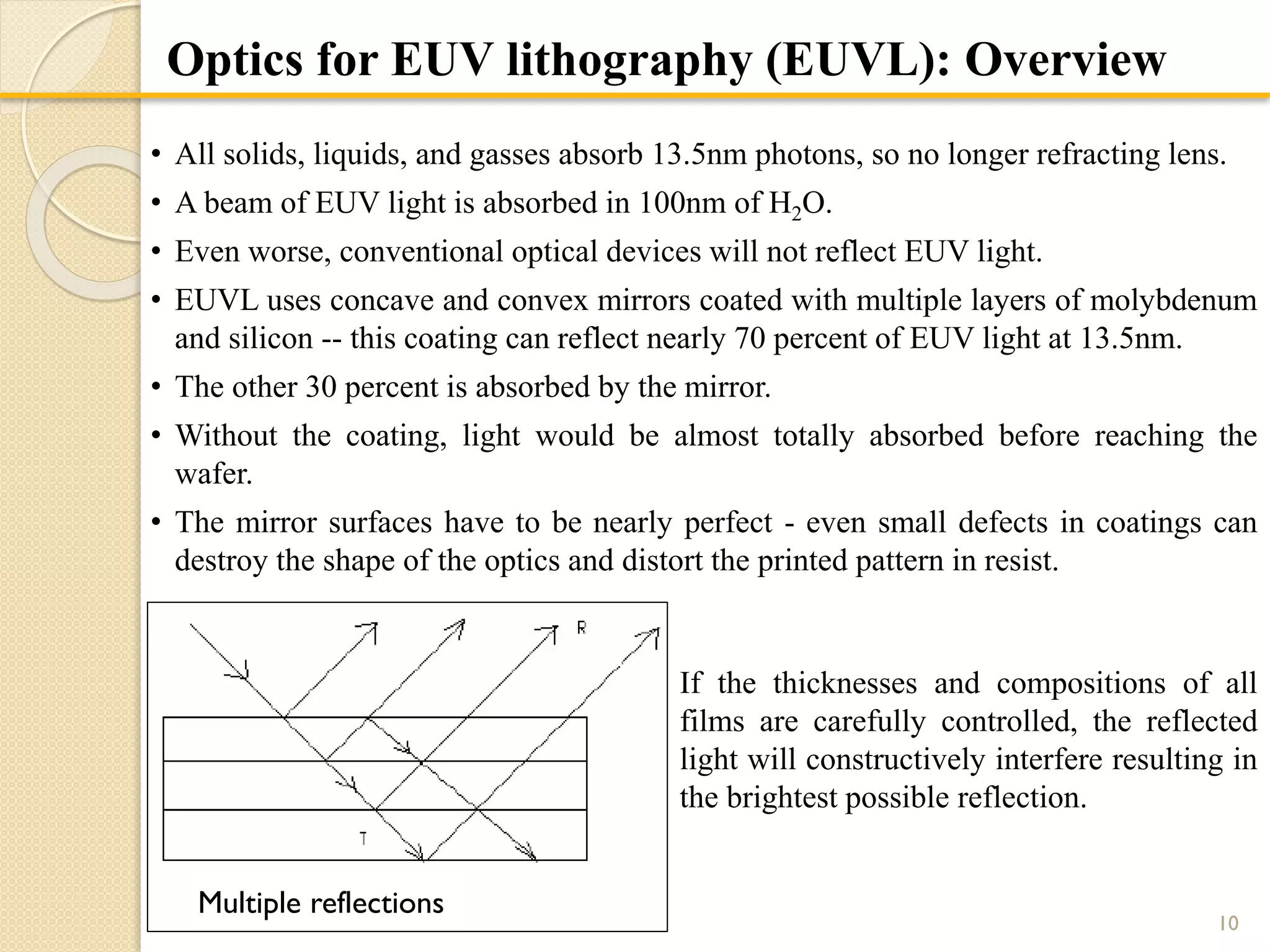
Optics for EUV lithography (EUVL): Overview
• All solids, liquids, and gasses absorb 13.5nm photons, so no longer refracting lens.
• A beam of EUV light is absorbed in 100nm of H2O.
• Even worse, conventional optical devices will not reflect EUV light.
• EUVL uses concave and convex mirrors coated with multiple layers of molybdenum
and silicon -- this coating can reflect nearly 70 percent of EUV light at 13.5nm.
• The other 30 percent is absorbed by the mirror.
• Without the coating, light would be almost totally absorbed before reaching the
wafer.
• The mirror surfaces have to be nearly perfect - even small defects in coatings can
destroy the shape of the optics and distort the printed pattern in resist.
If the thicknesses and compositions of all
films are carefully controlled, the reflected
light will constructively interfere resulting in
the brightest possible reflection.
10
Multiple reflections
Absorption in solids for EUV and soft x-rays
Why Si/Mo and 13.5nm?
• Mo/Si 40 layer pairs ~70% reflectance where Mo and Si are most
transparent.
11
For high reflection, the
absorption should be low
(i.e. attenuation length
should be large). So Mo,
Si, Be are good
candidates at 10-15nm.
EUVL alpha-tool
Schematic of EUV lithography system
How is EUV different from the prior
lithography technologies?
 There are multiple ways that EUV differs, mostly
associated with the methods to create and
transport the short wavelength light.
 Traditional lenses cannot be used with EUV as
they absorb the light.A mirror with a
highly specialized coating, called a multilayer
mirror (MLM) must be used. Even these special
mirrors still absorb about 30% of the light so it is
advantageous to use as few as possible.
 Any gas in the light path, such as air or nitrogen,
will also absorb the light - thus the entire light
path is inside a vacuum chamber.
13
APPLICATIONS
 In lithography, the complex process used to
create computer chips, a six-inch glass plate
called a mask carries one layer of a circuit
pattern—the image of which is transferred onto a
silicon wafer that becomes a computer chip.
 A microprocessor made with the EUVL
technology would be a hundred times more
powerful than today's. (etc)
14
Defects
 A single undetected defect can ruin the mask and the
entire process. Currently, one of the major obstacles to
the commercialization of EUV lithography is the lack of
mask inspection and imaging tools that can detect
defects before they are printed and replicated on
millions of chips.
 Contamination of lens: EUV irradiation leads to
photochemical reactions that cause hydrocarbons to
adsorb to the mirror and mask, reducing mirror’s
reflectivity.
15
16

Extreme uv lithography

  • 1.
  • 2.
    OUTLINE 1. Electromagnetic spectrum 2.Introduction 3. Why EUV lithography? 4. Sources of 13nm EUV 5. Working 6. Optics for EUVL 7. Importance of EUVL 8. Applications 9. Defects 2
  • 3.
    Electromagnetic spectrum • UVdown to about 170 nm (7eV) • EUV/soft x-ray, 2-50nm • 47nm is the λ for the Ne-like-Ar X-ray Laser (capillary discharge laser). • But for EUV lithography, it is at 13.5nm (92eV). 3
  • 4.
    EUV Lithography-An Introduction Since the 1970s, the semiconductor industry has strived to shrink the cost and size of circuit patterns printed onto computer chips, doubling the number of transistors on a computer’s central processing unit (CPU) every two years.  The introduction of extreme ultraviolet (EUV) lithography, printing chips using 13-nm-wavelength light, opens the way to future generations of smaller, faster, and cheaper semiconductors. In this way, EUVL is one technology vying to replace the optical lithography.  EUV lithography relies on specialized lenses made of curved mirrors with reflective coatings called multilayers to print patterns with high resolution. One special flat mirror called a mask is particularly sensitive to even the smallest imperfections. 4
  • 5.
    Why EUV lithography? •Shorter  gives higher resolution. • No need of resolution enhancement techniques. • Relax the requirement for NA. • For EUV lithography, =13.5nm where efficient “lens” (reflected mirror) exists. 5
  • 6.
    EUV An extensionof Optical lithography  Uses very short wavelength 13.5nm of light  13.5nm radiations absorbed by all materials  All optics are reflective  Uses reflective mask  Vaccum operation  Unique source for EUV light 6
  • 7.
    Sources of 13nmEUV  Light sources must match the wavelengths at which Mo/Si multi-layers have high reflectivity.  The only viable source for 13.5nm photons is a hot and dense plasma.  Powerful plasma: temperature of up to 200,000o C, atoms ionized up to +20 state.  Emit photons by (e - ion) recombination and de-excitation of the ions.  Plasma must be pulsed: pulse length in pico- to nanosecond range.  Plasma is produced by powerful pulsed laser or electric arc (discharge) of up to 60,000A peak current. 7 Laser Produced Plasma (LPP) plasma laserlaser pulse (ns) target 100m Discharge Produced Plasma (DPP) (or Sn vapor)
  • 8.
    • EUV radiationis strongly absorbed in virtually all materials, even gases, so EUV imaging must be carried out in a near vacuum. • There is no refractive lenses usable - EUVL imaging systems are entirely reflective. EUV lithography :Working
  • 9.
    • But EUVreflectivity of individual materials at near- normal incidence is very low, so distributed Bragg reflectors (period about λ/2) are used. • The best of these function in the region between 11 and 14nm (Si/Mo material) • EUV absorption in standard optical photo-resists is very high (low penetration depth into resist), so new resist and processing techniques will be required 9
  • 10.
    Optics for EUVlithography (EUVL): Overview • All solids, liquids, and gasses absorb 13.5nm photons, so no longer refracting lens. • A beam of EUV light is absorbed in 100nm of H2O. • Even worse, conventional optical devices will not reflect EUV light. • EUVL uses concave and convex mirrors coated with multiple layers of molybdenum and silicon -- this coating can reflect nearly 70 percent of EUV light at 13.5nm. • The other 30 percent is absorbed by the mirror. • Without the coating, light would be almost totally absorbed before reaching the wafer. • The mirror surfaces have to be nearly perfect - even small defects in coatings can destroy the shape of the optics and distort the printed pattern in resist. If the thicknesses and compositions of all films are carefully controlled, the reflected light will constructively interfere resulting in the brightest possible reflection. 10 Multiple reflections
  • 11.
    Absorption in solidsfor EUV and soft x-rays Why Si/Mo and 13.5nm? • Mo/Si 40 layer pairs ~70% reflectance where Mo and Si are most transparent. 11 For high reflection, the absorption should be low (i.e. attenuation length should be large). So Mo, Si, Be are good candidates at 10-15nm.
  • 12.
    EUVL alpha-tool Schematic ofEUV lithography system
  • 13.
    How is EUVdifferent from the prior lithography technologies?  There are multiple ways that EUV differs, mostly associated with the methods to create and transport the short wavelength light.  Traditional lenses cannot be used with EUV as they absorb the light.A mirror with a highly specialized coating, called a multilayer mirror (MLM) must be used. Even these special mirrors still absorb about 30% of the light so it is advantageous to use as few as possible.  Any gas in the light path, such as air or nitrogen, will also absorb the light - thus the entire light path is inside a vacuum chamber. 13
  • 14.
    APPLICATIONS  In lithography,the complex process used to create computer chips, a six-inch glass plate called a mask carries one layer of a circuit pattern—the image of which is transferred onto a silicon wafer that becomes a computer chip.  A microprocessor made with the EUVL technology would be a hundred times more powerful than today's. (etc) 14
  • 15.
    Defects  A singleundetected defect can ruin the mask and the entire process. Currently, one of the major obstacles to the commercialization of EUV lithography is the lack of mask inspection and imaging tools that can detect defects before they are printed and replicated on millions of chips.  Contamination of lens: EUV irradiation leads to photochemical reactions that cause hydrocarbons to adsorb to the mirror and mask, reducing mirror’s reflectivity. 15
  • 16.