School of Engineering 
Department of Biomedical Engineering 
Fall 2014-2015 
EENG624 – Biomedical Optics 
Instructor: Jad AYOUB
Chapters 
1. Introduction to biomedical optics 
2. Single scattering: Rayleigh theory and Mie theory 
3. Monte Carlo modeling of photon transport 
4. Convolution for broad-beam responses 
5. Radiative transfer equation and diffusion theory 
6. Hybrid model of Monte Carlo method and diffusion theory 
7. Sensing of optical properties and spectroscopy 
8. Ballistic imaging and microscopy 
9. Optical coherence tomography 
10.Mueller optical coherence tomography 
11.Diffuse optical tomography 
12.Photoacoustic tomography 
13.Ultrasound-modulated optical tomography
Chapter 1 - Introduction 
• Motivation for Optical Imaging 
• General Behavior of Light in Biological Tissue 
• Basic Physics of Light-Matter Interaction
Motivation for Optical Imaging 
1. Optical photons provide nonionizing and safe radiation for medical applications. 
2. Optical spectra -based on absorption, fluorescence, or Raman scattering- provide biochemical 
information because they are related to molecular conformation. 
3. Optical absorption, in particular, reveals angiogenesis and hypermetabolism, both of which are 
hallmarks of cancer; the former is related to the concentration of hemoglobin and the latter to the 
oxygen saturation of hemoglobin. Therefore, optical absorption provides contrast for functional 
imaging. 
4. Optical scattering spectra provide information about the size distribution of optical scatterers, 
such as cell nuclei. 
5. Optical polarization provides information about structurally anisotropic tissue components, 
such as collagen and muscle fiber.
Motivation for Optical Imaging (cont’d) 
6. Optical frequency shifts due to the optical Doppler effect provide information about blood flow. 
7. Optical properties of targeted contrast agents provide contrast for the molecular imaging of 
biomarkers. 
8. Optical properties or bioluminescence of products from gene expression provide contrast for 
the molecular imaging of gene activities. 
9. Optical spectroscopy permits simultaneous detection of multiple contrast agents. 
10. Optical transparency in the eye provides a unique opportunity for high-resolution imaging of 
the retina.
Behavior of light in Biological Tissue
Optical properties of biological tissue 
Basic properties 
• n [–]: index of refraction; e.g., 1.37 
• μa [cm–1]: absorption coefficient; e.g., 0.1 
• μs [cm–1]: scattering coefficient; e.g., 100 
• g [–]: scattering anisotropy, <cosθ>; e.g., 0.9 
Derived properties 
• μt [cm–1]: total interaction (extinction) coefficient, μa + μs 
• lt [cm]: mean free path, 1/ μt; e.g., 0.1 mm 
• μs’ [cm–1]: reduced scattering coefficient, μs(1 – g) 
• μt’ [cm–1]: transport interaction coefficient, μa + μs’ 
• lt’ [cm]: transport mean free path, 1/ μt’; e.g., 1 mm 
• μeff [cm–1]: effective attenuation coefficient, (3μa μt’)1/2 
• δ [cm]: penetration depth, 1/(3μa μt’)1/2; e.g., 5 mm
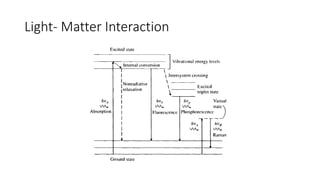
Light- Matter Interaction
Beer’s Law 
• − 
푑퐼/퐼 
푑푥 
= 휇푡 
• 퐼 푥 = 퐼 0 푒−휇푡푥 = 퐼(0)푒−푥/푙푡 
I : Ballistic intensity 
x : Pathlength 
휇푡: Total interaction (extinction) coefficient
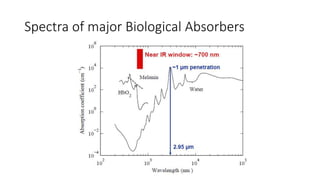
Spectra of major Biological Absorbers
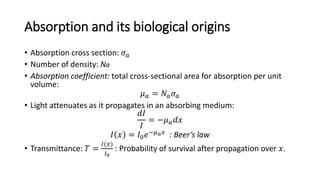
Absorption and its biological origins 
• Absorption cross section: 휎푎 
• Number of density: Na 
• Absorption coefficient: total cross-sectional area for absorption per unit 
volume: 
휇푎 = 푁푎휎푎 
• Light attenuates as it propagates in an absorbing medium: 
푑퐼 
퐼 
= −휇푎푑푥 
퐼 푥 = 퐼0푒−휇푎푥 : Beer’s law 
• Transmittance: 푇 = 
퐼(푥) 
퐼0 
: Probability of survival after propagation over 푥.
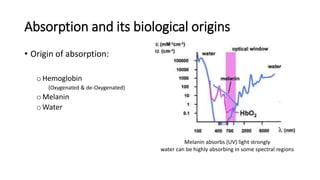
Absorption and its biological origins 
• Origin of absorption: 
oHemoglobin 
(Oxygenated & de-Oxygenated) 
oMelanin 
oWater 
Melanin absorbs (UV) light strongly 
water can be highly absorbing in some spectral regions
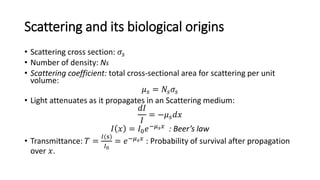
Scattering and its biological origins 
• Scattering cross section: 휎푠 
• Number of density: Ns 
• Scattering coefficient: total cross-sectional area for scattering per unit 
volume: 
휇푠 = 푁푠휎푠 
• Light attenuates as it propagates in an Scattering medium: 
푑퐼 
퐼 
= −휇푠푑푥 
퐼 푥 = 퐼0푒−휇푠푥 : Beer’s law 
• Transmittance: 푇 = 
퐼(s) 
퐼0 
= 푒−휇푠푥 : Probability of survival after propagation 
over 푥.
Scattering and its biological origins 
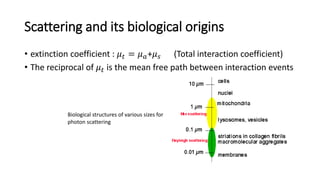
• extinction coefficient : 휇푡 = 휇푎+휇푠 (Total interaction coefficient) 
• The reciprocal of 휇푡 is the mean free path between interaction events 
Biological structures of various sizes for 
photon scattering
Exercise 1 
• In a purely absorbing (non-scattering) medium with absorption 
coefficient 휇푎, what percentage of light is left after a lightbeam 
propagates a length of L?
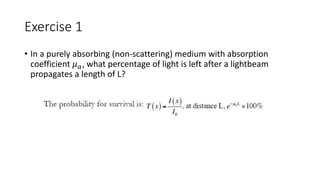
Exercise 1 
• In a purely absorbing (non-scattering) medium with absorption 
coefficient 휇푎, what percentage of light is left after a lightbeam 
propagates a length of L?
Exercise 2 
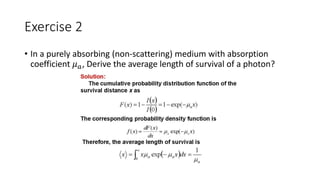
• In a purely absorbing (non-scattering) medium with absorption 
coefficient 휇푎, Derive the average length of survival of a photon?
Exercise 2 
• In a purely absorbing (non-scattering) medium with absorption 
coefficient 휇푎, Derive the average length of survival of a photon?
Exercise 3 
• In a purely scattering (non-absorbing) medium with scattering 
coefficient 휇푠, what percentage of light has not been scattered after 
the original lightbeam propagates a length of L?
Exercise 3 
• In a purely scattering (non-absorbing) medium with scattering 
coefficient 휇푠, what percentage of light has not been scattered after 
the original lightbeam propagates a length of L?
Exercise 4 
• In a purely scattering (non-absorbing) medium with scattering 
coefficient 휇푠, Derive the average length of survival of a photon.
Exercise 4 
• In a purely scattering (non-absorbing) medium with scattering 
coefficient 휇푠, Derive the average length of survival of a photon.
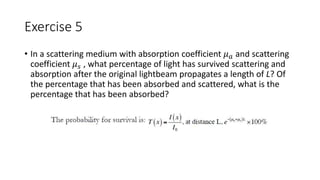
Exercise 5 
• In a scattering medium with absorption coefficient 휇푎 and scattering 
coefficient 휇푠 , what percentage of light has survived scattering and 
absorption after the original lightbeam propagates a length of L? Of 
the percentage that has been absorbed and scattered, what is the 
percentage that has been absorbed?
Oxygen Saturation and Concentration 
• Estimating concentration by absorption coefficients (@ 휆1 ≠ 휆2): 
• 휆1 , 휆2 : the two wavelengths 
• 휀표푥 , 휀푑푒: Molar extinction coefficients of oxy- and deoxyhemoglobin 
• 퐶표푥 , 퐶푑푒: Molar concentrations of oxy- and deoxyhemoglobin.
Oxygen Saturation and Concentration 
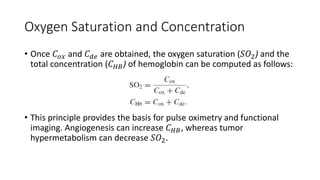
• Once 퐶표푥 and 퐶푑푒 are obtained, the oxygen saturation (푆푂2) and the 
total concentration (퐶퐻퐵 ) of hemoglobin can be computed as follows: 
• This principle provides the basis for pulse oximetry and functional 
imaging. Angiogenesis can increase 퐶퐻퐵, whereas tumor 
hypermetabolism can decrease 푆푂2.
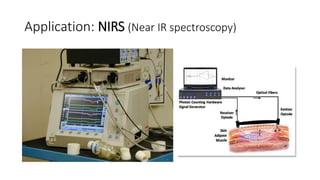
Application: NIRS (Near IR spectroscopy)

Introduction to Biomedical Optics

  • 1.
    School of Engineering Department of Biomedical Engineering Fall 2014-2015 EENG624 – Biomedical Optics Instructor: Jad AYOUB
  • 2.
    Chapters 1. Introductionto biomedical optics 2. Single scattering: Rayleigh theory and Mie theory 3. Monte Carlo modeling of photon transport 4. Convolution for broad-beam responses 5. Radiative transfer equation and diffusion theory 6. Hybrid model of Monte Carlo method and diffusion theory 7. Sensing of optical properties and spectroscopy 8. Ballistic imaging and microscopy 9. Optical coherence tomography 10.Mueller optical coherence tomography 11.Diffuse optical tomography 12.Photoacoustic tomography 13.Ultrasound-modulated optical tomography
  • 3.
    Chapter 1 -Introduction • Motivation for Optical Imaging • General Behavior of Light in Biological Tissue • Basic Physics of Light-Matter Interaction
  • 4.
    Motivation for OpticalImaging 1. Optical photons provide nonionizing and safe radiation for medical applications. 2. Optical spectra -based on absorption, fluorescence, or Raman scattering- provide biochemical information because they are related to molecular conformation. 3. Optical absorption, in particular, reveals angiogenesis and hypermetabolism, both of which are hallmarks of cancer; the former is related to the concentration of hemoglobin and the latter to the oxygen saturation of hemoglobin. Therefore, optical absorption provides contrast for functional imaging. 4. Optical scattering spectra provide information about the size distribution of optical scatterers, such as cell nuclei. 5. Optical polarization provides information about structurally anisotropic tissue components, such as collagen and muscle fiber.
  • 5.
    Motivation for OpticalImaging (cont’d) 6. Optical frequency shifts due to the optical Doppler effect provide information about blood flow. 7. Optical properties of targeted contrast agents provide contrast for the molecular imaging of biomarkers. 8. Optical properties or bioluminescence of products from gene expression provide contrast for the molecular imaging of gene activities. 9. Optical spectroscopy permits simultaneous detection of multiple contrast agents. 10. Optical transparency in the eye provides a unique opportunity for high-resolution imaging of the retina.
  • 6.
    Behavior of lightin Biological Tissue
  • 7.
    Optical properties ofbiological tissue Basic properties • n [–]: index of refraction; e.g., 1.37 • μa [cm–1]: absorption coefficient; e.g., 0.1 • μs [cm–1]: scattering coefficient; e.g., 100 • g [–]: scattering anisotropy, <cosθ>; e.g., 0.9 Derived properties • μt [cm–1]: total interaction (extinction) coefficient, μa + μs • lt [cm]: mean free path, 1/ μt; e.g., 0.1 mm • μs’ [cm–1]: reduced scattering coefficient, μs(1 – g) • μt’ [cm–1]: transport interaction coefficient, μa + μs’ • lt’ [cm]: transport mean free path, 1/ μt’; e.g., 1 mm • μeff [cm–1]: effective attenuation coefficient, (3μa μt’)1/2 • δ [cm]: penetration depth, 1/(3μa μt’)1/2; e.g., 5 mm
  • 8.
  • 9.
    Beer’s Law •− 푑퐼/퐼 푑푥 = 휇푡 • 퐼 푥 = 퐼 0 푒−휇푡푥 = 퐼(0)푒−푥/푙푡 I : Ballistic intensity x : Pathlength 휇푡: Total interaction (extinction) coefficient
  • 10.
    Spectra of majorBiological Absorbers
  • 11.
    Absorption and itsbiological origins • Absorption cross section: 휎푎 • Number of density: Na • Absorption coefficient: total cross-sectional area for absorption per unit volume: 휇푎 = 푁푎휎푎 • Light attenuates as it propagates in an absorbing medium: 푑퐼 퐼 = −휇푎푑푥 퐼 푥 = 퐼0푒−휇푎푥 : Beer’s law • Transmittance: 푇 = 퐼(푥) 퐼0 : Probability of survival after propagation over 푥.
  • 12.
    Absorption and itsbiological origins • Origin of absorption: oHemoglobin (Oxygenated & de-Oxygenated) oMelanin oWater Melanin absorbs (UV) light strongly water can be highly absorbing in some spectral regions
  • 13.
    Scattering and itsbiological origins • Scattering cross section: 휎푠 • Number of density: Ns • Scattering coefficient: total cross-sectional area for scattering per unit volume: 휇푠 = 푁푠휎푠 • Light attenuates as it propagates in an Scattering medium: 푑퐼 퐼 = −휇푠푑푥 퐼 푥 = 퐼0푒−휇푠푥 : Beer’s law • Transmittance: 푇 = 퐼(s) 퐼0 = 푒−휇푠푥 : Probability of survival after propagation over 푥.
  • 14.
    Scattering and itsbiological origins • extinction coefficient : 휇푡 = 휇푎+휇푠 (Total interaction coefficient) • The reciprocal of 휇푡 is the mean free path between interaction events Biological structures of various sizes for photon scattering
  • 15.
    Exercise 1 •In a purely absorbing (non-scattering) medium with absorption coefficient 휇푎, what percentage of light is left after a lightbeam propagates a length of L?
  • 16.
    Exercise 1 •In a purely absorbing (non-scattering) medium with absorption coefficient 휇푎, what percentage of light is left after a lightbeam propagates a length of L?
  • 17.
    Exercise 2 •In a purely absorbing (non-scattering) medium with absorption coefficient 휇푎, Derive the average length of survival of a photon?
  • 18.
    Exercise 2 •In a purely absorbing (non-scattering) medium with absorption coefficient 휇푎, Derive the average length of survival of a photon?
  • 19.
    Exercise 3 •In a purely scattering (non-absorbing) medium with scattering coefficient 휇푠, what percentage of light has not been scattered after the original lightbeam propagates a length of L?
  • 20.
    Exercise 3 •In a purely scattering (non-absorbing) medium with scattering coefficient 휇푠, what percentage of light has not been scattered after the original lightbeam propagates a length of L?
  • 21.
    Exercise 4 •In a purely scattering (non-absorbing) medium with scattering coefficient 휇푠, Derive the average length of survival of a photon.
  • 22.
    Exercise 4 •In a purely scattering (non-absorbing) medium with scattering coefficient 휇푠, Derive the average length of survival of a photon.
  • 23.
    Exercise 5 •In a scattering medium with absorption coefficient 휇푎 and scattering coefficient 휇푠 , what percentage of light has survived scattering and absorption after the original lightbeam propagates a length of L? Of the percentage that has been absorbed and scattered, what is the percentage that has been absorbed?
  • 24.
    Oxygen Saturation andConcentration • Estimating concentration by absorption coefficients (@ 휆1 ≠ 휆2): • 휆1 , 휆2 : the two wavelengths • 휀표푥 , 휀푑푒: Molar extinction coefficients of oxy- and deoxyhemoglobin • 퐶표푥 , 퐶푑푒: Molar concentrations of oxy- and deoxyhemoglobin.
  • 25.
    Oxygen Saturation andConcentration • Once 퐶표푥 and 퐶푑푒 are obtained, the oxygen saturation (푆푂2) and the total concentration (퐶퐻퐵 ) of hemoglobin can be computed as follows: • This principle provides the basis for pulse oximetry and functional imaging. Angiogenesis can increase 퐶퐻퐵, whereas tumor hypermetabolism can decrease 푆푂2.
  • 26.
    Application: NIRS (NearIR spectroscopy)