
COLORECTAL CANCER
PREPARED BY: ARPANA
BHUSAL
DEFINITION
• Third most common type of cancer and second most frequent
cause of cancer-related death
• A disease in which normal cells in the lining of the colon or
rectum begin to change, grow without control, and no longer
die
• Usually begins as a noncancerous polyp that can, over time,
become a cancerous tumor
TYPICAL SITES OF INCIDENCE AND
SYMPOMS OF COLON CANCER
RISK FACTOR
• Polyps (a noncancerous or precancerous growth associated with aging)
• Age
• Inflammatory bowel disease (IBD)
• Diet high in saturated fats, such as red meat
• Personal or family history of cancer
• Obesity
• Smoking
• alcohol
Result of interplay between environmental and
Genetic factors
Central environmental factors:
Diet and lifestyle
35% of all cancers are attributable to diet
50%-75% of crc in the us may be preventable
Through dietary modifications
Development of CRC
consumption of red meat
animal and saturated fat
refined carbohydrates
alcohol
increased risk
Dietary factors implicated in
colorectal carcinogenesis
dietary fiber
vegetables
fruits
antioxidant vitamins
calcium
folate (B Vitamin)
decreased risk
Dietary factors implicated in
colorectal carcinogenesis
HEREDITARY COLORECTAL CANCER
SYNDROMES:
• Familial syndromes such as familial adenomatous polyposis.
• (FAP)—an autosomal dominant disorder caused by mutations in the
adenomatous polyposis Coli (APC) gene on chromosome 5—may lead to
an increased risk of colon cancer.
• In FAP, Cancers commonly develop in adolescence and young adulthood,
and the incidence of colorectal Neoplasms is nearly 100% by age 50
years.
CONT….
• Hereditary nonpolyposis colon cancer.
• (HNPCC or lynch syndrome) is associated with a lower but significant risk
of cancer of the Colon and rectum.
• Mutations in tumor suppressor genes such as MCC, DCC, BRCA1, and
p53
• Also confer higher risks for colorectal neoplasms.
SCREENING
• A. Adults with signs or symptoms consistent with colorectal neoplasm should undergo testing
To exclude the presence of a mass.
• B. All average-risk adults aged 50 years or older should undergo one or more of the
following: annual Fecal occult blood test (FOBT) or fecal immunochemical test (FIT), flexible
sigmoidoscopy every 5 years, double-contrast barium enema (DCBE) every 5 years, CT
colonography every 5 years, or Colonoscopy every 10 years. All positive tests should be
followed up with a colonoscopy.
• C. High-risk patients, including those with a personal or family history of colorectal cancer or
Adenomatous polyps, a history of FAP or HNPCC, or a history of inflammatory bowel
disease, Should be screened earlier and more frequently.
PATHOLOGY
• A. The large majority of colorectal neoplasms are adenocarcinomas,
and most are well or moderately differentiated. Poorly differentiated
neoplasms are associated with poor prognosis.
• B. Squamous cell carcinomas can arise in the anus. Such neoplasms
differ from adenocarcinomas in terms of biology and therapy.
DIAGNOSIS
• Colonoscopy is the preferred diagnostic test for colorectal cancer
• Barium enema and fl exible sigmoidoscopy.
• Biopsy of suspicious lesions is required to establish a diagnosis.
• Tumor markers such as carcinoembryonic antigen (cea) or
carbohydrate antigen (ca).
• Radiologic studies are used to evaluate the extent of local disease and to
screen for metastatic disease.
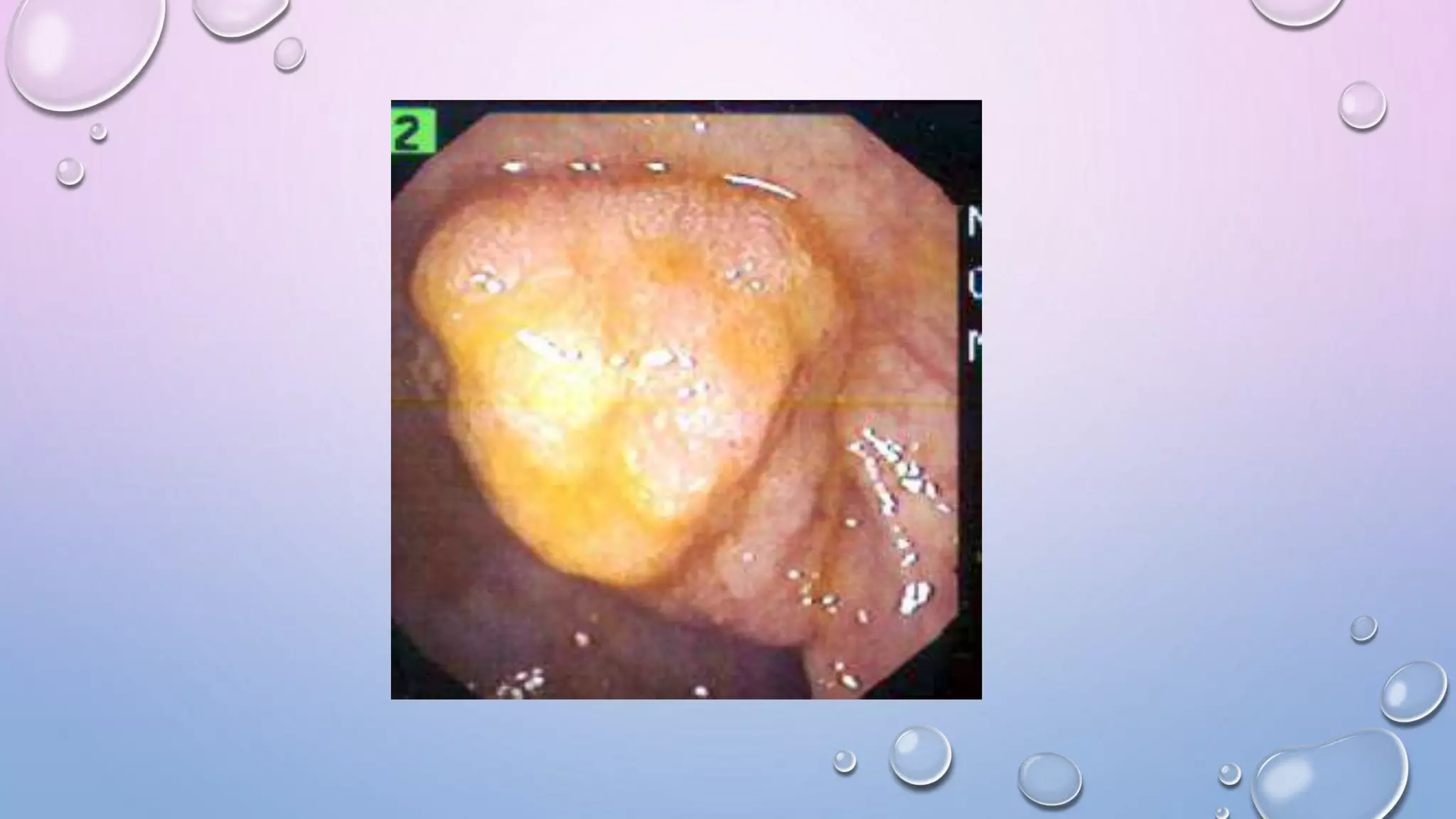
Multiple adenomatous polyps of the cecum are seen here in a case of familial polyposis.
STAGE 0 COLORECTAL CANCER
• Known as “cancer in situ,” meaning the
cancer is located in the mucosa (moist
tissue lining the colon or rectum)
• Removal of the polyp (polypectomy) is the
usual treatment
STAGE I COLORECTAL CANCER
• The cancer has grown through the mucosa
and invaded the muscularis (muscular
coat)
• Treatment is surgery to remove the tumor
and some surrounding lymph nodes
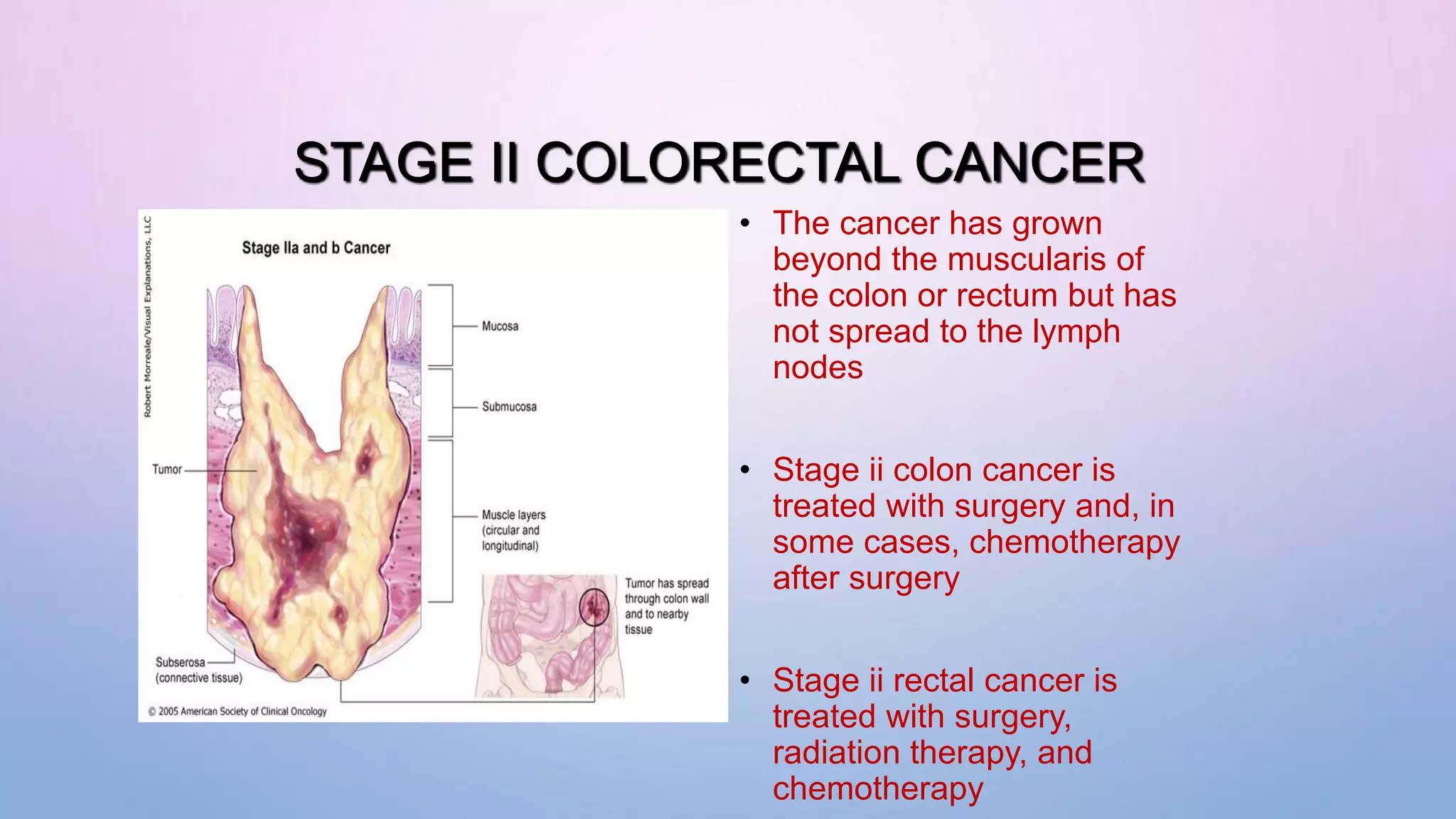
STAGE II COLORECTAL CANCER
• The cancer has grown
beyond the muscularis of
the colon or rectum but has
not spread to the lymph
nodes
• Stage ii colon cancer is
treated with surgery and, in
some cases, chemotherapy
after surgery
• Stage ii rectal cancer is
treated with surgery,
radiation therapy, and
chemotherapy
STAGE III COLORECTAL CANCER
• The cancer has spread to the
regional lymph nodes (lymph
nodes near the colon and
rectum)
• Stage iii colon cancer is
treated with surgery and
chemotherapy
• Stage iii rectal cancer is
treated with surgery, radiation
therapy, and chemotherapy
STAGE IV COLORECTAL CANCER
• The cancer has spread outside
of the colon or rectum to other
areas of the body
• Stage IV cancer is treated with
chemotherapy. Surgery to
remove the colon or rectal
tumor may or may not be done
• Additional surgery to remove
metastases may also be done
in carefully selected patients
Goals of treatment
Goals of treatment for
early disease
• Remove cancer cells
• Kill cancer cells
• Keep the cancer cells
from returning
Treatment is defined by stage and type of cancer present
Goals of treatment for
advanced disease
• Slow or stop the growth of
cancer cells
• Manage quality of life
concerns
REFERENCES
• DAVIDSON’S
• KUMAR
• WEBSITE
Colorectal Cancer

Colorectal Cancer

  • 1.
  • 2.
    DEFINITION • Third mostcommon type of cancer and second most frequent cause of cancer-related death • A disease in which normal cells in the lining of the colon or rectum begin to change, grow without control, and no longer die • Usually begins as a noncancerous polyp that can, over time, become a cancerous tumor
  • 3.
    TYPICAL SITES OFINCIDENCE AND SYMPOMS OF COLON CANCER
  • 4.
    RISK FACTOR • Polyps(a noncancerous or precancerous growth associated with aging) • Age • Inflammatory bowel disease (IBD) • Diet high in saturated fats, such as red meat • Personal or family history of cancer • Obesity • Smoking • alcohol
  • 5.
    Result of interplaybetween environmental and Genetic factors Central environmental factors: Diet and lifestyle 35% of all cancers are attributable to diet 50%-75% of crc in the us may be preventable Through dietary modifications Development of CRC
  • 6.
    consumption of redmeat animal and saturated fat refined carbohydrates alcohol increased risk Dietary factors implicated in colorectal carcinogenesis
  • 7.
    dietary fiber vegetables fruits antioxidant vitamins calcium folate(B Vitamin) decreased risk Dietary factors implicated in colorectal carcinogenesis
  • 8.
    HEREDITARY COLORECTAL CANCER SYNDROMES: •Familial syndromes such as familial adenomatous polyposis. • (FAP)—an autosomal dominant disorder caused by mutations in the adenomatous polyposis Coli (APC) gene on chromosome 5—may lead to an increased risk of colon cancer. • In FAP, Cancers commonly develop in adolescence and young adulthood, and the incidence of colorectal Neoplasms is nearly 100% by age 50 years.
  • 9.
    CONT…. • Hereditary nonpolyposiscolon cancer. • (HNPCC or lynch syndrome) is associated with a lower but significant risk of cancer of the Colon and rectum. • Mutations in tumor suppressor genes such as MCC, DCC, BRCA1, and p53 • Also confer higher risks for colorectal neoplasms.
  • 10.
    SCREENING • A. Adultswith signs or symptoms consistent with colorectal neoplasm should undergo testing To exclude the presence of a mass. • B. All average-risk adults aged 50 years or older should undergo one or more of the following: annual Fecal occult blood test (FOBT) or fecal immunochemical test (FIT), flexible sigmoidoscopy every 5 years, double-contrast barium enema (DCBE) every 5 years, CT colonography every 5 years, or Colonoscopy every 10 years. All positive tests should be followed up with a colonoscopy. • C. High-risk patients, including those with a personal or family history of colorectal cancer or Adenomatous polyps, a history of FAP or HNPCC, or a history of inflammatory bowel disease, Should be screened earlier and more frequently.
  • 11.
    PATHOLOGY • A. Thelarge majority of colorectal neoplasms are adenocarcinomas, and most are well or moderately differentiated. Poorly differentiated neoplasms are associated with poor prognosis. • B. Squamous cell carcinomas can arise in the anus. Such neoplasms differ from adenocarcinomas in terms of biology and therapy.
  • 12.
    DIAGNOSIS • Colonoscopy isthe preferred diagnostic test for colorectal cancer • Barium enema and fl exible sigmoidoscopy. • Biopsy of suspicious lesions is required to establish a diagnosis. • Tumor markers such as carcinoembryonic antigen (cea) or carbohydrate antigen (ca). • Radiologic studies are used to evaluate the extent of local disease and to screen for metastatic disease.
  • 13.
    Multiple adenomatous polypsof the cecum are seen here in a case of familial polyposis.
  • 16.
    STAGE 0 COLORECTALCANCER • Known as “cancer in situ,” meaning the cancer is located in the mucosa (moist tissue lining the colon or rectum) • Removal of the polyp (polypectomy) is the usual treatment
  • 17.
    STAGE I COLORECTALCANCER • The cancer has grown through the mucosa and invaded the muscularis (muscular coat) • Treatment is surgery to remove the tumor and some surrounding lymph nodes
  • 18.
    STAGE II COLORECTALCANCER • The cancer has grown beyond the muscularis of the colon or rectum but has not spread to the lymph nodes • Stage ii colon cancer is treated with surgery and, in some cases, chemotherapy after surgery • Stage ii rectal cancer is treated with surgery, radiation therapy, and chemotherapy
  • 19.
    STAGE III COLORECTALCANCER • The cancer has spread to the regional lymph nodes (lymph nodes near the colon and rectum) • Stage iii colon cancer is treated with surgery and chemotherapy • Stage iii rectal cancer is treated with surgery, radiation therapy, and chemotherapy
  • 20.
    STAGE IV COLORECTALCANCER • The cancer has spread outside of the colon or rectum to other areas of the body • Stage IV cancer is treated with chemotherapy. Surgery to remove the colon or rectal tumor may or may not be done • Additional surgery to remove metastases may also be done in carefully selected patients
  • 21.
    Goals of treatment Goalsof treatment for early disease • Remove cancer cells • Kill cancer cells • Keep the cancer cells from returning Treatment is defined by stage and type of cancer present Goals of treatment for advanced disease • Slow or stop the growth of cancer cells • Manage quality of life concerns
  • 22.