Colorectal Cancer


- Dr. Suneet Khurana
Colorectal Cancer
Definition
 Colorectal Cancer is
  the cancer affecting
  caecum, colon and
  rectum
 Anal canal and
  Appendix are not
  considered in the
  definition, and are
  treated as a separate
  entities
Incidence
 SECOND most common cause of Cancer
  related deaths in North America
 Estimated new cases and deaths from
  colon and rectal cancer in the United
  States in 2009*
New cases: 106,100 (colon); 40,870 (rectal)
Deaths: 49,920 (colon and rectal combined)


    *Source – National Cancer Institute
Cancer Related Mortality
High Risk Factors
   Familial Adenomatous Polyposis
   Hereditary Non Poliposis Colon Cancer
   Family history of Colo Rectal Carcinoma
   Previous Colorectal CA, Ovarian, Endometrial, Breast CA*
   Age >50
   Inflammatory Bowel Disease (UC > CD)
   Poor Diet (increased fat, red meat, decreased fibre)
   Smoking
   Diabetes mellitus & Acromegaly
   Streptococcus Bovis Bacteremia*
   Ureterosigmoidostomy*


* Harrisons
Familial Factors – Risks for CRC
Syndrome        Distrubution Histology      Malignant   Other
                                            potential   Lesions
Familial    Large Intestine Adenoma         Common      none
Adenomatous
Polyposis
Gardner         Large and       Adenoma     Common      Multiple
Syndrome        Small Intestine                         Malignancies
Turcot          Large Intestine Adenoma     Common      Brain Tumors
Syndrome
Nonpolyposis Large Intestine Adenoma        Common      Endometrial
Syndrome                                                and Ovarian
                                                        Tumors
Peutz Jeghers   Small, Large   Hamartoma    Rare        Multiple
Syndrome        Intestine,                              Malignancies
                Stomach
Juvenile        Large and       Hamartoma   Rare        Congenital
Polyposis       Small Intestine                         Anomalies
Genetic Changes in CRC
GENETIC CHANGES          MECHANISM - the
 Activation of proto-   mutational activation
  oncogenes (K-ras)      of an oncogene
 Loss of tumour-
                         followed by and
  suppressor gene        coupled with the loss
  activity (APC, DCC)    of genes that
                         normally suppress
 Abnormalities in
                         tumorigenesis
  DNA repair genes
  (hMSH2, hMLH1),
  especially HNPCC
  syndromes
Colorectal Polyps
Pathophysiology
Prevention

   Increase fibre in diet
   Decrease animal fat
    and red meat,
   Decrease smoking and
    EtOH
   Increase exercise and
    decrease BMI
   Secondary prevention
    with screening
Canadian Task Force on Preventive Health Care
grading of health promotion actions
   A: Good evidence to              D: Fair evidence to
    recommend the                     recommend against the
    preventive health                 preventive health
    measure                           measure
   B: Fair evidence to              E: Good evidence to
    recommend the                     recommend against the
    preventive health                 preventive health
    measure                           measure
   C: Existing evidence is          I: Insufficient evidence (in
    conflicting and does not          quantity and/or quality)
    allow making a                    to make a
    recommendation for or             recommendation,
    against use of the clinical       however other factors
    preventive action,                may influence decision-
    however other factors             making
    may influence decision-
    making
Screening Tools
Digital rectal exam (DRE): most common exam, but not recommended as a screening tool
Fecal occult blood test (FOBT):
-     proper test requires 3 samples of stool
-     still recommended annually by the World Health Organization (WHO)
-     results in 16-33% reduction in mortality in RCTs
-     Minnesota Colon Cancer Study: RCT showed that annual FOBT can decrease mortality rate by
      1/3 in patients 50-80 years old
Sigmoidoscopy:
-     can identify 30-60% of lesions
-     sigmoidoscopy + FOBT misses 24% of colonic neoplasms
    Colonoscopy:
      can remove or biopsy lesions during procedure
      can identify proximal lesions missed by sigmoidoscopy
      used as follow-up to other tests if lesions found
      disadvantages: expensive, not always available, poor compliance, requires sedation, risk of
      perforation (0.2%
Virtual colonoscopy: 91% sensitive, 17% false positive rate
Air contrast barium enema: 50% sensitive for large (>1 cm) adenomas, 39% for polyps
Carcinogenic embryonic antigen (CEA): to monitor for recurrence q3 months
Screening for Colorectal Cancer
Average risk individuals, at age 50
   (incl. those with <2 relatives with   Family Hx (>2 relatives with
   CRC) – recommendations are              CRC/adenoma, one being a 1st
   variable:                               degree relative): start screening
• American Gastroenterology                10 years prior to the age of the
   Society and American Cancer             relative’s age with the earliest
   Society - Yearly fecal occult
   blood test (FOBT), flexible             onset of carcinoma
   sigmoidoscopy q5y, colonoscopy        • FAP genetic testing +ve:
   q10y
• Canadian Task Force on                      • yearly sigmoidoscopy starting
   Preventative Health Care:                at puberty (“B”
     • yearly FOBT (“A”                     recommendation)
   recommendation)                       • HNPCC genetic testing +ve:
     • Sigmoidoscopy (“B”                     • yearly colonoscopy starting at
   recommendation)
                                            age 20 years (“B”
     • whether to use one or both
   of FOBT or Sigmoidoscopy (“C”            recommendation)
   recommendation)
     • colonoscopy (“C”
   recommendation d/t lack of good
   RCT’s)
Screening - Canadian Guidelines
Investigations
    Colonoscopy (best), look for synchronous
    lesions - Alternative: air contrast barium
    enema (“apple core” lesion) +
    sigmoidoscopy
    If a patient is FOBT +ve, microcytic anemia
    or has a change in bowel habits, do
    colonoscopy
    Metastatic workup: CXR, abdominal
    CT/ultrasound
   Bone scan, CT head only if lesions suspected
    Labs: CBC, urinalysis, liver function tests,
    CEA (before surgery baseline)
Barium Enema
Sigmoidoscopy
Colonoscopy
Capsule (Colonoscopy)
Capsule Endoscopy
Virtual Endoscopy
Virtual Endoscopy
Virtual Colonoscopy
Apple Core Lesion in Colorectal
Cancer
Ulcerating Carcinoma
Clinical Features

  Often asymptomatic
  Hematochezia / melena, abdominal pain, change
  in bowel habits
 Weakness, anemia, weight loss, palpable mass,
  obstruction
Spread
 Direct extension, lymphatic, hematogenous (liver
  most common, lung, rarely bone and brain)
 Peritoneal seeding: ovary, Blumer’s shelf (pelvic
  cul-de-sac)
 Intraluminal
Clinical Presentation
            Right Colon         Left Colon          Rectum
Frequency   25%                 35%                 30%
Pathology   Exophytic lesions   Annular invasive    Ulcerating lesions
            with occult         lesions
            bleeding
Symptoms    Weight loss,        Constipation,       Obstruction,
            weakness, rarely    alternating bowel   tenesmus,
            obstruction         patterns,           bleeding
                                abdominal pain,
                                decreased stool
                                caliber, rectal
                                bleeding
Signs       Fe-Deficiency       Bright Red Blood    Palpable mass on
            Anemia              Per Rectum, Large   rectal exam.
                                Bowel               Bright Red Blood
                                Obstruction         Per Rectum
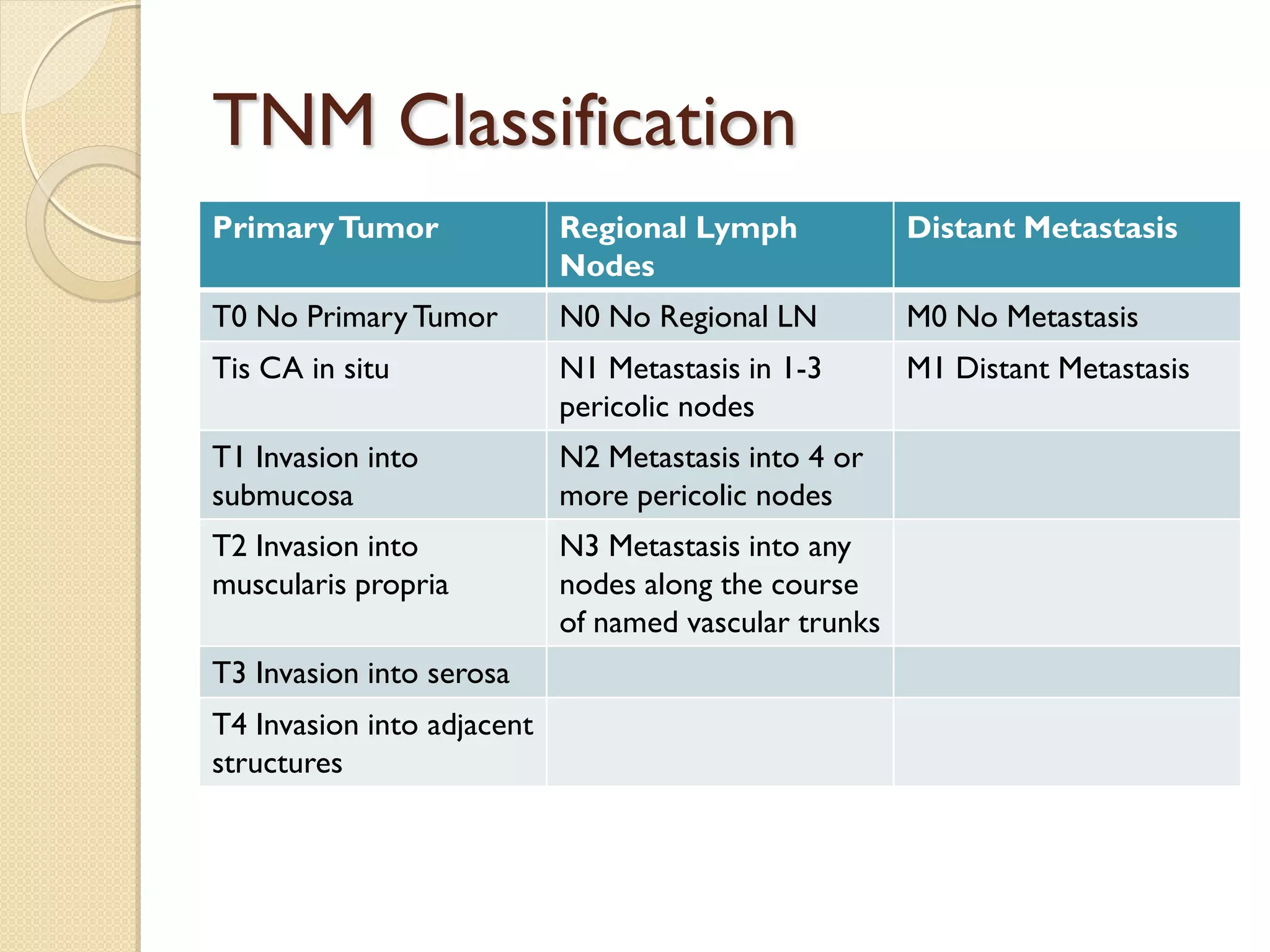
TNM Classification
Primary Tumor               Regional Lymph             Distant Metastasis
                            Nodes
T0 No Primary Tumor         N0 No Regional LN          M0 No Metastasis
Tis CA in situ              N1 Metastasis in 1-3       M1 Distant Metastasis
                            pericolic nodes
T1 Invasion into            N2 Metastasis into 4 or
submucosa                   more pericolic nodes
T2 Invasion into            N3 Metastasis into any
muscularis propria          nodes along the course
                            of named vascular trunks
T3 Invasion into serosa
T4 Invasion into adjacent
structures
Stages of Colorectal Cancer
Prognosis
Stage       5 Year Survival (%)
T1 N0 M0    >90
T2 N0 M0    85
T3 N0 M0    70 - 80
Tx N1 M0    35 - 65
Tx Nx M1    5
Treatment
SURGERY (indicated in potentially curable or symptomatic cases - not always in stage IV)
 Curative: wide resection of lesion (5 cm margins) with nodes and mesentery
 Palliative: if distant spread, then local control for hemorrhage or obstruction
 80% of recurrences occur within 2 years of resection
 Improved survival if metastasis consists of solitary hepatic mass that is resected
 Colectomy:
-  most patients get primary anastomosis (e.g. hemicolectomy, low anterior resection (LAR)-
-  if cancer is below levators in rectum, patient may require an abdominal perineal resection
   (APR) with a permanent end colostomy, especially if lesion involves the sphincter complex
- complications: anastomotic leak or stricture, recurrent disease, pelvic abscess,
   enterocutaneous fistula

RADIOTHERAPY & CHEMOTHERAPY
 Chemotherapy (5 FU based regimens): for patients with node-positive disease
 Radiation: for patients with node-positive or transmural rectal cancer (pre ± post-op),
  not effective in treatment of colon cancer
 Adjuvant therapy – chemotherapy (colon) and radiation (rectum)
 Palliative chemotherapy/radiation therapy for improvement in symptoms and survival
Local Excision, Resection
Anastomosis
Resection and Colostomy
Case Finding
 Case finding for colorectal cancer
  (symptomatic or history of UC, polyps, or
  CRC)
 Surveillance (when polyps are found):
  colonoscopy within 3 years after initial
  finding
 Patients with past CRC: colonoscopy every
  3-5 years, or more frequently
 IBD: some recommend colonoscopy every
  1-2 years after 8 years of disease (especially
  UC)
Follow up
 Intensive follow up improves overall
  survival in good risk patients
 Currently there is no data suggesting
  optimal follow up
 Combination of periodic CT
  chest/abdo/pelvis, CEA and colonoscopy
  is recommended

Colorectal Cancer

  • 1.
  • 2.
  • 3.
    Definition  Colorectal Canceris the cancer affecting caecum, colon and rectum  Anal canal and Appendix are not considered in the definition, and are treated as a separate entities
  • 4.
    Incidence  SECOND mostcommon cause of Cancer related deaths in North America  Estimated new cases and deaths from colon and rectal cancer in the United States in 2009* New cases: 106,100 (colon); 40,870 (rectal) Deaths: 49,920 (colon and rectal combined) *Source – National Cancer Institute
  • 5.
  • 6.
    High Risk Factors  Familial Adenomatous Polyposis  Hereditary Non Poliposis Colon Cancer  Family history of Colo Rectal Carcinoma  Previous Colorectal CA, Ovarian, Endometrial, Breast CA*  Age >50  Inflammatory Bowel Disease (UC > CD)  Poor Diet (increased fat, red meat, decreased fibre)  Smoking  Diabetes mellitus & Acromegaly  Streptococcus Bovis Bacteremia*  Ureterosigmoidostomy* * Harrisons
  • 7.
    Familial Factors –Risks for CRC Syndrome Distrubution Histology Malignant Other potential Lesions Familial Large Intestine Adenoma Common none Adenomatous Polyposis Gardner Large and Adenoma Common Multiple Syndrome Small Intestine Malignancies Turcot Large Intestine Adenoma Common Brain Tumors Syndrome Nonpolyposis Large Intestine Adenoma Common Endometrial Syndrome and Ovarian Tumors Peutz Jeghers Small, Large Hamartoma Rare Multiple Syndrome Intestine, Malignancies Stomach Juvenile Large and Hamartoma Rare Congenital Polyposis Small Intestine Anomalies
  • 8.
    Genetic Changes inCRC GENETIC CHANGES MECHANISM - the  Activation of proto- mutational activation oncogenes (K-ras) of an oncogene  Loss of tumour- followed by and suppressor gene coupled with the loss activity (APC, DCC) of genes that normally suppress  Abnormalities in tumorigenesis DNA repair genes (hMSH2, hMLH1), especially HNPCC syndromes
  • 9.
  • 10.
  • 11.
    Prevention  Increase fibre in diet  Decrease animal fat and red meat,  Decrease smoking and EtOH  Increase exercise and decrease BMI  Secondary prevention with screening
  • 12.
    Canadian Task Forceon Preventive Health Care grading of health promotion actions  A: Good evidence to  D: Fair evidence to recommend the recommend against the preventive health preventive health measure measure  B: Fair evidence to  E: Good evidence to recommend the recommend against the preventive health preventive health measure measure  C: Existing evidence is  I: Insufficient evidence (in conflicting and does not quantity and/or quality) allow making a to make a recommendation for or recommendation, against use of the clinical however other factors preventive action, may influence decision- however other factors making may influence decision- making
  • 13.
    Screening Tools Digital rectalexam (DRE): most common exam, but not recommended as a screening tool Fecal occult blood test (FOBT): - proper test requires 3 samples of stool - still recommended annually by the World Health Organization (WHO) - results in 16-33% reduction in mortality in RCTs - Minnesota Colon Cancer Study: RCT showed that annual FOBT can decrease mortality rate by 1/3 in patients 50-80 years old Sigmoidoscopy: - can identify 30-60% of lesions - sigmoidoscopy + FOBT misses 24% of colonic neoplasms Colonoscopy: can remove or biopsy lesions during procedure can identify proximal lesions missed by sigmoidoscopy used as follow-up to other tests if lesions found disadvantages: expensive, not always available, poor compliance, requires sedation, risk of perforation (0.2% Virtual colonoscopy: 91% sensitive, 17% false positive rate Air contrast barium enema: 50% sensitive for large (>1 cm) adenomas, 39% for polyps Carcinogenic embryonic antigen (CEA): to monitor for recurrence q3 months
  • 14.
    Screening for ColorectalCancer Average risk individuals, at age 50 (incl. those with <2 relatives with Family Hx (>2 relatives with CRC) – recommendations are CRC/adenoma, one being a 1st variable: degree relative): start screening • American Gastroenterology 10 years prior to the age of the Society and American Cancer relative’s age with the earliest Society - Yearly fecal occult blood test (FOBT), flexible onset of carcinoma sigmoidoscopy q5y, colonoscopy • FAP genetic testing +ve: q10y • Canadian Task Force on • yearly sigmoidoscopy starting Preventative Health Care: at puberty (“B” • yearly FOBT (“A” recommendation) recommendation) • HNPCC genetic testing +ve: • Sigmoidoscopy (“B” • yearly colonoscopy starting at recommendation) age 20 years (“B” • whether to use one or both of FOBT or Sigmoidoscopy (“C” recommendation) recommendation) • colonoscopy (“C” recommendation d/t lack of good RCT’s)
  • 15.
  • 16.
    Investigations  Colonoscopy (best), look for synchronous lesions - Alternative: air contrast barium enema (“apple core” lesion) + sigmoidoscopy  If a patient is FOBT +ve, microcytic anemia or has a change in bowel habits, do colonoscopy  Metastatic workup: CXR, abdominal CT/ultrasound  Bone scan, CT head only if lesions suspected  Labs: CBC, urinalysis, liver function tests, CEA (before surgery baseline)
  • 17.
  • 18.
  • 19.
  • 20.
  • 21.
  • 22.
  • 23.
  • 24.
  • 25.
    Apple Core Lesionin Colorectal Cancer
  • 26.
  • 27.
    Clinical Features  Often asymptomatic  Hematochezia / melena, abdominal pain, change in bowel habits  Weakness, anemia, weight loss, palpable mass, obstruction Spread  Direct extension, lymphatic, hematogenous (liver most common, lung, rarely bone and brain)  Peritoneal seeding: ovary, Blumer’s shelf (pelvic cul-de-sac)  Intraluminal
  • 28.
    Clinical Presentation Right Colon Left Colon Rectum Frequency 25% 35% 30% Pathology Exophytic lesions Annular invasive Ulcerating lesions with occult lesions bleeding Symptoms Weight loss, Constipation, Obstruction, weakness, rarely alternating bowel tenesmus, obstruction patterns, bleeding abdominal pain, decreased stool caliber, rectal bleeding Signs Fe-Deficiency Bright Red Blood Palpable mass on Anemia Per Rectum, Large rectal exam. Bowel Bright Red Blood Obstruction Per Rectum
  • 29.
    TNM Classification Primary Tumor Regional Lymph Distant Metastasis Nodes T0 No Primary Tumor N0 No Regional LN M0 No Metastasis Tis CA in situ N1 Metastasis in 1-3 M1 Distant Metastasis pericolic nodes T1 Invasion into N2 Metastasis into 4 or submucosa more pericolic nodes T2 Invasion into N3 Metastasis into any muscularis propria nodes along the course of named vascular trunks T3 Invasion into serosa T4 Invasion into adjacent structures
  • 30.
  • 31.
    Prognosis Stage 5 Year Survival (%) T1 N0 M0 >90 T2 N0 M0 85 T3 N0 M0 70 - 80 Tx N1 M0 35 - 65 Tx Nx M1 5
  • 32.
    Treatment SURGERY (indicated inpotentially curable or symptomatic cases - not always in stage IV)  Curative: wide resection of lesion (5 cm margins) with nodes and mesentery  Palliative: if distant spread, then local control for hemorrhage or obstruction  80% of recurrences occur within 2 years of resection  Improved survival if metastasis consists of solitary hepatic mass that is resected  Colectomy: - most patients get primary anastomosis (e.g. hemicolectomy, low anterior resection (LAR)- - if cancer is below levators in rectum, patient may require an abdominal perineal resection (APR) with a permanent end colostomy, especially if lesion involves the sphincter complex - complications: anastomotic leak or stricture, recurrent disease, pelvic abscess, enterocutaneous fistula RADIOTHERAPY & CHEMOTHERAPY  Chemotherapy (5 FU based regimens): for patients with node-positive disease  Radiation: for patients with node-positive or transmural rectal cancer (pre ± post-op), not effective in treatment of colon cancer  Adjuvant therapy – chemotherapy (colon) and radiation (rectum)  Palliative chemotherapy/radiation therapy for improvement in symptoms and survival
  • 33.
  • 34.
  • 35.
    Case Finding  Casefinding for colorectal cancer (symptomatic or history of UC, polyps, or CRC)  Surveillance (when polyps are found): colonoscopy within 3 years after initial finding  Patients with past CRC: colonoscopy every 3-5 years, or more frequently  IBD: some recommend colonoscopy every 1-2 years after 8 years of disease (especially UC)
  • 36.
    Follow up Intensivefollow up improves overall survival in good risk patients  Currently there is no data suggesting optimal follow up  Combination of periodic CT chest/abdo/pelvis, CEA and colonoscopy is recommended