The   People   Code   for Core Motives
To experience passion, one must have an   accurate sense of oneself and feel a   congruence between who one is  and the   life one lives.
People Code Outcomes Identify driving core motive Consider filters that affect behavior Understand the four personality types List strengths and limitations Recognize the impact of a secondary color Develop ideas for effectively communicating and interacting Maximize synergy and minimize conflict
Since the beginning ….
Hartman People Code™ System Personality is the innate style of attitudes and behaviors that comes with you  at birth  and is based on one primary motive. Core Motive is not  learned or developed .
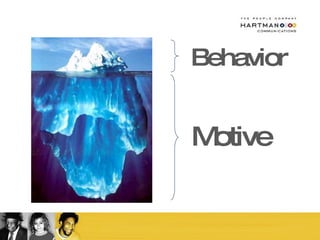
Behavior Motive
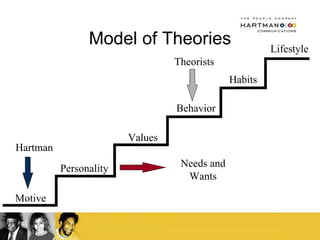
Model of Theories Motive Personality Values Behavior Habits Needs and Wants Hartman Theorists Lifestyle
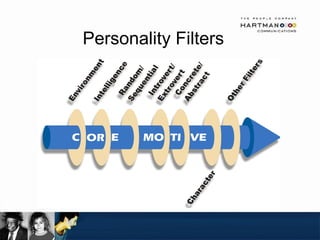
Personality Filters
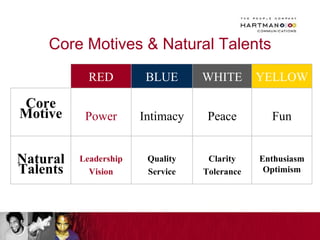
Core Motives & Natural Talents YELLOW WHITE BLUE RED Enthusiasm Optimism Clarity Tolerance Quality Service Leadership Vision Natural Talents Fun Peace Intimacy Power Core Motive
“ Healthy REDS are the lifeblood of humanity.  They are the movers and shakers of society” -Dr. Taylor Hartman
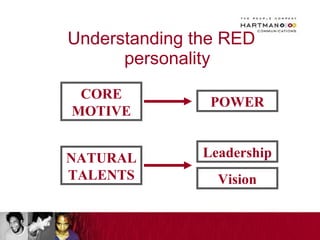
Understanding the RED personality CORE MOTIVE NATURAL TALENTS Vision Leadership POWER
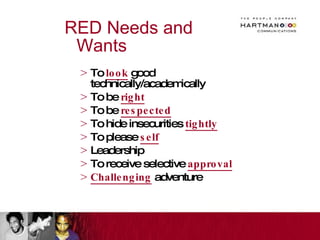
RED Needs and Wants To  look  good technically/academically To be  right To be  respected To hide insecurities  tightly To please  self Leadership To receive selective  approval Challenging  adventure
RED Strengths Decisive Assertive Action-Oriented Motivated Determined Responsible Articulate Confident Leader Proactive
RED Limitations Selfish Insensitive Arrogant Always Right Impatient Bossy Aggressive Argumentative Demanding Obsessive
Keys to Relating to REDS  DO: Present facts and figures Be direct, brief, and specific Present issues logically Emphasize productivity and efficiency Articulate your feelings clearly Support their leadership instincts Support their correct decisions
Keys to Relating to REDS  DO NOT: Embarrass them in front of others Argue from an emotional perspective Be slow and indecisive Always use an authoritarian approach Wait for them to ask your opinion Take their arguments personally Demand constant social interaction
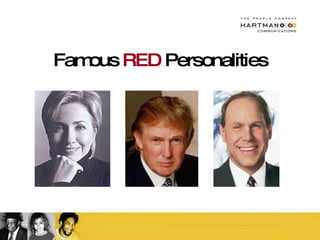
Famous  RED  Personalities
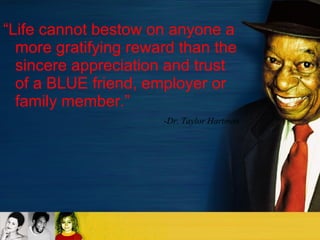
“ Life cannot bestow on anyone a more gratifying reward than the sincere appreciation and trust of a BLUE friend, employer or family member.” - Dr. Taylor Hartman
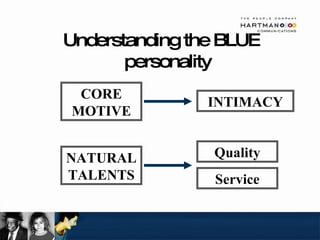
Understanding the BLUE personality CORE MOTIVE NATURAL TALENTS Service Quality INTIMACY
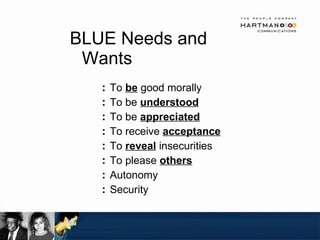
BLUE Needs and Wants To  be  good morally To be  understood To be  appreciated To receive  acceptance To  reveal  insecurities To please  others Autonomy Security
BLUE Strengths Compassionate Sincere Loyal Thoughtful Analytical Caring Intuitive Detail Conscious Dependable Deliberate
BLUE Limitations Worry Prone Overly Sensitive Self-Righteous Unforgiving Judgmental Suspicious Perfectionist Hard to Please Moody Jealous
Keys to Relating to BLUES  DO: Show appreciation Take a sensitive approach Demonstrate sincerity Limit their perceived exposure to risk Help them feel secure Promote their creative efforts Be loyal
Keys to Relating to BLUES  DO NOT: Make them feel guilty Be rude or abrupt Expect spontaneity Promote too much change Expect them to bounce back easily from “the blues”  Expect them to forgive quickly Abandon them
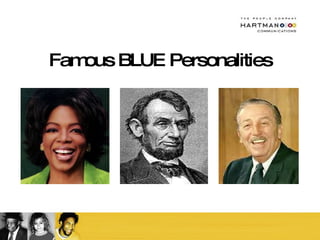
Famous BLUE Personalities
“ WHITES offer us all a model for gentle, human dignity.” -Dr. Taylor Hartman
Understanding the  WHITE   personality CORE MOTIVE NATURAL TALENTS Voice of Reason Clarity PEACE
WHITE  Needs and Wants To  feel  good inside To be given  space To be  respected To be  accepted To  withhold   insecurities To please  self and others To be independent Contentment
WHITE  Strengths Kind Balanced Even Tempered Non-Discriminate Self-Regulated Good Listener Inventive Objective Diplomatic Centered
WHITE  Limitations Timid Indecisive Unmotivated Silently Stubborn Unexpressive Avoids Conflict Boring Indifferent Ambivalent Detached
Keys to Relating to  WHITES   DO: Accept their individuality Create an informal, relaxed setting Combine firmness with kindness Always react gently Show patience, try not to rush them Look for nonverbal clues Hear them out; listen quietly, and carefully
Keys to Relating to  WHITES   DO NOT: Be cruel or insensitive Expect them to need much social interaction Force immediate verbal expression Be domineering or too intense Overwhelm them with too much at once Force confrontation Take away all their daydreams
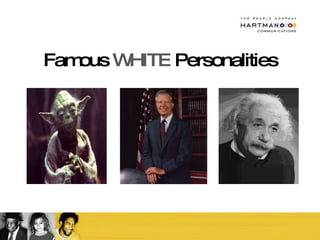
Famous  WHITE  Personalities
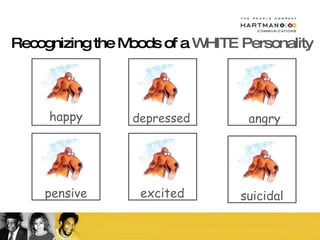
Recognizing the Moods of a  WHITE Personality happy suicidal excited pensive angry depressed
“ Happy is as happy does.  YELLOW people love themselves because they know exactly what they love to do and always find the time to do it.” -Dr. Taylor Hartman
Understanding the   YELLOW  personality CORE MOTIVE NATURAL TALENTS Optimism Enthusiasm FUN
YELLOW  Needs and Wants To look good  socially To be  well-liked To be  praised To gain  general  approval To  hide  insecurities  loosely To be  noticed Freedom Playful adventure
YELLOW  Strengths Fun-Loving Flexible Carefree Engaging of others Happy Inclusive Spontaneous Insightful Charismatic Sociable
YELLOW  Limitations Uncommitted Self-centered Disorganized Impulsive Undisciplined Vain Afraid to face facts Inconsistent Unfocused Interrupter
Keys to Relating to  YELLOWS   DO: Take a positive, upbeat approach Offer praise and appreciation Accept some playful teasing Encourage them to enjoy their work Encourage their verbal self-expression Reinforce trust with appropriate physical gestures Value their social interaction skills
Keys to Relating to  YELLOWS   DO NOT: Be too serious in criticism Ignore them Forget that they have “down” times, too Expect them to dwell on problems Attack their sensitivity or be unforgiving Totally control their schedules/time Give them too much rope, or they may hang themselves
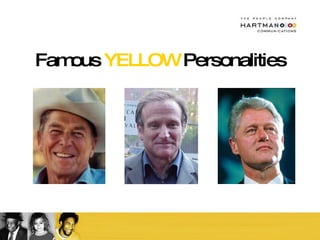
Famous  YELLOW  Personalities
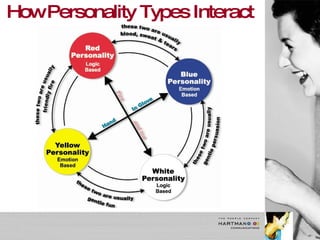
How Personality Types Interact
The Four Paths Charactered Healthy Unhealthy Pathological (Sick)
The voyage of discovery   depends not on visiting distant shores,  but on seeing the world  with new eyes.    ~ Marcel Proust
Your Next Steps What can you do to change an existing relationship for the better? What can you do to communicate more effectively? What can you do to create harmony amongst those you work with?
Whatever you can do,  or dream you can, begin it. Boldness has genius, power, and magic in it.  ~   Goethe
[email_address] Copyright 2003 Hartman Communications, All Rights Reserved.

Colorcode 1hr

  • 1.
    The People Code for Core Motives
  • 2.
    To experience passion,one must have an accurate sense of oneself and feel a congruence between who one is and the life one lives.
  • 3.
    People Code OutcomesIdentify driving core motive Consider filters that affect behavior Understand the four personality types List strengths and limitations Recognize the impact of a secondary color Develop ideas for effectively communicating and interacting Maximize synergy and minimize conflict
  • 4.
  • 5.
    Hartman People Code™System Personality is the innate style of attitudes and behaviors that comes with you at birth and is based on one primary motive. Core Motive is not learned or developed .
  • 6.
  • 7.
    Model of TheoriesMotive Personality Values Behavior Habits Needs and Wants Hartman Theorists Lifestyle
  • 8.
  • 9.
    Core Motives &Natural Talents YELLOW WHITE BLUE RED Enthusiasm Optimism Clarity Tolerance Quality Service Leadership Vision Natural Talents Fun Peace Intimacy Power Core Motive
  • 10.
    “ Healthy REDSare the lifeblood of humanity. They are the movers and shakers of society” -Dr. Taylor Hartman
  • 11.
    Understanding the REDpersonality CORE MOTIVE NATURAL TALENTS Vision Leadership POWER
  • 12.
    RED Needs andWants To look good technically/academically To be right To be respected To hide insecurities tightly To please self Leadership To receive selective approval Challenging adventure
  • 13.
    RED Strengths DecisiveAssertive Action-Oriented Motivated Determined Responsible Articulate Confident Leader Proactive
  • 14.
    RED Limitations SelfishInsensitive Arrogant Always Right Impatient Bossy Aggressive Argumentative Demanding Obsessive
  • 15.
    Keys to Relatingto REDS DO: Present facts and figures Be direct, brief, and specific Present issues logically Emphasize productivity and efficiency Articulate your feelings clearly Support their leadership instincts Support their correct decisions
  • 16.
    Keys to Relatingto REDS DO NOT: Embarrass them in front of others Argue from an emotional perspective Be slow and indecisive Always use an authoritarian approach Wait for them to ask your opinion Take their arguments personally Demand constant social interaction
  • 17.
    Famous RED Personalities
  • 18.
    “ Life cannotbestow on anyone a more gratifying reward than the sincere appreciation and trust of a BLUE friend, employer or family member.” - Dr. Taylor Hartman
  • 19.
    Understanding the BLUEpersonality CORE MOTIVE NATURAL TALENTS Service Quality INTIMACY
  • 20.
    BLUE Needs andWants To be good morally To be understood To be appreciated To receive acceptance To reveal insecurities To please others Autonomy Security
  • 21.
    BLUE Strengths CompassionateSincere Loyal Thoughtful Analytical Caring Intuitive Detail Conscious Dependable Deliberate
  • 22.
    BLUE Limitations WorryProne Overly Sensitive Self-Righteous Unforgiving Judgmental Suspicious Perfectionist Hard to Please Moody Jealous
  • 23.
    Keys to Relatingto BLUES DO: Show appreciation Take a sensitive approach Demonstrate sincerity Limit their perceived exposure to risk Help them feel secure Promote their creative efforts Be loyal
  • 24.
    Keys to Relatingto BLUES DO NOT: Make them feel guilty Be rude or abrupt Expect spontaneity Promote too much change Expect them to bounce back easily from “the blues” Expect them to forgive quickly Abandon them
  • 25.
  • 26.
    “ WHITES offerus all a model for gentle, human dignity.” -Dr. Taylor Hartman
  • 27.
    Understanding the WHITE personality CORE MOTIVE NATURAL TALENTS Voice of Reason Clarity PEACE
  • 28.
    WHITE Needsand Wants To feel good inside To be given space To be respected To be accepted To withhold insecurities To please self and others To be independent Contentment
  • 29.
    WHITE StrengthsKind Balanced Even Tempered Non-Discriminate Self-Regulated Good Listener Inventive Objective Diplomatic Centered
  • 30.
    WHITE LimitationsTimid Indecisive Unmotivated Silently Stubborn Unexpressive Avoids Conflict Boring Indifferent Ambivalent Detached
  • 31.
    Keys to Relatingto WHITES DO: Accept their individuality Create an informal, relaxed setting Combine firmness with kindness Always react gently Show patience, try not to rush them Look for nonverbal clues Hear them out; listen quietly, and carefully
  • 32.
    Keys to Relatingto WHITES DO NOT: Be cruel or insensitive Expect them to need much social interaction Force immediate verbal expression Be domineering or too intense Overwhelm them with too much at once Force confrontation Take away all their daydreams
  • 33.
    Famous WHITE Personalities
  • 34.
    Recognizing the Moodsof a WHITE Personality happy suicidal excited pensive angry depressed
  • 35.
    “ Happy isas happy does. YELLOW people love themselves because they know exactly what they love to do and always find the time to do it.” -Dr. Taylor Hartman
  • 36.
    Understanding the YELLOW personality CORE MOTIVE NATURAL TALENTS Optimism Enthusiasm FUN
  • 37.
    YELLOW Needsand Wants To look good socially To be well-liked To be praised To gain general approval To hide insecurities loosely To be noticed Freedom Playful adventure
  • 38.
    YELLOW StrengthsFun-Loving Flexible Carefree Engaging of others Happy Inclusive Spontaneous Insightful Charismatic Sociable
  • 39.
    YELLOW LimitationsUncommitted Self-centered Disorganized Impulsive Undisciplined Vain Afraid to face facts Inconsistent Unfocused Interrupter
  • 40.
    Keys to Relatingto YELLOWS DO: Take a positive, upbeat approach Offer praise and appreciation Accept some playful teasing Encourage them to enjoy their work Encourage their verbal self-expression Reinforce trust with appropriate physical gestures Value their social interaction skills
  • 41.
    Keys to Relatingto YELLOWS DO NOT: Be too serious in criticism Ignore them Forget that they have “down” times, too Expect them to dwell on problems Attack their sensitivity or be unforgiving Totally control their schedules/time Give them too much rope, or they may hang themselves
  • 42.
    Famous YELLOW Personalities
  • 43.
  • 44.
    The Four PathsCharactered Healthy Unhealthy Pathological (Sick)
  • 45.
    The voyage ofdiscovery depends not on visiting distant shores, but on seeing the world with new eyes. ~ Marcel Proust
  • 46.
    Your Next StepsWhat can you do to change an existing relationship for the better? What can you do to communicate more effectively? What can you do to create harmony amongst those you work with?
  • 47.
    Whatever you cando, or dream you can, begin it. Boldness has genius, power, and magic in it. ~ Goethe
  • 48.
    [email_address] Copyright 2003Hartman Communications, All Rights Reserved.

Editor's Notes

  • #4 Taylor Hartman
  • #5 Greeks/Romans: interactions with one or more of the gods explained personality/behavior Astrology and the zodiac Western Europeans of a later age: dominant aspects of nature – earth, air, fire, and water 3 more recent Psychological Schools of Thought Psycho-Dynamic or Freudian Theory People are born psychologically unhealthy and society fixes them. Humanistic or Existential Theory People are born psychologically healthy and society damages them. Behaviorist Theory People are born psychologically neutral and develop a positive or negative life orientation depending upon their life experiences. And “typing” Myers-Briggs Kiersey True Colors DISC Color Code
  • #6 True Colors is a personality assessment system adapted from the arcehtype model developed by professor of psychology, David Keirsey. The Keirsey Temperament Sorter identifies individuals as one of four different types of temperaments. The model draws upon the principles of personality psychology previously established by Hippocrates, Carl Jung, and Isabel Briggs Myers. The Keirsey Personality Sorter is different from the Myers-Briggs Personality Test in that it identies individuals according to how they act and communicate in their environment, rather than upon their internal mental processes. Don Lowry, a student of David Keirsey, realized that the Keirsey Temperament Sorter, with its focused on the individual's interpersonal and environmental interactions, could be adapted to provide career guidance according to personality type. In 1978, Lowry founded True Colors Inc. a program that identifies personality and career types according to the archetypes set forth by the Keirsey Temperament Sorter. True Colors Inc makes Keirsey’s psychological theory more tangible by assigning each personality type to a corresponding color. The program helps individuals to recognize their strengths by first helping them to better understand their personality types and the careers paths that would be well suited for them. The programs and seminars hosted True Colors Inc are now used internationally by businesses, non-profit organizations, government programs, and universities. Several books have been written to integrate True Colors into the workplace and school systems, including Showing Your True Colors, by Mary Miscisin Positively Mary!, Following Your True Colors to the Work You Love, Student’s Guide by Caolyn Kalil, Following Your True Colors to the Work You Love, Instructor’s Guide by Caol Imai, Peaceful Converstions, by Ann Kashiwa, and Peaceful Colors by Gail Shapiro. [edit] True Colors There are four colors assigned to the four personality types in the True Colors system. They are as follows: Orange represents energy, consuming physiological potency, power, and strength. Orange is the expression of vital force, of nervous and glandular activity. Thus, it has the meaning of desire and all forms of appetite and craving. Those with Orange as a Primary Color feel the will to achieve results, to win, to be successful. They desire all things that offer intense living and full experience. Orange generates an impulse toward active doing: sport, struggle, competition and enterprising productivity. In temporal terms, Orange is the present. Gold is the body's natural perceptions. It represents a need to be responsible, to fulfill duties and obligations, to organize and structure our life and that of others. Those with Gold as a Primary Color value being practical and sensible. They believe that people should earn their way in life through work and service to others. Gold reflects a need to belong through carrying a share of the load in all areas of living. It represents stability, maintenance of the culture and the organization, efficiency, and dependability. It embraces the concepts of home and family with fierce loyalty and faithfulness. Green expresses itself psychologically as human will in operation: as persistence and determination. Green is an expression of firmness and consistency. Its strength can lead to a resistance to change if it is not proven that the change will work or is warranted. Those with Green as a Primary Color value their intellect and capabilities above all else. Comfort in these areas creates a sense of personal security and self-esteem.Green characteristics seek to increase the certainty of their own values through being assertive and requiring differences from others in intellectual areas. They are rarely settled in their countenance, since they depend upon information rather than feelings to create a sense of well-being. Green expresses the grounding of theory and data in its practical applications and creative constructs. Blue represents calm. Contemplation of this color pacifies the central nervous system. It creates physiological tranquility and psychological contentment. Those with Blue as a Primary Color value balance and harmony. They prefer lives free from tension... settled, united, and secure. Blue represents loyalty and a sense of belonging, and yet, when friends are involved, a vulnerability. Blue corresponds to depth in feeling and a relaxed sensitivity. It is characterized by empathy, aesthetic experiences, and reflective awareness. Retrieved from "http://en.wikipedia.org/wiki/True_Colors_Inc."
  • #7 Motive v. Behavior = Why v. What
  • #9 Even if you’ve done other profiles and assessments – knowledge and understanding is power – and this evening may reveal another facet in the unique gem that is you so that you can shine brighter, more powerfully. It may also inspire you to change negative behaviours if you so choose, and to understand the motives underlying others behaviors and respond according to that understanding instead of with your typical response pattern which may have limitations when it comes to enhancing your personal power and the power of your relationships. A key part of this understanding comes from understanding the difference between core motive and filters and the influences each has and the complex mix that results. (Look beyond culturally induced behavior to see the innate, natural personality of any individual)
  • #10 In the general population: 35% Blue 25% Red 20% White 20% Yellow
  • #15 Remedy for limitations is not always among strengths of your own color; we’ll talk more about this later, but a quick intro to how Hartman suggests we develop Character, is by remedying our limitiations by emulating, learning, and developing with awareness of the strengths of others.
  • #18 Red Bumper Stickers: Absolute Power corrupts absolutely, but it’s still kinda neat don’t you think? And your point is?
  • #26 Blue Bumper Stickers: I don’t get mad, I get even. Leave me alone, I’m having a crisis.
  • #33 Tell about Trash Cans!
  • #35 White Bumper stickers: I’m not deaf, I’m ignoring you. I used to be apathetic, now I just don’t care.
  • #43 Yellow Bumper Stickers: Hard work may not kill me . . . But why take the chance? Out of my mind . . . Back in 5 minutes! A fool and his money are soon partying!
  • #44 First talk about Secondary Colors: (Chart could say How Motives Interact) Secondary colors more than other factors, make us unique – and secondary colors can be innate or learned. A secondary color is present when there are strengths and limitations that belong to a different core motive than our own. e.g. Mother Teresa, a Red with the gift of tremendous compassion which is not innate to the Red core motive Red/Blue: experience difficult internal struggles; very resourceful Yellow/White: tremendous people skills (if you can’t enjoy them and get along, consider yourself the one with the problem) Etc. (matches the chart on relationships)
  • #45 Finger exercise on perspective here --
  • #47 The Color Code is a tool to help you with these next steps – you can add it to other tools/ideas/theories/models. But as with any tool, it is not enough to learn of it and never use it, and you must realize that it can be like fire and the outcocme depends on how it is used . . . . To light the way and warm us, or to destroy. We can begin an amazing and powerful collaborative future with some attention to our limitations and to others’ strengths for building truly powerful relationships. See others as role models of strengths that will help you; ask others to mentor you in developing new strengths.
  • #48 Until one is committed, there is hesitancy, the chance to draw back, always ineffectiveness. Concerning all acts of initiative (and creation), there is one elementary truth, the ignorance of which kills countless ideas and splendid plans. The moment that one definitely commits oneself, then providence moves too. All sorts of things occur to help that would never otherwise have occurred. A whole stream of events issues from the decision, raising in one’s favor all manner of unforeseen incidents and meetings and material assistance, which no man could have dreamt would have come his way.