True Colors A Colorful Look at  Personality Types By: Lacey Morgan
Our personality greatly impacts the way we see our world…… and the way we learn.  As teachers, it is imperative that we be informed about our students learning styles.
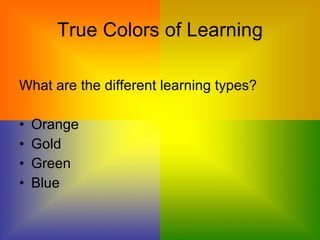
True Colors of Learning What are the different learning types?  Orange Gold Green  Blue
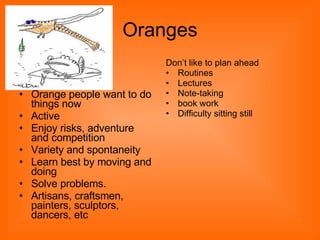
Oranges Orange people want to do things now  Active  Enjoy risks, adventure and competition Variety and spontaneity  Learn best by moving and doing Solve problems.  Artisans, craftsmen, painters, sculptors, dancers, etc Don’t like to plan ahead Routines  Lectures  Note-taking book work Difficulty sitting still
Teaching Orange Students Design lessons that provide opportunities for physical involvement Chances to take risks in a safe and structured environment Provide cooperative learning situations. Laid back supervision of adults.  Include games, dramatic presentations and role playing
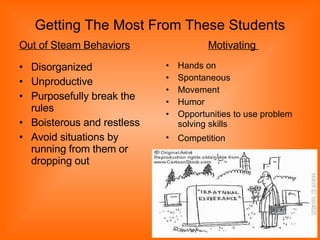
Getting The Most From These Students Out of Steam Behaviors Disorganized  Unproductive Purposefully break the rules Boisterous and restless Avoid situations by running from them or dropping out  Motivating  Hands on Spontaneous Movement Humor  Opportunities to use problem solving skills Competition
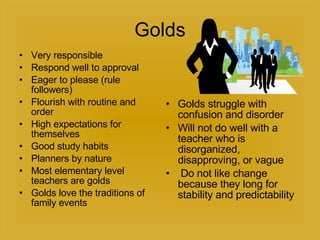
Golds Very responsible  Respond well to approval  Eager to please (rule followers) Flourish with routine and order  High expectations for themselves  Good study habits Planners by nature  Most elementary level teachers are golds  Golds love the traditions of family events  Golds struggle with confusion and disorder  Will not do well with a teacher who is disorganized, disapproving, or vague Do not like change because they long for stability and predictability
Teaching Gold Students Most likely of all colors to like “traditional” teaching practices Maintain routines Lots of praise and feedback Use carefully sequenced activities.  Lectures, note taking and drill and practice activities allow them to predict their own success
Getting The Most From These Students Out of Steam Behaviors Moody, complaining, self pitying individuals They can suffer from fatigue and depression They can become very rigid towards situations and prove to be very difficult to sway back on track  Motivating Activities that include detailed, explicit directions  Recognition for doing the right thing and being on task Structure and dependable situations Family
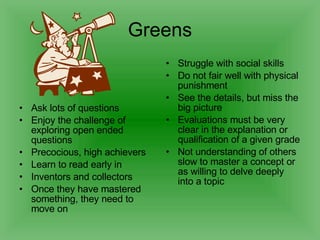
Greens Ask lots of questions  Enjoy the challenge of exploring open ended questions  Precocious, high achievers Learn to read early in Inventors and collectors Once they have mastered something, they need to move on Struggle with social skills Do not fair well with physical punishment See the details, but miss the big picture Evaluations must be very clear in the explanation or qualification of a given grade  Not understanding of others slow to master a concept or as willing to delve deeply into a topic
Teaching Green Students Need lots of opportunities to experience success  Need lots of intellectual stimulation  Hands on opportunities that allow for lots of exploration Provide time for feed back  Allow an option of working independently
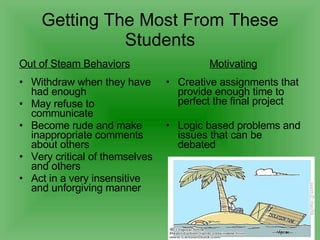
Getting The Most From These Students Out of Steam Behaviors Withdraw when they have had enough May refuse to communicate  Become rude and make inappropriate comments about others Very critical of themselves and others Act in a very insensitive and unforgiving manner Motivating Creative assignments that provide enough time to perfect the final project Logic based problems and issues that can be debated
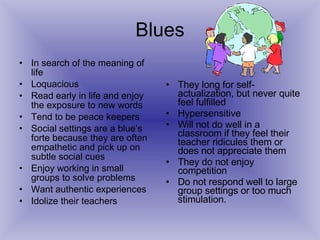
Blues In search of the meaning of life  Loquacious  Read early in life and enjoy the exposure to new words Tend to be peace keepers  Social settings are a blue’s forte because they are often empathetic and pick up on subtle social cues Enjoy working in small groups to solve problems  Want authentic experiences Idolize their teachers They long for self-actualization, but never quite feel fulfilled Hypersensitive  Will not do well in a classroom if they feel their teacher ridicules them or does not appreciate them  They do not enjoy competition  Do not respond well to large group settings or too much stimulation.
Teaching Blue Students Blues need a learning environment that is rich with language, harmony, justice and physical closeness Opportunities for students to work cooperatively and use their imaginations Instruction that is geared towards individual goals and high standards
Getting The Most From These Students Out of Steam Behaviors Tend to become withdrawn Daydream  Attention getting behaviors Become stubborn  Depressed and cry over small issues Hard time rebounding from injured egos Motivating Dramatic or expressive outlets, especially poetry and arts  Opportunity to show their unique talents and skills Nurturing, supportive environment
If students do not  learn the  way we teach…… Let us teach  the way they learn.    -Kenneth Dunn

True Colors

  • 1.
    True Colors AColorful Look at Personality Types By: Lacey Morgan
  • 2.
    Our personality greatlyimpacts the way we see our world…… and the way we learn. As teachers, it is imperative that we be informed about our students learning styles.
  • 3.
    True Colors ofLearning What are the different learning types? Orange Gold Green Blue
  • 4.
    Oranges Orange peoplewant to do things now Active Enjoy risks, adventure and competition Variety and spontaneity Learn best by moving and doing Solve problems. Artisans, craftsmen, painters, sculptors, dancers, etc Don’t like to plan ahead Routines Lectures Note-taking book work Difficulty sitting still
  • 5.
    Teaching Orange StudentsDesign lessons that provide opportunities for physical involvement Chances to take risks in a safe and structured environment Provide cooperative learning situations. Laid back supervision of adults. Include games, dramatic presentations and role playing
  • 6.
    Getting The MostFrom These Students Out of Steam Behaviors Disorganized Unproductive Purposefully break the rules Boisterous and restless Avoid situations by running from them or dropping out Motivating Hands on Spontaneous Movement Humor Opportunities to use problem solving skills Competition
  • 7.
    Golds Very responsible Respond well to approval Eager to please (rule followers) Flourish with routine and order High expectations for themselves Good study habits Planners by nature Most elementary level teachers are golds Golds love the traditions of family events Golds struggle with confusion and disorder Will not do well with a teacher who is disorganized, disapproving, or vague Do not like change because they long for stability and predictability
  • 8.
    Teaching Gold StudentsMost likely of all colors to like “traditional” teaching practices Maintain routines Lots of praise and feedback Use carefully sequenced activities. Lectures, note taking and drill and practice activities allow them to predict their own success
  • 9.
    Getting The MostFrom These Students Out of Steam Behaviors Moody, complaining, self pitying individuals They can suffer from fatigue and depression They can become very rigid towards situations and prove to be very difficult to sway back on track Motivating Activities that include detailed, explicit directions Recognition for doing the right thing and being on task Structure and dependable situations Family
  • 10.
    Greens Ask lotsof questions Enjoy the challenge of exploring open ended questions Precocious, high achievers Learn to read early in Inventors and collectors Once they have mastered something, they need to move on Struggle with social skills Do not fair well with physical punishment See the details, but miss the big picture Evaluations must be very clear in the explanation or qualification of a given grade Not understanding of others slow to master a concept or as willing to delve deeply into a topic
  • 11.
    Teaching Green StudentsNeed lots of opportunities to experience success Need lots of intellectual stimulation Hands on opportunities that allow for lots of exploration Provide time for feed back Allow an option of working independently
  • 12.
    Getting The MostFrom These Students Out of Steam Behaviors Withdraw when they have had enough May refuse to communicate Become rude and make inappropriate comments about others Very critical of themselves and others Act in a very insensitive and unforgiving manner Motivating Creative assignments that provide enough time to perfect the final project Logic based problems and issues that can be debated
  • 13.
    Blues In searchof the meaning of life Loquacious Read early in life and enjoy the exposure to new words Tend to be peace keepers Social settings are a blue’s forte because they are often empathetic and pick up on subtle social cues Enjoy working in small groups to solve problems Want authentic experiences Idolize their teachers They long for self-actualization, but never quite feel fulfilled Hypersensitive Will not do well in a classroom if they feel their teacher ridicules them or does not appreciate them They do not enjoy competition Do not respond well to large group settings or too much stimulation.
  • 14.
    Teaching Blue StudentsBlues need a learning environment that is rich with language, harmony, justice and physical closeness Opportunities for students to work cooperatively and use their imaginations Instruction that is geared towards individual goals and high standards
  • 15.
    Getting The MostFrom These Students Out of Steam Behaviors Tend to become withdrawn Daydream Attention getting behaviors Become stubborn Depressed and cry over small issues Hard time rebounding from injured egos Motivating Dramatic or expressive outlets, especially poetry and arts Opportunity to show their unique talents and skills Nurturing, supportive environment
  • 16.
    If students donot learn the way we teach…… Let us teach the way they learn. -Kenneth Dunn