By
Dr/ Mohamed A. Nada
Lecturer of General Surgery
Ain Shams University
Coloanal anastomosis pioneered in the 1970s by Sir
Alan Parks had become part of the operations used to
preserve peranal defecation after proctectomy.
Incidence of leakage zero-18% (Cavaliere et al 1991, Olagne et
al 2000, Schmidt et al 2002, Huh et al 2006).
Incidence of stenosis 3-15% (Cavaliere et al 1991, Olagne et al
2000, Luna- Perez et al 2003, Baik et al 2005, Huh et al 2006).
Incidence of incontinence 4-31% (Benchimol et al 1994,
Olagne et al 2000, Baik et al 2005).
CAA is a savior technique of anastomosis
when there is any difficulties while
performing low rectal resection anastomosis
& unfortunately now a days most CR
surgeons (young generation) missed how to
do CAA.
Aim of the study
to evaluate the outcome of coloanal anastomosis in Ain
Shams University hospitals at the period 2008-2011.
•A retrospective analysis of a prospectively collected
data.
•13 patients had had proctectomy and coloanal
anastomosis with defunctioning loop ileostomy.
•8 males & 5 females .
•8 for benign lesions (2 megarectum, 1 rectocutaneous
fistula, 1 benign stricture , 1 recto prostatic fistula, 2
patients with multiple hamartomas and one patient with
rectal adenoma).
•5 patients with low malignant rectal tumor 3 out of them
with preoperative RCT.
•Median age:
1. Benign group 29 years.
2. Malignant group 45 years.
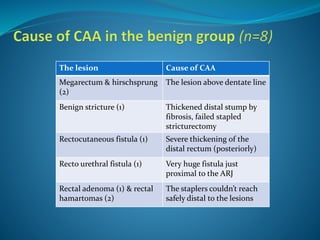
The lesion Cause of CAA
Megarectum & hirschsprung
(2)
The lesion above dentate line
Benign stricture (1) Thickened distal stump by
fibrosis, failed stapled
stricturectomy
Rectocutaneous fistula (1) Severe thickening of the
distal rectum (posteriorly)
Recto urethral fistula (1) Very huge fistula just
proximal to the ARJ
Rectal adenoma (1) & rectal
hamartomas (2)
The staplers couldn’t reach
safely distal to the lesions
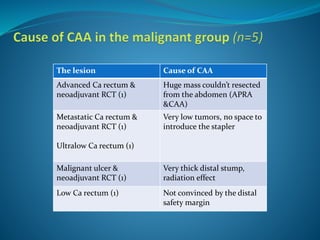
The lesion Cause of CAA
Advanced Ca rectum &
neoadjuvant RCT (1)
Huge mass couldn’t resected
from the abdomen (APRA
&CAA)
Metastatic Ca rectum &
neoadjuvant RCT (1)
Ultralow Ca rectum (1)
Very low tumors, no space to
introduce the stapler
Malignant ulcer &
neoadjuvant RCT (1)
Very thick distal stump,
radiation effect
Low Ca rectum (1) Not convinced by the distal
safety margin
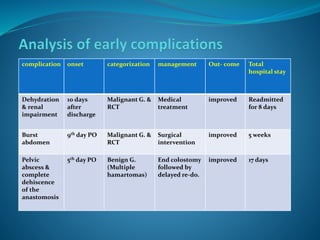
complication onset categorization management Out- come Total
hospital stay
Dehydration
& renal
impairment
10 days
after
discharge
Malignant G. &
RCT
Medical
treatment
improved Readmitted
for 8 days
Burst
abdomen
9th day PO Malignant G. &
RCT
Surgical
intervention
improved 5 weeks
Pelvic
abscess &
complete
dehiscence
of the
anastomosis
5th day PO Benign G.
(Multiple
hamartomas)
End colostomy
followed by
delayed re-do.
improved 17 days
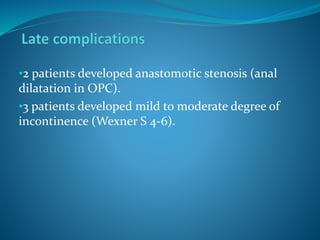
•2 patients developed anastomotic stenosis (anal
dilatation in OPC).
•3 patients developed mild to moderate degree of
incontinence (Wexner S 4-6).
Proctectomy & CAA is
• Not a time consuming.
• safe.
• technically feasible.
• accepted rate of complications.
• good functional outcome.
There is a time intraoperatively that I have to change my
decision from stapled to hand sewn anastomosis
•Extensive fibrosis.
•Extensive radiation effect.
•Failed stapling.
•Narrow pelvis.
•Inadequate distal safety margin.
So we believe that It’s mandatory from
our senior coloproctology surgeons to
train there younger fellows on the
technique of hand sewn coloanal
anastomosis even before being expert
on stapled anastomosis because it
could be the safest solution for many
intraoperative problems.

Coloanal anastomosis presentation (2)

  • 1.
    By Dr/ Mohamed A.Nada Lecturer of General Surgery Ain Shams University
  • 2.
    Coloanal anastomosis pioneeredin the 1970s by Sir Alan Parks had become part of the operations used to preserve peranal defecation after proctectomy. Incidence of leakage zero-18% (Cavaliere et al 1991, Olagne et al 2000, Schmidt et al 2002, Huh et al 2006). Incidence of stenosis 3-15% (Cavaliere et al 1991, Olagne et al 2000, Luna- Perez et al 2003, Baik et al 2005, Huh et al 2006). Incidence of incontinence 4-31% (Benchimol et al 1994, Olagne et al 2000, Baik et al 2005).
  • 3.
    CAA is asavior technique of anastomosis when there is any difficulties while performing low rectal resection anastomosis & unfortunately now a days most CR surgeons (young generation) missed how to do CAA. Aim of the study to evaluate the outcome of coloanal anastomosis in Ain Shams University hospitals at the period 2008-2011.
  • 4.
    •A retrospective analysisof a prospectively collected data. •13 patients had had proctectomy and coloanal anastomosis with defunctioning loop ileostomy. •8 males & 5 females .
  • 5.
    •8 for benignlesions (2 megarectum, 1 rectocutaneous fistula, 1 benign stricture , 1 recto prostatic fistula, 2 patients with multiple hamartomas and one patient with rectal adenoma). •5 patients with low malignant rectal tumor 3 out of them with preoperative RCT. •Median age: 1. Benign group 29 years. 2. Malignant group 45 years.
  • 17.
    The lesion Causeof CAA Megarectum & hirschsprung (2) The lesion above dentate line Benign stricture (1) Thickened distal stump by fibrosis, failed stapled stricturectomy Rectocutaneous fistula (1) Severe thickening of the distal rectum (posteriorly) Recto urethral fistula (1) Very huge fistula just proximal to the ARJ Rectal adenoma (1) & rectal hamartomas (2) The staplers couldn’t reach safely distal to the lesions
  • 18.
    The lesion Causeof CAA Advanced Ca rectum & neoadjuvant RCT (1) Huge mass couldn’t resected from the abdomen (APRA &CAA) Metastatic Ca rectum & neoadjuvant RCT (1) Ultralow Ca rectum (1) Very low tumors, no space to introduce the stapler Malignant ulcer & neoadjuvant RCT (1) Very thick distal stump, radiation effect Low Ca rectum (1) Not convinced by the distal safety margin
  • 19.
    complication onset categorizationmanagement Out- come Total hospital stay Dehydration & renal impairment 10 days after discharge Malignant G. & RCT Medical treatment improved Readmitted for 8 days Burst abdomen 9th day PO Malignant G. & RCT Surgical intervention improved 5 weeks Pelvic abscess & complete dehiscence of the anastomosis 5th day PO Benign G. (Multiple hamartomas) End colostomy followed by delayed re-do. improved 17 days
  • 20.
    •2 patients developedanastomotic stenosis (anal dilatation in OPC). •3 patients developed mild to moderate degree of incontinence (Wexner S 4-6).
  • 21.
    Proctectomy & CAAis • Not a time consuming. • safe. • technically feasible. • accepted rate of complications. • good functional outcome. There is a time intraoperatively that I have to change my decision from stapled to hand sewn anastomosis •Extensive fibrosis. •Extensive radiation effect. •Failed stapling. •Narrow pelvis. •Inadequate distal safety margin.
  • 22.
    So we believethat It’s mandatory from our senior coloproctology surgeons to train there younger fellows on the technique of hand sewn coloanal anastomosis even before being expert on stapled anastomosis because it could be the safest solution for many intraoperative problems.