
LAPAROSCOPY AND NATURAL ORIFICE SURGERY: SAFE PRACTICE MODIFICATION
AuthorsDaniel A. Tsin (1), MDThe Mount Sinai Hospital of Queens, Long Island City, New York, USAMember of the New European Surgical Academy (NESA);Natural Orifice Surgery working group.Andrea Tinelli (2), MDDepartment of Obstetric & Gynecology, Division of Experimental Endoscopic Surgery, Imaging, Technology and Minimally Invasive Therapy, Vito Fazzi Hospital, Lecce, ItalyMember of the New European Surgical Academy (NESA); Natural Orifice Surgery working group.Antonio Malvasi (3), MDDepartment of Obstetric & Gynecology, Santa Maria Hospital, Bari, ItalyMember of the New European Surgical Academy (NESA);Natural Orifice Surgery working group.Fausto Davila (4), MDUniversidad Autonoma de Mexico. Facultad de EstudiosSuperiores. Iztacala, Mexico.Ramiro Jesus (4), MDUniversidad Autonoma de Mexico. Facultad de EstudiosSuperiores. Iztacala, Mexico.Raul Castro –Perez (5), MDHospital Universitario Abel SantamaríaCuadrado. Pinar del Río. Universidad de CienciasMédicas de Pinar del Río, Cuba
None of the currently available entry forms into the abdominal cavity are free of complications.
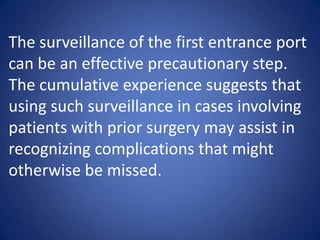
We are sharing information regarding the surveillance of the first entrance port  (FEP) in Laparoscopy , Minilaparoscopy Assisted Natural Orifice Surgery and Natural Orifice TransvaginalEndoscopy Surgery
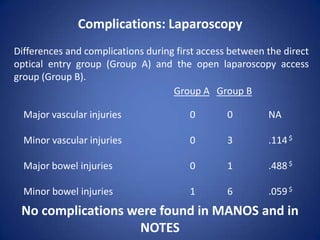
Patients and Methods 168 women with previous abdominal surgery underwent         laparoscopic surgery:  86 were assigned to abdominal DOE (Group A), and
 82 to Open Laparoscopy (OL) (Group B).
 145 patients underwent transvaginalMinilaparoscopy Assisted           Natural Orifice Surgery (hybrid) 3 patients underwent pure natural orifice transvaginal endoscopic surgery (pure). Procedures LAPAROSCOPY
Gynecological Surgeries
 MINILAPAROSCOPY ASSISTED NATURAL ORIFICE SURGERY    (MANOS)Gynecological Surgeries
Appendectomies
Cholecystectomies
 NATURAL ORIFICE TRANSLUMINAL ENDOSCOPIC SURGERY    (NOTES)CholecystectomiesThe laparoscopies were done either by accessing the peritoneal cavity using a Direct Optical Entry (DOE) that employed a bladeless trocar with an optical viewing port (Endopath or Endopath Xcel; Ethicon EndoSurgery, Cincinnati, OH, USA) without previous pneumoperitoneum. (Group A) OR by the open entry method using the Hasson technique (Ethicon Endo-Surgery, Cincinnati, OH, USA) (Group B).
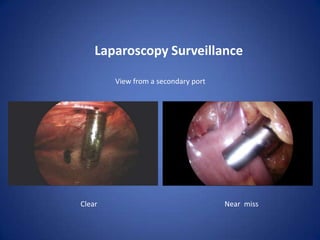
Laparoscopy SurveillanceView from a secondary portClear Near  miss
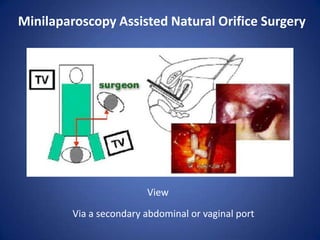
Minilaparoscopy Assisted Natural Orifice Surgery View Via a secondary abdominal or vaginal port
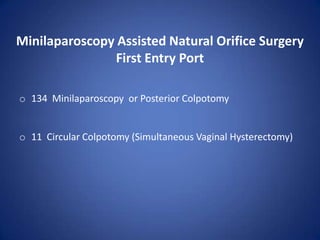
Minilaparoscopy Assisted Natural Orifice Surgery  First Entry Port134  Minilaparoscopy  or Posterior Colpotomy
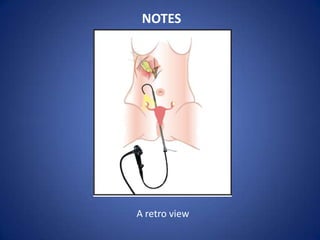
11  Circular Colpotomy (Simultaneous Vaginal Hysterectomy) NOTESA retro view

Laparoscopy and Natural Orifice Surgery: Safe practice Modification

  • 1.
    LAPAROSCOPY AND NATURALORIFICE SURGERY: SAFE PRACTICE MODIFICATION
  • 2.
    AuthorsDaniel A. Tsin(1), MDThe Mount Sinai Hospital of Queens, Long Island City, New York, USAMember of the New European Surgical Academy (NESA);Natural Orifice Surgery working group.Andrea Tinelli (2), MDDepartment of Obstetric & Gynecology, Division of Experimental Endoscopic Surgery, Imaging, Technology and Minimally Invasive Therapy, Vito Fazzi Hospital, Lecce, ItalyMember of the New European Surgical Academy (NESA); Natural Orifice Surgery working group.Antonio Malvasi (3), MDDepartment of Obstetric & Gynecology, Santa Maria Hospital, Bari, ItalyMember of the New European Surgical Academy (NESA);Natural Orifice Surgery working group.Fausto Davila (4), MDUniversidad Autonoma de Mexico. Facultad de EstudiosSuperiores. Iztacala, Mexico.Ramiro Jesus (4), MDUniversidad Autonoma de Mexico. Facultad de EstudiosSuperiores. Iztacala, Mexico.Raul Castro –Perez (5), MDHospital Universitario Abel SantamaríaCuadrado. Pinar del Río. Universidad de CienciasMédicas de Pinar del Río, Cuba
  • 3.
    None of thecurrently available entry forms into the abdominal cavity are free of complications.
  • 4.
    We are sharinginformation regarding the surveillance of the first entrance port (FEP) in Laparoscopy , Minilaparoscopy Assisted Natural Orifice Surgery and Natural Orifice TransvaginalEndoscopy Surgery
  • 5.
    Patients and Methods168 women with previous abdominal surgery underwent laparoscopic surgery: 86 were assigned to abdominal DOE (Group A), and
  • 6.
    82 toOpen Laparoscopy (OL) (Group B).
  • 7.
    145 patientsunderwent transvaginalMinilaparoscopy Assisted Natural Orifice Surgery (hybrid) 3 patients underwent pure natural orifice transvaginal endoscopic surgery (pure). Procedures LAPAROSCOPY
  • 8.
  • 9.
    MINILAPAROSCOPY ASSISTEDNATURAL ORIFICE SURGERY (MANOS)Gynecological Surgeries
  • 10.
  • 11.
  • 12.
    NATURAL ORIFICETRANSLUMINAL ENDOSCOPIC SURGERY (NOTES)CholecystectomiesThe laparoscopies were done either by accessing the peritoneal cavity using a Direct Optical Entry (DOE) that employed a bladeless trocar with an optical viewing port (Endopath or Endopath Xcel; Ethicon EndoSurgery, Cincinnati, OH, USA) without previous pneumoperitoneum. (Group A) OR by the open entry method using the Hasson technique (Ethicon Endo-Surgery, Cincinnati, OH, USA) (Group B).
  • 13.
    Laparoscopy SurveillanceView froma secondary portClear Near miss
  • 14.
    Minilaparoscopy Assisted NaturalOrifice Surgery View Via a secondary abdominal or vaginal port
  • 15.
    Minilaparoscopy Assisted NaturalOrifice Surgery First Entry Port134 Minilaparoscopy or Posterior Colpotomy
  • 16.
    11 CircularColpotomy (Simultaneous Vaginal Hysterectomy) NOTESA retro view