NOTES
        Dr.Kamran Yousaf
        Meeqat Gen Hospital
        Madinah Munawwarah


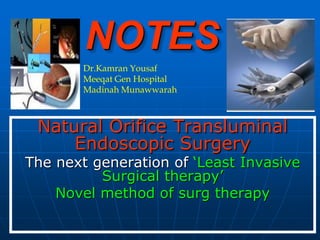
 Natural Orifice Transluminal
     Endoscopic Surgery
The next generation of ‘Least Invasive
          Surgical therapy’
    Novel method of surg therapy
NOTES
   Scarless abd surgery
   Emerging field-GI surg & Interven
    Gastroentrologists
   Evolving rapidly
   Presenting limitless possibilities for
    innovation,tech & device development
   May revolutionize the surgical approach
   Proponents,Researchers believe it may
    well be the next Paradigm shift in surg as
    was laparoscopy in 80’s,90’s
SURGEONS WITHOUT
     SCALPEL
NOTES: DEFINITION
   An experimental surg
    tech,scarless abd
    operation,performed by
    introducing a multi-channeled
    endoscope thru a natural
    orifice(mouth,vagina,urethra,
    anus),puncturing the hollow
    viscus & doing a diag or
    therapeutic procedure.
NOTES:A STEP FORWARD
   emerging surgical
    approach 
    ‘viewed as a step
    forward’
             utilize the
    body’s natural
    openings.
History in the making????
NOTES
   Latest craze among todays
    surgeons.
   Highest level of minimal invasiveness.
   Can be ‘Future of Surgery’
           -Minimal invasive surgery

            -Least invasive surgery
   SILS,,,,,NOTES
NOTES: HISTORY
   That endoscopy can be used
    to do procedures beyond the
    wall of the GIT was known
    since 1980 when the first
    transluminal feeding
    gastrostomy was described by
    Gauderer et al.
NOTES: HISTORY
   Kozarek et al. reported first of
    successful endoscopic drainage of
    pancreatic pseudocyst in 1985.

   The first report of oral
    peritoneoscopy done in animals
    was published by Kalloo et al. in
    2004,John Hopkins,US
NOTES: HISTORY
   In September 2007,
    Novare announced
    the successful
    completion of the first
    NOTES gallbladder removal (TV) procedures.
   2007-Bessler et all,Marescaeux et all,,TV chol
   Same year,Swanstrom,colleagues reported TG chole
    as well
   2008,,TV donor kidney extraction done in John
    Hopkins
NOTES: HISTORY
 •In March 2008, Dr Ricardo
  Zorron, of Brazil,
  performed the first series
  of NOTES cholecystectomy
  on four patients via
  transvaginal route.
NOTES:


   Transgastric appendectomy in
    humans in India By Dr. G V Rao
    and Dr. N Reddy. (Hyderabad,
    India),,,2007
NOTES:
   Famous bollywood actress
    ‘Shilpa Shetty’ and
    south Indian actress ‘Khusboo’
    have recently undergone
    transgastric appendicectomy.
NOTES: HISTORY
   Since then, multiple investigators
    have used transluminal endoscopy
    in animal models to perform various
    intraperitoneal surgical procedures,
    ranging from tubal ligation to
    splenectomy,oophorectomy,nephrect
    omy,Gastro-jej etc

       NOTES:
    Abd cavity access thru natural
                                   The technique

    route,mouth,vagina,urethra,anus
   An adv endoscope with multiple channels is pushed
    thru
   Hollow viscus is punctured from inside
   Periton insufflation is done to have wide working
    space
   Conventional laparoscopic instruments are
    advanced thru edosc for dissection
   Principles of safe access are,,,,minimal tissue
    inj,,,good exposure,,,safety to avoid
    vascular/visceral inj,,,maintain seal & manipulate
    instruments
   ???Hybrid NOTES

     NOTES: WHY???
   Basic human nature to keep on
   experimenting/research to improve the
   qualityof life
 To get the max from mini

 Ultimate goal of med prof

  is Patients welfare
 Advantages associated with

   NOTES are numerous like
         Less physiolog insult
 No question of pain
NOTES:                  Why?Advantages
   Less hospital stay
   Less resources
   Bed occupancy,rapid turn over
   Early return to work
   NOTES can be done as an
    outpatient
   Conscious sedation instead of
    Gen Anaesth
    Cosmetic result is un-matched as no incision
NOTES: ADVANTAGES
 No wound,no infection
 No infection,no incisional hernia

 Minimal chance for intra-abd adhesions

 No post op intest obs

 Ideal for any surgery

  on ICU patients
 Last but not the least

  More public/pt
   satisfaction
NOTES: THE CONCEPT
   NOTES - safe and feasible

           - same efficacy

       as traditional laparoscopic
    procedures.
NOTES: INSTRUMENTS
NOTES: INSTRUMENTS
NOTES: INSTRUMENTS
NOTES: INSTRUMENTS
NOTES
   Result of active cooperation
    between minimally invasive
    surgeons and interventional
    gastroenterologists.
NOTES

   Internal incision is over stomach,
    vagina, bladder or colon, thus
    completely avoiding any external
    incisions or scars.
INTERNAL INCISION
NOTES
   Continued evolution of flexible
    endoscopy  +  Growing awareness
    about invasiveness of surgery having
    impact on patient outcomes
                    Lead to
    Endoscopy and Surgery - working
    together as   NOTES
NOTES: ROUTES
   NOTES has been
    mostly practised
    on animals, for diagnosis
    and treatments, including
    transgastric organ
    removal.
NOTES: ROUTES
DEMONSTRATING

TRANSGASTRIC
    ROUTE
DEMONSTRATING

TRANSVAGINAL
    ROUTE
NOTES: ROUTES
   Acc. To some transvesical and
    transcolonic approaches- more suited to
    access upper abdominal structures,
    which are often more difficult to work
    with if using a transgastric approach.
NOTES: ROUTES
   Transvaginal access appears to
    be the safest and most
    feasible.


   potentially less complications,
    but only possible in women.
PROCEDURES DESCRIBED
            TILL NOW
   Laboratory reports
    Cholecystectomy, Splenectomy,
    Tubal ligation, Gastrojejunostomy,
    Pyloroplasty,
    Staging peritoneoscopy, Liver biopsy,
    Distal pancreatectomy,
    Ventral hernia repair,
    Gastric sleeve resection,
    Colectomy (right and left)
PROCEDURES DESCRIBED
          TILL NOW
   Human cases
    TG- appendectomy,
    TV- cholecystectomy,
    TG- cholecystectomy,
    TG- gastro-enterostomy,
    Cancer staging.
FIRST ‘NOTES’

(TRANS-VAGINAL)

CHOLECYSTECTOMY
NOTES: The Way Forward
   NOSCAR
   Regulates progress of NOTES
   NOTES necessitates surg skills,endosc skills
    & ability to manage complications
   NOTES expertise,,,Dlilgent lab work-
    systematized training models-judicious
    clinical trials,,,,stepwise approach
   Instituitional training & fellowship in NOTES
   Research engineers focus Comptr assissted
    3D image system
   Routine clinical Application-long way-steady
NOTES: The Way Forward
   Advance technolog develop in
    progress,substantial refinement
   A spate of new instruments
    more suitable,flexible
   Time may come when NOTES
    may well become the order of the
    day.
   FUTURE OF SURGERY???
NOTES: The Way Forward
The medical fraternity & Gen public has
 captivated the idea of NOTES-scarless
 abd surgery,with great enthusiasm &
 interest
          BUT
                  For us,the patients
 safety & welfare is of paramount
 importance,not the advancement of
 NOTES,,,,,no ground for over-exitement
NOTES:Current Challenge
            Change is part of
             surgery but it is
             never easy to
             accept.
            A lot of
             sceptisism,undoubt
             ed interest as well
NOTES:Current Challenge
   At the dawn of surgery, excellence of
    a surgeon was associated with big
    incisions:


       "Big scar, big surgeon”.
NOTES:Current Challenge
   1882- open chole

   1985- first laparoscopic chole-- strongly
    criticized.

   1992- lap chole- declared tmt of choice
    for GB-stones.
   SILS,,,,,New dimention,,,step towards
    NOTES,,,,
NOTES:Current Challenge
   But now with NOTES moving one
    step further: philosophy of surgery
    will be dramatically changed, as
    surgical trauma & associated pain -
    physical barrier for surgery.
NOTES Questions???
   What are the infectious complications?
   How reliable is the organ
    Closure?
   How practical is viscerot?
    contravenes surg dogma.
   How good are instruments
   Ethics/Acceptability
   Cogent answers needed
NOTES:Hurdles-Problems
   Presently NOTES cases being reported
    anecdotally
   Inadequate instruments,organ closure
   Ethical/Moral issues
   Lack of instituitional training & supervision
   One of basic tenets of Lap surg is tringulation
    of Optics & Instruments,,,,lost in NOTES result
    is partial loss of spatial orientation & depth
    perception.
   Who is Who?Dilema of speciality?
NOTES

   witnessing a true remarkable shift in
    their lifetime i.e. Natural Orifice
    Transluminal Endoscopic
    Surgery (NOTES).
Notes presentation

Notes presentation

  • 1.
    NOTES Dr.Kamran Yousaf Meeqat Gen Hospital Madinah Munawwarah Natural Orifice Transluminal Endoscopic Surgery The next generation of ‘Least Invasive Surgical therapy’ Novel method of surg therapy
  • 2.
    NOTES  Scarless abd surgery  Emerging field-GI surg & Interven Gastroentrologists  Evolving rapidly  Presenting limitless possibilities for innovation,tech & device development  May revolutionize the surgical approach  Proponents,Researchers believe it may well be the next Paradigm shift in surg as was laparoscopy in 80’s,90’s
  • 3.
  • 4.
    NOTES: DEFINITION  An experimental surg tech,scarless abd operation,performed by introducing a multi-channeled endoscope thru a natural orifice(mouth,vagina,urethra, anus),puncturing the hollow viscus & doing a diag or therapeutic procedure.
  • 5.
    NOTES:A STEP FORWARD  emerging surgical approach  ‘viewed as a step forward’ utilize the body’s natural openings. History in the making????
  • 6.
    NOTES  Latest craze among todays surgeons.  Highest level of minimal invasiveness.  Can be ‘Future of Surgery’ -Minimal invasive surgery -Least invasive surgery  SILS,,,,,NOTES
  • 7.
    NOTES: HISTORY  That endoscopy can be used to do procedures beyond the wall of the GIT was known since 1980 when the first transluminal feeding gastrostomy was described by Gauderer et al.
  • 8.
    NOTES: HISTORY  Kozarek et al. reported first of successful endoscopic drainage of pancreatic pseudocyst in 1985.  The first report of oral peritoneoscopy done in animals was published by Kalloo et al. in 2004,John Hopkins,US
  • 9.
    NOTES: HISTORY  In September 2007, Novare announced the successful completion of the first NOTES gallbladder removal (TV) procedures.  2007-Bessler et all,Marescaeux et all,,TV chol  Same year,Swanstrom,colleagues reported TG chole as well  2008,,TV donor kidney extraction done in John Hopkins
  • 10.
    NOTES: HISTORY •InMarch 2008, Dr Ricardo Zorron, of Brazil, performed the first series of NOTES cholecystectomy on four patients via transvaginal route.
  • 11.
    NOTES:  Transgastric appendectomy in humans in India By Dr. G V Rao and Dr. N Reddy. (Hyderabad, India),,,2007
  • 12.
    NOTES:  Famous bollywood actress ‘Shilpa Shetty’ and south Indian actress ‘Khusboo’ have recently undergone transgastric appendicectomy.
  • 13.
    NOTES: HISTORY  Since then, multiple investigators have used transluminal endoscopy in animal models to perform various intraperitoneal surgical procedures, ranging from tubal ligation to splenectomy,oophorectomy,nephrect omy,Gastro-jej etc
  • 14.
    NOTES: Abd cavity access thru natural The technique route,mouth,vagina,urethra,anus  An adv endoscope with multiple channels is pushed thru  Hollow viscus is punctured from inside  Periton insufflation is done to have wide working space  Conventional laparoscopic instruments are advanced thru edosc for dissection  Principles of safe access are,,,,minimal tissue inj,,,good exposure,,,safety to avoid vascular/visceral inj,,,maintain seal & manipulate instruments  ???Hybrid NOTES
  • 15.
    NOTES: WHY??? Basic human nature to keep on experimenting/research to improve the qualityof life  To get the max from mini  Ultimate goal of med prof is Patients welfare  Advantages associated with NOTES are numerous like  Less physiolog insult  No question of pain
  • 16.
    NOTES: Why?Advantages  Less hospital stay  Less resources  Bed occupancy,rapid turn over  Early return to work  NOTES can be done as an outpatient  Conscious sedation instead of Gen Anaesth  Cosmetic result is un-matched as no incision
  • 17.
    NOTES: ADVANTAGES  Nowound,no infection  No infection,no incisional hernia  Minimal chance for intra-abd adhesions  No post op intest obs  Ideal for any surgery on ICU patients  Last but not the least More public/pt satisfaction
  • 18.
    NOTES: THE CONCEPT  NOTES - safe and feasible - same efficacy as traditional laparoscopic procedures.
  • 19.
  • 20.
  • 21.
  • 22.
  • 24.
    NOTES  Result of active cooperation between minimally invasive surgeons and interventional gastroenterologists.
  • 27.
    NOTES  Internal incision is over stomach, vagina, bladder or colon, thus completely avoiding any external incisions or scars.
  • 28.
  • 31.
    NOTES  Continued evolution of flexible endoscopy + Growing awareness about invasiveness of surgery having impact on patient outcomes Lead to Endoscopy and Surgery - working together as NOTES
  • 32.
    NOTES: ROUTES  NOTES has been mostly practised on animals, for diagnosis and treatments, including transgastric organ removal.
  • 33.
  • 34.
  • 38.
  • 41.
    NOTES: ROUTES  Acc. To some transvesical and transcolonic approaches- more suited to access upper abdominal structures, which are often more difficult to work with if using a transgastric approach.
  • 42.
    NOTES: ROUTES  Transvaginal access appears to be the safest and most feasible.  potentially less complications, but only possible in women.
  • 43.
    PROCEDURES DESCRIBED TILL NOW  Laboratory reports Cholecystectomy, Splenectomy, Tubal ligation, Gastrojejunostomy, Pyloroplasty, Staging peritoneoscopy, Liver biopsy, Distal pancreatectomy, Ventral hernia repair, Gastric sleeve resection, Colectomy (right and left)
  • 44.
    PROCEDURES DESCRIBED TILL NOW  Human cases TG- appendectomy, TV- cholecystectomy, TG- cholecystectomy, TG- gastro-enterostomy, Cancer staging.
  • 46.
  • 48.
    NOTES: The WayForward  NOSCAR  Regulates progress of NOTES  NOTES necessitates surg skills,endosc skills & ability to manage complications  NOTES expertise,,,Dlilgent lab work- systematized training models-judicious clinical trials,,,,stepwise approach  Instituitional training & fellowship in NOTES  Research engineers focus Comptr assissted 3D image system  Routine clinical Application-long way-steady
  • 49.
    NOTES: The WayForward  Advance technolog develop in progress,substantial refinement  A spate of new instruments more suitable,flexible  Time may come when NOTES may well become the order of the day.  FUTURE OF SURGERY???
  • 50.
    NOTES: The WayForward The medical fraternity & Gen public has captivated the idea of NOTES-scarless abd surgery,with great enthusiasm & interest BUT For us,the patients safety & welfare is of paramount importance,not the advancement of NOTES,,,,,no ground for over-exitement
  • 51.
    NOTES:Current Challenge  Change is part of surgery but it is never easy to accept.  A lot of sceptisism,undoubt ed interest as well
  • 52.
    NOTES:Current Challenge  At the dawn of surgery, excellence of a surgeon was associated with big incisions: "Big scar, big surgeon”.
  • 53.
    NOTES:Current Challenge  1882- open chole  1985- first laparoscopic chole-- strongly criticized.  1992- lap chole- declared tmt of choice for GB-stones.  SILS,,,,,New dimention,,,step towards NOTES,,,,
  • 54.
    NOTES:Current Challenge  But now with NOTES moving one step further: philosophy of surgery will be dramatically changed, as surgical trauma & associated pain - physical barrier for surgery.
  • 55.
    NOTES Questions???  What are the infectious complications?  How reliable is the organ Closure?  How practical is viscerot? contravenes surg dogma.  How good are instruments  Ethics/Acceptability  Cogent answers needed
  • 56.
    NOTES:Hurdles-Problems  Presently NOTES cases being reported anecdotally  Inadequate instruments,organ closure  Ethical/Moral issues  Lack of instituitional training & supervision  One of basic tenets of Lap surg is tringulation of Optics & Instruments,,,,lost in NOTES result is partial loss of spatial orientation & depth perception.  Who is Who?Dilema of speciality?
  • 57.
    NOTES  witnessing a true remarkable shift in their lifetime i.e. Natural Orifice Transluminal Endoscopic Surgery (NOTES).