Chapter 14:
Organic Compounds
Principles of Science II
This lecture will help you understand:
• Organic Chemistry
• Hydrocarbons
• Unsaturated Hydrocarbons
• Functional Groups
• Alcohols, Phenols, and Ethers
• Amines and Alkaloids
• Carbonyl Compounds
• Polymers
Organic Chemistry
• Organic chemistry is the branch of chemistry that
involves the study of carbon-containing chemical
compounds.
• An organic compound is a carbon-containing
chemical compound.
– More than 13 million organic compounds are
known.
• Carbon atoms connect with one another through
strong and stable covalent bonds.
Organic Chemistry
Organic Chemistry
• Carbon atoms also readily form bonds with many
other types of atoms. This provides for a nearly
infinite number of different kinds of organic
compounds.
• A hydrocarbon is a chemical compound that
contains only hydrogen and carbon.
Hydrocarbons
• Structural isomers are molecules that have the
same molecular formula but different configurations.
Hydrocarbons
• A configuration is the specific way in which the atoms of
a molecule are connected to one another.
"configuration" = "connectivity“
• Conformation is the spatial orientation of a single
configuration.
Hydrocarbons
C7H16
C8H18
C10H22
C20H42
C6H14
C5H12
9
18
75
366,319
5
3
Formula
Number of
possible
isomers
Hydrocarbons
• A schematic for the fractional distillation of petroleum into
useful hydrocarbon components
A hydrocarbon, such as heptane, can be ignited from the
heat generator as gasoline is compressed by a piston-
before a spark plug fires. This upsets the timing of the
engine cycle, giving rise to a knock sound.
Branched hydrocarbons, such as isooctane, burn less
readily and are ignited not by compression alone but
only when the spark plug fires.
Octane ratings are posted on gasoline pumps. The
engines of modern cars are designed to run best on
87 octane grade fuel.
• Carbon always forms four bonds.
Unsaturated Hydrocarbons
• Some of carbon's four bonds, however, may be
within multiple bonds.
Unsaturated Hydrocarbons
• An unsaturated hydrocarbon is a hydrocarbon that
contains one or more multiple bonds.
– A special case of an unsaturated hydrocarbon is
the benzene ring.
Unsaturated Hydrocarbons
• A heteroatom is any atom other than hydrogen or
carbon in an organic molecule.
• A functional group is a combination of carbon,
hydrogen, and heteroatoms that behave as a single
unit.
– Organic molecules are classified by the functional
groups they contain.
Functional Groups
Functional
Groups
Alcohols, Phenols, and Ethers
Hydroxyl group
• Alcohols contain the hydroxyl group.
Alcohols, Phenols, and Ethers
Methanol
(bp 65°C)
Ethanol
(bp 78°C)
2-Propanol
(bp 97°C)
Alcohols, Phenols, and Ethers
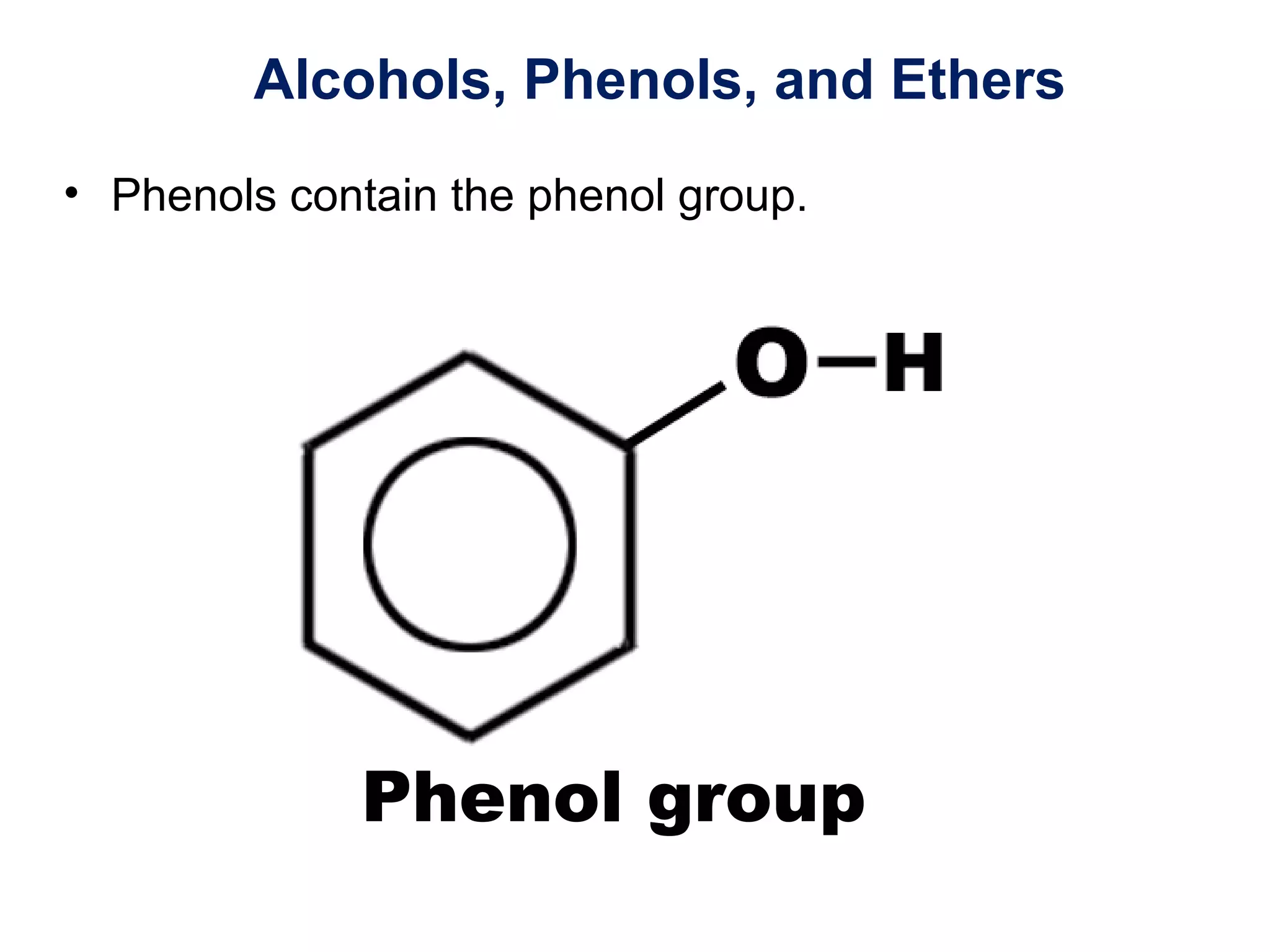
• Phenols contain the phenol group.
Phenol group
Alcohols, Phenols, and Ethers
• Ethers contain the ether group, an oxygen atom
bonded to two carbon atoms.
Ether group
Alcohols, Phenols, and Ethers
Dimethyl ether
(bp −25°C)
Diethyl ether
Amines and Alkaloids
• Amines form alkaline solutions.
Amine group
Alcohols, Phenols, and Ethers
Ethyl amine
Hydroxide
ion
Alcohols, Phenols, and Ethers
Caffeine
Phosphoric
acid
Caffeine
salt
Water
soluble
Carbonyl Compounds
• A carbonyl is a carbon atom double bonded to an
oxygen atom.
Carbonyl
Carbonyl Compounds
Ketone
group
Aldehyde
group
Carbonyl Compounds
Acetone Acetaldehyde
Carbonyl Compounds
Cinnamonaldehyde Benzaldehyde
Vanillin
Carbonyl Compounds
Amide
group
Carbonyl Compounds
N,N-Diethyl-m-toluamide
DEET
Carbonyl Compounds
Carboxyl
group
Carbonyl Compounds
Salicylic acid Acetylsalicylic acid
Aspirin
Carbonyl Compounds
Ester
group
Carbonyl Compounds
Salicylic acid
H2SO4
CH3OH
Methyl salicylate
(wintergreen)
Carbonyl Compounds
Penicillin
• A polymer is a very long organic molecule made by
the joining together of smaller organic molecule
units known as monomers.
MonomerMonomer MonomerMonomer MonomerMonomer MonomerMonomer
Polymers
H
C C
H
H
C C
H
H H
H H
H
C C
H
H H
H
C C
H
H H
C
H
H
H
C
H
Polymers
• An addition polymer is a polymer whose mass is
equal to the sum of the masses of the monomer
units.
H
C C
H
H
C C
H
H H
H H
H
C C
H
H H
H
C C
H
H H
C
H
H
H
C
H
Ethylene Ethylene Ethylene Ethylene EthyleneEthylene
Polyethylene
C
H
H
C
H
H
Polymers
Polypropylene
C
H
C C
H
H
C C
H H
H
H
C C
H
H CH3
C C
H H
H
C
H H
HCH3 CH3 CH3 CH3
Propylene Propylene Propylene Propylene Propylene Propylene
H
C
H
C
H
CH3
Polymers
Polymers
• A condensation polymer is a polymer formed when
the joining of monomer units is accompanied by the
loss of a small molecule, such as water.
Polymers
Polymers
• Many of the natural product
molecules synthesized by plants are
formed by the joining together of
isoprene monomers via an addition
polymerization. A good example is
the flavoring molecule citral, which is
made of two isoprene units. Find
and circle these units in the structure
shown to the right.
Isoprene
(2-methyl-1,3-butadiene) Citral
Polymers
• Many of the natural product
molecules synthesized by plants are
formed by the joining together of
isoprene monomers via an addition
polymerization. A good example is
the flavoring molecule citral, which is
made of two isoprene units. Find
and circle these units in the structure
shown to the right.
Citral
Polymers
Isoprene
(2-methyl-1,3-butadiene)
• Beta-carotene is a natural addition polymer made of
eight isoprene units. Find and circle these units in
the structure shown below.
Beta-carotene
Isoprene
(2-methyl-1,3-butadiene)
Polymers
Isoprene
(2-methyl-1,3-butadiene)
Beta-carotene
Polymers
• Beta-carotene is a natural addition polymer made of
eight isoprene units. Find and circle these units in
the structure shown below.
Chapter 14 organic compounds

Chapter 14 organic compounds

Editor's Notes

  • #5 Unnumbered Figure Page 377
  • #12 Figure 14.4a
  • #13 Figure 14.4b
  • #14 Figure 14.5
  • #21 Unnumbered Figure Page 384
  • #24 Unnumbered Figure Page 386
  • #27 Unnumbered Figure Page 387
  • #31 Unnumbered Figure Page 388
  • #34 Unnumbered Figure 1 Page 390
  • #35 Unnumbered Figure 2 Page 390
  • #40 Unnumbered Figure 2 Page 391
  • #43 Unnumbered Figure 3 Page 391
  • #47 Unnumbered Figure 1 Page 393
  • #48 Table 14.1
  • #60 Table 14.5