1Department of
Pharmacy
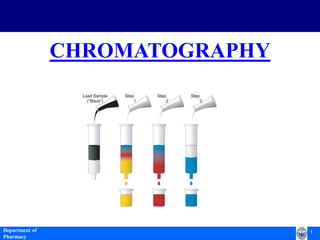
CHROMATOGRAPHY
2Department of
Pharmacy
Outcomes
 Understand the classifications of Chromatographic
methods.
 Understand the method of the different chromatographic
method and the techniques used.
 Characterization of plant constituents after purification
will be discussed.
3Department of
Pharmacy
The different Classifications of Chromatographic methods
are:
1. Column Chromatography
2. Thin-layer Chromatography
3. Paper Chromatography
4. Gas Chromatography
5. High Performance Liquid Chromatography
Chromatography
4Department of
Pharmacy
When the adsorption or partition chromatographic separations are
carried out on a column of adsorbents packed in a glass or
metallic tube.
Column Chromatography
5Department of
Pharmacy
Adsorption Column Chromatography:
The powdered adsorbent is packed in a glass or metallic tube to make a
column and an organic liquid is used to develop it.
The solid adsorbent acts as the stationary phase.
The organic liquid acts as the mobile phase.
Partition Column Chromatography:
A liquid is used as the stationary phase and another liquid, usually an
organic solvent, is used as the mobile phase.
The liquid stationary phase is thoroughly mixed with the a normal
adsorbent, then packed in a glass or metal tube.
Column Chromatography
6Department of
Pharmacy
TLC is an adsorption chromatographic technique in which the
adsorbent, acting as a stationary phase, is coated on a glass slab or
plastic sheet in the form of a uniform thin layer.
Thin Layer Chromatography (TLC) is now one of the most popular
and widely used separation techniques.
Advantages are:
•Ease of operation
•Wide application to a great number of different samples
•High sensitivity
•Higher speed of separation
•Relatively low cost
Thin Layer Chromatography
7Department of
Pharmacy
The separated compounds can be located in a number of ways as
follows:
•By examining the chromatogram in day light for any colored spot.
•By exposing the chromatogram under ultra-violet light for any
florescent spot.
•By spraying the chromatogram with a suitable spray reagent for
converting the separated compounds into colored spots.
Thin Layer Chromatography
8Department of
Pharmacy
Paper Chromatography
Paper Chromatography is a simple and efficient reparative technique
and has a wide applicability like TLC.
In this technique, the separation of the mixtures is accomplished on a
filter paper strip which acts as the support medium on which the
solution of the mixture is applied.
Partition chromatographic technique is used
in this method.
During chromatography on filter paper,
separation of mixtures of substances is
affected by continuous partition between
the liquid mobile phase flowing along the
paper and the water held in the paper which
acts as the stationary phase.
9Department of
Pharmacy
Gas Chromatography
Gas Chromatography includes all those chromatographic processes in
which a solid or a liquid coated on a solid support is used as the stationary
phase and a gas is used as the mobile phase.
In the gas chromatographic technique, the components of the mixture to
be separated are dissolved in a suitable organic solvent and placed on top
of the column of the stationary phase by an injection device.
They are then carried or transported through the stationary phase in the
gaseous or vapour form.
Thus this method can be used to separate only those substances, which
can be vaporised at the operating temperatures.
10Department of
Pharmacy
Gas Chromatography
Based on the principle of separation and the type of the stationary phase
the Gas chromatographic techniques can be broadly divided into two as
follows:
1. Gas-solid Chromatography (GSC) or Adsorption Gas chromatography,
where a solid (usually an adsorbent) is used as the stationary phase
and a neutral gas as the mobile phase.
2. Gas-Liquid Chromatography (GLC) or Partition Gas Chromatography,
where a liquid, coated on an inert support, is used as the stationary
phase and an inert gas as the mobile phase.
11Department of
Pharmacy
High Performance Liquid Chromatography
High performance liquid chromatography or High-pressure liquid
chromatography or simply HPLC is a kind of sophisticated and mechanized
column chromatography that can also be used both as an adsorption and
partition chromatography.
HPLC gives much improved and more rapid separation than classical column
chromatography
12Department of
Pharmacy
Process of analysis of plant constituents
Why?: To obtain the plant active constituents in pure form
Analysis involves a number of successive processes:
Extraction of the plant material
Separation and isolation of the constituents of interest
Purification
Characterization & identification of the isolated compounds & their
quantification
13Department of
Pharmacy
Characterization Of Plant Constituents
 Characterization and identification of the separated and isolated
constituents are the final steps in the phytochemical analysis of the
plant.
 Plant constituents must be obtained in a very pure form.
 The purification processes include:
• Repeated column chromatography
• Preparative Thin layer and paper chromatography
 These pure compounds are then further purified by repeated
crystallization from suitable solvents or solvent mixtures.
14Department of
Pharmacy
 A pure compound thus obtained is characterised and identified by
determining its various physical and chemical properties like
• Rf value,
• melting point
• optical values
• nature and type of crystals
• Types and number of elements and fucntional groups
present in the molecule
 Determination of these various physio-chemical properties of a
chemical compound is done by the use of different chemical tests and
reactions, chromatographic techniques, crystallographic and
spectroscopic methods, etc.
Characterization Of Plant Constituents
15Department of
Pharmacy
That’s all for today

chromatography

  • 1.
  • 2.
    2Department of Pharmacy Outcomes  Understandthe classifications of Chromatographic methods.  Understand the method of the different chromatographic method and the techniques used.  Characterization of plant constituents after purification will be discussed.
  • 3.
    3Department of Pharmacy The differentClassifications of Chromatographic methods are: 1. Column Chromatography 2. Thin-layer Chromatography 3. Paper Chromatography 4. Gas Chromatography 5. High Performance Liquid Chromatography Chromatography
  • 4.
    4Department of Pharmacy When theadsorption or partition chromatographic separations are carried out on a column of adsorbents packed in a glass or metallic tube. Column Chromatography
  • 5.
    5Department of Pharmacy Adsorption ColumnChromatography: The powdered adsorbent is packed in a glass or metallic tube to make a column and an organic liquid is used to develop it. The solid adsorbent acts as the stationary phase. The organic liquid acts as the mobile phase. Partition Column Chromatography: A liquid is used as the stationary phase and another liquid, usually an organic solvent, is used as the mobile phase. The liquid stationary phase is thoroughly mixed with the a normal adsorbent, then packed in a glass or metal tube. Column Chromatography
  • 6.
    6Department of Pharmacy TLC isan adsorption chromatographic technique in which the adsorbent, acting as a stationary phase, is coated on a glass slab or plastic sheet in the form of a uniform thin layer. Thin Layer Chromatography (TLC) is now one of the most popular and widely used separation techniques. Advantages are: •Ease of operation •Wide application to a great number of different samples •High sensitivity •Higher speed of separation •Relatively low cost Thin Layer Chromatography
  • 7.
    7Department of Pharmacy The separatedcompounds can be located in a number of ways as follows: •By examining the chromatogram in day light for any colored spot. •By exposing the chromatogram under ultra-violet light for any florescent spot. •By spraying the chromatogram with a suitable spray reagent for converting the separated compounds into colored spots. Thin Layer Chromatography
  • 8.
    8Department of Pharmacy Paper Chromatography PaperChromatography is a simple and efficient reparative technique and has a wide applicability like TLC. In this technique, the separation of the mixtures is accomplished on a filter paper strip which acts as the support medium on which the solution of the mixture is applied. Partition chromatographic technique is used in this method. During chromatography on filter paper, separation of mixtures of substances is affected by continuous partition between the liquid mobile phase flowing along the paper and the water held in the paper which acts as the stationary phase.
  • 9.
    9Department of Pharmacy Gas Chromatography GasChromatography includes all those chromatographic processes in which a solid or a liquid coated on a solid support is used as the stationary phase and a gas is used as the mobile phase. In the gas chromatographic technique, the components of the mixture to be separated are dissolved in a suitable organic solvent and placed on top of the column of the stationary phase by an injection device. They are then carried or transported through the stationary phase in the gaseous or vapour form. Thus this method can be used to separate only those substances, which can be vaporised at the operating temperatures.
  • 10.
    10Department of Pharmacy Gas Chromatography Basedon the principle of separation and the type of the stationary phase the Gas chromatographic techniques can be broadly divided into two as follows: 1. Gas-solid Chromatography (GSC) or Adsorption Gas chromatography, where a solid (usually an adsorbent) is used as the stationary phase and a neutral gas as the mobile phase. 2. Gas-Liquid Chromatography (GLC) or Partition Gas Chromatography, where a liquid, coated on an inert support, is used as the stationary phase and an inert gas as the mobile phase.
  • 11.
    11Department of Pharmacy High PerformanceLiquid Chromatography High performance liquid chromatography or High-pressure liquid chromatography or simply HPLC is a kind of sophisticated and mechanized column chromatography that can also be used both as an adsorption and partition chromatography. HPLC gives much improved and more rapid separation than classical column chromatography
  • 12.
    12Department of Pharmacy Process ofanalysis of plant constituents Why?: To obtain the plant active constituents in pure form Analysis involves a number of successive processes: Extraction of the plant material Separation and isolation of the constituents of interest Purification Characterization & identification of the isolated compounds & their quantification
  • 13.
    13Department of Pharmacy Characterization OfPlant Constituents  Characterization and identification of the separated and isolated constituents are the final steps in the phytochemical analysis of the plant.  Plant constituents must be obtained in a very pure form.  The purification processes include: • Repeated column chromatography • Preparative Thin layer and paper chromatography  These pure compounds are then further purified by repeated crystallization from suitable solvents or solvent mixtures.
  • 14.
    14Department of Pharmacy  Apure compound thus obtained is characterised and identified by determining its various physical and chemical properties like • Rf value, • melting point • optical values • nature and type of crystals • Types and number of elements and fucntional groups present in the molecule  Determination of these various physio-chemical properties of a chemical compound is done by the use of different chemical tests and reactions, chromatographic techniques, crystallographic and spectroscopic methods, etc. Characterization Of Plant Constituents
  • 15.