Assessment in Action:
Academic Libraries &
Student Success
CRITICAL THINKING & INFORMATION LITERACY
Poster Presentation: American Library Association Annual Conference, San Francisco, 2015 Sherry Tinerella
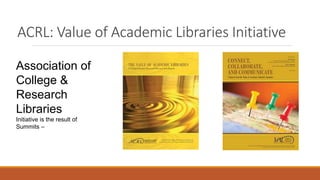
ACRL: Value of Academic Libraries Initiative
Association of
College &
Research
Libraries
Initiative is the result of
Summits –
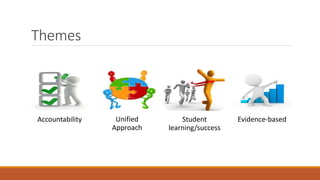
Themes
Accountability Unified
Approach
Student
learning/success
Evidence-based
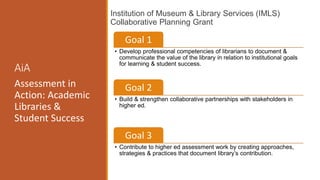
AiA
Institution of Museum & Library Services (IMLS)
Collaborative Planning Grant
Assessment in
Action: Academic
Libraries &
Student Success
Goal 1
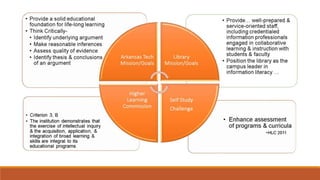
• Develop professional competencies of librarians to document &
communicate the value of the library in relation to institutional goals
for learning & student success.
Goal 2
• Build & strengthen collaborative partnerships with stakeholders in
higher ed.
Goal 3
• Contribute to higher ed assessment work by creating approaches,
strategies & practices that document library’s contribution.
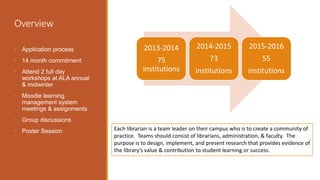
Overview
2013-2014
75
institutions
2014-2015
73
institutions
2015-2016
55
institutions
• Application process
• 14 month commitment
• Attend 2 full day
workshops at ALA annual
& midwinter
• Moodle learning
management system
meetings & assignments
• Group discussions
• Poster Session Each librarian is a team leader on their campus who is to create a community of
practice. Teams should consist of librarians, administration, & faculty. The
purpose is to design, implement, and present research that provides evidence of
the library’s value & contribution to student learning or success.
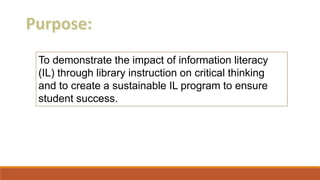
To demonstrate the impact of information literacy
(IL) through library instruction on critical thinking
and to create a sustainable IL program to ensure
student success.
Arkansas Tech Team
Sherry Tinerella – Team Leader
Monica Varner – Director of Institutional Effectiveness
Rebecca Callaway – Professor of Education & Instructional Designer for eTech
Regina St. John - Associate Professor of English
Hanna Norton – Assistant VP for Academic Affairs
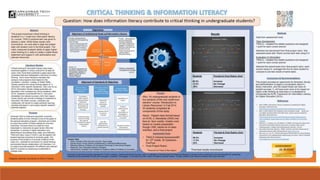
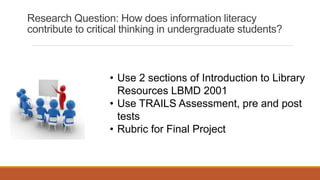
Research Question: How does information literacy
contribute to critical thinking in undergraduate students?
• Use 2 sections of Introduction to Library
Resources LBMD 2001
• Use TRAILS Assessment, pre and post
tests
• Rubric for Final Project
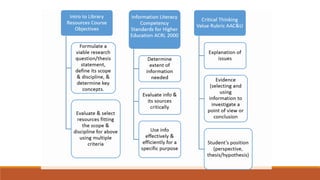
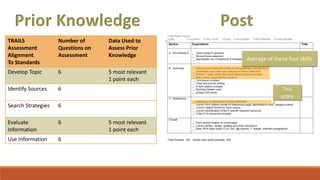
TRAILS
Assessment
Alignment
To Standards
Number of
Questions on
Assessment
Data Used to
Assess Prior
Knowledge
Develop Topic 6 5 most relevant
1 point each
Identify Sources 6
Search Strategies 6
Evaluate
Information
6 5 most relevant
1 point each
Use Information 6
Prior Knowledge Post
This
score
Average of these four skills
0
1
2
3
4
5
6
0 5 10 15 20 25 30 35 40 45
SCORE
STUDENTS
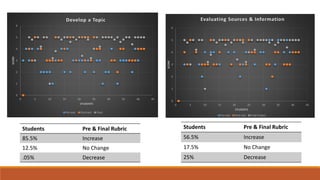
Develop a Topic
Pre-test Post-test Final
0
1
2
3
4
5
6
0 5 10 15 20 25 30 35 40 45
SCORE
STUDENTS
Evaluating Sources & Information
Pre-test Post-test Final Project
Students Pre & Final Rubric
85.5% Increase
12.5% No Change
.05% Decrease
Students Pre & Final Rubric
56.5% Increase
17.5% No Change
25% Decrease
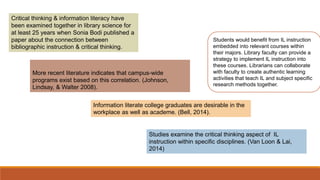
Students would benefit from IL instruction
embedded into relevant courses within
their majors. Library faculty can provide a
strategy to implement IL instruction into
these courses. Librarians can collaborate
with faculty to create authentic learning
activities that teach IL and subject specific
research methods together.
Critical thinking & information literacy have
been examined together in library science for
at least 25 years when Sonia Bodi published a
paper about the connection between
bibliographic instruction & critical thinking.
More recent literature indicates that campus-wide
programs exist based on this correlation. (Johnson,
Lindsay, & Walter 2008).
Studies examine the critical thinking aspect of IL
instruction within specific disciplines. (Van Loon & Lai,
2014)
Information literate college graduates are desirable in the
workplace as well as academe. (Bell, 2014).
Benefits of AiA
• Created relationships with campus administrators and
faculty
• Invaluable professional development and networking
• Education in assessment, research, and communication
• Basis for expanding Information Literacy education through
library instruction
• ACRL (2000). Information Literacy Competency Standards for Higher
Education. Retrieved from
http://www.ala.org/acrl/standards/informationliteracycompetency
• Bell, S. (2014, March 19). Employers want workplace-ready grads, but
can higher ed deliver?/from the Bell Tower. Library Journal: Academic
Newswire. Retrieved from
http://lj.libraryjournal.com/2014/03/opinion/steven-bell/employers-
want-workplace-ready-grads-but-can-higher-ed-deliver-from-the-bell-
tower/#_
• Johnson, C., Lindsay, E.B., and Walter, S. (2008). Learning more about how
they think: Information literacy instruction in campus-wide critical
thinking project. College and Undergraduate Libraries, 15(1/2).
• Kent State University Libraries. TRAILS: Tools for real-time assessment of
information literacy skills. Retrieved from www.trails-9.org
• Van Loon, J.E., Lai, H.L. (2014) Information literacy skills as critical thinking
framework in the undergraduate engineering curriculum. Library Scholarly
Publications 80. Retrieved from
http://digitalcommons.wayne.edu/libsp/80

Assessment in action present to library

  • 1.
    Assessment in Action: AcademicLibraries & Student Success CRITICAL THINKING & INFORMATION LITERACY Poster Presentation: American Library Association Annual Conference, San Francisco, 2015 Sherry Tinerella
  • 3.
    ACRL: Value ofAcademic Libraries Initiative Association of College & Research Libraries Initiative is the result of Summits –
  • 4.
  • 5.
    AiA Institution of Museum& Library Services (IMLS) Collaborative Planning Grant Assessment in Action: Academic Libraries & Student Success Goal 1 • Develop professional competencies of librarians to document & communicate the value of the library in relation to institutional goals for learning & student success. Goal 2 • Build & strengthen collaborative partnerships with stakeholders in higher ed. Goal 3 • Contribute to higher ed assessment work by creating approaches, strategies & practices that document library’s contribution.
  • 6.
    Overview 2013-2014 75 institutions 2014-2015 73 institutions 2015-2016 55 institutions • Application process •14 month commitment • Attend 2 full day workshops at ALA annual & midwinter • Moodle learning management system meetings & assignments • Group discussions • Poster Session Each librarian is a team leader on their campus who is to create a community of practice. Teams should consist of librarians, administration, & faculty. The purpose is to design, implement, and present research that provides evidence of the library’s value & contribution to student learning or success.
  • 7.
    To demonstrate theimpact of information literacy (IL) through library instruction on critical thinking and to create a sustainable IL program to ensure student success.
  • 8.
    Arkansas Tech Team SherryTinerella – Team Leader Monica Varner – Director of Institutional Effectiveness Rebecca Callaway – Professor of Education & Instructional Designer for eTech Regina St. John - Associate Professor of English Hanna Norton – Assistant VP for Academic Affairs
  • 9.
    Research Question: Howdoes information literacy contribute to critical thinking in undergraduate students? • Use 2 sections of Introduction to Library Resources LBMD 2001 • Use TRAILS Assessment, pre and post tests • Rubric for Final Project
  • 12.
    TRAILS Assessment Alignment To Standards Number of Questionson Assessment Data Used to Assess Prior Knowledge Develop Topic 6 5 most relevant 1 point each Identify Sources 6 Search Strategies 6 Evaluate Information 6 5 most relevant 1 point each Use Information 6 Prior Knowledge Post This score Average of these four skills
  • 13.
    0 1 2 3 4 5 6 0 5 1015 20 25 30 35 40 45 SCORE STUDENTS Develop a Topic Pre-test Post-test Final 0 1 2 3 4 5 6 0 5 10 15 20 25 30 35 40 45 SCORE STUDENTS Evaluating Sources & Information Pre-test Post-test Final Project Students Pre & Final Rubric 85.5% Increase 12.5% No Change .05% Decrease Students Pre & Final Rubric 56.5% Increase 17.5% No Change 25% Decrease
  • 14.
    Students would benefitfrom IL instruction embedded into relevant courses within their majors. Library faculty can provide a strategy to implement IL instruction into these courses. Librarians can collaborate with faculty to create authentic learning activities that teach IL and subject specific research methods together. Critical thinking & information literacy have been examined together in library science for at least 25 years when Sonia Bodi published a paper about the connection between bibliographic instruction & critical thinking. More recent literature indicates that campus-wide programs exist based on this correlation. (Johnson, Lindsay, & Walter 2008). Studies examine the critical thinking aspect of IL instruction within specific disciplines. (Van Loon & Lai, 2014) Information literate college graduates are desirable in the workplace as well as academe. (Bell, 2014).
  • 15.
    Benefits of AiA •Created relationships with campus administrators and faculty • Invaluable professional development and networking • Education in assessment, research, and communication • Basis for expanding Information Literacy education through library instruction
  • 16.
    • ACRL (2000).Information Literacy Competency Standards for Higher Education. Retrieved from http://www.ala.org/acrl/standards/informationliteracycompetency • Bell, S. (2014, March 19). Employers want workplace-ready grads, but can higher ed deliver?/from the Bell Tower. Library Journal: Academic Newswire. Retrieved from http://lj.libraryjournal.com/2014/03/opinion/steven-bell/employers- want-workplace-ready-grads-but-can-higher-ed-deliver-from-the-bell- tower/#_ • Johnson, C., Lindsay, E.B., and Walter, S. (2008). Learning more about how they think: Information literacy instruction in campus-wide critical thinking project. College and Undergraduate Libraries, 15(1/2). • Kent State University Libraries. TRAILS: Tools for real-time assessment of information literacy skills. Retrieved from www.trails-9.org • Van Loon, J.E., Lai, H.L. (2014) Information literacy skills as critical thinking framework in the undergraduate engineering curriculum. Library Scholarly Publications 80. Retrieved from http://digitalcommons.wayne.edu/libsp/80