   Enrollment     Attendance    Dropout rate    Ethnicity    Gender    Grade level -- Over time, demographic data indicate changes in the context of the school.    Description of school programs and processes    Perception of learning environment    Values and beliefs    Attitudes      Observations    Standardized tests Norm/criterion-referenced tests Teacher observations of abilities Authentic assessments -- Over time, school processes show how classrooms change. -- Over time, perceptions can tell us about environmental improvements. -- Over time, student learning data give information about student performance on different measures. TELLS US: Student participation in different programs and processes. TELLS US: What processes/programs work best for different groups of students with respect to student learning. TELLS US: The impact of demographic factors and attitudes about the learning environment on student learning. TELLS US: If groups of students are “experiencing school” differently. TELLS US: What processes/programs different groups of students like best. TELLS US: If a program is making a difference in student learning results. TELLS US: The impact of student perceptions of the learning environment on student learning. TELLS US: The impact of the program on student learning based upon perceptions of the program and on the processes used. Allows the prediction of actions, processes, programs, that best meet the learning needs of all students. Multiple Measures of Data: Paying Attention to Busy Intersections SOURCE:  Data Analysis for Continuous School Improvement,  2 nd   edition, by Victoria L. Bernhardt (Larchmont, NY: Eye on Education, 2004).  Reprinted with permission. DEMOGRAPHICS PERCEPTONS STUDENT LEARNING SCHOOL PROCESSES

Multiple Measures Of Data Slide

  • 1.
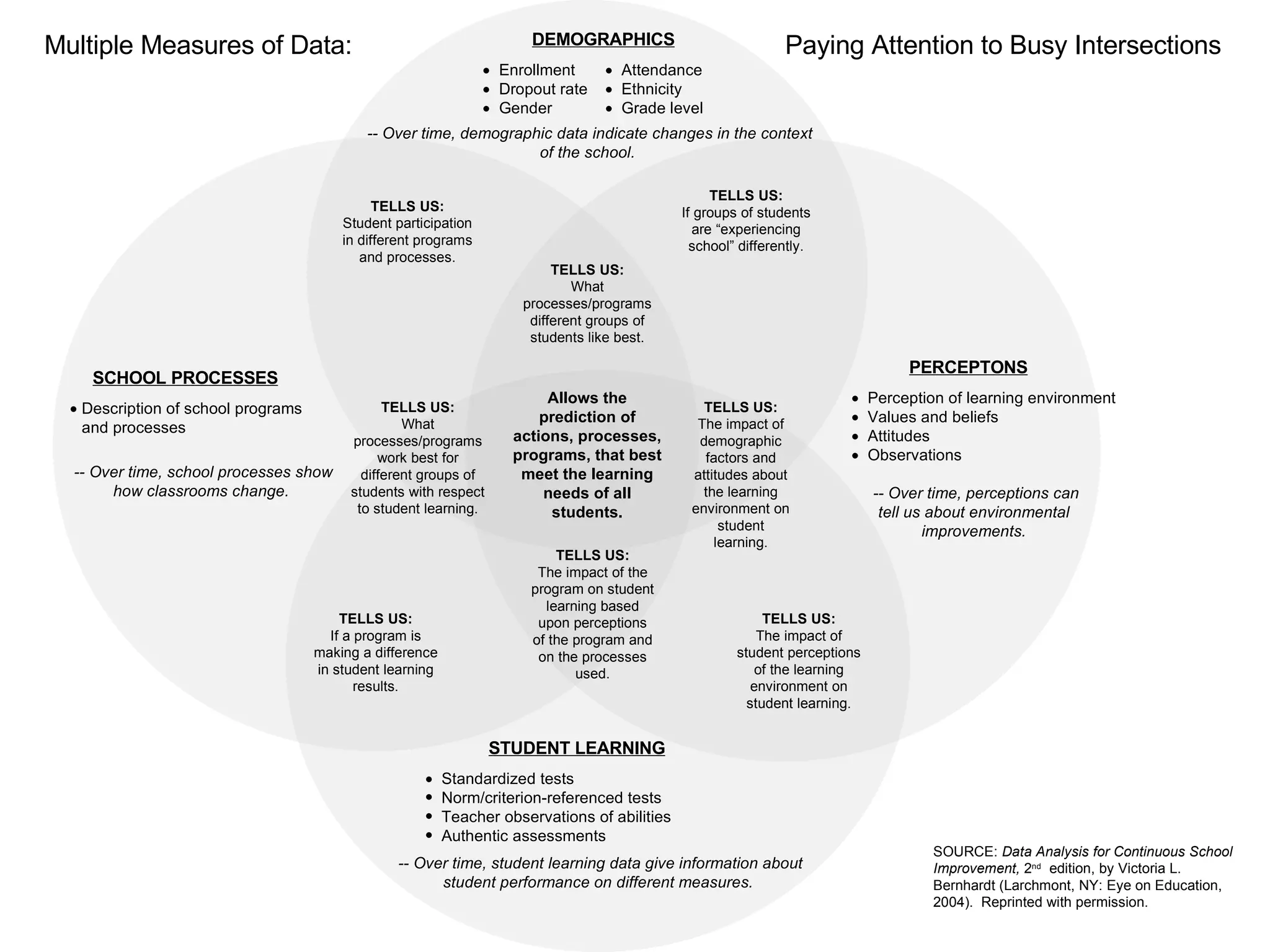
    Enrollment  Attendance  Dropout rate  Ethnicity  Gender  Grade level -- Over time, demographic data indicate changes in the context of the school.  Description of school programs and processes  Perception of learning environment  Values and beliefs  Attitudes  Observations  Standardized tests Norm/criterion-referenced tests Teacher observations of abilities Authentic assessments -- Over time, school processes show how classrooms change. -- Over time, perceptions can tell us about environmental improvements. -- Over time, student learning data give information about student performance on different measures. TELLS US: Student participation in different programs and processes. TELLS US: What processes/programs work best for different groups of students with respect to student learning. TELLS US: The impact of demographic factors and attitudes about the learning environment on student learning. TELLS US: If groups of students are “experiencing school” differently. TELLS US: What processes/programs different groups of students like best. TELLS US: If a program is making a difference in student learning results. TELLS US: The impact of student perceptions of the learning environment on student learning. TELLS US: The impact of the program on student learning based upon perceptions of the program and on the processes used. Allows the prediction of actions, processes, programs, that best meet the learning needs of all students. Multiple Measures of Data: Paying Attention to Busy Intersections SOURCE: Data Analysis for Continuous School Improvement, 2 nd edition, by Victoria L. Bernhardt (Larchmont, NY: Eye on Education, 2004). Reprinted with permission. DEMOGRAPHICS PERCEPTONS STUDENT LEARNING SCHOOL PROCESSES