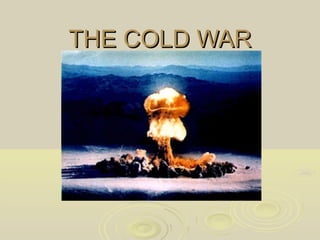
THE COLD WAR
 The Cold War existed between the

USA and its allies, and the USSR
and its allies.
 While the war never went ‘hot’ the
fear and suspicion, combined with
nuclear weapons, kept the world on
edge for several decades.
 (1945-1991)
Igor Gouzenko





He was a clerk in the
Soviet Embassy in Canada
in 195
Asked for political asylum
In return would give
government documents
that proved Russia was
operating two spy rings in
Canada
Igor Gouzenko
 37 spies were caught from

his information
 Canadians were shocked at these claims
and for many, this is when the Cold War
started
 Gouzenko live in Ontario under police
protection until the day he died in 1985
 He published two books, one of which won
the Governor General’s Prize for Literature
After the War
 Europe was in ruins and the USA and

Soviet Union (USSR) became the two
major powers in the world
 Canada would side with the Americans
 Canada would come to evolve into a
middle power
 Would help contribute to the creation of
the United Nations
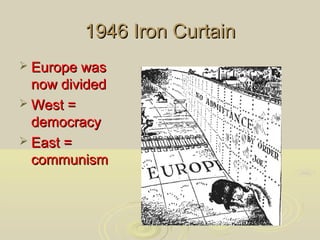
1946 Iron Curtain



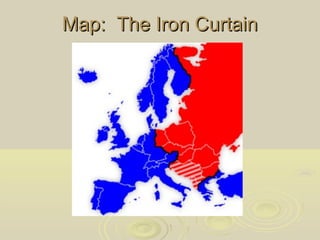
Russia set up communist governments in all the
countries they ‘liberated’ during WWII.
Churchill gave a speech in which he said: “From Stettin
in the Baltic to Trieste in the Adriatic, an iron curtain has
descended across the Continent. Behind that line lie all
the capitals of the ancient states of Central and Eastern
Europe. Warsaw, Berlin, Prague, Vienna, Budapest,
Belgrade, Bucharest and Sofia, all these famous cities
and the populations around them lie in what I must call
the Soviet sphere, and all are subject in one form or
another, not only to Soviet influence but to a very high
and, in many cases, increasing measure of control from
Moscow ”.
1946 Iron Curtain
 Europe was

now divided
 West =
democracy
 East =
communism
Map: The Iron Curtain
1947 Truman Doctrine




US President Truman
promised American
support to any
country where
communism was a
threat
Canada sided with
the US because they
didn’t feel the UN was
effective enough
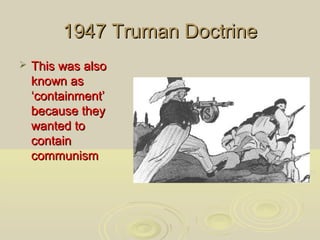
1947 Truman Doctrine


This was also
known as
‘containment’
because they
wanted to
contain
communism
1947 Marshall Plan




The US gov’t sent
money and supplies
to rebuild war-torn
Europe
Reasons:
humanitarian,
beneficial to US
economy, prevent
spread of
communism
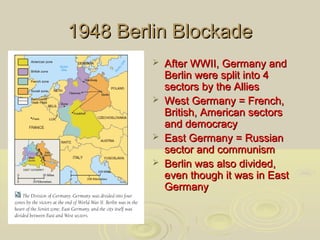
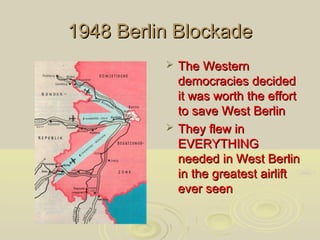
1948 Berlin Blockade







After WWII, Germany and
Berlin were split into 4
sectors by the Allies
West Germany = French,
British, American sectors
and democracy
East Germany = Russian
sector and communism
Berlin was also divided,
even though it was in East
Germany
1948 Berlin Blockade




Stalin decided to
close the roads and
rails from West
Germany to West
Berlin
He was determined to
starve West Berliners
into submission and
gain control of Berlin
1948 Berlin Blockade




The Western
democracies decided
it was worth the effort
to save West Berlin
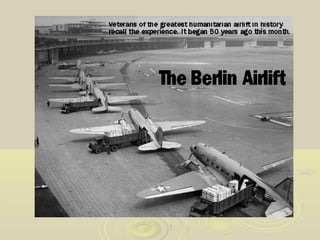
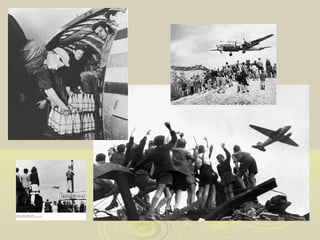
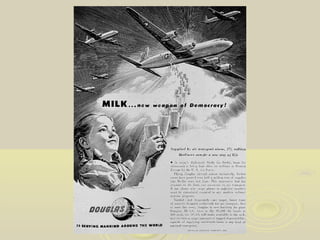
They flew in
EVERYTHING
needed in West Berlin
in the greatest airlift
ever seen
1948 Berlin Blockade





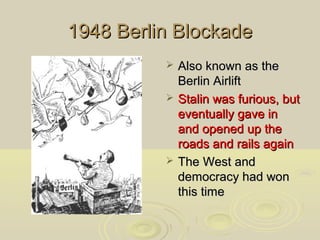
Also known as the
Berlin Airlift
Stalin was furious, but
eventually gave in
and opened up the
roads and rails again
The West and
democracy had won
this time
1949 USSR has the bomb
 Soviet spies

helped the
USSR build a
bomb just like
Fat Man, the
atomic bomb
the Americans
had dropped on
Japan.
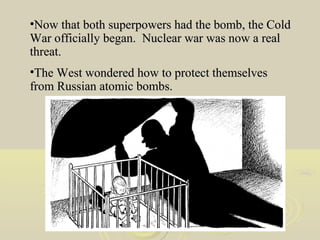
•Now that both superpowers had the bomb, the Cold
War officially began. Nuclear war was now a real
threat.
•The West wondered how to protect themselves
from Russian atomic bombs.
1949/1955 NATO and the
Warsaw Pact




In 1949, Western
Allies formed a
defensive alliance
known as the North
Atlantic Treaty
Organization
This was to protect
themselves against
the USSR and its
allies




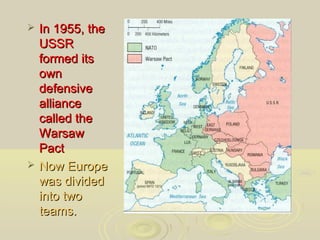
In 1955, the
USSR
formed its
own
defensive
alliance
called the
Warsaw
Pact
Now Europe
was divided
into two
teams.
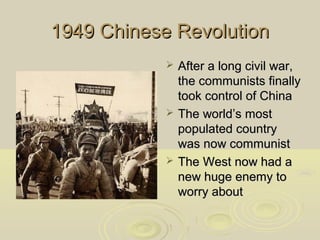
1949 Chinese Revolution






After a long civil war,
the communists finally
took control of China
The world’s most
populated country
was now communist
The West now had a
new huge enemy to
worry about
Cold War Hysteria
 1950s and 60s were full of tension

between the Eastern and Western “Blocs”.
 West was scared that the communists
would continue to take land
 The spread of communism was seen as a
direct threat
 East was scared of the West’s intentions
and so they kept a ‘buffer’ between its
borders incase of invasion
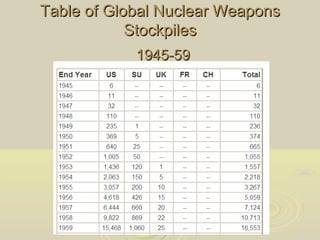
Nuclear War






Hysteria came from
the possibility of
nuclear war
Any tension could rise
into a war that could
destroy most of the
world
All it took was one
push of the button!
Table of Global Nuclear Weapons
Stockpiles
1945-59

The Cold War 1945-50

  • 1.
  • 2.
     The ColdWar existed between the USA and its allies, and the USSR and its allies.  While the war never went ‘hot’ the fear and suspicion, combined with nuclear weapons, kept the world on edge for several decades.  (1945-1991)
  • 3.
    Igor Gouzenko    He wasa clerk in the Soviet Embassy in Canada in 195 Asked for political asylum In return would give government documents that proved Russia was operating two spy rings in Canada
  • 4.
    Igor Gouzenko  37spies were caught from his information  Canadians were shocked at these claims and for many, this is when the Cold War started  Gouzenko live in Ontario under police protection until the day he died in 1985  He published two books, one of which won the Governor General’s Prize for Literature
  • 5.
    After the War Europe was in ruins and the USA and Soviet Union (USSR) became the two major powers in the world  Canada would side with the Americans  Canada would come to evolve into a middle power  Would help contribute to the creation of the United Nations
  • 6.
    1946 Iron Curtain   Russiaset up communist governments in all the countries they ‘liberated’ during WWII. Churchill gave a speech in which he said: “From Stettin in the Baltic to Trieste in the Adriatic, an iron curtain has descended across the Continent. Behind that line lie all the capitals of the ancient states of Central and Eastern Europe. Warsaw, Berlin, Prague, Vienna, Budapest, Belgrade, Bucharest and Sofia, all these famous cities and the populations around them lie in what I must call the Soviet sphere, and all are subject in one form or another, not only to Soviet influence but to a very high and, in many cases, increasing measure of control from Moscow ”.
  • 7.
    1946 Iron Curtain Europe was now divided  West = democracy  East = communism
  • 8.
  • 9.
    1947 Truman Doctrine   USPresident Truman promised American support to any country where communism was a threat Canada sided with the US because they didn’t feel the UN was effective enough
  • 10.
    1947 Truman Doctrine  Thiswas also known as ‘containment’ because they wanted to contain communism
  • 11.
    1947 Marshall Plan   TheUS gov’t sent money and supplies to rebuild war-torn Europe Reasons: humanitarian, beneficial to US economy, prevent spread of communism
  • 14.
    1948 Berlin Blockade     AfterWWII, Germany and Berlin were split into 4 sectors by the Allies West Germany = French, British, American sectors and democracy East Germany = Russian sector and communism Berlin was also divided, even though it was in East Germany
  • 15.
    1948 Berlin Blockade   Stalindecided to close the roads and rails from West Germany to West Berlin He was determined to starve West Berliners into submission and gain control of Berlin
  • 16.
    1948 Berlin Blockade   TheWestern democracies decided it was worth the effort to save West Berlin They flew in EVERYTHING needed in West Berlin in the greatest airlift ever seen
  • 20.
    1948 Berlin Blockade    Alsoknown as the Berlin Airlift Stalin was furious, but eventually gave in and opened up the roads and rails again The West and democracy had won this time
  • 21.
    1949 USSR hasthe bomb  Soviet spies helped the USSR build a bomb just like Fat Man, the atomic bomb the Americans had dropped on Japan.
  • 22.
    •Now that bothsuperpowers had the bomb, the Cold War officially began. Nuclear war was now a real threat. •The West wondered how to protect themselves from Russian atomic bombs.
  • 23.
    1949/1955 NATO andthe Warsaw Pact   In 1949, Western Allies formed a defensive alliance known as the North Atlantic Treaty Organization This was to protect themselves against the USSR and its allies
  • 24.
      In 1955, the USSR formedits own defensive alliance called the Warsaw Pact Now Europe was divided into two teams.
  • 26.
    1949 Chinese Revolution    Aftera long civil war, the communists finally took control of China The world’s most populated country was now communist The West now had a new huge enemy to worry about
  • 28.
    Cold War Hysteria 1950s and 60s were full of tension between the Eastern and Western “Blocs”.  West was scared that the communists would continue to take land  The spread of communism was seen as a direct threat  East was scared of the West’s intentions and so they kept a ‘buffer’ between its borders incase of invasion
  • 29.
    Nuclear War    Hysteria camefrom the possibility of nuclear war Any tension could rise into a war that could destroy most of the world All it took was one push of the button!
  • 30.
    Table of GlobalNuclear Weapons Stockpiles 1945-59