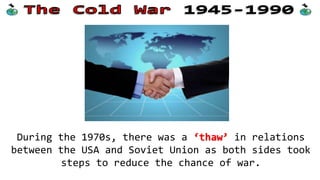
During the 1970s, there was a ‘thaw’ in relations
between the USA and Soviet Union as both sides took
steps to reduce the chance of war.
Détente means ‘relax’
in French.
During this period both
the USA and USSR worked
together on projects.
They also took steps to
reduce the number of
weapons they had.
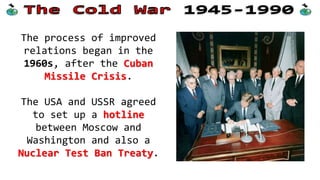
The process of improved
relations began in the
1960s, after the Cuban
Missile Crisis.
The USA and USSR agreed
to set up a hotline
between Moscow and
Washington and also a
Nuclear Test Ban Treaty.
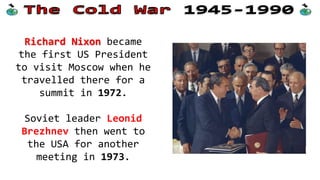
Richard Nixon became
the first US President
to visit Moscow when he
travelled there for a
summit in 1972.
Soviet leader Leonid
Brezhnev then went to
the USA for another
meeting in 1973.
Nixon also showed a
willingness to work
with other Communist
countries.
He travelled to China
for a meeting in 1972,
a year after the US
table tennis team
toured the country.
Détente took place for
many reasons although
one of them was fear of
a possible nuclear war.
They two countries held
talks about limiting
the amount and type of
nuclear weapons that
each side had.
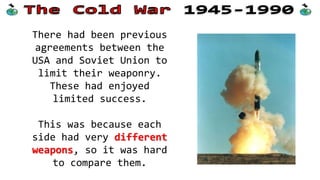
There had been previous
agreements between the
USA and Soviet Union to
limit their weaponry.
These had enjoyed
limited success.
This was because each
side had very different
weapons, so it was hard
to compare them.
In 1972, a new
agreement was
reached: Strategic
Arms Limitation Talks
(SALT).
These talks became
known as SALT I and
agreed three
outcomes.
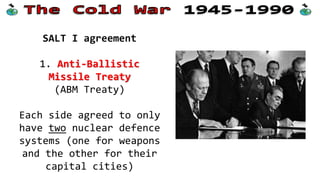
SALT I agreement
1. Anti-Ballistic
Missile Treaty
(ABM Treaty)
Each side agreed to only
have two nuclear defence
systems (one for weapons
and the other for their
capital cities)
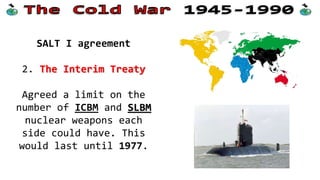
SALT I agreement
2. The Interim Treaty
Agreed a limit on the
number of ICBM and SLBM
nuclear weapons each
side could have. This
would last until 1977.
SALT I agreement
3. The Basic Principles
Agreement
Tried to minimise
conflict between the two
by improving relations
e.g. increasing trade
between them
Overall SALT I was seen
as a positive step. This
lead to SALT II.
SALT II started in 1974
and proposed further
controls on weaponry.
However ultimately this
treaty was rejected by
the US Senate.
In March 1975 most
countries – including
the USA and USSR –
signed a biological
weapons treaty.
This agreement said
that countries involved
would not make or use
biological weapons.
The two sides also
met together at
Helsinki in Finland
in 1975 to discuss
various issues.
These became known
as the Helsinki
Accords.
Three main agreements
(baskets) were reached :
1. Confirmed that Eastern
Bloc borders could not
be altered by force
2. Improved trade between
both sides
3. USSR agreed to improve
human rights e.g. free
speech
A very symbolic action
took place not on earth
but in space.
In 1975 both countries
allowed their astronauts
and cosmonauts to work
together in space.
The Apollo-Soyuz link up
was a major TV event.
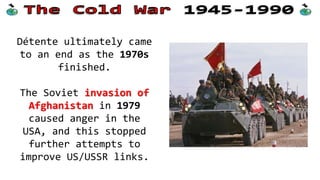
Détente ultimately came
to an end as the 1970s
finished.
The Soviet invasion of
Afghanistan in 1979
caused anger in the
USA, and this stopped
further attempts to
improve US/USSR links.

Changing Cold War relations - Detente

  • 2.
    During the 1970s,there was a ‘thaw’ in relations between the USA and Soviet Union as both sides took steps to reduce the chance of war.
  • 3.
    Détente means ‘relax’ inFrench. During this period both the USA and USSR worked together on projects. They also took steps to reduce the number of weapons they had.
  • 4.
    The process ofimproved relations began in the 1960s, after the Cuban Missile Crisis. The USA and USSR agreed to set up a hotline between Moscow and Washington and also a Nuclear Test Ban Treaty.
  • 5.
    Richard Nixon became thefirst US President to visit Moscow when he travelled there for a summit in 1972. Soviet leader Leonid Brezhnev then went to the USA for another meeting in 1973.
  • 6.
    Nixon also showeda willingness to work with other Communist countries. He travelled to China for a meeting in 1972, a year after the US table tennis team toured the country.
  • 7.
    Détente took placefor many reasons although one of them was fear of a possible nuclear war. They two countries held talks about limiting the amount and type of nuclear weapons that each side had.
  • 8.
    There had beenprevious agreements between the USA and Soviet Union to limit their weaponry. These had enjoyed limited success. This was because each side had very different weapons, so it was hard to compare them.
  • 9.
    In 1972, anew agreement was reached: Strategic Arms Limitation Talks (SALT). These talks became known as SALT I and agreed three outcomes.
  • 10.
    SALT I agreement 1.Anti-Ballistic Missile Treaty (ABM Treaty) Each side agreed to only have two nuclear defence systems (one for weapons and the other for their capital cities)
  • 11.
    SALT I agreement 2.The Interim Treaty Agreed a limit on the number of ICBM and SLBM nuclear weapons each side could have. This would last until 1977.
  • 12.
    SALT I agreement 3.The Basic Principles Agreement Tried to minimise conflict between the two by improving relations e.g. increasing trade between them
  • 13.
    Overall SALT Iwas seen as a positive step. This lead to SALT II. SALT II started in 1974 and proposed further controls on weaponry. However ultimately this treaty was rejected by the US Senate.
  • 14.
    In March 1975most countries – including the USA and USSR – signed a biological weapons treaty. This agreement said that countries involved would not make or use biological weapons.
  • 15.
    The two sidesalso met together at Helsinki in Finland in 1975 to discuss various issues. These became known as the Helsinki Accords.
  • 16.
    Three main agreements (baskets)were reached : 1. Confirmed that Eastern Bloc borders could not be altered by force 2. Improved trade between both sides 3. USSR agreed to improve human rights e.g. free speech
  • 17.
    A very symbolicaction took place not on earth but in space. In 1975 both countries allowed their astronauts and cosmonauts to work together in space. The Apollo-Soyuz link up was a major TV event.
  • 18.
    Détente ultimately came toan end as the 1970s finished. The Soviet invasion of Afghanistan in 1979 caused anger in the USA, and this stopped further attempts to improve US/USSR links.