Cohort Study
Dr. Win Aye Hlaing
Lecturer
Department of Epidemiology
University of Public Health, Yangon
Cohort Study
A cohort study is one in which a population (cohort) of persons who
are free of disease is defined at a point in time, and subsequently
classified according to the presence or absence of a determinant (e.
g. exposure to an agent). They are then observed over a period of time
to identify the subsequent appearance (incidence) of disease in those
with and without the determinant (exposure or risk factor) .
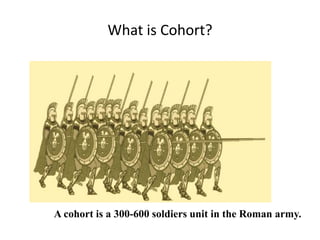
What is Cohort?
A cohort is a 300-600 soldiers unit in the Roman army.
Advantages of Cohort Study
• Proper temporal sequence of events can be observed,
thus helping to distinguish causes from associated
factors;
• New cases of disease can be identified in a specified
population and time period, which allows incidence to
be calculated;
• Several possible determinants and outcomes can be
studied simultaneously;
• Determinants and outcomes can be measured precisely
Disadvantages of Cohort Study
• Large population required if incidence is low;
• Long time-scale before results emerge especially if
incubation period is prolonged;
• Relatively expensive in resources;
• Losses from population during study may bias results;
• Standard methods and criteria may drift over
prolonged follow up
• Observational Analytic Studies
• etiologic or causal relationships
• First, association between a factor or a
characteristic and disease
• Second, appropriate inferences - possible
causal relationship
Design of a Cohort Study
• investigator selects a group of exposed
individuals and non-exposed individuals and
• follows up both groups to compare the
incidence of disease (or rate of death from
disease) in the two groups
• If a positive association
• exposed group – disease develops (incidence
in the exposed group)
• greater than the non-exposed group - disease
develops (incidence in the non-exposed
group)
6/26/2017 9
Disease
(+)
Disease
(-)
Exposure (+) a b a+b a/a+b
Exposure (-) c d c+d c/c+d
• (a + b) exposed persons – disease develops in
a but not in b; Disease in Exposure = (a/a + b)
• (c + d) non-exposed persons - disease
develops in c but not in d;
Disease in Non-Exposure = (c/c + d)
• If exposure is associated with disease,
a/a + b ˃ c/c + d
• association of smoking with coronary heart
disease (CHD)
• 3,000 smokers (exposed) and
• 5,000 non-smokers (non-exposed) who are free
of heart disease at baseline
• Both groups are followed
• the incidence of CHD in both groups is compared
• CHD develops in 84 of the smokers and in 87 of
the non-smokers
• The result is an incidence of CHD
• 28.0/1,000 in the smokers and
• 17.4/1,000 in the non-smokers
• new (incident) cases
• whether a temporal relationship exists
between the exposure and the disease
• whether the exposure preceded the onset of
the disease
• Consider the exposure a possible cause of the
disease
COMPARING COHORT STUDIES
WITH RANDOMIZED TRIALS
• compare the Cohort study (observational)
with RCT (experimental)
• “exposure” in RCT is a treatment or preventive
measure
• In cohort studies, “exposure” is toxic or
carcinogenic agent
• exposed group is compared with a non-
exposed group or with a group with another
exposure
SELECTION OF STUDY POPULATIONS
Two basic ways
1. We can create a study population
by selecting groups for inclusion
on the basis of whether or not they were
exposed (e.g., occupationally exposed
cohorts)
2. - We can select a defined population before
exposed or before exposures are identified
- select a population on the basis of some
factor not related to exposure (such a
community of residence)
• wait for an outcome
• often require a long follow-up period, lasting
until enough events (outcomes) have occurred
• We compare exposed and non-exposed
persons
• This comparison is Hallmark of Cohort design
Types of Cohort Study
• (Prospective) Cohort Study:
If the study plan calls for the cohort to be identified and
recruited “today” and followed into the future, the study
is called a prospective cohort study
• Retrospective Cohort Study:
If the study plan calls for the cohort to be selected based
on their membership in the population at a specified
point in the past, and followed from that point (in the
past) up to “today”, then the study is called a
retrospective cohort study
• E.g. The relationship of smoking to lung
cancer
• followed up for a long period
• to determine the outcome
• a population of elementary school students
and follow them up
• 10 years later, when they are teenagers, we
identify those who smoke and those who do
not
• follow up both groups—to see who develops
lung cancer and who does not
• we begin our study in 2016
• children who will become smokers within 10
years
• 10 years later, in 2026, Exposure status
(smoker or non-smoker)
• latent period from beginning smoking to
development of lung cancer is 10 years (2036)
• This type of study design is called a
prospective cohort study (also a concurrent
cohort or longitudinal study)
• It is concurrent because the investigator
identifies the original population at the
beginning of the study and
• accompanies the subjects concurrently
through calendar time until the point at which
the disease develops or does not develop
• Problem - take at least 20 years to complete
• Several problems can result
• research grant, such funding is generally
limited to a maximum of only 3 to 5 years
• subjects will outlive the investigator, or loss to
follow up due to various reasons
• the investigator may not survive to the end of
the study
• unattractive
• to shorten the time
• alternate approach
• we again begin our study in 2016
• but now we find that an old roster of
elementary schoolchildren from 1996
• Surveyed their smoking habits in 2006
• data resources in 2016, we can begin to
determine who has developed lung cancer
and who has not
• This is called a retrospective cohort (also called a
non-concurrent prospective study or historical
cohort study)
• not differ – prospective cohort design—we are
still comparing exposed and non-exposed groups
• retrospective cohort design - to use historical
data from the past
• Scope the frame of calendar time
• we are beginning the study with a pre-existing
population to reduce the duration of the study
• only difference between them is calendar time
• Prospective cohort design - exposure and non-
exposure - followed up for several years -
incidence is measured
• Retrospective cohort design – exposure from
past records and outcome (development or no
development of disease) at the time the study
is begun
• from objective records in the past and follow-
up and measurement of outcome
POTENTIAL BIASES IN COHORT STUDIES
• two major categories:
– Selection bias and
– information bias
Selection Bias
• nonparticipation and nonresponse
• major biases Loss to follow up
Information Bias
1. Quality and Extent of information
– Historical cohort studies – from past records
2. Also knows whether that subject was
exposed
– May be biased by that knowledge
– Problem can be addressed by Masking/Blinding
3. May un-intensionally introduce biases
– Data analyses
– interpretation
Conclusion
• the cohort is attractive when we can minimize
attrition (losses to follow-up)
• Generally, we do not have appropriate past
records or other sources of data - to conduct a
retrospective cohort study
• Today, many of the diseases occur at very low
rates
6/26/2017 31
THANK YOU!!

Cohort dr.wah

  • 1.
    Cohort Study Dr. WinAye Hlaing Lecturer Department of Epidemiology University of Public Health, Yangon
  • 2.
    Cohort Study A cohortstudy is one in which a population (cohort) of persons who are free of disease is defined at a point in time, and subsequently classified according to the presence or absence of a determinant (e. g. exposure to an agent). They are then observed over a period of time to identify the subsequent appearance (incidence) of disease in those with and without the determinant (exposure or risk factor) .
  • 3.
    What is Cohort? Acohort is a 300-600 soldiers unit in the Roman army.
  • 4.
    Advantages of CohortStudy • Proper temporal sequence of events can be observed, thus helping to distinguish causes from associated factors; • New cases of disease can be identified in a specified population and time period, which allows incidence to be calculated; • Several possible determinants and outcomes can be studied simultaneously; • Determinants and outcomes can be measured precisely
  • 5.
    Disadvantages of CohortStudy • Large population required if incidence is low; • Long time-scale before results emerge especially if incubation period is prolonged; • Relatively expensive in resources; • Losses from population during study may bias results; • Standard methods and criteria may drift over prolonged follow up
  • 6.
    • Observational AnalyticStudies • etiologic or causal relationships • First, association between a factor or a characteristic and disease • Second, appropriate inferences - possible causal relationship
  • 7.
    Design of aCohort Study • investigator selects a group of exposed individuals and non-exposed individuals and • follows up both groups to compare the incidence of disease (or rate of death from disease) in the two groups
  • 8.
    • If apositive association • exposed group – disease develops (incidence in the exposed group) • greater than the non-exposed group - disease develops (incidence in the non-exposed group)
  • 9.
  • 10.
    Disease (+) Disease (-) Exposure (+) ab a+b a/a+b Exposure (-) c d c+d c/c+d
  • 11.
    • (a +b) exposed persons – disease develops in a but not in b; Disease in Exposure = (a/a + b) • (c + d) non-exposed persons - disease develops in c but not in d; Disease in Non-Exposure = (c/c + d) • If exposure is associated with disease, a/a + b ˃ c/c + d
  • 12.
    • association ofsmoking with coronary heart disease (CHD) • 3,000 smokers (exposed) and • 5,000 non-smokers (non-exposed) who are free of heart disease at baseline • Both groups are followed • the incidence of CHD in both groups is compared • CHD develops in 84 of the smokers and in 87 of the non-smokers • The result is an incidence of CHD • 28.0/1,000 in the smokers and • 17.4/1,000 in the non-smokers
  • 13.
    • new (incident)cases • whether a temporal relationship exists between the exposure and the disease • whether the exposure preceded the onset of the disease • Consider the exposure a possible cause of the disease
  • 14.
    COMPARING COHORT STUDIES WITHRANDOMIZED TRIALS • compare the Cohort study (observational) with RCT (experimental) • “exposure” in RCT is a treatment or preventive measure • In cohort studies, “exposure” is toxic or carcinogenic agent • exposed group is compared with a non- exposed group or with a group with another exposure
  • 15.
    SELECTION OF STUDYPOPULATIONS Two basic ways 1. We can create a study population by selecting groups for inclusion on the basis of whether or not they were exposed (e.g., occupationally exposed cohorts)
  • 16.
    2. - Wecan select a defined population before exposed or before exposures are identified - select a population on the basis of some factor not related to exposure (such a community of residence)
  • 17.
    • wait foran outcome • often require a long follow-up period, lasting until enough events (outcomes) have occurred • We compare exposed and non-exposed persons • This comparison is Hallmark of Cohort design
  • 18.
    Types of CohortStudy • (Prospective) Cohort Study: If the study plan calls for the cohort to be identified and recruited “today” and followed into the future, the study is called a prospective cohort study • Retrospective Cohort Study: If the study plan calls for the cohort to be selected based on their membership in the population at a specified point in the past, and followed from that point (in the past) up to “today”, then the study is called a retrospective cohort study
  • 19.
    • E.g. Therelationship of smoking to lung cancer • followed up for a long period • to determine the outcome • a population of elementary school students and follow them up • 10 years later, when they are teenagers, we identify those who smoke and those who do not • follow up both groups—to see who develops lung cancer and who does not
  • 20.
    • we beginour study in 2016 • children who will become smokers within 10 years • 10 years later, in 2026, Exposure status (smoker or non-smoker) • latent period from beginning smoking to development of lung cancer is 10 years (2036)
  • 21.
    • This typeof study design is called a prospective cohort study (also a concurrent cohort or longitudinal study) • It is concurrent because the investigator identifies the original population at the beginning of the study and • accompanies the subjects concurrently through calendar time until the point at which the disease develops or does not develop
  • 22.
    • Problem -take at least 20 years to complete • Several problems can result • research grant, such funding is generally limited to a maximum of only 3 to 5 years • subjects will outlive the investigator, or loss to follow up due to various reasons • the investigator may not survive to the end of the study • unattractive
  • 23.
    • to shortenthe time • alternate approach • we again begin our study in 2016 • but now we find that an old roster of elementary schoolchildren from 1996 • Surveyed their smoking habits in 2006 • data resources in 2016, we can begin to determine who has developed lung cancer and who has not
  • 24.
    • This iscalled a retrospective cohort (also called a non-concurrent prospective study or historical cohort study) • not differ – prospective cohort design—we are still comparing exposed and non-exposed groups • retrospective cohort design - to use historical data from the past • Scope the frame of calendar time • we are beginning the study with a pre-existing population to reduce the duration of the study
  • 25.
    • only differencebetween them is calendar time • Prospective cohort design - exposure and non- exposure - followed up for several years - incidence is measured • Retrospective cohort design – exposure from past records and outcome (development or no development of disease) at the time the study is begun • from objective records in the past and follow- up and measurement of outcome
  • 26.
    POTENTIAL BIASES INCOHORT STUDIES • two major categories: – Selection bias and – information bias
  • 27.
    Selection Bias • nonparticipationand nonresponse • major biases Loss to follow up
  • 28.
    Information Bias 1. Qualityand Extent of information – Historical cohort studies – from past records 2. Also knows whether that subject was exposed – May be biased by that knowledge – Problem can be addressed by Masking/Blinding 3. May un-intensionally introduce biases – Data analyses – interpretation
  • 29.
    Conclusion • the cohortis attractive when we can minimize attrition (losses to follow-up) • Generally, we do not have appropriate past records or other sources of data - to conduct a retrospective cohort study • Today, many of the diseases occur at very low rates
  • 31.