Dr. Faiza A. Abou El-Soud
Professor - Community Health Nursing
Menoufiya University-Egypt
Cohort Studies
✓ To define the design of a cohort study
✓ To identify features of cohort studies
✓ To regonize the indications for cohort study
✓ to determine the considerations during selection of cohort
✓ To differentaite between the types of cohort study
✓ To apply the elements of cohort study
✓ To describe the strengths of cohort studies
✓ To explain the weakness of cohort studies
✓ To disucss biases in cohort study
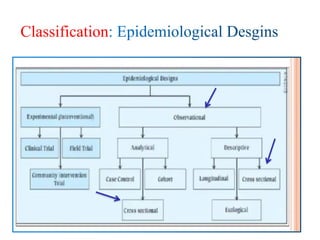
Classification
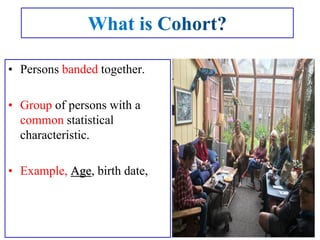
• Persons banded together.
• Group of persons with a
common statistical
characteristic.
• Example, Age, birth date,
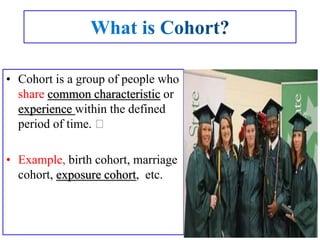
• Cohort is a group of people who
share common characteristic or
experience within the defined
period of time.
• Example, birth cohort, marriage
cohort, exposure cohort, etc.
• Cohorts are identified prior to appearance
of disease under investigation.
• The study groups are observed over a
period of time to determine the frequency
of disease among them.
• The study proceeds from cause to effects.
here is good evidence of an association
between exposure and disease, from other
studies.
xposure is rare.
ttrition of study population can be minimized.
•
ufficient fund is available.
• Starts with people free of disease
• Assesses exposure at “baseline”
• Assesses disease status at “follow-up”
• Both the groups must be comparable in respect of
which influence the occurrence of disease.
• The exposed & non-exposed groups under study be as
as possible with regard to possible confounding
factors
• Both the groups should to disease
• Diagnostic and eligibility criteria of the disease must be
defined before hand.
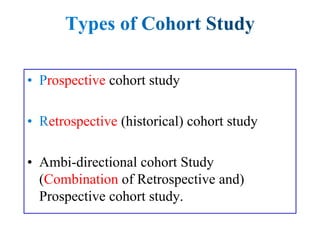
rospective cohort study
etrospective (historical) cohort study
• Ambi-directional cohort Study
(Combination of Retrospective and)
Prospective cohort study.
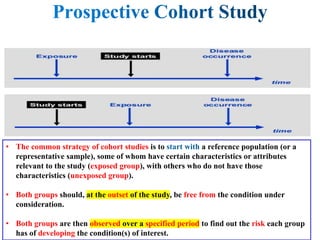
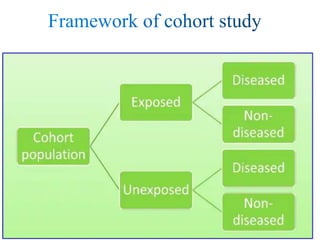
• The common strategy of cohort studies is to a reference population (or a
representative sample), some of whom have certain characteristics or attributes
relevant to the study (exposed group), with others who do not have those
characteristics (unexposed group).
• Both groups should, at the outset of the study, be free from the condition under
consideration.
• Both groups are then observed over a specified period to find out the risk each group
has of developing the condition(s) of interest.
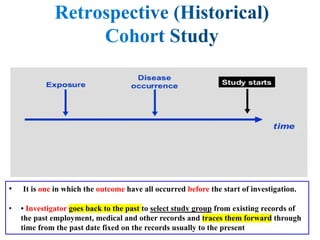
• It is one in which the outcome have all occurred before the start of investigation.
• • Investigator goes back to the past to select study group from existing records of
the past employment, medical and other records and traces them forward through
time from the past date fixed on the records usually to the present
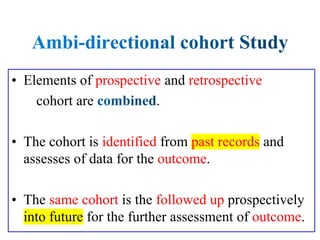
• Elements of prospective and retrospective
cohort are .
• The cohort is identified from past records and
assesses of data for the outcome.
• The same cohort is the followed up prospectively
into future for the further assessment of outcome.
I. Selection of study subjects
II. Selection of comparison group
III. Obtaining data on exposure
IV.Follow up
V. Analysis
• General population:
*Whole population in an area
*A representative sample
• Special group of population:
Select group
*Occupation group / professional group
Exposure groups
*Person having exposure to some physical,
chemical or biological agent
e.g. X-ray exposure to radiologists
Internal comparison
✓Only one cohort involved in study
✓Sub-classified and internal comparison done
External comparison
✓More than one cohort in the study for the purpose
of comparison
e.g.Cohort of radiologist compared with
ophthalmologist
Comparison with general population rates
*If is available - we can
compare the rates of study cohort with
general population.
of with cancer in
general population
e.g., Dose of drug, radiation, type of surgery etc.
e.g.,Blood pressure, serum cholesterol
e.g.,Water, Air, Sanitation status etc.
• Follow up is the most critical part of the study-
To obtain data about outcome to be determined (morbidity
or mortality) through:
✓ Mailed questionnaire, telephone calls, personal interviews
✓ Periodic medical examination Reviewing records Surveillance
of death records
• Some loss to follow up is inevitable due to
• Loss to follow-up is one of the
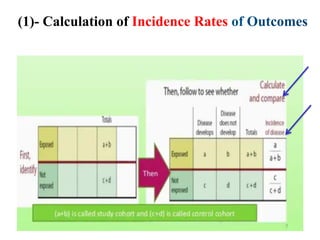
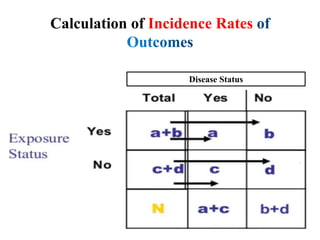
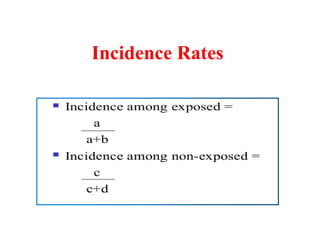
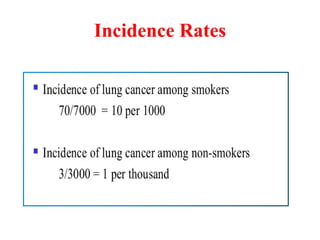
1) Calculation of incidence rates among
and non exposed groups
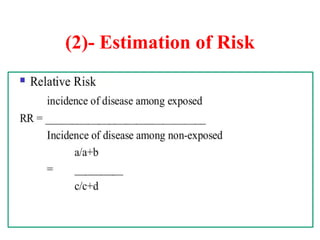
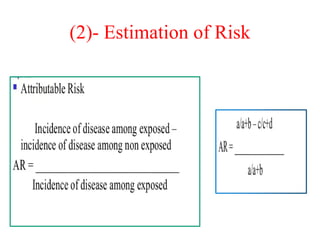
2) Estimation of risk:
✓RR (Relative Rate)
✓AR (Attributable risk)
(1)- Calculation of Incidence Rates
Calculation of Incidence Rates
Disease Status
Incidence Rates
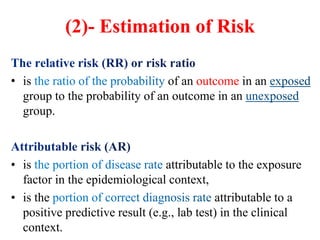
(2)- Estimation of Risk
• is of an outcome in an
group to the probability of an outcome in an
group.
• is attributable to the exposure
factor in the epidemiological context,
• is the attributable to a
positive predictive result (e.g., lab test) in the clinical
context.
(2)- Estimation of Risk
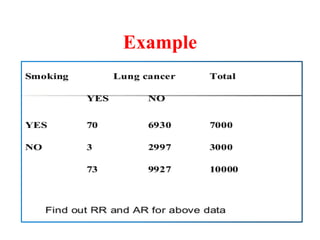
Example
Incidence Rates
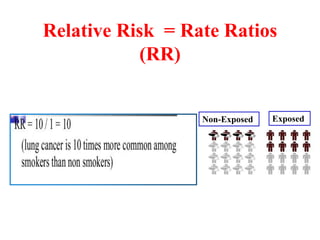
Relative Risk = Rate Ratios
(RR)
Exposed
Non-Exposed
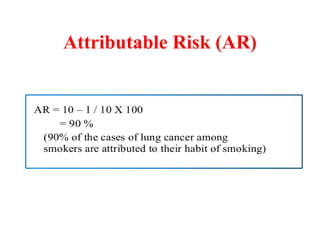
Attributable Risk (AR)
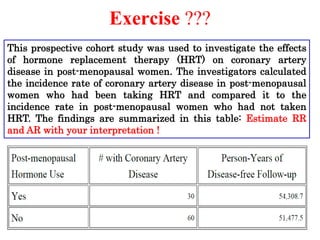
Exercise ???
This prospective cohort study was used to investigate the effects
of hormone replacement therapy (HRT) on coronary artery
disease in post-menopausal women. The investigators calculated
the incidence rate of coronary artery disease in post-menopausal
women who had been taking HRT and compared it to the
incidence rate in post-menopausal women who had not taken
HRT. The findings are summarized in this table: Estimate RR
and AR with your interpretation !
• Can establish population-based incidence
• Accurate relative risk (risk ratio) estimation
• Can examine rare exposures (asbestos > lung cancer)
• Can establish cause - effect
• Minimizes selection and information bias
• Can be used where randomization is not possible
• Magnitude of a risk factor’s effect can be quantified
• More than one disease related to single exposure
• Multiple outcomes can be studied (smoking > lung
cancer, COPD, larynx cancer)
• Often requires large sample
• Long time to complete
• Expensive
• Ethical issues
• Non response, migration and loss-to-followup
biases
• Unexpected environmental changes may influence
the association
Differential loss of follow up
follow-up between compared groups may be
a major problem.
to follow-up due to study withdrawals,
unmeasured outcomes, or unknown reasons, are always
a concern.
Contamination Subjects initially unexposed to the risk
factor of interest may become exposed at a later date. Such
“ contamination ” tends to reduce the observed effect of the
risk factor.
Selection Bias
• The largest threat to the internal validity of a cohort
studies is selection bias, also called case-mix bias .
• Select participants into exposed and not exposed groups
based on some characteristics that may affect the outcome
Information bias
Collect different quality and extent of information from
exposed and not exposed groups.
Thank You

Cohort study

  • 1.
    Dr. Faiza A.Abou El-Soud Professor - Community Health Nursing Menoufiya University-Egypt Cohort Studies
  • 2.
    ✓ To definethe design of a cohort study ✓ To identify features of cohort studies ✓ To regonize the indications for cohort study ✓ to determine the considerations during selection of cohort ✓ To differentaite between the types of cohort study ✓ To apply the elements of cohort study ✓ To describe the strengths of cohort studies ✓ To explain the weakness of cohort studies ✓ To disucss biases in cohort study
  • 3.
  • 5.
    • Persons bandedtogether. • Group of persons with a common statistical characteristic. • Example, Age, birth date,
  • 6.
    • Cohort isa group of people who share common characteristic or experience within the defined period of time. • Example, birth cohort, marriage cohort, exposure cohort, etc.
  • 7.
    • Cohorts areidentified prior to appearance of disease under investigation. • The study groups are observed over a period of time to determine the frequency of disease among them. • The study proceeds from cause to effects.
  • 8.
    here is goodevidence of an association between exposure and disease, from other studies. xposure is rare. ttrition of study population can be minimized. • ufficient fund is available.
  • 9.
    • Starts withpeople free of disease • Assesses exposure at “baseline” • Assesses disease status at “follow-up” • Both the groups must be comparable in respect of which influence the occurrence of disease. • The exposed & non-exposed groups under study be as as possible with regard to possible confounding factors • Both the groups should to disease • Diagnostic and eligibility criteria of the disease must be defined before hand.
  • 10.
    rospective cohort study etrospective(historical) cohort study • Ambi-directional cohort Study (Combination of Retrospective and) Prospective cohort study.
  • 11.
    • The commonstrategy of cohort studies is to a reference population (or a representative sample), some of whom have certain characteristics or attributes relevant to the study (exposed group), with others who do not have those characteristics (unexposed group). • Both groups should, at the outset of the study, be free from the condition under consideration. • Both groups are then observed over a specified period to find out the risk each group has of developing the condition(s) of interest.
  • 12.
    • It isone in which the outcome have all occurred before the start of investigation. • • Investigator goes back to the past to select study group from existing records of the past employment, medical and other records and traces them forward through time from the past date fixed on the records usually to the present
  • 13.
    • Elements ofprospective and retrospective cohort are . • The cohort is identified from past records and assesses of data for the outcome. • The same cohort is the followed up prospectively into future for the further assessment of outcome.
  • 15.
    I. Selection ofstudy subjects II. Selection of comparison group III. Obtaining data on exposure IV.Follow up V. Analysis
  • 16.
    • General population: *Wholepopulation in an area *A representative sample • Special group of population: Select group *Occupation group / professional group Exposure groups *Person having exposure to some physical, chemical or biological agent e.g. X-ray exposure to radiologists
  • 17.
    Internal comparison ✓Only onecohort involved in study ✓Sub-classified and internal comparison done External comparison ✓More than one cohort in the study for the purpose of comparison e.g.Cohort of radiologist compared with ophthalmologist
  • 18.
    Comparison with generalpopulation rates *If is available - we can compare the rates of study cohort with general population. of with cancer in general population
  • 19.
    e.g., Dose ofdrug, radiation, type of surgery etc. e.g.,Blood pressure, serum cholesterol e.g.,Water, Air, Sanitation status etc.
  • 20.
    • Follow upis the most critical part of the study- To obtain data about outcome to be determined (morbidity or mortality) through: ✓ Mailed questionnaire, telephone calls, personal interviews ✓ Periodic medical examination Reviewing records Surveillance of death records • Some loss to follow up is inevitable due to • Loss to follow-up is one of the
  • 21.
    1) Calculation ofincidence rates among and non exposed groups 2) Estimation of risk: ✓RR (Relative Rate) ✓AR (Attributable risk)
  • 22.
    (1)- Calculation ofIncidence Rates
  • 23.
    Calculation of IncidenceRates Disease Status
  • 24.
  • 25.
    (2)- Estimation ofRisk • is of an outcome in an group to the probability of an outcome in an group. • is attributable to the exposure factor in the epidemiological context, • is the attributable to a positive predictive result (e.g., lab test) in the clinical context.

  • 26.
  • 27.
  • 28.
  • 29.
  • 30.
    Relative Risk =Rate Ratios (RR) Exposed Non-Exposed
  • 31.
  • 32.
    Exercise ??? This prospectivecohort study was used to investigate the effects of hormone replacement therapy (HRT) on coronary artery disease in post-menopausal women. The investigators calculated the incidence rate of coronary artery disease in post-menopausal women who had been taking HRT and compared it to the incidence rate in post-menopausal women who had not taken HRT. The findings are summarized in this table: Estimate RR and AR with your interpretation !
  • 33.
    • Can establishpopulation-based incidence • Accurate relative risk (risk ratio) estimation • Can examine rare exposures (asbestos > lung cancer) • Can establish cause - effect • Minimizes selection and information bias • Can be used where randomization is not possible • Magnitude of a risk factor’s effect can be quantified • More than one disease related to single exposure • Multiple outcomes can be studied (smoking > lung cancer, COPD, larynx cancer)
  • 34.
    • Often requireslarge sample • Long time to complete • Expensive • Ethical issues • Non response, migration and loss-to-followup biases • Unexpected environmental changes may influence the association
  • 35.
    Differential loss offollow up follow-up between compared groups may be a major problem. to follow-up due to study withdrawals, unmeasured outcomes, or unknown reasons, are always a concern. Contamination Subjects initially unexposed to the risk factor of interest may become exposed at a later date. Such “ contamination ” tends to reduce the observed effect of the risk factor.
  • 36.
    Selection Bias • Thelargest threat to the internal validity of a cohort studies is selection bias, also called case-mix bias . • Select participants into exposed and not exposed groups based on some characteristics that may affect the outcome Information bias Collect different quality and extent of information from exposed and not exposed groups.
  • 37.