Journal Club Presentation
Presented By:
Name: Surakshya Devkota
Roll No: 32
BPH, VIII Semester, SHAS, PU.
12/10/2020 Surakshya Devkota 1
Presented for the partial fulfillment of requirement
of
PHA 451 Journal Club/Health Seminar
of
Bachelor of Public Health, VIII Semester,
School of Health and Allied Sciences, Pokhara University
under the cardinal supervision of
Assistant Professor Dr. Hari Prasad Kaphle
By
Surakshya Devkota,
17370209,
2016-1-37-0133.
12/10/2020 Surakshya Devkota 2
Selected Article for Presentation
• Pandey AR, Bista B, Dhungana RR, Aryal KK, Chalise B, DhimalM
(2019) Factors associated with suicidal ideation and suicidal attempts
among adolescent students in Nepal: Findings from Global School-
based Students Health Survey. PLoS ONE Volume 14 Issue 4:
e0210383. https://doi.org/10.1371/journal.pone.0210383
12/10/2020 Surakshya Devkota 3
Journal Information
• PLOS One is a peer reviewed open access scientific journal published
by the Public Library of Science since the year 2006.
• The journal covers primary research from any discipline like natural
sciences, medical, engineering social sciences, etc.
• The impact factor of the journal is 2.870 as per year 2019-2020.
• The frequency of publication depends upon the acceptance of the
journals.
• The ISSN Number is 1932-6203
12/10/2020 Surakshya Devkota 4
Contd.
• The Journal Acceptance Rate is 60.2% as per the journal acceptance
rate feedback system.
• The journal has a total of 30 editors combining the chief and associate
editors. Joerg Heber is the editor in chief.
• Usually US $ 1350 is charged for accepted articles and may be
reduced for authors from low and middle income countries.
• The time to render a first decision is of a minimum of 43 days but it
may vary.
• The journal is indexed by PubMed, MEDLINE, Scopus, Google
Scholar, Web of Science and etc.
12/10/2020 Surakshya Devkota 5
Critical Appraisal of Journal
• The articles published have open access and is a paid journal.
• The journal has set its criteria for the publication hence making more
accountable.
• This journal goes through rigorous multi stage editorial and screening
process before any final steps.
• The impact factor is good.
• It has a good editorial managing team who are highly experienced in
their subject field.
12/10/2020 Surakshya Devkota 6
Title of Article
Factors associated with suicidal ideation and suicidal attempts among
adolescent students in Nepal: Findings from Global School-based
Students Health Survey
12/10/2020 Surakshya Devkota 7
Critical Appraisal of Tittle
• The title is quite good in terms of length and indicates well on the
focus of the study.
• The title profoundly addresses the research question and the
objectives.
• The title is meaningful as it states what is done in the research.
• The title gives the idea of study population and study setting.
12/10/2020 Surakshya Devkota 8
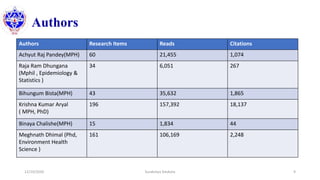
Authors
Authors Research Items Reads Citations
Achyut Raj Pandey(MPH) 60 21,455 1,074
Raja Ram Dhungana
(Mphil , Epidemiology &
Statistics )
34 6,051 267
Bihungum Bista(MPH) 43 35,632 1,865
Krishna Kumar Aryal
( MPH, PhD)
196 157,392 18,137
Binaya Chalishe(MPH) 15 1,834 44
Meghnath Dhimal (Phd,
Environment Health
Science )
161 106,169 2,248
12/10/2020 Surakshya Devkota 9
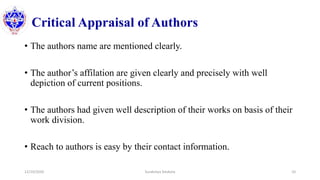
Critical Appraisal of Authors
• The authors name are mentioned clearly.
• The author’s affilation are given clearly and precisely with well
depiction of current positions.
• The authors had given well description of their works on basis of their
work division.
• Reach to authors is easy by their contact information.
12/10/2020 Surakshya Devkota 10
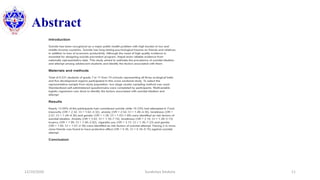
Abstract
12/10/2020 Surakshya Devkota 11
Critical Appraisal of Abstract
• The abstract of the article is well structured.
• The abstract is informative and in brief.
• The abstract is short, conscised and well equipped with needed
information.
• This shows the overall summary of the article.
12/10/2020 Surakshya Devkota 12
Introduction
• Suicide is one of the major cause of morbidity and mortality
worldwide.
• Suicide is the second leading cause of death among 15–29years.
• Suicide rate in Nepal is 7.2 in general with 8.2 in male, and 6.3 in
female per every 100,000 population.
• Suicide in adolescence is often underreported with possible causes of
negativity in their lives.
12/10/2020 Surakshya Devkota 13
Contd.
• Suicidal ideation and suicidal attempt share the common risk factors
such as hopelessness, social isolation, anxiety, depression, impulsivity
and substance abuse, etc.
• Nepal lacks large scale nationwide studies to guide policymaking
process.
• In this context, this study aims to design to assess the determinants of
suicidal ideation and attempts among adolescents of Nepal.
12/10/2020 Surakshya Devkota 14
Critical Appraisal of Introduction
• The introduction is well illustrated based on the available literatures.
• The introduction comes in a sequential manner depicting the short
brief discussion , scenario , causal factors and the need for the study
• The information given are well depicted with their proper referencing .
• The objective of the study is stated but with no hypothesis.
12/10/2020 Surakshya Devkota 15
Materials and methods
• Target population: Adolescents students
• Study setting: Schools with grade 7-11.
• Study population: Adolescent students with grade 7 to 11 from 74 schools
representing all three ecological belts and five development regions.
• Sampling method: Two stage cluster sampling method
• Sample size:6,531
• Study design: A descriptive cross-sectional study design
12/10/2020 Surakshya Devkota 16
Contd.
• Statistical Analysis: Data analysis was performed using STATA software version
15.0.
• Chi square test & Odds Ratio OR were used for bivariate analysis to assess
association between suicidal ideation and attempts.
• The research was approved by Ethical Review Board of Nepal Health Research
Council.
• Prior to participation of student in survey, administrative permission from
respective schools and written informed consent was taken from student's parent
and students.
12/10/2020 Surakshya Devkota 17
Critical Appraisal of Materials and Methods
• The study design of the research is cross sectional.
• Ethical approval was taken from NHRC and students and guardians.
• There isn’t any evidence of sampling error and sample bias.
• The sample size is large and covers a wide study range.
• The non response rate has been incorporated.
12/10/2020 Surakshya Devkota 18
Results
• Around 23.72% of the research participants were of age 16 years or
older.
• 13.59% of the participants had ever thought of suicide whereas
10.33% had attempted it.
• 4.57% of research participants had faced food insecurity.
• 4.36% had anxiety and 6.27% had felt lonely.
12/10/2020 Surakshya Devkota 19
Contd.
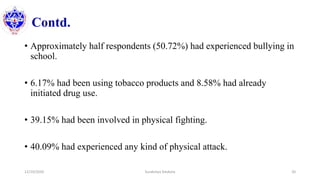
• Approximately half respondents (50.72%) had experienced bullying in
school.
• 6.17% had been using tobacco products and 8.58% had already
initiated drug use.
• 39.15% had been involved in physical fighting.
• 40.09% had experienced any kind of physical attack.
12/10/2020 Surakshya Devkota 20
Critical Appraisal of Results
• The results are presented in well tabulated way with brief explanation
below.
• The results have been presented in logical order.
• The data in the table matched with the explanations.
• The results are based on aim and objectives of the study.
12/10/2020 Surakshya Devkota 21
Discussion
12/10/2020 Surakshya Devkota 22
Critical Appraisal of Discussion
• The discussion of the article is meaningful and has highlighted the
important findings of the study.
• All the findings are shown properly with appropriate comparison
among various countries.
• The discussion are well drawn with respect to the research.
• The strengths , limitations and flaws of the study is included.
12/10/2020 Surakshya Devkota 23
Conclusion
• Study reveals high suicide rate of suicidal ideation and attempt among
Nepalese school going adolescents.
• Girls are at higher risk of suicidal ideation and suicidal attempt compared to
boy.
• Factors like food insecurity, anxiety, Loneliness and gender were found to
be associated with suicidal ideation while anxiety, loneliness, truancy,
cigarette use and gender were found to be associated with suicidal attempt.
• Appropriate coping strategies for factors like anxiety, loneliness could be
useful for preventing both suicidal ideation and attempt.
12/10/2020 Surakshya Devkota 24
Critical Appraisal of Conclusion
• The conclusion is precise and is of meaning.
• Based on aim and objectives of the study.
• The research question has been answered well.
• The conclusion derived can be believed .
• There is no enough recommendations given which seems incomplete.
12/10/2020 Surakshya Devkota 25
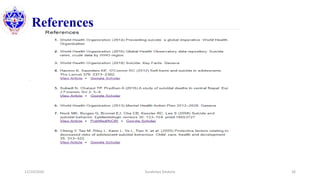
References
12/10/2020 Surakshya Devkota 26
Critical Appraisal of References
• The references are in Vancouver style of referencing.
• Total 43 references are depicted in the article which shows a better
reliability on the data and information used.
• The shown references are enough for the readers to pursue further
reading and learning.
• The citations and references are matching.
12/10/2020 Surakshya Devkota 27
Strengths
• This was the first study done in Nepal among large and nationwide
representative sample intended to determine the risk factors of suicidal
ideation and attempt.
• The study has used globally standardized methodology of GSHS,
hence study findings are comparable to other countries adopting same
or similar methodology.
12/10/2020 Surakshya Devkota 28
Contd.
• The article is a reliable and useful source of information for academic
and non academic purposes.
• An authentic and scientific research design and methods have been
applied.
• The authors contribution were well shown with their portion of work
in a clear way.
12/10/2020 Surakshya Devkota 29
Weaknesses
• Study does not cover the adolescents who did not attend school.
• Study also did not collect information on socioeconomic status,
religious affiliation, social participation and psychological co-
morbidities that could be important in characterizing suicidal ideation
and attempt.
• Lacking of recommendations was vividly missing.
12/10/2020 Surakshya Devkota 30
Overall significance of the article
• The overall findings are trustworthy and believable.
• The findings from the study serves as a basemark for further studies.
• It can be a useful article for academic and non academic purpose.
• The study findings could be useful for policy makers in designing
appropriate strategies for suicide prevention.
12/10/2020 Surakshya Devkota 31
Contribution in conducting my research
• The title of my research is : Prevalence and factors associated with
suicidal ideation and attempts among school going adolescents in
schools of Pokhara Metropolitan.
• I can get help from this article through this ways :
Literature review for research proposal.
The questionnaire in the study can be helpful for designing
questionnaire for my research.
The cited references can add more learning base for continuing my
research.
Helps to reduce possible errors in my research.
12/10/2020 Surakshya Devkota 32
Questions?
Quarries?
Suggestions?
Feedbacks?
12/10/2020 <Insert your name here> 33
Thank You!
12/10/2020 Surakshya Devkota 34

32 surakshya devkota-journal-club-presentation

  • 1.
    Journal Club Presentation PresentedBy: Name: Surakshya Devkota Roll No: 32 BPH, VIII Semester, SHAS, PU. 12/10/2020 Surakshya Devkota 1
  • 2.
    Presented for thepartial fulfillment of requirement of PHA 451 Journal Club/Health Seminar of Bachelor of Public Health, VIII Semester, School of Health and Allied Sciences, Pokhara University under the cardinal supervision of Assistant Professor Dr. Hari Prasad Kaphle By Surakshya Devkota, 17370209, 2016-1-37-0133. 12/10/2020 Surakshya Devkota 2
  • 3.
    Selected Article forPresentation • Pandey AR, Bista B, Dhungana RR, Aryal KK, Chalise B, DhimalM (2019) Factors associated with suicidal ideation and suicidal attempts among adolescent students in Nepal: Findings from Global School- based Students Health Survey. PLoS ONE Volume 14 Issue 4: e0210383. https://doi.org/10.1371/journal.pone.0210383 12/10/2020 Surakshya Devkota 3
  • 4.
    Journal Information • PLOSOne is a peer reviewed open access scientific journal published by the Public Library of Science since the year 2006. • The journal covers primary research from any discipline like natural sciences, medical, engineering social sciences, etc. • The impact factor of the journal is 2.870 as per year 2019-2020. • The frequency of publication depends upon the acceptance of the journals. • The ISSN Number is 1932-6203 12/10/2020 Surakshya Devkota 4
  • 5.
    Contd. • The JournalAcceptance Rate is 60.2% as per the journal acceptance rate feedback system. • The journal has a total of 30 editors combining the chief and associate editors. Joerg Heber is the editor in chief. • Usually US $ 1350 is charged for accepted articles and may be reduced for authors from low and middle income countries. • The time to render a first decision is of a minimum of 43 days but it may vary. • The journal is indexed by PubMed, MEDLINE, Scopus, Google Scholar, Web of Science and etc. 12/10/2020 Surakshya Devkota 5
  • 6.
    Critical Appraisal ofJournal • The articles published have open access and is a paid journal. • The journal has set its criteria for the publication hence making more accountable. • This journal goes through rigorous multi stage editorial and screening process before any final steps. • The impact factor is good. • It has a good editorial managing team who are highly experienced in their subject field. 12/10/2020 Surakshya Devkota 6
  • 7.
    Title of Article Factorsassociated with suicidal ideation and suicidal attempts among adolescent students in Nepal: Findings from Global School-based Students Health Survey 12/10/2020 Surakshya Devkota 7
  • 8.
    Critical Appraisal ofTittle • The title is quite good in terms of length and indicates well on the focus of the study. • The title profoundly addresses the research question and the objectives. • The title is meaningful as it states what is done in the research. • The title gives the idea of study population and study setting. 12/10/2020 Surakshya Devkota 8
  • 9.
    Authors Authors Research ItemsReads Citations Achyut Raj Pandey(MPH) 60 21,455 1,074 Raja Ram Dhungana (Mphil , Epidemiology & Statistics ) 34 6,051 267 Bihungum Bista(MPH) 43 35,632 1,865 Krishna Kumar Aryal ( MPH, PhD) 196 157,392 18,137 Binaya Chalishe(MPH) 15 1,834 44 Meghnath Dhimal (Phd, Environment Health Science ) 161 106,169 2,248 12/10/2020 Surakshya Devkota 9
  • 10.
    Critical Appraisal ofAuthors • The authors name are mentioned clearly. • The author’s affilation are given clearly and precisely with well depiction of current positions. • The authors had given well description of their works on basis of their work division. • Reach to authors is easy by their contact information. 12/10/2020 Surakshya Devkota 10
  • 11.
  • 12.
    Critical Appraisal ofAbstract • The abstract of the article is well structured. • The abstract is informative and in brief. • The abstract is short, conscised and well equipped with needed information. • This shows the overall summary of the article. 12/10/2020 Surakshya Devkota 12
  • 13.
    Introduction • Suicide isone of the major cause of morbidity and mortality worldwide. • Suicide is the second leading cause of death among 15–29years. • Suicide rate in Nepal is 7.2 in general with 8.2 in male, and 6.3 in female per every 100,000 population. • Suicide in adolescence is often underreported with possible causes of negativity in their lives. 12/10/2020 Surakshya Devkota 13
  • 14.
    Contd. • Suicidal ideationand suicidal attempt share the common risk factors such as hopelessness, social isolation, anxiety, depression, impulsivity and substance abuse, etc. • Nepal lacks large scale nationwide studies to guide policymaking process. • In this context, this study aims to design to assess the determinants of suicidal ideation and attempts among adolescents of Nepal. 12/10/2020 Surakshya Devkota 14
  • 15.
    Critical Appraisal ofIntroduction • The introduction is well illustrated based on the available literatures. • The introduction comes in a sequential manner depicting the short brief discussion , scenario , causal factors and the need for the study • The information given are well depicted with their proper referencing . • The objective of the study is stated but with no hypothesis. 12/10/2020 Surakshya Devkota 15
  • 16.
    Materials and methods •Target population: Adolescents students • Study setting: Schools with grade 7-11. • Study population: Adolescent students with grade 7 to 11 from 74 schools representing all three ecological belts and five development regions. • Sampling method: Two stage cluster sampling method • Sample size:6,531 • Study design: A descriptive cross-sectional study design 12/10/2020 Surakshya Devkota 16
  • 17.
    Contd. • Statistical Analysis:Data analysis was performed using STATA software version 15.0. • Chi square test & Odds Ratio OR were used for bivariate analysis to assess association between suicidal ideation and attempts. • The research was approved by Ethical Review Board of Nepal Health Research Council. • Prior to participation of student in survey, administrative permission from respective schools and written informed consent was taken from student's parent and students. 12/10/2020 Surakshya Devkota 17
  • 18.
    Critical Appraisal ofMaterials and Methods • The study design of the research is cross sectional. • Ethical approval was taken from NHRC and students and guardians. • There isn’t any evidence of sampling error and sample bias. • The sample size is large and covers a wide study range. • The non response rate has been incorporated. 12/10/2020 Surakshya Devkota 18
  • 19.
    Results • Around 23.72%of the research participants were of age 16 years or older. • 13.59% of the participants had ever thought of suicide whereas 10.33% had attempted it. • 4.57% of research participants had faced food insecurity. • 4.36% had anxiety and 6.27% had felt lonely. 12/10/2020 Surakshya Devkota 19
  • 20.
    Contd. • Approximately halfrespondents (50.72%) had experienced bullying in school. • 6.17% had been using tobacco products and 8.58% had already initiated drug use. • 39.15% had been involved in physical fighting. • 40.09% had experienced any kind of physical attack. 12/10/2020 Surakshya Devkota 20
  • 21.
    Critical Appraisal ofResults • The results are presented in well tabulated way with brief explanation below. • The results have been presented in logical order. • The data in the table matched with the explanations. • The results are based on aim and objectives of the study. 12/10/2020 Surakshya Devkota 21
  • 22.
  • 23.
    Critical Appraisal ofDiscussion • The discussion of the article is meaningful and has highlighted the important findings of the study. • All the findings are shown properly with appropriate comparison among various countries. • The discussion are well drawn with respect to the research. • The strengths , limitations and flaws of the study is included. 12/10/2020 Surakshya Devkota 23
  • 24.
    Conclusion • Study revealshigh suicide rate of suicidal ideation and attempt among Nepalese school going adolescents. • Girls are at higher risk of suicidal ideation and suicidal attempt compared to boy. • Factors like food insecurity, anxiety, Loneliness and gender were found to be associated with suicidal ideation while anxiety, loneliness, truancy, cigarette use and gender were found to be associated with suicidal attempt. • Appropriate coping strategies for factors like anxiety, loneliness could be useful for preventing both suicidal ideation and attempt. 12/10/2020 Surakshya Devkota 24
  • 25.
    Critical Appraisal ofConclusion • The conclusion is precise and is of meaning. • Based on aim and objectives of the study. • The research question has been answered well. • The conclusion derived can be believed . • There is no enough recommendations given which seems incomplete. 12/10/2020 Surakshya Devkota 25
  • 26.
  • 27.
    Critical Appraisal ofReferences • The references are in Vancouver style of referencing. • Total 43 references are depicted in the article which shows a better reliability on the data and information used. • The shown references are enough for the readers to pursue further reading and learning. • The citations and references are matching. 12/10/2020 Surakshya Devkota 27
  • 28.
    Strengths • This wasthe first study done in Nepal among large and nationwide representative sample intended to determine the risk factors of suicidal ideation and attempt. • The study has used globally standardized methodology of GSHS, hence study findings are comparable to other countries adopting same or similar methodology. 12/10/2020 Surakshya Devkota 28
  • 29.
    Contd. • The articleis a reliable and useful source of information for academic and non academic purposes. • An authentic and scientific research design and methods have been applied. • The authors contribution were well shown with their portion of work in a clear way. 12/10/2020 Surakshya Devkota 29
  • 30.
    Weaknesses • Study doesnot cover the adolescents who did not attend school. • Study also did not collect information on socioeconomic status, religious affiliation, social participation and psychological co- morbidities that could be important in characterizing suicidal ideation and attempt. • Lacking of recommendations was vividly missing. 12/10/2020 Surakshya Devkota 30
  • 31.
    Overall significance ofthe article • The overall findings are trustworthy and believable. • The findings from the study serves as a basemark for further studies. • It can be a useful article for academic and non academic purpose. • The study findings could be useful for policy makers in designing appropriate strategies for suicide prevention. 12/10/2020 Surakshya Devkota 31
  • 32.
    Contribution in conductingmy research • The title of my research is : Prevalence and factors associated with suicidal ideation and attempts among school going adolescents in schools of Pokhara Metropolitan. • I can get help from this article through this ways : Literature review for research proposal. The questionnaire in the study can be helpful for designing questionnaire for my research. The cited references can add more learning base for continuing my research. Helps to reduce possible errors in my research. 12/10/2020 Surakshya Devkota 32
  • 33.
  • 34.