Dr. Tanya Anand Student Id : 19MDS15 Department of Periodontology
COHORT STUDY
INDEX
 EPIDEMIOLOGY
 CLASSIFICATION
 DESIGN-COHORT STUDY
 CONCEPT
 INDICATION
 TPYES
 ELEMENTS
 ADAVANTAGES AND DISADVANTAGES
 RELATED STUDIES
 REFERENCES
Epidemiology
• “The study of the distribution and determinants of health-related states or
events in specified populations, and the application of this study to the
control of health problems”
John M. Last 1988
Epidemiologic Method
The primary concern of the epidemiologist is to study disease occurrence in
people , who during the course of their lives are exposed to numerous factors
and circumstances, some of which may have a role in disease aetiology.
Classification
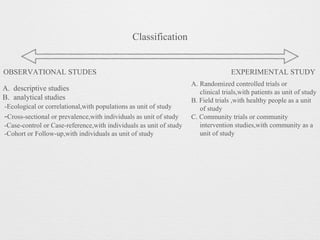
EXPERIMENTAL STUDYOBSERVATIONAL STUDES
A. Randomized controlled trials or
clinical trials,with patients as unit of study
B. Field trials ,with healthy people as a unit
of study
C. Community trials or community
intervention studies,with community as a
unit of study
A. descriptive studies
B. analytical studies
-Ecological or correlational,with populations as unit of study
-Cross-sectional or prevalence,with individuals as unit of study
-Case-control or Case-reference,with individuals as unit of study
-Cohort or Follow-up,with individuals as unit of study
Analytical Epidemiology
• It is second major type of epidemiological studies.
• In contrast to descriptive studies that look at entire population, in analytical
studies ,the subject of interest is the individual within the population.
• The object is not to formulate but to test hypotheses.
• It comprises of two distinct types of observational studies :
-case control study
-cohort study
• From each of these designs,one can determine :
a)whether or not a statistical association exists between a disease and a
suspected factor
b)if one exists,the strength of association
Design of cohort studies
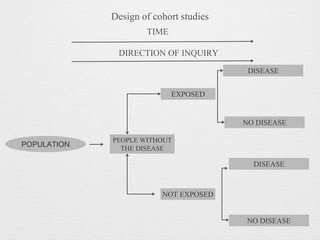
TIME
DIRECTION OF INQUIRY
POPULATION
PEOPLE WITHOUT
THE DISEASE
EXPOSED
NOT EXPOSED
DISEASE
NO DISEASE
DISEASE
NO DISEASE
Cohort Study
• Cohort study is another type of analytical (observational) study which is
usually undertaken to obtain additional evidence to refute or support the
existence of an association between suspected cause and disease.
• Also known as:
✦ propective study,
✦ longitudinal study,
✦ incidence study,
✦ forward looking study
DISTINGUISHING FEATURES:
• The cohorts are identified prior to appearance of the disease under
investigation
• The study groups, so defined, are observed over a period of time to
determine the frequency of disease among them
• study proceeds forward from cause to effect
CONCEPT
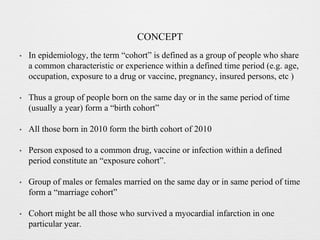
• In epidemiology, the term “cohort” is defined as a group of people who share
a common characteristic or experience within a defined time period (e.g. age,
occupation, exposure to a drug or vaccine, pregnancy, insured persons, etc )
• Thus a group of people born on the same day or in the same period of time
(usually a year) form a “birth cohort”
• All those born in 2010 form the birth cohort of 2010
• Person exposed to a common drug, vaccine or infection within a defined
period constitute an “exposure cohort”.
• Group of males or females married on the same day or in same period of time
form a “marriage cohort”
• Cohort might be all those who survived a myocardial infarction in one
particular year.
• Comparasion group may be the general group population from which the
cohort is drawn, or it may be another cohort of persons thought to have had
little or no exposure to the substance in question, but otherwise similar.
INDICATION
• When there is good evidence of an association between exposure and
disease, as derived from clinical observations and supported by descriptive
and case control studies
• When exposure is rare, but the incidence of disease high among exposed
eg. special exposure groups like those in industries, exposure to X-rays etc.
• When attrition of study population can be minimized, e.g. ,follow-up is easy,
cohort is stable , co-operative and easily accessible
• When ample funds are available
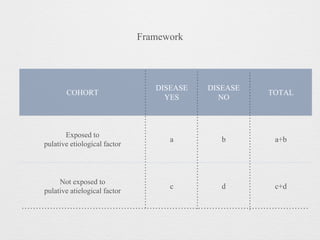
Framework
COHORT
DISEASE
YES
DISEASE
NO
TOTAL
• In assembling cohort, the following general considerations are taken into
account :
➡ The cohort must be 'free from the disease' under study.Thus, if disease under
the study is coronary heart disease,the cohort members are first examined
and those who already have evidence of the disease under investigation are
excluded.
➡ Insofar as the knowledge of the disease permits , both the groups(i.e., study
and control cohorts) should be ‘equally susceptible to the disease’ under
study. (for e.g. males over 35 years would be appropriate example for studies
of lung cancer).
➡ Both the groups should be ‘comparable' in respect of all the possible
variables,which may influence the frequency of the disease; and
➡ The 'diagnostic and eligibility criteria of the disease' must be defined before
hand ; this will depend upon the availability of reliable methods of
recognizing the disease when it develops.
TYPES
• Classified on the basis of the 'time of occurence of disease' in relation to the
time at which the investigation is initiated and continued :
❖ Prospective cohort study
❖ Retrospective cohort study
❖ combination of retrospective and prospective cohort studies
Prospective Cohort Study
• aka "current cohort" study
• In this study , the outcome (e.g. disease) has not yet occurred at the time
investigation begins.
• present future
• e.g. long term effects of exposure to uranium was evaluated by identifying a
group of uranium miners and a comparison group of individuals not exposed
to uranium mining and by assessing subsequent development of lung cancer
in both the groups.The principal finding was that the uranium miners had an
excess frequency of lung cancer compared to non-miners.
• since the disease had not yet occurred when the study was undertaken , this
was prospective study design.
• Few other examples of cohort study
➡ The US Public Health Service’s Framingham Heart Study
➡ Doll and Hills prospective study smoking and lung cancer
➡ Study of oral contraceptives and health by the Royal College of General
Practitioners
Retrospective cohort Study
• aka "historical cohort" study or "prospective study in retrospect" or
“non-concurrent prospective study"
• In this study , 'outcomes have all occurred' before the start of investigation
• The investigator goes back in time, sometimes 10 to 30 years, to select his
study groups from existing records of past employment,medical or other
records and traces them forward through time , from a past date fixed on the
records, usually upto the present .
• Study undertaken in 1978: -a cohort of 17,080 babies born between January
1, 1969 and December 31st , 1975 at a boston hospital were investigated of
the effects electronic foetal monitoring during labour.The outcome measured
was neonatal death. The study showed neonatal death rate was 1.7 times
higher in unmonitored infants
• most notable retrospective study to date are those of occupational
exposures,because the recorded information is easily available e.g. the study
of role of arsenic in human carcinogenesis ,study of lung cancer in uranium
miners, study of mortality experience of groups of physicians in relation to
their probable exposure to radiation
✴ “Retrospective cohort studies are generally 'more economical' and produce
results more 'quickly' than prospective cohort studies
Combination of retrospective and prospective cohort studies
• Both retrospective and prospective elements are combined
• The cohort is identified from the past records, and is assessed of date for the
outcome
• The same cohort is followed up prospectively into future for further
assessment of outcome .
Elements of cohort study
➡ Selection of study subjects
➡ Obtaining data on exposure
➡ Selection of comparison groups
➡ Follow-up
➡ Analysis
Selection of study subjects
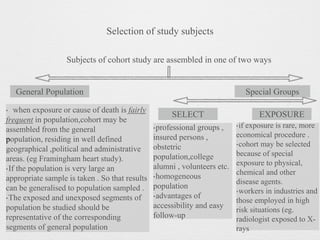
Subjects of cohort study are assembled in one of two ways
Special GroupsGeneral Population
‣ when exposure or cause of death is fairly
frequent in population,cohort may be
assembled from the general
population, residing in well defined
geographical ,political and administrative
areas. (eg Framingham heart study).
‣If the population is very large an
appropriate sample is taken . So that results
can be generalised to population sampled .
‣The exposed and unexposed segments of
population be studied should be
representative of the corresponding
segments of general population
‣professional groups ,
insured persons ,
obstetric
population,college
alumni , volunteers etc.
‣homogeneous
population
‣advantages of
accessibility and easy
follow-up
‣if exposure is rare, more
economical procedure .
‣cohort may be selected
because of special
exposure to physical,
chemical and other
disease agents.
‣workers in industries and
those employed in high
risk situations (eg.
radiologist exposed to X-
rays
SELECT EXPOSURE
Obtaining data on exposure
Information about exposure may be obtained directly from
A. Cohort Members : through 'personal interviews' or 'mailed questionnaires'
Since cohort studies involve large numbers of population mailed
questionnaires offer a simple and economic way of obtaining information.
For example, Doll and Hill used mailed questionnaires to collect smoking
histories from british doctors.
B. Review Of Records : Certain kind of information (eg. dose of radiation,
Kinds of surgery or details of medical treatment) can be obtained only
from Medical records.
C. Medical Examination or Special Tests : Some types of information can be
obtained only by medical examination or special tests e.g. blood pressure,
serum cholesterol , ECG.
D. Environmental Surveys : This is the best source of obtaining information
on exposure surveys of the suspected factors in the environment where the
cohort lived or worked.
Infact information may be needed from more than one or all of the above
sources.
• classification of cohort members :
➡ according to whether or not hey have been 'exposed' to the suspected factors
➡ according to the 'level or degree of exposure', at least in broad classes, in the
case of special exposure groups
Selection of comparison groups
• There are many ways of assembling comparison groups:
✤ Internal Comparisons:
‣ No outside comparison group is required , comparison groups are in-built i.e.
single cohort enters the study ,and its members may, on the basis of
information obtained, be classified into several comparison groups according
to the degrees or levels of exposure to risk (e.g. smoking , blood pressure ,
serum cholesterol) before development of disease in question.
‣ groups are compared in terms of morbidity and mortality rates.
‣ Eg: mortality from lung cancer increases with increasing number of
cigarettes smoked reinforcing the conclusion that there is valid association
between smoking and lung cancer.
✤ External comparison:
‣ When information on degree of exposure is not available, it is necessary to
put up an external control, to evaluate the experience of the exposed group,
e.g. smokers and non-smokers ; cohort of radiologists compared with a
cohort of ophthalmologists, etc
‣ The study and control cohorts should be similar in demographic and possibly
important variables other than those under study.
✤ Comparison with general population rates :
‣ if none is available , the mortality experience of the exposed group is
compared with the mortality experience of the general population in the
same geographic area as the exposed people
‣ e.g. comparison of frequency of lung cancer mortality in general population
where the miners resided
‣ comparison of frequency of cancer among asbestos workers with the rate in
general population in the same geographic area.
‣ Limitations in using general population rates for comparisons are :
๏ non-availability of population rates for the outcome required.
๏ the difficulties of selecting the study and comparison groups which are
representative of the exposed and non-exposed segments of general
population.
Follow-up
• One of the problem in cohort studies is the regular follow-up of the
participants
• Therefore, at the start of study, methods should be devised depending upon
the outcome to be determined (morbidity or death), to obtain data for
assessing the outcome
• the procedures required comprise:
i) periodic medical examination of each member of the cohort
ii)reviewing physician and hospital records
iii) routine surveillance of death records
iv)mailed questionnaires , telephone calls , periodic home visits-preferably all
three on an annual basis
• Of the above , periodic examination of each member of the cohort , yields
greater amount of information on the individuals examined , than would the
use of any other procedure.
• however inspite of best efforts, a certain percentage of losses to follow-up
are inevitable due to death , change of residence , migration or withdrawal of
occupation.
• these losses may bias the results.
• Therefore, it is necessary to build into the study design a system for
obtaining basic information on outcome for those who cannot be followed up
in the detail for the full duration of the study.
• Safest course recommended is to achieve as close to a 95% follow-up as
possible.
Analysis
• The data is analysed in terms of:
➡ Incidence rates of outcome among exposed and non-exposed
➡ Estimation of risk
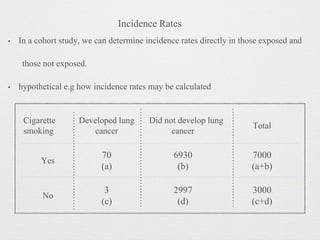
Incidence Rates
• In a cohort study, we can determine incidence rates directly in those exposed and
those not exposed.
• hypothetical e.g how incidence rates may be calculated
• Icidence rates
‣ among smokers = 70/7000 = 10 per 1000
‣ among non-smokers = 3/3000 = 1 per 1000
statistical significance : P < 0.001
Estimation of Risk
• Having calculated the incidence rates, the next step is to estimate the risk of
outcome (e.g. disease or death) in the exposed and non-exposed cohorts
• This is done in terms of two well-known indices
‣ relative risk
‣ attributable risk
Relative Risk
• Relative risk (RR) is the ratio of the incidence of the disease (or death) among
exposed and the incidence among non-exposed.
• aka risk ratio
• RR = Incidence of disease (or death) among exposed
Incidence of disease (or death) among non-exposed
• Estimation of relative risk is important in 'etiological enquiries'.
• Direct measure (or index) of “strength” of the association between suspected
cause and effect.
• Relative risk of one indicates no association
• Relative risk greater than one shows “positive” association between exposure
and disease under study
• Relative risk of two indicates that the incidence rate of disease is two times
higher in the exposed group as compared with the unexposed. Equivalently,
this represents 100 percent increase in risk.
• Relative risk of 0.25 indicates a 75% reduction in the incidence rate in
exposed individuals as compared with the unexposed.
• It is often useful to consider 95% confidence interval of relative risk since it
provides an indication of the likely and maximum levels of risk.
Attributable Risk
• Attributable risk (AR) is the differencce in incidence rates of disease (or
death)between an exposed group and non-exposed group.
• aka risk difference
• AR = incidence of disease rate among exposed - incidence of disease
rate among non exposed X 100
Incidence rate among exposed
• AR indicates to what extent the disease under study can be attributed to the
exposure
Population-Attributable Risk
• P-A R = “Incidence of disease (or death) in total population” - “ Incidence
of disease (or death) among those who were not exposed to the
suspected casual factor”
• The concept of population provides an estimate of the amount by which the
disease could be reduced in that population if the suspected factor was
eliminated or modified.
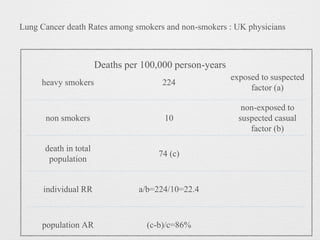
Lung Cancer death Rates among smokers and non-smokers : UK physicians
Deaths per 100,000 person-years
Relative Risk versus Attributable Risk
• Relative risk is important in aetiological enquiries.
• Its size is better index than is attributable risk for assessing the aetiological
role of a factor in disease.
• Larger the relative risk stronger the association between cause and affect.
• But relative risk does not reflect the potential public health importance as the
attributable risk , i.e. attributable risk gives a better idea than does the
relative risk of the impact of successful preventive or public health
programme might in reducing the problem.
Advantages-Cohort Study
• Incidence can be calculated
• Several Possible outcomes related to exposure can be studied
simultaneously-i.e we can study the association of the suspected factor with
many other diseases in addition to the one under study.
‣ for eg: cohort studies designed to study the association between smoking
and lung cancer also showed association of smoking with coronary heart
disease , peptic ulcer cancer oesophagus and several other.
• Provide a direct estimate of relative risk.
• Dose-Response ratios can be calculated
• Since comparison groups are formed before disease develops,certain form of
bias can be minimized .
Disadvantage-Cohort Study
• It involves large number of people. They are unsuitable for investigating
uncommon diseases with low incidence in the population.
• Long duration in completion of study
• Administrative problem
• It is not unusual to lose a substantial proportion of orignal cohort
• Selection of comparison groups which are representative of the exposed and
unexposed segments of the population is a limiting factor.Those who
volunteer for the study may not be representative of all individuals with the
characteristic of interest.
• Expensive
• There may be changes in the standard methods or diagnostic criteria of the
disease over prolonged follow-up.Once the study protocol is established , it
is difficult to introduce new knowledge or new tests later.
• study may alter people’s behaviour.
Related Studies
• Yamamoto, Tatsuo,Kondo, Katsunori,Hirai, Hiroshi, et al : Analysis was
conducted on 4425 residents 65 years or older. Four self-reported dental health
variables included the number of teeth and/or use of dentures, ability to chew,
presence/absence of a regular dentist, and taking care of dental health. Data were
collected using self-administered questionnaires given in 2003.Dementia onset
was recorded in 220 participants.Concluding Few teeth without dentures and
absence of a regular dentist, not poor mastication and poor attitudes toward
dental health, were associated with higher risk of dementia onset in the older
Japanese cohort even after adjustment for available covariates.
Yamamoto T, Kondo K, Hirai H, Nakade M, Aida J, Hirata Y. Association between self-reported dental health status and onset of dementia: a 4-year prospective cohort study of older Japanese adults from the Aichi Gerontological Evaluation Study
(AGES) Project. Psychosomatic medicine. 2012 1;74(3):241-248.
• Xian‐Tao Zeng Ling‐Yun Xia Yong‐Gang Zhang Sheng Li Wei‐Dong
Leng Joey S.W. Kwong :Five cohort studies were included, involving
321,420 participants in this meta‐analysis. Summary estimates based on
adjusted data showed that periodontal disease was associated with a
significant risk of lung cancer.Subgroup analysis indicated that the
association of periodontal disease and lung cancer remained significant in the
female population.
Zeng XT, Xia LY, Zhang YG, Li S, Leng WD, Kwong JS. Periodontal disease and incident lung cancer risk: A meta‐analysis of
cohort studies. Journal of periodontology. 2016 Oct 1;87(10):1158-1164.
• Lin TH, Lung CC, Su HP, Huang JY, Ko PC, Jan SR, et all : Data were
retrieved from the National Health Insurance Research Database,
Taiwan. A diagnosis of periodontitis was defined on the basis of
subgingival curettage, periodontal flap operation, and gingivectomy
(excluding those with restorative or aesthetic indications). Multiple
logistic regression was used for analysis.After adjusting for age, sex,
income, and geographical region, there was a significant association
between periodontitis and osteoporosis among women.
Lin TH, Lung CC, Su HP, Huang JY, Ko PC, Jan SR, Sun YH, Nfor ON, Tu HP, Chang CS, Jian ZH. Association between periodontal
disease and osteoporosis by gender: a nationwide population-based cohort study. Medicine. 2015 ;94-97.
• Park.k.,(2017), Park’s textbook of preventive and social medicine(24th
edition) Jabalpur:Banarsidad bhanot,2017
• Yamamoto T, Kondo K, Hirai H, Nakade M, Aida J, Hirata Y. Association
between self-reported dental health status and onset of dementia: a 4-year
prospective cohort study of older Japanese adults from the Aichi
Gerontological Evaluation Study (AGES) Project. Psychosomatic medicine.
2012 1;74(3):241-248.
• Zeng XT, Xia LY, Zhang YG, Li S, Leng WD, Kwong JS. Periodontal
disease and incident lung cancer risk: A meta‐analysis of cohort studies.
Journal of periodontology. 2016 Oct 1;87(10):1158-1164.
• Lin TH, Lung CC, Su HP, Huang JY, Ko PC, Jan SR, Sun YH, Nfor ON, Tu
HP, Chang CS, Jian ZH. Association between periodontal disease and
osteoporosis by gender: a nationwide population-based cohort study.
Medicine. 2015 ;94-97.
REFERENCE
Cohort study

Cohort study

  • 1.
    Dr. Tanya AnandStudent Id : 19MDS15 Department of Periodontology COHORT STUDY
  • 2.
    INDEX  EPIDEMIOLOGY  CLASSIFICATION DESIGN-COHORT STUDY  CONCEPT  INDICATION  TPYES  ELEMENTS  ADAVANTAGES AND DISADVANTAGES  RELATED STUDIES  REFERENCES
  • 3.
    Epidemiology • “The studyof the distribution and determinants of health-related states or events in specified populations, and the application of this study to the control of health problems” John M. Last 1988
  • 4.
    Epidemiologic Method The primaryconcern of the epidemiologist is to study disease occurrence in people , who during the course of their lives are exposed to numerous factors and circumstances, some of which may have a role in disease aetiology.
  • 5.
    Classification EXPERIMENTAL STUDYOBSERVATIONAL STUDES A.Randomized controlled trials or clinical trials,with patients as unit of study B. Field trials ,with healthy people as a unit of study C. Community trials or community intervention studies,with community as a unit of study A. descriptive studies B. analytical studies -Ecological or correlational,with populations as unit of study -Cross-sectional or prevalence,with individuals as unit of study -Case-control or Case-reference,with individuals as unit of study -Cohort or Follow-up,with individuals as unit of study
  • 6.
    Analytical Epidemiology • Itis second major type of epidemiological studies. • In contrast to descriptive studies that look at entire population, in analytical studies ,the subject of interest is the individual within the population. • The object is not to formulate but to test hypotheses. • It comprises of two distinct types of observational studies : -case control study -cohort study
  • 7.
    • From eachof these designs,one can determine : a)whether or not a statistical association exists between a disease and a suspected factor b)if one exists,the strength of association
  • 8.
    Design of cohortstudies TIME DIRECTION OF INQUIRY POPULATION PEOPLE WITHOUT THE DISEASE EXPOSED NOT EXPOSED DISEASE NO DISEASE DISEASE NO DISEASE
  • 9.
    Cohort Study • Cohortstudy is another type of analytical (observational) study which is usually undertaken to obtain additional evidence to refute or support the existence of an association between suspected cause and disease. • Also known as: ✦ propective study, ✦ longitudinal study, ✦ incidence study, ✦ forward looking study
  • 10.
    DISTINGUISHING FEATURES: • Thecohorts are identified prior to appearance of the disease under investigation • The study groups, so defined, are observed over a period of time to determine the frequency of disease among them • study proceeds forward from cause to effect
  • 11.
    CONCEPT • In epidemiology,the term “cohort” is defined as a group of people who share a common characteristic or experience within a defined time period (e.g. age, occupation, exposure to a drug or vaccine, pregnancy, insured persons, etc ) • Thus a group of people born on the same day or in the same period of time (usually a year) form a “birth cohort” • All those born in 2010 form the birth cohort of 2010 • Person exposed to a common drug, vaccine or infection within a defined period constitute an “exposure cohort”. • Group of males or females married on the same day or in same period of time form a “marriage cohort” • Cohort might be all those who survived a myocardial infarction in one particular year.
  • 12.
    • Comparasion groupmay be the general group population from which the cohort is drawn, or it may be another cohort of persons thought to have had little or no exposure to the substance in question, but otherwise similar.
  • 13.
    INDICATION • When thereis good evidence of an association between exposure and disease, as derived from clinical observations and supported by descriptive and case control studies • When exposure is rare, but the incidence of disease high among exposed eg. special exposure groups like those in industries, exposure to X-rays etc. • When attrition of study population can be minimized, e.g. ,follow-up is easy, cohort is stable , co-operative and easily accessible • When ample funds are available
  • 14.
  • 15.
    • In assemblingcohort, the following general considerations are taken into account : ➡ The cohort must be 'free from the disease' under study.Thus, if disease under the study is coronary heart disease,the cohort members are first examined and those who already have evidence of the disease under investigation are excluded. ➡ Insofar as the knowledge of the disease permits , both the groups(i.e., study and control cohorts) should be ‘equally susceptible to the disease’ under study. (for e.g. males over 35 years would be appropriate example for studies of lung cancer). ➡ Both the groups should be ‘comparable' in respect of all the possible variables,which may influence the frequency of the disease; and ➡ The 'diagnostic and eligibility criteria of the disease' must be defined before hand ; this will depend upon the availability of reliable methods of recognizing the disease when it develops.
  • 16.
    TYPES • Classified onthe basis of the 'time of occurence of disease' in relation to the time at which the investigation is initiated and continued : ❖ Prospective cohort study ❖ Retrospective cohort study ❖ combination of retrospective and prospective cohort studies
  • 17.
    Prospective Cohort Study •aka "current cohort" study • In this study , the outcome (e.g. disease) has not yet occurred at the time investigation begins. • present future • e.g. long term effects of exposure to uranium was evaluated by identifying a group of uranium miners and a comparison group of individuals not exposed to uranium mining and by assessing subsequent development of lung cancer in both the groups.The principal finding was that the uranium miners had an excess frequency of lung cancer compared to non-miners. • since the disease had not yet occurred when the study was undertaken , this was prospective study design.
  • 18.
    • Few otherexamples of cohort study ➡ The US Public Health Service’s Framingham Heart Study ➡ Doll and Hills prospective study smoking and lung cancer ➡ Study of oral contraceptives and health by the Royal College of General Practitioners
  • 19.
    Retrospective cohort Study •aka "historical cohort" study or "prospective study in retrospect" or “non-concurrent prospective study" • In this study , 'outcomes have all occurred' before the start of investigation • The investigator goes back in time, sometimes 10 to 30 years, to select his study groups from existing records of past employment,medical or other records and traces them forward through time , from a past date fixed on the records, usually upto the present .
  • 20.
    • Study undertakenin 1978: -a cohort of 17,080 babies born between January 1, 1969 and December 31st , 1975 at a boston hospital were investigated of the effects electronic foetal monitoring during labour.The outcome measured was neonatal death. The study showed neonatal death rate was 1.7 times higher in unmonitored infants • most notable retrospective study to date are those of occupational exposures,because the recorded information is easily available e.g. the study of role of arsenic in human carcinogenesis ,study of lung cancer in uranium miners, study of mortality experience of groups of physicians in relation to their probable exposure to radiation ✴ “Retrospective cohort studies are generally 'more economical' and produce results more 'quickly' than prospective cohort studies
  • 21.
    Combination of retrospectiveand prospective cohort studies • Both retrospective and prospective elements are combined • The cohort is identified from the past records, and is assessed of date for the outcome • The same cohort is followed up prospectively into future for further assessment of outcome .
  • 22.
    Elements of cohortstudy ➡ Selection of study subjects ➡ Obtaining data on exposure ➡ Selection of comparison groups ➡ Follow-up ➡ Analysis
  • 23.
    Selection of studysubjects Subjects of cohort study are assembled in one of two ways Special GroupsGeneral Population ‣ when exposure or cause of death is fairly frequent in population,cohort may be assembled from the general population, residing in well defined geographical ,political and administrative areas. (eg Framingham heart study). ‣If the population is very large an appropriate sample is taken . So that results can be generalised to population sampled . ‣The exposed and unexposed segments of population be studied should be representative of the corresponding segments of general population ‣professional groups , insured persons , obstetric population,college alumni , volunteers etc. ‣homogeneous population ‣advantages of accessibility and easy follow-up ‣if exposure is rare, more economical procedure . ‣cohort may be selected because of special exposure to physical, chemical and other disease agents. ‣workers in industries and those employed in high risk situations (eg. radiologist exposed to X- rays SELECT EXPOSURE
  • 24.
    Obtaining data onexposure Information about exposure may be obtained directly from A. Cohort Members : through 'personal interviews' or 'mailed questionnaires' Since cohort studies involve large numbers of population mailed questionnaires offer a simple and economic way of obtaining information. For example, Doll and Hill used mailed questionnaires to collect smoking histories from british doctors. B. Review Of Records : Certain kind of information (eg. dose of radiation, Kinds of surgery or details of medical treatment) can be obtained only from Medical records.
  • 25.
    C. Medical Examinationor Special Tests : Some types of information can be obtained only by medical examination or special tests e.g. blood pressure, serum cholesterol , ECG. D. Environmental Surveys : This is the best source of obtaining information on exposure surveys of the suspected factors in the environment where the cohort lived or worked. Infact information may be needed from more than one or all of the above sources.
  • 26.
    • classification ofcohort members : ➡ according to whether or not hey have been 'exposed' to the suspected factors ➡ according to the 'level or degree of exposure', at least in broad classes, in the case of special exposure groups
  • 27.
    Selection of comparisongroups • There are many ways of assembling comparison groups: ✤ Internal Comparisons: ‣ No outside comparison group is required , comparison groups are in-built i.e. single cohort enters the study ,and its members may, on the basis of information obtained, be classified into several comparison groups according to the degrees or levels of exposure to risk (e.g. smoking , blood pressure , serum cholesterol) before development of disease in question. ‣ groups are compared in terms of morbidity and mortality rates. ‣ Eg: mortality from lung cancer increases with increasing number of cigarettes smoked reinforcing the conclusion that there is valid association between smoking and lung cancer.
  • 28.
    ✤ External comparison: ‣When information on degree of exposure is not available, it is necessary to put up an external control, to evaluate the experience of the exposed group, e.g. smokers and non-smokers ; cohort of radiologists compared with a cohort of ophthalmologists, etc ‣ The study and control cohorts should be similar in demographic and possibly important variables other than those under study.
  • 29.
    ✤ Comparison withgeneral population rates : ‣ if none is available , the mortality experience of the exposed group is compared with the mortality experience of the general population in the same geographic area as the exposed people ‣ e.g. comparison of frequency of lung cancer mortality in general population where the miners resided ‣ comparison of frequency of cancer among asbestos workers with the rate in general population in the same geographic area.
  • 30.
    ‣ Limitations inusing general population rates for comparisons are : ๏ non-availability of population rates for the outcome required. ๏ the difficulties of selecting the study and comparison groups which are representative of the exposed and non-exposed segments of general population.

  • 31.
    Follow-up • One ofthe problem in cohort studies is the regular follow-up of the participants • Therefore, at the start of study, methods should be devised depending upon the outcome to be determined (morbidity or death), to obtain data for assessing the outcome • the procedures required comprise: i) periodic medical examination of each member of the cohort ii)reviewing physician and hospital records iii) routine surveillance of death records iv)mailed questionnaires , telephone calls , periodic home visits-preferably all three on an annual basis
  • 32.
    • Of theabove , periodic examination of each member of the cohort , yields greater amount of information on the individuals examined , than would the use of any other procedure. • however inspite of best efforts, a certain percentage of losses to follow-up are inevitable due to death , change of residence , migration or withdrawal of occupation. • these losses may bias the results. • Therefore, it is necessary to build into the study design a system for obtaining basic information on outcome for those who cannot be followed up in the detail for the full duration of the study. • Safest course recommended is to achieve as close to a 95% follow-up as possible.
  • 33.
    Analysis • The datais analysed in terms of: ➡ Incidence rates of outcome among exposed and non-exposed ➡ Estimation of risk
  • 34.
    Incidence Rates • Ina cohort study, we can determine incidence rates directly in those exposed and those not exposed. • hypothetical e.g how incidence rates may be calculated
  • 35.
    • Icidence rates ‣among smokers = 70/7000 = 10 per 1000 ‣ among non-smokers = 3/3000 = 1 per 1000 statistical significance : P < 0.001
  • 36.
    Estimation of Risk •Having calculated the incidence rates, the next step is to estimate the risk of outcome (e.g. disease or death) in the exposed and non-exposed cohorts • This is done in terms of two well-known indices ‣ relative risk ‣ attributable risk
  • 37.
    Relative Risk • Relativerisk (RR) is the ratio of the incidence of the disease (or death) among exposed and the incidence among non-exposed. • aka risk ratio • RR = Incidence of disease (or death) among exposed Incidence of disease (or death) among non-exposed • Estimation of relative risk is important in 'etiological enquiries'. • Direct measure (or index) of “strength” of the association between suspected cause and effect.

  • 38.
    • Relative riskof one indicates no association • Relative risk greater than one shows “positive” association between exposure and disease under study • Relative risk of two indicates that the incidence rate of disease is two times higher in the exposed group as compared with the unexposed. Equivalently, this represents 100 percent increase in risk. • Relative risk of 0.25 indicates a 75% reduction in the incidence rate in exposed individuals as compared with the unexposed. • It is often useful to consider 95% confidence interval of relative risk since it provides an indication of the likely and maximum levels of risk.
  • 39.
    Attributable Risk • Attributablerisk (AR) is the differencce in incidence rates of disease (or death)between an exposed group and non-exposed group. • aka risk difference • AR = incidence of disease rate among exposed - incidence of disease rate among non exposed X 100 Incidence rate among exposed • AR indicates to what extent the disease under study can be attributed to the exposure
  • 40.
    Population-Attributable Risk • P-AR = “Incidence of disease (or death) in total population” - “ Incidence of disease (or death) among those who were not exposed to the suspected casual factor” • The concept of population provides an estimate of the amount by which the disease could be reduced in that population if the suspected factor was eliminated or modified.
  • 41.
    Lung Cancer deathRates among smokers and non-smokers : UK physicians Deaths per 100,000 person-years
  • 42.
    Relative Risk versusAttributable Risk • Relative risk is important in aetiological enquiries. • Its size is better index than is attributable risk for assessing the aetiological role of a factor in disease. • Larger the relative risk stronger the association between cause and affect. • But relative risk does not reflect the potential public health importance as the attributable risk , i.e. attributable risk gives a better idea than does the relative risk of the impact of successful preventive or public health programme might in reducing the problem.
  • 43.
    Advantages-Cohort Study • Incidencecan be calculated • Several Possible outcomes related to exposure can be studied simultaneously-i.e we can study the association of the suspected factor with many other diseases in addition to the one under study. ‣ for eg: cohort studies designed to study the association between smoking and lung cancer also showed association of smoking with coronary heart disease , peptic ulcer cancer oesophagus and several other.
  • 44.
    • Provide adirect estimate of relative risk. • Dose-Response ratios can be calculated • Since comparison groups are formed before disease develops,certain form of bias can be minimized .
  • 45.
    Disadvantage-Cohort Study • Itinvolves large number of people. They are unsuitable for investigating uncommon diseases with low incidence in the population. • Long duration in completion of study • Administrative problem • It is not unusual to lose a substantial proportion of orignal cohort • Selection of comparison groups which are representative of the exposed and unexposed segments of the population is a limiting factor.Those who volunteer for the study may not be representative of all individuals with the characteristic of interest. • Expensive
  • 46.
    • There maybe changes in the standard methods or diagnostic criteria of the disease over prolonged follow-up.Once the study protocol is established , it is difficult to introduce new knowledge or new tests later. • study may alter people’s behaviour.
  • 47.
    Related Studies • Yamamoto,Tatsuo,Kondo, Katsunori,Hirai, Hiroshi, et al : Analysis was conducted on 4425 residents 65 years or older. Four self-reported dental health variables included the number of teeth and/or use of dentures, ability to chew, presence/absence of a regular dentist, and taking care of dental health. Data were collected using self-administered questionnaires given in 2003.Dementia onset was recorded in 220 participants.Concluding Few teeth without dentures and absence of a regular dentist, not poor mastication and poor attitudes toward dental health, were associated with higher risk of dementia onset in the older Japanese cohort even after adjustment for available covariates. Yamamoto T, Kondo K, Hirai H, Nakade M, Aida J, Hirata Y. Association between self-reported dental health status and onset of dementia: a 4-year prospective cohort study of older Japanese adults from the Aichi Gerontological Evaluation Study (AGES) Project. Psychosomatic medicine. 2012 1;74(3):241-248.
  • 48.
    • Xian‐Tao ZengLing‐Yun Xia Yong‐Gang Zhang Sheng Li Wei‐Dong Leng Joey S.W. Kwong :Five cohort studies were included, involving 321,420 participants in this meta‐analysis. Summary estimates based on adjusted data showed that periodontal disease was associated with a significant risk of lung cancer.Subgroup analysis indicated that the association of periodontal disease and lung cancer remained significant in the female population. Zeng XT, Xia LY, Zhang YG, Li S, Leng WD, Kwong JS. Periodontal disease and incident lung cancer risk: A meta‐analysis of cohort studies. Journal of periodontology. 2016 Oct 1;87(10):1158-1164.
  • 49.
    • Lin TH,Lung CC, Su HP, Huang JY, Ko PC, Jan SR, et all : Data were retrieved from the National Health Insurance Research Database, Taiwan. A diagnosis of periodontitis was defined on the basis of subgingival curettage, periodontal flap operation, and gingivectomy (excluding those with restorative or aesthetic indications). Multiple logistic regression was used for analysis.After adjusting for age, sex, income, and geographical region, there was a significant association between periodontitis and osteoporosis among women. Lin TH, Lung CC, Su HP, Huang JY, Ko PC, Jan SR, Sun YH, Nfor ON, Tu HP, Chang CS, Jian ZH. Association between periodontal disease and osteoporosis by gender: a nationwide population-based cohort study. Medicine. 2015 ;94-97.
  • 50.
    • Park.k.,(2017), Park’stextbook of preventive and social medicine(24th edition) Jabalpur:Banarsidad bhanot,2017 • Yamamoto T, Kondo K, Hirai H, Nakade M, Aida J, Hirata Y. Association between self-reported dental health status and onset of dementia: a 4-year prospective cohort study of older Japanese adults from the Aichi Gerontological Evaluation Study (AGES) Project. Psychosomatic medicine. 2012 1;74(3):241-248. • Zeng XT, Xia LY, Zhang YG, Li S, Leng WD, Kwong JS. Periodontal disease and incident lung cancer risk: A meta‐analysis of cohort studies. Journal of periodontology. 2016 Oct 1;87(10):1158-1164. • Lin TH, Lung CC, Su HP, Huang JY, Ko PC, Jan SR, Sun YH, Nfor ON, Tu HP, Chang CS, Jian ZH. Association between periodontal disease and osteoporosis by gender: a nationwide population-based cohort study. Medicine. 2015 ;94-97. REFERENCE