



''By virtue of being born
to humanity, every
human being has a right
to the development and
fulfillment of his
potentialities as a
human being.''
- Ashley Montagu
Theories Of
Cognitive
Development
Prepared by;
Aria Mica U. Fernandez
BSEd-1B
Cognitive
Development
- Concerned with the
development of a
person’s thought
processes.
Habituation
- Type of learning in which
repeated or continuous
exposure to a stimulus
reduces attention to that
stimulus.
Dehabituation
- Increase in attention or
responsiveness of the child
to a certain stimulus.
Information
Processing
Theory
- takes the human mind
as a system that
processes information.
Three Major
Components of
Information
Processing
Theory
•Sensory memory  - holds information 
associated with the senses just long 
enough for the information to be process 
further. 
•Short Term Memory - functions as a 
temporary working memory, whereby 
further processing is carried out to make 
information ready for long-term storage 
or for a response. 
•Long Term Memory -  represents our 
permanent storehouse of information, 
capable of retaining an unlimited amount 
and variety of information.
Four
Fundamental
Assumptions of
Information
Processing
Theory
1. Thinking is information
processing.
2. Mechanisms of change
are important to
describe.
3. The cognitive system is
self-modifying.
4.Careful task analysis is
crucial.
Bio-cultural
Theory
-an integration of both biological 
anthropology and social/cultural 
anthropology.
- involves integrating how cultures 
approach health and healing based on 
gender, class, age, education, and 
their own traditional experience with 
illness and healing.
Microgenetic Analysis - a
detailed examination of how a
child solves a problem on a
particular learning situation or
in the succeeding learning
activities that immediately
follow.
Metacognition - individual's
knowledge and control of
cognitive activities.
Nativism
- views human as endowed with
genetic traits seen in all
members of the species,
regardless of differences in their
environments.

Sociobiology
- focuses on the study of
society using the methods and
concepts of biological science.
 Ethology
- points to genetically
survival behaviors assumed
to have evolved through
natural selection.
- emotional relationships are
important for survival.
Brofenbrenner's
Ecological
Theory
- explains development in terms of
relationships between people in
their environments.
- ''contexts'' as Brofenbrenner's
calls them.
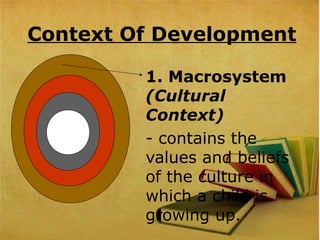
Context Of Development
1. Macrosystem
(Cultural
Context)
- contains the
values and beliefs
of the culture in
which a child is
growing up.
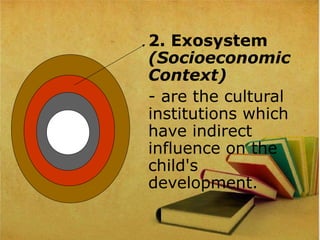
2. Exosystem
(Socioeconomic
Context)
- are the cultural
institutions which
have indirect
influence on the
child's
development.
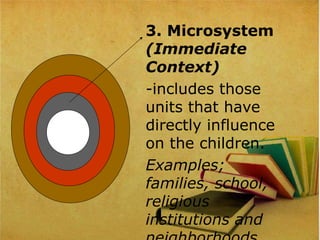
3. Microsystem
(Immediate
Context)
-includes those
units that have
directly influence
on the children.
Examples;
families, school,
religious
institutions and
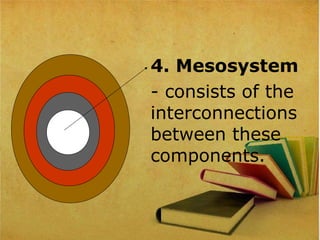
4. Mesosystem
- consists of the
interconnections
between these
components.
References;
Developmental Characteristics of
Young Children - Aurelia T. Estrada
Child and Adolescent
Development
www.ask.com

Cognitive Theory