Overview:
 Some noted authors in this area are Marian
  Diamond, U. C., Berkeley; Howard Gardner, Harvard
  University; Renate and Geoffrey Caine; Thomas
  Armstrong; Candace Pert, Eric Jensen.
 Until the mid 1900’s the brain was compared to a
  city’s switchboard.
 Brain theory in the 1970’s .
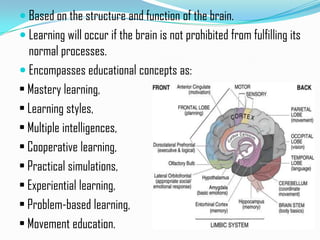
 Based on the structure and function of the brain.
 Learning will occur if the brain is not prohibited from fulfilling its
  normal processes.
 Encompasses educational concepts as:
• Mastery learning,
• Learning styles,
• Multiple intelligences,
• Cooperative learning,
• Practical simulations,
• Experiential learning,
• Problem-based learning,
• Movement education.
Core principles directing brain-based
              education are:
1. The brain is a parallel processor.
2. The brain perceives whole and parts simultaneously.
3. Information is stored in multiple areas of the brain
   and is retrieved through multiple memory and neural
   pathways.
4. Learning engages the whole body.
5. Humans’ search for meaning is innate.
Cont…
6. The search for meaning comes through patterning.
7. Emotions are critical to patterning, and drive our
   attention, meaning and memory.
8. Meaning is more important than just information.
9. Learning involves focused attention and peripheral
   perception.
10. We have two types of memory: spatial and rote.
11. We understand best when facts are embedded in
   natural spatial memory.
Cont…
12. The brain is social. It develops better in concert with
  other brains.
13. Complex learning is enhanced by challenge and
  inhibited by stress.
14. Every brain in uniquely organized.
15. Learning is developmental.
Implications for best teaching practices
           and optimal learning:
1. Orchestrated immersion- Learning environments are
   created that immerse students in a learning experience.
2. Relaxed Alertness- An effort is made to eliminate
   fear while maintaining a highly challenging
   environment.
3. Active Processing- The learner consolidates and
   internalizes information by actively processing it.
   Information is connected to prior learning.
Twelve design principles based on brain-
            based research:
1) Rich, stimulating environments using student created
   materials and products are evident on bulletin boards
   and display areas.
2) Places for group learning like tables and desks
   grouped together, to stimulate social skills and
   cooperative work groups.
3) Link indoor and outdoor spaces so students can
   move about using their motor cortex for more brain
   oxygenation.
Cont…
4) Safe places for students to be where threat is
  reduced, particularly in large urban settings.
5) Variety of places that provide different lighting, and
  nooks and crannies. Many elementary children prefer
  the floor and under tables to work with a partner.
6) Change displays in the classroom regularly to provide a
  stimulating situations for brain development. Have
  students create stage sets where they can act out scenes
  from their readings or demonstrate a science principle or
  act out a dialogue between historical figures.
Cont…
7) Have multiple resources available. Provide
  educational, physical and a variety of setting within the
  classroom so that learning activities can be integrated
  easily. Computers areas, wet areas, experimental
  science areas should be in close proximity to one
  another.
8) Flexibility: This common principle of the past is relevant.
  The ‘teachable moment” must be recognized and
  capitalized upon. Dimensions of flexibility are evident in
  other principles.
Cont…
9) Active and passive places: Students need quiet areas
   for reflection and retreat from others to use
   intrapersonal intelligences.
10) Personal space: Students need a home base, a
   desk, a locker area. Allows learners to express their
   unique identity.
11) The community at large as an optimal learning
   environment.
Cont…
12) Enrichment: The brain can grow new connections at
  any age. Challenging, complex experiences with
  appropriate feedback are best. Cognitive skills
  develop better with music and motor skills.
Optimizing learning through different
                mediums:
Music
   As a carrier
   As Arousal
   As a primer.
Art
Diverse forms of assessment.
CRITIQUES OF BRAIN BASED LEARNING
 Lack of Support from Experts:
  There is a lack of support from neuroscientists on the
  subject of brain-based learning.
 Left Brain, Right Brain:
  Brain-based learning separates its students into one of two
  categories: left-brained or right-brained.
 Too New:
  A big downside of brain-based learning is the fact that it's
  very new. Brain-based learning began in 1990s.
Prepared by:
              Kabita Sahu.
                  MBA.
            Id: SB12MB0018
Kaziranga University- School of Business.

Brain Based Learning Theory

  • 2.
    Overview:  Some notedauthors in this area are Marian Diamond, U. C., Berkeley; Howard Gardner, Harvard University; Renate and Geoffrey Caine; Thomas Armstrong; Candace Pert, Eric Jensen.  Until the mid 1900’s the brain was compared to a city’s switchboard.  Brain theory in the 1970’s .
  • 3.
     Based onthe structure and function of the brain.  Learning will occur if the brain is not prohibited from fulfilling its normal processes.  Encompasses educational concepts as: • Mastery learning, • Learning styles, • Multiple intelligences, • Cooperative learning, • Practical simulations, • Experiential learning, • Problem-based learning, • Movement education.
  • 4.
    Core principles directingbrain-based education are: 1. The brain is a parallel processor. 2. The brain perceives whole and parts simultaneously. 3. Information is stored in multiple areas of the brain and is retrieved through multiple memory and neural pathways. 4. Learning engages the whole body. 5. Humans’ search for meaning is innate.
  • 5.
    Cont… 6. The searchfor meaning comes through patterning. 7. Emotions are critical to patterning, and drive our attention, meaning and memory. 8. Meaning is more important than just information. 9. Learning involves focused attention and peripheral perception. 10. We have two types of memory: spatial and rote. 11. We understand best when facts are embedded in natural spatial memory.
  • 6.
    Cont… 12. The brainis social. It develops better in concert with other brains. 13. Complex learning is enhanced by challenge and inhibited by stress. 14. Every brain in uniquely organized. 15. Learning is developmental.
  • 7.
    Implications for bestteaching practices and optimal learning: 1. Orchestrated immersion- Learning environments are created that immerse students in a learning experience. 2. Relaxed Alertness- An effort is made to eliminate fear while maintaining a highly challenging environment. 3. Active Processing- The learner consolidates and internalizes information by actively processing it. Information is connected to prior learning.
  • 8.
    Twelve design principlesbased on brain- based research: 1) Rich, stimulating environments using student created materials and products are evident on bulletin boards and display areas. 2) Places for group learning like tables and desks grouped together, to stimulate social skills and cooperative work groups. 3) Link indoor and outdoor spaces so students can move about using their motor cortex for more brain oxygenation.
  • 9.
    Cont… 4) Safe placesfor students to be where threat is reduced, particularly in large urban settings. 5) Variety of places that provide different lighting, and nooks and crannies. Many elementary children prefer the floor and under tables to work with a partner. 6) Change displays in the classroom regularly to provide a stimulating situations for brain development. Have students create stage sets where they can act out scenes from their readings or demonstrate a science principle or act out a dialogue between historical figures.
  • 10.
    Cont… 7) Have multipleresources available. Provide educational, physical and a variety of setting within the classroom so that learning activities can be integrated easily. Computers areas, wet areas, experimental science areas should be in close proximity to one another. 8) Flexibility: This common principle of the past is relevant. The ‘teachable moment” must be recognized and capitalized upon. Dimensions of flexibility are evident in other principles.
  • 11.
    Cont… 9) Active andpassive places: Students need quiet areas for reflection and retreat from others to use intrapersonal intelligences. 10) Personal space: Students need a home base, a desk, a locker area. Allows learners to express their unique identity. 11) The community at large as an optimal learning environment.
  • 12.
    Cont… 12) Enrichment: Thebrain can grow new connections at any age. Challenging, complex experiences with appropriate feedback are best. Cognitive skills develop better with music and motor skills.
  • 13.
    Optimizing learning throughdifferent mediums: Music  As a carrier  As Arousal  As a primer. Art Diverse forms of assessment.
  • 14.
    CRITIQUES OF BRAINBASED LEARNING  Lack of Support from Experts: There is a lack of support from neuroscientists on the subject of brain-based learning.  Left Brain, Right Brain: Brain-based learning separates its students into one of two categories: left-brained or right-brained.  Too New: A big downside of brain-based learning is the fact that it's very new. Brain-based learning began in 1990s.
  • 15.
    Prepared by: Kabita Sahu. MBA. Id: SB12MB0018 Kaziranga University- School of Business.