Downloaded 233 times
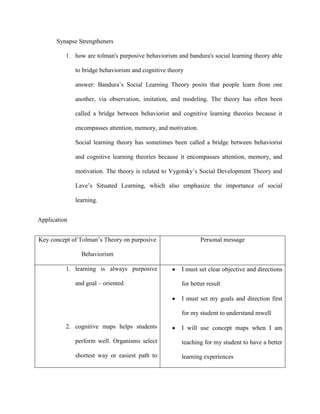

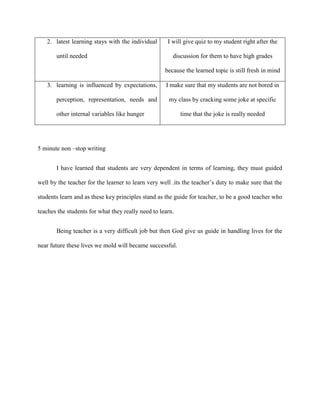

This document discusses Neo Behaviorism and the theories of Tolman and Bandura. It provides examples of how to apply their concepts when teaching, including using cognitive maps to help students learn easily and retain information, giving quizzes after lessons to reinforce learning, and ensuring students remain engaged through humor. Key concepts discussed are purposive behaviorism, cognitive maps, the influence of expectations and perceptions on learning, and Bandura's social learning theory which emphasizes the role of observation and modeling behavior.


![Learning theorymatrix[1]](https://cdn.slidesharecdn.com/ss_thumbnails/learningtheorymatrix1-110216134913-phpapp02-thumbnail.jpg?width=640&height=640&fit=bounds)


