An Integrative Look at
Happiness
Happiness
• Common beliefs about what contributes to
happiness (i.e. money!) are not confirmed
by psychological research
• People get used to originally happy
situations so the happiness wears off
• Lyubomirsky (2001):
– Inborn genetic set-point for happiness probably
accounts for 50% of our happiness
– Circumstances affect 10% of our happiness
– Individuals can influence the other 40%
Jeremy Bentham (1748-1832)
• Defined happiness: the sum of positive
emotions minus the sum of negative
emotions
• Believed any action that promoted
happiness was morally right
– Actions promoting happiness defined as
pleasure and the absence of pain
Rich Doesn’t = Happy
• Two explanations:
– People compare themselves to others
• Based on Leon Festinger’s social comparison theory
• People assess themselves in comparison with others;
they aren’t as happy if they compare themselves to
people who have more/as much
– People link happiness to reaching goals, but
continue to set higher ones
• Based on Julian Rotter’s level of aspiration theory
• People formulate general expectancy
• Only happy for a short time (if at all) once they reach
their goal
Myers and Dieners (1995)
• Found discrepancy between wealth and
happiness
• Buying power of average American had
tripled since 1950
• Proportion of Americans who described
themselves as “very happy” remained at
about 1/3
• Shows no direct link between increase in
wealth and increase in happiness!
Hagerty (2003)
• Happiness was positively correlated with
equality of distribution of wealth in the
country
• As inequality of income decreased, average
level of life satisfaction increased
• Could be explained by social comparison
theory
– We often tend to compare ourselves to those
who are more fortunate (upward comparison)
which leads to dissatisfaction
Goals & Happiness
• People who link happiness to specific goals
are less likely to be happy
• When they reach their goals and do not find
themselves to be any happier they set new
ones!
• The media portrays wealthy consumers as
happy and the public believes it!
Johnson and Kruger (2006)
• Satisfaction with one’s own salary is a better
indicator of happiness
• Dissatisfaction when people think they
should earn more or feel others deserve less
than they earn
– Less happy, more greedy, because they compare
themselves to others
Conway, di Fazio, and Mayman (1999)
• Judge emotional reactions of high-status
people (with money) and low-status people
(without money)
• Widespread false belief (illusory correlation)
that richer = happier, less angry, less
depressed, less afraid
• Did not believe the status made a difference
in love
Dalai Lama
• Dalai Lama thinks the key to happiness is in
our hands
• Compassion is an important part of spiritual
development
– State of mind which is non-aggressive and rests
on the desire to help other people
– Acknowledging all people’s right to happiness
• Base happiness on connectedness to other
people—not wealth
– Empathy is an important factor
Sociocultural Influences: Bhutan
• Bhutan is very poor, but people are very happy
• Spiritual and meditative people; happy with idle
time, contemplation, and the pursuit of wisdom
• Government is not focused on
productivity, efficiency, and money
• Government considers the unique nature of
Bhutanese culture valuable
• King of Bhutan introduced the gross national
happiness to measure happiness
– The king is a Buddhist and thinks the purpose of life
is inner happiness
Sociocultural Influences
• The Danes are the happiest people on Earth
– Over 2/3 are “very satisfied” with their lives
– Climate does not seem a positive happy force
– Welfare state and highest level of income
equality
– Prosperous economy and well-functioning
democracy
– Do not have particularly high expectations about
the future—more realistic
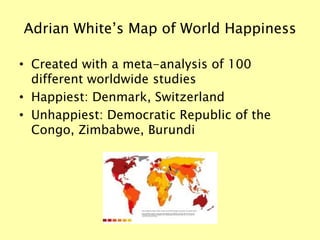
Adrian White’s Map of World Happiness
• Created with a meta-analysis of 100
different worldwide studies
• Happiest: Denmark, Switzerland
• Unhappiest: Democratic Republic of the
Congo, Zimbabwe, Burundi
National Happiness
• 81% of population think the government
should focus on making citizens happier
rather than wealthier
• .62 correlation between nation’s happiness
and health
• .52 correlation between nation’s happiness
and wealth
• .51 correlation between nation’s happiness
and provision of education
Positive Psychology
• Term coined by Martin Seligman
• One main goal: conduct research that
promotes human happiness and well-being
• People can learn to think positively
• Positive emotions help mentally and
physically
• However, most happiness research is only
applicable to Western civilizations
Biological Factors in Happiness
• Habituation: People tend to adapt to their
environment
• Inherited ability to adapt to both negative
and positive situations
– Evolutionarily: our ancestors passed on genes
such as the ability to notice changes/adapt
• Humans seem to have an inner voice of
dissatisfaction that prompts them to strive
for more
– Our ancestors were the same way
Genetics & Happiness
• David Lykken thinks we have an innate
baseline (or set-point) of happiness
• Happiness Twin Study (Lykken 1996) to
compare happiness scores of identical and
fraternal twins
– Identical twins were very similar in happiness
scores
– Fraternal twins were not similar at all
Happiness
• 50% of happiness is due to genetics
• 10% due to situational factors
– i.e. rich, poor, healthy, unhealthy, married, sing
• 40% within one’s own control
– According to Sonja Lyubomirsky
– Actions and thoughts can affect happiness
Characteristics of Happy People
• Devote a lot of time to family and friends
• Easily express gratitude
• First to offer a helping hand
• Optimistic outlook on future
• Enjoy pleasures of life; live in the present
• Spend time doing physical exercise
• Committed to lifelong goals and ambitions
• Cope well in times of crisis
Lyubomirky Suggests…
• Express gratitude
• Investigate social connections
• Practice acts of kindness
• Avoid overthinking
• Avoid social comparison
Volunteering & Happiness
• Swartz et al. (1999)
• Volunteer work resulted in dramatic
changes in their lives
– Thinking of other people’s problems
– More tolerant and open
– Confidence in coping abilities
– Participated in more social activities
– Fewer episodes of depression
• Small sample; not large enough to
generalize

An Integrative Look at Happiness

  • 1.
    An Integrative Lookat Happiness
  • 2.
    Happiness • Common beliefsabout what contributes to happiness (i.e. money!) are not confirmed by psychological research • People get used to originally happy situations so the happiness wears off • Lyubomirsky (2001): – Inborn genetic set-point for happiness probably accounts for 50% of our happiness – Circumstances affect 10% of our happiness – Individuals can influence the other 40%
  • 3.
    Jeremy Bentham (1748-1832) •Defined happiness: the sum of positive emotions minus the sum of negative emotions • Believed any action that promoted happiness was morally right – Actions promoting happiness defined as pleasure and the absence of pain
  • 4.
    Rich Doesn’t =Happy • Two explanations: – People compare themselves to others • Based on Leon Festinger’s social comparison theory • People assess themselves in comparison with others; they aren’t as happy if they compare themselves to people who have more/as much – People link happiness to reaching goals, but continue to set higher ones • Based on Julian Rotter’s level of aspiration theory • People formulate general expectancy • Only happy for a short time (if at all) once they reach their goal
  • 5.
    Myers and Dieners(1995) • Found discrepancy between wealth and happiness • Buying power of average American had tripled since 1950 • Proportion of Americans who described themselves as “very happy” remained at about 1/3 • Shows no direct link between increase in wealth and increase in happiness!
  • 6.
    Hagerty (2003) • Happinesswas positively correlated with equality of distribution of wealth in the country • As inequality of income decreased, average level of life satisfaction increased • Could be explained by social comparison theory – We often tend to compare ourselves to those who are more fortunate (upward comparison) which leads to dissatisfaction
  • 7.
    Goals & Happiness •People who link happiness to specific goals are less likely to be happy • When they reach their goals and do not find themselves to be any happier they set new ones! • The media portrays wealthy consumers as happy and the public believes it!
  • 8.
    Johnson and Kruger(2006) • Satisfaction with one’s own salary is a better indicator of happiness • Dissatisfaction when people think they should earn more or feel others deserve less than they earn – Less happy, more greedy, because they compare themselves to others
  • 9.
    Conway, di Fazio,and Mayman (1999) • Judge emotional reactions of high-status people (with money) and low-status people (without money) • Widespread false belief (illusory correlation) that richer = happier, less angry, less depressed, less afraid • Did not believe the status made a difference in love
  • 10.
    Dalai Lama • DalaiLama thinks the key to happiness is in our hands • Compassion is an important part of spiritual development – State of mind which is non-aggressive and rests on the desire to help other people – Acknowledging all people’s right to happiness • Base happiness on connectedness to other people—not wealth – Empathy is an important factor
  • 11.
    Sociocultural Influences: Bhutan •Bhutan is very poor, but people are very happy • Spiritual and meditative people; happy with idle time, contemplation, and the pursuit of wisdom • Government is not focused on productivity, efficiency, and money • Government considers the unique nature of Bhutanese culture valuable • King of Bhutan introduced the gross national happiness to measure happiness – The king is a Buddhist and thinks the purpose of life is inner happiness
  • 12.
    Sociocultural Influences • TheDanes are the happiest people on Earth – Over 2/3 are “very satisfied” with their lives – Climate does not seem a positive happy force – Welfare state and highest level of income equality – Prosperous economy and well-functioning democracy – Do not have particularly high expectations about the future—more realistic
  • 13.
    Adrian White’s Mapof World Happiness • Created with a meta-analysis of 100 different worldwide studies • Happiest: Denmark, Switzerland • Unhappiest: Democratic Republic of the Congo, Zimbabwe, Burundi
  • 14.
    National Happiness • 81%of population think the government should focus on making citizens happier rather than wealthier • .62 correlation between nation’s happiness and health • .52 correlation between nation’s happiness and wealth • .51 correlation between nation’s happiness and provision of education
  • 15.
    Positive Psychology • Termcoined by Martin Seligman • One main goal: conduct research that promotes human happiness and well-being • People can learn to think positively • Positive emotions help mentally and physically • However, most happiness research is only applicable to Western civilizations
  • 16.
    Biological Factors inHappiness • Habituation: People tend to adapt to their environment • Inherited ability to adapt to both negative and positive situations – Evolutionarily: our ancestors passed on genes such as the ability to notice changes/adapt • Humans seem to have an inner voice of dissatisfaction that prompts them to strive for more – Our ancestors were the same way
  • 17.
    Genetics & Happiness •David Lykken thinks we have an innate baseline (or set-point) of happiness • Happiness Twin Study (Lykken 1996) to compare happiness scores of identical and fraternal twins – Identical twins were very similar in happiness scores – Fraternal twins were not similar at all
  • 18.
    Happiness • 50% ofhappiness is due to genetics • 10% due to situational factors – i.e. rich, poor, healthy, unhealthy, married, sing • 40% within one’s own control – According to Sonja Lyubomirsky – Actions and thoughts can affect happiness
  • 19.
    Characteristics of HappyPeople • Devote a lot of time to family and friends • Easily express gratitude • First to offer a helping hand • Optimistic outlook on future • Enjoy pleasures of life; live in the present • Spend time doing physical exercise • Committed to lifelong goals and ambitions • Cope well in times of crisis
  • 20.
    Lyubomirky Suggests… • Expressgratitude • Investigate social connections • Practice acts of kindness • Avoid overthinking • Avoid social comparison
  • 21.
    Volunteering & Happiness •Swartz et al. (1999) • Volunteer work resulted in dramatic changes in their lives – Thinking of other people’s problems – More tolerant and open – Confidence in coping abilities – Participated in more social activities – Fewer episodes of depression • Small sample; not large enough to generalize