A Personality Disorder(s) Kaitlyn Heskett
Personality Disorders Rigid and potentially self-destructive pattern of thinking and behaving Actions are outside of norm for your society Criteria: Perception and interp. Of self and others Intensity and duration of feelings and appropriateness to situations Relationships with others Ability to control impulses
Timeline of P.D. Can arise at any time in life From late childhood to early adult Children avoided to be classified due to the malleable nature of their personalities
Manifestations of P.D. Difficult to give estimate as to how many people have personality disorders: such a large number of them Approximately 15% of U.S. P.D. Possible to have more than one P.D.>dual diagnosis
Clusters of P.D. Three “clusters” of P.D., as by specifications inside DSM-IV Each deals with personalities under the description “patterns of perceiving, reacting, and relating to other people and events that are relatively inflexible and that impair a person’s ability to function socially”
Cluster A Odd/Eccentric behavior Paranoid (obvious) Schizoid (introverted to extreme, seen as cold, socially distant; fear of intimacy; prefer daydreaming/theorectical speculation to practical action; fantasizing is a common coping defense) Schizotypal (similar to schizoid and schizophrenia; can be precursor to schizo.; believe they can harm others with their thoughts)
Cluster B Dramatic/erratic behavior Histrionic/Hysterical (exaggerated) Narcissistic (sense of superiority, need for admiration, lack of empathy, grandiosity {exaggerated belief of own importance}) Antisocial (aka psychopathic/sociopathic personality; “show callous disregard for the rights and feelings of others”; exploit for material gain; consequences are unanticipated) Borderline (Modern Woman Conundrum: common succubae)
Cluster C Anxious or inhibited behavior Avoidant (want love, afraid to peruse it due to fear of rejection; similar to generalized social phobia) Dependent (insecure about salve's ability to be self-sufficient; let others decide lives for them) Obsessive-compulsive (preoccupied with perfection, orderliness, control; similar to OCD, but need not perform unwanted ritualistic behaviour)
Problems with DSM-IV Three additional P.D. not classified by the “clusters” Many believe the DSM-IV needs to be expanded or revamped to include these three  Do not fit under one specific cluster
3 More Passive-Aggressive P. (appear passive in order to secretly pursue behaviors in order to control others, get retribution; duh) Cyclothymic P. (rapidly alternating highs and lows) Depressive P. (chronic moroseness and drag down those around them; believe that they do not deserve merits of work)
Causes of P.D. Personality is shaped, formed from childhood through biological disposition & developing environment Chemical imbalance in brain (high dopamine=need for novelty, high serotonin=aggression) Brain damage (less common; wiring in brain messed up/ damage causes chemical imbalance)
Treatment: Diagnoses Criteria of individual P.D. met Possibly inconclusive physical tests (I.E.: blood pressure, heart rate, abdominal examination), laboratory tests (blood count, etc.) Psychological evaluation (interview; “How do you feel when you…?) Personality Inventory (MMPI) Projective Tests (Short answer)
Actual Treatments Hospitalization (paranoid P.D., suicidal, withdrawal) Psychotherapy (dependent, obsessive-compulsive, avoidant P.D., narcissistic and borderline need specialized treatment; matter of years; paranoid and antisocial not recommended: come to resent doctor; schizoid: supportive therapy)
Other Treatments (Therapies) Cognitive-Behavioral (avoidant/dependent: challenge mistaken ideas about self) Group therapy (schizoid/avoidant’s outbursts silenced by peer pressure) Family therapy (borderline patients with overinvolved/possessive families; pose threats to families)
Other Treatments (Meds) Antipsychotic Drugs (prevent psychotic episodes; paranoid, borderline, schizotypal; dosage dependent on severity) Mood Stabilizers (Borderline: carbamazepine-rage outbursts; lithium, valproate) Antidepressants Anti-Anxiety Meds (schizoid P.D. manage symptoms while in therapy; borderline)
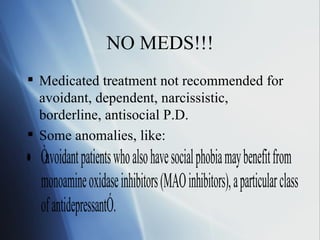
NO MEDS!!! Medicated treatment not recommended for avoidant, dependent, narcissistic, borderline, antisocial P.D. Some anomalies, like:
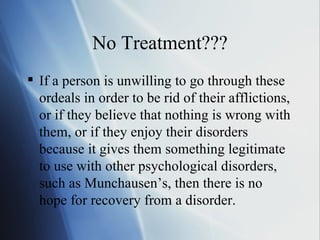
No Treatment??? If a person is unwilling to go through these ordeals in order to be rid of their afflictions, or if they believe that nothing is wrong with them, or if they enjoy their disorders because it gives them something legitimate to use with other psychological disorders, such as Munchausen’s, then there is no hope for recovery from a disorder.
END!!!!!!!!!!!!!!!!!!!!!!!!!!!!!!!!!!!!!!!!!!!!!!!!!!!!!!!!!!!!!!!!!!!!!!!!!!!!!!!!!!!!!!! !!!!!!!!!!!!!!!!!!!!!!!!!!!!!!!! !!!!!!!!!!!!!!!!!!!!!!!!!!!!!!!! !!!!!!!!!!!!!!!!!!!!!!!!!!!!!!!! !!!!!!!!!!!!!!!!!!!!!!!!!!!!!!!! !!!!!!!!!!!!!!!!!!!!!!!!!!!!!!!! !!!!!!!!!!!!!!!!!!!!!!!!!!!!!!!! !!!!!!!!!!!!!!!!!!!!!!!!!!!!!!!!

Personality Disorders

  • 1.
  • 2.
    Personality Disorders Rigidand potentially self-destructive pattern of thinking and behaving Actions are outside of norm for your society Criteria: Perception and interp. Of self and others Intensity and duration of feelings and appropriateness to situations Relationships with others Ability to control impulses
  • 3.
    Timeline of P.D.Can arise at any time in life From late childhood to early adult Children avoided to be classified due to the malleable nature of their personalities
  • 4.
    Manifestations of P.D.Difficult to give estimate as to how many people have personality disorders: such a large number of them Approximately 15% of U.S. P.D. Possible to have more than one P.D.>dual diagnosis
  • 5.
    Clusters of P.D.Three “clusters” of P.D., as by specifications inside DSM-IV Each deals with personalities under the description “patterns of perceiving, reacting, and relating to other people and events that are relatively inflexible and that impair a person’s ability to function socially”
  • 6.
    Cluster A Odd/Eccentricbehavior Paranoid (obvious) Schizoid (introverted to extreme, seen as cold, socially distant; fear of intimacy; prefer daydreaming/theorectical speculation to practical action; fantasizing is a common coping defense) Schizotypal (similar to schizoid and schizophrenia; can be precursor to schizo.; believe they can harm others with their thoughts)
  • 7.
    Cluster B Dramatic/erraticbehavior Histrionic/Hysterical (exaggerated) Narcissistic (sense of superiority, need for admiration, lack of empathy, grandiosity {exaggerated belief of own importance}) Antisocial (aka psychopathic/sociopathic personality; “show callous disregard for the rights and feelings of others”; exploit for material gain; consequences are unanticipated) Borderline (Modern Woman Conundrum: common succubae)
  • 8.
    Cluster C Anxiousor inhibited behavior Avoidant (want love, afraid to peruse it due to fear of rejection; similar to generalized social phobia) Dependent (insecure about salve's ability to be self-sufficient; let others decide lives for them) Obsessive-compulsive (preoccupied with perfection, orderliness, control; similar to OCD, but need not perform unwanted ritualistic behaviour)
  • 9.
    Problems with DSM-IVThree additional P.D. not classified by the “clusters” Many believe the DSM-IV needs to be expanded or revamped to include these three Do not fit under one specific cluster
  • 10.
    3 More Passive-AggressiveP. (appear passive in order to secretly pursue behaviors in order to control others, get retribution; duh) Cyclothymic P. (rapidly alternating highs and lows) Depressive P. (chronic moroseness and drag down those around them; believe that they do not deserve merits of work)
  • 11.
    Causes of P.D.Personality is shaped, formed from childhood through biological disposition & developing environment Chemical imbalance in brain (high dopamine=need for novelty, high serotonin=aggression) Brain damage (less common; wiring in brain messed up/ damage causes chemical imbalance)
  • 12.
    Treatment: Diagnoses Criteriaof individual P.D. met Possibly inconclusive physical tests (I.E.: blood pressure, heart rate, abdominal examination), laboratory tests (blood count, etc.) Psychological evaluation (interview; “How do you feel when you…?) Personality Inventory (MMPI) Projective Tests (Short answer)
  • 13.
    Actual Treatments Hospitalization(paranoid P.D., suicidal, withdrawal) Psychotherapy (dependent, obsessive-compulsive, avoidant P.D., narcissistic and borderline need specialized treatment; matter of years; paranoid and antisocial not recommended: come to resent doctor; schizoid: supportive therapy)
  • 14.
    Other Treatments (Therapies)Cognitive-Behavioral (avoidant/dependent: challenge mistaken ideas about self) Group therapy (schizoid/avoidant’s outbursts silenced by peer pressure) Family therapy (borderline patients with overinvolved/possessive families; pose threats to families)
  • 15.
    Other Treatments (Meds)Antipsychotic Drugs (prevent psychotic episodes; paranoid, borderline, schizotypal; dosage dependent on severity) Mood Stabilizers (Borderline: carbamazepine-rage outbursts; lithium, valproate) Antidepressants Anti-Anxiety Meds (schizoid P.D. manage symptoms while in therapy; borderline)
  • 16.
    NO MEDS!!! Medicatedtreatment not recommended for avoidant, dependent, narcissistic, borderline, antisocial P.D. Some anomalies, like:
  • 17.
    No Treatment??? Ifa person is unwilling to go through these ordeals in order to be rid of their afflictions, or if they believe that nothing is wrong with them, or if they enjoy their disorders because it gives them something legitimate to use with other psychological disorders, such as Munchausen’s, then there is no hope for recovery from a disorder.
  • 18.
    END!!!!!!!!!!!!!!!!!!!!!!!!!!!!!!!!!!!!!!!!!!!!!!!!!!!!!!!!!!!!!!!!!!!!!!!!!!!!!!!!!!!!!!! !!!!!!!!!!!!!!!!!!!!!!!!!!!!!!!! !!!!!!!!!!!!!!!!!!!!!!!!!!!!!!!!!!!!!!!!!!!!!!!!!!!!!!!!!!!!!!!! !!!!!!!!!!!!!!!!!!!!!!!!!!!!!!!! !!!!!!!!!!!!!!!!!!!!!!!!!!!!!!!! !!!!!!!!!!!!!!!!!!!!!!!!!!!!!!!! !!!!!!!!!!!!!!!!!!!!!!!!!!!!!!!!