Hypotheses about Second-
Language Learner’s Language
By: Mona Dabagh
The Interlanguage Hypothesis
In the late 60s and early 70s, second language
learner’s errors gained a great prominence.
Alongside this, a revolutionary concept in the field
of second-language learner’s language developed
which is called interlanguage, a language which is
between source and target language.
Larry Selinker has written an influential paper in
the title of Interlanguage. And he has suggested
five processes for second language learning:
1. Language transfer: according to Lado
(1957): “... Individuals tend to transfer the forms
and meanings and the distribution of forms and
meanings of their native language and culture to
the foreign language and culture.”
2. Overgeneralization: According to Richards et al.
(1989), overgeneralization is a process that occurs in
both first and second-language learning that the use of
grammatical rule is extended beyond its accepted
application.
*He always try to help other people.
3. Transfer of training: As Cheng and C.K. Ho have in
their paper Transfer of training can be defined as the
application of knowledge, skills and attitudes learned
from training on the job and subsequent maintenance of
them over a certain period of time (Baldwin and Ford,
1988; Xiao, 1996).
4. Second-language learning strategies:
1. Overgeneralization
2. Transfer of form
3. Simplification
*daddy want chair. *I am student English language.
5. Second-Language Communication Strategies:
These strategies are learner’s tactics to bridge the gap
between his limited linguistic knowledge and his
communication needs by using inappropriate elements.
*a cloth for my nose (instead of handkerchief)
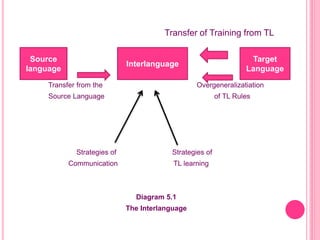
Transfer of Training from TL
Transfer from the Overgeneralizatiation
Source Language of TL Rules
Strategies of Strategies of
Communication TL learning
Diagram 5.1
The Interlanguage
Source
language
Interlanguage
Target
Language
McLaughlin (1987):
1) “The learner’s system at a single point in time
2) The range of interlocking systems that
characterizes the development of learner’s language
over time” (p. 60).
Some of the important features of interlanguage
are as follows:
1) they are assumed to be systematic.
2) they are typically reduced systems.
3) they are assumed to be systematically variable.
4) Another mechanism in interlanguage system is
fossilization.
Backsliding: The reappearance of fossilized
characteristics of a learner language under definite
conditions.
The Approximative System Hypothesis:
According to Nemser (1971) who introduced this
hypothesis, the acquisition of a second language includes
systematic stages with an approximative system at each
stage. A second language learner in different stages goes
through different interlanguages, with each stage
approximating to the TL.
Native Language
Approximative System 1
Approximative System 2
Approximative System 3
Approximative System N
Target Language
The Idiosyncratic Dialect:
According to Pit Corder (1971) the learner’s language is
referred to as The Idiosyncratic Dialect. And he maintains
that idiosyncratic dialects are systematic, regular, unstable,
and meaningfull. And learner’s language is unique to a
particular individual and the grammar of this language is
particular only to that individual.
1. Language of poems
2. The speech of an aphasic
3. Of an infant learning his mother tongue
The idiosyncratic dialect shares features of native language
and target language while maintaining some features of its
own.
According to Corder’s notion of idiosyncratic dialects,
Nemser’s concept of approximative system, and Selinker’s
theory of interlanguage hypothesis, the study of learner’s
language system involves an analysis of:
1. the learner’s NL utterances,
2. the learner’s IL or idiosyncratic utterances,
3. utterances which are produced by native speakers of the
TL
References:
Keshavarz, M.H. (2013). Contrastive analysis & error analysis (New
ed.). Tehran: Rahnama Press.
Selinker, L. (2011). Some Unresolved Issues in an ELT New
Media Age: Towards building an interlanguage semantics.
740-752.
Cheng, E., & Ho, D. (1999). A Review Of Transfer Of Training
Studies In The Past Decade.Personnel Review, 30, 102-118.

Chapter 5

  • 1.
    Hypotheses about Second- LanguageLearner’s Language By: Mona Dabagh
  • 2.
    The Interlanguage Hypothesis Inthe late 60s and early 70s, second language learner’s errors gained a great prominence. Alongside this, a revolutionary concept in the field of second-language learner’s language developed which is called interlanguage, a language which is between source and target language.
  • 3.
    Larry Selinker haswritten an influential paper in the title of Interlanguage. And he has suggested five processes for second language learning: 1. Language transfer: according to Lado (1957): “... Individuals tend to transfer the forms and meanings and the distribution of forms and meanings of their native language and culture to the foreign language and culture.”
  • 4.
    2. Overgeneralization: Accordingto Richards et al. (1989), overgeneralization is a process that occurs in both first and second-language learning that the use of grammatical rule is extended beyond its accepted application. *He always try to help other people. 3. Transfer of training: As Cheng and C.K. Ho have in their paper Transfer of training can be defined as the application of knowledge, skills and attitudes learned from training on the job and subsequent maintenance of them over a certain period of time (Baldwin and Ford, 1988; Xiao, 1996).
  • 5.
    4. Second-language learningstrategies: 1. Overgeneralization 2. Transfer of form 3. Simplification *daddy want chair. *I am student English language. 5. Second-Language Communication Strategies: These strategies are learner’s tactics to bridge the gap between his limited linguistic knowledge and his communication needs by using inappropriate elements. *a cloth for my nose (instead of handkerchief)
  • 6.
    Transfer of Trainingfrom TL Transfer from the Overgeneralizatiation Source Language of TL Rules Strategies of Strategies of Communication TL learning Diagram 5.1 The Interlanguage Source language Interlanguage Target Language
  • 7.
    McLaughlin (1987): 1) “Thelearner’s system at a single point in time 2) The range of interlocking systems that characterizes the development of learner’s language over time” (p. 60). Some of the important features of interlanguage are as follows: 1) they are assumed to be systematic. 2) they are typically reduced systems. 3) they are assumed to be systematically variable. 4) Another mechanism in interlanguage system is fossilization.
  • 8.
    Backsliding: The reappearanceof fossilized characteristics of a learner language under definite conditions. The Approximative System Hypothesis: According to Nemser (1971) who introduced this hypothesis, the acquisition of a second language includes systematic stages with an approximative system at each stage. A second language learner in different stages goes through different interlanguages, with each stage approximating to the TL.
  • 9.
    Native Language Approximative System1 Approximative System 2 Approximative System 3 Approximative System N Target Language
  • 10.
    The Idiosyncratic Dialect: Accordingto Pit Corder (1971) the learner’s language is referred to as The Idiosyncratic Dialect. And he maintains that idiosyncratic dialects are systematic, regular, unstable, and meaningfull. And learner’s language is unique to a particular individual and the grammar of this language is particular only to that individual. 1. Language of poems 2. The speech of an aphasic 3. Of an infant learning his mother tongue
  • 11.
    The idiosyncratic dialectshares features of native language and target language while maintaining some features of its own. According to Corder’s notion of idiosyncratic dialects, Nemser’s concept of approximative system, and Selinker’s theory of interlanguage hypothesis, the study of learner’s language system involves an analysis of: 1. the learner’s NL utterances, 2. the learner’s IL or idiosyncratic utterances, 3. utterances which are produced by native speakers of the TL
  • 12.
    References: Keshavarz, M.H. (2013).Contrastive analysis & error analysis (New ed.). Tehran: Rahnama Press. Selinker, L. (2011). Some Unresolved Issues in an ELT New Media Age: Towards building an interlanguage semantics. 740-752. Cheng, E., & Ho, D. (1999). A Review Of Transfer Of Training Studies In The Past Decade.Personnel Review, 30, 102-118.