Logic Simplification
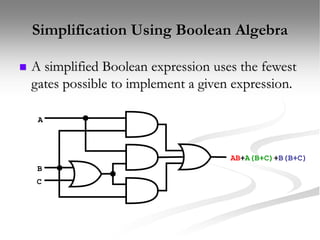
Simplification Using Boolean Algebra
 A simplified Boolean expression uses the fewest
gates possible to implement a given expression.
A
B
C
AB+A(B+C)+B(B+C)
Simplification Using Boolean Algebra
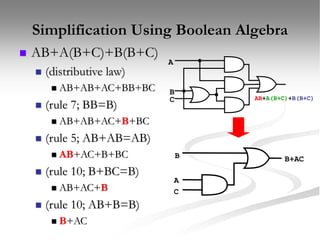
 AB+A(B+C)+B(B+C)
 (distributive law)
 AB+AB+AC+BB+BC
 (rule 7; BB=B)
 AB+AB+AC+B+BC
 (rule 5; AB+AB=AB)
 AB+AC+B+BC
 (rule 10; B+BC=B)
 AB+AC+B
 (rule 10; AB+B=B)
 B+AC
A
B
C
B+AC
A
B
C AB+A(B+C)+B(B+C)
Simplification Using Boolean Algebra
 Try these:
C
B
A
AC
AB
ABC
C
B
A
C
B
A
C
B
A
BC
A
C
B
A
BD
C
B
A







 ]
)
(
[
8
Standard Forms of Boolean Expressions
 All Boolean expressions, regardless of their
form, can be converted into either of two
standard forms:
 The sum-of-products (SOP) form
 The product-of-sums (POS) form
 Standardization makes the evaluation,
simplification, and implementation of Boolean
expressions much more systematic and easier.
Sum-of-Products (SOP)
The Sum-of-Products (SOP) Form
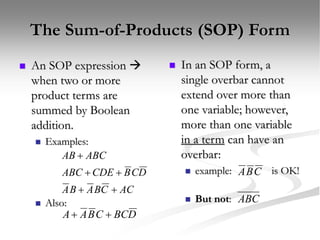
 An SOP expression 
when two or more
product terms are
summed by Boolean
addition.
 Examples:
 Also:
AC
C
B
A
B
A
D
C
B
CDE
ABC
ABC
AB





D
BC
C
B
A
A 

 In an SOP form, a
single overbar cannot
extend over more than
one variable; however,
more than one variable
in a term can have an
overbar:
 example: is OK!
 But not:
C
B
A
ABC
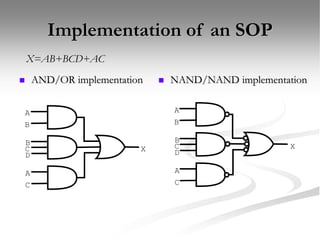
Implementation of an SOP
 AND/OR implementation  NAND/NAND implementation
X=AB+BCD+AC
A
B
B
C
D
A
C
X
A
B
B
C
D
A
C
X
C
B
C
A
C
B
A
C
B
A
C
B
A
BD
BC
BB
AD
AC
AB
D
C
B
B
A
BEF
BCD
AB
EF
CD
B
AB
ACD
AB
CD
B
A

























)
(
)
(
)
(
)
)(
(
)
(
)
(
General Expression  SOP
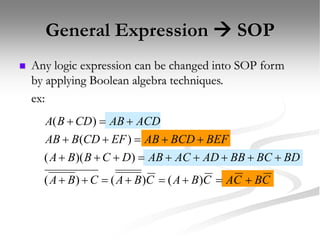
 Any logic expression can be changed into SOP form
by applying Boolean algebra techniques.
ex:
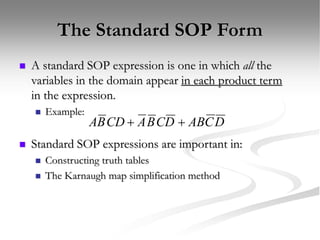
The Standard SOP Form
 A standard SOP expression is one in which all the
variables in the domain appear in each product term
in the expression.
 Example:
 Standard SOP expressions are important in:
 Constructing truth tables
 The Karnaugh map simplification method
D
C
AB
D
C
B
A
CD
B
A 

Converting Product Terms to
Standard SOP
 Step 1: Multiply each nonstandard product term by a
term made up of the sum of a missing variable and its
complement. This results in two product terms.
 As you know, you can multiply anything by 1 without
changing its value.
 Step 2: Repeat step 1 until all resulting product term
contains all variables in the domain in either
complemented or uncomplemented form. In
converting a product term to standard form, the
number of product terms is doubled for each missing
variable.
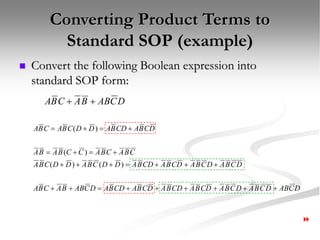
Converting Product Terms to
Standard SOP (example)
 Convert the following Boolean expression into
standard SOP form:
D
C
AB
B
A
C
B
A 

D
C
AB
D
C
B
A
D
C
B
A
D
C
B
A
CD
B
A
D
C
B
A
CD
B
A
D
C
AB
B
A
C
B
A
D
C
B
A
D
C
B
A
D
C
B
A
CD
B
A
D
D
C
B
A
D
D
C
B
A
C
B
A
C
B
A
C
C
B
A
B
A
D
C
B
A
CD
B
A
D
D
C
B
A
C
B
A
























)
(
)
(
)
(
)
(
8
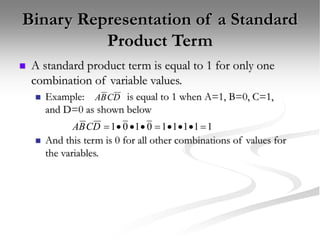
Binary Representation of a Standard
Product Term
 A standard product term is equal to 1 for only one
combination of variable values.
 Example: is equal to 1 when A=1, B=0, C=1,
and D=0 as shown below
 And this term is 0 for all other combinations of values for
the variables.
1
1
1
1
1
0
1
0
1 








D
C
B
A
D
C
B
A
Product-of-Sums (POS)
The Product-of-Sums (POS) Form
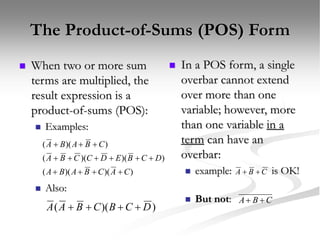
 When two or more sum
terms are multiplied, the
result expression is a
product-of-sums (POS):
 Examples:
 Also:
 In a POS form, a single
overbar cannot extend
over more than one
variable; however, more
than one variable in a
term can have an
overbar:
 example: is OK!
 But not:
C
B
A 

C
B
A 

)
)(
)(
(
)
)(
)(
(
)
)(
(
C
A
C
B
A
B
A
D
C
B
E
D
C
C
B
A
C
B
A
B
A













)
)(
( D
C
B
C
B
A
A 



Implementation of a POS
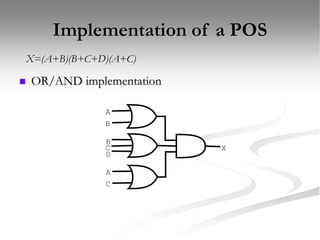
 OR/AND implementation
X=(A+B)(B+C+D)(A+C)
A
B
B
C
D
A
C
X
The Standard POS Form
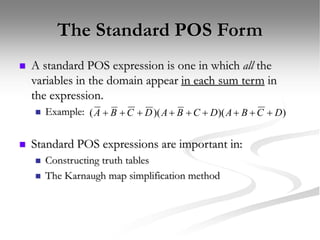
 A standard POS expression is one in which all the
variables in the domain appear in each sum term in
the expression.
 Example:
 Standard POS expressions are important in:
 Constructing truth tables
 The Karnaugh map simplification method
)
)(
)(
( D
C
B
A
D
C
B
A
D
C
B
A 








Converting a Sum Term to Standard
POS
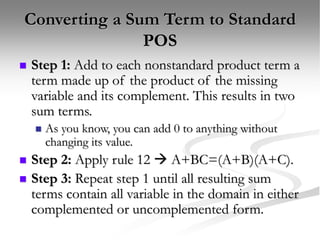
 Step 1: Add to each nonstandard product term a
term made up of the product of the missing
variable and its complement. This results in two
sum terms.
 As you know, you can add 0 to anything without
changing its value.
 Step 2: Apply rule 12  A+BC=(A+B)(A+C).
 Step 3: Repeat step 1 until all resulting sum
terms contain all variable in the domain in either
complemented or uncomplemented form.
Converting a Sum Term to Standard
POS (example)
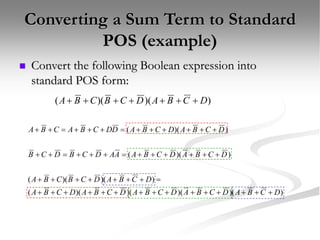
 Convert the following Boolean expression into
standard POS form:
)
)(
)(
( D
C
B
A
D
C
B
C
B
A 






)
)(
)(
)(
)(
(
)
)(
)(
(
)
)(
(
)
)(
(
D
C
B
A
D
C
B
A
D
C
B
A
D
C
B
A
D
C
B
A
D
C
B
A
D
C
B
C
B
A
D
C
B
A
D
C
B
A
A
A
D
C
B
D
C
B
D
C
B
A
D
C
B
A
D
D
C
B
A
C
B
A

















































Binary Representation of a Standard
Sum Term
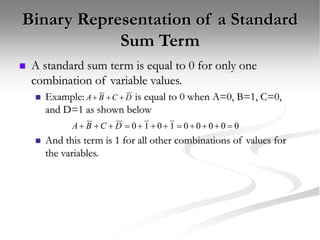
 A standard sum term is equal to 0 for only one
combination of variable values.
 Example: is equal to 0 when A=0, B=1, C=0,
and D=1 as shown below
 And this term is 1 for all other combinations of values for
the variables.
0
0
0
0
0
1
0
1
0 










 D
C
B
A
D
C
B
A 


SOP/POS
Converting Standard SOP to
Standard POS
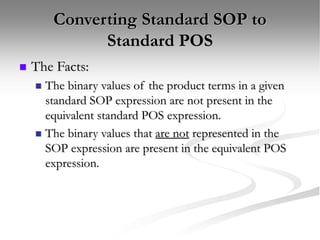
 The Facts:
 The binary values of the product terms in a given
standard SOP expression are not present in the
equivalent standard POS expression.
 The binary values that are not represented in the
SOP expression are present in the equivalent POS
expression.
Converting Standard SOP to
Standard POS
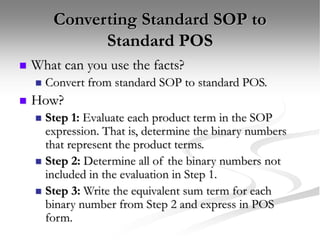
 What can you use the facts?
 Convert from standard SOP to standard POS.
 How?
 Step 1: Evaluate each product term in the SOP
expression. That is, determine the binary numbers
that represent the product terms.
 Step 2: Determine all of the binary numbers not
included in the evaluation in Step 1.
 Step 3: Write the equivalent sum term for each
binary number from Step 2 and express in POS
form.
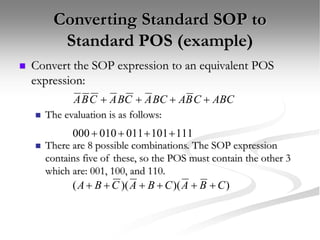
Converting Standard SOP to
Standard POS (example)
 Convert the SOP expression to an equivalent POS
expression:
 The evaluation is as follows:
 There are 8 possible combinations. The SOP expression
contains five of these, so the POS must contain the other 3
which are: 001, 100, and 110.
)
)(
)(
(
111
101
011
010
000
C
B
A
C
B
A
C
B
A
ABC
C
B
A
BC
A
C
B
A
C
B
A














Boolean Expressions & Truth Tables
 All standard Boolean expression can be easily
converted into truth table format using binary
values for each term in the expression.
 Also, standard SOP or POS expression can be
determined from the truth table.
Converting SOP Expressions to
Truth Table Format
 Recall the fact:
 An SOP expression is equal to 1 only if at least one of the
product term is equal to 1.
 Constructing a truth table:
 Step 1: List all possible combinations of binary values of the
variables in the expression.
 Step 2: Convert the SOP expression to standard form if it is
not already.
 Step 3: Place a 1 in the output column (X) for each binary
value that makes the standard SOP expression a 1 and place 0
for all the remaining binary values.
Converting SOP Expressions to
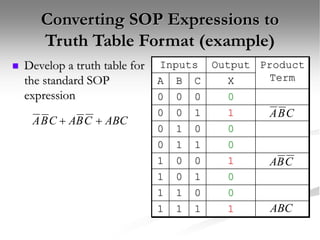
Truth Table Format (example)
 Develop a truth table for
the standard SOP
expression
ABC
C
B
A
C
B
A 

Inputs Output Product
Term
A B C X
0 0 0
0 0 1
0 1 0
0 1 1
1 0 0
1 0 1
1 1 0
1 1 1
Inputs Output Product
Term
A B C X
0 0 0
0 0 1
0 1 0
0 1 1
1 0 0
1 0 1
1 1 0
1 1 1
C
B
A
C
B
A
ABC
Inputs Output Product
Term
A B C X
0 0 0
0 0 1 1
0 1 0
0 1 1
1 0 0 1
1 0 1
1 1 0
1 1 1 1
C
B
A
C
B
A
ABC
Inputs Output Product
Term
A B C X
0 0 0 0
0 0 1 1
0 1 0 0
0 1 1 0
1 0 0 1
1 0 1 0
1 1 0 0
1 1 1 1
C
B
A
C
B
A
ABC
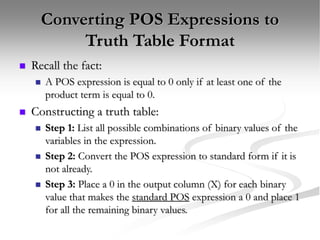
Converting POS Expressions to
Truth Table Format
 Recall the fact:
 A POS expression is equal to 0 only if at least one of the
product term is equal to 0.
 Constructing a truth table:
 Step 1: List all possible combinations of binary values of the
variables in the expression.
 Step 2: Convert the POS expression to standard form if it is
not already.
 Step 3: Place a 0 in the output column (X) for each binary
value that makes the standard POS expression a 0 and place 1
for all the remaining binary values.
Converting POS Expressions to
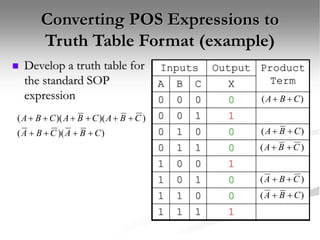
Truth Table Format (example)
 Develop a truth table for
the standard SOP
expression
)
)(
(
)
)(
)(
(
C
B
A
C
B
A
C
B
A
C
B
A
C
B
A










Inputs Output Product
Term
A B C X
0 0 0
0 0 1
0 1 0
0 1 1
1 0 0
1 0 1
1 1 0
1 1 1
Inputs Output Product
Term
A B C X
0 0 0
0 0 1
0 1 0
0 1 1
1 0 0
1 0 1
1 1 0
1 1 1
)
( C
B
A 

)
( C
B
A 

)
( C
B
A 

)
( C
B
A 

)
( C
B
A 

Inputs Output Product
Term
A B C X
0 0 0 0
0 0 1
0 1 0 0
0 1 1 0
1 0 0
1 0 1 0
1 1 0 0
1 1 1
)
( C
B
A 

)
( C
B
A 

)
( C
B
A 

)
( C
B
A 

)
( C
B
A 

Inputs Output Product
Term
A B C X
0 0 0 0
0 0 1 1
0 1 0 0
0 1 1 0
1 0 0 1
1 0 1 0
1 1 0 0
1 1 1 1
)
( C
B
A 

)
( C
B
A 

)
( C
B
A 

)
( C
B
A 

)
( C
B
A 

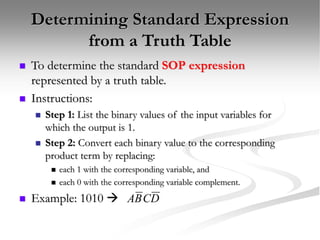
Determining Standard Expression
from a Truth Table
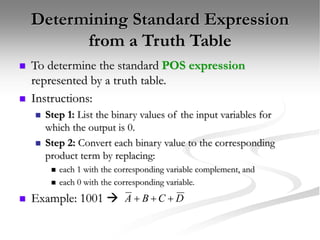
 To determine the standard SOP expression
represented by a truth table.
 Instructions:
 Step 1: List the binary values of the input variables for
which the output is 1.
 Step 2: Convert each binary value to the corresponding
product term by replacing:
 each 1 with the corresponding variable, and
 each 0 with the corresponding variable complement.
 Example: 1010  D
C
B
A
Determining Standard Expression
from a Truth Table
 To determine the standard POS expression
represented by a truth table.
 Instructions:
 Step 1: List the binary values of the input variables for
which the output is 0.
 Step 2: Convert each binary value to the corresponding
product term by replacing:
 each 1 with the corresponding variable complement, and
 each 0 with the corresponding variable.
 Example: 1001  D
C
B
A 


POS
SOP
Determining Standard Expression
from a Truth Table (example)
I/P O/P
A B C X
0 0 0 0
0 0 1 0
0 1 0 0
0 1 1 1
1 0 0 1
1 0 1 0
1 1 0 1
1 1 1 1
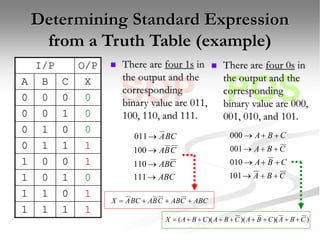
 There are four 1s in
the output and the
corresponding
binary value are 011,
100, 110, and 111.
ABC
C
AB
C
B
A
BC
A




111
110
100
011
 There are four 0s in
the output and the
corresponding
binary value are 000,
001, 010, and 101.
C
B
A
C
B
A
C
B
A
C
B
A












101
010
001
000
ABC
C
AB
C
B
A
BC
A
X 



)
)(
)(
)(
( C
B
A
C
B
A
C
B
A
C
B
A
X 








The Karnaugh Map
The Karnaugh Map
 Feel a little difficult using Boolean algebra laws,
rules, and theorems to simplify logic?
 A K-map provides a systematic method for
simplifying Boolean expressions and, if properly
used, will produce the simplest SOP or POS
expression possible, known as the minimum
expression.
What is K-Map
 It’s similar to truth table; instead of being organized
(i/p and o/p) into columns and rows, the K-map is an
array of cells in which each cell represents a binary
value of the input variables.
 The cells are arranged in a way so that simplification of
a given expression is simply a matter of properly
grouping the cells.
 K-maps can be used for expressions with 2, 3, 4, and 5
variables.
 3 and 4 variables will be discussed to illustrate the principles.
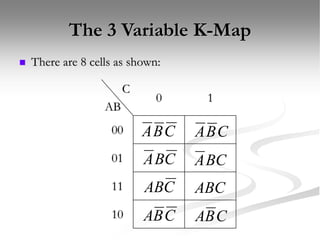
The 3 Variable K-Map
 There are 8 cells as shown:
C
AB
0 1
00
01
11
10
C
B
A C
B
A
C
B
A BC
A
C
AB ABC
C
B
A C
B
A
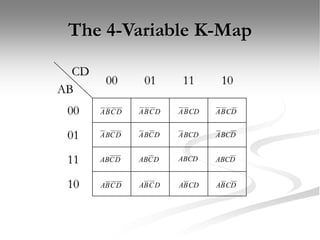
The 4-Variable K-Map
CD
AB
00 01 11 10
00
01
11
10 D
C
B
A
D
C
AB
D
C
B
A
D
C
B
A
D
C
B
A
D
C
AB
D
C
B
A
D
C
B
A
CD
B
A
ABCD
BCD
A
CD
B
A
D
C
B
A
D
ABC
D
BC
A
D
C
B
A
CD
AB
00 01 11 10
00
01
11
10
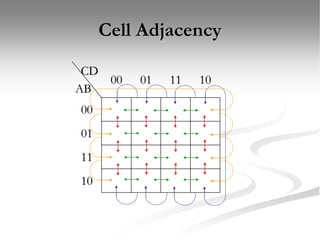
Cell Adjacency
K-Map SOP Minimization
 The K-Map is used for simplifying Boolean
expressions to their minimal form.
 A minimized SOP expression contains the
fewest possible terms with fewest possible
variables per term.
 Generally, a minimum SOP expression can be
implemented with fewer logic gates than a
standard expression.
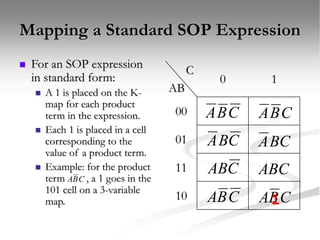
Mapping a Standard SOP Expression
 For an SOP expression
in standard form:
 A 1 is placed on the K-
map for each product
term in the expression.
 Each 1 is placed in a cell
corresponding to the
value of a product term.
 Example: for the product
term , a 1 goes in the
101 cell on a 3-variable
map.
C
AB
0 1
00
01
11
10
C
B
A C
B
A
C
B
A BC
A
C
AB ABC
C
B
A C
B
A
C
B
A
1
C
AB
0 1
00
01
11
10
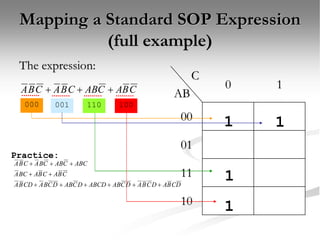
Mapping a Standard SOP Expression
(full example)
The expression:
C
B
A
C
AB
C
B
A
C
B
A 


000 001 110 100
1 1
1
1
D
C
B
A
D
C
B
A
D
C
AB
ABCD
D
C
AB
D
C
B
A
CD
B
A
C
B
A
C
B
A
BC
A
ABC
C
AB
C
B
A
C
B
A











Practice:
Mapping a Nonstandard SOP
Expression
 A Boolean expression must be in standard form
before you use a K-map.
 If one is not in standard form, it must be converted.
 You may use the procedure mentioned earlier or
use numerical expansion.
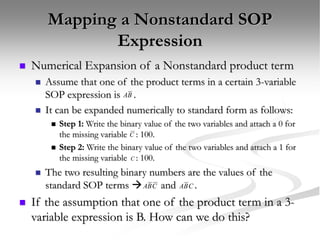
Mapping a Nonstandard SOP
Expression
 Numerical Expansion of a Nonstandard product term
 Assume that one of the product terms in a certain 3-variable
SOP expression is .
 It can be expanded numerically to standard form as follows:
 Step 1: Write the binary value of the two variables and attach a 0 for
the missing variable : 100.
 Step 2: Write the binary value of the two variables and attach a 1 for
the missing variable : 100.
 The two resulting binary numbers are the values of the
standard SOP terms  and .
 If the assumption that one of the product term in a 3-
variable expression is B. How can we do this?
C
B
A
C
C
B
A C
B
A
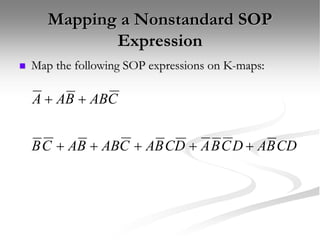
Mapping a Nonstandard SOP
Expression
 Map the following SOP expressions on K-maps:
D
BC
A
D
AC
D
C
A
CD
B
A
D
C
B
A
D
C
B
A
C
AB
B
A
C
B
C
A
BC
C
AB
B
A
A











K-Map Simplification of SOP
Expressions
 After an SOP expression has been mapped, we
can do the process of minimization:
 Grouping the 1s
 Determining the minimum SOP expression from the
map
Grouping the 1s
 You can group 1s on the K-map according to
the following rules by enclosing those adjacent
cells containing 1s.
 The goal is to maximize the size of the
groups and to minimize the number of
groups.
Grouping the 1s (rules)
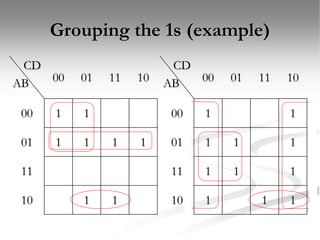
1. A group must contain either 1,2,4,8,or 16 cells
(depending on number of variables in the expression)
2. Each cell in a group must be adjacent to one or more
cells in that same group, but all cells in the group do
not have to be adjacent to each other.
3. Always include the largest possible number of 1s in a
group in accordance with rule 1.
4. Each 1 on the map must be included in at least one
group. The 1s already in a group can be included in
another group as long as the overlapping groups
include noncommon 1s.
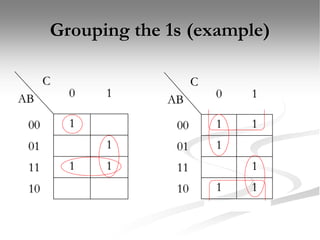
Grouping the 1s (example)
C
AB 0 1
00 1
01 1
11 1 1
10
C
AB 0 1
00 1 1
01 1
11 1
10 1 1
Grouping the 1s (example)
CD
AB 00 01 11 10
00 1 1
01 1 1 1 1
11
10 1 1
CD
AB 00 01 11 10
00 1 1
01 1 1 1
11 1 1 1
10 1 1 1
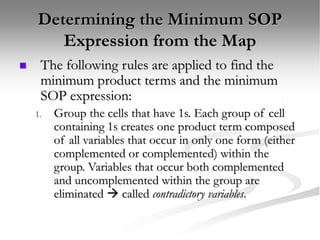
Determining the Minimum SOP
Expression from the Map
 The following rules are applied to find the
minimum product terms and the minimum
SOP expression:
1. Group the cells that have 1s. Each group of cell
containing 1s creates one product term composed
of all variables that occur in only one form (either
complemented or complemented) within the
group. Variables that occur both complemented
and uncomplemented within the group are
eliminated  called contradictory variables.
Determining the Minimum SOP
Expression from the Map
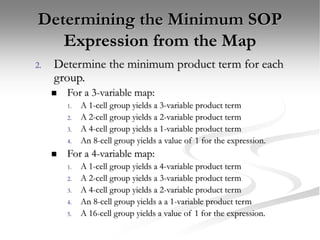
2. Determine the minimum product term for each
group.
 For a 3-variable map:
1. A 1-cell group yields a 3-variable product term
2. A 2-cell group yields a 2-variable product term
3. A 4-cell group yields a 1-variable product term
4. An 8-cell group yields a value of 1 for the expression.
 For a 4-variable map:
1. A 1-cell group yields a 4-variable product term
2. A 2-cell group yields a 3-variable product term
3. A 4-cell group yields a 2-variable product term
4. An 8-cell group yields a a 1-variable product term
5. A 16-cell group yields a value of 1 for the expression.
Determining the Minimum SOP
Expression from the Map
3. When all the minimum product terms are derived
from the K-map, they are summed to form the
minimum SOP expression.
Determining the Minimum SOP
Expression from the Map (example)
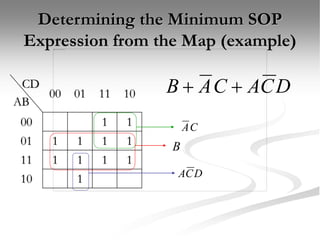
CD
AB
00 01 11 10
00 1 1
01 1 1 1 1
11 1 1 1 1
10 1
B
C
A
D
C
A
D
C
A
C
A
B 

Determining the Minimum SOP
Expression from the Map (exercises)
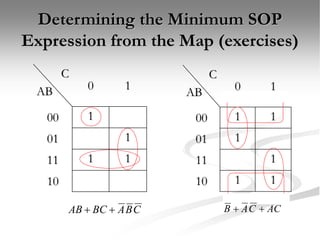
C
B
A
BC
AB 

C
AB 0 1
00 1
01 1
11 1 1
10
C
AB 0 1
00 1 1
01 1
11 1
10 1 1
AC
C
A
B 

Determining the Minimum SOP
Expression from the Map (exercises)
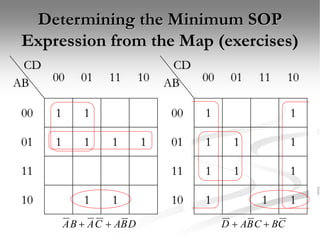
D
B
A
C
A
B
A 
 C
B
C
B
A
D 

CD
AB 00 01 11 10
00 1 1
01 1 1 1 1
11
10 1 1
CD
AB 00 01 11 10
00 1 1
01 1 1 1
11 1 1 1
10 1 1 1
Practicing K-Map (SOP)
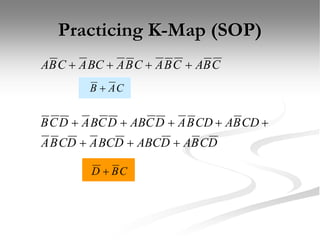
D
C
B
A
D
ABC
D
BC
A
D
C
B
A
CD
B
A
CD
B
A
D
C
AB
D
C
B
A
D
C
B
C
B
A
C
B
A
C
B
A
BC
A
C
B
A












C
A
B 
C
B
D 
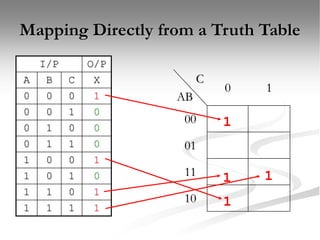
Mapping Directly from a Truth Table
I/P O/P
A B C X
0 0 0 1
0 0 1 0
0 1 0 0
0 1 1 0
1 0 0 1
1 0 1 0
1 1 0 1
1 1 1 1
C
AB
0 1
00
01
11
10
1
1
1
1
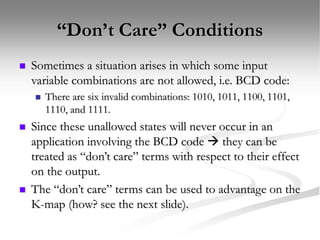
“Don’t Care” Conditions
 Sometimes a situation arises in which some input
variable combinations are not allowed, i.e. BCD code:
 There are six invalid combinations: 1010, 1011, 1100, 1101,
1110, and 1111.
 Since these unallowed states will never occur in an
application involving the BCD code  they can be
treated as “don’t care” terms with respect to their effect
on the output.
 The “don’t care” terms can be used to advantage on the
K-map (how? see the next slide).
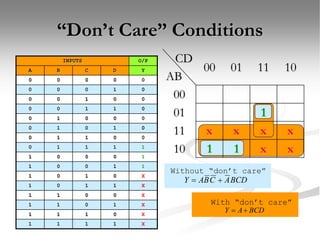
“Don’t Care” Conditions
INPUTS O/P
A B C D Y
0 0 0 0 0
0 0 0 1 0
0 0 1 0 0
0 0 1 1 0
0 1 0 0 0
0 1 0 1 0
0 1 1 0 0
0 1 1 1 1
1 0 0 0 1
1 0 0 1 1
1 0 1 0 X
1 0 1 1 X
1 1 0 0 X
1 1 0 1 X
1 1 1 0 X
1 1 1 1 X
CD
AB
00 01 11 10
00
01 1
11 x x x x
10 1 1 x x
BCD
A
C
B
A
Y 

Without “don’t care”
BCD
A
Y 

With “don’t care”
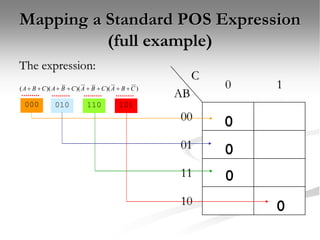
K-Map POS Minimization
 The approaches are much the same (as SOP)
except that with POS expression, 0s
representing the standard sum terms are placed
on the K-map instead of 1s.
C
AB
0 1
00
01
11
10
Mapping a Standard POS Expression
(full example)
The expression:
)
)(
)(
)(
( C
B
A
C
B
A
C
B
A
C
B
A 







000 010 110 101
0
0
0
0
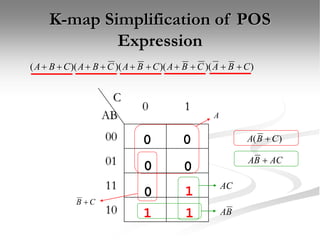
K-map Simplification of POS
Expression
)
)(
)(
)(
)(
( C
B
A
C
B
A
C
B
A
C
B
A
C
B
A 









C
AB
0 1
00
01
11
10 B
A
0 0
0 0
0
AC
C
B 
A
1
1
1
)
( C
B
A 
AC
B
A 
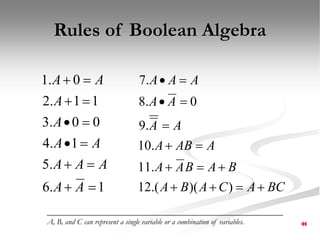
Rules of Boolean Algebra
1
.
6
.
5
1
.
4
0
0
.
3
1
1
.
2
0
.
1












A
A
A
A
A
A
A
A
A
A
A
BC
A
C
A
B
A
B
A
B
A
A
A
AB
A
A
A
A
A
A
A
A














)
)(
.(
12
.
11
.
10
.
9
0
.
8
.
7
___________________________________________________________
A, B, and C can represent a single variable or a combination of variables. 7

08 logic simplification

  • 1.
  • 2.
    Simplification Using BooleanAlgebra  A simplified Boolean expression uses the fewest gates possible to implement a given expression. A B C AB+A(B+C)+B(B+C)
  • 3.
    Simplification Using BooleanAlgebra  AB+A(B+C)+B(B+C)  (distributive law)  AB+AB+AC+BB+BC  (rule 7; BB=B)  AB+AB+AC+B+BC  (rule 5; AB+AB=AB)  AB+AC+B+BC  (rule 10; B+BC=B)  AB+AC+B  (rule 10; AB+B=B)  B+AC A B C B+AC A B C AB+A(B+C)+B(B+C)
  • 4.
    Simplification Using BooleanAlgebra  Try these: C B A AC AB ABC C B A C B A C B A BC A C B A BD C B A         ] ) ( [ 8
  • 5.
    Standard Forms ofBoolean Expressions  All Boolean expressions, regardless of their form, can be converted into either of two standard forms:  The sum-of-products (SOP) form  The product-of-sums (POS) form  Standardization makes the evaluation, simplification, and implementation of Boolean expressions much more systematic and easier.
  • 6.
  • 7.
    The Sum-of-Products (SOP)Form  An SOP expression  when two or more product terms are summed by Boolean addition.  Examples:  Also: AC C B A B A D C B CDE ABC ABC AB      D BC C B A A    In an SOP form, a single overbar cannot extend over more than one variable; however, more than one variable in a term can have an overbar:  example: is OK!  But not: C B A ABC
  • 8.
    Implementation of anSOP  AND/OR implementation  NAND/NAND implementation X=AB+BCD+AC A B B C D A C X A B B C D A C X
  • 9.
  • 10.
    The Standard SOPForm  A standard SOP expression is one in which all the variables in the domain appear in each product term in the expression.  Example:  Standard SOP expressions are important in:  Constructing truth tables  The Karnaugh map simplification method D C AB D C B A CD B A  
  • 11.
    Converting Product Termsto Standard SOP  Step 1: Multiply each nonstandard product term by a term made up of the sum of a missing variable and its complement. This results in two product terms.  As you know, you can multiply anything by 1 without changing its value.  Step 2: Repeat step 1 until all resulting product term contains all variables in the domain in either complemented or uncomplemented form. In converting a product term to standard form, the number of product terms is doubled for each missing variable.
  • 12.
    Converting Product Termsto Standard SOP (example)  Convert the following Boolean expression into standard SOP form: D C AB B A C B A   D C AB D C B A D C B A D C B A CD B A D C B A CD B A D C AB B A C B A D C B A D C B A D C B A CD B A D D C B A D D C B A C B A C B A C C B A B A D C B A CD B A D D C B A C B A                         ) ( ) ( ) ( ) ( 8
  • 13.
    Binary Representation ofa Standard Product Term  A standard product term is equal to 1 for only one combination of variable values.  Example: is equal to 1 when A=1, B=0, C=1, and D=0 as shown below  And this term is 0 for all other combinations of values for the variables. 1 1 1 1 1 0 1 0 1          D C B A D C B A
  • 14.
  • 15.
    The Product-of-Sums (POS)Form  When two or more sum terms are multiplied, the result expression is a product-of-sums (POS):  Examples:  Also:  In a POS form, a single overbar cannot extend over more than one variable; however, more than one variable in a term can have an overbar:  example: is OK!  But not: C B A   C B A   ) )( )( ( ) )( )( ( ) )( ( C A C B A B A D C B E D C C B A C B A B A              ) )( ( D C B C B A A    
  • 16.
    Implementation of aPOS  OR/AND implementation X=(A+B)(B+C+D)(A+C) A B B C D A C X
  • 17.
    The Standard POSForm  A standard POS expression is one in which all the variables in the domain appear in each sum term in the expression.  Example:  Standard POS expressions are important in:  Constructing truth tables  The Karnaugh map simplification method ) )( )( ( D C B A D C B A D C B A         
  • 18.
    Converting a SumTerm to Standard POS  Step 1: Add to each nonstandard product term a term made up of the product of the missing variable and its complement. This results in two sum terms.  As you know, you can add 0 to anything without changing its value.  Step 2: Apply rule 12  A+BC=(A+B)(A+C).  Step 3: Repeat step 1 until all resulting sum terms contain all variable in the domain in either complemented or uncomplemented form.
  • 19.
    Converting a SumTerm to Standard POS (example)  Convert the following Boolean expression into standard POS form: ) )( )( ( D C B A D C B C B A        ) )( )( )( )( ( ) )( )( ( ) )( ( ) )( ( D C B A D C B A D C B A D C B A D C B A D C B A D C B C B A D C B A D C B A A A D C B D C B D C B A D C B A D D C B A C B A                                                 
  • 20.
    Binary Representation ofa Standard Sum Term  A standard sum term is equal to 0 for only one combination of variable values.  Example: is equal to 0 when A=0, B=1, C=0, and D=1 as shown below  And this term is 1 for all other combinations of values for the variables. 0 0 0 0 0 1 0 1 0             D C B A D C B A   
  • 21.
  • 22.
    Converting Standard SOPto Standard POS  The Facts:  The binary values of the product terms in a given standard SOP expression are not present in the equivalent standard POS expression.  The binary values that are not represented in the SOP expression are present in the equivalent POS expression.
  • 23.
    Converting Standard SOPto Standard POS  What can you use the facts?  Convert from standard SOP to standard POS.  How?  Step 1: Evaluate each product term in the SOP expression. That is, determine the binary numbers that represent the product terms.  Step 2: Determine all of the binary numbers not included in the evaluation in Step 1.  Step 3: Write the equivalent sum term for each binary number from Step 2 and express in POS form.
  • 24.
    Converting Standard SOPto Standard POS (example)  Convert the SOP expression to an equivalent POS expression:  The evaluation is as follows:  There are 8 possible combinations. The SOP expression contains five of these, so the POS must contain the other 3 which are: 001, 100, and 110. ) )( )( ( 111 101 011 010 000 C B A C B A C B A ABC C B A BC A C B A C B A              
  • 25.
    Boolean Expressions &Truth Tables  All standard Boolean expression can be easily converted into truth table format using binary values for each term in the expression.  Also, standard SOP or POS expression can be determined from the truth table.
  • 26.
    Converting SOP Expressionsto Truth Table Format  Recall the fact:  An SOP expression is equal to 1 only if at least one of the product term is equal to 1.  Constructing a truth table:  Step 1: List all possible combinations of binary values of the variables in the expression.  Step 2: Convert the SOP expression to standard form if it is not already.  Step 3: Place a 1 in the output column (X) for each binary value that makes the standard SOP expression a 1 and place 0 for all the remaining binary values.
  • 27.
    Converting SOP Expressionsto Truth Table Format (example)  Develop a truth table for the standard SOP expression ABC C B A C B A   Inputs Output Product Term A B C X 0 0 0 0 0 1 0 1 0 0 1 1 1 0 0 1 0 1 1 1 0 1 1 1 Inputs Output Product Term A B C X 0 0 0 0 0 1 0 1 0 0 1 1 1 0 0 1 0 1 1 1 0 1 1 1 C B A C B A ABC Inputs Output Product Term A B C X 0 0 0 0 0 1 1 0 1 0 0 1 1 1 0 0 1 1 0 1 1 1 0 1 1 1 1 C B A C B A ABC Inputs Output Product Term A B C X 0 0 0 0 0 0 1 1 0 1 0 0 0 1 1 0 1 0 0 1 1 0 1 0 1 1 0 0 1 1 1 1 C B A C B A ABC
  • 28.
    Converting POS Expressionsto Truth Table Format  Recall the fact:  A POS expression is equal to 0 only if at least one of the product term is equal to 0.  Constructing a truth table:  Step 1: List all possible combinations of binary values of the variables in the expression.  Step 2: Convert the POS expression to standard form if it is not already.  Step 3: Place a 0 in the output column (X) for each binary value that makes the standard POS expression a 0 and place 1 for all the remaining binary values.
  • 29.
    Converting POS Expressionsto Truth Table Format (example)  Develop a truth table for the standard SOP expression ) )( ( ) )( )( ( C B A C B A C B A C B A C B A           Inputs Output Product Term A B C X 0 0 0 0 0 1 0 1 0 0 1 1 1 0 0 1 0 1 1 1 0 1 1 1 Inputs Output Product Term A B C X 0 0 0 0 0 1 0 1 0 0 1 1 1 0 0 1 0 1 1 1 0 1 1 1 ) ( C B A   ) ( C B A   ) ( C B A   ) ( C B A   ) ( C B A   Inputs Output Product Term A B C X 0 0 0 0 0 0 1 0 1 0 0 0 1 1 0 1 0 0 1 0 1 0 1 1 0 0 1 1 1 ) ( C B A   ) ( C B A   ) ( C B A   ) ( C B A   ) ( C B A   Inputs Output Product Term A B C X 0 0 0 0 0 0 1 1 0 1 0 0 0 1 1 0 1 0 0 1 1 0 1 0 1 1 0 0 1 1 1 1 ) ( C B A   ) ( C B A   ) ( C B A   ) ( C B A   ) ( C B A  
  • 30.
    Determining Standard Expression froma Truth Table  To determine the standard SOP expression represented by a truth table.  Instructions:  Step 1: List the binary values of the input variables for which the output is 1.  Step 2: Convert each binary value to the corresponding product term by replacing:  each 1 with the corresponding variable, and  each 0 with the corresponding variable complement.  Example: 1010  D C B A
  • 31.
    Determining Standard Expression froma Truth Table  To determine the standard POS expression represented by a truth table.  Instructions:  Step 1: List the binary values of the input variables for which the output is 0.  Step 2: Convert each binary value to the corresponding product term by replacing:  each 1 with the corresponding variable complement, and  each 0 with the corresponding variable.  Example: 1001  D C B A   
  • 32.
    POS SOP Determining Standard Expression froma Truth Table (example) I/P O/P A B C X 0 0 0 0 0 0 1 0 0 1 0 0 0 1 1 1 1 0 0 1 1 0 1 0 1 1 0 1 1 1 1 1  There are four 1s in the output and the corresponding binary value are 011, 100, 110, and 111. ABC C AB C B A BC A     111 110 100 011  There are four 0s in the output and the corresponding binary value are 000, 001, 010, and 101. C B A C B A C B A C B A             101 010 001 000 ABC C AB C B A BC A X     ) )( )( )( ( C B A C B A C B A C B A X         
  • 33.
  • 34.
    The Karnaugh Map Feel a little difficult using Boolean algebra laws, rules, and theorems to simplify logic?  A K-map provides a systematic method for simplifying Boolean expressions and, if properly used, will produce the simplest SOP or POS expression possible, known as the minimum expression.
  • 35.
    What is K-Map It’s similar to truth table; instead of being organized (i/p and o/p) into columns and rows, the K-map is an array of cells in which each cell represents a binary value of the input variables.  The cells are arranged in a way so that simplification of a given expression is simply a matter of properly grouping the cells.  K-maps can be used for expressions with 2, 3, 4, and 5 variables.  3 and 4 variables will be discussed to illustrate the principles.
  • 36.
    The 3 VariableK-Map  There are 8 cells as shown: C AB 0 1 00 01 11 10 C B A C B A C B A BC A C AB ABC C B A C B A
  • 37.
    The 4-Variable K-Map CD AB 0001 11 10 00 01 11 10 D C B A D C AB D C B A D C B A D C B A D C AB D C B A D C B A CD B A ABCD BCD A CD B A D C B A D ABC D BC A D C B A
  • 38.
    CD AB 00 01 1110 00 01 11 10 Cell Adjacency
  • 39.
    K-Map SOP Minimization The K-Map is used for simplifying Boolean expressions to their minimal form.  A minimized SOP expression contains the fewest possible terms with fewest possible variables per term.  Generally, a minimum SOP expression can be implemented with fewer logic gates than a standard expression.
  • 40.
    Mapping a StandardSOP Expression  For an SOP expression in standard form:  A 1 is placed on the K- map for each product term in the expression.  Each 1 is placed in a cell corresponding to the value of a product term.  Example: for the product term , a 1 goes in the 101 cell on a 3-variable map. C AB 0 1 00 01 11 10 C B A C B A C B A BC A C AB ABC C B A C B A C B A 1
  • 41.
    C AB 0 1 00 01 11 10 Mapping aStandard SOP Expression (full example) The expression: C B A C AB C B A C B A    000 001 110 100 1 1 1 1 D C B A D C B A D C AB ABCD D C AB D C B A CD B A C B A C B A BC A ABC C AB C B A C B A            Practice:
  • 42.
    Mapping a NonstandardSOP Expression  A Boolean expression must be in standard form before you use a K-map.  If one is not in standard form, it must be converted.  You may use the procedure mentioned earlier or use numerical expansion.
  • 43.
    Mapping a NonstandardSOP Expression  Numerical Expansion of a Nonstandard product term  Assume that one of the product terms in a certain 3-variable SOP expression is .  It can be expanded numerically to standard form as follows:  Step 1: Write the binary value of the two variables and attach a 0 for the missing variable : 100.  Step 2: Write the binary value of the two variables and attach a 1 for the missing variable : 100.  The two resulting binary numbers are the values of the standard SOP terms  and .  If the assumption that one of the product term in a 3- variable expression is B. How can we do this? C B A C C B A C B A
  • 44.
    Mapping a NonstandardSOP Expression  Map the following SOP expressions on K-maps: D BC A D AC D C A CD B A D C B A D C B A C AB B A C B C A BC C AB B A A           
  • 45.
    K-Map Simplification ofSOP Expressions  After an SOP expression has been mapped, we can do the process of minimization:  Grouping the 1s  Determining the minimum SOP expression from the map
  • 46.
    Grouping the 1s You can group 1s on the K-map according to the following rules by enclosing those adjacent cells containing 1s.  The goal is to maximize the size of the groups and to minimize the number of groups.
  • 47.
    Grouping the 1s(rules) 1. A group must contain either 1,2,4,8,or 16 cells (depending on number of variables in the expression) 2. Each cell in a group must be adjacent to one or more cells in that same group, but all cells in the group do not have to be adjacent to each other. 3. Always include the largest possible number of 1s in a group in accordance with rule 1. 4. Each 1 on the map must be included in at least one group. The 1s already in a group can be included in another group as long as the overlapping groups include noncommon 1s.
  • 48.
    Grouping the 1s(example) C AB 0 1 00 1 01 1 11 1 1 10 C AB 0 1 00 1 1 01 1 11 1 10 1 1
  • 49.
    Grouping the 1s(example) CD AB 00 01 11 10 00 1 1 01 1 1 1 1 11 10 1 1 CD AB 00 01 11 10 00 1 1 01 1 1 1 11 1 1 1 10 1 1 1
  • 50.
    Determining the MinimumSOP Expression from the Map  The following rules are applied to find the minimum product terms and the minimum SOP expression: 1. Group the cells that have 1s. Each group of cell containing 1s creates one product term composed of all variables that occur in only one form (either complemented or complemented) within the group. Variables that occur both complemented and uncomplemented within the group are eliminated  called contradictory variables.
  • 51.
    Determining the MinimumSOP Expression from the Map 2. Determine the minimum product term for each group.  For a 3-variable map: 1. A 1-cell group yields a 3-variable product term 2. A 2-cell group yields a 2-variable product term 3. A 4-cell group yields a 1-variable product term 4. An 8-cell group yields a value of 1 for the expression.  For a 4-variable map: 1. A 1-cell group yields a 4-variable product term 2. A 2-cell group yields a 3-variable product term 3. A 4-cell group yields a 2-variable product term 4. An 8-cell group yields a a 1-variable product term 5. A 16-cell group yields a value of 1 for the expression.
  • 52.
    Determining the MinimumSOP Expression from the Map 3. When all the minimum product terms are derived from the K-map, they are summed to form the minimum SOP expression.
  • 53.
    Determining the MinimumSOP Expression from the Map (example) CD AB 00 01 11 10 00 1 1 01 1 1 1 1 11 1 1 1 1 10 1 B C A D C A D C A C A B  
  • 54.
    Determining the MinimumSOP Expression from the Map (exercises) C B A BC AB   C AB 0 1 00 1 01 1 11 1 1 10 C AB 0 1 00 1 1 01 1 11 1 10 1 1 AC C A B  
  • 55.
    Determining the MinimumSOP Expression from the Map (exercises) D B A C A B A   C B C B A D   CD AB 00 01 11 10 00 1 1 01 1 1 1 1 11 10 1 1 CD AB 00 01 11 10 00 1 1 01 1 1 1 11 1 1 1 10 1 1 1
  • 56.
  • 57.
    Mapping Directly froma Truth Table I/P O/P A B C X 0 0 0 1 0 0 1 0 0 1 0 0 0 1 1 0 1 0 0 1 1 0 1 0 1 1 0 1 1 1 1 1 C AB 0 1 00 01 11 10 1 1 1 1
  • 58.
    “Don’t Care” Conditions Sometimes a situation arises in which some input variable combinations are not allowed, i.e. BCD code:  There are six invalid combinations: 1010, 1011, 1100, 1101, 1110, and 1111.  Since these unallowed states will never occur in an application involving the BCD code  they can be treated as “don’t care” terms with respect to their effect on the output.  The “don’t care” terms can be used to advantage on the K-map (how? see the next slide).
  • 59.
    “Don’t Care” Conditions INPUTSO/P A B C D Y 0 0 0 0 0 0 0 0 1 0 0 0 1 0 0 0 0 1 1 0 0 1 0 0 0 0 1 0 1 0 0 1 1 0 0 0 1 1 1 1 1 0 0 0 1 1 0 0 1 1 1 0 1 0 X 1 0 1 1 X 1 1 0 0 X 1 1 0 1 X 1 1 1 0 X 1 1 1 1 X CD AB 00 01 11 10 00 01 1 11 x x x x 10 1 1 x x BCD A C B A Y   Without “don’t care” BCD A Y   With “don’t care”
  • 60.
    K-Map POS Minimization The approaches are much the same (as SOP) except that with POS expression, 0s representing the standard sum terms are placed on the K-map instead of 1s.
  • 61.
    C AB 0 1 00 01 11 10 Mapping aStandard POS Expression (full example) The expression: ) )( )( )( ( C B A C B A C B A C B A         000 010 110 101 0 0 0 0
  • 62.
    K-map Simplification ofPOS Expression ) )( )( )( )( ( C B A C B A C B A C B A C B A           C AB 0 1 00 01 11 10 B A 0 0 0 0 0 AC C B  A 1 1 1 ) ( C B A  AC B A 
  • 63.
    Rules of BooleanAlgebra 1 . 6 . 5 1 . 4 0 0 . 3 1 1 . 2 0 . 1             A A A A A A A A A A A BC A C A B A B A B A A A AB A A A A A A A A               ) )( .( 12 . 11 . 10 . 9 0 . 8 . 7 ___________________________________________________________ A, B, and C can represent a single variable or a combination of variables. 7