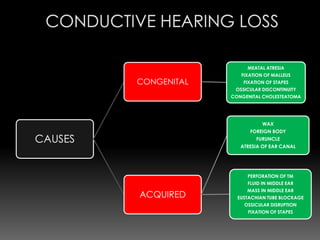
CAUSES
ACQUIRED
WAX
FOREIGN BODY
FURUNCLE
ATRESIA OF EAR CANAL
PERFORATION OF TM
FLUID IN MIDDLE EAR
MASS IN MIDDLE EAR
EUSTACHIAN TUBE BLOCKAGE
OSSICULAR DISRUPTION
FIXATION OF STAPES
CONGENITAL
MEATAL ATRESIA
FIXATION OF MALLEUS
FIXATION OF STAPES
OSSICULAR DISCONTINUITY
CONGENITAL CHOLESTEATOMA
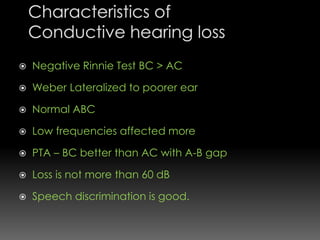
 Negative Rinnie Test BC > AC
 Weber Lateralized to poorer ear
 Normal ABC
 Low frequencies affected more
 PTA – BC better than AC with A-B gap
 Loss is not more than 60 dB
 Speech discrimination is good.
 Complete Obstruction of ear canal – 30dB
 TM Perforation – 10 – 40 dB
 Ossicular disruption with intact TM – 54dB
 Ossicular disruption with TM Perforation – 38 dB
 Malleus Fixation – 10-25 dB
 Closure of Oval Window – 60dB
 Removal of canal obstruction
 Removal of fluid
 Removal of mass
 Stapedectomy
 Tympanoplasty
 Hearing Aid
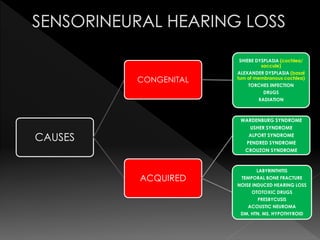
CAUSES
ACQUIRED
WARDENBURG SYNDROME
USHER SYNDROME
ALPORT SYNDROME
PENDRED SYNDROME
CROUZON SYNDROME
LABYRINTHITIS
TEMPORAL BONE FRACTURE
NOISE INDUCED HEARING LOSS
OTOTOXIC DRUGS
PRESBYCUSIS
ACOUSTIC NEUROMA
DM, HTN, MS, HYPOTHYROID
CONGENITAL
SHIEBE DYSPLASIA (cochlea/
saccule)
ALEXANDER DYSPLASIA (basal
turn of membranous cochlea)
TORCHES INFECTION
DRUGS
RADIATION
 Positive Rinnie Test AC > BC
 Weber Lateralized to better ear
 Reduced ABC & Schwabach
 High frequencies affected more
 PTA – AC better than BC with no A-B gap
 Loss is more than 60 dB
 Speech discrimination is poor.
 Difficulty hearing in presence of noise.
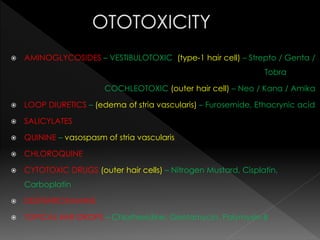
 AMINOGLYCOSIDES – VESTIBULOTOXIC (type-1 hair cell) – Strepto / Genta /
Tobra
COCHLEOTOXIC (outer hair cell) – Neo / Kana / Amika
 LOOP DIURETICS – (edema of stria vascularis) – Furosemide, Ethacrynic acid
 SALICYLATES
 QUININE – vasospasm of stria vascularis
 CHLOROQUINE
 CYTOTOXIC DRUGS (outer hair cells) – Nitrogen Mustard, Cisplatin,
Carboplatin
 DESFERRIOXAMINE
 TOPICAL EAR DROPS – Chlorhexidine, Gentamycin, Polymyxin-B
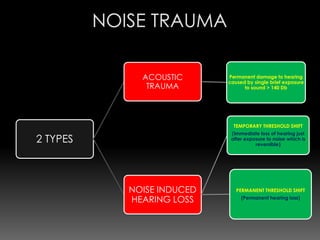
2 TYPES
NOISE INDUCED
HEARING LOSS
TEMPORARY THRESHOLD SHIFT
(Immediate loss of hearing just
after exposure to noise which is
reversible)
PERMANENT THRESHOLD SHIFT
(Permanent hearing loss)
ACOUSTIC
TRAUMA
Permanent damage to hearing
caused by single brief exposure
to sound > 140 Db
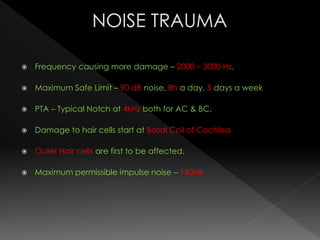
 Frequency causing more damage – 2000 – 3000 Hz.
 Maximum Safe Limit – 90 dB noise, 8h a day, 5 days a week
 PTA – Typical Notch at 4kHz both for AC & BC.
 Damage to hair cells start at Basal Coil of Cochlea
 Outer Hair cells are first to be affected.
 Maximum permissible impulse noise – 140dB
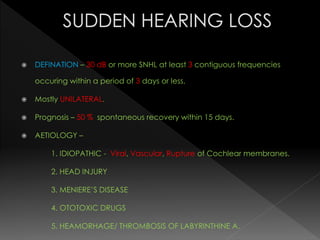
 DEFINATION – 30 dB or more SNHL at least 3 contiguous frequencies
occuring within a period of 3 days or less.
 Mostly UNILATERAL.
 Prognosis – 50 % spontaneous recovery within 15 days.
 AETIOLOGY –
1. IDIOPATHIC - Viral, Vascular, Rupture of Cochlear membranes.
2. HEAD INJURY
3. MENIERE’S DISEASE
4. OTOTOXIC DRUGS
5. HEAMORHAGE/ THROMBOSIS OF LABYRINTHINE A.
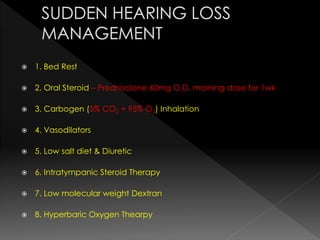
 1. Bed Rest
 2. Oral Steroid – Prednisolone 60mg O.D. morning dose for 1wk
 3. Carbogen (5% CO2 + 95% O2) Inhalation
 4. Vasodilators
 5. Low salt diet & Diuretic
 6. Intratympanic Steroid Therapy
 7. Low molecular weight Dextran
 8. Hyperbaric Oxygen Thearpy
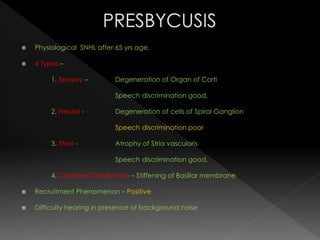
 Physiological SNHL after 65 yrs age.
 4 Types –
1. Sensory – Degeneration of Organ of Corti
Speech discrimination good.
2. Neural - Degeneration of cells of Spiral Ganglion
Speech discrimination poor
3. Strial - Atrophy of Stria vascularis
Speech discrimination good.
4. Cochlear Conductive – Stiffening of Basillar membrane
 Recruitment Phenomenon – Positive
 Difficulty hearing in presence of background noise
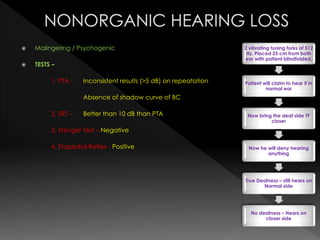
 Malingering / Psychogenic
 TESTS –
1. PTA - Inconsistent results (>5 dB) on repeatation
Absence of shadow curve of BC
2. SRT – Better than 10 dB than PTA
3. Stenger Test – Negative
4. Stapedial Reflex - Positive
2 vibrating tuning forks of 512
Hz. Placed 25 cm from both
ear with patient blindfolded.
Patient will claim to hear it in
normal ear
Now bring the deaf side TF
closer
Now he will deny hearing
anything
True Deafness – still hears on
Normal side
No deafness – Hears on
closer side
Hearing loss

Hearing loss

  • 3.
    CAUSES ACQUIRED WAX FOREIGN BODY FURUNCLE ATRESIA OFEAR CANAL PERFORATION OF TM FLUID IN MIDDLE EAR MASS IN MIDDLE EAR EUSTACHIAN TUBE BLOCKAGE OSSICULAR DISRUPTION FIXATION OF STAPES CONGENITAL MEATAL ATRESIA FIXATION OF MALLEUS FIXATION OF STAPES OSSICULAR DISCONTINUITY CONGENITAL CHOLESTEATOMA
  • 4.
     Negative RinnieTest BC > AC  Weber Lateralized to poorer ear  Normal ABC  Low frequencies affected more  PTA – BC better than AC with A-B gap  Loss is not more than 60 dB  Speech discrimination is good.
  • 5.
     Complete Obstructionof ear canal – 30dB  TM Perforation – 10 – 40 dB  Ossicular disruption with intact TM – 54dB  Ossicular disruption with TM Perforation – 38 dB  Malleus Fixation – 10-25 dB  Closure of Oval Window – 60dB
  • 6.
     Removal ofcanal obstruction  Removal of fluid  Removal of mass  Stapedectomy  Tympanoplasty  Hearing Aid
  • 7.
    CAUSES ACQUIRED WARDENBURG SYNDROME USHER SYNDROME ALPORTSYNDROME PENDRED SYNDROME CROUZON SYNDROME LABYRINTHITIS TEMPORAL BONE FRACTURE NOISE INDUCED HEARING LOSS OTOTOXIC DRUGS PRESBYCUSIS ACOUSTIC NEUROMA DM, HTN, MS, HYPOTHYROID CONGENITAL SHIEBE DYSPLASIA (cochlea/ saccule) ALEXANDER DYSPLASIA (basal turn of membranous cochlea) TORCHES INFECTION DRUGS RADIATION
  • 8.
     Positive RinnieTest AC > BC  Weber Lateralized to better ear  Reduced ABC & Schwabach  High frequencies affected more  PTA – AC better than BC with no A-B gap  Loss is more than 60 dB  Speech discrimination is poor.  Difficulty hearing in presence of noise.
  • 9.
     AMINOGLYCOSIDES –VESTIBULOTOXIC (type-1 hair cell) – Strepto / Genta / Tobra COCHLEOTOXIC (outer hair cell) – Neo / Kana / Amika  LOOP DIURETICS – (edema of stria vascularis) – Furosemide, Ethacrynic acid  SALICYLATES  QUININE – vasospasm of stria vascularis  CHLOROQUINE  CYTOTOXIC DRUGS (outer hair cells) – Nitrogen Mustard, Cisplatin, Carboplatin  DESFERRIOXAMINE  TOPICAL EAR DROPS – Chlorhexidine, Gentamycin, Polymyxin-B
  • 10.
    2 TYPES NOISE INDUCED HEARINGLOSS TEMPORARY THRESHOLD SHIFT (Immediate loss of hearing just after exposure to noise which is reversible) PERMANENT THRESHOLD SHIFT (Permanent hearing loss) ACOUSTIC TRAUMA Permanent damage to hearing caused by single brief exposure to sound > 140 Db
  • 11.
     Frequency causingmore damage – 2000 – 3000 Hz.  Maximum Safe Limit – 90 dB noise, 8h a day, 5 days a week  PTA – Typical Notch at 4kHz both for AC & BC.  Damage to hair cells start at Basal Coil of Cochlea  Outer Hair cells are first to be affected.  Maximum permissible impulse noise – 140dB
  • 12.
     DEFINATION –30 dB or more SNHL at least 3 contiguous frequencies occuring within a period of 3 days or less.  Mostly UNILATERAL.  Prognosis – 50 % spontaneous recovery within 15 days.  AETIOLOGY – 1. IDIOPATHIC - Viral, Vascular, Rupture of Cochlear membranes. 2. HEAD INJURY 3. MENIERE’S DISEASE 4. OTOTOXIC DRUGS 5. HEAMORHAGE/ THROMBOSIS OF LABYRINTHINE A.
  • 13.
     1. BedRest  2. Oral Steroid – Prednisolone 60mg O.D. morning dose for 1wk  3. Carbogen (5% CO2 + 95% O2) Inhalation  4. Vasodilators  5. Low salt diet & Diuretic  6. Intratympanic Steroid Therapy  7. Low molecular weight Dextran  8. Hyperbaric Oxygen Thearpy
  • 14.
     Physiological SNHLafter 65 yrs age.  4 Types – 1. Sensory – Degeneration of Organ of Corti Speech discrimination good. 2. Neural - Degeneration of cells of Spiral Ganglion Speech discrimination poor 3. Strial - Atrophy of Stria vascularis Speech discrimination good. 4. Cochlear Conductive – Stiffening of Basillar membrane  Recruitment Phenomenon – Positive  Difficulty hearing in presence of background noise
  • 15.
     Malingering /Psychogenic  TESTS – 1. PTA - Inconsistent results (>5 dB) on repeatation Absence of shadow curve of BC 2. SRT – Better than 10 dB than PTA 3. Stenger Test – Negative 4. Stapedial Reflex - Positive 2 vibrating tuning forks of 512 Hz. Placed 25 cm from both ear with patient blindfolded. Patient will claim to hear it in normal ear Now bring the deaf side TF closer Now he will deny hearing anything True Deafness – still hears on Normal side No deafness – Hears on closer side