COASTALINFRASTRUCTURE 
Primary Source: The introduction of coastal infrastructure as a driver of change in marine environments. (2010) Authors: Fabio Bulleri and Maura G. Chapman, Journal of Applied Ecology 
Presentationpreparedby: GlorynelOjeda-Matos, BSCE, MP 
Departmentof EnvironmentalSciences 
Universityof Puerto Rico, Río Piedras Campus
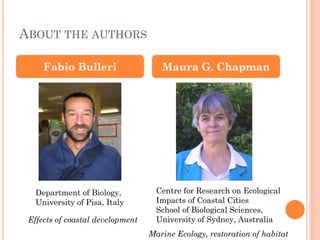
ABOUTTHEAUTHORS 
Fabio Bulleri 
Maura G. Chapman 
Department of Biology, University of Pisa, Italy 
Centre for Research on Ecological 
Impacts of Coastal Cities 
School of Biological Sciences, University of Sydney, Australia 
Marine Ecology, restoration of habitat 
Effects of coastal development
PAPERCONTENT 
Summary 
Introduction 
Ecological consequences of the introduction of artificial structures 
•Introduction of Novel Habitat 
•Effects on Adjacent Habitats 
•Regional or Large-scale Changes 
•Implications for the Spread of Exotic Species 
Alternative management options 
Future directions for research 
Concluding remarks
OUROBJECTIVESARE: 
I.Overview of the current knowledge of the ecological effects and impacts of urban infrastructure on marine habitats. 
II.Discuss the alternative coastal defence options might mitigate their impacts. 
III.Identify future research directions that might advance understanding of these artificial habitats and, hence, our ability to preserve biodiversity in urbanized environments.
EXPONENTIALGROWTHOFPOPULATIONS 
Many of the largest cities in the world are located in coastal zones. 
Areas with higher coastal population generally link to a more altered state of shoreline. 
75% of people are expected to live within 100 km of a coast by 2025. 
Source: https://wiki.colby.edu/display/stateofmaine2009/State+of+Coastal+and+Marine+Management+in+Maine
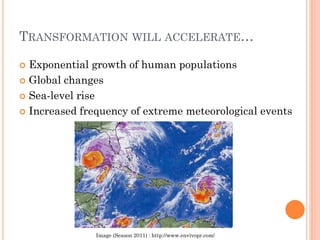
TRANSFORMATIONWILLACCELERATE… 
Exponential growth of human populations 
Global changes 
Sea-level rise 
Increased frequency of extreme meteorological events 
Image(Season2011) : http://www.envivopr.com/
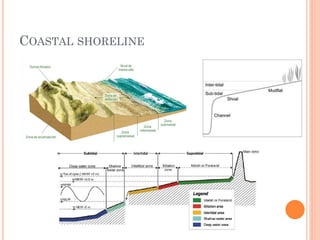
COASTALSHORELINE
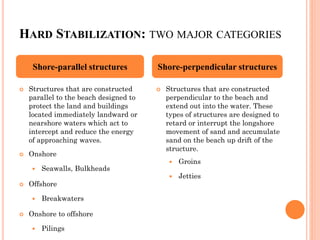
HARDSTABILIZATION: TWOMAJORCATEGORIES 
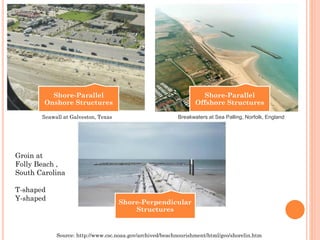
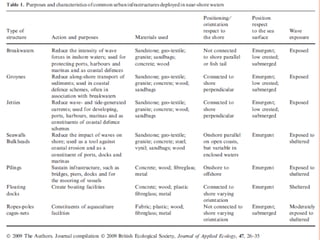
Structures that are constructed parallel to the beach designed to protect the land and buildings located immediately landwardor nearshorewaters which act to intercept and reduce the energy of approaching waves. 
Onshore 
Seawalls, Bulkheads 
Offshore 
Breakwaters 
Onshore to offshore 
Pilings 
Structures that are constructed perpendicular to the beach and extend out into the water. These types of structures are designed to retard or interrupt the longshore movement of sand and accumulate sand on the beach up drift of the structure. 
Groins 
Jetties 
Shore-parallel structures 
Shore-perpendicular structures
Shore-Parallel Onshore Structures 
Shore-Parallel Offshore Structures 
Shore-Perpendicular Structures 
Source: http://www.csc.noaa.gov/archived/beachnourishment/html/geo/shorelin.htm 
Groin at 
Folly Beach , 
South Carolina 
T-shaped 
Y-shaped 
Breakwaters at Sea Palling, Norfolk, England 
Seawall at Galveston, Texas
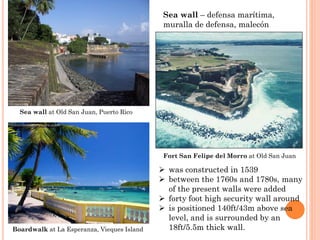
was constructed in 1539 
between the 1760s and 1780s, many of the present walls were added 
forty foot high security wall around 
is positioned 140ft/43m above sea level, and is surrounded by an 18ft/5.5m thick wall. 
Fort San Felipe del Morro at Old San Juan 
Sea wall –defensa marítima, muralla de defensa, malecón 
Boardwalkat La Esperanza, ViequesIsland 
Sea wall at Old San Juan, Puerto Rico
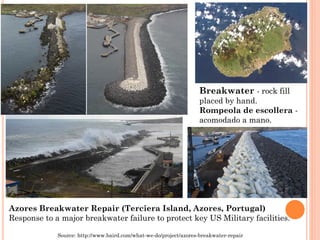
Azores Breakwater Repair (TercieraIsland, Azores, Portugal) 
Response to a major breakwater failure to protect key US Military facilities. 
Breakwater-rock fillplaced byhand. 
Rompeolade escollera - acomodado a mano. 
Source: http://www.baird.com/what-we-do/project/azores-breakwater-repair
ECOLOGICALIMPACTSOFCOASTALINFRASTRUCTURE 
Artificial structuresare alsooftenconstructedof unnaturalmaterial, (e.g. concrete, plasticormetal) whichmayaffectcolonization.
ECOLOGICALIMPACTSOFCOASTALINFRASTRUCTURE 
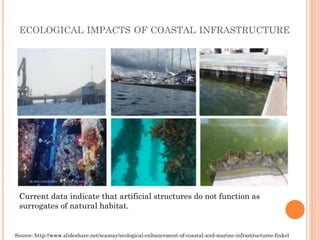
Current data indicate that artificial structures do not function as surrogates of natural habitat. 
Source: http://www.slideshare.net/scamay/ecological-enhancement-of-coastal-and-marine-infrastructures-finkel
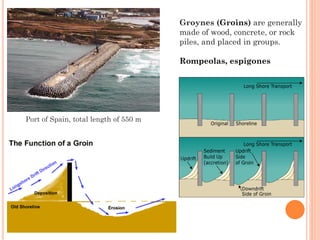
Groynes(Groins) are generally made of wood, concrete, or rock piles, and placed in groups. 
Rompeolas, espigones 
Port of Spain, total length of 550 m
FROMPUNTALIMA, NAGUABOTOPUNTAARENASVIEQUESISLAND(WESTSIDE) 
Puerto Rico's underwater cable By Gabriel D'Attili
PUNTAARENAS, VIEQUES, PUERTORICO 
1994 
2006 
2012 
2012 
WEBINAR, CTPR (2012):Calentamiento Globaly elefecto en nuestras costas. AurelioMercado Irizarry, Programa Sea Grant, UPRM
Vary according to the nature of the surrounding habitat(s) 
Evidence that epibiotaliving on and fish assemblages associated with artificial structures, differ from those on natural reefs. 
Different types of infrastructure generally providevertical habitat, whereasmanynatural habitatsslopemore gently or have heterogeneous topography. 
Densities may be abnormally increased, or species that do not usually come into contact can be forced to occupy the same area, potentially increasing the strength of interspecific interactions. 
ECOLOGICALIMPACTSOFCOASTALINFRASTRUCTURE
Altering the feeding behaviourand local distribution - The biota living on artificial structures may also provide an important food-source for species living in adjacent waters. 
Fragmentation and loss of habitat 
Substantial alteration in the functioning of the system 
Many built structures are deployed on sedimentary bottoms and severe sand-scouring can be an important cause of mortality for sessile organisms, ultimately leading to relatively low levels of species richness. 
ECOLOGICALIMPACTSOFCOASTALINFRASTRUCTURE
oPotentially causing loss of nursery and foraging grounds for fish and shorebirds, or breeding sites for turtles. 
oPrevent inland migration of these habitats if sea- level rises. 
oChanges water flow -Disruption of water flow by infrastructure may stop or limit dispersal of propagules. 
oIllumination –Light Pollution 
oIncrease rates of sedimentation 
ECOLOGICALIMPACTSOFCOASTALINFRASTRUCTURE
In many cases, infrastructure is, however, obligatory, either for public safety or to meet engineering standards (e.g. ports, roads, bridges or wharves). Under these circumstances, minimizing their ecological impacts should be considered a priority. 
The age of introduced surfaces is also an important determinant of the extent to which the assemblages they support can resemble those on natural rocky substrata. 
Managed retreat or realignment of hard coastal defence structures (mostly seawalls) has been identified as an adaptive strategy for alleviating estuarine flood risk or for the re-establishment of ecologically valuable intertidal habitats. 
ALTERNATIVEMANAGEMENTOPTIONS
Burt et al. (2009) have shown that the use of Gabbroas a material to construct breakwaters could encourage the recovery of corals in tropical regions, while Russell et al. (1983) have shown that disused docks can support diverse assemblages of marine animals and plants and can be used to promote educational, amenity and economic activities. 
ALTERNATIVEMANAGEMENTOPTIONS
Conventional coastal engineering compared with new ecosystem-based defence. 
ALTERNATIVEMANAGEMENTOPTIONS 
Ecosystem creation and restoration can provide a more sustainable, cost-effective and ecologically sound alternative to conventional coastal engineering 
Source: http://www.nature.com/nature/journal/v504/n7478/full/nature12859.html
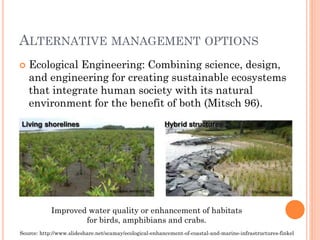
Ecological Engineering: Combining science, design, and engineering for creating sustainable ecosystems that integrate human society with its natural environment for the benefit of both (Mitsch96). 
ALTERNATIVEMANAGEMENTOPTIONS 
Source: http://www.slideshare.net/scamay/ecological-enhancement-of-coastal-and-marine-infrastructures-finkel 
Improved water quality or enhancement of habitats for birds, amphibians and crabs.
MARINEURBANECOSYSTEMS 
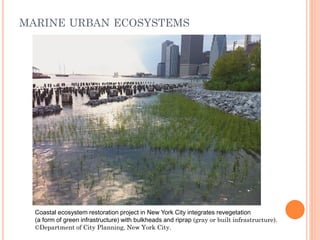
Coastal ecosystem restoration project in New York City integrates revegetation 
(a form of green infrastructure) with bulkheads and riprap (gray or built infrastructure). ©Department of City Planning, New York City.
MARINEURBANECOSYSTEMS 
Novel or emerging ecosystems 
Needs of research for advancing our understanding of marine urban ecosystems 
Importance of these novel conditions for sustaining biodiversity 
Successful conservation or management of species needs robust and up-to-date ecological knowledge and theories
FUTUREDIRECTIONSFORRESEARCH 
Alternative management options might mitigate their impacts. 
Incorporate ecological criteria into coastal engineering -to develop improved ways of building infrastructure to provide habitat formorespecies without compromising engineering standards. 
Identify the mechanisms that cause differences in patterns or processes between natural and artificial rocky habitats. 
Understanding how fundamental ecological processes (competition, predation, facilitation, etc.) are affected
FUTUREDIRECTIONSFORRESEARCH 
Field experiments with adequate replication and at spatial and temporal scales relevant to managers so that the results of the experiments can underpin future management practices. 
It is important that engineering practices become flexible and recognize that the same design may have different outcomes in different places. 
There is little current knowledge about how connected are marine populations. 
The potential role of marine artificial structures in promoting gene exchange remains virtually unexplored.
PUERTORICO 
In Puerto Rico there are 8,431 hectares classified as coastal barriers. These are principally in the Southwest and Northeast side of the Island. These are fragile and high risk coastal areas, primarily formed from consolidated sediments. This structure explains coastal areas’ high instability for construction and erosion susceptibility. 
Needs 
Extensive studies of coastal erosion, which include physical and quantitative estimates of damages from erosion. 
Study the process of erosion and sand deposits in various sites. 
Protect the coast using creative, environmentally safe and cost-effective measures. 
Puerto Rico CoastalZoneManagement Program, ExecutiveSummary, August2008
It is not yet possible to provide a ‘recipe book’ of ecological engineering, but with more experimental collaborations between engineers and ecologists, progress will be made.

Discussion of Bulleri et al. 2011 on coastal infrastructure

  • 1.
    COASTALINFRASTRUCTURE Primary Source:The introduction of coastal infrastructure as a driver of change in marine environments. (2010) Authors: Fabio Bulleri and Maura G. Chapman, Journal of Applied Ecology Presentationpreparedby: GlorynelOjeda-Matos, BSCE, MP Departmentof EnvironmentalSciences Universityof Puerto Rico, Río Piedras Campus
  • 2.
    ABOUTTHEAUTHORS Fabio Bulleri Maura G. Chapman Department of Biology, University of Pisa, Italy Centre for Research on Ecological Impacts of Coastal Cities School of Biological Sciences, University of Sydney, Australia Marine Ecology, restoration of habitat Effects of coastal development
  • 3.
    PAPERCONTENT Summary Introduction Ecological consequences of the introduction of artificial structures •Introduction of Novel Habitat •Effects on Adjacent Habitats •Regional or Large-scale Changes •Implications for the Spread of Exotic Species Alternative management options Future directions for research Concluding remarks
  • 4.
    OUROBJECTIVESARE: I.Overview ofthe current knowledge of the ecological effects and impacts of urban infrastructure on marine habitats. II.Discuss the alternative coastal defence options might mitigate their impacts. III.Identify future research directions that might advance understanding of these artificial habitats and, hence, our ability to preserve biodiversity in urbanized environments.
  • 6.
    EXPONENTIALGROWTHOFPOPULATIONS Many ofthe largest cities in the world are located in coastal zones. Areas with higher coastal population generally link to a more altered state of shoreline. 75% of people are expected to live within 100 km of a coast by 2025. Source: https://wiki.colby.edu/display/stateofmaine2009/State+of+Coastal+and+Marine+Management+in+Maine
  • 7.
    TRANSFORMATIONWILLACCELERATE… Exponential growthof human populations Global changes Sea-level rise Increased frequency of extreme meteorological events Image(Season2011) : http://www.envivopr.com/
  • 8.
  • 9.
    HARDSTABILIZATION: TWOMAJORCATEGORIES Structuresthat are constructed parallel to the beach designed to protect the land and buildings located immediately landwardor nearshorewaters which act to intercept and reduce the energy of approaching waves. Onshore Seawalls, Bulkheads Offshore Breakwaters Onshore to offshore Pilings Structures that are constructed perpendicular to the beach and extend out into the water. These types of structures are designed to retard or interrupt the longshore movement of sand and accumulate sand on the beach up drift of the structure. Groins Jetties Shore-parallel structures Shore-perpendicular structures
  • 10.
    Shore-Parallel Onshore Structures Shore-Parallel Offshore Structures Shore-Perpendicular Structures Source: http://www.csc.noaa.gov/archived/beachnourishment/html/geo/shorelin.htm Groin at Folly Beach , South Carolina T-shaped Y-shaped Breakwaters at Sea Palling, Norfolk, England Seawall at Galveston, Texas
  • 12.
    was constructed in1539 between the 1760s and 1780s, many of the present walls were added forty foot high security wall around is positioned 140ft/43m above sea level, and is surrounded by an 18ft/5.5m thick wall. Fort San Felipe del Morro at Old San Juan Sea wall –defensa marítima, muralla de defensa, malecón Boardwalkat La Esperanza, ViequesIsland Sea wall at Old San Juan, Puerto Rico
  • 13.
    Azores Breakwater Repair(TercieraIsland, Azores, Portugal) Response to a major breakwater failure to protect key US Military facilities. Breakwater-rock fillplaced byhand. Rompeolade escollera - acomodado a mano. Source: http://www.baird.com/what-we-do/project/azores-breakwater-repair
  • 14.
    ECOLOGICALIMPACTSOFCOASTALINFRASTRUCTURE Artificial structuresarealsooftenconstructedof unnaturalmaterial, (e.g. concrete, plasticormetal) whichmayaffectcolonization.
  • 15.
    ECOLOGICALIMPACTSOFCOASTALINFRASTRUCTURE Current dataindicate that artificial structures do not function as surrogates of natural habitat. Source: http://www.slideshare.net/scamay/ecological-enhancement-of-coastal-and-marine-infrastructures-finkel
  • 16.
    Groynes(Groins) are generallymade of wood, concrete, or rock piles, and placed in groups. Rompeolas, espigones Port of Spain, total length of 550 m
  • 17.
    FROMPUNTALIMA, NAGUABOTOPUNTAARENASVIEQUESISLAND(WESTSIDE) PuertoRico's underwater cable By Gabriel D'Attili
  • 18.
    PUNTAARENAS, VIEQUES, PUERTORICO 1994 2006 2012 2012 WEBINAR, CTPR (2012):Calentamiento Globaly elefecto en nuestras costas. AurelioMercado Irizarry, Programa Sea Grant, UPRM
  • 19.
    Vary according tothe nature of the surrounding habitat(s) Evidence that epibiotaliving on and fish assemblages associated with artificial structures, differ from those on natural reefs. Different types of infrastructure generally providevertical habitat, whereasmanynatural habitatsslopemore gently or have heterogeneous topography. Densities may be abnormally increased, or species that do not usually come into contact can be forced to occupy the same area, potentially increasing the strength of interspecific interactions. ECOLOGICALIMPACTSOFCOASTALINFRASTRUCTURE
  • 20.
    Altering the feedingbehaviourand local distribution - The biota living on artificial structures may also provide an important food-source for species living in adjacent waters. Fragmentation and loss of habitat Substantial alteration in the functioning of the system Many built structures are deployed on sedimentary bottoms and severe sand-scouring can be an important cause of mortality for sessile organisms, ultimately leading to relatively low levels of species richness. ECOLOGICALIMPACTSOFCOASTALINFRASTRUCTURE
  • 21.
    oPotentially causing lossof nursery and foraging grounds for fish and shorebirds, or breeding sites for turtles. oPrevent inland migration of these habitats if sea- level rises. oChanges water flow -Disruption of water flow by infrastructure may stop or limit dispersal of propagules. oIllumination –Light Pollution oIncrease rates of sedimentation ECOLOGICALIMPACTSOFCOASTALINFRASTRUCTURE
  • 22.
    In many cases,infrastructure is, however, obligatory, either for public safety or to meet engineering standards (e.g. ports, roads, bridges or wharves). Under these circumstances, minimizing their ecological impacts should be considered a priority. The age of introduced surfaces is also an important determinant of the extent to which the assemblages they support can resemble those on natural rocky substrata. Managed retreat or realignment of hard coastal defence structures (mostly seawalls) has been identified as an adaptive strategy for alleviating estuarine flood risk or for the re-establishment of ecologically valuable intertidal habitats. ALTERNATIVEMANAGEMENTOPTIONS
  • 23.
    Burt et al.(2009) have shown that the use of Gabbroas a material to construct breakwaters could encourage the recovery of corals in tropical regions, while Russell et al. (1983) have shown that disused docks can support diverse assemblages of marine animals and plants and can be used to promote educational, amenity and economic activities. ALTERNATIVEMANAGEMENTOPTIONS
  • 24.
    Conventional coastal engineeringcompared with new ecosystem-based defence. ALTERNATIVEMANAGEMENTOPTIONS Ecosystem creation and restoration can provide a more sustainable, cost-effective and ecologically sound alternative to conventional coastal engineering Source: http://www.nature.com/nature/journal/v504/n7478/full/nature12859.html
  • 25.
    Ecological Engineering: Combiningscience, design, and engineering for creating sustainable ecosystems that integrate human society with its natural environment for the benefit of both (Mitsch96). ALTERNATIVEMANAGEMENTOPTIONS Source: http://www.slideshare.net/scamay/ecological-enhancement-of-coastal-and-marine-infrastructures-finkel Improved water quality or enhancement of habitats for birds, amphibians and crabs.
  • 26.
    MARINEURBANECOSYSTEMS Coastal ecosystemrestoration project in New York City integrates revegetation (a form of green infrastructure) with bulkheads and riprap (gray or built infrastructure). ©Department of City Planning, New York City.
  • 27.
    MARINEURBANECOSYSTEMS Novel oremerging ecosystems Needs of research for advancing our understanding of marine urban ecosystems Importance of these novel conditions for sustaining biodiversity Successful conservation or management of species needs robust and up-to-date ecological knowledge and theories
  • 28.
    FUTUREDIRECTIONSFORRESEARCH Alternative managementoptions might mitigate their impacts. Incorporate ecological criteria into coastal engineering -to develop improved ways of building infrastructure to provide habitat formorespecies without compromising engineering standards. Identify the mechanisms that cause differences in patterns or processes between natural and artificial rocky habitats. Understanding how fundamental ecological processes (competition, predation, facilitation, etc.) are affected
  • 29.
    FUTUREDIRECTIONSFORRESEARCH Field experimentswith adequate replication and at spatial and temporal scales relevant to managers so that the results of the experiments can underpin future management practices. It is important that engineering practices become flexible and recognize that the same design may have different outcomes in different places. There is little current knowledge about how connected are marine populations. The potential role of marine artificial structures in promoting gene exchange remains virtually unexplored.
  • 30.
    PUERTORICO In PuertoRico there are 8,431 hectares classified as coastal barriers. These are principally in the Southwest and Northeast side of the Island. These are fragile and high risk coastal areas, primarily formed from consolidated sediments. This structure explains coastal areas’ high instability for construction and erosion susceptibility. Needs Extensive studies of coastal erosion, which include physical and quantitative estimates of damages from erosion. Study the process of erosion and sand deposits in various sites. Protect the coast using creative, environmentally safe and cost-effective measures. Puerto Rico CoastalZoneManagement Program, ExecutiveSummary, August2008
  • 31.
    It is notyet possible to provide a ‘recipe book’ of ecological engineering, but with more experimental collaborations between engineers and ecologists, progress will be made.