


COASTAL DEFENCE
BY,
SUMAN KUMAR
M-TECH (OENA)
IIT KHARAGPUR
11/14/2014
DEPARTMENT OF OCEAN ENGINEERING AND NAVAL ARCHITECTURE,
INDIAN INSTITUTE OF TECHNOLOGY (KHARAGPUR)
What is Coastal defence ?
• This refers to sea defence or coastal protection.
• Coastal defence is defense against flooding and erosion and
techniques that allow erosion to claim land.
11/14/2014
DEPARTMENT OF OCEAN ENGINEERING AND NAVAL ARCHITECTURE,
INDIAN INSTITUTE OF TECHNOLOGY (KHARAGPUR)
Why is Coastal defence is Important?
• The economy growth of countries.
• Erosion threatening beaches or coastal settlements.
• Development of tourism.
• flooding if sea levels rise.
• Problem with sewage and/or pollution.
11/14/2014
DEPARTMENT OF OCEAN ENGINEERING AND NAVAL ARCHITECTURE,
INDIAN INSTITUTE OF TECHNOLOGY (KHARAGPUR)
Types of Approach for coastal defence:
• Hard Engineering Approach.
• Soft Engineering Approach.
11/14/2014
DEPARTMENT OF OCEAN ENGINEERING AND NAVAL ARCHITECTURE,
INDIAN INSTITUTE OF TECHNOLOGY (KHARAGPUR)
Hard Engineering:
• It involves the use of man made structures to defend against the
erosive power of waves.
• Also known as the structural approach.
• Some structures used are gabions, groynes, sea walls, revetments and
rip raps.
11/14/2014 DEPARTMENT OF OCEAN ENGINEERING AND NAVAL ARCHITECTURE, INDIAN
INSTITUTE OF TECHNOLOGY (KHARAGPUR)
Soft Engineering:
• These are methods that try to work with nature to protect the coast.
• Beaches or naturally formed materials are used to control or re-direct
erosion processes.
• Some coastal features used are sand dunes and mangroves. Beach
replenishment is also a form of soft engineering.
• Also known as the non-structural approach.
11/14/2014
DEPARTMENT OF OCEAN ENGINEERING AND NAVAL ARCHITECTURE,
INDIAN INSTITUTE OF TECHNOLOGY (KHARAGPUR)
Hard Engineering
11/14/2014
DEPARTMENT OF OCEAN ENGINEERING AND NAVAL ARCHITECTURE, INDIAN
INSTITUTE OF TECHNOLOGY (KHARAGPUR)
Breakwaters
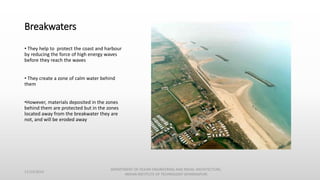
• They help to protect the coast and harbour
by reducing the force of high energy waves
before they reach the waves
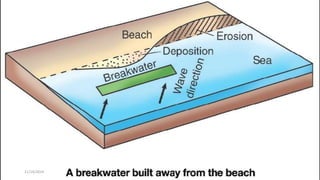
• They create a zone of calm water behind
them
•However, materials deposited in the zones
behind them are protected but in the zones
located away from the breakwater they are
not, and will be eroded away
11/14/2014
DEPARTMENT OF OCEAN ENGINEERING AND NAVAL ARCHITECTURE,
INDIAN INSTITUTE OF TECHNOLOGY (KHARAGPUR)
11/14/2014
Gabions
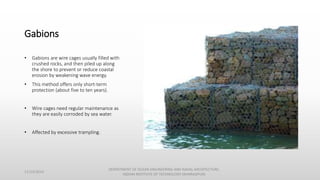
• Gabions are wire cages usually filled with
crushed rocks, and then piled up along
the shore to prevent or reduce coastal
erosion by weakening wave energy.
• This method offers only short-term
protection (about five to ten years).
• Wire cages need regular maintenance as
they are easily corroded by sea water.
• Affected by excessive trampling.
11/14/2014
DEPARTMENT OF OCEAN ENGINEERING AND NAVAL ARCHITECTURE,
INDIAN INSTITUTE OF TECHNOLOGY (KHARAGPUR)
11/14/2014
Groynes
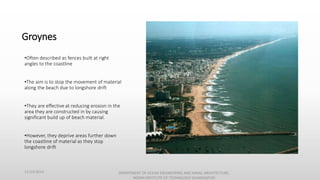
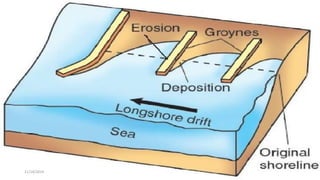
•Often described as fences built at right
angles to the coastline
•The aim is to stop the movement of material
along the beach due to longshore drift
•They are effective at reducing erosion in the
area they are constructed in by causing
significant build up of beach material.
•However, they deprive areas further down
the coastline of material as they stop
longshore drift
11/14/2014 DEPARTMENT OF OCEAN ENGINEERING AND NAVAL ARCHITECTURE,
INDIAN INSTITUTE OF TECHNOLOGY (KHARAGPUR)
11/14/2014
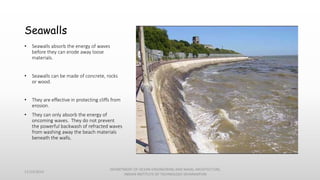
Seawalls
• Seawalls absorb the energy of waves
before they can erode away loose
materials.
• Seawalls can be made of concrete, rocks
or wood.
• They are effective in protecting cliffs from
erosion.
• They can only absorb the energy of
oncoming waves. They do not prevent
the powerful backwash of refracted waves
from washing away the beach materials
beneath the walls.
11/14/2014
DEPARTMENT OF OCEAN ENGINEERING AND NAVAL ARCHITECTURE,
INDIAN INSTITUTE OF TECHNOLOGY (KHARAGPUR)
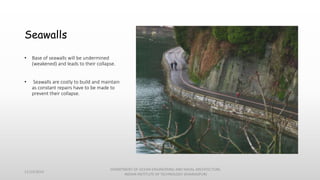
Seawalls
• Base of seawalls will be undermined
(weakened) and leads to their collapse.
• Seawalls are costly to build and maintain
as constant repairs have to be made to
prevent their collapse.
11/14/2014
DEPARTMENT OF OCEAN ENGINEERING AND NAVAL ARCHITECTURE,
INDIAN INSTITUTE OF TECHNOLOGY (KHARAGPUR)
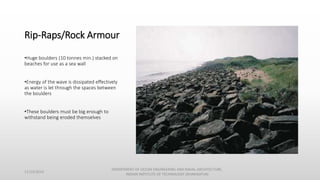
Rip-Raps/Rock Armour
•Huge boulders (10 tonnes min.) stacked on
beaches for use as a sea wall
•Energy of the wave is dissipated effectively
as water is let through the spaces between
the boulders
•These boulders must be big enough to
withstand being eroded themselves
11/14/2014
DEPARTMENT OF OCEAN ENGINEERING AND NAVAL ARCHITECTURE,
INDIAN INSTITUTE OF TECHNOLOGY (KHARAGPUR)
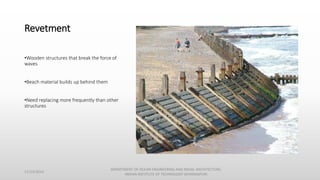
Revetment
•Wooden structures that break the force of
waves
•Beach material builds up behind them
•Need replacing more frequently than other
structures
11/14/2014
DEPARTMENT OF OCEAN ENGINEERING AND NAVAL ARCHITECTURE,
INDIAN INSTITUTE OF TECHNOLOGY (KHARAGPUR)
Soft Engineering
11/14/2014
DEPARTMENT OF OCEAN ENGINEERING AND NAVAL ARCHITECTURE,
INDIAN INSTITUTE OF TECHNOLOGY (KHARAGPUR)
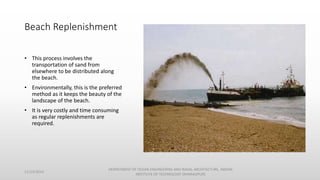
Beach Replenishment
• This process involves the
transportation of sand from
elsewhere to be distributed along
the beach.
• Environmentally, this is the preferred
method as it keeps the beauty of the
landscape of the beach.
• It is very costly and time consuming
as regular replenishments are
required.
11/14/2014
DEPARTMENT OF OCEAN ENGINEERING AND NAVAL ARCHITECTURE, INDIAN
INSTITUTE OF TECHNOLOGY (KHARAGPUR)
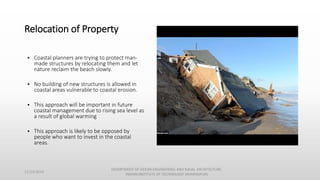
Relocation of Property
• Coastal planners are trying to protect man-
made structures by relocating them and let
nature reclaim the beach slowly.
• No building of new structures is allowed in
coastal areas vulnerable to coastal erosion.
• This approach will be important in future
coastal management due to rising sea level as
a result of global warming
• This approach is likely to be opposed by
people who want to invest in the coastal
areas.
11/14/2014
DEPARTMENT OF OCEAN ENGINEERING AND NAVAL ARCHITECTURE,
INDIAN INSTITUTE OF TECHNOLOGY (KHARAGPUR)
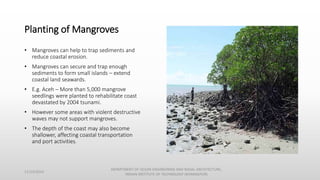
Planting of Mangroves
• Mangroves can help to trap sediments and
reduce coastal erosion.
• Mangroves can secure and trap enough
sediments to form small islands – extend
coastal land seawards.
• E.g. Aceh – More than 5,000 mangrove
seedlings were planted to rehabilitate coast
devastated by 2004 tsunami.
• However some areas with violent destructive
waves may not support mangroves.
• The depth of the coast may also become
shallower, affecting coastal transportation
and port activities.
11/14/2014
DEPARTMENT OF OCEAN ENGINEERING AND NAVAL ARCHITECTURE,
INDIAN INSTITUTE OF TECHNOLOGY (KHARAGPUR)
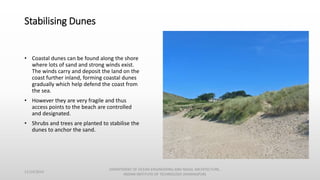
Stabilising Dunes
• Coastal dunes can be found along the shore
where lots of sand and strong winds exist.
The winds carry and deposit the land on the
coast further inland, forming coastal dunes
gradually which help defend the coast from
the sea.
• However they are very fragile and thus
access points to the beach are controlled
and designated.
• Shrubs and trees are planted to stabilise the
dunes to anchor the sand.
11/14/2014
DEPARTMENT OF OCEAN ENGINEERING AND NAVAL ARCHITECTURE,
INDIAN INSTITUTE OF TECHNOLOGY (KHARAGPUR)
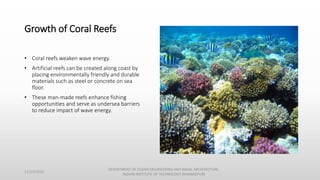
Growth of Coral Reefs
• Coral reefs weaken wave energy.
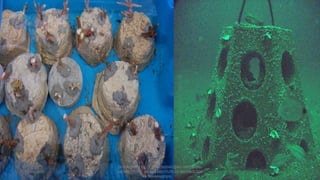
• Artificial reefs can be created along coast by
placing environmentally friendly and durable
materials such as steel or concrete on sea
floor.
• These man-made reefs enhance fishing
opportunities and serve as undersea barriers
to reduce impact of wave energy.
11/14/2014
DEPARTMENT OF OCEAN ENGINEERING AND NAVAL ARCHITECTURE,
INDIAN INSTITUTE OF TECHNOLOGY (KHARAGPUR)
11/14/2014
DEPARTMENT OF OCEAN ENGINEERING AND NAVAL
ARCHITECTURE, INDIAN INSTITUTE OF TECHNOLOGY
(KHARAGPUR)
11/14/2014

Coastal Management or defense.

  • 1.
    COASTAL DEFENCE BY, SUMAN KUMAR M-TECH(OENA) IIT KHARAGPUR 11/14/2014 DEPARTMENT OF OCEAN ENGINEERING AND NAVAL ARCHITECTURE, INDIAN INSTITUTE OF TECHNOLOGY (KHARAGPUR)
  • 2.
    What is Coastaldefence ? • This refers to sea defence or coastal protection. • Coastal defence is defense against flooding and erosion and techniques that allow erosion to claim land. 11/14/2014 DEPARTMENT OF OCEAN ENGINEERING AND NAVAL ARCHITECTURE, INDIAN INSTITUTE OF TECHNOLOGY (KHARAGPUR)
  • 3.
    Why is Coastaldefence is Important? • The economy growth of countries. • Erosion threatening beaches or coastal settlements. • Development of tourism. • flooding if sea levels rise. • Problem with sewage and/or pollution. 11/14/2014 DEPARTMENT OF OCEAN ENGINEERING AND NAVAL ARCHITECTURE, INDIAN INSTITUTE OF TECHNOLOGY (KHARAGPUR)
  • 4.
    Types of Approachfor coastal defence: • Hard Engineering Approach. • Soft Engineering Approach. 11/14/2014 DEPARTMENT OF OCEAN ENGINEERING AND NAVAL ARCHITECTURE, INDIAN INSTITUTE OF TECHNOLOGY (KHARAGPUR)
  • 5.
    Hard Engineering: • Itinvolves the use of man made structures to defend against the erosive power of waves. • Also known as the structural approach. • Some structures used are gabions, groynes, sea walls, revetments and rip raps. 11/14/2014 DEPARTMENT OF OCEAN ENGINEERING AND NAVAL ARCHITECTURE, INDIAN INSTITUTE OF TECHNOLOGY (KHARAGPUR)
  • 6.
    Soft Engineering: • Theseare methods that try to work with nature to protect the coast. • Beaches or naturally formed materials are used to control or re-direct erosion processes. • Some coastal features used are sand dunes and mangroves. Beach replenishment is also a form of soft engineering. • Also known as the non-structural approach. 11/14/2014 DEPARTMENT OF OCEAN ENGINEERING AND NAVAL ARCHITECTURE, INDIAN INSTITUTE OF TECHNOLOGY (KHARAGPUR)
  • 7.
    Hard Engineering 11/14/2014 DEPARTMENT OFOCEAN ENGINEERING AND NAVAL ARCHITECTURE, INDIAN INSTITUTE OF TECHNOLOGY (KHARAGPUR)
  • 8.
    Breakwaters • They helpto protect the coast and harbour by reducing the force of high energy waves before they reach the waves • They create a zone of calm water behind them •However, materials deposited in the zones behind them are protected but in the zones located away from the breakwater they are not, and will be eroded away 11/14/2014 DEPARTMENT OF OCEAN ENGINEERING AND NAVAL ARCHITECTURE, INDIAN INSTITUTE OF TECHNOLOGY (KHARAGPUR)
  • 9.
  • 10.
    Gabions • Gabions arewire cages usually filled with crushed rocks, and then piled up along the shore to prevent or reduce coastal erosion by weakening wave energy. • This method offers only short-term protection (about five to ten years). • Wire cages need regular maintenance as they are easily corroded by sea water. • Affected by excessive trampling. 11/14/2014 DEPARTMENT OF OCEAN ENGINEERING AND NAVAL ARCHITECTURE, INDIAN INSTITUTE OF TECHNOLOGY (KHARAGPUR)
  • 11.
  • 12.
    Groynes •Often described asfences built at right angles to the coastline •The aim is to stop the movement of material along the beach due to longshore drift •They are effective at reducing erosion in the area they are constructed in by causing significant build up of beach material. •However, they deprive areas further down the coastline of material as they stop longshore drift 11/14/2014 DEPARTMENT OF OCEAN ENGINEERING AND NAVAL ARCHITECTURE, INDIAN INSTITUTE OF TECHNOLOGY (KHARAGPUR)
  • 13.
  • 14.
    Seawalls • Seawalls absorbthe energy of waves before they can erode away loose materials. • Seawalls can be made of concrete, rocks or wood. • They are effective in protecting cliffs from erosion. • They can only absorb the energy of oncoming waves. They do not prevent the powerful backwash of refracted waves from washing away the beach materials beneath the walls. 11/14/2014 DEPARTMENT OF OCEAN ENGINEERING AND NAVAL ARCHITECTURE, INDIAN INSTITUTE OF TECHNOLOGY (KHARAGPUR)
  • 15.
    Seawalls • Base ofseawalls will be undermined (weakened) and leads to their collapse. • Seawalls are costly to build and maintain as constant repairs have to be made to prevent their collapse. 11/14/2014 DEPARTMENT OF OCEAN ENGINEERING AND NAVAL ARCHITECTURE, INDIAN INSTITUTE OF TECHNOLOGY (KHARAGPUR)
  • 16.
    Rip-Raps/Rock Armour •Huge boulders(10 tonnes min.) stacked on beaches for use as a sea wall •Energy of the wave is dissipated effectively as water is let through the spaces between the boulders •These boulders must be big enough to withstand being eroded themselves 11/14/2014 DEPARTMENT OF OCEAN ENGINEERING AND NAVAL ARCHITECTURE, INDIAN INSTITUTE OF TECHNOLOGY (KHARAGPUR)
  • 17.
    Revetment •Wooden structures thatbreak the force of waves •Beach material builds up behind them •Need replacing more frequently than other structures 11/14/2014 DEPARTMENT OF OCEAN ENGINEERING AND NAVAL ARCHITECTURE, INDIAN INSTITUTE OF TECHNOLOGY (KHARAGPUR)
  • 18.
    Soft Engineering 11/14/2014 DEPARTMENT OFOCEAN ENGINEERING AND NAVAL ARCHITECTURE, INDIAN INSTITUTE OF TECHNOLOGY (KHARAGPUR)
  • 19.
    Beach Replenishment • Thisprocess involves the transportation of sand from elsewhere to be distributed along the beach. • Environmentally, this is the preferred method as it keeps the beauty of the landscape of the beach. • It is very costly and time consuming as regular replenishments are required. 11/14/2014 DEPARTMENT OF OCEAN ENGINEERING AND NAVAL ARCHITECTURE, INDIAN INSTITUTE OF TECHNOLOGY (KHARAGPUR)
  • 20.
    Relocation of Property •Coastal planners are trying to protect man- made structures by relocating them and let nature reclaim the beach slowly. • No building of new structures is allowed in coastal areas vulnerable to coastal erosion. • This approach will be important in future coastal management due to rising sea level as a result of global warming • This approach is likely to be opposed by people who want to invest in the coastal areas. 11/14/2014 DEPARTMENT OF OCEAN ENGINEERING AND NAVAL ARCHITECTURE, INDIAN INSTITUTE OF TECHNOLOGY (KHARAGPUR)
  • 21.
    Planting of Mangroves •Mangroves can help to trap sediments and reduce coastal erosion. • Mangroves can secure and trap enough sediments to form small islands – extend coastal land seawards. • E.g. Aceh – More than 5,000 mangrove seedlings were planted to rehabilitate coast devastated by 2004 tsunami. • However some areas with violent destructive waves may not support mangroves. • The depth of the coast may also become shallower, affecting coastal transportation and port activities. 11/14/2014 DEPARTMENT OF OCEAN ENGINEERING AND NAVAL ARCHITECTURE, INDIAN INSTITUTE OF TECHNOLOGY (KHARAGPUR)
  • 22.
    Stabilising Dunes • Coastaldunes can be found along the shore where lots of sand and strong winds exist. The winds carry and deposit the land on the coast further inland, forming coastal dunes gradually which help defend the coast from the sea. • However they are very fragile and thus access points to the beach are controlled and designated. • Shrubs and trees are planted to stabilise the dunes to anchor the sand. 11/14/2014 DEPARTMENT OF OCEAN ENGINEERING AND NAVAL ARCHITECTURE, INDIAN INSTITUTE OF TECHNOLOGY (KHARAGPUR)
  • 23.
    Growth of CoralReefs • Coral reefs weaken wave energy. • Artificial reefs can be created along coast by placing environmentally friendly and durable materials such as steel or concrete on sea floor. • These man-made reefs enhance fishing opportunities and serve as undersea barriers to reduce impact of wave energy. 11/14/2014 DEPARTMENT OF OCEAN ENGINEERING AND NAVAL ARCHITECTURE, INDIAN INSTITUTE OF TECHNOLOGY (KHARAGPUR)
  • 24.
    11/14/2014 DEPARTMENT OF OCEANENGINEERING AND NAVAL ARCHITECTURE, INDIAN INSTITUTE OF TECHNOLOGY (KHARAGPUR)
  • 25.

Editor's Notes