The Introduction of coastal
infrastructure as a driver of change
in marine environments
Elvis Torres Delgado
September 11, 2013
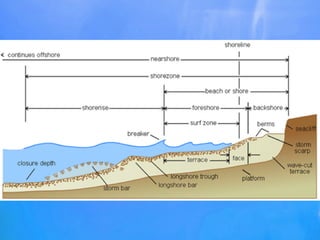
Some Concepts
• Intertidial zone – part of the shore that is
above water at low tide and below the water
at high tide.
• Nearshore – area that extends seawards from
the low water line.
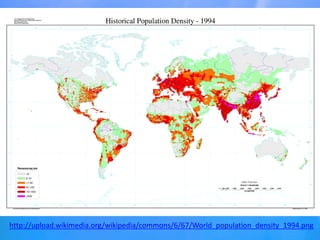
http://upload.wikimedia.org/wikipedia/commons/6/67/World_population_density_1994.png
Urban Growth
• High percentage of the population lives in the
coast and they receive a lot of tourism.
• Urbanization and coastal structures affect the
ecosystem.
• A lot of hard structures are added to “protect”
the shores of erosion.
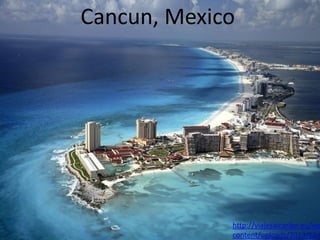
Cancun, Mexico
http://viajesalcaribe.eu/wp
content/uploads/2013/08/I
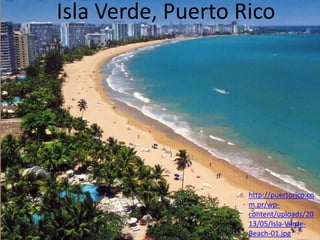
Isla Verde, Puerto Rico
http://puertorico.co
m.pr/wp-
content/uploads/20
13/05/Isla-Verde-
Beach-01.jpg
Ecological consequences of the
introduction of artificial structure
• Artificial structures affect the normal epibiota
and fish assemblages. It’s worse with
unnatural materials.
• Sometimes the problem is not the material,
but the structural change what affects biota
development (ex. lack of rock pools).
Ecological consequences of the
introduction of artificial structure
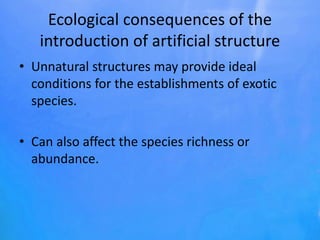
• Unnatural structures may provide ideal
conditions for the establishments of exotic
species.
• Can also affect the species richness or
abundance.
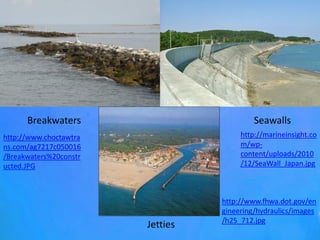
SeawallsBreakwaters
Jetties
http://marineinsight.co
m/wp-
content/uploads/2010
/12/SeaWall_Japan.jpg
http://www.fhwa.dot.gov/en
gineering/hydraulics/images
/h25_712.jpg
http://www.choctawtra
ns.com/ag7217c050016
/Breakwaters%20constr
ucted.JPG
Ecological consequences of the
introduction of artificial structure
• It is believed that some of these structures
may resemble better the natural ones after
many years of weathering.
• It has been shown that many of these artificial
structures don’t support natural assembly
even after many decades of exposition.
Effects on adjacent habitats
• Differences in diversity of species has been
found in rocky shores bordered by seawalls.
• Biota living in artificial structures may be a
food source for species nearby.
• Some structures favor a shift from consumers
domination to producers domination.
Regional or large-scale changes
• Urbanization contributes to species
homogenization.
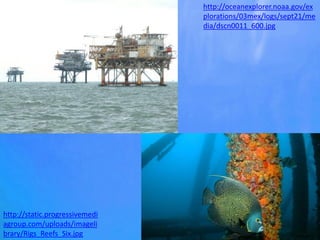
• Artificial structures can help connect
separated populations. Reduces gene flow and
genetic diversity.
http://oceanexplorer.noaa.gov/ex
plorations/03mex/logs/sept21/me
dia/dscn0011_600.jpg
http://static.progressivemedi
agroup.com/uploads/imageli
brary/Rigs_Reefs_Six.jpg
Alternative management options
• New solutions to fight coastal erosion without
using hard structures are being considered.
• In high wave energy a combination of natural and
artificial elements may be needed (hybrid
designs).
• Hard structures that consider suitable habitat for
species affected by urbanization processes,
fishing, recreation, and education are starting to
get used.
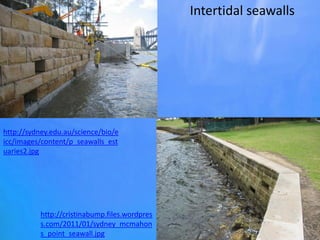
Intertidal seawalls
http://cristinabump.files.wordpres
s.com/2011/01/sydney_mcmahon
s_point_seawall.jpg
http://sydney.edu.au/science/bio/e
icc/images/content/p_seawalls_est
uaries2.jpg
Final thoughts
• More interdisciplinary research is needed to
understand the effects of urbanism on coastal
ecosystem.
• There is a need to explore new solutions to
protect coastal structures affecting the
ecosystem as less as possible.

Discussion of Bulleri and Chapman 2010