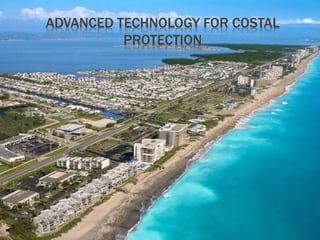
ADVANCED TECHNOLOGY FOR COSTAL
PROTECTION
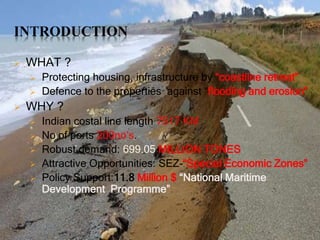
INTRODUCTION
 WHAT ?
 Protecting housing, infrastructure by “coastline retreat”
 Defence to the properties against “flooding and erosion”
 WHY ?
 Indian costal line length 7517 KM.
 No of ports 200no’s.
 Robust demand: 699.05 MILLION TONES
 Attractive Opportunities: SEZ-“Special Economic Zones”
 Policy Support:11.8 Million $ “National Maritime
Development Programme”.
TYPES OF COASTAL PROTECTION
METHODS
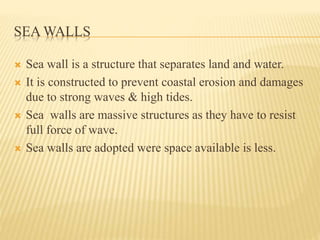
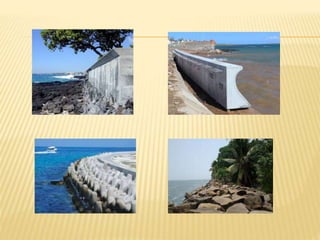
SEA WALLS
 Sea wall is a structure that separates land and water.
 It is constructed to prevent coastal erosion and damages
due to strong waves & high tides.
 Sea walls are massive structures as they have to resist
full force of wave.
 Sea walls are adopted were space available is less.
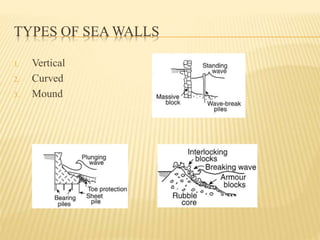
TYPES OF SEA WALLS
1. Vertical
2. Curved
3. Mound
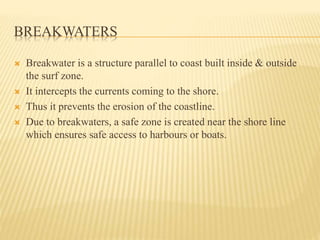
BREAKWATERS
 Breakwater is a structure parallel to coast built inside & outside
the surf zone.
 It intercepts the currents coming to the shore.
 Thus it prevents the erosion of the coastline.
 Due to breakwaters, a safe zone is created near the shore line
which ensures safe access to harbours or boats.
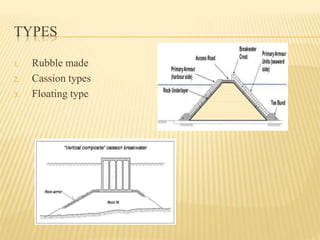
TYPES
1. Rubble made
2. Cassion types
3. Floating type
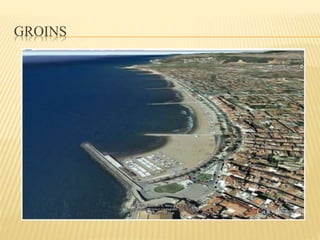
GROINS
CONTD…
 A groins is a rigid hydraulic structure built from an ocean shore or
from a bank that interrupts water flow and limits the movement of
sediment.
 It is usually made out of wood, concrete or stone.
 Built at right angles to the shore to prevent longshore drift.
 These structures absorb or reduce the energy of the waves and
cause materials to be deposited on the side of thegroins
facing the longshore drift.
 Erosion can still take place on the part of the coast that is not
protected by groins.
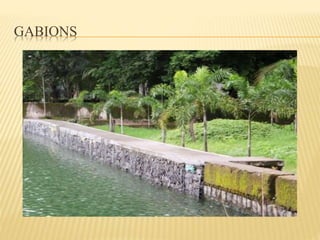
GABIONS
CONTD…
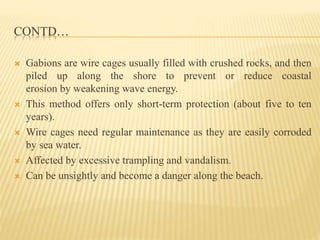
 Gabions are wire cages usually filled with crushed rocks, and then
piled up along the shore to prevent or reduce coastal
erosion by weakening wave energy.
 This method offers only short-term protection (about five to ten
years).
 Wire cages need regular maintenance as they are easily corroded
by sea water.
 Affected by excessive trampling and vandalism.
 Can be unsightly and become a danger along the beach.
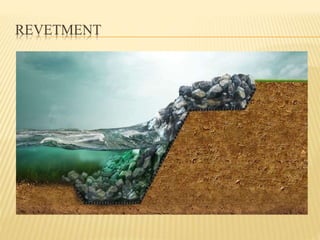
REVETMENT
CONTD…
 Revetments are sloping structures placed on banks or cliffs in such
a way as to absorb the energy of incoming water.
 In military engineering they are structures, again sloped, formed to
secure an area from artillery, bombing, or stored explosives.
 The most effective type of shore protection.
 Beach material builds up behind them.
 Need replacing more frequently than other structures.
BULKHEADS
CONTD…
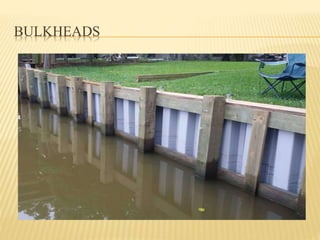
 A bulkhead is a retaining wall, such as a bulkhead within a ship or
a watershed retaining wall.
 It may also be used in mines to contain flooding. Coastal
bulkheads are most often referred to as seawalls, bulk heading, or
riprap revetments.
 Used when deep water must be maintained up to the shoreline for
boating or shipping.
 Constructed-either steel sheet piles or treated timbers.
 These types of structures have very little resistance to wave action.
BEACH NOURISHMENT
CONTD…
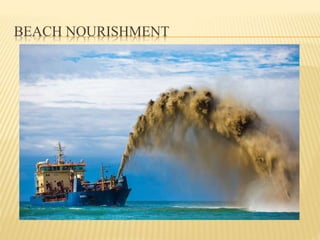
 Refers to constant replenishment of large quantities of sand to the
beach system.
 Beach is therefore extended seawards, leading to improvement of
both beach quality and storm protection.
 Very expensive and impractical to constantly transport large
quantities of sand to fill up beach.
 Imported sand that can be continuously eroded and transported
away could have serious consequences on wildlife living
within coastal environment.
 E.g. Singapore – Large scale land reclamation along coast has led
to muddy and polluted water and has destroyed coral reefs.
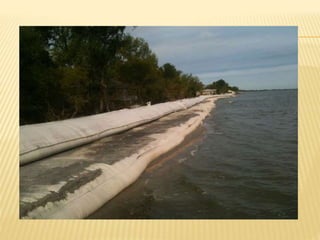
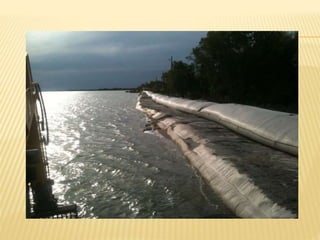
GEO-TEXTILE TUBES
 Geo-textile Tubes are well known as a practical and
affordable solution to shoreline erosion problems.
 There are several different ways to utilize geo-tubes for
erosion control, depending on your property's needs and
the surrounding environmental conditions.
EROSION CONTROL
 Shoreline erosion problems are solved by using geo-
tubes for erosion control.
 Place the geo-textile tube to help trap sand and soil, and
prevent further erosion.
 UV treated, they can withstand the elements.
 For greater visual appeal, incorporate them into the
landscape as man-made sand dunes.
SLOPE STABILIZATION
 Geo-textile tubes are not only used for erosion control,
but also to stabilize banks and provide support for steep
slopes.
 Use them as a barrier or retaining wall for reinforcement,
and backfill with local soil and sand.
 Since they stand up to wave pressure, they're also a good
protective measure against storms or the effects of rising
water levels.
EXAMPLES
Geo-textile tubes used in
1. Devbag, Malvan, Maharastra.
2. Shankarpur, West bengal.
3. INS Hamala, Mumbai.
Importance Of Coastal Protection
 Coral reefs, mangroves, seagrasses, salt marshes, and sea ice act as
natural buffers against incoming waves. By protecting against
storm damage, flooding, and erosion, these living habitats keep
people safe and can help mitigate economic loss of personal and
public property, cultural landmarks and natural resources.
 The amount of protection provided by marine and coastal habitats
by measuring the area they cover now relative to the area they
covered in the recent (1980s) past.
 Development within coastal areas has increased interest in erosion
problems; it has led to major efforts to manage coastal erosion
problems and to restore coastal capacity to accommodate short-
and long-term changes induced by human activities, extreme
events and sea level rise.
Important Issues Of Coastline Are :
 Badly planned developments
 Decline of fishing industry
 Poorly conceived transport networks
 Increasing urbanization
 Erosion
 Pollution
 Habitat
CONCLUSION
 At present ,mangroves along with their coastal habitats, are
threatened both directly and indirectly by human activities,
resulting in a significant loss of natural coastal protection
worldwide.
 Understand the site for a site-specific design.
 Try to work with natural forces.
 Protect the beach and the land-not just land .
 Consider social ,economic and environmental Impacts.
 Use a long- term perspective; allow for future developments .
Thank you

Advanced technologies for costal protection

  • 1.
    ADVANCED TECHNOLOGY FORCOSTAL PROTECTION
  • 2.
    INTRODUCTION  WHAT ? Protecting housing, infrastructure by “coastline retreat”  Defence to the properties against “flooding and erosion”  WHY ?  Indian costal line length 7517 KM.  No of ports 200no’s.  Robust demand: 699.05 MILLION TONES  Attractive Opportunities: SEZ-“Special Economic Zones”  Policy Support:11.8 Million $ “National Maritime Development Programme”.
  • 3.
    TYPES OF COASTALPROTECTION METHODS
  • 4.
    SEA WALLS  Seawall is a structure that separates land and water.  It is constructed to prevent coastal erosion and damages due to strong waves & high tides.  Sea walls are massive structures as they have to resist full force of wave.  Sea walls are adopted were space available is less.
  • 5.
    TYPES OF SEAWALLS 1. Vertical 2. Curved 3. Mound
  • 7.
    BREAKWATERS  Breakwater isa structure parallel to coast built inside & outside the surf zone.  It intercepts the currents coming to the shore.  Thus it prevents the erosion of the coastline.  Due to breakwaters, a safe zone is created near the shore line which ensures safe access to harbours or boats.
  • 8.
    TYPES 1. Rubble made 2.Cassion types 3. Floating type
  • 10.
  • 11.
    CONTD…  A groinsis a rigid hydraulic structure built from an ocean shore or from a bank that interrupts water flow and limits the movement of sediment.  It is usually made out of wood, concrete or stone.  Built at right angles to the shore to prevent longshore drift.  These structures absorb or reduce the energy of the waves and cause materials to be deposited on the side of thegroins facing the longshore drift.  Erosion can still take place on the part of the coast that is not protected by groins.
  • 12.
  • 13.
    CONTD…  Gabions arewire cages usually filled with crushed rocks, and then piled up along the shore to prevent or reduce coastal erosion by weakening wave energy.  This method offers only short-term protection (about five to ten years).  Wire cages need regular maintenance as they are easily corroded by sea water.  Affected by excessive trampling and vandalism.  Can be unsightly and become a danger along the beach.
  • 14.
  • 15.
    CONTD…  Revetments aresloping structures placed on banks or cliffs in such a way as to absorb the energy of incoming water.  In military engineering they are structures, again sloped, formed to secure an area from artillery, bombing, or stored explosives.  The most effective type of shore protection.  Beach material builds up behind them.  Need replacing more frequently than other structures.
  • 16.
  • 17.
    CONTD…  A bulkheadis a retaining wall, such as a bulkhead within a ship or a watershed retaining wall.  It may also be used in mines to contain flooding. Coastal bulkheads are most often referred to as seawalls, bulk heading, or riprap revetments.  Used when deep water must be maintained up to the shoreline for boating or shipping.  Constructed-either steel sheet piles or treated timbers.  These types of structures have very little resistance to wave action.
  • 18.
  • 19.
    CONTD…  Refers toconstant replenishment of large quantities of sand to the beach system.  Beach is therefore extended seawards, leading to improvement of both beach quality and storm protection.  Very expensive and impractical to constantly transport large quantities of sand to fill up beach.  Imported sand that can be continuously eroded and transported away could have serious consequences on wildlife living within coastal environment.  E.g. Singapore – Large scale land reclamation along coast has led to muddy and polluted water and has destroyed coral reefs.
  • 20.
    GEO-TEXTILE TUBES  Geo-textileTubes are well known as a practical and affordable solution to shoreline erosion problems.  There are several different ways to utilize geo-tubes for erosion control, depending on your property's needs and the surrounding environmental conditions.
  • 23.
    EROSION CONTROL  Shorelineerosion problems are solved by using geo- tubes for erosion control.  Place the geo-textile tube to help trap sand and soil, and prevent further erosion.  UV treated, they can withstand the elements.  For greater visual appeal, incorporate them into the landscape as man-made sand dunes.
  • 24.
    SLOPE STABILIZATION  Geo-textiletubes are not only used for erosion control, but also to stabilize banks and provide support for steep slopes.  Use them as a barrier or retaining wall for reinforcement, and backfill with local soil and sand.  Since they stand up to wave pressure, they're also a good protective measure against storms or the effects of rising water levels.
  • 25.
    EXAMPLES Geo-textile tubes usedin 1. Devbag, Malvan, Maharastra. 2. Shankarpur, West bengal. 3. INS Hamala, Mumbai.
  • 26.
    Importance Of CoastalProtection  Coral reefs, mangroves, seagrasses, salt marshes, and sea ice act as natural buffers against incoming waves. By protecting against storm damage, flooding, and erosion, these living habitats keep people safe and can help mitigate economic loss of personal and public property, cultural landmarks and natural resources.  The amount of protection provided by marine and coastal habitats by measuring the area they cover now relative to the area they covered in the recent (1980s) past.  Development within coastal areas has increased interest in erosion problems; it has led to major efforts to manage coastal erosion problems and to restore coastal capacity to accommodate short- and long-term changes induced by human activities, extreme events and sea level rise.
  • 27.
    Important Issues OfCoastline Are :  Badly planned developments  Decline of fishing industry  Poorly conceived transport networks  Increasing urbanization  Erosion  Pollution  Habitat
  • 28.
    CONCLUSION  At present,mangroves along with their coastal habitats, are threatened both directly and indirectly by human activities, resulting in a significant loss of natural coastal protection worldwide.  Understand the site for a site-specific design.  Try to work with natural forces.  Protect the beach and the land-not just land .  Consider social ,economic and environmental Impacts.  Use a long- term perspective; allow for future developments .
  • 29.