Introduction toEnvironmental ChangeProfessor Simon K. HaslettCentre for Excellence in Learning and TeachingSimon.haslett@newport.ac.uk7th May 2010
IntroductionThe global environment is transient.No such thing as ‘normal’ environmental conditions.Environmental variation within the historic period, scientific reconstruction of prehistoric environments, and the geological record provide evidence for this.In this presentation, approaches to reconstructing past environments and events are examined.
Geological RecordThe geological record provides information about past or palaeo-environments that is essential for placing the present environment in context, and for predicting future environments.However, in interpreting the geological record it is important to distinguish between evidence that indicates global environmental change rather than local factors.
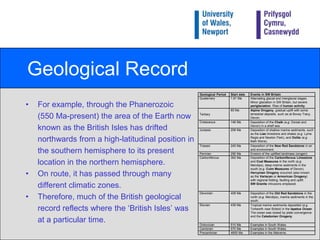
Geological RecordFor example, through the Phanerozoic	(550 Ma-present) the area of the Earth now	known as the British Isles has drifted 	northwards from a high-latitudinal position in	the southern hemisphere to its present 	location in the northern hemisphere.On route, it has passed through many 	different climatic zones.Therefore, much of the British geological 	record reflects where the ‘British Isles’ was 	at a particular time.
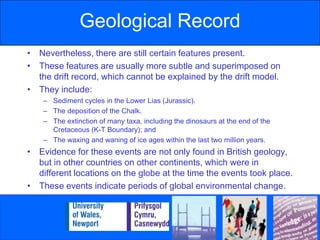
Geological RecordNevertheless, there are still certain features present.These features are usually more subtle and superimposed on the drift record, which cannot be explained by the drift model.They include:Sediment cycles in the Lower Lias (Jurassic).The deposition of the Chalk.The extinction of many taxa, including the dinosaurs at the end of the Cretaceous (K-T Boundary); andThe waxing and waning of ice ages within the last two million years.Evidence for these events are not only found in British geology, but in other countries on other continents, which were in different locations on the globe at the time the events took place.These events indicate periods of global environmental change.
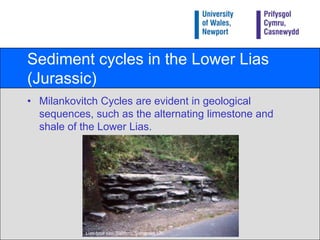
Sediment cycles in the Lower Lias (Jurassic)Milankovitch Cycles are evident in geological sequences, such as the alternating limestone and shale of the Lower Lias.Lias-type site; Saltford, Somerset, UK.
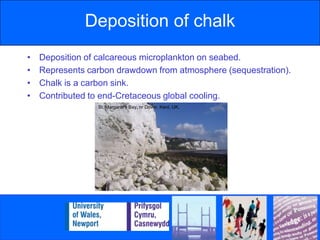
Deposition of chalkDeposition of calcareous microplankton on seabed. Represents carbon drawdown from atmosphere (sequestration).Chalk is a carbon sink.Contributed to end-Cretaceous global cooling.St. Margaret’s Bay, nr Dover, Kent, UK.
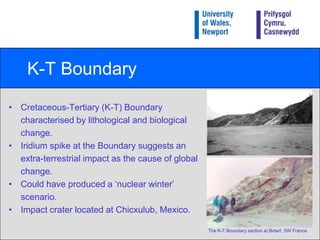
K-T BoundaryCretaceous-Tertiary (K-T) Boundary 	characterised by lithological and biological	change.Iridium spike at the Boundary suggests an	extra-terrestrial impact as the cause of global	change.Could have produced a ‘nuclear winter’ 	scenario.Impact crater located at Chicxulub, Mexico. The K-T Boundary section at Bidart, SW France
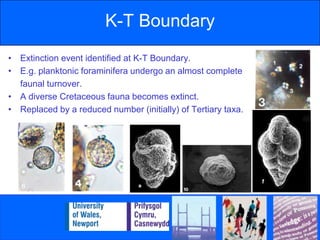
K-T BoundaryExtinction event identified at K-T Boundary.E.g. planktonic foraminifera undergo an almost complete 	faunal turnover.A diverse Cretaceous fauna becomes extinct.Replaced by a reduced number (initially) of Tertiary taxa.
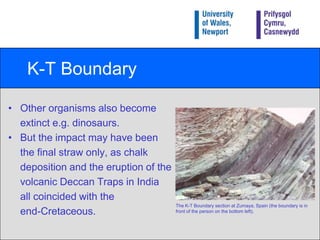
K-T BoundaryOther organisms also become 	extinct e.g. dinosaurs.But the impact may have been 	the final straw only, as chalk 	deposition and the eruption of the	volcanic Deccan Traps in India 	all coincided with the 	end-Cretaceous.The K-T Boundary section at Zumaya, Spain (the boundary is in front of the person on the bottom left).
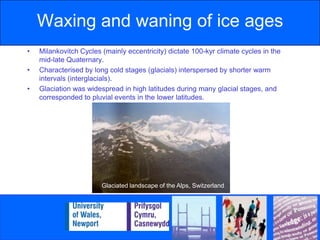
Waxing and waning of ice agesMilankovitch Cycles (mainly eccentricity) dictate 100-kyr climate cycles in the mid-late Quaternary.Characterised by long cold stages (glacials) interspersed by shorter warm intervals (interglacials).Glaciation was widespread in high latitudes during many glacial stages, and corresponded to pluvial events in the lower latitudes.Glaciated landscape of the Alps, Switzerland
Reconstructing EnvironmentsReconstructing environments from the geological record is fraught with difficulty and uncertainty.The main interpretative method is through the use of environmental proxies, components in rocks or sediment which indicate the depositional environment.Proxies include rock or sediment chemistry, mineralogy or sedimentology. One of the most useful and widely used proxies are fossils.
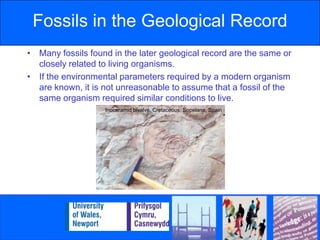
Fossils in the Geological RecordMany fossils found in the later geological record are the same or closely related to living organisms.If the environmental parameters required by a modern organism are known, it is not unreasonable to assume that a fossil of the same organism required similar conditions to live.Inoceramid bivalve, Cretaceous, Sopelana, Spain
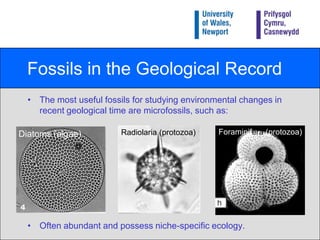
Fossils in the Geological RecordThe most useful fossils for studying environmental changes in recent geological time are microfossils, such as:
Often abundant and possess niche-specific ecology.Foraminifera (protozoa)Radiolaria (protozoa)Diatoms (algae)
Fossils in the Geological RecordIn addition to direct evidence, such as the presence or absence of a particular species, analysis of the shell of some microfossils can also yield environmental information e.g. geochemistry.For example, isotope analysis of foraminifera shells has revolutionized some aspects of global environmental reconstruction.Isotope analysis may be performed on micro- and macrofossils (e.g. corals, snails), and ice cores.
SummaryThere is no such thing as ‘normal’ environmental conditions.The geological record and reconstruction of prehistoric environments demonstrates this.The geological record is essential for placing the present environment in context.Features and events in the geological record indicate periods of local and global environmental change.Reconstructing environments from the geological record is fraught with difficulty and uncertainty.Fossils are the most useful and widely used indicators of change.Analysis of microfossil shells can also yield environmental information.
Further ReadingHaslett, S.K. 1994. Planktonicforaminiferalbiostratigraphy and palaeoceanography of the Cretaceous-Tertiary boundary section at Bidart, south-west France. Cretaceous Research, 15: 179-192.Haslett, S.K. ed. 2002. Quaternary Environmental Micropalaeontology. Arnold, 340pp. (especially chapters 1 and 11).Pickering, K.T. & Owen, L.A. 1997. An Introduction to Global Environmental Issues (2nd Edition). Routledge, 512pp. (read pp. 8-13, 21-26, 32, 39-41, 43-44, Box 2.1, Box 2.2).

An introduction to environmental change

  • 1.
    Introduction toEnvironmental ChangeProfessorSimon K. HaslettCentre for Excellence in Learning and TeachingSimon.haslett@newport.ac.uk7th May 2010
  • 2.
    IntroductionThe global environmentis transient.No such thing as ‘normal’ environmental conditions.Environmental variation within the historic period, scientific reconstruction of prehistoric environments, and the geological record provide evidence for this.In this presentation, approaches to reconstructing past environments and events are examined.
  • 3.
    Geological RecordThe geologicalrecord provides information about past or palaeo-environments that is essential for placing the present environment in context, and for predicting future environments.However, in interpreting the geological record it is important to distinguish between evidence that indicates global environmental change rather than local factors.
  • 4.
    Geological RecordFor example,through the Phanerozoic (550 Ma-present) the area of the Earth now known as the British Isles has drifted northwards from a high-latitudinal position in the southern hemisphere to its present location in the northern hemisphere.On route, it has passed through many different climatic zones.Therefore, much of the British geological record reflects where the ‘British Isles’ was at a particular time.
  • 5.
    Geological RecordNevertheless, thereare still certain features present.These features are usually more subtle and superimposed on the drift record, which cannot be explained by the drift model.They include:Sediment cycles in the Lower Lias (Jurassic).The deposition of the Chalk.The extinction of many taxa, including the dinosaurs at the end of the Cretaceous (K-T Boundary); andThe waxing and waning of ice ages within the last two million years.Evidence for these events are not only found in British geology, but in other countries on other continents, which were in different locations on the globe at the time the events took place.These events indicate periods of global environmental change.
  • 6.
    Sediment cycles inthe Lower Lias (Jurassic)Milankovitch Cycles are evident in geological sequences, such as the alternating limestone and shale of the Lower Lias.Lias-type site; Saltford, Somerset, UK.
  • 7.
    Deposition of chalkDepositionof calcareous microplankton on seabed. Represents carbon drawdown from atmosphere (sequestration).Chalk is a carbon sink.Contributed to end-Cretaceous global cooling.St. Margaret’s Bay, nr Dover, Kent, UK.
  • 8.
    K-T BoundaryCretaceous-Tertiary (K-T)Boundary characterised by lithological and biological change.Iridium spike at the Boundary suggests an extra-terrestrial impact as the cause of global change.Could have produced a ‘nuclear winter’ scenario.Impact crater located at Chicxulub, Mexico. The K-T Boundary section at Bidart, SW France
  • 9.
    K-T BoundaryExtinction eventidentified at K-T Boundary.E.g. planktonic foraminifera undergo an almost complete faunal turnover.A diverse Cretaceous fauna becomes extinct.Replaced by a reduced number (initially) of Tertiary taxa.
  • 10.
    K-T BoundaryOther organismsalso become extinct e.g. dinosaurs.But the impact may have been the final straw only, as chalk deposition and the eruption of the volcanic Deccan Traps in India all coincided with the end-Cretaceous.The K-T Boundary section at Zumaya, Spain (the boundary is in front of the person on the bottom left).
  • 11.
    Waxing and waningof ice agesMilankovitch Cycles (mainly eccentricity) dictate 100-kyr climate cycles in the mid-late Quaternary.Characterised by long cold stages (glacials) interspersed by shorter warm intervals (interglacials).Glaciation was widespread in high latitudes during many glacial stages, and corresponded to pluvial events in the lower latitudes.Glaciated landscape of the Alps, Switzerland
  • 12.
    Reconstructing EnvironmentsReconstructing environmentsfrom the geological record is fraught with difficulty and uncertainty.The main interpretative method is through the use of environmental proxies, components in rocks or sediment which indicate the depositional environment.Proxies include rock or sediment chemistry, mineralogy or sedimentology. One of the most useful and widely used proxies are fossils.
  • 13.
    Fossils in theGeological RecordMany fossils found in the later geological record are the same or closely related to living organisms.If the environmental parameters required by a modern organism are known, it is not unreasonable to assume that a fossil of the same organism required similar conditions to live.Inoceramid bivalve, Cretaceous, Sopelana, Spain
  • 14.
    Fossils in theGeological RecordThe most useful fossils for studying environmental changes in recent geological time are microfossils, such as:
  • 15.
    Often abundant andpossess niche-specific ecology.Foraminifera (protozoa)Radiolaria (protozoa)Diatoms (algae)
  • 16.
    Fossils in theGeological RecordIn addition to direct evidence, such as the presence or absence of a particular species, analysis of the shell of some microfossils can also yield environmental information e.g. geochemistry.For example, isotope analysis of foraminifera shells has revolutionized some aspects of global environmental reconstruction.Isotope analysis may be performed on micro- and macrofossils (e.g. corals, snails), and ice cores.
  • 17.
    SummaryThere is nosuch thing as ‘normal’ environmental conditions.The geological record and reconstruction of prehistoric environments demonstrates this.The geological record is essential for placing the present environment in context.Features and events in the geological record indicate periods of local and global environmental change.Reconstructing environments from the geological record is fraught with difficulty and uncertainty.Fossils are the most useful and widely used indicators of change.Analysis of microfossil shells can also yield environmental information.
  • 18.
    Further ReadingHaslett, S.K.1994. Planktonicforaminiferalbiostratigraphy and palaeoceanography of the Cretaceous-Tertiary boundary section at Bidart, south-west France. Cretaceous Research, 15: 179-192.Haslett, S.K. ed. 2002. Quaternary Environmental Micropalaeontology. Arnold, 340pp. (especially chapters 1 and 11).Pickering, K.T. & Owen, L.A. 1997. An Introduction to Global Environmental Issues (2nd Edition). Routledge, 512pp. (read pp. 8-13, 21-26, 32, 39-41, 43-44, Box 2.1, Box 2.2).

Editor's Notes