This research article examines how two endangered plant species in coastal sand dunes, Layia carnosa and Lupinus tidestromii, persist in different successional microhabitats (early vs. late stages). The researchers found both species had higher frequencies in early successional habitats. For L. tidestromii, plants in early successional microhabitats had higher projected population growth rates than those in late successional habitats, primarily due to higher recruitment rates in early successional microhabitats. The results support restoring natural disturbance regimes to allow persistence of endemic plant species in these ecosystems.
![RESEARCH ARTICLE
Early Successional Microhabitats Allow the
Persistence of Endangered Plants in Coastal
Sand Dunes
Eleanor A. Pardini☯
*, Kyle E. Vickstrom¤☯
, Tiffany M. Knight☯
Department of Biology, Washington University in St. Louis, St. Louis, Missouri, United States of America
¤ Current address: School of Chemical, Biological, and Environmental Engineering, Oregon State
University, Corvallis, Oregon, United States of America
☯ These authors contributed equally to this work.
* epardini@wustl.edu
Abstract
Many species are adapted to disturbance and occur within dynamic, mosaic landscapes
that contain early and late successional microhabitats. Human modification of disturbance
regimes alters the availability of microhabitats and may affect the viability of species in
these ecosystems. Because restoring historical disturbance regimes is typically expensive
and requires action at large spatial scales, such restoration projects must be justified by link-
ing the persistence of species with successional microhabitats. Coastal sand dune ecosys-
tems worldwide are characterized by their endemic biodiversity and frequent disturbance.
Dune-stabilizing invasive plants alter successional dynamics and may threaten species in
these ecosystems. We examined the distribution and population dynamics of two federally
endangered plant species, the annual Layia carnosa and the perennial Lupinus tidestromii,
within a dune ecosystem in northern California, USA. We parameterized a matrix population
model for L. tidestromii and examined the magnitude by which the successional stage of
the habitat (early or late) influenced population dynamics. Both species had higher frequen-
cies and L. tidestromii had higher frequency of seedlings in early successional habitats.
Lupinus tidestromii plants in early successional microhabitats had higher projected rates of
population growth than those associated with stabilized, late successional habitats, due pri-
marily to higher rates of recruitment in early successional microhabitats. These results sup-
port the idea that restoration of disturbance is critical in historically dynamic landscapes.
Our results suggest that large-scale restorations are necessary to allow persistence of the
endemic plant species that characterize these ecosystems.
Introduction
Rare species with limited distributions are often those that have evolved to take advantage of
spatially restricted, transient disturbances, which characterize a large number of ecosystems
[1]. Human activities have dramatically altered many historical disturbance regimes. For
PLOS ONE | DOI:10.1371/journal.pone.0119567 April 2, 2015 1 / 15
OPEN ACCESS
Citation: Pardini EA, Vickstrom KE, Knight TM
(2015) Early Successional Microhabitats Allow the
Persistence of Endangered Plants in Coastal Sand
Dunes. PLoS ONE 10(4): e0119567. doi:10.1371/
journal.pone.0119567
Academic Editor: Fei-Hai Yu, Beijing Forestry
University, CHINA
Received: October 17, 2014
Accepted: January 14, 2015
Published: April 2, 2015
Copyright: © 2015 Pardini et al. This is an open
access article distributed under the terms of the
Creative Commons Attribution License, which permits
unrestricted use, distribution, and reproduction in any
medium, provided the original author and source are
credited.
Data Availability Statement: All relevant data are
within the paper and its Supporting Information files.
Funding: Funding for this project was provided by
National Science Foundation DEB Award number
0743731 to TMK and EAP. The funders had no role in
study design, data collection and analysis, decision to
publish, or preparation of the manuscript.
Competing Interests: The authors have declared
that no competing interests exist.](https://image.slidesharecdn.com/9dfa81cf-4b26-4c57-9346-1b23e85c5d68-150619184105-lva1-app6892/85/Pardini-et-al-2015-1-320.jpg)
![example, dams and water control have limited periodic stream flooding, and thus negatively af-
fected the floodplain species that are dependent on regular flood intervals [2]. Fire suppression
has limited the ability of fire-dependent species to persist in their native ecosystems [3]. Inva-
sive species have also dramatically transformed disturbance regimes with wide-ranging effects
from altering fire frequency and intensity to changing soil disturbance patterns [4]. Invasive
species change many biotic and abiotic factors simultaneously, so a deeper understanding of
the ecological factors that limit population growth of disturbance-adapted species would allow
for more precise conservation planning [5]. For example, is removing the invasive species and
restoring the natural disturbance regime enough to increase populations of rare species, or
must other factors altered by the invasion (e.g., changes in soil nutrients or microbial commu-
nities) also be managed?
The relationship between the successional state of the habitat and population dynamics of
rare species is best understood by studies that consider multiple habitat types and integrate de-
mographic data across the life cycle of the species. In an exemplary study, Smith and colleagues
[6] found that the endangered floodplain plant Boltonia decurrens shifts its demography to-
wards an annual life cycle and has much higher population growth rates in recently flooded
areas, relative to more stabilized environments. Similar demographic studies have documented
the importance of successional state or time since disturbance to plant population dynamics in
systems that are disturbed by fire, [7,8], grazing [9,10] and hurricanes [11]. One important ap-
plication of these studies is that they have been used to determine the frequency of disturbance
necessary for species persistence.
Worldwide, coastal sand dunes are important for coastal defense against erosion, recreation,
ecotourism, and as reservoirs of biodiversity [12]. They are a classic example of a dynamic eco-
system defined by disturbance and successional processes [13]. They consist of a mosaic of
open and stabilized microhabitats created by geological processes and wind movement. Coastal
sand dunes worldwide contain endemic plant species adapted to the frequent disturbance and
unique edaphic conditions present, such as sand burial, moving substrate, low soil nutrients
and moisture, and strong, salty winds [14,15]. Sand burial is a particularly important factor af-
fecting plant distribution and vital rates [16][16–18]. Despite a rich history of research on
dunes, little is known about the link between dune dynamics and the population-level process-
es of plants endemic to the ecosystem.
Coastal dune ecosystems are threatened worldwide due to human reduction of land area
and modification of their disturbance regimes. Coastal dunes are attractive locations for
human settlement and recreation. For example, nearly 75% of Mediterranean coastal dunes
have been lost in the last 30 years [19] and in New Zealand, coastal sand dunes have declined
from 129,000 ha to 39,000 ha (~70% of the habitat lost) over the past 100 years due to land con-
version and erosion [20]. Similar losses are observed in North America, Australia, Europe and
Asia [21]. Coastal dunes are highly susceptible to biological invasions, especially by plants in-
tentionally introduced for dune stabilization. For example, Rosa rugosa (Japanese rose) shades
native vegetation and alters soil nutrients in dunes throughout Europe as well as the northeast-
ern U.S. [22]. Likewise, in western North America and Australia, Ammophila arenaria (Euro-
pean beachgrass) displaces native species, changes dune topology and stabilizes dunes
[15,20,23,24]. Both invaders are difficult and expensive to manage because of deep under-
ground clonal structures that re-sprout after they are disturbed by fire, herbicide, or manual re-
moval [23,25,26].
The California Floristic Province along the western coast of North America is recognized as
a global biodiversity hotspot known for its high plant endemism [27]. Sand dunes in this area
have declined due to land modification and invasive plants, most notably the grass Ammophila
arenaria [15,23]. One way in which A. arenaria threatens native ecosystems is by creating a
Plant Persistence in Dune Microhabitats
PLOS ONE | DOI:10.1371/journal.pone.0119567 April 2, 2015 2 / 15](https://image.slidesharecdn.com/9dfa81cf-4b26-4c57-9346-1b23e85c5d68-150619184105-lva1-app6892/85/Pardini-et-al-2015-2-320.jpg)
![high foredune and reducing interior sand movement, which reduces the frequency of blowouts
that lead to ephemeral early successional habitats [24]. Ammophila arenaria is implicated in
the decline of plant diversity [28,29], including six federally endangered plant species [30], and
decline of the federally threatened Western snowy plover [31]. However, to date, no study has
rigorously assessed the role of the successional dynamics in the decline of these rare species.
In this study, we examined dune plant communities at Point Reyes National Seashore
(PRNS) in northern California, USA. The sand dunes of PRNS house a large proportion of the
ranges of several rare plant species, but have become heavily dominated by A. arenaria, which
has dramatically reduced the availability of early successional habitat within the dunes. We
documented differences in community composition between early and late successional habi-
tats. We quantified differences in the abundance of two federally endangered plants (Lupinus
tidestromii and Layia carnosa) and in the stage structure of L. tidestromii between different suc-
cessional microhabitats. We used three years of demographic data to parameterize a matrix
population model of Lupinus tidestromii in early and late successional microsites. We used a
life table response experiment (LTRE) to understand the role of each demographic parameter
in causing the observed shift in population growth rate between these microhabitats.
Materials and Methods
Study area
This study was conducted on the dunes at Abbotts Lagoon within PRNS (Marin County, Cali-
fornia). The area experiences a Mediterranean climate moderated by maritime influences,
which includes short, wet winters, windy springs, and long, dry summers [32]. Dunes at PRNS
consist of patches of remnant, native dune that are surrounded by introduced European beach-
grass (Ammophila arenaria) and iceplant (Carpobrotus spp.). The 20 ha remnant dune imme-
diately west of Abbotts Lagoon has been surrounded on all other sides by A. arenaria, which
was introduced some time after the 1940s [33]. The remnant dune area is characterized by a
high foredune with interior dunes that consist of early, middle, and late successional habitats
and is home to high plant diversity. In remnant dune patches, some sand movement in the di-
rection of NW prevailing wind is typical [34], but the high foredune has likely altered historical
disturbance regimes and reduced interior sand. Between January and July 2011 PRNS con-
ducted a large-scale dune restoration project at Abbotts Lagoon and successfully removed 32
ha of A. arenaria from a 77 ha area surrounding the remnant native dune patch by mechanical
removal and hand-pulling [33].
Study species
Lupinus tidestromii (Fabaceae) is a low, herbaceous, perennial plant endemic to coastal dunes
in Sonoma, Marin, and Monterey counties in California. It is federally endangered and now oc-
curs in 15 locations, 9 of which are located within PRNS [35]. Abbotts Lagoon is home to the
largest extant population of L. tidestromii which has ranged in size from ~90,000 to 176,000 in-
dividuals between 2001 to 2012 [33]. Across its range, L. tidestromii is threatened by habitat
loss, trampling by visitors and cattle, hybridization, direct competition with invasive plants,
and elevated levels of seed predation in the presence of A. arenaria [36,37]. The primary threats
at Abbotts Lagoon are from A. arenaria, which competes with native vegetation, houses elevat-
ed levels of native seed predators [34,36,38], and stabilizes native dunes, reducing the amount
of suitable early successional habitat that appears to favor seedling establishment [33].
Layia carnosa (Asteraceae) is a succulent, winter annual that is endemic to coastal dunes in
Humboldt, Marin, Monterey, and Santa Barbara counties in California. It is federally endan-
gered and is threatened by land development, encroachment by invasive plants, and
Plant Persistence in Dune Microhabitats
PLOS ONE | DOI:10.1371/journal.pone.0119567 April 2, 2015 3 / 15](https://image.slidesharecdn.com/9dfa81cf-4b26-4c57-9346-1b23e85c5d68-150619184105-lva1-app6892/85/Pardini-et-al-2015-3-320.jpg)
![recreational habitat use [37]. Layia carnosa recruits readily in open sand with sparse vegetation,
and population dynamics appear to be tied to dune blowouts [37]. At PRNS, the most signifi-
cant threat is thought to be reduction of early successional habitat due to dune stabilization by
A. arenaria, but there is little quantitative data to support this.
Community composition across habitats of different successional stages
To describe community composition of early, middle, and late successional habitats at Abbott’s
Lagoon, in 2008 we sampled vegetation in 180 1-m2
quadrats across the northern half of the
population. We sampled 5 1-m2
quadrats at each of 36 sites along two N-S transects; sites were
separated by at least 50 m. At each site, the 5 quadrats were separated from one another by
5 m. In each quadrat, we identified all herbaceous forbs to species and placed them in one of
nine percent cover categories (0%; <1%, 1–5%, 6–15%, 16–25%, 26–50%, 51–75%, 76–90%,
91–100%). We also estimated the percent cover of bare sand in the quadrat using the same
categories.
For analysis, quadrats were categorized as early, mid or late successional stages based on
their percent cover of bare sand (>75%, 25–75%, <25% bare sand, respectively). To get a single
value of percent cover for each species and quadrat, we used the midpoint of the percent cover
category. We averaged the percent cover of each species across quadrats within a sample site
that were in the same successional stage, creating a data set of 69 sites for analysis (because
some sites contained multiple successional stages). We calculated similarity in community
composition across sites using a Bray-Curtis metric. We used Permutational Multivariate
Analysis of Variance (PERMANOVA) in PRIMER-E to test whether sites within a successional
stage category are more similar to each other than they are to those in other categories [39].
Frequency of endangered plants and stage structure of L. tidestromii
To examine the frequency and stage structure of L. tidestromii and L. carnosa across the entire
native dune area, in 2012 we surveyed vegetation in 207 1-m2
vegetation plots on a 50 m grid
system that was placed on a randomly chosen start point. In each plot, we recorded density of
L. carnosa and L. tidestromii. The successional stage of each plot was scored as early, middle, or
late, based on the percent of the plot area occupied by bare sand (70% bare sand for early;
35%-90% for mid; 0%-40% for late) and by the identity of occurring plants (e.g., presence of
stabilizing grass species). For analysis, to ensure the frequency of plants in the early, mid, and
late successional stage plots was reflective of pre-restoration vegetation frequencies, we includ-
ed only those 145 plots that were not blown over by sand movement resulting from the 2011
dune restoration. Of the 145 plots included in the analyses, 22 (15%) were classified as early
(mean 84.4% bare ground), 98 (68%) were classified as mid (mean 60% bare ground), and 17%
were classified as late (mean 18.8% bare ground). We calculated the proportion of plots within
each type of microhabitat that contained L. tidestromii or L. carnosa. For L. tidestromii, we fur-
ther calculated the proportion of individuals in each of three stage classes (seedling, non-repro-
ductive, and reproductive) found within each successional microhabitat type.
Matrix population model for L. tidestromii
We used matrix population models to project the effects of microhabitat on the population dy-
namics of L. tidestromii. Lupinus tidestromii is well-described by a stage-structured model that
includes five stage classes: seeds in a seed bank that will germinate after three winters (SB2),
seeds in a seed bank that will germinate after two winters (SB1), seedlings (SL), non-reproduc-
tive plants (NR), and reproductive plants (REP, see Fig. 1). The results presented here are part
of a larger study we are conducting on L. tidestromii. Our larger study includes demographic
Plant Persistence in Dune Microhabitats
PLOS ONE | DOI:10.1371/journal.pone.0119567 April 2, 2015 4 / 15](https://image.slidesharecdn.com/9dfa81cf-4b26-4c57-9346-1b23e85c5d68-150619184105-lva1-app6892/85/Pardini-et-al-2015-4-320.jpg)

![gRN, sN, sR, rNR, Fig. 1). In each year we tagged at least 50 new seedlings and additional non-re-
productive plants to supplement sample sizes reduced by growth or mortality.
For L. tidestromii, we estimate fertility as a product of the average number of racemes per
plant (r), average number of fruits per raceme (f), and the average number of seeds per fruit (s).
Transition from the reproductive class to the seed and seedling classes also depends on rates of
fruit abortion (a) and pre-dispersal seed consumption (c). We quantified r by counting racemes
on tagged reproductive plants (N = 121 reproductive plants in 2010 and 168 in 2011); r varies
across years and microhabitats. We quantified s by randomly collecting 23, 3, 15, and 39 fruits
in 2005, 2008, 2009, and 2010 at this field site and counting the number of seeds per fruit. We
calculated the mean number of seeds per fruit across all fruits and years (n = 80) and use this as
a constant in the model (we assume that s does not change across years or microhabitats). To
quantify a, c, and f, we followed the fates of marked racemes on each reproductive plant each
year. Following marked racemes was not possible in 2010 because reproduction of L. tidestro-
mii was unusually low. In 2010, we recorded the number of racemes that were dehisced/would
dehisce soon, were aborted, or had been completely consumed (evidenced by a diagonal clip on
a stalk and missing inflorescence) on 131 reproductive plants at one point in time during our
demographic census of tagged plants (June 7—June 18). In 2011 we tied colored yarn to all ra-
cemes (up to 16 per plant, mean 3.73 yarns per plant) on 148 reproductive plants between June
6-June 14 and we returned to these racemes every 2–3 weeks until all fruits had dehisced (June
14-July 7) to record if the raceme produced fruits, was aborted, or was consumed. To calculate
a and c, we summed the number of aborted racemes or consumed racemes and divided by the
sum of the total number of observed racemes. To calculate f (estimate available for 2011 only),
we averaged the number of fruits across all racemes for each plant and then averaged across
plants to produce the population-level value of f. We assume that a and c vary across years but
not habitats and f is constant across years and microhabitats.
Our model requires understanding how microhabitats affect recruitment and how recruit-
ment changes over time for seeds in the seed bank. We estimated microhabitat-specific recruit-
ment (e1) for the transition from reproductive plants to seedlings from a set of paired seedling
quadrats that were established in early and late microhabitats in 2011–2012 (note that the pa-
rameter e1 includes mortality due to post-dispersal seed predation). To test for differences in e1
between microhabitats we used a randomization test with 10,000 replicates. We estimated how
recruitment changes over time from seed baskets that were established in 2008 and in which
germination was observed in 2009–2011. For the reproductive to seed bank transitions, we ad-
just the e1 values by a proportion x or y determined from long-term seed baskets (methods de-
tailed in Supporting Information S1 File); x is the ratio of seeds that germinated after two
winters to the number of seeds that germinated after one winter, and y is the ratio of seeds that
germinated after three winters to the number of seeds that germinated after one winter (Fig. 1;
S1 File).
To quantify the effect of microhabitat on the population dynamics of L. tidestromii, we pro-
jected deterministic population growth rate (λ) for each transition year (2010–2011; 2011–
2012) and microhabitat (early; late) using a matrix population model [40]. We calculated 95%
confidence intervals around vital rates and population projections using 1,000 bootstrapped
simulations. Specifically, we sampled five datasets with replacement to generate bootstrap data-
sets, calculated vital rates from each bootstrap dataset, and then projected population growth
rates. The datasets used for bootstrapping were: (1) individuals in the demography dataset for
parameters gRS, gNS, gRN, sN, sR, rNR, and r, (2) individuals in the raceme dataset for parameters
f, a, and c, (3) fruits in the fruit dataset for parameter s, (4) seedling quadrats to generate e1,
and (5) seed baskets to generate x and y. Analyses were performed in MATLAB (Math Works
2010).
Plant Persistence in Dune Microhabitats
PLOS ONE | DOI:10.1371/journal.pone.0119567 April 2, 2015 6 / 15](https://image.slidesharecdn.com/9dfa81cf-4b26-4c57-9346-1b23e85c5d68-150619184105-lva1-app6892/85/Pardini-et-al-2015-6-320.jpg)
![We made the following assumptions in our model. First, we assumed that some fertility pa-
rameters are constant among habitats, years or both. We have observed that fertility in this
population varies largely in the number of racemes, rather than in the number of seeds per
fruit or fruits per raceme. Thus we measured microhabitat-specific values of r but we hold a, c,
and f constant across microhabitats. Second, we assume that seeds do not persist in the seed
bank for more than two years. This assumption matches our observations in the seed baskets.
Seedling recruitment was observed in 2009–2011, but not in 2012. This assumption is reason-
able in the current habitat, in which large disturbances that bring deeply buried seeds to the
surface are nonexistent due to the stabilization of sand by A. arenaria. However, we note that
L. tidestromii has a seed coat that should allow for long-term dormancy. Third, we assume that
parameters are density-independent. It is well known that seed consumption rates (i.e., c in our
model) respond in a compensatory manor to plant and seed densities. We use a simple, densi-
ty-independent model because our main objective is to examine potential differences among
successional microhabitats in mean population fitness, not to forecast population size.
Life table response experiment
Nine matrix elements varied between plants in early and late successional habitats. We used a
life table response experiment (LTRE) to determine how each of these contributed to the over-
all difference in λ observed across habitat types in each of our study years [40]. The contribu-
tion of each element is determined by the product of the difference in the element between
early and late successional habitats (aij
early
—aij
late
) and the sensitivity of λ to changes in each
matrix element (sij). The sensitivities were calculated from a matrix that was the mean of early
and late successional habitat matrices in each year. Analyses were performed in MATLAB [41].
Results
Community composition across habitats of different successional stages
Successional stage significantly affected plant community composition (PERMANOVA
SS = 21.26, F = 2.51, P = 0.001; Fig. 2), and pairwise differences between successional stage cate-
gories showed that all were distinct from each other in composition except for the mid and late
successional stages (Early vs. Mid P = 0.009, Early vs. Late P = 0.049, Mid vs. Late P = 0.11).
Lupinus tidestromii was the most abundant species on early successional plots, whereas Abro-
nia latifolia dominated late successional plots.
Frequency of endangered plants and stage structure of L. tidestromii
The frequency of plots containing L. tidestromii and L. carnosa differed significantly among
successional microhabitats, with the highest frequency of occurrence in early plots and the low-
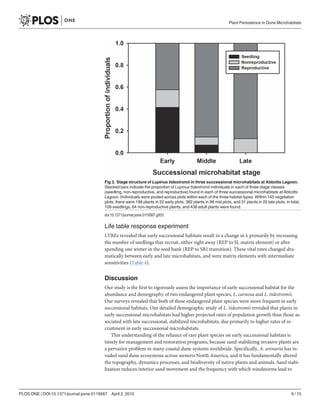
est in late plots (Table 1). In 112 plots where L. tidestromii occurred, the stage structure differed
among successional microhabitats. Seedling occurrence differed significantly among habitat
types (χ2 = 36.07, df = 2, P0.001): 86% of early plots contained seedlings while no late plots
contained seedlings (Fig. 3). Most plots (102 of 112) contained adult L. tidestromii, but the oc-
currence of adults was lowest among early plots (Fig. 3).
Matrix population model for L. tidestromii
The stage transitions of the seedling, non-reproductive, and reproductive plants did not vary in
a consistent manner between microhabitats. For example, there were more seedlings that be-
came non-reproductive plants in the early compared to the late successional habitat in 2011–
2012, but this was not the case in the 2010–2011 (Table 2). In 2010 compared to 2011, plants
Plant Persistence in Dune Microhabitats
PLOS ONE | DOI:10.1371/journal.pone.0119567 April 2, 2015 7 / 15](https://image.slidesharecdn.com/9dfa81cf-4b26-4c57-9346-1b23e85c5d68-150619184105-lva1-app6892/85/Pardini-et-al-2015-7-320.jpg)

![blowouts that reset the successional trajectory by creating ephemeral early successional habitats
[23,24]. Ammophila arenaria has been documented in western North America to alter plant
distribution, reduce species richness, and reduce species evenness [28,29,34,42].
Dune stabilization likely threatens a variety of native plants and animals that are highly
adapted to these dynamic systems. Western snowy plovers (Charadrius alexandrinus nivosus)
select sites with open sand for their courtship and nesting [43]. The spread of A. arenaria in
western North America has been implicated as a primary reason for the threatened federal sta-
tus of these birds [31]. Both of our focal endangered plant species have traits that facilitate their
survivorship and growth in early successional habitats in dynamic dune environments: L. car-
nosa has succulent, sticky leaves, wind dispersed seeds, and an annual life cycle; L. tidestromii
has a long taproot, a prostrate habit, hairy leaves, and seed dormancy. Scarification of the seed
coat is required for germination of L. tidestromii seeds, and thus, seeds can remain dormant in
late-successional microhabitats until a disturbance brings seeds to the surface and scarifies
them [37].
Our research suggests that current and future removal of intransigent A. arenaria from
PRNS will likely lead to considerably higher population levels of L. tidestromii. While the rates
Table 2. Average transition matrices (with 95% bootstrapped confidence intervals and sample sizes for growth, survival, and regression transi-
tions) for Lupinus tidestromii in early and late successional microhabitat at Abbotts Lagoon.
L. tidestromii Plant stage at year t
Stage at year t+1 SB2 SB1 SL NR REP
2010–2011 Early
SB2 0 0 0 0 0.0039 (0.0000–0.0127)
SB1 1 0 0 0 0.1974 (0.0571–0.5646)
SL 0 1 0 0 0.2409 (0.1123–0.3995)
NR 0 0 0.5583 (0.4667–0.6417, 120) 0.2561 (0.1585–0.3537, 82) 0.0877 (0.0351–0.1579, 57)
REP 0 0 0.0750 (0.0333–0.1250, 120) 0.5000 (0.3902–0.6098, 82) 0.6491 (0.5088–0.7544, 57)
2010–2011 Late
SB2 0 0 0 0 0.0005 (0.0000–0.0018)
SB1 1 0 0 0 0.0235 (0.0044–0.0740)
SL 0 1 0 0 0.0287 (0.0065–0.0561)
NR 0 0 0.5294 (0.3922–0.6667, 51) 0.2174 (0.1087–0.3261, 46) 0.0968 (0.0323–0.1774, 62)
REP 0 0 0.2745 (0.1569–0.4118, 51) 0.5870 (0.4348–0.7174, 46) 0.6452 (0.5161–0.7581, 62)
2011–2012 Early
SB2 0 0 0 0 0.0190 (0.0000–0.0681)
SB1 1 0 0 0 0.9497 (0.4209–1.6198)
SL 0 1 0 0 1.1586 (0.8945–1.4678)
NR 0 0 0.4286 (0.2857–0.5714, 42) 0.2029 (0.1159–0.3043, 69) 0.0392 (0.0000–0.0980, 51)
REP 0 0 0.4286 (0.2857–0.5952, 42) 0.6087 (0.4928–0.7246, 69) 0.6667 (0.5294–0.8039, 51)
2011–2012 Late
SB2 0 0 0 0 0.0028 (0.0000–0.0098)
SB1 1 0 0 0 0.1397 (0.0248–0.4678)
SL 0 1 0 0 0.1704 (0.0.0410–0.3348)
NR 0 0 0.2530 (0.1687–0.3494, 83) 0.1220 (0.0244–0.2439, 41) 0.0274 (0.0000–0.0685, 73)
REP 0 0 0.4819 (0.3735–0.5783, 83) 0.6829 (0.5366–0.8293, 41) 0.6986 (0.6027–0.7945, 73)
Key to abbreviations: SB2, seeds in the seed bank that will germinate in two years; SB1, seeds in the seed bank that will germinate in one year; SL,
seedling; NR, non-reproductive; REP, reproductive.
doi:10.1371/journal.pone.0119567.t002
Plant Persistence in Dune Microhabitats
PLOS ONE | DOI:10.1371/journal.pone.0119567 April 2, 2015 10 / 15](https://image.slidesharecdn.com/9dfa81cf-4b26-4c57-9346-1b23e85c5d68-150619184105-lva1-app6892/85/Pardini-et-al-2015-10-320.jpg)
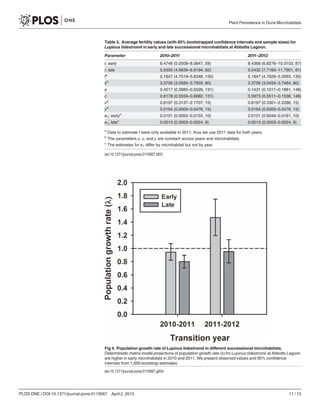
![of survival, growth, and fertility of established plants did not consistently differ between early
and late successional microhabitats, recruitment of seedlings was 10-fold higher in early com-
pared to late successional microhabitats. Our LTRE indicated that this difference contributed
to the difference in population growth rate (λ) across microhabitats. For L. tidestromii, removal
of A. arenaria should not only provide the early successional habitat that is critical for in-
creased seedling recruitment rates, as we have shown here, but also provide a respite from
heavy seed predation by Peromyscus maniculatus which utilize A. arenaria as refugia from
which to forage [36].
Despite the clear benefits for these endangered species, removal of A. arenaria is exception-
ally difficult due to its deep root system. For example, hand removal of the species often fails to
remove deep root structures, and allows A. arenaria to re-sprout (Pickart 1997). Two methods
that can successfully remove A. arenaria are the use of a combination of fire and herbicides be-
cause fire stimulates plant regrowth that readily absorbs herbicides [44] and the use of large
machinery that can dig 1–3 meters into the ground and destroy the deep root structures of the
plant [45].
A large-scale restoration project conducted between January and July 2011 at Abbotts La-
goon involved the removal of 32 ha of A. arenaria from a 77 ha area and landscape grading
with heavy machinery to restore the topology of the dunes. There has been an immediate re-
sponse of L. tidestromii to the dune restoration. Tens of thousands of seedling emerged in the
open, bare sand, beginning in August 2011. By summer 2012, approximately 25% of these indi-
viduals were reproductive and set seed in their first year (W Johnson, S Minnick, L Parsons,
unpublished data). In the years following the restoration (2011–2014), seed predation levels
were considerably lower than those levels observed in our 2005–2010 study years (EAP
Table 4. Life table response experiment for Lupinus tidestromii populations in early versus late successional microhabitats at Abbotts Lagoon.
Year Matrix element aij
early
aij
late
aij
early
−aij
late
sij Contribution
2010–2011 REP to SB2 0.0039 0.0005 0.0034 0.5280 0.0018
REP to SB1 0.1974 0.0235 0.1739 0.4759 0.0828
REP to SL 0.2409 0.0287 0.2122 0.4289 0.0910
SL to NR 0.5583 0.5294 0.0289 0.1472 0.0043
SL to REP 0.0750 0.2745 −0.1995 0.1800 −0.0359
NR to NR 0.2561 0.2174 0.0387 0.1913 0.0074
NR to REP 0.5000 0.5870 −0.0870 0.2340 −0.0204
REP to NR 0.0877 0.0968 −0.0091 0.5103 −0.0046
REP to REP 0.6491 0.6452 0.0039 0.6240 0.0024
2011–2012 REP to SB2 0.0190 0.0028 0.0162 0.1777 0.0029
REP to SB 0.9497 0.1397 0.8100 0.2256 0.1827
REP to SL 1.1586 0.1704 0.9882 0.2863 0.2829
SL to NR 0.4286 0.2530 0.1756 0.2811 0.0494
SL to REP 0.4286 0.4819 −0.0533 0.4817 −0.0257
NR to NR 0.2029 0.1220 0.0809 0.0963 0.0078
NR to REP 0.6087 0.6829 −0.0742 0.1650 −0.0122
REP to NR 0.0392 0.0274 0.0118 0.3242 0.0038
REP to REP 0.6667 0.6986 −0.0319 0.5556 −0.0177
Results are shown separately for year 2010–2011 and 2011–2012. Key to abbreviations: SB2, seeds in the seed bank that will germinate in two years;
SB1, seeds in the seed bank that will germinate in one year; SL, seedling; NR, non-reproductive; REP, reproductive.
doi:10.1371/journal.pone.0119567.t004
Plant Persistence in Dune Microhabitats
PLOS ONE | DOI:10.1371/journal.pone.0119567 April 2, 2015 12 / 15](https://image.slidesharecdn.com/9dfa81cf-4b26-4c57-9346-1b23e85c5d68-150619184105-lva1-app6892/85/Pardini-et-al-2015-12-320.jpg)
![TMK, unpublished data). These initial observations are consistent with the projected popula-
tion response of this endangered species to early successional habitats made by our model.
Conclusions
To our knowledge, ours is the first study to directly link plant demography to successional dy-
namics in sand dune ecosystems. Our results are consistent with results found in many other
ecosystems subject to periodic disturbances and subsequent successional dynamics, such as
those with fire [7,8], hurricanes [11], and floods [6]. These studies collectively show that the
persistence of native species with traits that facilitate their use of early successional habitats is
often linked to the maintenance of historical disturbance regimes. Our results are likely gener-
alizable to other sand dune ecosystems. Many plant species endemic to sand dunes are adapted
to tolerating the dynamic moving sand that historically characterized these ecosystems [14,15]
and many of these plants are threatened by dune-stabilizing plant invaders that reduce the fre-
quency and expanse of early successional microhabitats, such as R. rugosa [22] and A. arenaria
[23]. Removal of these invaders with the purpose of restoring disturbance dynamics and mosa-
ic landscapes should be a conservation priority.
Supporting Information
S1 File. Description of methods and data used to estimate seedling recruitment for Lupinus
tidestromii.
(DOCX)
Acknowledgments
This work was conducted at Point Reyes National Seashore under USFWS Permit TE018180-5
to PRNS dba the National Park Service. Lupinus tidestromii and Layia carnosa are listed as fed-
erally endangered under the U.S. Endangered Species Act; no plants were collected for this
study. We thank L Parsons, S Minnick, and B Becker at PRNS for extensive logistical support.
We are grateful to M Bogeberg, E Dangremond, Z Marine, M Patten, M Saylor, and S Roth for
assistance with field work and JM Chase for comments on the manuscript.
Author Contributions
Conceived and designed the experiments: EAP TMK. Performed the experiments: EAP KEV
TMK. Analyzed the data: EAP KEV TMK. Wrote the paper: EAP KEV TMK.
References
1. Kruckeberg AR, Rabinowitz D. Biological aspects of endemism in higher plants. Annu Rev Ecol Syst.
1985; 16: 447–479. doi: 10.2307/2097056
2. Dudgeon D, Arthington AH, Gessner MO, Kawabata Z-I, Knowler DJ, Lévêque C, et al. Freshwater bio-
diversity: importance, threats, status and conservation challenges. Biol Rev. 2006; 81: 163–182. PMID:
16336747
3. Driscoll DA, Lindenmayer DB, Bennett AF, Bode M, Bradstock RA, Cary GJ, et al. Fire management for
biodiversity conservation: Key research questions and our capacity to answer them. Biol Conserv.
2010; 143: 1928–1939.
4. Mack MC, D’Antonio CM. Impacts of biological invasions on disturbance regimes. Trends Ecol Evol.
1998; 13: 195–198. doi: 10.1016/S0169-5347(97)01286-X PMID: 21238260
5. Crone EE, Menges ES, Ellis MM, Bell T, Bierzychudek P, Ehrlén J, et al. How do plant ecologists use
matrix population models? Ecol Lett. 2011; 14: 1–8. doi: 10.1111/j.1461-0248.2010.01540.x PMID:
21070554
Plant Persistence in Dune Microhabitats
PLOS ONE | DOI:10.1371/journal.pone.0119567 April 2, 2015 13 / 15](https://image.slidesharecdn.com/9dfa81cf-4b26-4c57-9346-1b23e85c5d68-150619184105-lva1-app6892/85/Pardini-et-al-2015-13-320.jpg)

![31. USFWS. Recovery plan for the Pacific Coast population of the Western Snowy Plover (Charadrius alex-
andrinus nivosus). In 2 volumes. [Internet]. Sacramento, CA: U. S. Fish and Wildlife Service; 2007 p.
xiv + 751. Available: http://www.fws.gov/endangered/species/recovery-plans.html
32. Evens JG. Natural History of the Point Reyes Peninsula: Fully Revised and Expanded Edition. Berke-
ley, CA: University of California Press; 2008.
33. Parsons L, Minnick S. Annual Report 2001–2011 Tidestrom’s Lupine (Lupinus tidestromii) USFWS
Permit TE18180-2. 2012.
34. Pitts WD, Barbour MG. The microdistribution and feeding preferences of Peromyscus maniculatus in
the Strand at Point Reyes National Seashore, California. Am Midl Nat. 1979; 10: 38–48.
35. USFWS. Lupinus tidestromii (Clover lupine), 5-Year review: Summary and Evaluation [Internet]. Sacra-
mento, CA; 2009 p. 22. Available: http://www.fws.gov/ecos/ajax/docs/five_year_review/doc3210.pdf
36. Dangremond EM, Pardini EA, Knight TM. Apparent competition with an invasive plant hastens the ex-
tinction of an endangered lupine. Ecology. 2010; 91: 2261–2271. doi: 10.1890/09-0418.1 PMID:
20836448
37. USFWS. Seven coastal plants and the Myrtle’s silverspot butterfly recovery plan [Internet]. Portland,
OR; 1998 p. 141. Available: http://ecos.fws.gov/docs/recovery_plans/1998/980930d.pdf
38. Boyd RS. Microdistribution of the beach plant Cakile maritima (Brassicaceae) as influenced by a rodent
herbivore. Am J Bot. 1988; 75: 1540–1548.
39. Clarke KR, Gorley RN. PRIMER v6: User Manual/Tutorial. Plymouth, UK: PRIMER-E; 2009.
40. Caswell H. Matrix population models, Second edition. 2nd ed. Sunderland, MA: Sinauer Associates;
2001.
41. Math Works. MATLAB R2012b. Natick, MA: The Math Works; 2012.
42. Boyd RS. Influence of Ammophila arenaria on foredune plant microdistributions at Point Reyes National
Seashore, California. Madroño. 1992; 39: 67–76.
43. Muir JJ, Colwell MA. Snowy plovers select open habitats for courtship scrapes and nests. The Condor.
2010; 112: 507–510.
44. Hyland T, Holloran P. Controlling European beachgrass (Ammophila arenaria) using prescribed burns
and herbicide. Chico, CA: Cal-IPC (California Invasive Plant Council); 2005.
45. Pickart AJ. Control of European beachgrass (Ammophila arenaria) on the west coast of the United
States. Concord, CA: Cal-IPC (California Invasive Plant Council); 2007.
Plant Persistence in Dune Microhabitats
PLOS ONE | DOI:10.1371/journal.pone.0119567 April 2, 2015 15 / 15](https://image.slidesharecdn.com/9dfa81cf-4b26-4c57-9346-1b23e85c5d68-150619184105-lva1-app6892/85/Pardini-et-al-2015-15-320.jpg)


