SF, March 9, 2017
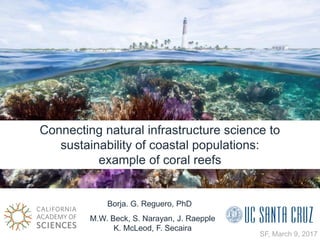
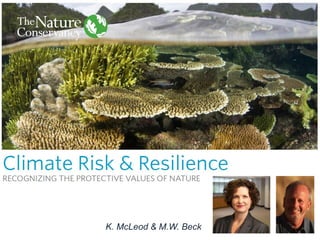
Connecting natural infrastructure science to
sustainability of coastal populations:
example of coral reefs
Borja. G. Reguero, PhD
M.W. Beck, S. Narayan, J. Raepple
K. McLeod, F. Secaira
With …
1. TNC & CRR
2. What is “natural” infrastructure?
3. How we assess Risk & the Economics of Adaptation
4. Coral reefs as natural infrastructure. Example 1. Making the case
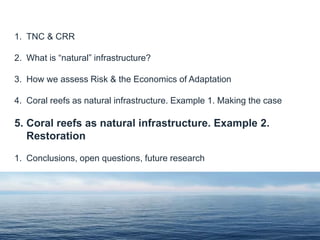
5. Coral reefs as natural infrastructure. Example 2. Restoration
1. Conclusions, open questions, future research
TNC
K. McLeod & M.W. Beck
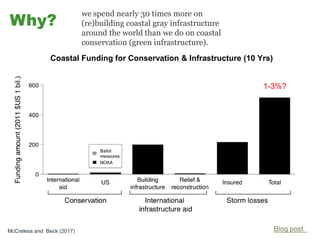
Coastal Funding for Conservation & Infrastructure (10 Yrs)
Why?
we spend nearly 30 times more on
(re)building coastal gray infrastructure
around the world than we do on coastal
conservation (green infrastructure).
Blog postMcCreless and Beck (2017)
1-3%?
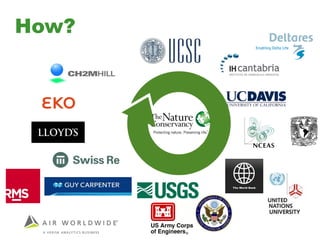
How?
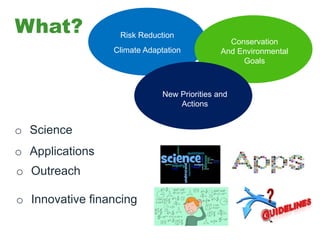
o Applications
o Science
o Outreach
Risk Reduction
Climate Adaptation
Conservation
And Environmental
Goals
New Priorities and
Actions
o Innovative financing
What?
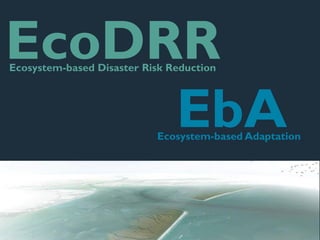
EcoDRR
EbAEcosystem-based Adaptation
Ecosystem-based Disaster Risk Reduction
1. TNC & CRR
2. What is “natural” infrastructure?
3. How we assess Risk & the Economics of Adaptation
4. Coral reefs as natural infrastructure. Example 1. Making the case
5. Coral reefs as natural infrastructure. Example 2. Restoration
1. Conclusions, open questions, future research
12
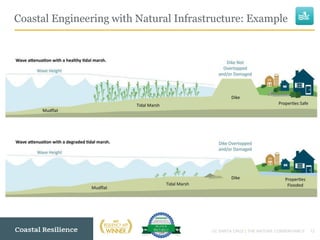
Coastal Engineering with Natural Infrastructure: Example
UC SANTA CRUZ | THE NATURE CONSERVANCY
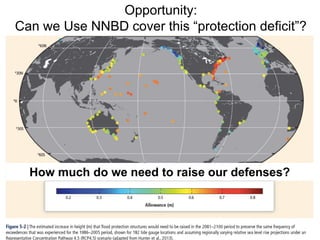
How much do we need to raise our defenses?
Opportunity:
Can we Use NNBD cover this “protection deficit”?
Eco-engineering: Connections
1. Risk deficit requires all options.
2. New Era of Sustainable Development: Stronger global interest and demand
then ever before (SFDRR 2015-2030, SDGs, UNFCCC, Adaptation Fund,
UNISDR, etc.).
3. Tremendous infrastructure upgrading globally.
4. Environmental degradation increases Risk
Opportune time for cross-disciplinary integration (planners, ecologists,
engineers) with multiple objectives/outcomes.
15
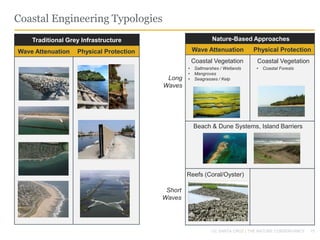
Coastal Engineering Typologies
UC SANTA CRUZ | THE NATURE CONSERVANCY
Traditional Grey Infrastructure
Wave Attenuation Physical Protection
Nature-Based Approaches
Wave Attenuation Physical Protection
Beach & Dune Systems, Island Barriers
Short
Waves
Long
Waves
Reefs (Coral/Oyster)
Coastal Vegetation Coastal Vegetation
• Saltmarshes / Wetlands
• Mangroves
• Seagrasses / Kelp
• Coastal Forests
1. TNC & CRR
2. What is “natural” infrastructure?
3. How we assess Risk & the Economics of Adaptation
4. Coral reefs as natural infrastructure. Example 1. Making the case
5. Coral reefs as natural infrastructure. Example 2. Restoration
1. Conclusions, open questions, future research
17UC SANTA CRUZ | THE NATURE CONSERVANCY
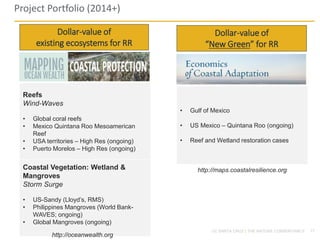
Reefs
Wind-Waves
• Global coral reefs
• Mexico Quintana Roo Mesoamerican
Reef
• USA territories – High Res (ongoing)
• Puerto Morelos – High Res (ongoing)
Coastal Vegetation: Wetland &
Mangroves
Storm Surge
• US-Sandy (Lloyd’s, RMS)
• Philippines Mangroves (World Bank-
WAVES; ongoing)
• Global Mangroves (ongoing)
• Gulf of Mexico
• US Mexico – Quintana Roo (ongoing)
• Reef and Wetland restoration cases
http://oceanwealth.org
http://maps.coastalresilience.org
Project Portfolio (2014+)
Dollar-value of
existing ecosystems for RR
Dollar-value of
“New Green” for RR
18UC SANTA CRUZ | THE NATURE CONSERVANCY
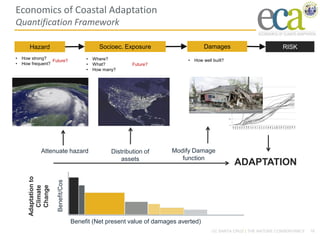
Economics of Coastal Adaptation
Quantification Framework
Hazard Socioec. Exposure Damages
• How strong?
• How frequent?
• How well built?• Where?
• What?
• How many?
RISK
Future?
Future?
ADAPTATION
Attenuate hazard Modify Damage
function
Distribution of
assets
Adaptationto
Climate
Change
Benefit/Cos
Benefit (Net present value of damages averted)
Reguero et al (in review)
Ex. US Gulf Coast
Risk and Drivers
High economic growth
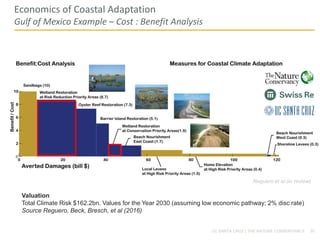
Economics of Coastal Adaptation
Gulf of Mexico Example – Cost : Benefit Analysis
20UC SANTA CRUZ | THE NATURE CONSERVANCY
Valuation
Total Climate Risk $162.2bn. Values for the Year 2030 (assuming low economic pathway; 2% disc rate)
Source Reguero, Beck, Bresch, et al (2016)
Reguero et al (in review)
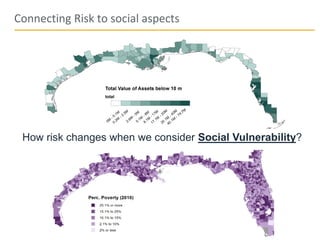
Connecting Risk to social aspects
How risk changes when we consider Social Vulnerability?
1. TNC & CRR
2. What is “natural” infrastructure?
3. How we assess Risk & the Economics of Adaptation
4. Coral reefs as natural infrastructure. Example 1.
Making the case
5. Coral reefs as natural infrastructure. Example 2. Restoration
1. Conclusions, open questions, future research
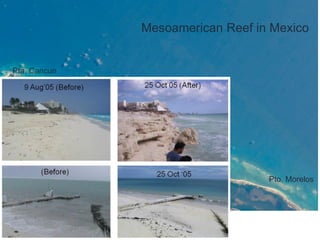
Mesoamerican Reef in Mexico
Pta. Cancun
Pto. Morelos
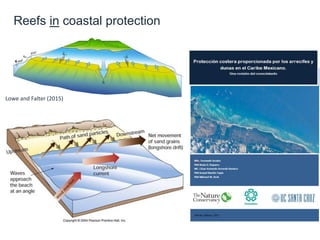
Reefs in coastal protection
Lowe and Falter (2015)
25UC SANTA CRUZ | THE NATURE CONSERVANCY
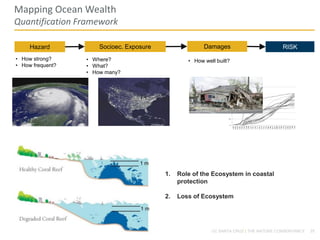
Mapping Ocean Wealth
Quantification Framework
Hazard Socioec. Exposure Damages
• How strong?
• How frequent?
• How well built?• Where?
• What?
• How many?
RISK
1. Role of the Ecosystem in coastal
protection
2. Loss of Ecosystem
26UC SANTA CRUZ | THE NATURE CONSERVANCY
Mapping Ocean Wealth
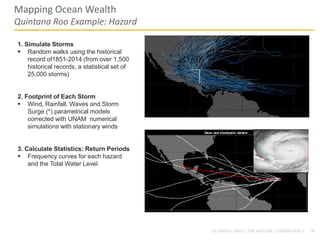
Quintana Roo Example: Hazard
1. Simulate Storms
 Random walks using the historical
record of1851-2014 (from over 1,500
historical records, a statistical set of
25,000 storms)
2. Footprint of Each Storm
 Wind, Rainfall, Waves and Storm
Surge (*) parametrical models
corrected with UNAM numerical
simulations with stationary winds
3. Calculate Statistics: Return Periods
 Frequency curves for each hazard
and the Total Water Level
27UC SANTA CRUZ | THE NATURE CONSERVANCY
Mapping Ocean Wealth
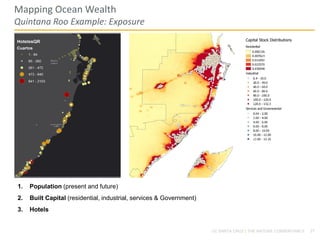
Quintana Roo Example: Exposure
1. Population (present and future)
2. Built Capital (residential, industrial, services & Government)
3. Hotels
28UC SANTA CRUZ | THE NATURE CONSERVANCY
Mapping Ocean Wealth
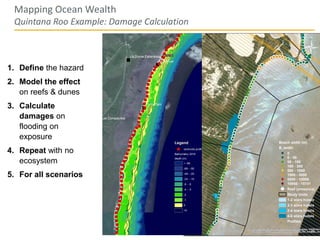
Quintana Roo Example: Damage Calculation
1. Define the hazard
2. Model the effect
on reefs & dunes
3. Calculate
damages on
flooding on
exposure
4. Repeat with no
ecosystem
5. For all scenarios
v
v
1 m
v
1 m
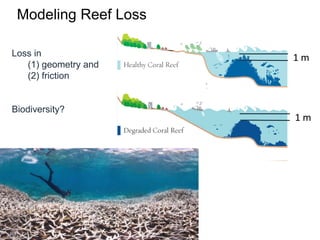
Modeling Reef Loss
Loss in
(1) geometry and
(2) friction
Biodiversity?
30
Mapping Ocean Wealth
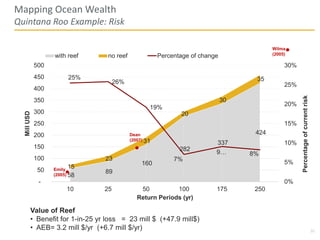
Quintana Roo Example: Risk
58
89
160
282
337
424
15
23
31
20
30
3525%
26%
19%
7%
9… 8%
0%
5%
10%
15%
20%
25%
30%
-
50
100
150
200
250
300
350
400
450
500
10 25 50 100 175 250
Percentageofcurrentrisk
MillUSD
Return Periods (yr)
with reef no reef Percentage of change
Value of Reef
• Benefit for 1-in-25 yr loss = 23 mill $ (+47.9 mill$)
• AEB= 3.2 mill $/yr (+6.7 mill $/yr)
Emily
(2005)
Dean
(2007)
Wilma
(2005)
N
“
a
o
WD4R
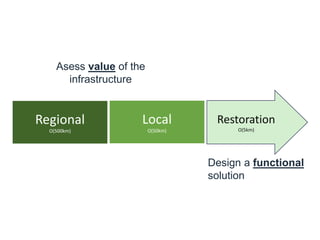
Regional
O(500km) O(50 km) O(5 km)
Local
O(50km)
Restoration
O(5km)
Asess value of the
infrastructure
Design a functional
solution
1. TNC & CRR
2. What is “natural” infrastructure?
3. How we assess Risk & the Economics of Adaptation
4. Coral reefs as natural infrastructure. Example 1. Making the case
5. Coral reefs as natural infrastructure. Example 2.
Restoration
1. Conclusions, open questions, future research
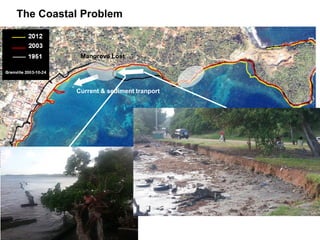
Current & sediment tranport
Mangrove Lost
Field inspection (28 Jan.) and local reporting
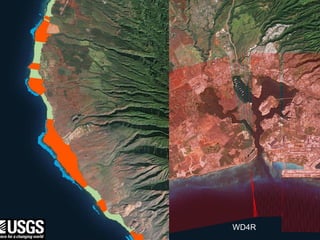
The Coastal Problem
37
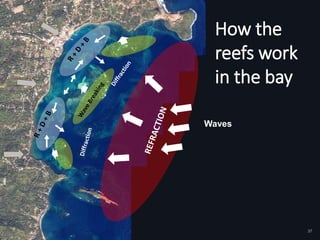
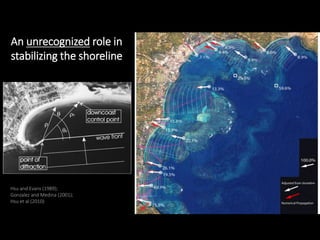
How the
reefs work
in the bay
Waves
Hsu and Evans (1989);
Gonzalez and Medina (2001);
Hsu et al (2010)
An unrecognized role in
stabilizing the shoreline
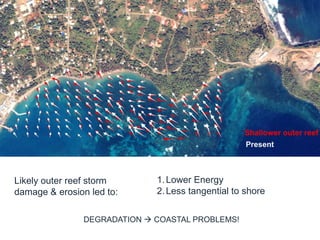
1.Lower Energy
2.Less tangential to shore
Likely outer reef storm
damage & erosion led to:
DEGRADATION  COASTAL PROBLEMS!
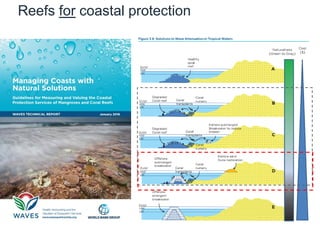
Reefs for coastal protection
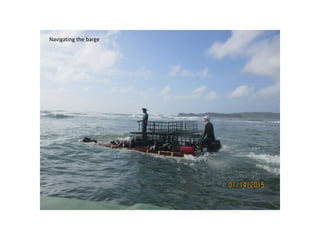
Navigating the barge
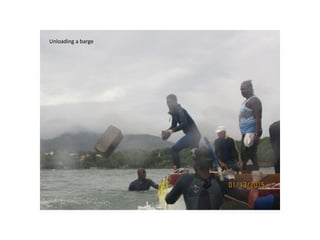
Unloading a barge
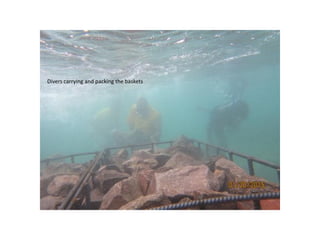
Divers carrying and packing the baskets
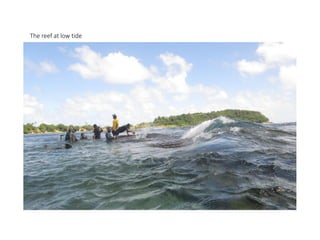
The reef at low tide
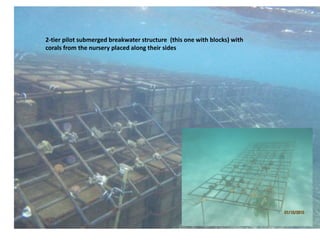
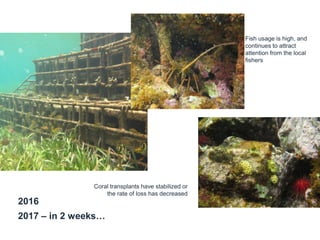
2-tier pilot submerged breakwater structure (this one with blocks) with
corals from the nursery placed along their sides
Fish usage is high, and
continues to attract
attention from the local
fishers
2016
2017 – in 2 weeks…
Coral transplants have stabilized or
the rate of loss has decreased
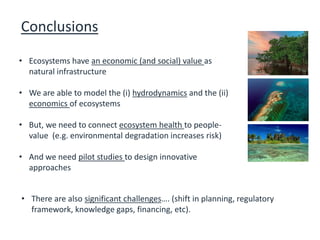
Conclusions
• Ecosystems have an economic (and social) value as
natural infrastructure
• We are able to model the (i) hydrodynamics and the (ii)
economics of ecosystems
• But, we need to connect ecosystem health to people-
value (e.g. environmental degradation increases risk)
• And we need pilot studies to design innovative
approaches
• There are also significant challenges…. (shift in planning, regulatory
framework, knowledge gaps, financing, etc).
v
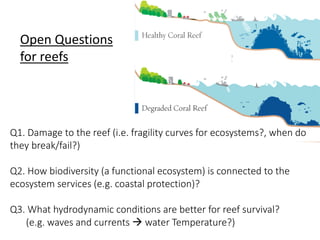
vQ1. Damage to the reef (i.e. fragility curves for ecosystems?, when do
they break/fail?)
Q2. How biodiversity (a functional ecosystem) is connected to the
ecosystem services (e.g. coastal protection)?
Q3. What hydrodynamic conditions are better for reef survival?
(e.g. waves and currents  water Temperature?)
Open Questions
for reefs
Contact Borja G. Reguero Email
breguero@ucsc.edu
UC SANTA CRUZ | THE NATURE CONSERVANCY
Thank you
Gracias
borja_reguero@tnc.org

Cal Academy Talk, March 9, 2017

  • 1.
    SF, March 9,2017 Connecting natural infrastructure science to sustainability of coastal populations: example of coral reefs Borja. G. Reguero, PhD M.W. Beck, S. Narayan, J. Raepple K. McLeod, F. Secaira
  • 2.
  • 3.
    1. TNC &CRR 2. What is “natural” infrastructure? 3. How we assess Risk & the Economics of Adaptation 4. Coral reefs as natural infrastructure. Example 1. Making the case 5. Coral reefs as natural infrastructure. Example 2. Restoration 1. Conclusions, open questions, future research
  • 4.
  • 5.
    K. McLeod &M.W. Beck
  • 6.
    Coastal Funding forConservation & Infrastructure (10 Yrs) Why? we spend nearly 30 times more on (re)building coastal gray infrastructure around the world than we do on coastal conservation (green infrastructure). Blog postMcCreless and Beck (2017) 1-3%?
  • 7.
  • 8.
    o Applications o Science oOutreach Risk Reduction Climate Adaptation Conservation And Environmental Goals New Priorities and Actions o Innovative financing What?
  • 9.
  • 10.
    1. TNC &CRR 2. What is “natural” infrastructure? 3. How we assess Risk & the Economics of Adaptation 4. Coral reefs as natural infrastructure. Example 1. Making the case 5. Coral reefs as natural infrastructure. Example 2. Restoration 1. Conclusions, open questions, future research
  • 12.
    12 Coastal Engineering withNatural Infrastructure: Example UC SANTA CRUZ | THE NATURE CONSERVANCY
  • 13.
    How much dowe need to raise our defenses? Opportunity: Can we Use NNBD cover this “protection deficit”?
  • 14.
    Eco-engineering: Connections 1. Riskdeficit requires all options. 2. New Era of Sustainable Development: Stronger global interest and demand then ever before (SFDRR 2015-2030, SDGs, UNFCCC, Adaptation Fund, UNISDR, etc.). 3. Tremendous infrastructure upgrading globally. 4. Environmental degradation increases Risk Opportune time for cross-disciplinary integration (planners, ecologists, engineers) with multiple objectives/outcomes.
  • 15.
    15 Coastal Engineering Typologies UCSANTA CRUZ | THE NATURE CONSERVANCY Traditional Grey Infrastructure Wave Attenuation Physical Protection Nature-Based Approaches Wave Attenuation Physical Protection Beach & Dune Systems, Island Barriers Short Waves Long Waves Reefs (Coral/Oyster) Coastal Vegetation Coastal Vegetation • Saltmarshes / Wetlands • Mangroves • Seagrasses / Kelp • Coastal Forests
  • 16.
    1. TNC &CRR 2. What is “natural” infrastructure? 3. How we assess Risk & the Economics of Adaptation 4. Coral reefs as natural infrastructure. Example 1. Making the case 5. Coral reefs as natural infrastructure. Example 2. Restoration 1. Conclusions, open questions, future research
  • 17.
    17UC SANTA CRUZ| THE NATURE CONSERVANCY Reefs Wind-Waves • Global coral reefs • Mexico Quintana Roo Mesoamerican Reef • USA territories – High Res (ongoing) • Puerto Morelos – High Res (ongoing) Coastal Vegetation: Wetland & Mangroves Storm Surge • US-Sandy (Lloyd’s, RMS) • Philippines Mangroves (World Bank- WAVES; ongoing) • Global Mangroves (ongoing) • Gulf of Mexico • US Mexico – Quintana Roo (ongoing) • Reef and Wetland restoration cases http://oceanwealth.org http://maps.coastalresilience.org Project Portfolio (2014+) Dollar-value of existing ecosystems for RR Dollar-value of “New Green” for RR
  • 18.
    18UC SANTA CRUZ| THE NATURE CONSERVANCY Economics of Coastal Adaptation Quantification Framework Hazard Socioec. Exposure Damages • How strong? • How frequent? • How well built?• Where? • What? • How many? RISK Future? Future? ADAPTATION Attenuate hazard Modify Damage function Distribution of assets Adaptationto Climate Change Benefit/Cos Benefit (Net present value of damages averted)
  • 19.
    Reguero et al(in review) Ex. US Gulf Coast Risk and Drivers High economic growth
  • 20.
    Economics of CoastalAdaptation Gulf of Mexico Example – Cost : Benefit Analysis 20UC SANTA CRUZ | THE NATURE CONSERVANCY Valuation Total Climate Risk $162.2bn. Values for the Year 2030 (assuming low economic pathway; 2% disc rate) Source Reguero, Beck, Bresch, et al (2016) Reguero et al (in review)
  • 21.
    Connecting Risk tosocial aspects How risk changes when we consider Social Vulnerability?
  • 22.
    1. TNC &CRR 2. What is “natural” infrastructure? 3. How we assess Risk & the Economics of Adaptation 4. Coral reefs as natural infrastructure. Example 1. Making the case 5. Coral reefs as natural infrastructure. Example 2. Restoration 1. Conclusions, open questions, future research
  • 23.
    Mesoamerican Reef inMexico Pta. Cancun Pto. Morelos
  • 24.
    Reefs in coastalprotection Lowe and Falter (2015)
  • 25.
    25UC SANTA CRUZ| THE NATURE CONSERVANCY Mapping Ocean Wealth Quantification Framework Hazard Socioec. Exposure Damages • How strong? • How frequent? • How well built?• Where? • What? • How many? RISK 1. Role of the Ecosystem in coastal protection 2. Loss of Ecosystem
  • 26.
    26UC SANTA CRUZ| THE NATURE CONSERVANCY Mapping Ocean Wealth Quintana Roo Example: Hazard 1. Simulate Storms  Random walks using the historical record of1851-2014 (from over 1,500 historical records, a statistical set of 25,000 storms) 2. Footprint of Each Storm  Wind, Rainfall, Waves and Storm Surge (*) parametrical models corrected with UNAM numerical simulations with stationary winds 3. Calculate Statistics: Return Periods  Frequency curves for each hazard and the Total Water Level
  • 27.
    27UC SANTA CRUZ| THE NATURE CONSERVANCY Mapping Ocean Wealth Quintana Roo Example: Exposure 1. Population (present and future) 2. Built Capital (residential, industrial, services & Government) 3. Hotels
  • 28.
    28UC SANTA CRUZ| THE NATURE CONSERVANCY Mapping Ocean Wealth Quintana Roo Example: Damage Calculation 1. Define the hazard 2. Model the effect on reefs & dunes 3. Calculate damages on flooding on exposure 4. Repeat with no ecosystem 5. For all scenarios
  • 29.
    v v 1 m v 1 m ModelingReef Loss Loss in (1) geometry and (2) friction Biodiversity?
  • 30.
    30 Mapping Ocean Wealth QuintanaRoo Example: Risk 58 89 160 282 337 424 15 23 31 20 30 3525% 26% 19% 7% 9… 8% 0% 5% 10% 15% 20% 25% 30% - 50 100 150 200 250 300 350 400 450 500 10 25 50 100 175 250 Percentageofcurrentrisk MillUSD Return Periods (yr) with reef no reef Percentage of change Value of Reef • Benefit for 1-in-25 yr loss = 23 mill $ (+47.9 mill$) • AEB= 3.2 mill $/yr (+6.7 mill $/yr) Emily (2005) Dean (2007) Wilma (2005)
  • 31.
  • 32.
    Regional O(500km) O(50 km)O(5 km) Local O(50km) Restoration O(5km) Asess value of the infrastructure Design a functional solution
  • 33.
    1. TNC &CRR 2. What is “natural” infrastructure? 3. How we assess Risk & the Economics of Adaptation 4. Coral reefs as natural infrastructure. Example 1. Making the case 5. Coral reefs as natural infrastructure. Example 2. Restoration 1. Conclusions, open questions, future research
  • 35.
    Current & sedimenttranport Mangrove Lost Field inspection (28 Jan.) and local reporting The Coastal Problem
  • 37.
  • 38.
    Hsu and Evans(1989); Gonzalez and Medina (2001); Hsu et al (2010) An unrecognized role in stabilizing the shoreline
  • 39.
    1.Lower Energy 2.Less tangentialto shore Likely outer reef storm damage & erosion led to: DEGRADATION  COASTAL PROBLEMS!
  • 40.
  • 41.
  • 42.
  • 43.
    Divers carrying andpacking the baskets
  • 44.
    The reef atlow tide
  • 45.
    2-tier pilot submergedbreakwater structure (this one with blocks) with corals from the nursery placed along their sides
  • 46.
    Fish usage ishigh, and continues to attract attention from the local fishers 2016 2017 – in 2 weeks… Coral transplants have stabilized or the rate of loss has decreased
  • 48.
    Conclusions • Ecosystems havean economic (and social) value as natural infrastructure • We are able to model the (i) hydrodynamics and the (ii) economics of ecosystems • But, we need to connect ecosystem health to people- value (e.g. environmental degradation increases risk) • And we need pilot studies to design innovative approaches • There are also significant challenges…. (shift in planning, regulatory framework, knowledge gaps, financing, etc).
  • 49.
    v vQ1. Damage tothe reef (i.e. fragility curves for ecosystems?, when do they break/fail?) Q2. How biodiversity (a functional ecosystem) is connected to the ecosystem services (e.g. coastal protection)? Q3. What hydrodynamic conditions are better for reef survival? (e.g. waves and currents  water Temperature?) Open Questions for reefs
  • 50.
    Contact Borja G.Reguero Email breguero@ucsc.edu UC SANTA CRUZ | THE NATURE CONSERVANCY Thank you Gracias borja_reguero@tnc.org