 Steam power plants converts the energy stored in
the fossil fuels in the form of heat energy
 In thermal power plants, the input energy is
produced by burning the coal
 1. CONVENTIONAL
◦ Fossil fuel energy
◦ Hydraulic energy
◦ Nuclear energy
 2.NON CONVENTIONAL ENERGY SOURCES
◦ Solar energy
◦ Wind energy
◦ Tidal energy
◦ Wave energy
◦ Geo thermal energy
◦ Biomass energy
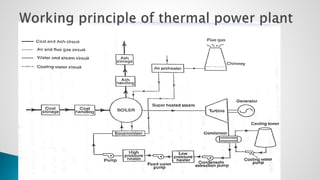
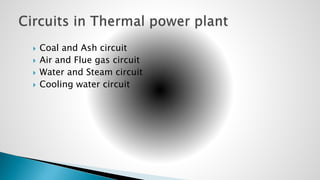
 Coal and Ash circuit
 Air and Flue gas circuit
 Water and Steam circuit
 Cooling water circuit
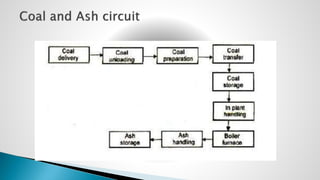
 Coal and Ash circuit:
◦ Coal to boiler transfer
◦ Ash resulting during combustion of coal from boiler removed and its stored
in ash storage device in ash handling
◦ Power plant of 100MW produces normally 20 to 25 tons of ash per hour.
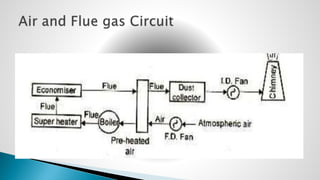
 Air is taken from atmosphere and send through an air
preheater.
 Dust is removed from the air through series of filters
 The waste heat of flue gas passed to the chimney for
preheating the air in the preheater
 Afetr the combustion process the sufficient quantity of
flue gas is passed around the boiler tubes for preheat the
water and air
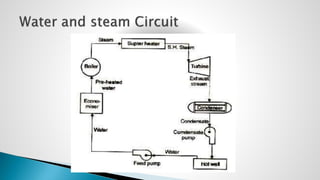
 It consists of boiler feed pump, boiler, turbine and feed water
pump
 The steam generated in the boiler passes through superheater
and supplied to steam turbine
 Out Water sent through condenser
 Then the feed water passes through economizer for boiler
 Feed water supplied external source to compensate losses
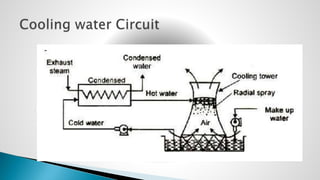
 It consists of condenser , cooling water pump and
cooling tower
 The warm water coming out from the condenser is
cooled in the cooling tower and recirculate within the
plant
 Initial investment is low
 The power plant can be located near load centre, so the
transmission cost and losses are considerably reduced
 The power production does not depend on the nature mercy
 Air pollution is the major problem inviting additional
investment
 It cannot be used as a peak load plant
 The coal may be exhausted by gradual use
 Power production cost is considerably high compared to hydel
plant
 Life efficiency is low as compared to hydel plant
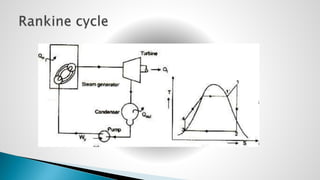
 Theoretical cycle which works on steam turbine works.
 Ideal cycle for vapour power cycles.
 The diagram shows the rankine cycle
 Process 1-2 (Turbine)
 Process 2-3 (condenser)
 Process 3-4 (pump
 Process 4-1 (Boiler)
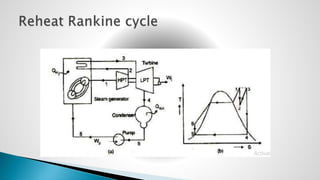
 Reheat rankine cycle
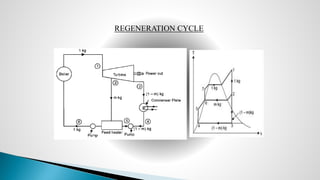
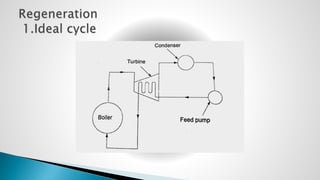
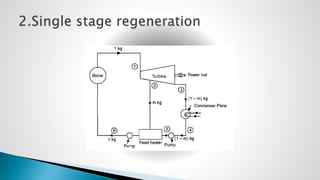
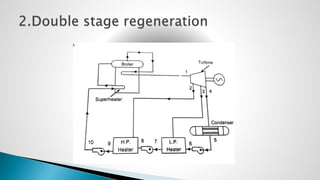
 Regeneration
 Combined reheating and regeneration
 Efficiency can be increased by increasing the pressure and temperature of
steam entering in to the turbine.
 Steam is initially expanded in high pressure steam
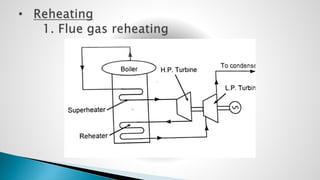
 Reheat the steam with the help of fluegas
 Then steam is expanded in to low pressure turbine.
 In rankine cycle in condensate which is coming out has very low
temperature and it mixes with hot water in boiler.
 It results it decrease in cycle efficiency
 Increase the temperature of the feed water is raised to the saturation
temperature before entering to the boiler.
REGENERATION CYCLE
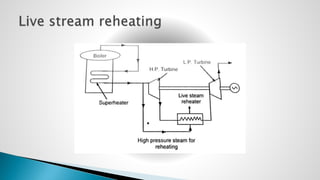
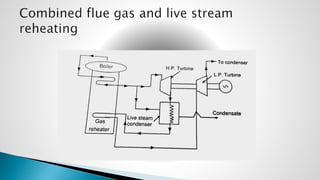
1. Reheating
• Flue gas reheating ( flue gas coming out from boiler to reheat the
steam)
• Live stream reheating (high-pressure steam from the boiler is used to
reheat the steam coming out from H.P Turbine designed for design heat
exchanger)
• Combined flue gas and live stream reheating : ( first pass through live
stream heater and gas heater)
2. Regeneration
• Ideal :
• Single Stage :
• Two Stage :
 Boiler is a closed vessel in which the steam is generated from
water by applying heat.
 Boiler is also known as steam generator
1.ACCORDING TO THE FLOW AND HOT GAS:
 Fire tube boiler
◦ Hot gas is passed through the tubes and the water
circulated around the tubes
◦ Eg:- Cochran Boiler, Locomotive Boiler
 Water tube boiler
◦ Water circulated through a number of tubes and hot gas
pass around the tubes
◦ Stirling boiler and Wilcox boiler
 2. According to the axis of shell:
◦ Vertical boilers
◦ Horizontal boilers
◦ Inclined boilers
 3.According to location or position of the furnace
◦ Internally fired boilers
◦ Externally and externally fired boilers
 4. according to the method of water circulation
◦ Natural circulation boilers
◦ Forced circulation boilers
 5. According to the application or boiler mobility
◦ Stationary boilers
◦ Mobile boilers
 6. According to steam pressure
◦ Low pressure , medium pressure, high pressure, supercritical boilers
 7. According to number of tubes used:
◦ Single tube used
◦ Multi tube boilers
 8.According to draft
◦ Natural draft boilers
◦ Artificial draft boilers
 9. according to types of fuel used
◦ Solid fuel boilers
◦ Liquid or gaseous fuel boilers
◦ Electrical heated and nuclear energy boilers
High Pressure Boilers
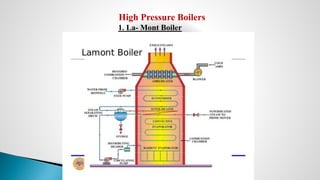
1. La- Mont Boiler
 Forced circulation
 Steam circulation maintained by centrifugal pump.
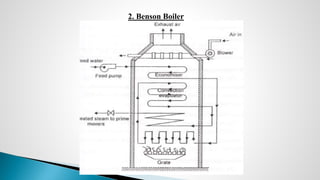
2. Benson Boiler
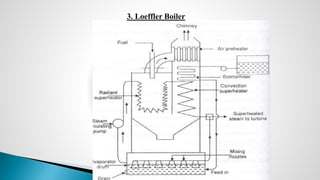
3. Loeffler Boiler
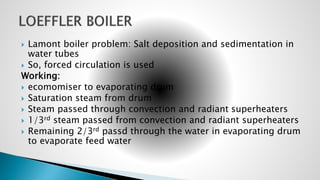
 Lamont boiler problem: Salt deposition and sedimentation in
water tubes
 So, forced circulation is used
Working:
 ecomomiser to evaporating drum
 Saturation steam from drum
 Steam passed through convection and radiant superheaters
 1/3rd steam passed from convection and radiant superheaters
 Remaining 2/3rd passd through the water in evaporating drum
to evaporate feed water
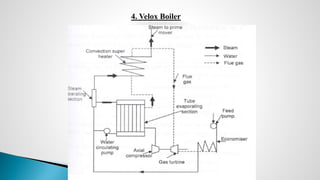
4. Velox Boiler
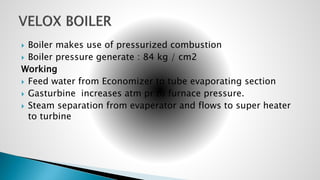
 Boiler makes use of pressurized combustion
 Boiler pressure generate : 84 kg / cm2
Working
 Feed water from Economizer to tube evaporating section
 Gasturbine increases atm pr to furnace pressure.
 Steam separation from evaperator and flows to super heater
to turbine
 Super critical boiler is a type of boiler which is operated at
super critical pressure.
 Working range of steam generating plants from 125 atm and
510°C to 300 atm and 660°C . Power plants operated above
the critical pressure and temperature condition is called super
critical powerplant
Two type of super critical boilers are
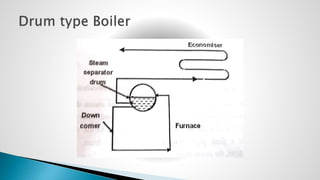
 Drum Type boiler (
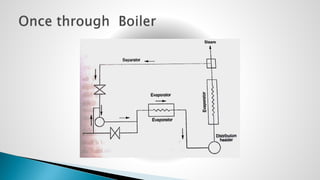
 Once through boiler
 Pressure gauge
 Stop valve
 Feed check valve
 Safety valve
 Fusible valve
 Blow off valve
 Water level indicator
 Man holes
 Economiser
 Steam super heater
 Airpreheater
 Deaerators ( removal of air and other gases in feed water)
 Steam seperator
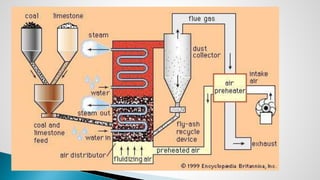
 The fuel are fed on a distribution plate ,due to high velocity of
air the feed material remains in suspended condition during
burning
 The bed temperature is about 800-900 C
 So2 emission and Nox emissions are greatly reduced with the
use of limestone/dolamite
 Steam can be produced by fossils and waste fules using these
technique
 TYPES OF FBC:
◦ Circulating fluidized bed boiler
◦ Bubbling fluidized bed boiler
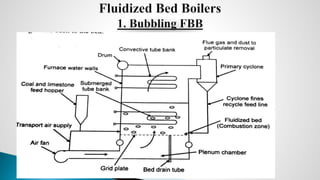
 Coal crushed (6-20 mm )
 Air fan flow upwards
 Chamber having large number of carbon particles
 H2SO4 acid less formation by bed material limestone
 Combustion 800-900degree C less Nox
 Heat release 10-15 times than conventional boiler
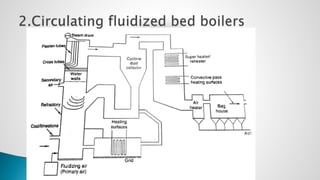
 Coal in lower section , limestone also
 Air distributors (primary and secondary)
 800-900 degree C
 Unburned particles colleceted in cyclone seperator again feed
to furnace
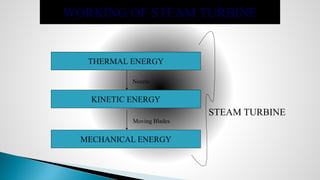
WORKING OF STEAM TURBINE
THERMAL ENERGY
KINETIC ENERGY
MECHANICAL ENERGY
STEAM TURBINE
Nozzle
Moving Blades
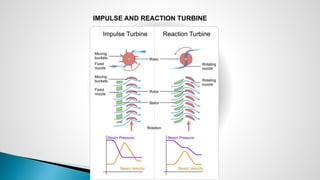
IMPULSE AND REACTION TURBINE
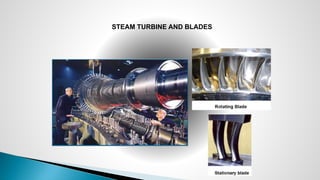
STEAM TURBINE AND BLADES
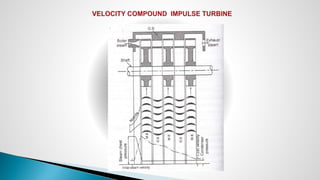
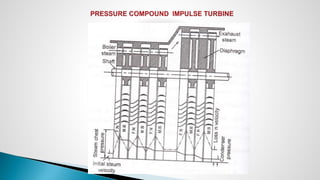
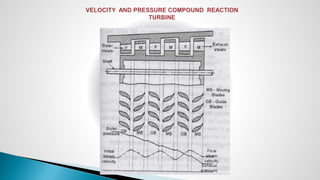
 Absorbing the jet velocity in more than one stage when steam
flows over moving blades
 Velocity compounding
 Pressure compounding
 Pressure – Velocity compounding
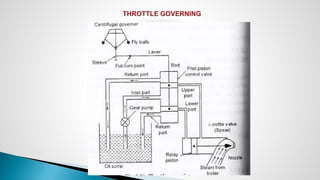
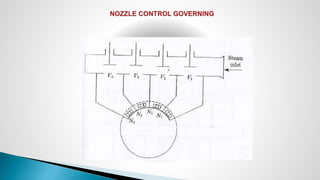
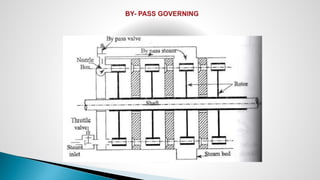
 The method of maintaining the speed of the turbine constant
irrespective on the basis of variation of load is known as
governing of turbines
Steam rate:
Capacity of the steam plant expressed in terms of steam rate or
specific fuel consumptions
SSC=Mass of steam / Work output unit kg/kWh
Heat rate:
It indicates the amount of fuel required to generate one unit of
electricity
Heat rate= Heat supplied/Work output kJ/kWh
 Fuel handling system
 Ash Handling system
 Cooling Towers
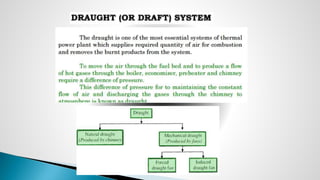
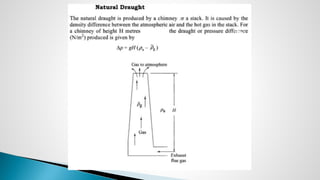
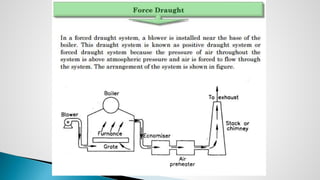
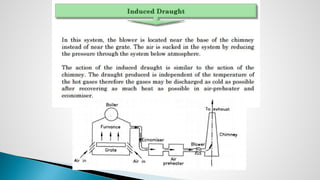
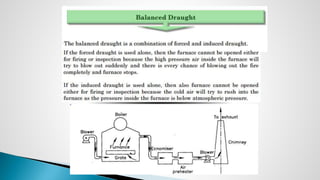
 Draught Systems
 Feed system
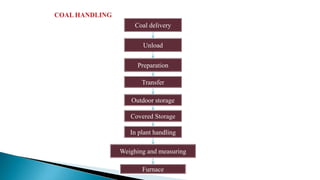
Coal delivery
Unload
Preparation
Transfer
Outdoor storage
Covered Storage
In plant handling
Weighing and measuring
Furnace
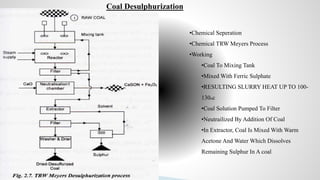
Coal Desulphurization
•Chemical Seperation
•Chemical TRW Meyers Process
•Working
•Coal To Mixing Tank
•Mixed With Ferric Sulphate
•RESULTING SLURRY HEAT UP TO 100-
130oc
•Coal Solution Pumped To Filter
•Neutrailized By Addition Of Coal
•In Extractor, Coal Is Mixed With Warm
Acetone And Water Which Dissolves
Remaining Sulphur In A coal
 1. Outplant handling of coal
◦ Transportation by sea or river
◦ By ropes
◦ By rail
◦ By road
◦ By pipeline
 2. Inplant handling of coal
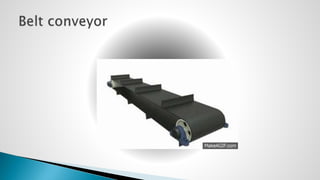
◦ Belt conveyor
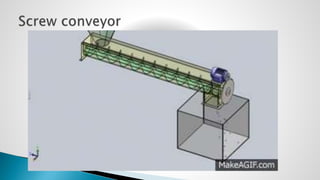
◦ Screw conveyors
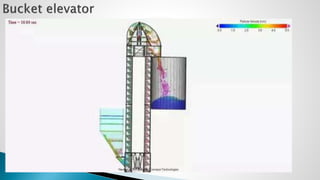
◦ Bucket elevators
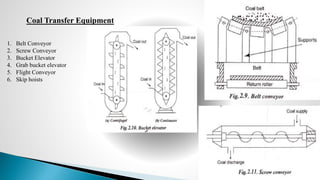
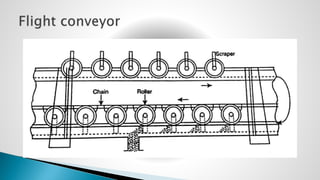
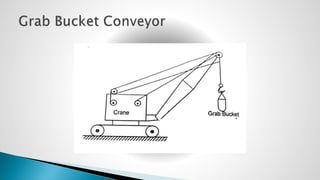
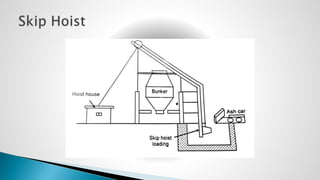
Coal Transfer Equipment
1. Belt Conveyor
2. Screw Conveyor
3. Bucket Elevator
4. Grab bucket elevator
5. Flight Conveyor
6. Skip hoists
 Fuel bed Furnaces (Coarse Particles)
 Fluidized bed furnaces (Crushed small Perticles)
 Cyclone Furnaces (Crushed particles)
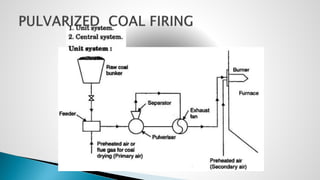
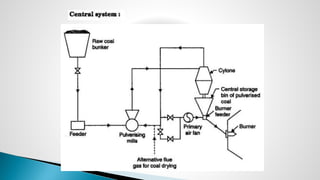
 Pulverized coal furnaces (Fine Particles)
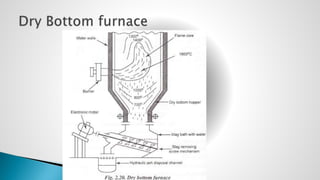
◦ Dry bottom furnance
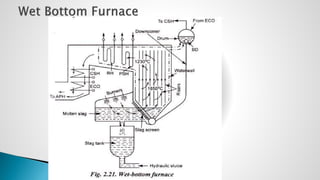
◦ Wet bottom furnance
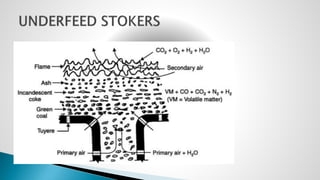
 Stokers are used to feed the solid fuels into the furnace in
power plants
 According to feed system, the stokers are classified into
types.
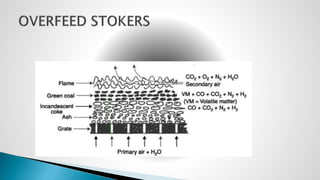
 Overfeed stokers
 Underfeed stokers
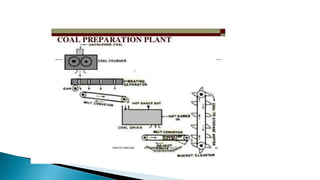
 Pulveriser mill is used to pulverize the coal for combustion in
the steam generating furnaces .
 Pulverized coal increase its surface exposure and complete
combustion.
Benefits:
 Combustion rate is increased
 Thermal efficiency is increased
 Fuel feed rate is increased
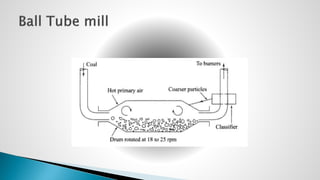
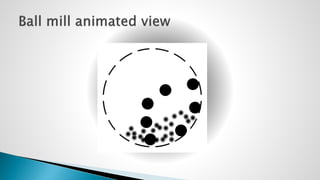
 Ball mill
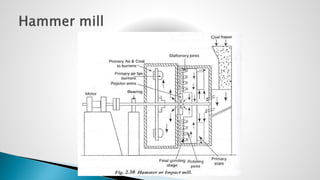
 Hammer mill
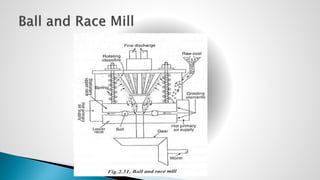
 Ball and race mill
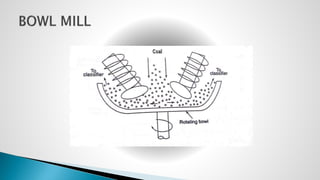
 Bowl mill
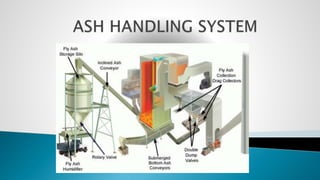
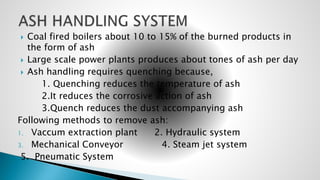
 Coal fired boilers about 10 to 15% of the burned products in
the form of ash
 Large scale power plants produces about tones of ash per day
 Ash handling requires quenching because,
1. Quenching reduces the temperature of ash
2.It reduces the corrosive action of ash
3.Quench reduces the dust accompanying ash
Following methods to remove ash:
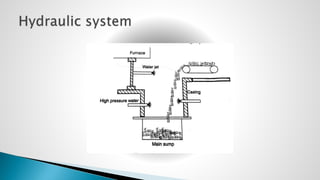
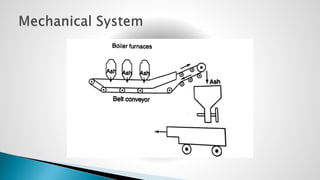
1. Vaccum extraction plant 2. Hydraulic system
3. Mechanical Conveyor 4. Steam jet system
5. Pneumatic System
 In a steam jet system, the ash is carried by high velocity
steam which carrying dry solid materials.
 In pneumatic system ash is carried by high velocity air or
stream to the point of delivery.
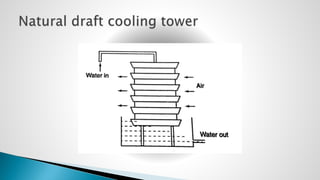
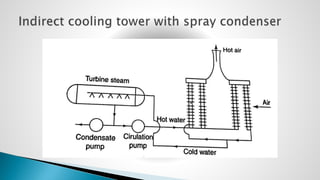
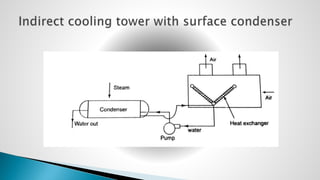
 The warm water discharged from the condenser is fed into the
cooling tower and the cooled water is fed back to the
condenser
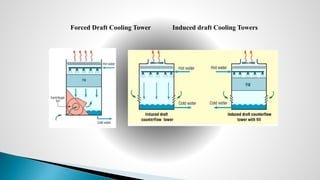
Forced Draft Cooling Tower Induced draft Cooling Towers
Dry cooling tower
1.Direct type
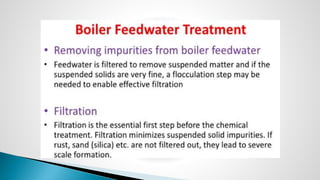
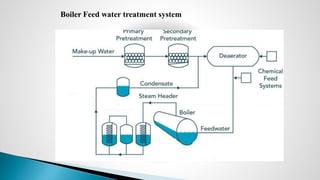
FEED WATER TREATMENT
Boiler Feed water treatment system
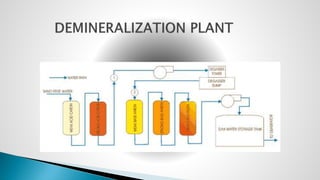
 The function of the demineralization plant is to remove the
dissolved salt by ion exchange method i.e. chemical method.
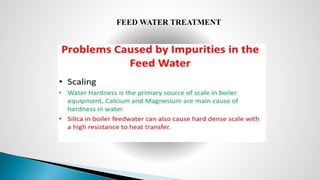
 Generally hard water contains sodium,chloride, carbonates,
bi-carbonates, silicates and potassium, iron, Calcium and
Magnesium.
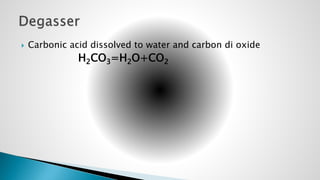
 Carbonic acid dissolved to water and carbon di oxide
H2CO3=H2O+CO2
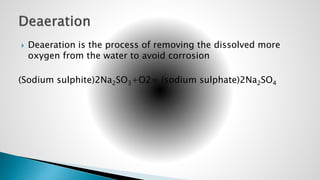
 Deaeration is the process of removing the dissolved more
oxygen from the water to avoid corrosion
(Sodium sulphite)2Na2SO3+O2= (sodium sulphate)2Na2SO4
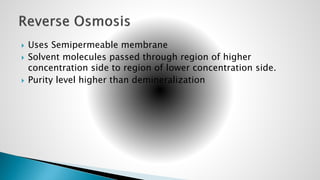
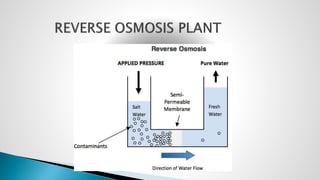
 Uses Semipermeable membrane
 Solvent molecules passed through region of higher
concentration side to region of lower concentration side.
 Purity level higher than demineralization
COAL BASED THERMAL POWER PLANTS (UNIT-1).pptx

COAL BASED THERMAL POWER PLANTS (UNIT-1).pptx

  • 3.
     Steam powerplants converts the energy stored in the fossil fuels in the form of heat energy  In thermal power plants, the input energy is produced by burning the coal
  • 4.
     1. CONVENTIONAL ◦Fossil fuel energy ◦ Hydraulic energy ◦ Nuclear energy  2.NON CONVENTIONAL ENERGY SOURCES ◦ Solar energy ◦ Wind energy ◦ Tidal energy ◦ Wave energy ◦ Geo thermal energy ◦ Biomass energy
  • 6.
     Coal andAsh circuit  Air and Flue gas circuit  Water and Steam circuit  Cooling water circuit
  • 7.
     Coal andAsh circuit: ◦ Coal to boiler transfer ◦ Ash resulting during combustion of coal from boiler removed and its stored in ash storage device in ash handling ◦ Power plant of 100MW produces normally 20 to 25 tons of ash per hour.
  • 9.
     Air istaken from atmosphere and send through an air preheater.  Dust is removed from the air through series of filters  The waste heat of flue gas passed to the chimney for preheating the air in the preheater  Afetr the combustion process the sufficient quantity of flue gas is passed around the boiler tubes for preheat the water and air
  • 11.
     It consistsof boiler feed pump, boiler, turbine and feed water pump  The steam generated in the boiler passes through superheater and supplied to steam turbine  Out Water sent through condenser  Then the feed water passes through economizer for boiler  Feed water supplied external source to compensate losses
  • 13.
     It consistsof condenser , cooling water pump and cooling tower  The warm water coming out from the condenser is cooled in the cooling tower and recirculate within the plant
  • 15.
     Initial investmentis low  The power plant can be located near load centre, so the transmission cost and losses are considerably reduced  The power production does not depend on the nature mercy
  • 16.
     Air pollutionis the major problem inviting additional investment  It cannot be used as a peak load plant  The coal may be exhausted by gradual use  Power production cost is considerably high compared to hydel plant  Life efficiency is low as compared to hydel plant
  • 17.
     Theoretical cyclewhich works on steam turbine works.  Ideal cycle for vapour power cycles.  The diagram shows the rankine cycle  Process 1-2 (Turbine)  Process 2-3 (condenser)  Process 3-4 (pump  Process 4-1 (Boiler)
  • 19.
     Reheat rankinecycle  Regeneration  Combined reheating and regeneration
  • 20.
     Efficiency canbe increased by increasing the pressure and temperature of steam entering in to the turbine.  Steam is initially expanded in high pressure steam  Reheat the steam with the help of fluegas  Then steam is expanded in to low pressure turbine.
  • 22.
     In rankinecycle in condensate which is coming out has very low temperature and it mixes with hot water in boiler.  It results it decrease in cycle efficiency  Increase the temperature of the feed water is raised to the saturation temperature before entering to the boiler.
  • 23.
  • 24.
    1. Reheating • Fluegas reheating ( flue gas coming out from boiler to reheat the steam) • Live stream reheating (high-pressure steam from the boiler is used to reheat the steam coming out from H.P Turbine designed for design heat exchanger) • Combined flue gas and live stream reheating : ( first pass through live stream heater and gas heater) 2. Regeneration • Ideal : • Single Stage : • Two Stage :
  • 31.
     Boiler isa closed vessel in which the steam is generated from water by applying heat.  Boiler is also known as steam generator 1.ACCORDING TO THE FLOW AND HOT GAS:  Fire tube boiler ◦ Hot gas is passed through the tubes and the water circulated around the tubes ◦ Eg:- Cochran Boiler, Locomotive Boiler  Water tube boiler ◦ Water circulated through a number of tubes and hot gas pass around the tubes ◦ Stirling boiler and Wilcox boiler
  • 32.
     2. Accordingto the axis of shell: ◦ Vertical boilers ◦ Horizontal boilers ◦ Inclined boilers  3.According to location or position of the furnace ◦ Internally fired boilers ◦ Externally and externally fired boilers  4. according to the method of water circulation ◦ Natural circulation boilers ◦ Forced circulation boilers  5. According to the application or boiler mobility ◦ Stationary boilers ◦ Mobile boilers  6. According to steam pressure ◦ Low pressure , medium pressure, high pressure, supercritical boilers
  • 33.
     7. Accordingto number of tubes used: ◦ Single tube used ◦ Multi tube boilers  8.According to draft ◦ Natural draft boilers ◦ Artificial draft boilers  9. according to types of fuel used ◦ Solid fuel boilers ◦ Liquid or gaseous fuel boilers ◦ Electrical heated and nuclear energy boilers
  • 34.
    High Pressure Boilers 1.La- Mont Boiler
  • 35.
     Forced circulation Steam circulation maintained by centrifugal pump.
  • 36.
  • 37.
  • 38.
     Lamont boilerproblem: Salt deposition and sedimentation in water tubes  So, forced circulation is used Working:  ecomomiser to evaporating drum  Saturation steam from drum  Steam passed through convection and radiant superheaters  1/3rd steam passed from convection and radiant superheaters  Remaining 2/3rd passd through the water in evaporating drum to evaporate feed water
  • 39.
  • 40.
     Boiler makesuse of pressurized combustion  Boiler pressure generate : 84 kg / cm2 Working  Feed water from Economizer to tube evaporating section  Gasturbine increases atm pr to furnace pressure.  Steam separation from evaperator and flows to super heater to turbine
  • 41.
     Super criticalboiler is a type of boiler which is operated at super critical pressure.  Working range of steam generating plants from 125 atm and 510°C to 300 atm and 660°C . Power plants operated above the critical pressure and temperature condition is called super critical powerplant Two type of super critical boilers are  Drum Type boiler (  Once through boiler
  • 44.
     Pressure gauge Stop valve  Feed check valve  Safety valve  Fusible valve  Blow off valve  Water level indicator  Man holes
  • 45.
     Economiser  Steamsuper heater  Airpreheater  Deaerators ( removal of air and other gases in feed water)  Steam seperator
  • 46.
     The fuelare fed on a distribution plate ,due to high velocity of air the feed material remains in suspended condition during burning  The bed temperature is about 800-900 C  So2 emission and Nox emissions are greatly reduced with the use of limestone/dolamite  Steam can be produced by fossils and waste fules using these technique  TYPES OF FBC: ◦ Circulating fluidized bed boiler ◦ Bubbling fluidized bed boiler
  • 49.
     Coal crushed(6-20 mm )  Air fan flow upwards  Chamber having large number of carbon particles  H2SO4 acid less formation by bed material limestone  Combustion 800-900degree C less Nox  Heat release 10-15 times than conventional boiler
  • 51.
     Coal inlower section , limestone also  Air distributors (primary and secondary)  800-900 degree C  Unburned particles colleceted in cyclone seperator again feed to furnace
  • 52.
    WORKING OF STEAMTURBINE THERMAL ENERGY KINETIC ENERGY MECHANICAL ENERGY STEAM TURBINE Nozzle Moving Blades
  • 53.
  • 54.
  • 56.
     Absorbing thejet velocity in more than one stage when steam flows over moving blades  Velocity compounding  Pressure compounding  Pressure – Velocity compounding
  • 60.
     The methodof maintaining the speed of the turbine constant irrespective on the basis of variation of load is known as governing of turbines
  • 64.
    Steam rate: Capacity ofthe steam plant expressed in terms of steam rate or specific fuel consumptions SSC=Mass of steam / Work output unit kg/kWh Heat rate: It indicates the amount of fuel required to generate one unit of electricity Heat rate= Heat supplied/Work output kJ/kWh
  • 65.
     Fuel handlingsystem  Ash Handling system  Cooling Towers  Draught Systems  Feed system
  • 66.
    Coal delivery Unload Preparation Transfer Outdoor storage CoveredStorage In plant handling Weighing and measuring Furnace
  • 70.
    Coal Desulphurization •Chemical Seperation •ChemicalTRW Meyers Process •Working •Coal To Mixing Tank •Mixed With Ferric Sulphate •RESULTING SLURRY HEAT UP TO 100- 130oc •Coal Solution Pumped To Filter •Neutrailized By Addition Of Coal •In Extractor, Coal Is Mixed With Warm Acetone And Water Which Dissolves Remaining Sulphur In A coal
  • 72.
     1. Outplanthandling of coal ◦ Transportation by sea or river ◦ By ropes ◦ By rail ◦ By road ◦ By pipeline  2. Inplant handling of coal ◦ Belt conveyor ◦ Screw conveyors ◦ Bucket elevators
  • 73.
    Coal Transfer Equipment 1.Belt Conveyor 2. Screw Conveyor 3. Bucket Elevator 4. Grab bucket elevator 5. Flight Conveyor 6. Skip hoists
  • 80.
     Fuel bedFurnaces (Coarse Particles)  Fluidized bed furnaces (Crushed small Perticles)  Cyclone Furnaces (Crushed particles)  Pulverized coal furnaces (Fine Particles) ◦ Dry bottom furnance ◦ Wet bottom furnance
  • 83.
     Stokers areused to feed the solid fuels into the furnace in power plants  According to feed system, the stokers are classified into types.  Overfeed stokers  Underfeed stokers
  • 86.
     Pulveriser millis used to pulverize the coal for combustion in the steam generating furnaces .  Pulverized coal increase its surface exposure and complete combustion. Benefits:  Combustion rate is increased  Thermal efficiency is increased  Fuel feed rate is increased
  • 87.
     Ball mill Hammer mill  Ball and race mill  Bowl mill
  • 101.
     Coal firedboilers about 10 to 15% of the burned products in the form of ash  Large scale power plants produces about tones of ash per day  Ash handling requires quenching because, 1. Quenching reduces the temperature of ash 2.It reduces the corrosive action of ash 3.Quench reduces the dust accompanying ash Following methods to remove ash: 1. Vaccum extraction plant 2. Hydraulic system 3. Mechanical Conveyor 4. Steam jet system 5. Pneumatic System
  • 104.
     In asteam jet system, the ash is carried by high velocity steam which carrying dry solid materials.  In pneumatic system ash is carried by high velocity air or stream to the point of delivery.
  • 106.
     The warmwater discharged from the condenser is fed into the cooling tower and the cooled water is fed back to the condenser
  • 108.
    Forced Draft CoolingTower Induced draft Cooling Towers
  • 109.
  • 112.
  • 114.
    Boiler Feed watertreatment system
  • 115.
     The functionof the demineralization plant is to remove the dissolved salt by ion exchange method i.e. chemical method.  Generally hard water contains sodium,chloride, carbonates, bi-carbonates, silicates and potassium, iron, Calcium and Magnesium.
  • 117.
     Carbonic aciddissolved to water and carbon di oxide H2CO3=H2O+CO2
  • 118.
     Deaeration isthe process of removing the dissolved more oxygen from the water to avoid corrosion (Sodium sulphite)2Na2SO3+O2= (sodium sulphate)2Na2SO4
  • 119.
     Uses Semipermeablemembrane  Solvent molecules passed through region of higher concentration side to region of lower concentration side.  Purity level higher than demineralization