30 June 2013 1
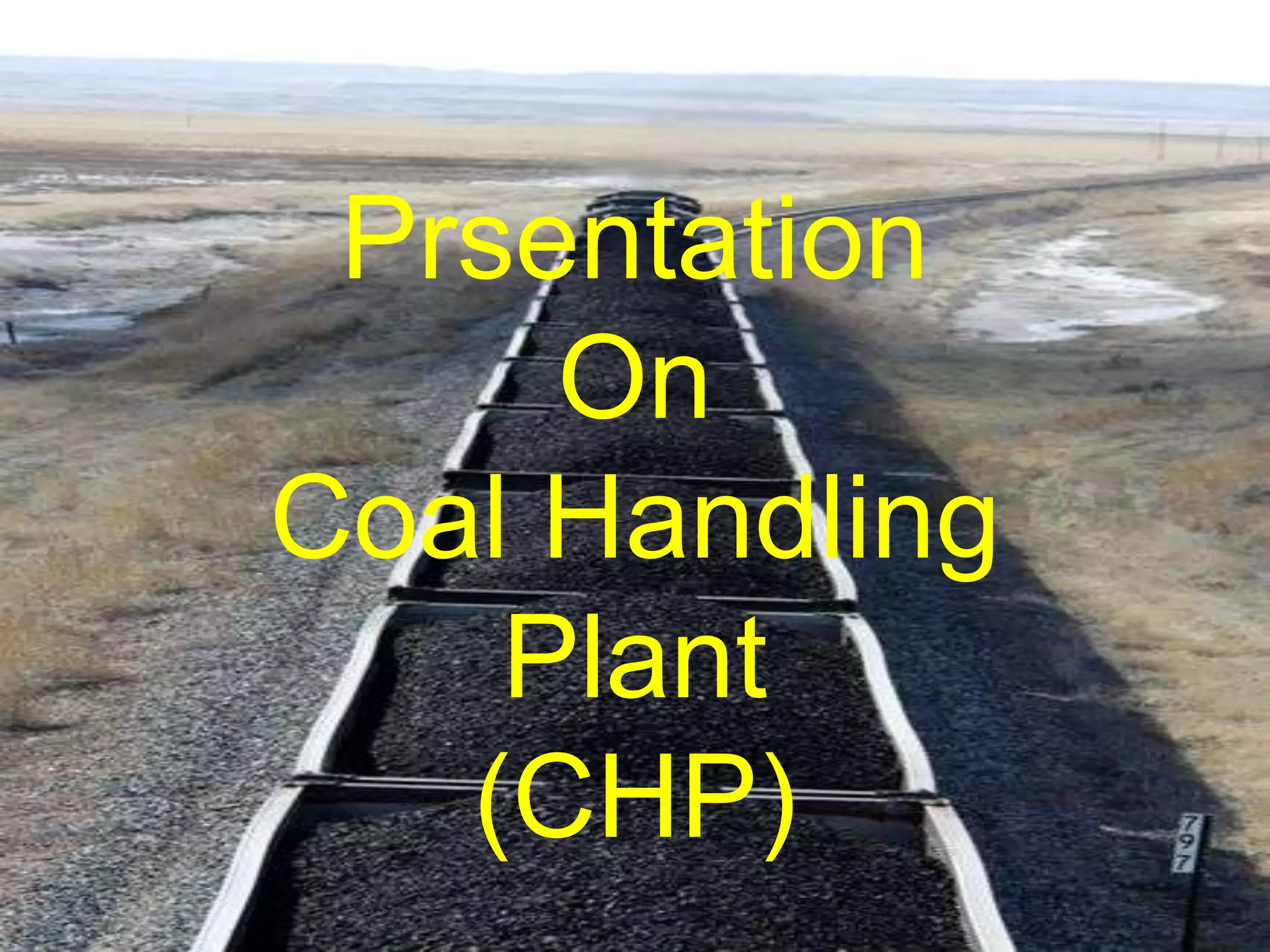
Prsentation
On
Coal Handling
Plant
(CHP)
Presented by:-
 Ronak Thakre
30 June 2013 2
Contents:-
 Introduction..
 What is actually CHP ??
 Main Target Of CHP…
 General Layout Of CHP…
 Grading Of coal….
 Constituents Of Coal…
 Consumption Of Coal at KTPS & CSTPS…
 Section Of CHP…
 CHP auxillary & Equipments….
 Coal feeders…
 Coal crushers…
 Operating sequence of CHP…
 Problem faced in CHP….
30 June 2013 3
Introduction:-
• Objective of CHP is to supply the quanta of processed
coal to bunkers of Coal mills for Boiler operation and to
stack the coal to coal storage area.
• Coal is a hard black or dark brown sedimentary rock
formed by the decomposition of plant material, widely
used as a fuel.
• A piece of coal called Coal Lumps. Mostly E and F grade
coal used in India.
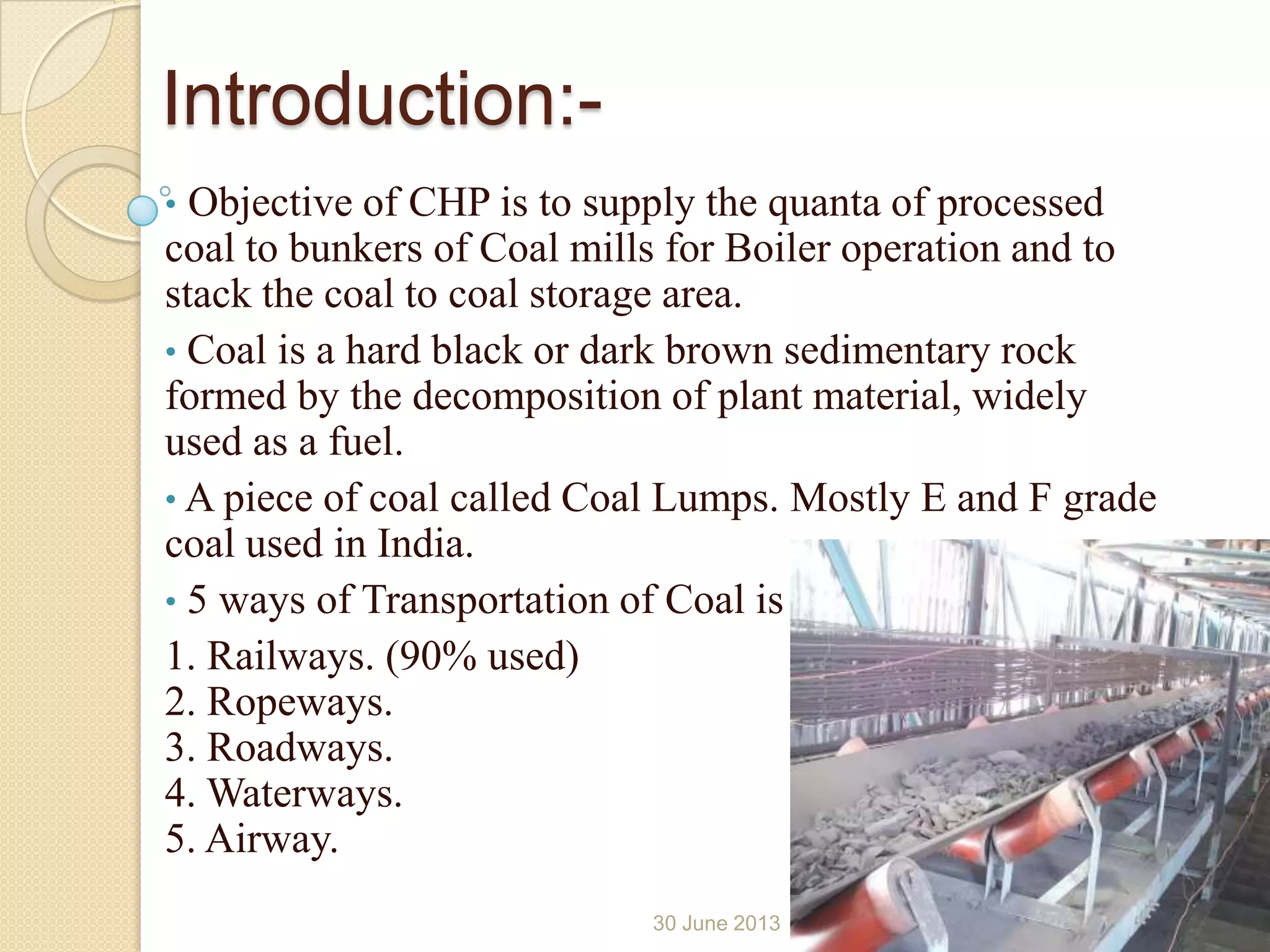
• 5 ways of Transportation of Coal is
1. Railways. (90% used)
2. Ropeways.
3. Roadways.
4. Waterways.
5. Airway.
30 June 2013 4
 The sizes of coal lumps is about to the
600mm.
 This coal is fed to single rotary crusher and
after that the size become 300mm.
 This coal is again fed to the double rotary
crusher and the size become 80mm.
 This coal is again fed to the crusher and the
size become less than 20 mm or 20mm.
 Then this coal is fed to the coal mill for
pulverization.
 Even when the bunker is full this coal is used
for stacking or storage of coal in coal storage
area.
30 June 2013 5
What is CHP??
 CHP is (C- Coal, H- Handling, P- Plant) a plant
which handles the coal from its receipt to
transporting it to Boiler and store in Bunkers. It also
processes the raw coal to make it suitable for Boiler
Opeartion.
 Extent of work: - In brief we can say that receipt of
coal from coal mines, weighing of coal, crushing it
to required size and transferring the quantity of coal
to various coal mill bunkers.
 This is the responsibility and duty of the CHP and
its staff.
30 June 2013 6
Main Target:-
 To Receive , Process , Store and Feed
coal.
 Bunkering of Coal.
 Unloading of Coal wagon.
 Stacking Of Coal.
30 June 2013 7
30 June 2013
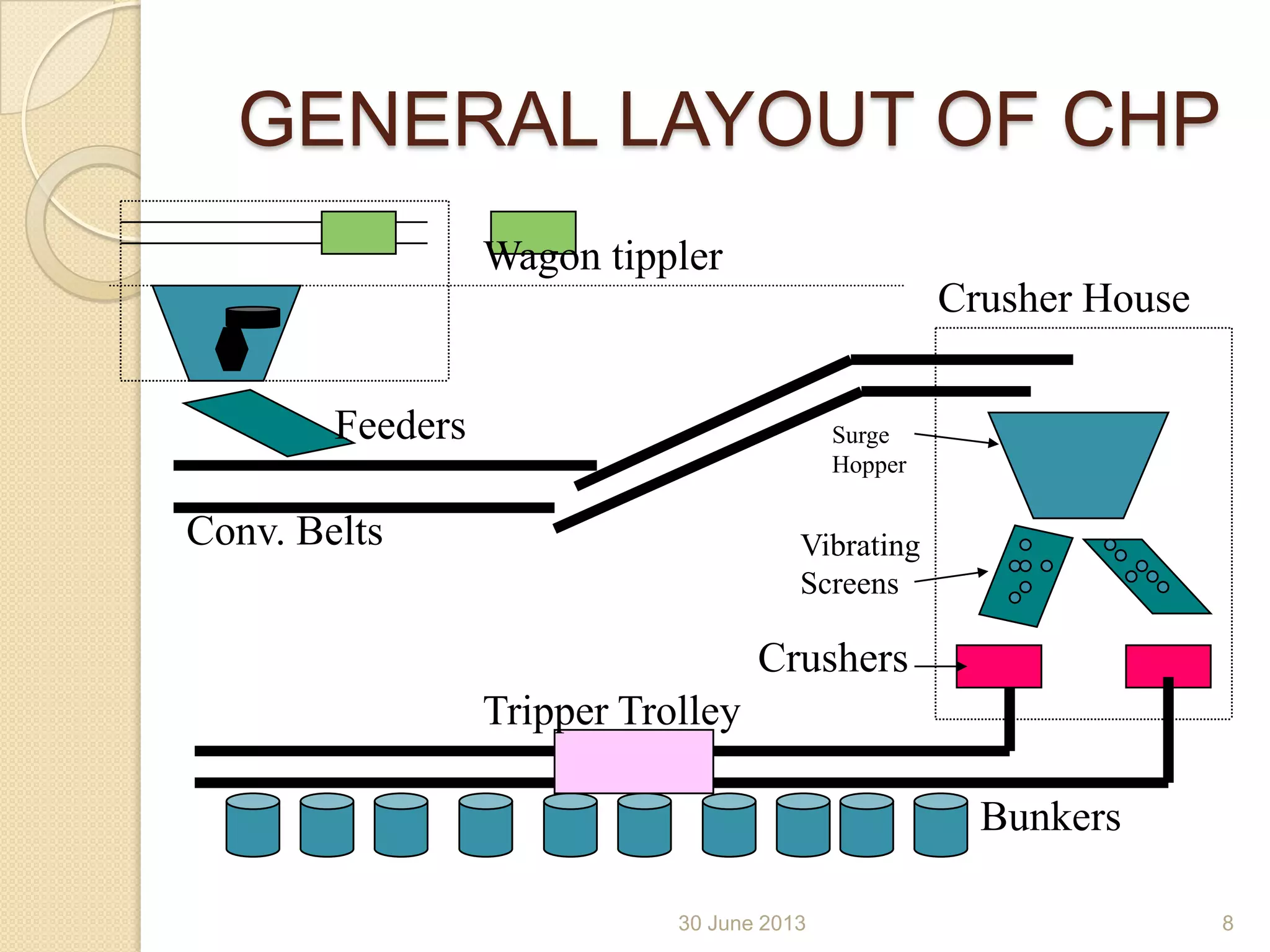
GENERAL LAYOUT OF CHP
Wagon tippler
Crusher House
Bunkers
Tripper Trolley
Conv. Belts Vibrating
Screens
Crushers
Feeders Surge
Hopper
8
30 June 2013
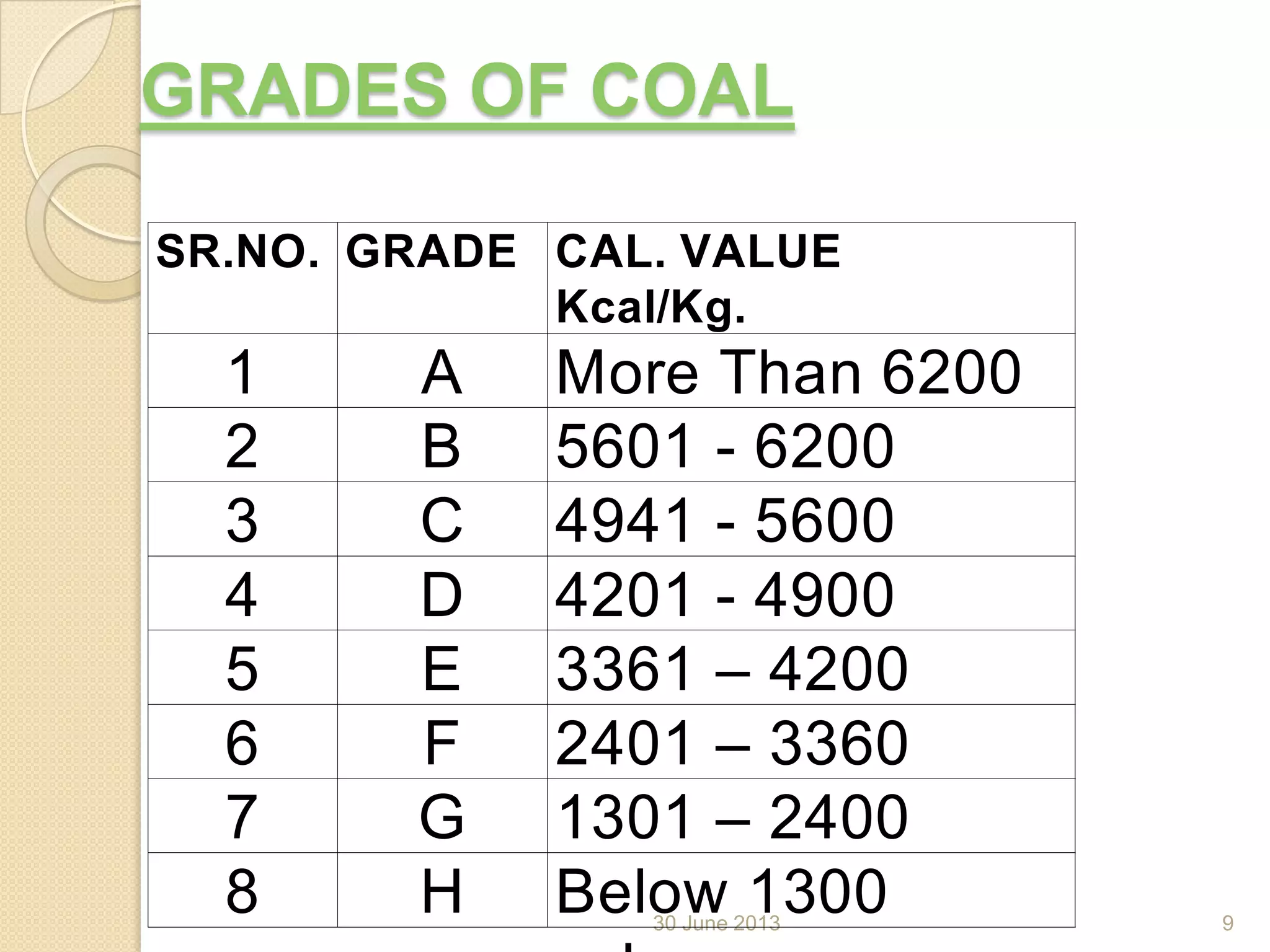
GRADES OF COAL
SR.NO. GRADE CAL. VALUE
Kcal/Kg.
1 A More Than 6200
2 B 5601 - 6200
3 C 4941 - 5600
4 D 4201 - 4900
5 E 3361 – 4200
6 F 2401 – 3360
7 G 1301 – 2400
8 H Below 1300 9
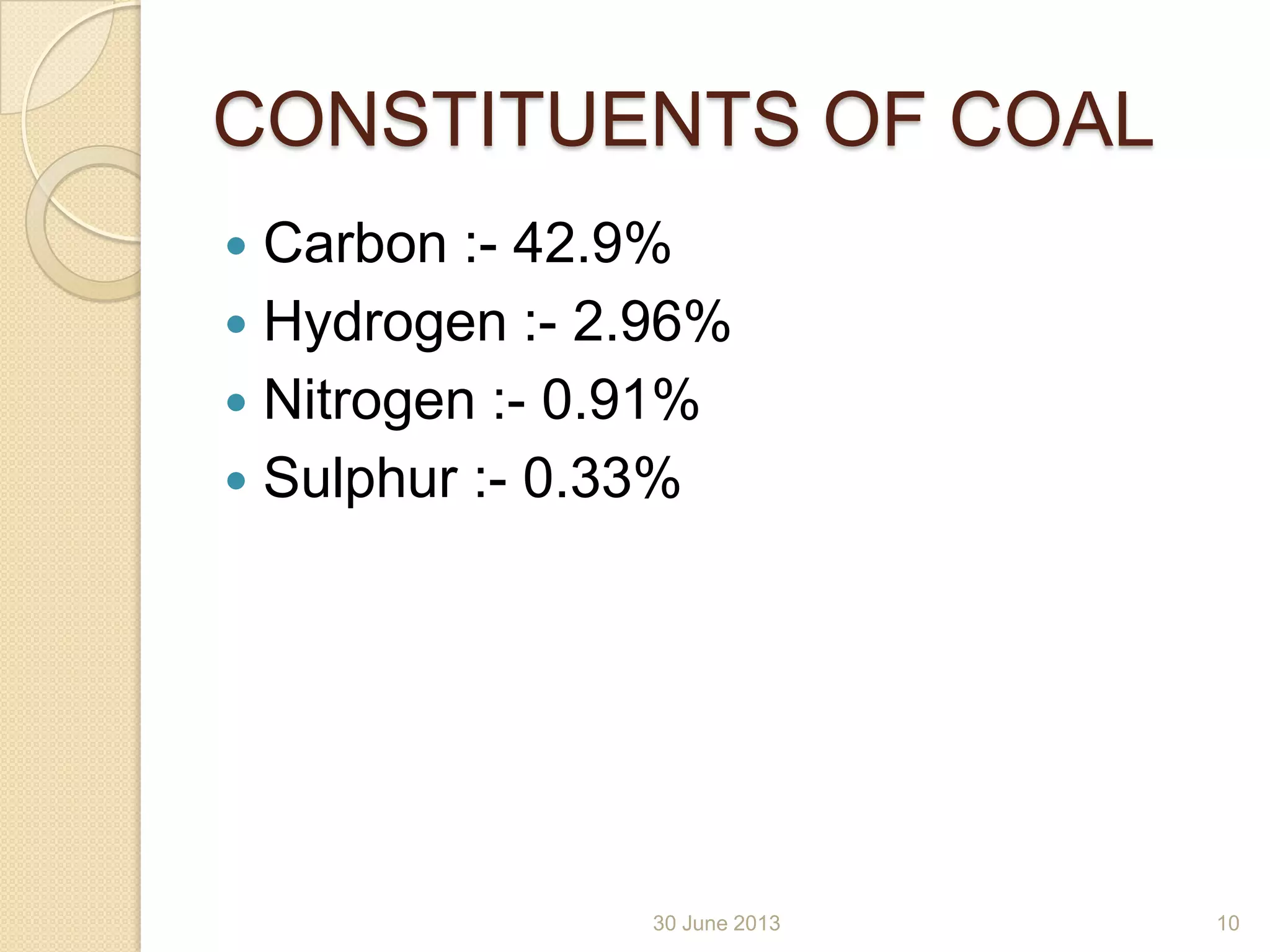
CONSTITUENTS OF COAL
 Carbon :- 42.9%
 Hydrogen :- 2.96%
 Nitrogen :- 0.91%
 Sulphur :- 0.33%
30 June 2013 10
30 June 2013
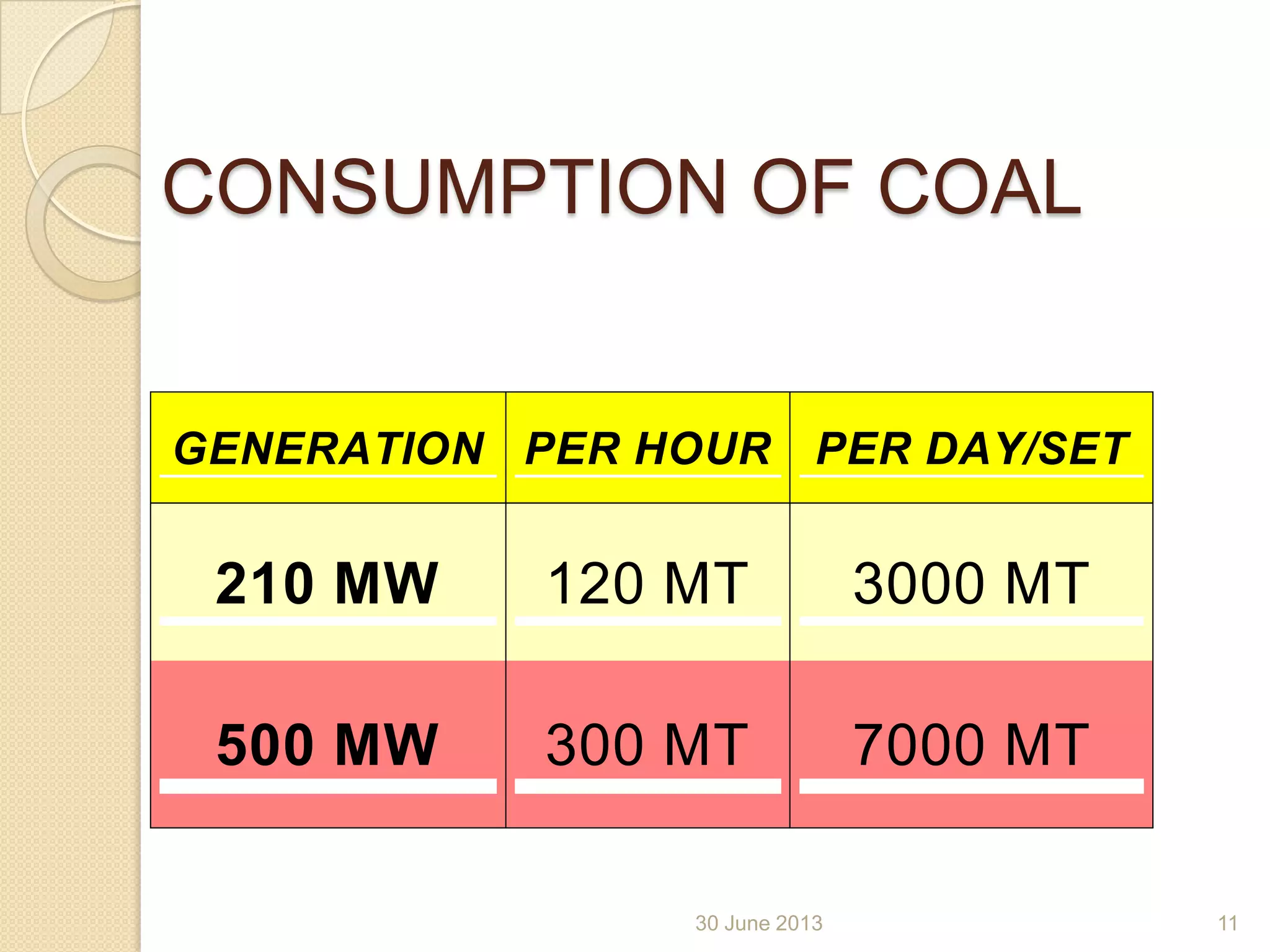
CONSUMPTION OF COAL
GENERATION PER HOUR PER DAY/SET
210 MW 120 MT 3000 MT
500 MW 300 MT 7000 MT
11
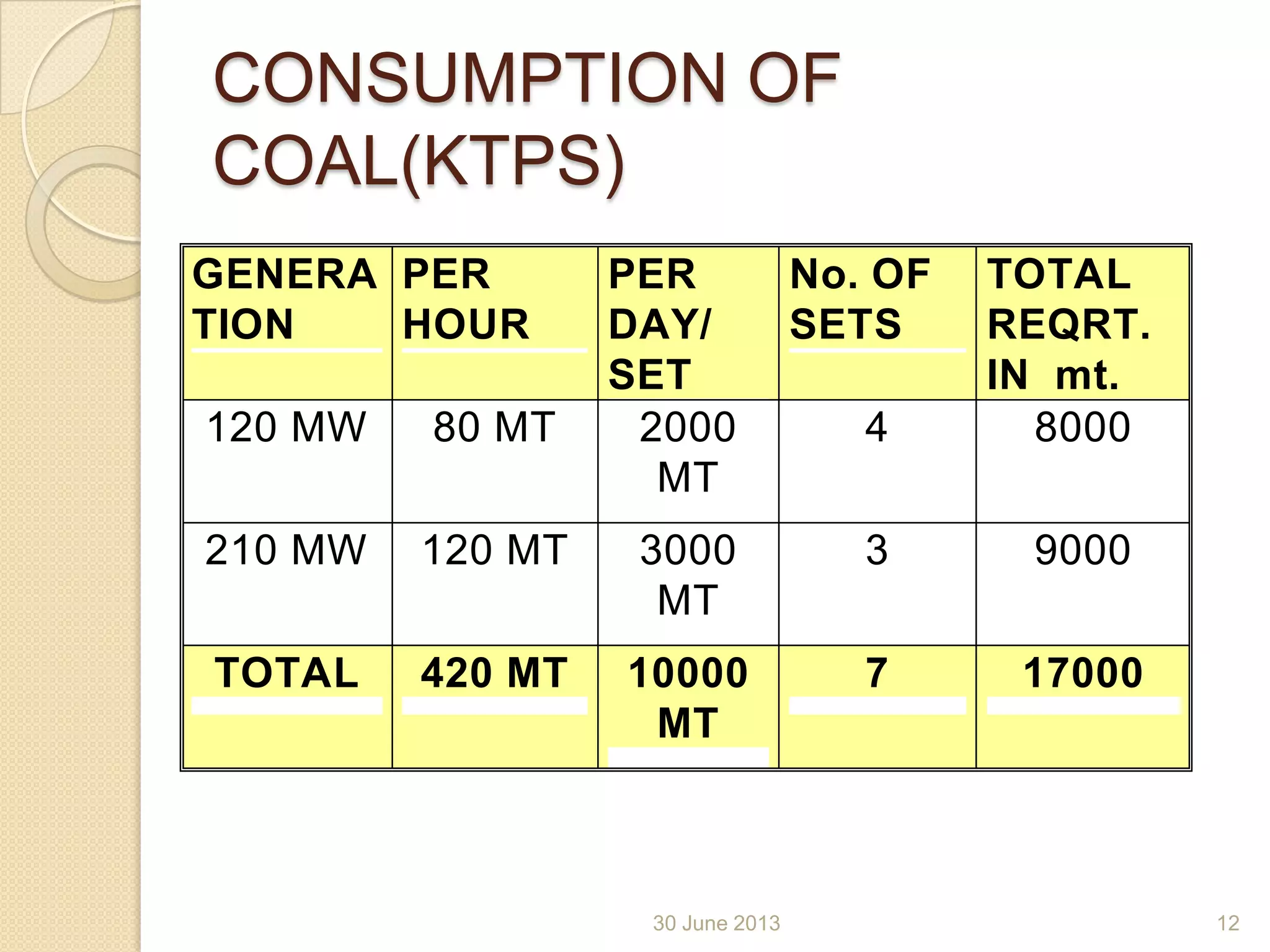
CONSUMPTION OF
COAL(KTPS)
GENERA
TION
PER
HOUR
PER
DAY/
SET
No. OF
SETS
TOTAL
REQRT.
IN mt.
120 MW 80 MT 2000
MT
4 8000
210 MW 120 MT 3000
MT
3 9000
TOTAL 420 MT 10000
MT
7 17000
30 June 2013 12
30 June 2013
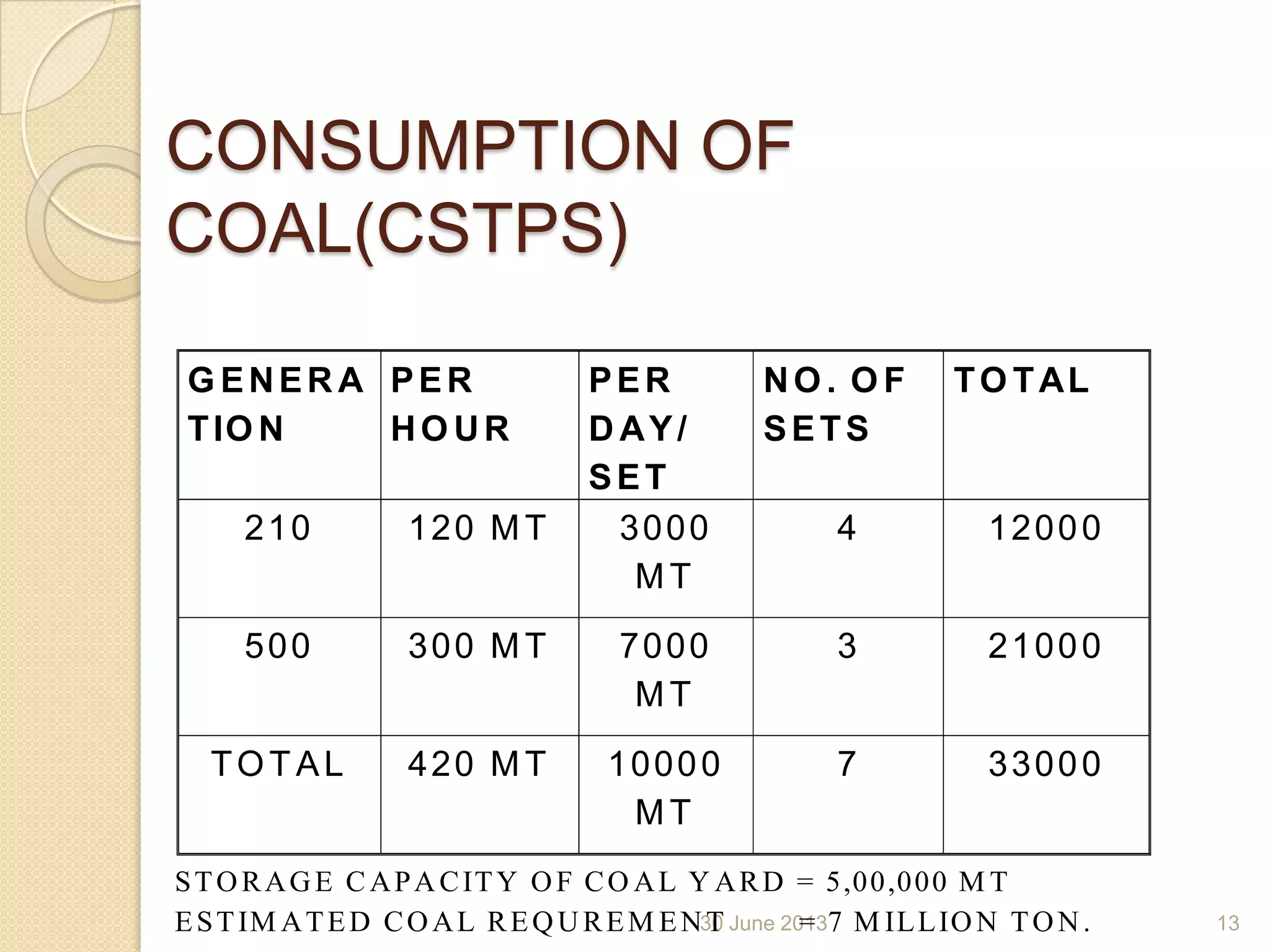
CONSUMPTION OF
COAL(CSTPS)
G ENER A
TIO N
PER
HO UR
PER
D AY/
SET
NO . O F
SETS
TO TAL
210 120 MT 3000
MT
4 12000
500 300 MT 7000
MT
3 21000
TOTAL 420 MT 10000
MT
7 33000
STORAGE CAPACITY OF CO AL Y ARD = 5,00,000 M T
ESTIM ATED COAL REQUREM ENT = 7 M ILLION TON. 13
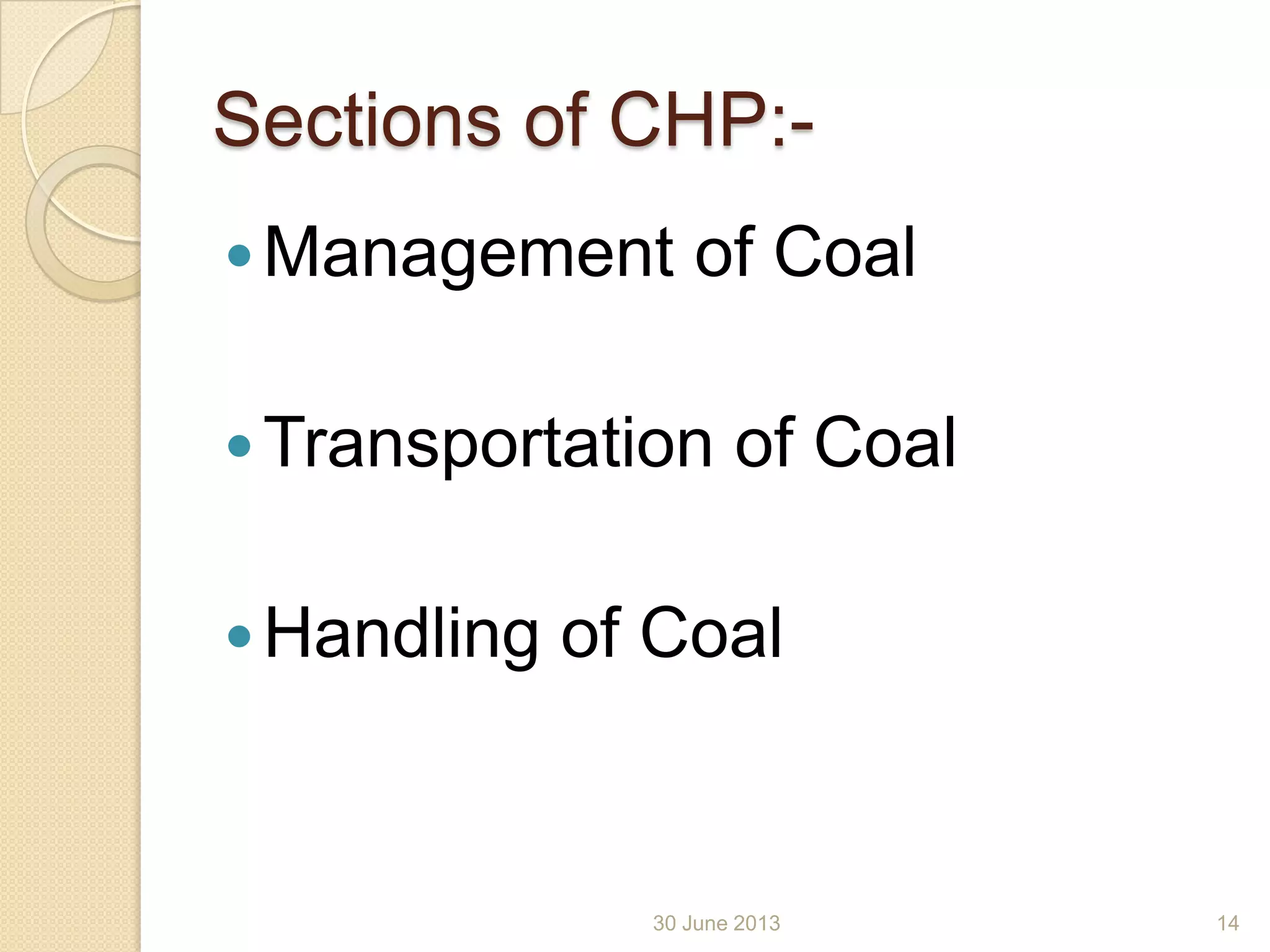
Sections of CHP:-
Management of Coal
Transportation of Coal
Handling of Coal
30 June 2013 14
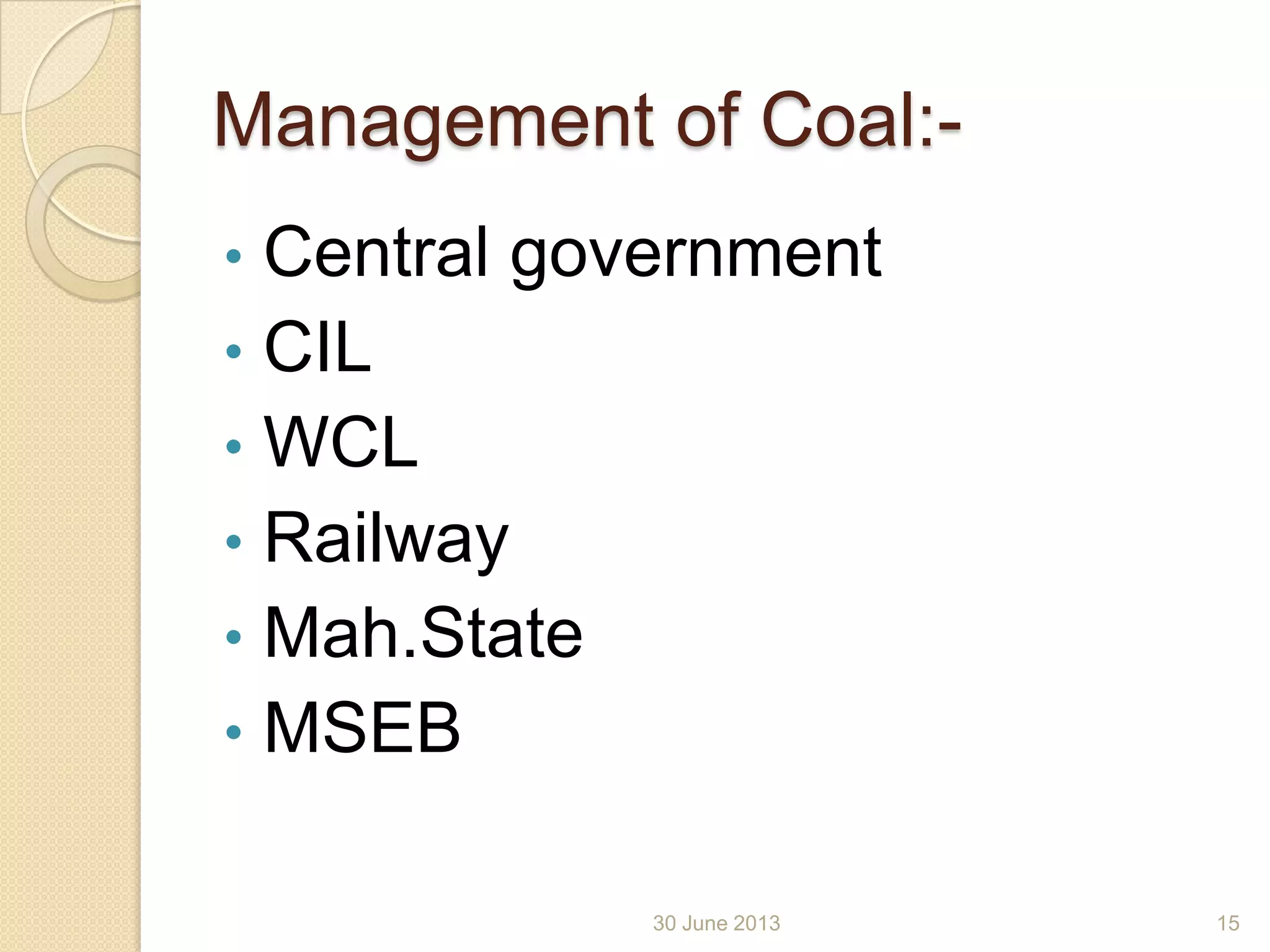
Management of Coal:-
• Central government
• CIL
• WCL
• Railway
• Mah.State
• MSEB
30 June 2013 15
30 June 2013
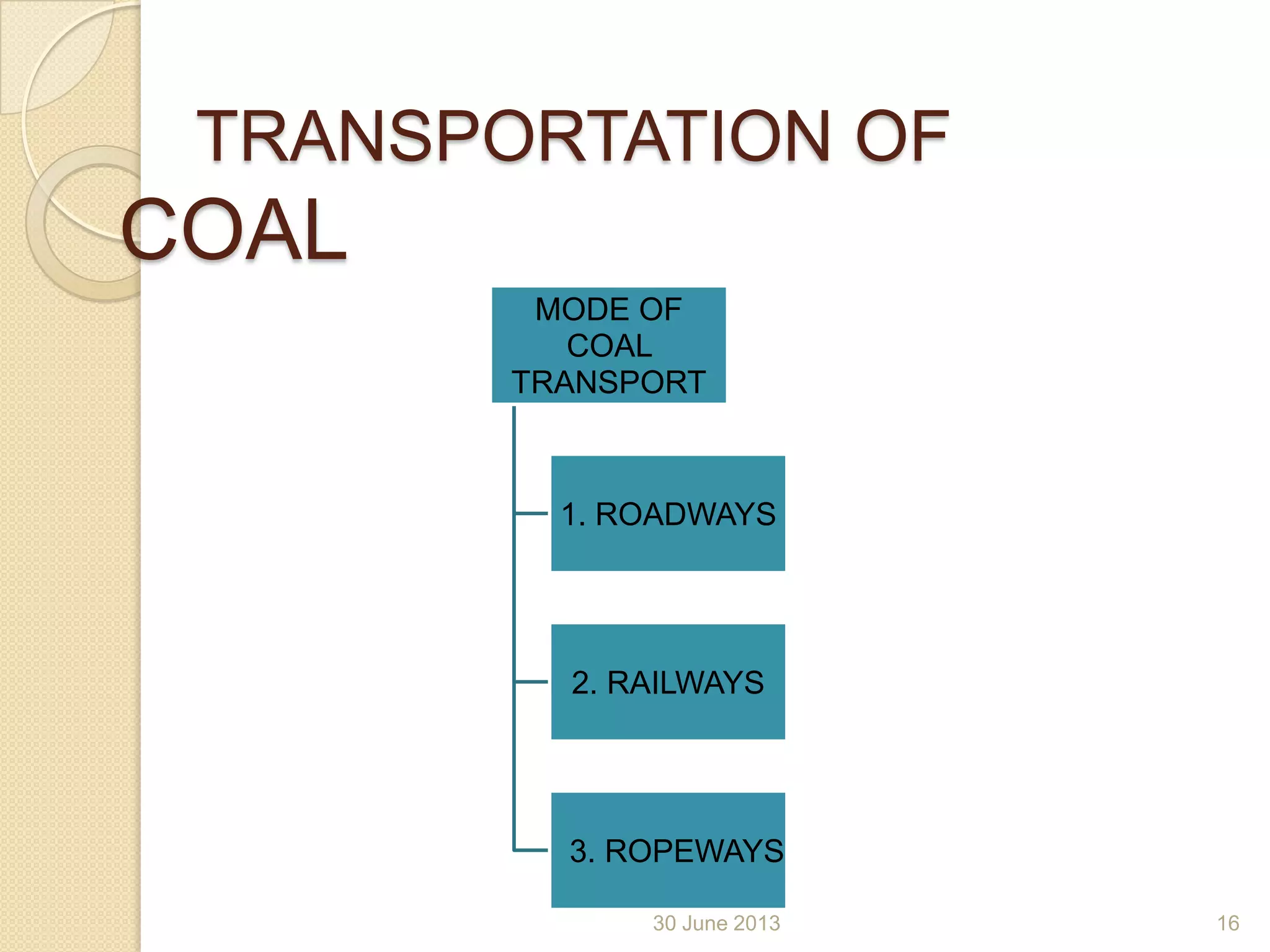
TRANSPORTATION OF
COAL
MODE OF
COAL
TRANSPORT
1. ROADWAYS
2. RAILWAYS
3. ROPEWAYS
16
30 June 2013
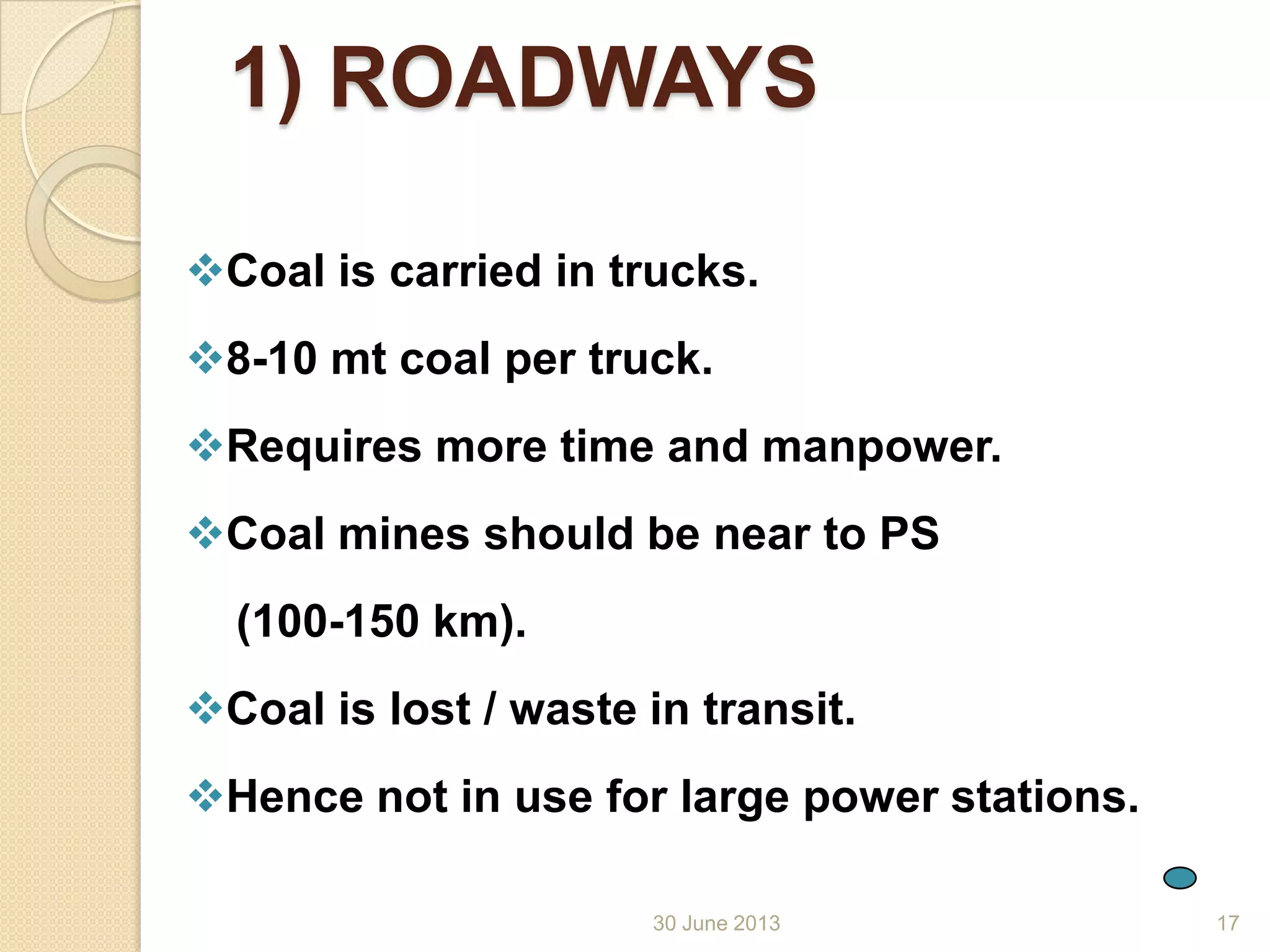
1) ROADWAYS
Coal is carried in trucks.
8-10 mt coal per truck.
Requires more time and manpower.
Coal mines should be near to PS
(100-150 km).
Coal is lost / waste in transit.
Hence not in use for large power stations.
17
30 June 2013
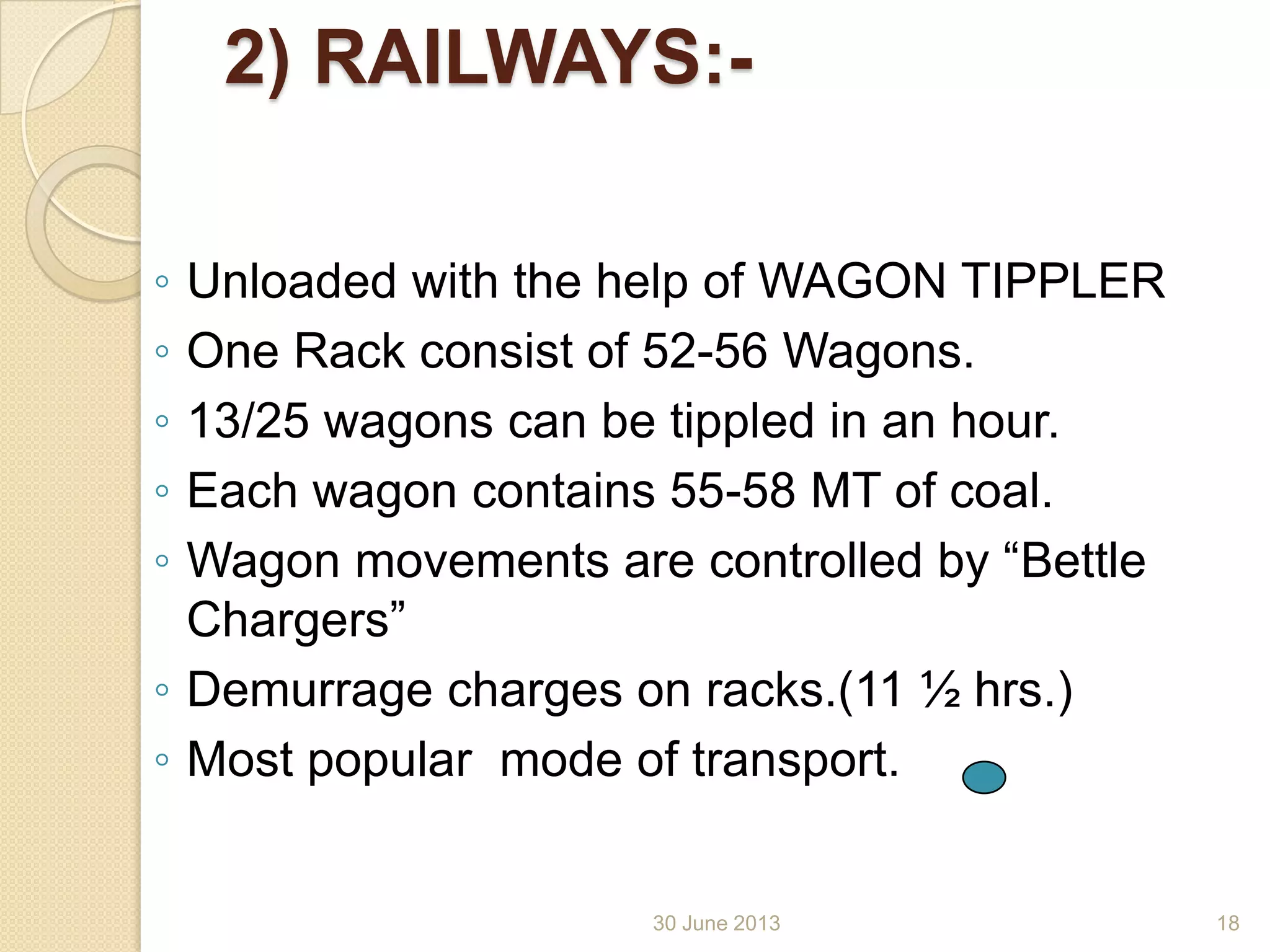
2) RAILWAYS:-
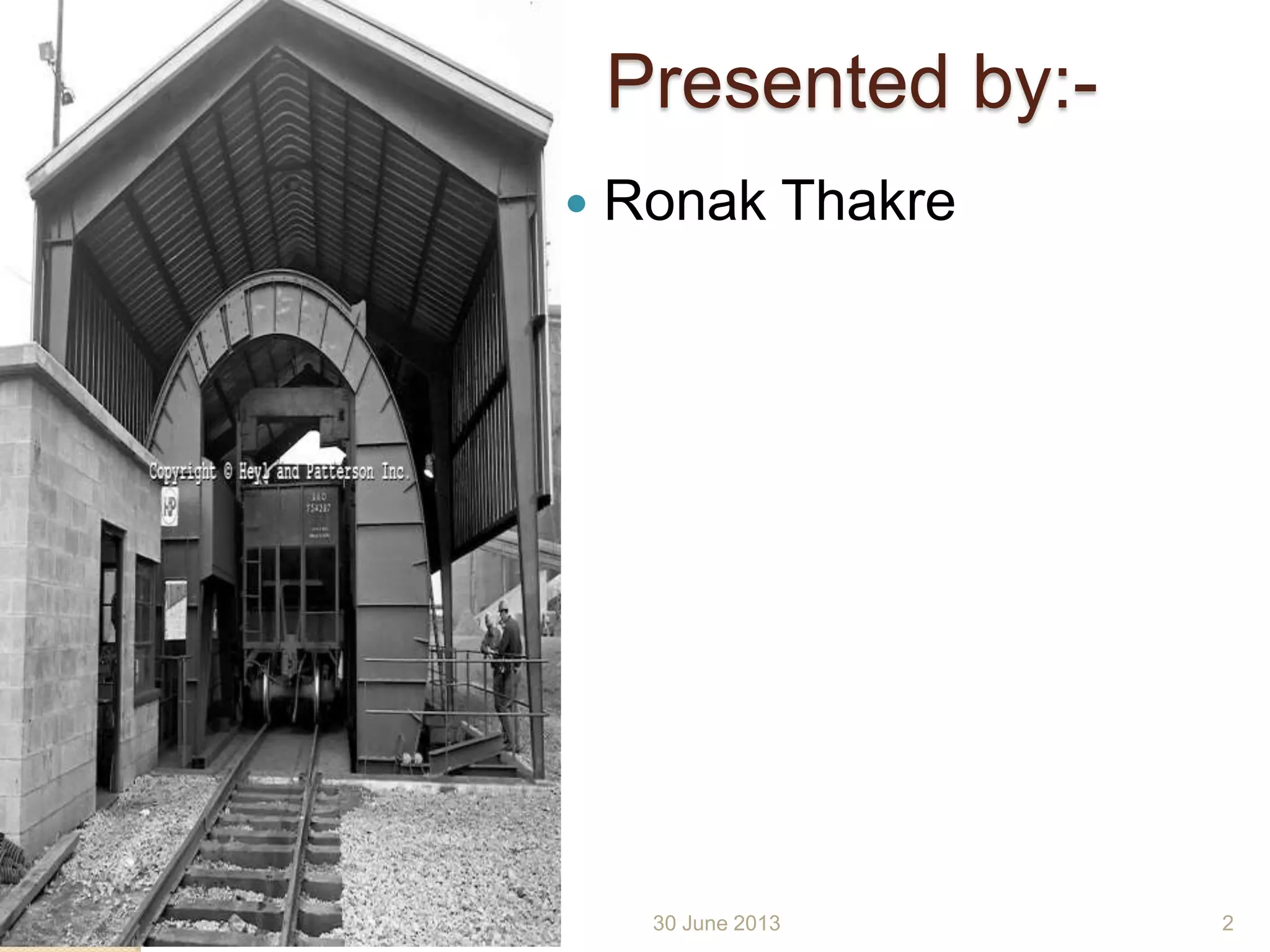
◦ Unloaded with the help of WAGON TIPPLER
◦ One Rack consist of 52-56 Wagons.
◦ 13/25 wagons can be tippled in an hour.
◦ Each wagon contains 55-58 MT of coal.
◦ Wagon movements are controlled by “Bettle
Chargers”
◦ Demurrage charges on racks.(11 ½ hrs.)
◦ Most popular mode of transport.
18
30 June 2013
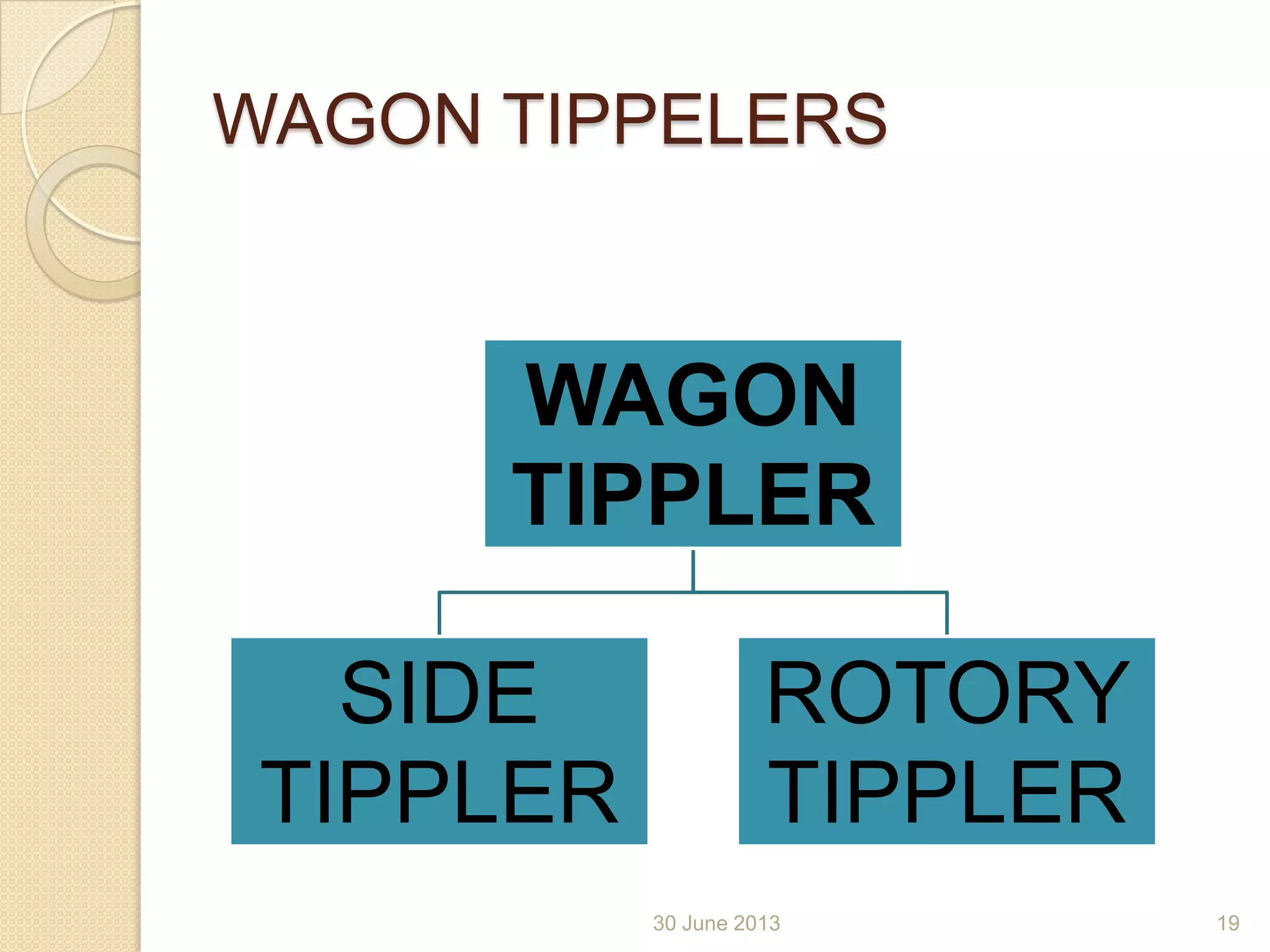
WAGON TIPPELERS
WAGON
TIPPLER
SIDE
TIPPLER
ROTORY
TIPPLER
19
30 June 2013
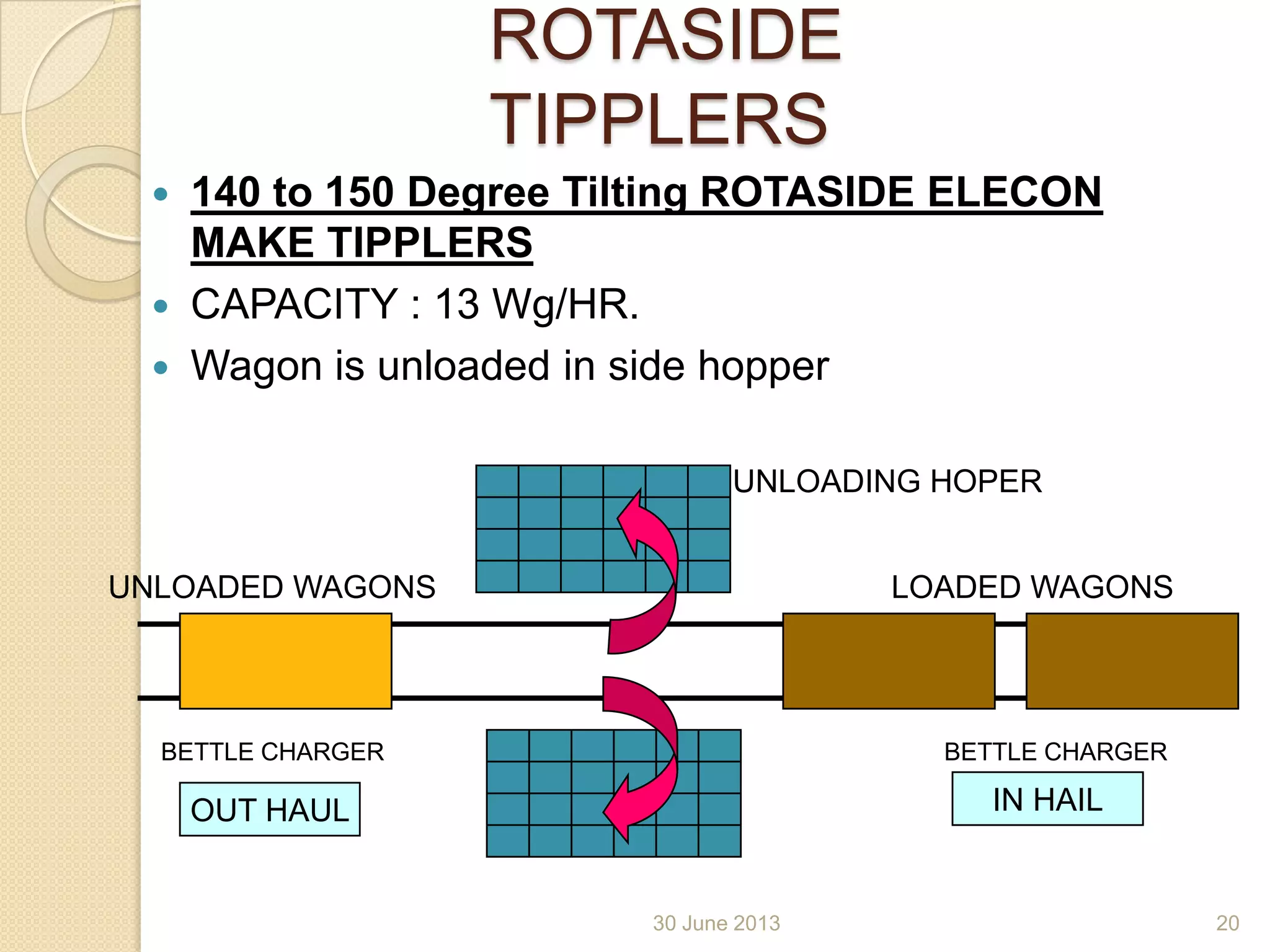
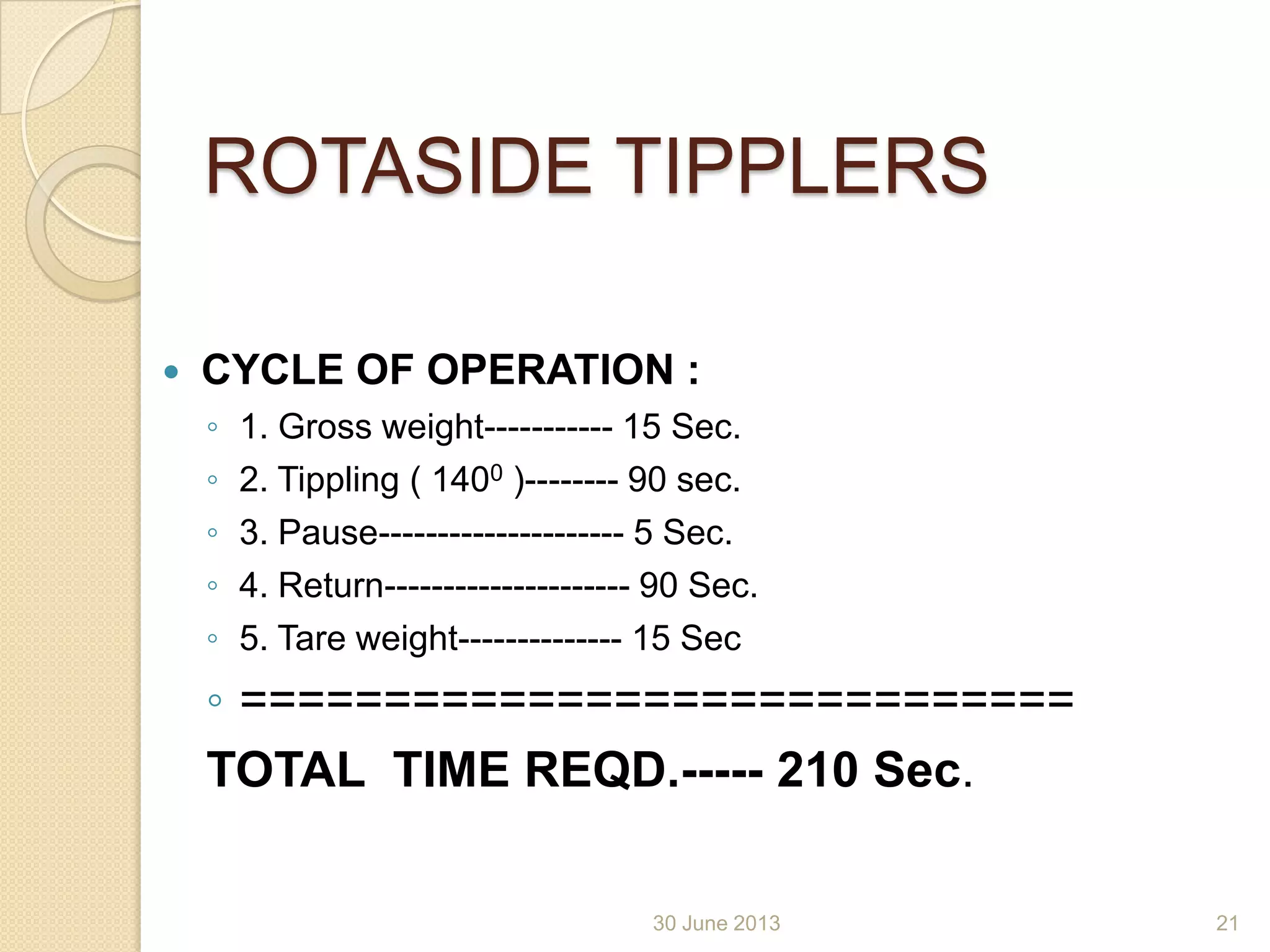
ROTASIDE
TIPPLERS
 140 to 150 Degree Tilting ROTASIDE ELECON
MAKE TIPPLERS
 CAPACITY : 13 Wg/HR.
 Wagon is unloaded in side hopper
IN HAILOUT HAUL
BETTLE CHARGERBETTLE CHARGER
LOADED WAGONSUNLOADED WAGONS
UNLOADING HOPER
20
ROTASIDE TIPPLERS
 CYCLE OF OPERATION :
◦ 1. Gross weight----------- 15 Sec.
◦ 2. Tippling ( 1400 )-------- 90 sec.
◦ 3. Pause--------------------- 5 Sec.
◦ 4. Return--------------------- 90 Sec.
◦ 5. Tare weight-------------- 15 Sec
◦ =============================
TOTAL TIME REQD.----- 210 Sec.
30 June 2013 21
30 June 2013
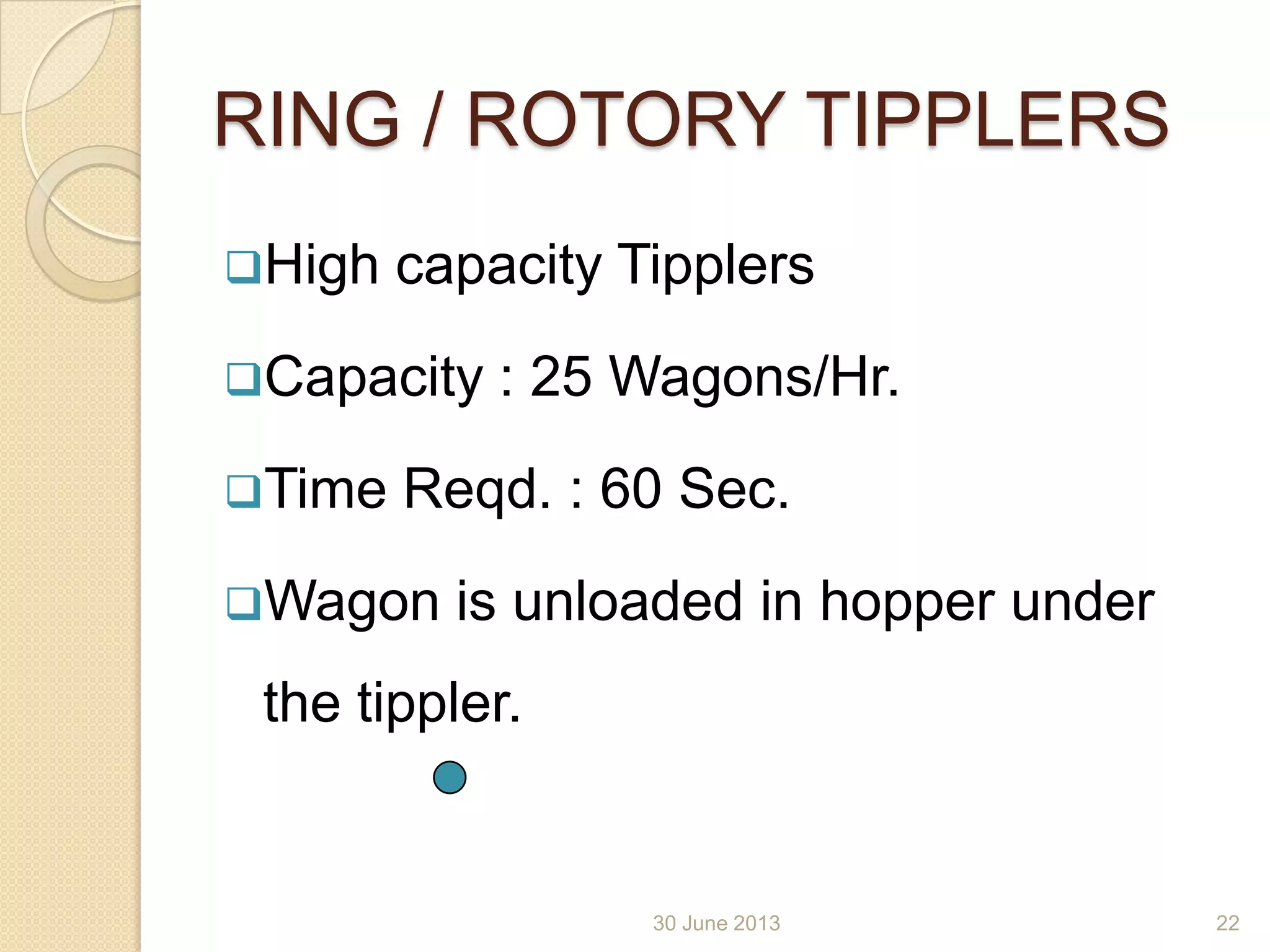
RING / ROTORY TIPPLERS
High capacity Tipplers
Capacity : 25 Wagons/Hr.
Time Reqd. : 60 Sec.
Wagon is unloaded in hopper under
the tippler.
22
30 June 2013
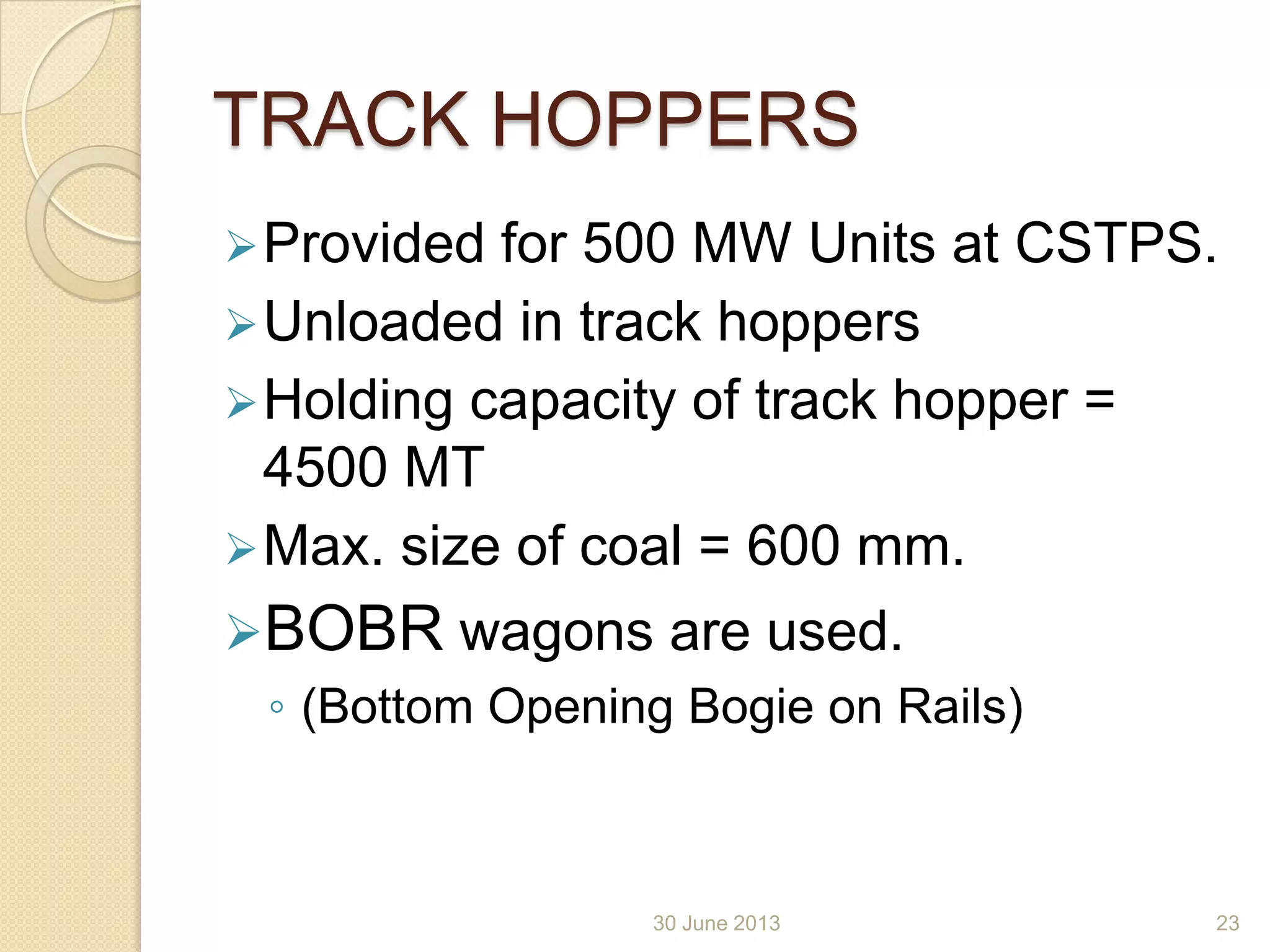
TRACK HOPPERS
Provided for 500 MW Units at CSTPS.
Unloaded in track hoppers
Holding capacity of track hopper =
4500 MT
Max. size of coal = 600 mm.
BOBR wagons are used.
◦ (Bottom Opening Bogie on Rails)
23
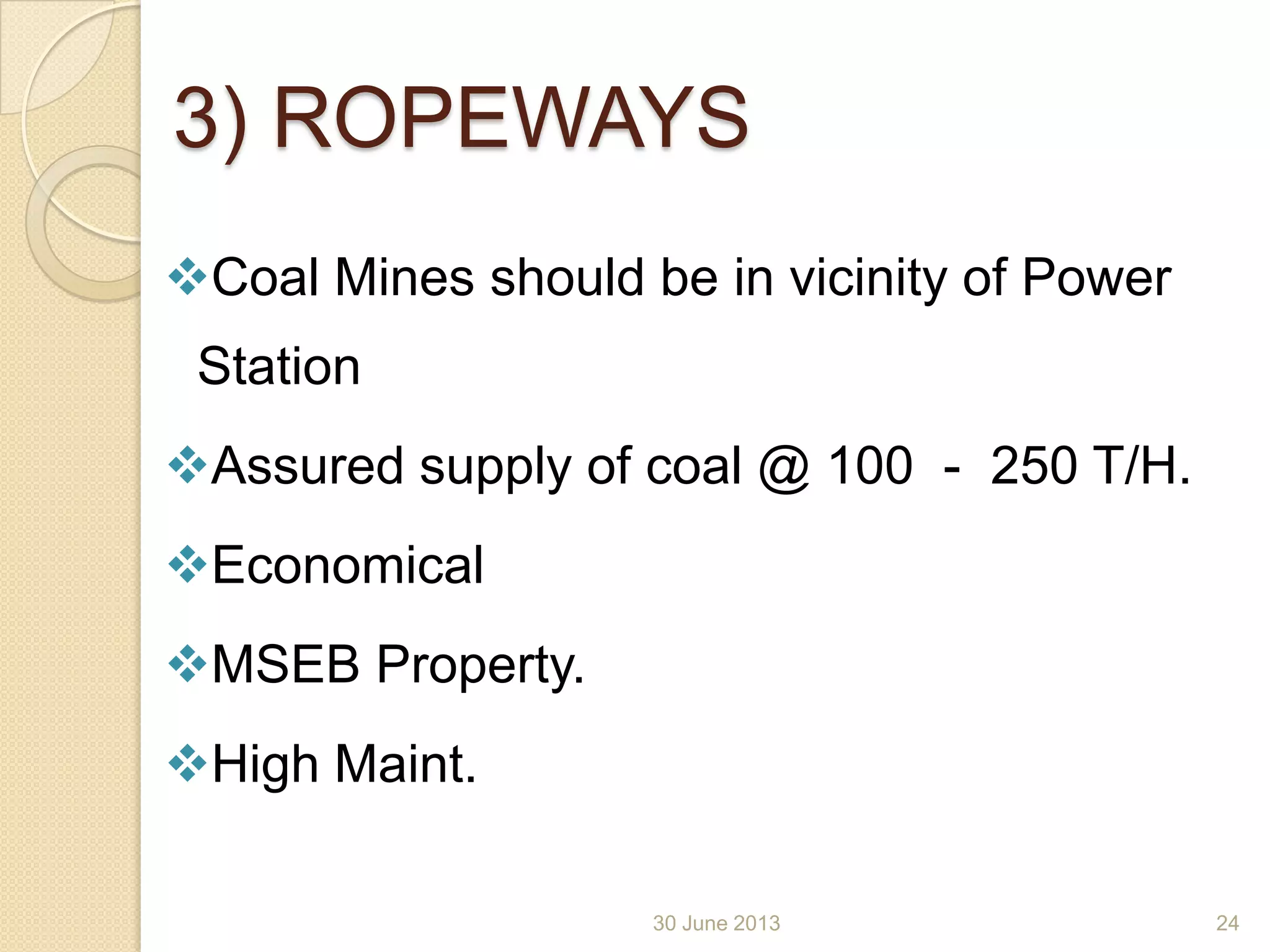
3) ROPEWAYS
Coal Mines should be in vicinity of Power
Station
Assured supply of coal @ 100 - 250 T/H.
Economical
MSEB Property.
High Maint.
30 June 2013 24
30 June 2013
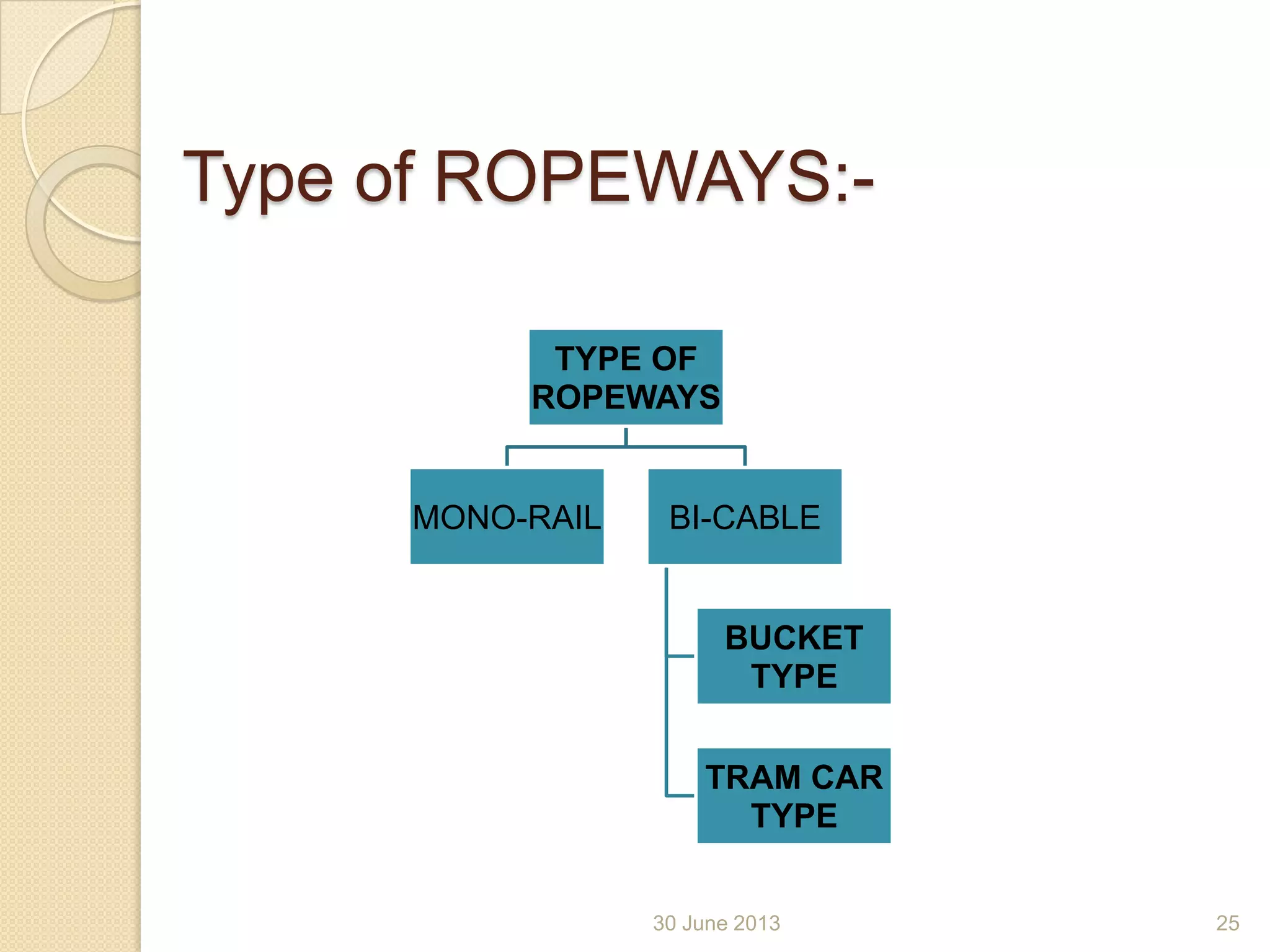
Type of ROPEWAYS:-
TYPE OF
ROPEWAYS
MONO-RAIL BI-CABLE
BUCKET
TYPE
TRAM CAR
TYPE
25
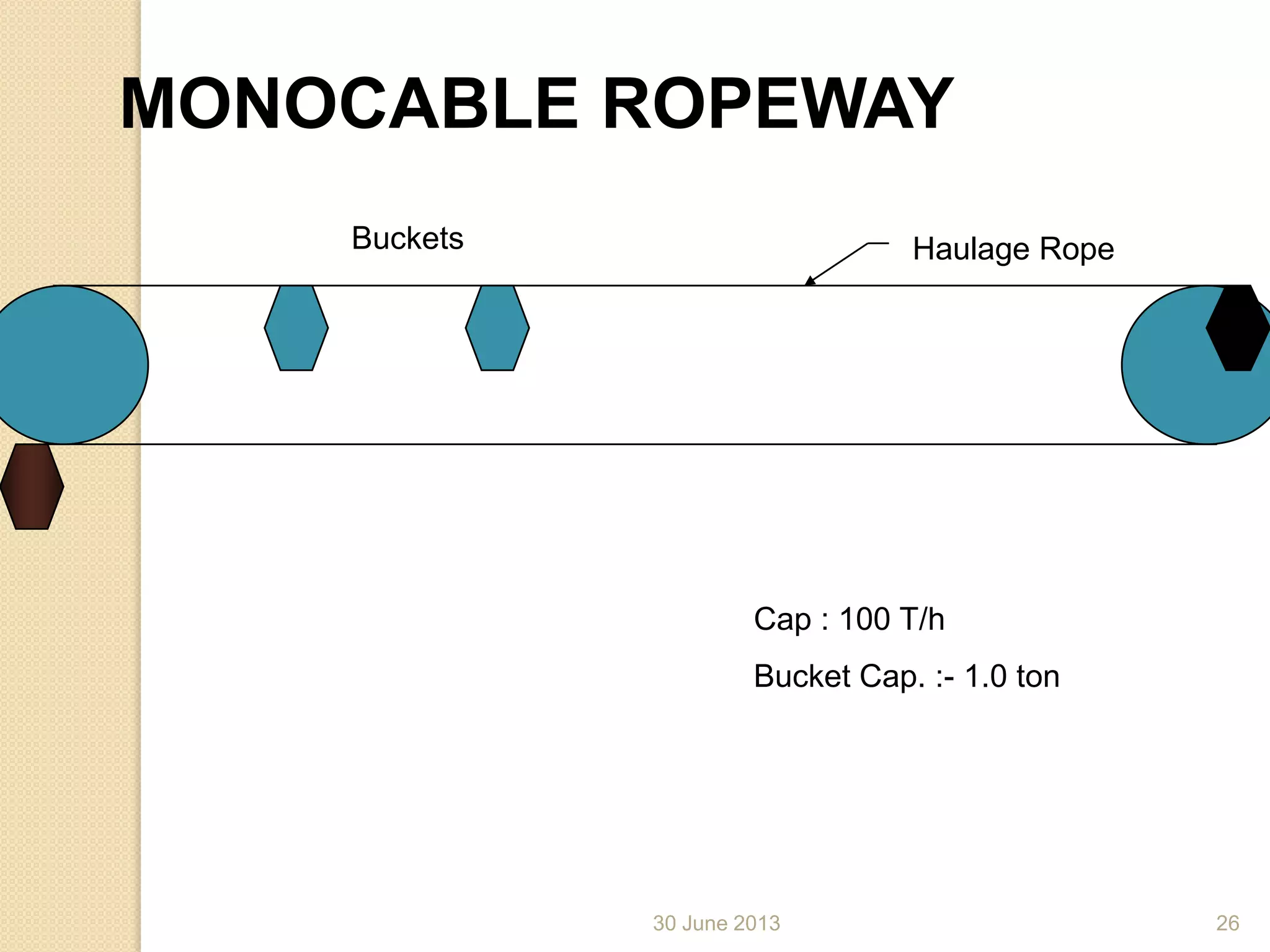
MONOCABLE ROPEWAY
Cap : 100 T/h
Bucket Cap. :- 1.0 ton
Haulage RopeBuckets
30 June 2013 26
30 June 2013
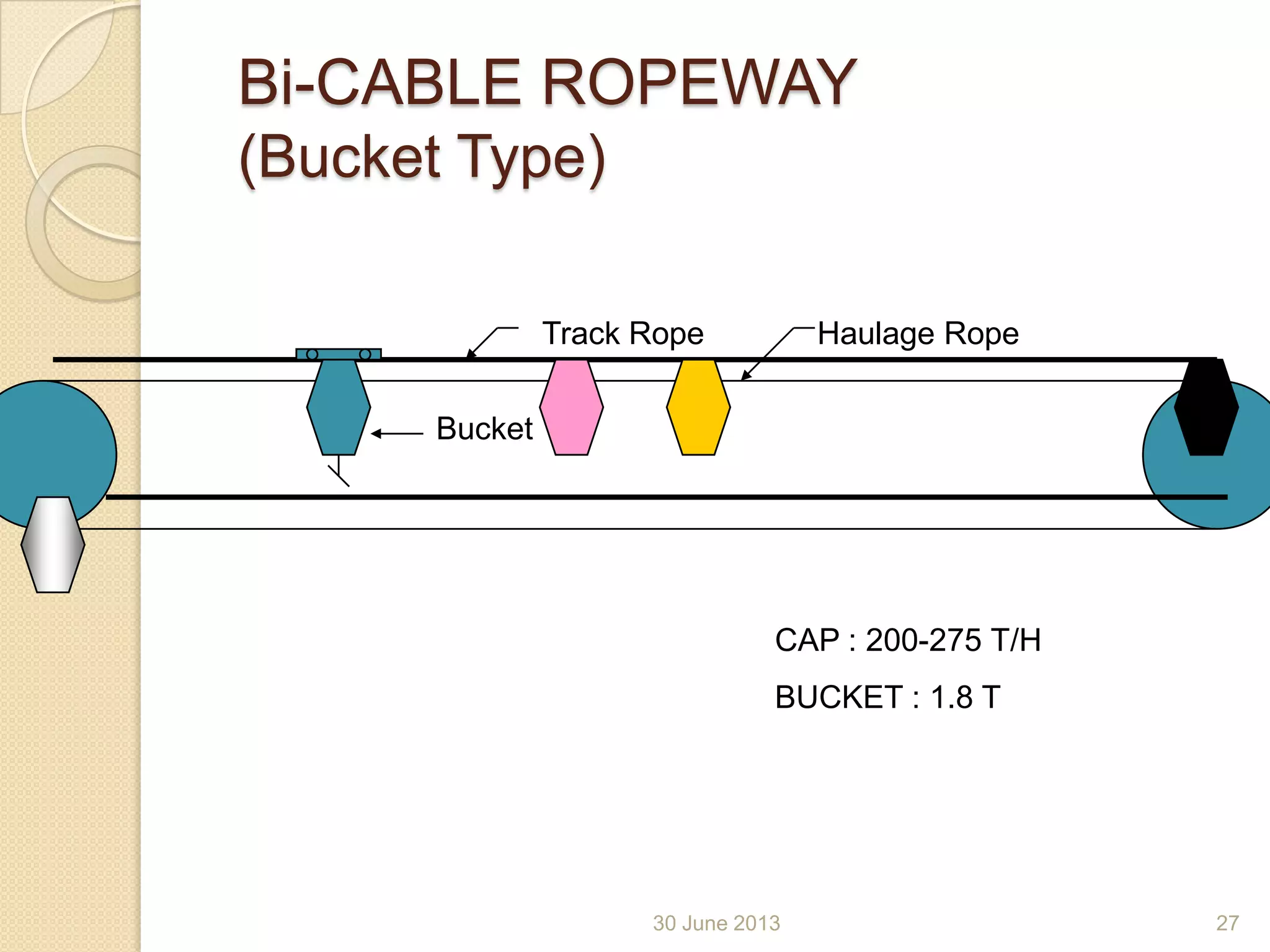
Bi-CABLE ROPEWAY
(Bucket Type)
Track Rope Haulage Rope
Bucket
CAP : 200-275 T/H
BUCKET : 1.8 T
27
30 June 2013
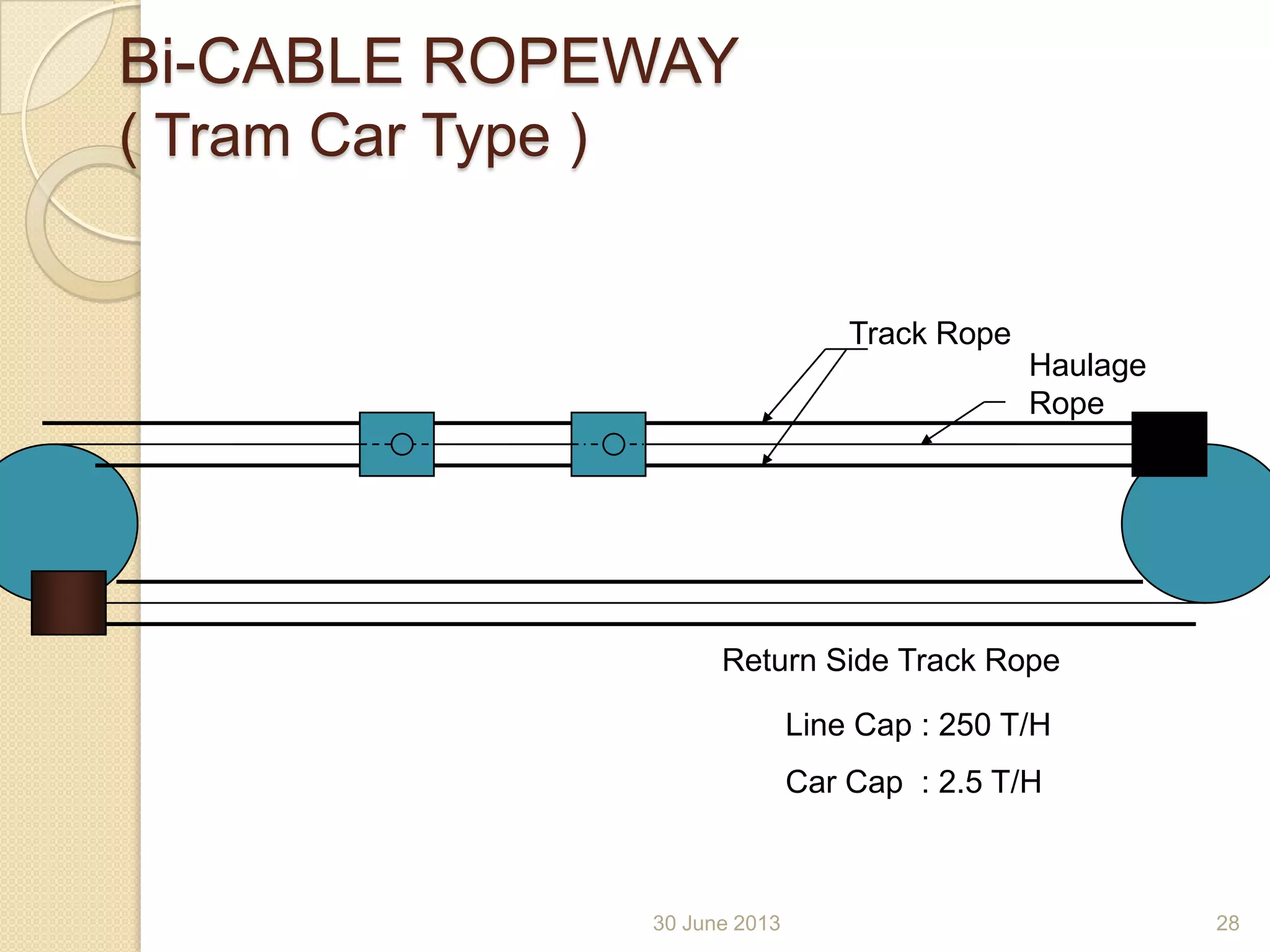
Bi-CABLE ROPEWAY
( Tram Car Type )
Track Rope
Haulage
Rope
Line Cap : 250 T/H
Car Cap : 2.5 T/H
Return Side Track Rope
28
30 June 2013
GROUP OF ROPEWAYS
A B
D
P C
E
KORADI
KHAPARKHEDA
PATAN
SAWANGI PIPLA VALANI SILEWARA
PA -MONO-CABLE(BUCKET)
AB -BI-CABLE(TRAM CAR)
BD -BI-CABLE9TRAM CAR)
CD -BI-CABLE(BUCKET)
DE -BI-CABLE(TRAM CAR)
LENGTH- 4.0 KM
BUCKETS - 92 (16 Parking)
LINE CAP- 75 T/H
BUCKET CAP-1.0 T
Hal.Rope - 33 mm
Speed - 168 m/min
LENGTH- 1.5 KM
BUCKETS- 32
LINE CAP-200 T/H
BUCKET CAP-2.5 T
Speed - 600 ft/min
HR-25 / TR-43/32 mm.
LENGTH-1.75 KM
BUCKETS- 63(57 Parking)
LINE CAP-200 T/H
BUCKET CAP-1.8 T
Speed - 650 ft/min
HR-25 / TR-48/33 mm
LENGTH-3.0 KM
BUCKETS-129
LINE CAP-200 T/H
BUCKET CAP-2.5 T
LENGTH- 3.0 KM
BUCKETS- 67
LINE CAP- 200 T/H
BUCKET CAP-2.5 T
29
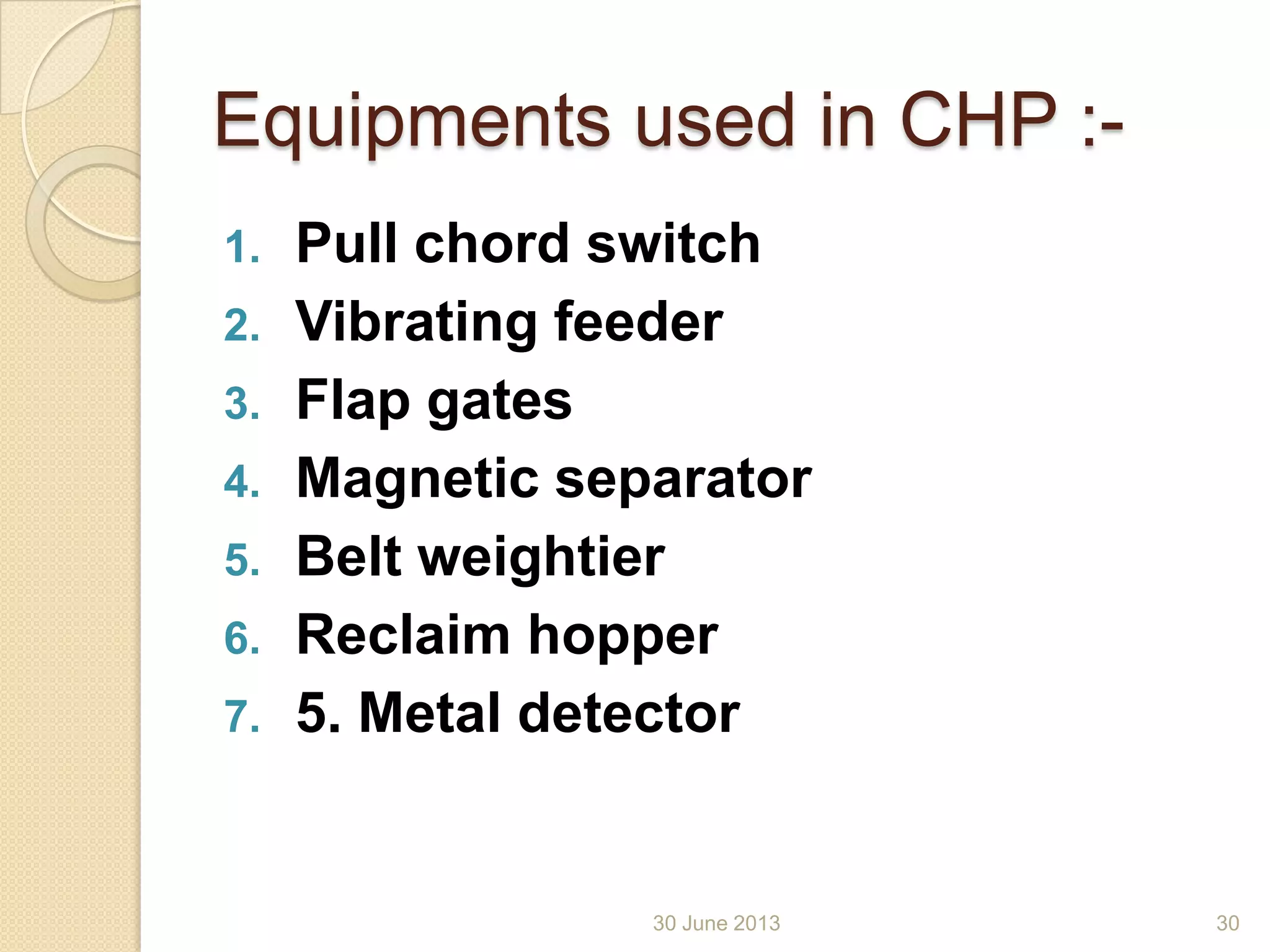
Equipments used in CHP :-
1. Pull chord switch
2. Vibrating feeder
3. Flap gates
4. Magnetic separator
5. Belt weightier
6. Reclaim hopper
7. 5. Metal detector
30 June 2013 30
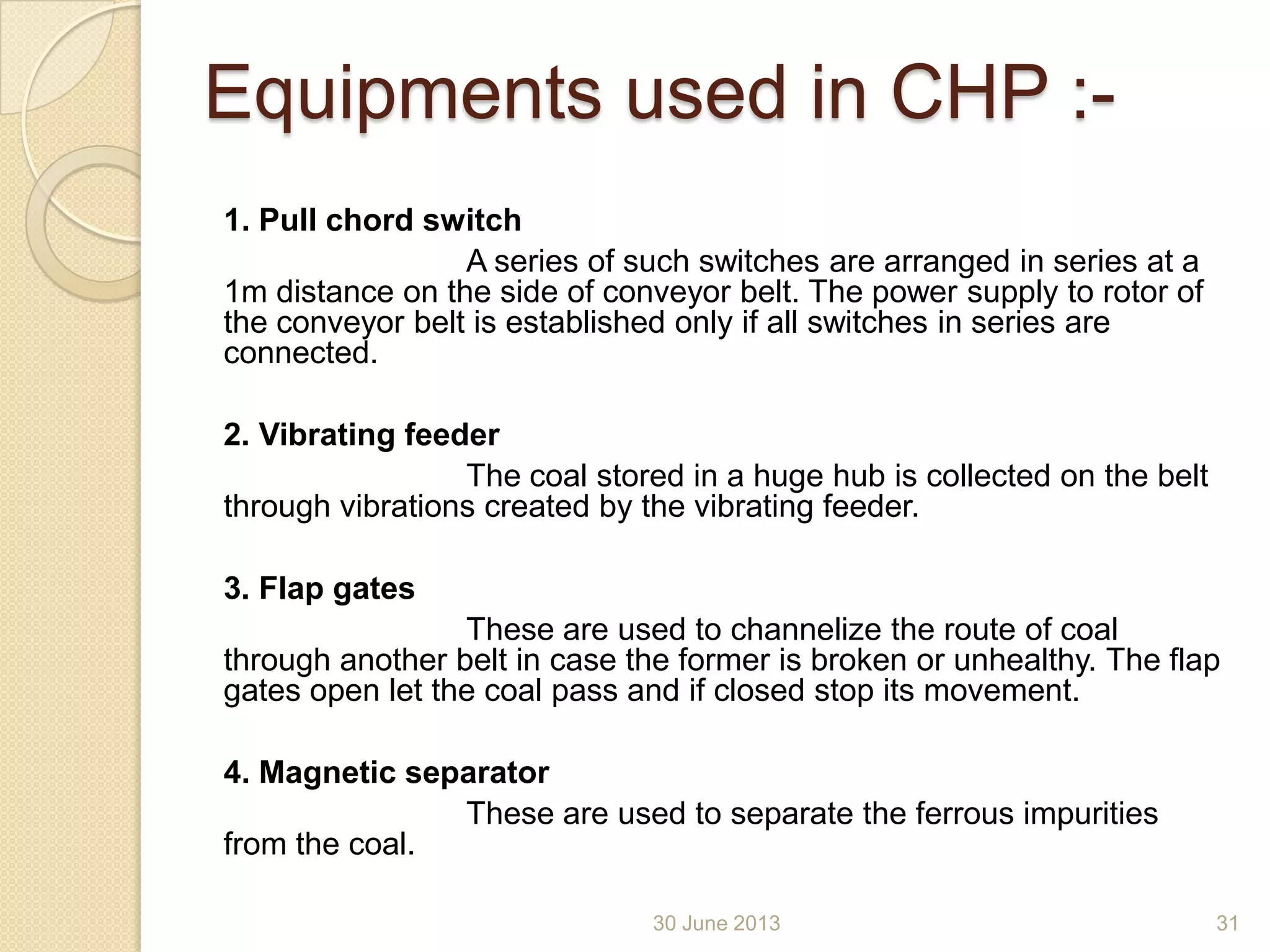
Equipments used in CHP :-
1. Pull chord switch
A series of such switches are arranged in series at a
1m distance on the side of conveyor belt. The power supply to rotor of
the conveyor belt is established only if all switches in series are
connected.
2. Vibrating feeder
The coal stored in a huge hub is collected on the belt
through vibrations created by the vibrating feeder.
3. Flap gates
These are used to channelize the route of coal
through another belt in case the former is broken or unhealthy. The flap
gates open let the coal pass and if closed stop its movement.
4. Magnetic separator
These are used to separate the ferrous impurities
from the coal.
30 June 2013 31
30 June 2013 32
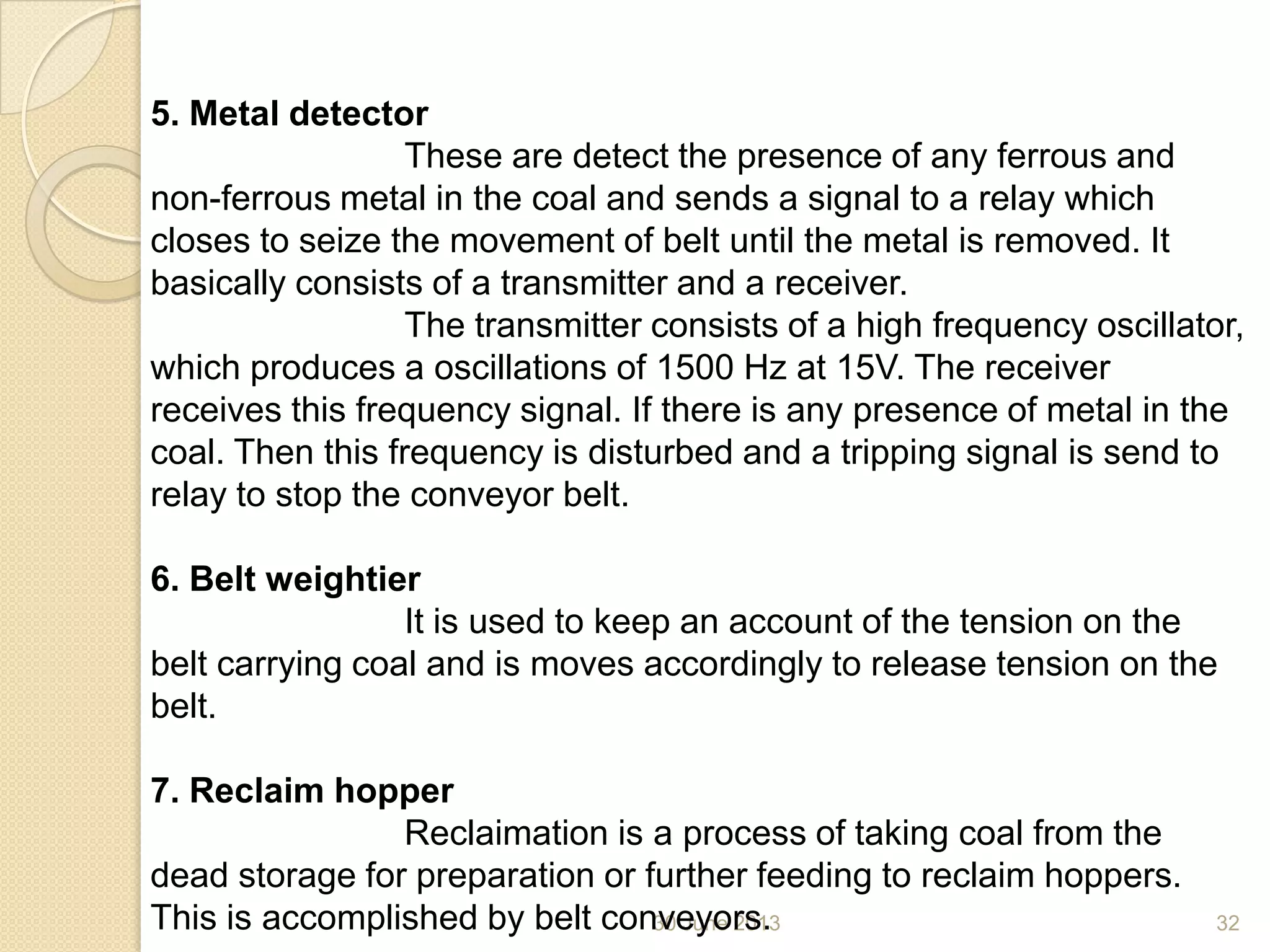
5. Metal detector
These are detect the presence of any ferrous and
non-ferrous metal in the coal and sends a signal to a relay which
closes to seize the movement of belt until the metal is removed. It
basically consists of a transmitter and a receiver.
The transmitter consists of a high frequency oscillator,
which produces a oscillations of 1500 Hz at 15V. The receiver
receives this frequency signal. If there is any presence of metal in the
coal. Then this frequency is disturbed and a tripping signal is send to
relay to stop the conveyor belt.
6. Belt weightier
It is used to keep an account of the tension on the
belt carrying coal and is moves accordingly to release tension on the
belt.
7. Reclaim hopper
Reclaimation is a process of taking coal from the
dead storage for preparation or further feeding to reclaim hoppers.
This is accomplished by belt conveyors.
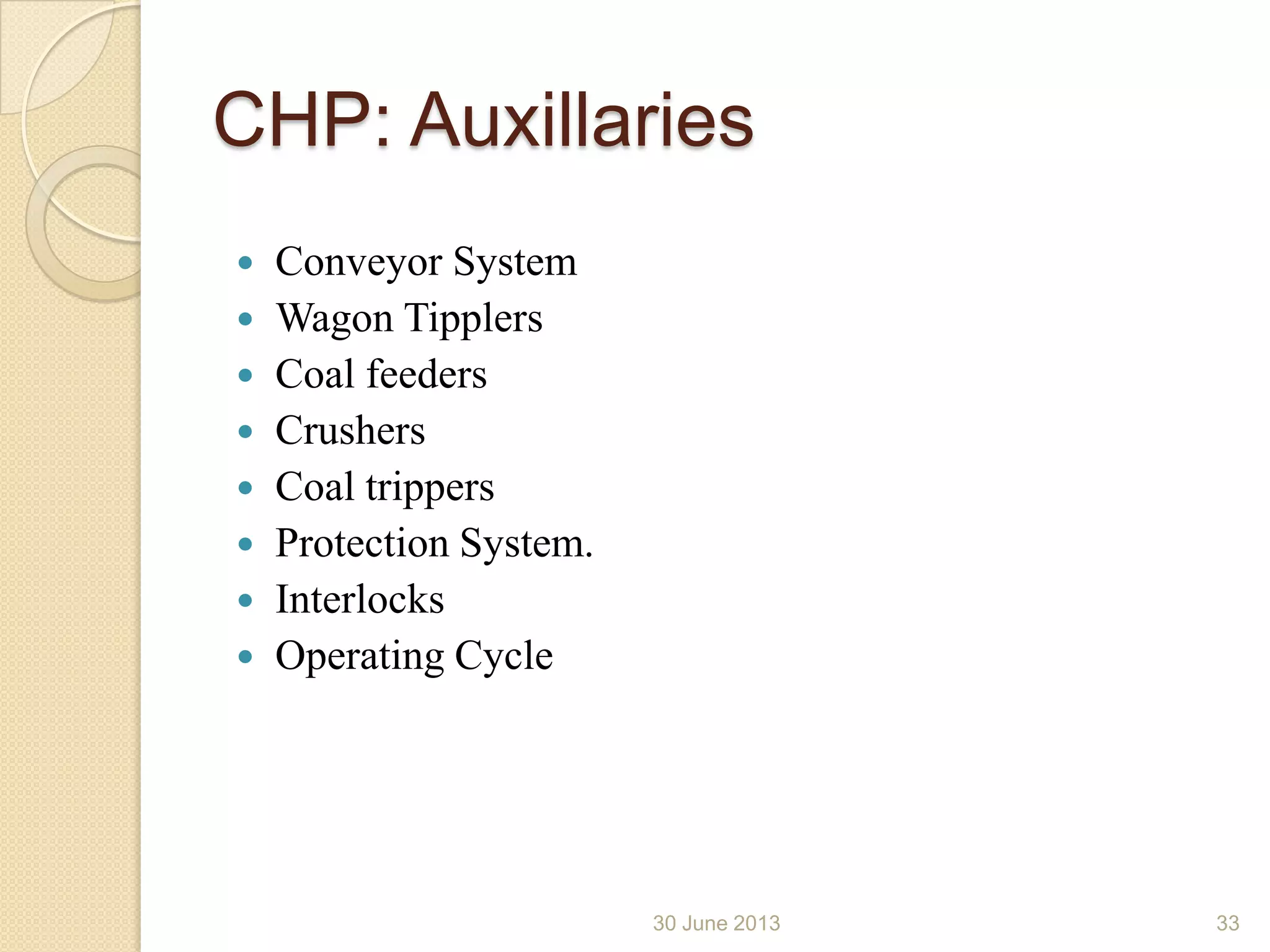
CHP: Auxillaries
 Conveyor System
 Wagon Tipplers
 Coal feeders
 Crushers
 Coal trippers
 Protection System.
 Interlocks
 Operating Cycle
30 June 2013 33
30 June 2013
Conveyor System
 Conveyor Belts
 Idlers
 Pulleys
34
30 June 2013
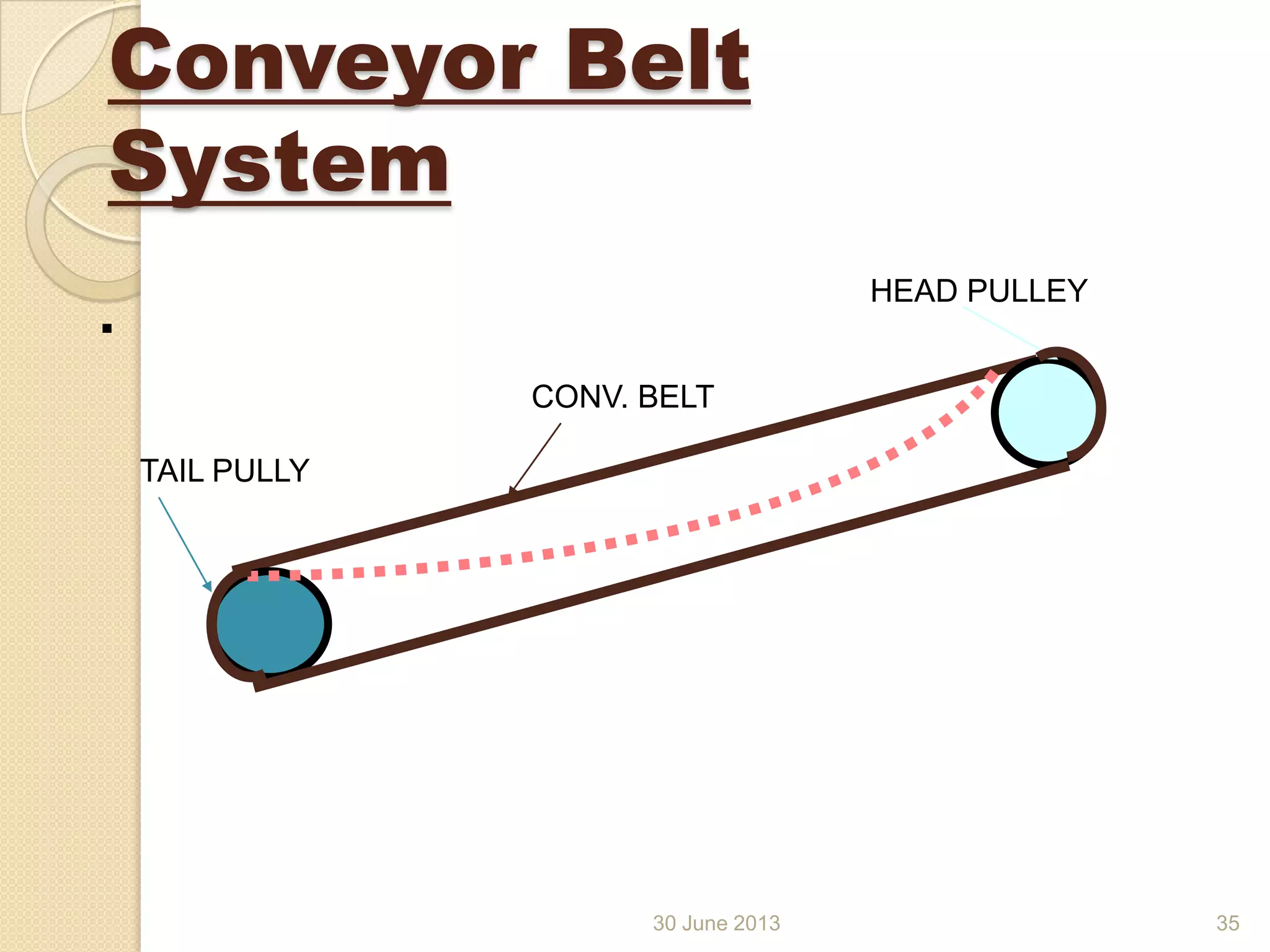
Conveyor Belt
System
. HEAD PULLEY
TAIL PULLY
CONV. BELT
35
30 June 2013
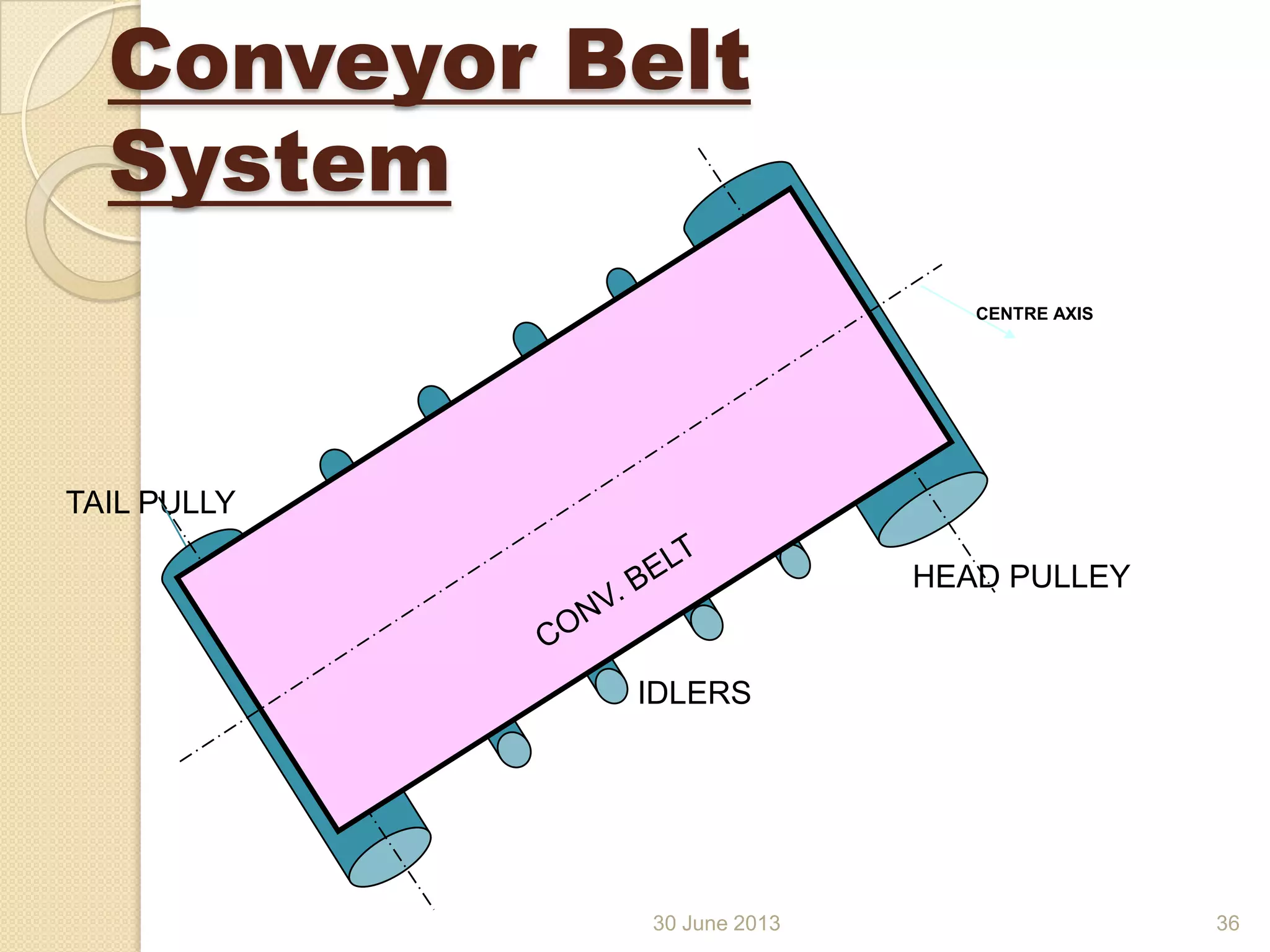
Conveyor Belt
System
HEAD PULLEY
TAIL PULLY
IDLERS
CENTRE AXIS
36
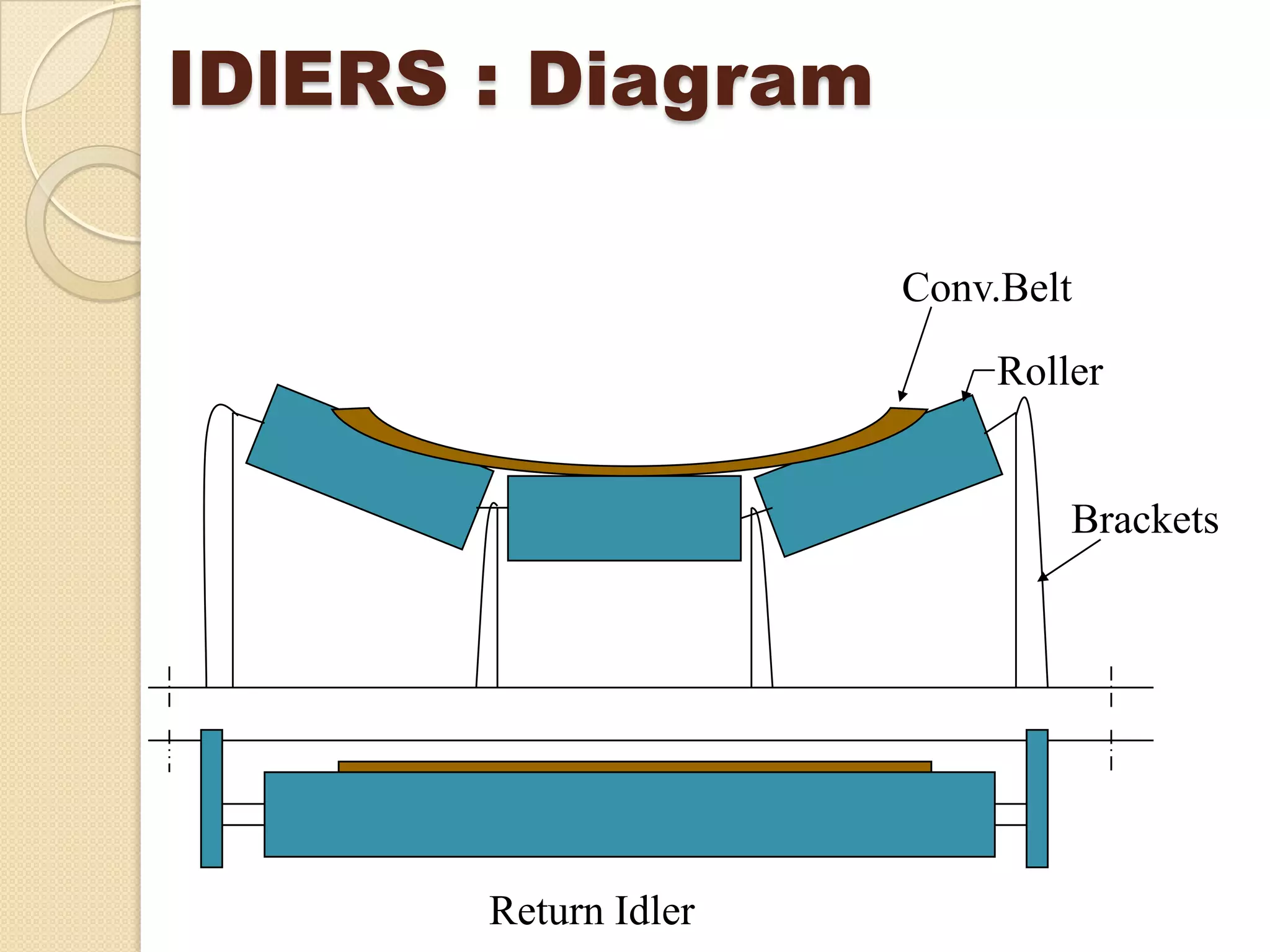
IDLERS
 Consists of 3 rollers
 Rollers are fitted with bearings/Life
sealed bearings.
 Profile makes an arc of a circle to
avoid sharp bends to increase belt life.
 Fitting arrangement : 2 types
 Fixed
 Detachable
IDlERS : Diagram
Roller
Conv.Belt
Brackets
Return Idler
PULLEYS :
 These are of heavy cast iron
 Driving pulleys are faced with ferodo
or similar frictional materials.
 The diameter of pulleys are large
enough to reduce the belt stresses.
 Width of the pulleys are 150 mm more
than belts.
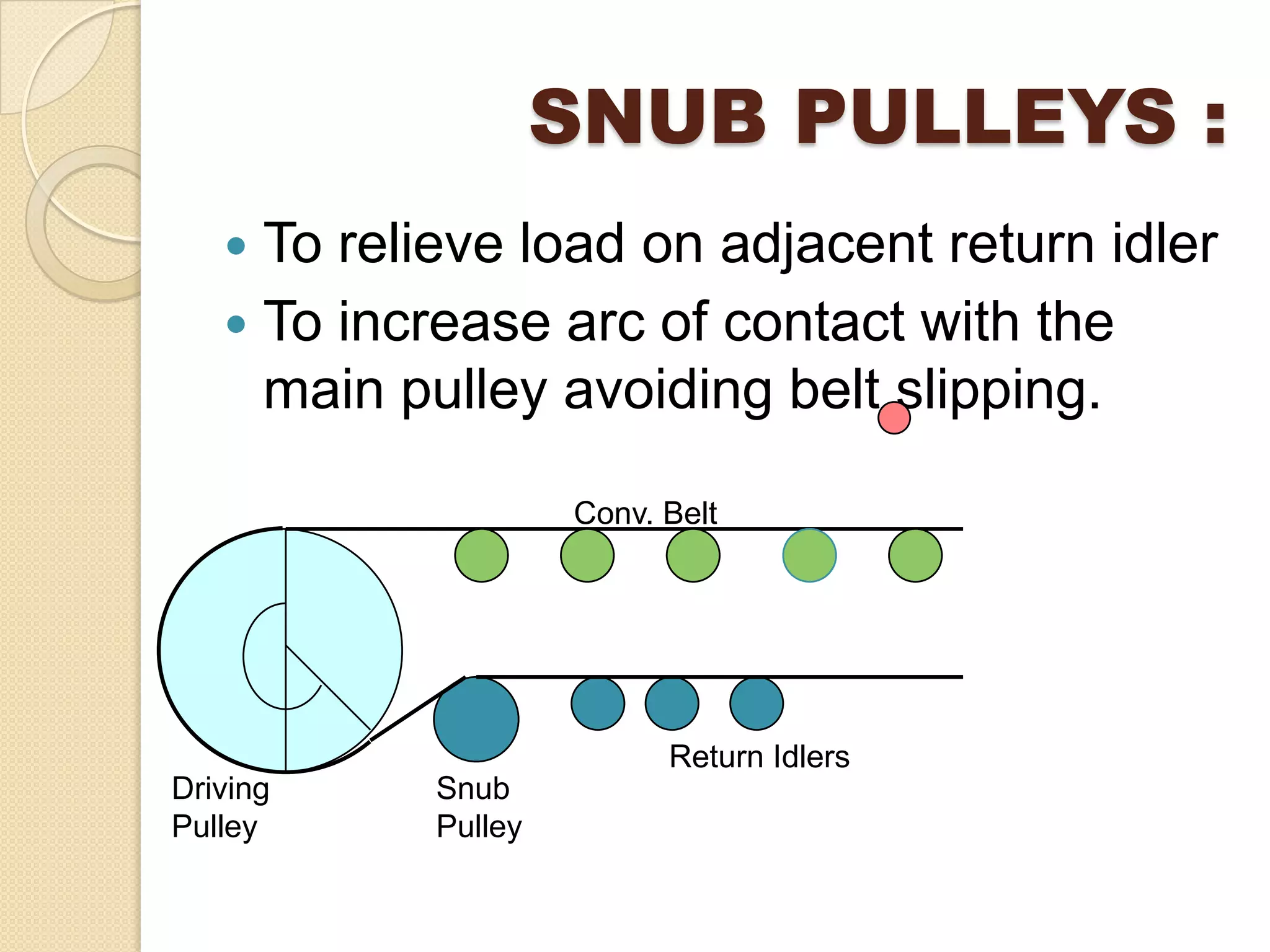
SNUB PULLEYS :
 To relieve load on adjacent return idler
 To increase arc of contact with the
main pulley avoiding belt slipping.
Snub
Pulley
Return Idlers
Conv. Belt
Driving
Pulley
30 June 2013
CONVEYOR BELTS
 Construction:
 Rubber+ Cotton Threads.
 Rubber + Fiber Threads
 Rubber + Steel Wires
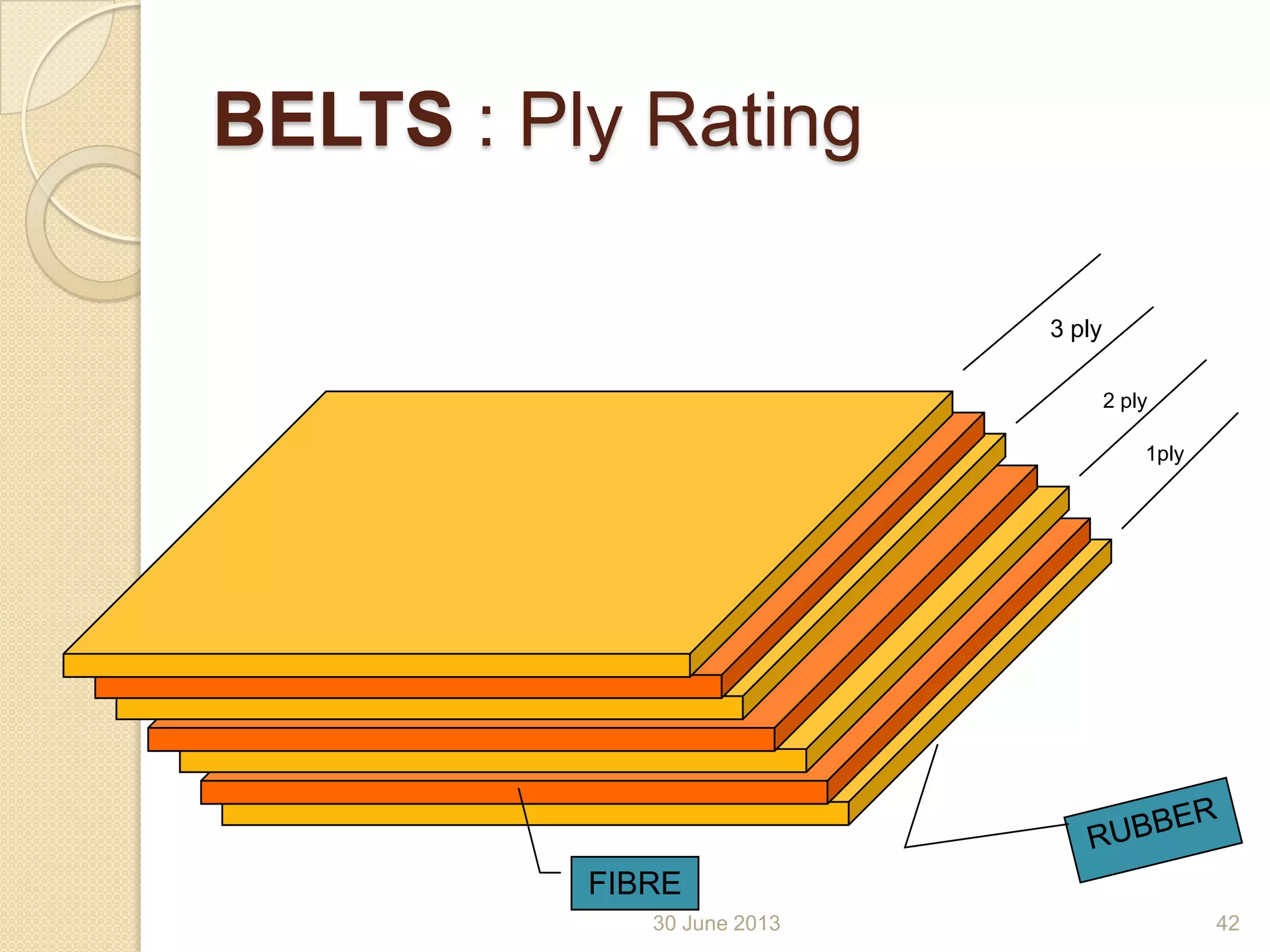
 Ply Rating :
 4 Ply
 5 Ply
 6 Ply
41
BELTS : Ply Rating
1ply
2 ply
3 ply
FIBRE
30 June 2013 42
30 June 2013
Belts : Quality
Long Life
Strength
Toughness
Light
Elastic
Pliability
43
30 June 2013
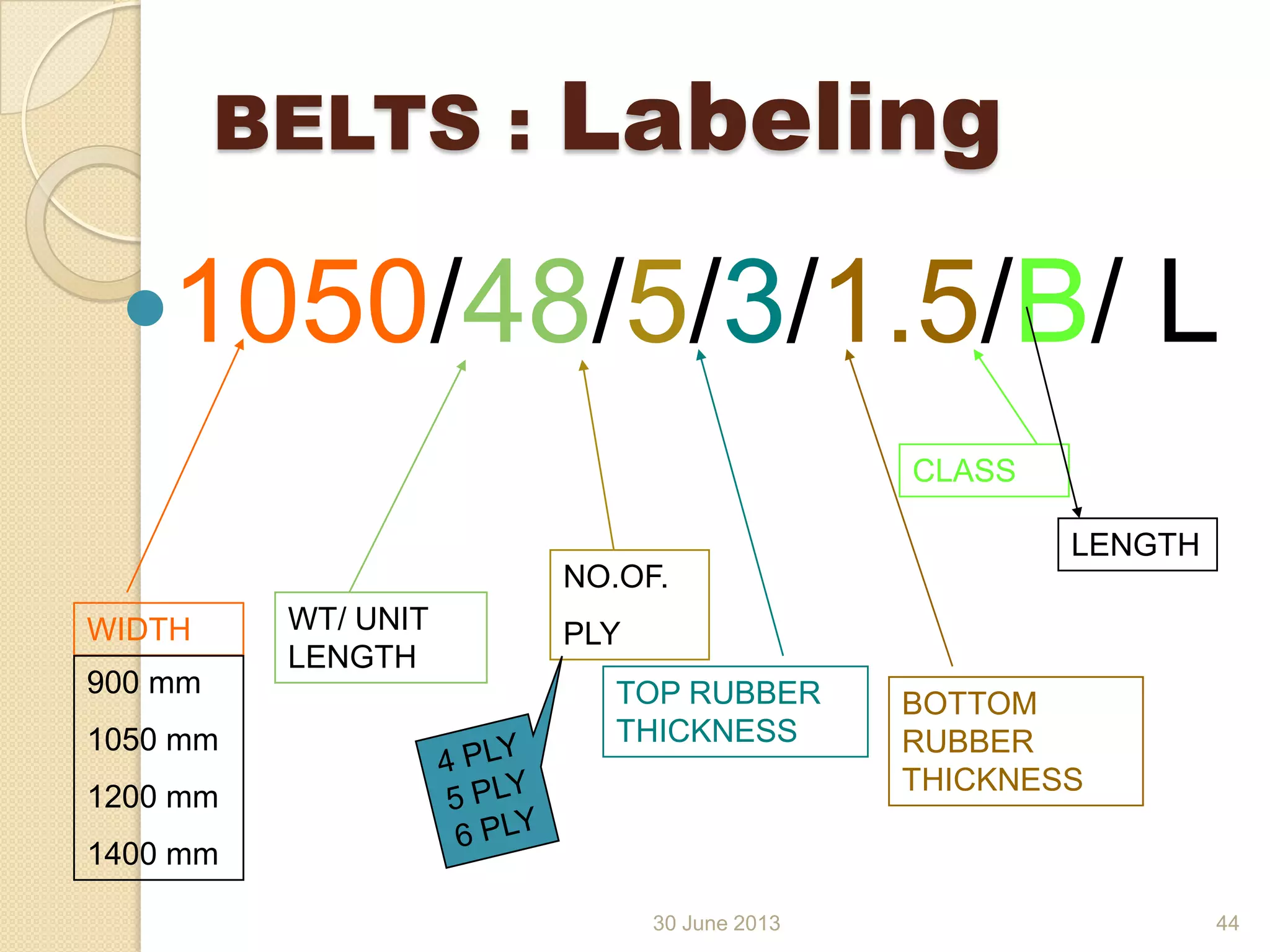
BELTS : Labeling
1050/48/5/3/1.5/B/ L
WIDTH WT/ UNIT
LENGTH
NO.OF.
PLY
TOP RUBBER
THICKNESS
BOTTOM
RUBBER
THICKNESS
CLASS
LENGTH
900 mm
1050 mm
1200 mm
1400 mm
44
Interlocks:
 Whenever a belt trips , all earlier
belt trips along with the
associated Coal feeder.
30 June 2013
COAL FEEDERS
 Vibrating Feeders
 Vibrating Screens
46
30 June 2013
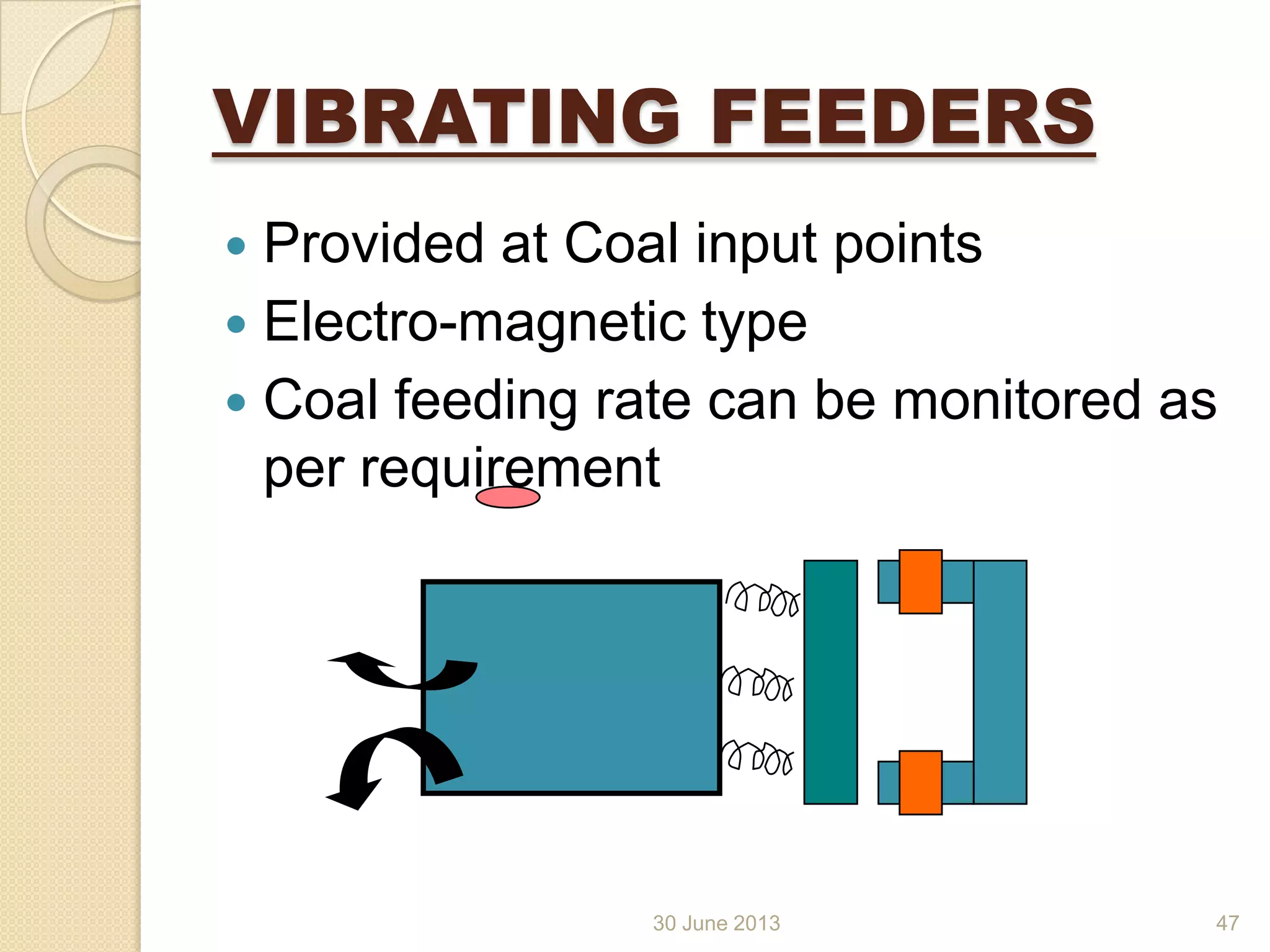
VIBRATING FEEDERS
 Provided at Coal input points
 Electro-magnetic type
 Coal feeding rate can be monitored as
per requirement
47
30 June 2013
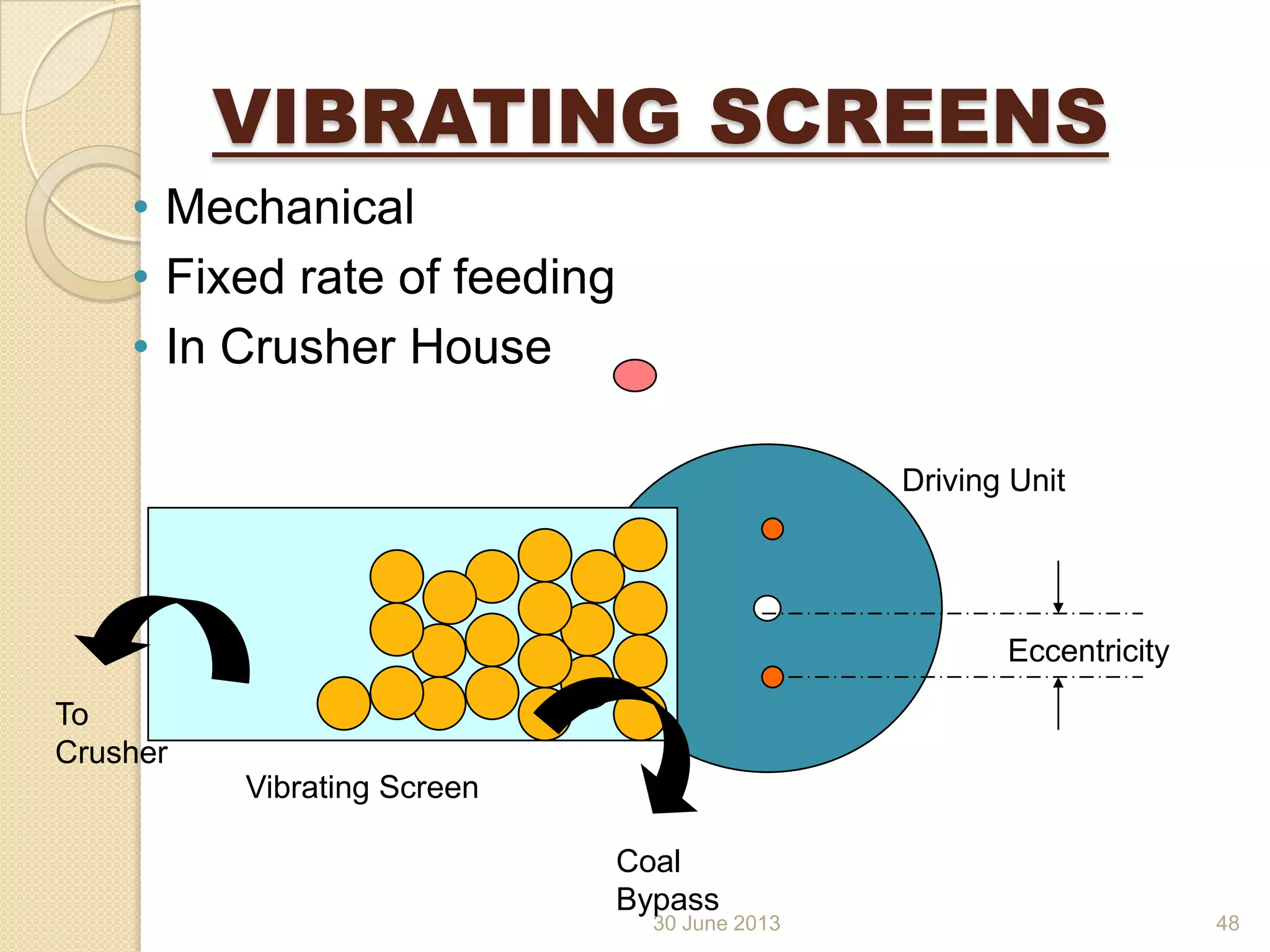
VIBRATING SCREENS
• Mechanical
• Fixed rate of feeding
• In Crusher House
Eccentricity
Vibrating Screen
Driving Unit
Coal
Bypass
To
Crusher
48
30 June 2013
COAL CRUSHERS
 Primary Crushers : up to 600 mm
 Secondary Crusher : 600 to 100 mm
 Final Crushers : Up to 25 mm
49
30 June 2013
OPERATING SEQUENCE OF
CHP
 DIRECT TO BUNKER
 DIRECT TO STACK
 STACK TO BUNKER (
RECLAIMING)
50
30 June 2013
PROBLEMS FACED IN CHP
 DESIGN PROBLEMS :
◦ Cal. Value
◦ Ash %
 RAINY SEASON PROBLEMS :
◦ Chute choke ups
◦ Mud
◦ Coal yard -Slurry formation
 OTHER MISCH. PROBLEMS :
◦ Snapping of belts/ropes
◦ Derailment of coal wagons
◦ Oversized coal / Muddy Coal.
51
Conclusion:-
 In this way we conclude that CHP is
the heart of any thermal power plant.
 without CHP we can not imagine any
thermal power plant which generate
electricity.
 In this way CHP is essential need of
TPS.
30 June 2013 52

Best ppt on Presentation on Coal handling plant

  • 1.
    30 June 20131 Prsentation On Coal Handling Plant (CHP)
  • 2.
    Presented by:-  RonakThakre 30 June 2013 2
  • 3.
    Contents:-  Introduction..  Whatis actually CHP ??  Main Target Of CHP…  General Layout Of CHP…  Grading Of coal….  Constituents Of Coal…  Consumption Of Coal at KTPS & CSTPS…  Section Of CHP…  CHP auxillary & Equipments….  Coal feeders…  Coal crushers…  Operating sequence of CHP…  Problem faced in CHP…. 30 June 2013 3
  • 4.
    Introduction:- • Objective ofCHP is to supply the quanta of processed coal to bunkers of Coal mills for Boiler operation and to stack the coal to coal storage area. • Coal is a hard black or dark brown sedimentary rock formed by the decomposition of plant material, widely used as a fuel. • A piece of coal called Coal Lumps. Mostly E and F grade coal used in India. • 5 ways of Transportation of Coal is 1. Railways. (90% used) 2. Ropeways. 3. Roadways. 4. Waterways. 5. Airway. 30 June 2013 4
  • 5.
     The sizesof coal lumps is about to the 600mm.  This coal is fed to single rotary crusher and after that the size become 300mm.  This coal is again fed to the double rotary crusher and the size become 80mm.  This coal is again fed to the crusher and the size become less than 20 mm or 20mm.  Then this coal is fed to the coal mill for pulverization.  Even when the bunker is full this coal is used for stacking or storage of coal in coal storage area. 30 June 2013 5
  • 6.
    What is CHP?? CHP is (C- Coal, H- Handling, P- Plant) a plant which handles the coal from its receipt to transporting it to Boiler and store in Bunkers. It also processes the raw coal to make it suitable for Boiler Opeartion.  Extent of work: - In brief we can say that receipt of coal from coal mines, weighing of coal, crushing it to required size and transferring the quantity of coal to various coal mill bunkers.  This is the responsibility and duty of the CHP and its staff. 30 June 2013 6
  • 7.
    Main Target:-  ToReceive , Process , Store and Feed coal.  Bunkering of Coal.  Unloading of Coal wagon.  Stacking Of Coal. 30 June 2013 7
  • 8.
    30 June 2013 GENERALLAYOUT OF CHP Wagon tippler Crusher House Bunkers Tripper Trolley Conv. Belts Vibrating Screens Crushers Feeders Surge Hopper 8
  • 9.
    30 June 2013 GRADESOF COAL SR.NO. GRADE CAL. VALUE Kcal/Kg. 1 A More Than 6200 2 B 5601 - 6200 3 C 4941 - 5600 4 D 4201 - 4900 5 E 3361 – 4200 6 F 2401 – 3360 7 G 1301 – 2400 8 H Below 1300 9
  • 10.
    CONSTITUENTS OF COAL Carbon :- 42.9%  Hydrogen :- 2.96%  Nitrogen :- 0.91%  Sulphur :- 0.33% 30 June 2013 10
  • 11.
    30 June 2013 CONSUMPTIONOF COAL GENERATION PER HOUR PER DAY/SET 210 MW 120 MT 3000 MT 500 MW 300 MT 7000 MT 11
  • 12.
    CONSUMPTION OF COAL(KTPS) GENERA TION PER HOUR PER DAY/ SET No. OF SETS TOTAL REQRT. INmt. 120 MW 80 MT 2000 MT 4 8000 210 MW 120 MT 3000 MT 3 9000 TOTAL 420 MT 10000 MT 7 17000 30 June 2013 12
  • 13.
    30 June 2013 CONSUMPTIONOF COAL(CSTPS) G ENER A TIO N PER HO UR PER D AY/ SET NO . O F SETS TO TAL 210 120 MT 3000 MT 4 12000 500 300 MT 7000 MT 3 21000 TOTAL 420 MT 10000 MT 7 33000 STORAGE CAPACITY OF CO AL Y ARD = 5,00,000 M T ESTIM ATED COAL REQUREM ENT = 7 M ILLION TON. 13
  • 14.
    Sections of CHP:- Managementof Coal Transportation of Coal Handling of Coal 30 June 2013 14
  • 15.
    Management of Coal:- •Central government • CIL • WCL • Railway • Mah.State • MSEB 30 June 2013 15
  • 16.
    30 June 2013 TRANSPORTATIONOF COAL MODE OF COAL TRANSPORT 1. ROADWAYS 2. RAILWAYS 3. ROPEWAYS 16
  • 17.
    30 June 2013 1)ROADWAYS Coal is carried in trucks. 8-10 mt coal per truck. Requires more time and manpower. Coal mines should be near to PS (100-150 km). Coal is lost / waste in transit. Hence not in use for large power stations. 17
  • 18.
    30 June 2013 2)RAILWAYS:- ◦ Unloaded with the help of WAGON TIPPLER ◦ One Rack consist of 52-56 Wagons. ◦ 13/25 wagons can be tippled in an hour. ◦ Each wagon contains 55-58 MT of coal. ◦ Wagon movements are controlled by “Bettle Chargers” ◦ Demurrage charges on racks.(11 ½ hrs.) ◦ Most popular mode of transport. 18
  • 19.
    30 June 2013 WAGONTIPPELERS WAGON TIPPLER SIDE TIPPLER ROTORY TIPPLER 19
  • 20.
    30 June 2013 ROTASIDE TIPPLERS 140 to 150 Degree Tilting ROTASIDE ELECON MAKE TIPPLERS  CAPACITY : 13 Wg/HR.  Wagon is unloaded in side hopper IN HAILOUT HAUL BETTLE CHARGERBETTLE CHARGER LOADED WAGONSUNLOADED WAGONS UNLOADING HOPER 20
  • 21.
    ROTASIDE TIPPLERS  CYCLEOF OPERATION : ◦ 1. Gross weight----------- 15 Sec. ◦ 2. Tippling ( 1400 )-------- 90 sec. ◦ 3. Pause--------------------- 5 Sec. ◦ 4. Return--------------------- 90 Sec. ◦ 5. Tare weight-------------- 15 Sec ◦ ============================= TOTAL TIME REQD.----- 210 Sec. 30 June 2013 21
  • 22.
    30 June 2013 RING/ ROTORY TIPPLERS High capacity Tipplers Capacity : 25 Wagons/Hr. Time Reqd. : 60 Sec. Wagon is unloaded in hopper under the tippler. 22
  • 23.
    30 June 2013 TRACKHOPPERS Provided for 500 MW Units at CSTPS. Unloaded in track hoppers Holding capacity of track hopper = 4500 MT Max. size of coal = 600 mm. BOBR wagons are used. ◦ (Bottom Opening Bogie on Rails) 23
  • 24.
    3) ROPEWAYS Coal Minesshould be in vicinity of Power Station Assured supply of coal @ 100 - 250 T/H. Economical MSEB Property. High Maint. 30 June 2013 24
  • 25.
    30 June 2013 Typeof ROPEWAYS:- TYPE OF ROPEWAYS MONO-RAIL BI-CABLE BUCKET TYPE TRAM CAR TYPE 25
  • 26.
    MONOCABLE ROPEWAY Cap :100 T/h Bucket Cap. :- 1.0 ton Haulage RopeBuckets 30 June 2013 26
  • 27.
    30 June 2013 Bi-CABLEROPEWAY (Bucket Type) Track Rope Haulage Rope Bucket CAP : 200-275 T/H BUCKET : 1.8 T 27
  • 28.
    30 June 2013 Bi-CABLEROPEWAY ( Tram Car Type ) Track Rope Haulage Rope Line Cap : 250 T/H Car Cap : 2.5 T/H Return Side Track Rope 28
  • 29.
    30 June 2013 GROUPOF ROPEWAYS A B D P C E KORADI KHAPARKHEDA PATAN SAWANGI PIPLA VALANI SILEWARA PA -MONO-CABLE(BUCKET) AB -BI-CABLE(TRAM CAR) BD -BI-CABLE9TRAM CAR) CD -BI-CABLE(BUCKET) DE -BI-CABLE(TRAM CAR) LENGTH- 4.0 KM BUCKETS - 92 (16 Parking) LINE CAP- 75 T/H BUCKET CAP-1.0 T Hal.Rope - 33 mm Speed - 168 m/min LENGTH- 1.5 KM BUCKETS- 32 LINE CAP-200 T/H BUCKET CAP-2.5 T Speed - 600 ft/min HR-25 / TR-43/32 mm. LENGTH-1.75 KM BUCKETS- 63(57 Parking) LINE CAP-200 T/H BUCKET CAP-1.8 T Speed - 650 ft/min HR-25 / TR-48/33 mm LENGTH-3.0 KM BUCKETS-129 LINE CAP-200 T/H BUCKET CAP-2.5 T LENGTH- 3.0 KM BUCKETS- 67 LINE CAP- 200 T/H BUCKET CAP-2.5 T 29
  • 30.
    Equipments used inCHP :- 1. Pull chord switch 2. Vibrating feeder 3. Flap gates 4. Magnetic separator 5. Belt weightier 6. Reclaim hopper 7. 5. Metal detector 30 June 2013 30
  • 31.
    Equipments used inCHP :- 1. Pull chord switch A series of such switches are arranged in series at a 1m distance on the side of conveyor belt. The power supply to rotor of the conveyor belt is established only if all switches in series are connected. 2. Vibrating feeder The coal stored in a huge hub is collected on the belt through vibrations created by the vibrating feeder. 3. Flap gates These are used to channelize the route of coal through another belt in case the former is broken or unhealthy. The flap gates open let the coal pass and if closed stop its movement. 4. Magnetic separator These are used to separate the ferrous impurities from the coal. 30 June 2013 31
  • 32.
    30 June 201332 5. Metal detector These are detect the presence of any ferrous and non-ferrous metal in the coal and sends a signal to a relay which closes to seize the movement of belt until the metal is removed. It basically consists of a transmitter and a receiver. The transmitter consists of a high frequency oscillator, which produces a oscillations of 1500 Hz at 15V. The receiver receives this frequency signal. If there is any presence of metal in the coal. Then this frequency is disturbed and a tripping signal is send to relay to stop the conveyor belt. 6. Belt weightier It is used to keep an account of the tension on the belt carrying coal and is moves accordingly to release tension on the belt. 7. Reclaim hopper Reclaimation is a process of taking coal from the dead storage for preparation or further feeding to reclaim hoppers. This is accomplished by belt conveyors.
  • 33.
    CHP: Auxillaries  ConveyorSystem  Wagon Tipplers  Coal feeders  Crushers  Coal trippers  Protection System.  Interlocks  Operating Cycle 30 June 2013 33
  • 34.
    30 June 2013 ConveyorSystem  Conveyor Belts  Idlers  Pulleys 34
  • 35.
    30 June 2013 ConveyorBelt System . HEAD PULLEY TAIL PULLY CONV. BELT 35
  • 36.
    30 June 2013 ConveyorBelt System HEAD PULLEY TAIL PULLY IDLERS CENTRE AXIS 36
  • 37.
    IDLERS  Consists of3 rollers  Rollers are fitted with bearings/Life sealed bearings.  Profile makes an arc of a circle to avoid sharp bends to increase belt life.  Fitting arrangement : 2 types  Fixed  Detachable
  • 38.
  • 39.
    PULLEYS :  Theseare of heavy cast iron  Driving pulleys are faced with ferodo or similar frictional materials.  The diameter of pulleys are large enough to reduce the belt stresses.  Width of the pulleys are 150 mm more than belts.
  • 40.
    SNUB PULLEYS : To relieve load on adjacent return idler  To increase arc of contact with the main pulley avoiding belt slipping. Snub Pulley Return Idlers Conv. Belt Driving Pulley
  • 41.
    30 June 2013 CONVEYORBELTS  Construction:  Rubber+ Cotton Threads.  Rubber + Fiber Threads  Rubber + Steel Wires  Ply Rating :  4 Ply  5 Ply  6 Ply 41
  • 42.
    BELTS : PlyRating 1ply 2 ply 3 ply FIBRE 30 June 2013 42
  • 43.
    30 June 2013 Belts: Quality Long Life Strength Toughness Light Elastic Pliability 43
  • 44.
    30 June 2013 BELTS: Labeling 1050/48/5/3/1.5/B/ L WIDTH WT/ UNIT LENGTH NO.OF. PLY TOP RUBBER THICKNESS BOTTOM RUBBER THICKNESS CLASS LENGTH 900 mm 1050 mm 1200 mm 1400 mm 44
  • 45.
    Interlocks:  Whenever abelt trips , all earlier belt trips along with the associated Coal feeder.
  • 46.
    30 June 2013 COALFEEDERS  Vibrating Feeders  Vibrating Screens 46
  • 47.
    30 June 2013 VIBRATINGFEEDERS  Provided at Coal input points  Electro-magnetic type  Coal feeding rate can be monitored as per requirement 47
  • 48.
    30 June 2013 VIBRATINGSCREENS • Mechanical • Fixed rate of feeding • In Crusher House Eccentricity Vibrating Screen Driving Unit Coal Bypass To Crusher 48
  • 49.
    30 June 2013 COALCRUSHERS  Primary Crushers : up to 600 mm  Secondary Crusher : 600 to 100 mm  Final Crushers : Up to 25 mm 49
  • 50.
    30 June 2013 OPERATINGSEQUENCE OF CHP  DIRECT TO BUNKER  DIRECT TO STACK  STACK TO BUNKER ( RECLAIMING) 50
  • 51.
    30 June 2013 PROBLEMSFACED IN CHP  DESIGN PROBLEMS : ◦ Cal. Value ◦ Ash %  RAINY SEASON PROBLEMS : ◦ Chute choke ups ◦ Mud ◦ Coal yard -Slurry formation  OTHER MISCH. PROBLEMS : ◦ Snapping of belts/ropes ◦ Derailment of coal wagons ◦ Oversized coal / Muddy Coal. 51
  • 52.
    Conclusion:-  In thisway we conclude that CHP is the heart of any thermal power plant.  without CHP we can not imagine any thermal power plant which generate electricity.  In this way CHP is essential need of TPS. 30 June 2013 52