Power Plant Engineering
Prepared by-
Nusrat Chowdhury
Assistant Professor, EEE
Daffodil International University (DIU)
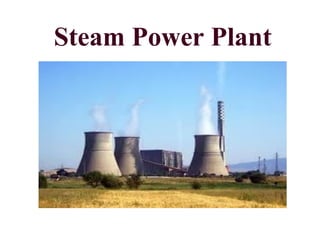
Steam Power Plant
Introduction
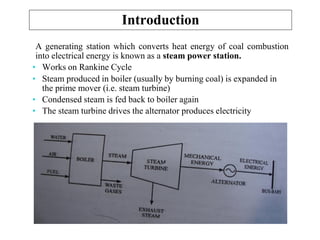
A generating station which converts heat energy of coal combustion
into electrical energy is known as a steam power station.
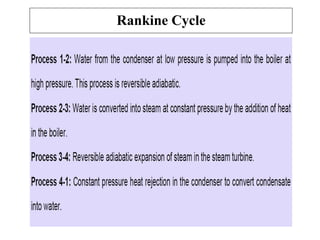
• Works on Rankine Cycle
• Steam produced in boiler (usually by burning coal) is expanded in
the prime mover (i.e. steam turbine)
• Condensed steam is fed back to boiler again
• The steam turbine drives the alternator produces electricity
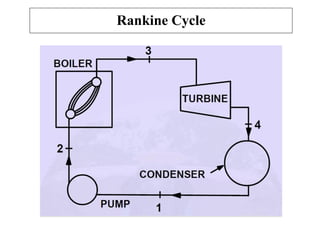
Rankine Cycle
Rankine Cycle
Advantages and Disadvantages
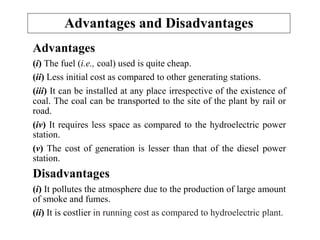
Advantages
(i) The fuel (i.e., coal) used is quite cheap.
(ii) Less initial cost as compared to other generating stations.
(iii) It can be installed at any place irrespective of the existence of
coal. The coal can be transported to the site of the plant by rail or
road.
(iv) It requires less space as compared to the hydroelectric power
station.
(v) The cost of generation is lesser than that of the diesel power
station.
Disadvantages
(i) It pollutes the atmosphere due to the production of large amount
of smoke and fumes.
(ii) It is costlier in running cost as compared to hydroelectric plant.
Layout of Steam Power Plant
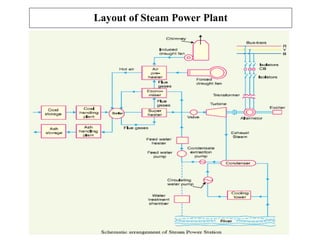
The schematic arrangement of a modern steam
power station can be divided into the following
stages:
•Coal and ash handling plant
•Steam generating plant
•Steam turbine
•Alternator
•Feed water
•Cooling arrangement
Layout of Steam Power Plant
Coal and Ash handling plant
•Coal is transported to power station by rail or
road and stored in coal storage plant and then
pulverized
•Pulverized coal is fed to the boiler by belt
conveyers
•Coal gets burned in the boiler and ash produced is
removed to the ash handling plant and then
delivered to ash storage plant for disposal
•A 100MW station operating at 50% LF may burn
about 20000tons of coal per month and produce
3000 tons of ash
Choice of Site for Steam Power Stations
•Supply of fuel.
•Availability of water.
•Transportation facilities.
•Cost and type of land.
•Nearness to load centers.
•Distance from populated area.
Equipment of Steam Power Station
• Steam generating equipment
• Condenser
• Prime mover
• Water treatment plant
• Electrical equipment.
Steam Generating Equipment
• Boiler
• boiler furnace
• Superheater
• Economizer
• air pre-heater
Boiler
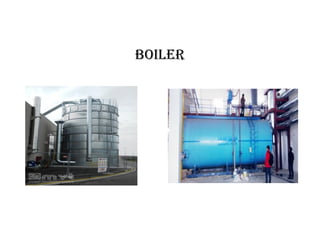
A boiler is closed vessel in which water is converted into steam by
utilizing the heat of coal combustion. Steam boilers are broadly
classified into the following two types :
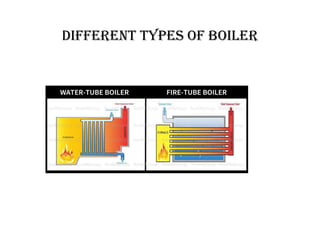
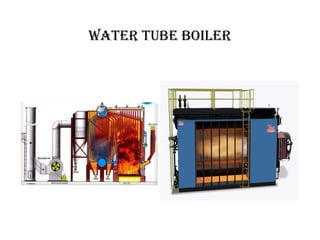
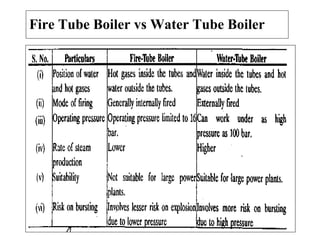
(a) Water tube boilers: water flows through the tubes and the hot
gases of combustion flow over these tubes.
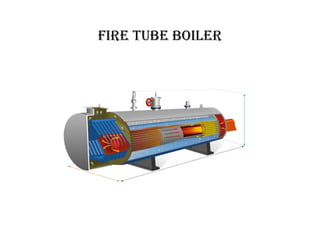
(b)Fire tube boilers: in a fire tube boiler, the hot products of
combustion pass through the tubes surrounded by water.
Water tube boilers have a number of advantages over fire tube boilers
• require less space
• smaller size of tubes and drum
• high working pressure due to small drum,
Boiler
Different Types of Boiler
Fire Tube Boiler
Water Tube Boiler
Fire Tube Boiler vs Water Tube Boiler
Boiler Furnace
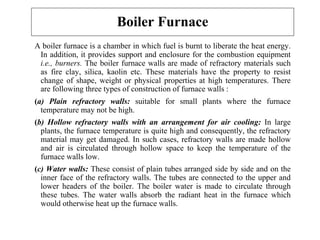
A boiler furnace is a chamber in which fuel is burnt to liberate the heat energy.
In addition, it provides support and enclosure for the combustion equipment
i.e., burners. The boiler furnace walls are made of refractory materials such
as fire clay, silica, kaolin etc. These materials have the property to resist
change of shape, weight or physical properties at high temperatures. There
are following three types of construction of furnace walls :
(a) Plain refractory walls: suitable for small plants where the furnace
temperature may not be high.
(b) Hollow refractory walls with an arrangement for air cooling: In large
plants, the furnace temperature is quite high and consequently, the refractory
material may get damaged. In such cases, refractory walls are made hollow
and air is circulated through hollow space to keep the temperature of the
furnace walls low.
(c) Water walls: These consist of plain tubes arranged side by side and on the
inner face of the refractory walls. The tubes are connected to the upper and
lower headers of the boiler. The boiler water is made to circulate through
these tubes. The water walls absorb the radiant heat in the furnace which
would otherwise heat up the furnace walls.
Superheater
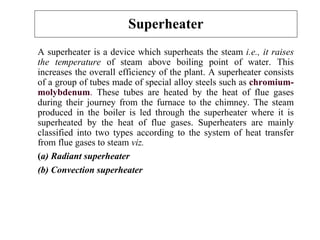
A superheater is a device which superheats the steam i.e., it raises
the temperature of steam above boiling point of water. This
increases the overall efficiency of the plant. A superheater consists
of a group of tubes made of special alloy steels such as chromium-
molybdenum. These tubes are heated by the heat of flue gases
during their journey from the furnace to the chimney. The steam
produced in the boiler is led through the superheater where it is
superheated by the heat of flue gases. Superheaters are mainly
classified into two types according to the system of heat transfer
from flue gases to steam viz.
(a) Radiant superheater
(b) Convection superheater
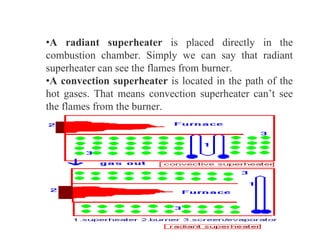
•A radiant superheater is placed directly in the
combustion chamber. Simply we can say that radiant
superheater can see the flames from burner.
•A convection superheater is located in the path of the
hot gases. That means convection superheater can’t see
the flames from the burner.
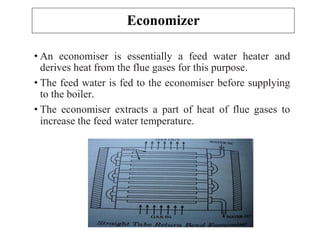
Economizer
• An economiser is essentially a feed water heater and
derives heat from the flue gases for this purpose.
• The feed water is fed to the economiser before supplying
to the boiler.
• The economiser extracts a part of heat of flue gases to
increase the feed water temperature.
Air Pre-heater
Super heaters and economizers generally cannot fully extract the
heat from flue gases. Therefore, pre-heaters are employed which
recover some of the heat in the escaping gases. The function of an
air pre-heater is to extract heat from the flue gases and give it to
the air being supplied to furnace for coal combustion. This raises
the furnace temperature and increases the thermal efficiency of the
plant. Depending upon the method of transfer of heat from flue
gases to air, air pre-heaters are divided into the following two
classes:
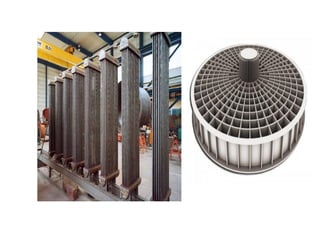
• Recuperative type: The recuperative type air-heater consists of a
group of steel tubes. The flue gases are passed through the tubes
while the air flows externally to the tubes. Thus heat of flue gases
is transferred to air.
• Regenerative type: The regenerative type air pre-heater consists of
slowly moving drum made of corrugated metal plates. The flue
gases flow continuously on one side of the drum and air on the
other side. This action permits the transference of heat of flue
gases to the air being supplied to the furnace for coal combustion
Condenser
A condenser is a device which condenses the steam at the
exhaust of turbine. It serves two important functions.
• Firstly, it creates a very low pressure at the exhaust of
turbine, thus permitting expansion of the steam in the
prime mover to a very low pressure. This helps in
converting heat energy of steam into mechanical energy in
the prime mover.
• Secondly, the condensed steam can be used as feed water
to the boiler.
There are two types of condensers, namely :
(i) Jet condenser
(ii) Surface condenser
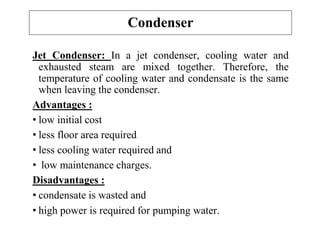
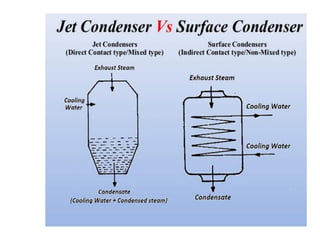
Jet Condenser: In a jet condenser, cooling water and
exhausted steam are mixed together. Therefore, the
temperature of cooling water and condensate is the same
when leaving the condenser.
Advantages :
• low initial cost
• less floor area required
• less cooling water required and
• low maintenance charges.
Disadvantages :
• condensate is wasted and
• high power is required for pumping water.
Condenser
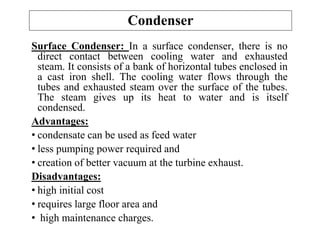
Surface Condenser: In a surface condenser, there is no
direct contact between cooling water and exhausted
steam. It consists of a bank of horizontal tubes enclosed in
a cast iron shell. The cooling water flows through the
tubes and exhausted steam over the surface of the tubes.
The steam gives up its heat to water and is itself
condensed.
Advantages:
• condensate can be used as feed water
• less pumping power required and
• creation of better vacuum at the turbine exhaust.
Disadvantages:
• high initial cost
• requires large floor area and
• high maintenance charges.
Condenser
Prime Mover
The prime mover converts steam energy into mechanical energy.
There are two types of steam prime movers:
• steam engines and
• steam turbines
A steam turbine has several advantages over a steam engine as a
prime mover:
• high efficiency
• simple construction
• Higher speed
• less floor area requirement and
• low maintenance cost.
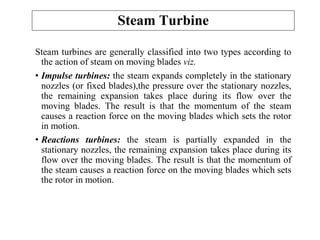
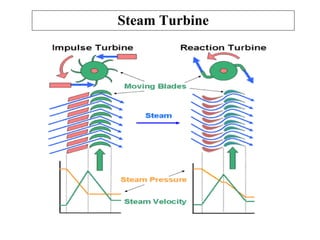
Steam turbines are generally classified into two types according to
the action of steam on moving blades viz.
• Impulse turbines: the steam expands completely in the stationary
nozzles (or fixed blades),the pressure over the stationary nozzles,
the remaining expansion takes place during its flow over the
moving blades. The result is that the momentum of the steam
causes a reaction force on the moving blades which sets the rotor
in motion.
• Reactions turbines: the steam is partially expanded in the
stationary nozzles, the remaining expansion takes place during its
flow over the moving blades. The result is that the momentum of
the steam causes a reaction force on the moving blades which sets
the rotor in motion.
Steam Turbine
Steam Turbine
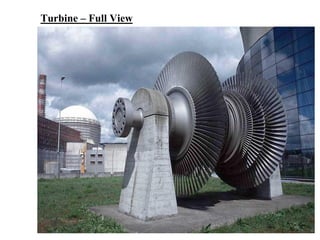
Turbine – Full View
Water Treatment Plant
Boilers require clean and soft water for longer life and better
efficiency. However, the source of boiler feed water is generally a
river or lake which may contain suspended and dissolved
impurities, dissolved gases etc. Therefore, it is very important that
water is first purified and softened by chemical treatment and then
delivered to the boiler.
The water from the source of supply is stored in storage tanks. The
suspended impurities are removed through sedimentation,
coagulation and filtration. Dissolved gases are removed by
aeration and degasification. The water is then ‘softened’ by
removing temporary and permanent hardness through different
chemical processes. The pure and soft water thus available is fed
to the boiler for steam generation.
Electrical Equipment
(i) Alternators: Each alternator is coupled to a steam turbine and
converts mechanical energy of the turbine into electrical energy.
The alternator may be hydrogen or air cooled. The necessary
excitation is provided by means of main and pilot exciters directly
coupled to the alternator shaft.
(ii) Transformers: A generating station has different types of
transformers, viz.,
(a) main step-up transformers which step-up the generation
voltage for transmission of power.
(b) station transformers which are used for general service (e.g.,
lighting) in the power station.
(c) auxiliary transformers which supply to individual unit-
auxiliaries.
(iii) Switchgear. It houses such equipment which locates the fault
on the system and isolate the faulty part from the healthy section.
It contains circuit breakers, relays, switches and other control
devices
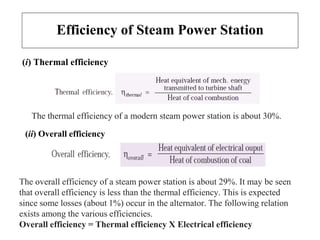
Efficiency of Steam Power Station
(i) Thermal efficiency
(ii) Overall efficiency
The thermal efficiency of a modern steam power station is about 30%.
The overall efficiency of a steam power station is about 29%. It may be seen
that overall efficiency is less than the thermal efficiency. This is expected
since some losses (about 1%) occur in the alternator. The following relation
exists among the various efficiencies.
Overall efficiency = Thermal efficiency X Electrical efficiency
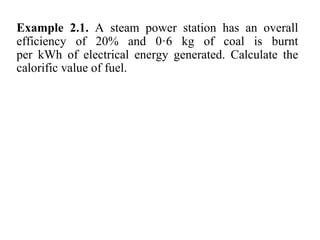
Example 2.1. A steam power station has an overall
efficiency of 20% and 0·6 kg of coal is burnt
per kWh of electrical energy generated. Calculate the
calorific value of fuel.
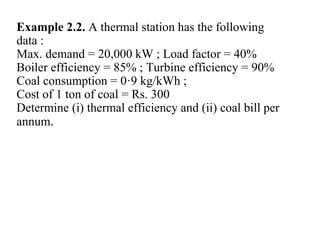
Example 2.2. A thermal station has the following
data :
Max. demand = 20,000 kW ; Load factor = 40%
Boiler efficiency = 85% ; Turbine efficiency = 90%
Coal consumption = 0·9 kg/kWh ;
Cost of 1 ton of coal = Rs. 300
Determine (i) thermal efficiency and (ii) coal bill per
annum.
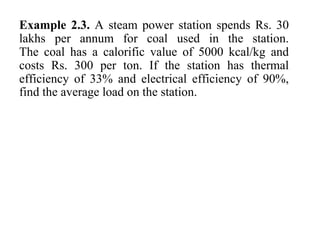
Example 2.3. A steam power station spends Rs. 30
lakhs per annum for coal used in the station.
The coal has a calorific value of 5000 kcal/kg and
costs Rs. 300 per ton. If the station has thermal
efficiency of 33% and electrical efficiency of 90%,
find the average load on the station.
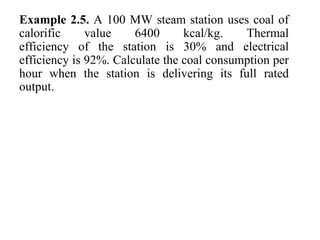
Example 2.5. A 100 MW steam station uses coal of
calorific value 6400 kcal/kg. Thermal
efficiency of the station is 30% and electrical
efficiency is 92%. Calculate the coal consumption per
hour when the station is delivering its full rated
output.
Steam-Power-Plant-updated.pdf engineering students

Steam-Power-Plant-updated.pdf engineering students

  • 1.
    Power Plant Engineering Preparedby- Nusrat Chowdhury Assistant Professor, EEE Daffodil International University (DIU)
  • 2.
  • 3.
    Introduction A generating stationwhich converts heat energy of coal combustion into electrical energy is known as a steam power station. • Works on Rankine Cycle • Steam produced in boiler (usually by burning coal) is expanded in the prime mover (i.e. steam turbine) • Condensed steam is fed back to boiler again • The steam turbine drives the alternator produces electricity
  • 4.
  • 5.
  • 6.
    Advantages and Disadvantages Advantages (i)The fuel (i.e., coal) used is quite cheap. (ii) Less initial cost as compared to other generating stations. (iii) It can be installed at any place irrespective of the existence of coal. The coal can be transported to the site of the plant by rail or road. (iv) It requires less space as compared to the hydroelectric power station. (v) The cost of generation is lesser than that of the diesel power station. Disadvantages (i) It pollutes the atmosphere due to the production of large amount of smoke and fumes. (ii) It is costlier in running cost as compared to hydroelectric plant.
  • 7.
    Layout of SteamPower Plant The schematic arrangement of a modern steam power station can be divided into the following stages: •Coal and ash handling plant •Steam generating plant •Steam turbine •Alternator •Feed water •Cooling arrangement
  • 8.
    Layout of SteamPower Plant
  • 9.
    Coal and Ashhandling plant •Coal is transported to power station by rail or road and stored in coal storage plant and then pulverized •Pulverized coal is fed to the boiler by belt conveyers •Coal gets burned in the boiler and ash produced is removed to the ash handling plant and then delivered to ash storage plant for disposal •A 100MW station operating at 50% LF may burn about 20000tons of coal per month and produce 3000 tons of ash
  • 10.
    Choice of Sitefor Steam Power Stations •Supply of fuel. •Availability of water. •Transportation facilities. •Cost and type of land. •Nearness to load centers. •Distance from populated area.
  • 11.
    Equipment of SteamPower Station • Steam generating equipment • Condenser • Prime mover • Water treatment plant • Electrical equipment.
  • 12.
    Steam Generating Equipment •Boiler • boiler furnace • Superheater • Economizer • air pre-heater
  • 13.
    Boiler A boiler isclosed vessel in which water is converted into steam by utilizing the heat of coal combustion. Steam boilers are broadly classified into the following two types : (a) Water tube boilers: water flows through the tubes and the hot gases of combustion flow over these tubes. (b)Fire tube boilers: in a fire tube boiler, the hot products of combustion pass through the tubes surrounded by water. Water tube boilers have a number of advantages over fire tube boilers • require less space • smaller size of tubes and drum • high working pressure due to small drum,
  • 14.
  • 15.
  • 16.
  • 17.
  • 18.
    Fire Tube Boilervs Water Tube Boiler
  • 19.
    Boiler Furnace A boilerfurnace is a chamber in which fuel is burnt to liberate the heat energy. In addition, it provides support and enclosure for the combustion equipment i.e., burners. The boiler furnace walls are made of refractory materials such as fire clay, silica, kaolin etc. These materials have the property to resist change of shape, weight or physical properties at high temperatures. There are following three types of construction of furnace walls : (a) Plain refractory walls: suitable for small plants where the furnace temperature may not be high. (b) Hollow refractory walls with an arrangement for air cooling: In large plants, the furnace temperature is quite high and consequently, the refractory material may get damaged. In such cases, refractory walls are made hollow and air is circulated through hollow space to keep the temperature of the furnace walls low. (c) Water walls: These consist of plain tubes arranged side by side and on the inner face of the refractory walls. The tubes are connected to the upper and lower headers of the boiler. The boiler water is made to circulate through these tubes. The water walls absorb the radiant heat in the furnace which would otherwise heat up the furnace walls.
  • 20.
    Superheater A superheater isa device which superheats the steam i.e., it raises the temperature of steam above boiling point of water. This increases the overall efficiency of the plant. A superheater consists of a group of tubes made of special alloy steels such as chromium- molybdenum. These tubes are heated by the heat of flue gases during their journey from the furnace to the chimney. The steam produced in the boiler is led through the superheater where it is superheated by the heat of flue gases. Superheaters are mainly classified into two types according to the system of heat transfer from flue gases to steam viz. (a) Radiant superheater (b) Convection superheater
  • 21.
    •A radiant superheateris placed directly in the combustion chamber. Simply we can say that radiant superheater can see the flames from burner. •A convection superheater is located in the path of the hot gases. That means convection superheater can’t see the flames from the burner.
  • 22.
    Economizer • An economiseris essentially a feed water heater and derives heat from the flue gases for this purpose. • The feed water is fed to the economiser before supplying to the boiler. • The economiser extracts a part of heat of flue gases to increase the feed water temperature.
  • 23.
    Air Pre-heater Super heatersand economizers generally cannot fully extract the heat from flue gases. Therefore, pre-heaters are employed which recover some of the heat in the escaping gases. The function of an air pre-heater is to extract heat from the flue gases and give it to the air being supplied to furnace for coal combustion. This raises the furnace temperature and increases the thermal efficiency of the plant. Depending upon the method of transfer of heat from flue gases to air, air pre-heaters are divided into the following two classes: • Recuperative type: The recuperative type air-heater consists of a group of steel tubes. The flue gases are passed through the tubes while the air flows externally to the tubes. Thus heat of flue gases is transferred to air. • Regenerative type: The regenerative type air pre-heater consists of slowly moving drum made of corrugated metal plates. The flue gases flow continuously on one side of the drum and air on the other side. This action permits the transference of heat of flue gases to the air being supplied to the furnace for coal combustion
  • 25.
    Condenser A condenser isa device which condenses the steam at the exhaust of turbine. It serves two important functions. • Firstly, it creates a very low pressure at the exhaust of turbine, thus permitting expansion of the steam in the prime mover to a very low pressure. This helps in converting heat energy of steam into mechanical energy in the prime mover. • Secondly, the condensed steam can be used as feed water to the boiler. There are two types of condensers, namely : (i) Jet condenser (ii) Surface condenser
  • 26.
    Jet Condenser: Ina jet condenser, cooling water and exhausted steam are mixed together. Therefore, the temperature of cooling water and condensate is the same when leaving the condenser. Advantages : • low initial cost • less floor area required • less cooling water required and • low maintenance charges. Disadvantages : • condensate is wasted and • high power is required for pumping water. Condenser
  • 27.
    Surface Condenser: Ina surface condenser, there is no direct contact between cooling water and exhausted steam. It consists of a bank of horizontal tubes enclosed in a cast iron shell. The cooling water flows through the tubes and exhausted steam over the surface of the tubes. The steam gives up its heat to water and is itself condensed. Advantages: • condensate can be used as feed water • less pumping power required and • creation of better vacuum at the turbine exhaust. Disadvantages: • high initial cost • requires large floor area and • high maintenance charges. Condenser
  • 29.
    Prime Mover The primemover converts steam energy into mechanical energy. There are two types of steam prime movers: • steam engines and • steam turbines A steam turbine has several advantages over a steam engine as a prime mover: • high efficiency • simple construction • Higher speed • less floor area requirement and • low maintenance cost.
  • 30.
    Steam turbines aregenerally classified into two types according to the action of steam on moving blades viz. • Impulse turbines: the steam expands completely in the stationary nozzles (or fixed blades),the pressure over the stationary nozzles, the remaining expansion takes place during its flow over the moving blades. The result is that the momentum of the steam causes a reaction force on the moving blades which sets the rotor in motion. • Reactions turbines: the steam is partially expanded in the stationary nozzles, the remaining expansion takes place during its flow over the moving blades. The result is that the momentum of the steam causes a reaction force on the moving blades which sets the rotor in motion. Steam Turbine
  • 31.
  • 32.
  • 33.
    Water Treatment Plant Boilersrequire clean and soft water for longer life and better efficiency. However, the source of boiler feed water is generally a river or lake which may contain suspended and dissolved impurities, dissolved gases etc. Therefore, it is very important that water is first purified and softened by chemical treatment and then delivered to the boiler. The water from the source of supply is stored in storage tanks. The suspended impurities are removed through sedimentation, coagulation and filtration. Dissolved gases are removed by aeration and degasification. The water is then ‘softened’ by removing temporary and permanent hardness through different chemical processes. The pure and soft water thus available is fed to the boiler for steam generation.
  • 34.
    Electrical Equipment (i) Alternators:Each alternator is coupled to a steam turbine and converts mechanical energy of the turbine into electrical energy. The alternator may be hydrogen or air cooled. The necessary excitation is provided by means of main and pilot exciters directly coupled to the alternator shaft. (ii) Transformers: A generating station has different types of transformers, viz., (a) main step-up transformers which step-up the generation voltage for transmission of power. (b) station transformers which are used for general service (e.g., lighting) in the power station. (c) auxiliary transformers which supply to individual unit- auxiliaries. (iii) Switchgear. It houses such equipment which locates the fault on the system and isolate the faulty part from the healthy section. It contains circuit breakers, relays, switches and other control devices
  • 35.
    Efficiency of SteamPower Station (i) Thermal efficiency (ii) Overall efficiency The thermal efficiency of a modern steam power station is about 30%. The overall efficiency of a steam power station is about 29%. It may be seen that overall efficiency is less than the thermal efficiency. This is expected since some losses (about 1%) occur in the alternator. The following relation exists among the various efficiencies. Overall efficiency = Thermal efficiency X Electrical efficiency
  • 36.
    Example 2.1. Asteam power station has an overall efficiency of 20% and 0·6 kg of coal is burnt per kWh of electrical energy generated. Calculate the calorific value of fuel.
  • 37.
    Example 2.2. Athermal station has the following data : Max. demand = 20,000 kW ; Load factor = 40% Boiler efficiency = 85% ; Turbine efficiency = 90% Coal consumption = 0·9 kg/kWh ; Cost of 1 ton of coal = Rs. 300 Determine (i) thermal efficiency and (ii) coal bill per annum.
  • 38.
    Example 2.3. Asteam power station spends Rs. 30 lakhs per annum for coal used in the station. The coal has a calorific value of 5000 kcal/kg and costs Rs. 300 per ton. If the station has thermal efficiency of 33% and electrical efficiency of 90%, find the average load on the station.
  • 39.
    Example 2.5. A100 MW steam station uses coal of calorific value 6400 kcal/kg. Thermal efficiency of the station is 30% and electrical efficiency is 92%. Calculate the coal consumption per hour when the station is delivering its full rated output.