Ash Handling
System
Ntpc-BRBCL
(250*4) MW
Submitted by :
Aditya Anand
Medha Mehta
Abhijeet Bouri
Sourav Mondal
What is ash ?
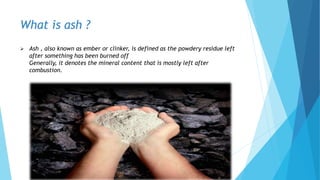
 Ash , also known as ember or clinker, is defined as the powdery residue left
after something has been burned off
Generally, it denotes the mineral content that is mostly left after
combustion.
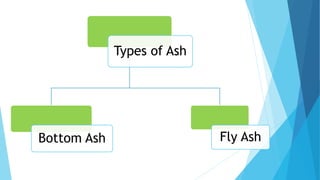
Types of Ash
Bottom Ash Fly Ash
Bottom Ash
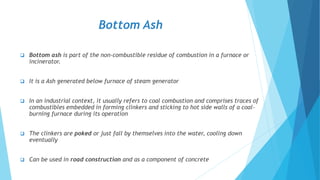
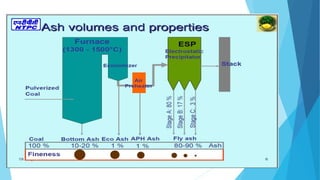
 Bottom ash is part of the non-combustible residue of combustion in a furnace or
incinerator.
 It is a Ash generated below furnace of steam generator
 In an industrial context, it usually refers to coal combustion and comprises traces of
combustibles embedded in forming clinkers and sticking to hot side walls of a coal-
burning furnace during its operation
 The clinkers are poked or just fall by themselves into the water, cooling down
eventually
 Can be used in road construction and as a component of concrete
Fly Ash
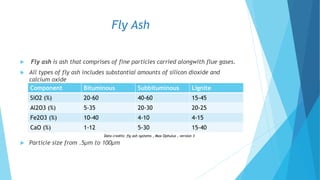
 Fly ash is ash that comprises of fine particles carried alongwith flue gases.
 All types of fly ash includes substantial amounts of silicon dioxide and
calcium oxide
 Particle size from .5µm to 100µm
Component Bituminous Subbituminous Lignite
SiO2 (%) 20-60 40-60 15-45
Al2O3 (%) 5-35 20-30 20-25
Fe2O3 (%) 10-40 4-10 4-15
CaO (%) 1-12 5-30 15-40
Data credits: fly ash systems , Max Ophulus , version 3
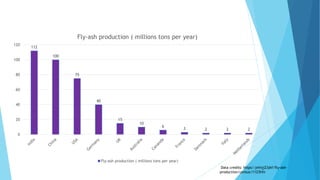
112
100
75
40
15
10
6
3 2 2 2
0
20
40
60
80
100
120
Fly-ash production ( millions tons per year)
Data credits: https/:jnfnjj23jkf/fly-ash-
production/census/1123hfn
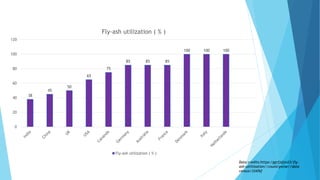
38
45
50
65
75
85 85 85
100 100 100
0
20
40
60
80
100
120
Fly-ash utilization ( % )
Data credits:https:/ggrfjdjsn23/fly-
ash-utlilization//countrywise//data
census/334?bf
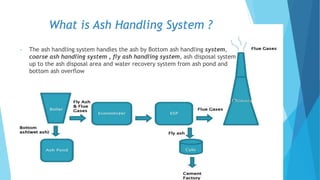
What is Ash Handling System ?
• The ash handling system handles the ash by Bottom ash handling system,
coarse ash handling system , fly ash handling system, ash disposal system
up to the ash disposal area and water recovery system from ash pond and
bottom ash overflow
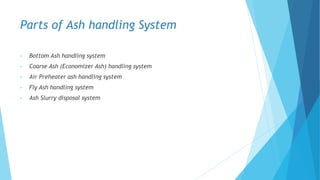
Parts of Ash handling System
• Bottom Ash handling system
• Coarse Ash (Economizer Ash) handling system
• Air Preheater ash handling system
• Fly Ash handling system
• Ash Slurry disposal system
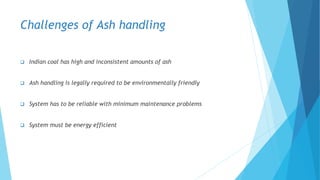
Challenges of Ash handling
 Indian coal has high and inconsistent amounts of ash
 Ash handling is legally required to be environmentally friendly
 System has to be reliable with minimum maintenance problems
 System must be energy efficient
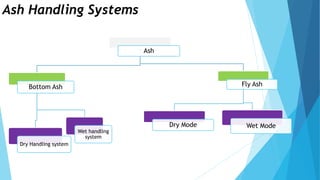
Ash Handling Systems
Ash
Bottom Ash
Wet handling
system
Dry Handling system
Fly Ash
Dry Mode Wet Mode
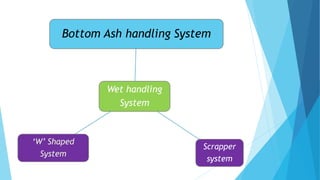
Wet handling
System
Bottom Ash handling System
Scrapper
system
‘W’ Shaped
System
Wet Ash handling System
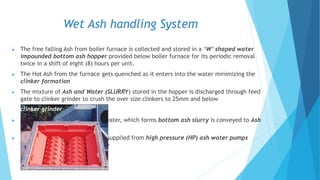
 The free falling Ash from boiler furnace is collected and stored in a ‘W’ shaped water
impounded bottom ash hopper provided below boiler furnace for its periodic removal
twice in a shift of eight (8) hours per unit.
 The Hot Ash from the furnace gets quenched as it enters into the water minimizing the
clinker formation
 The mixture of Ash and Water (SLURRY) stored in the hopper is discharged through feed
gate to clinker grinder to crush the over size clinkers to 25mm and below
 The crushed clinker along with water, which forms bottom ash slurry is conveyed to Ash
Slurry sump
 Water required for jet pumps is supplied from high pressure (HP) ash water pumps
located in Ash water pump house
clinker grinder
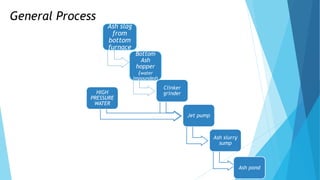
General Process
Ash slag
from
bottom
furnace
Bottom
Ash
hopper
(water
impounded)
Clinker
grinder
Jet pump
Ash slurry
sump
Ash pond
HIGH
PRESSURE
WATER
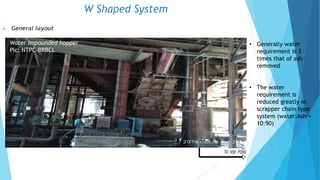
W Shaped System
 General layout
Water Impounded hopper
Pic: NTPC-BRBCL
• Generally water
requirement is 3
times that of ash
removed
• The water
requirement is
reduced greatly in
scrapper chain type
system (water:Ash =
10:90)
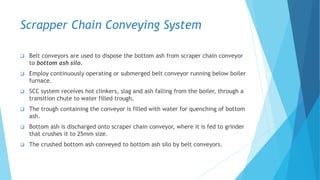
Scrapper Chain Conveying System
 Belt conveyors are used to dispose the bottom ash from scraper chain conveyor
to bottom ash silo.
 Employ continuously operating or submerged belt conveyor running below boiler
furnace.
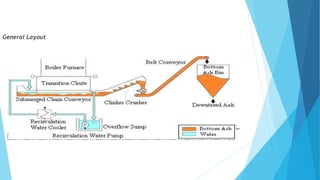
 SCC system receives hot clinkers, slag and ash falling from the boiler, through a
transition chute to water filled trough.
 The trough containing the conveyor is filled with water for quenching of bottom
ash.
 Bottom ash is discharged onto scraper chain conveyor, where it is fed to grinder
that crushes it to 25mm size.
 The crushed bottom ash conveyed to bottom ash silo by belt conveyors.
General Layout
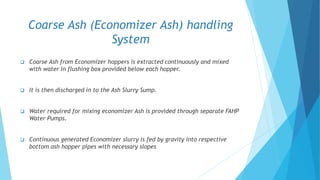
Coarse Ash (Economizer Ash) handling
System
 Coarse Ash from Economizer hoppers is extracted continuously and mixed
with water in flushing box provided below each hopper.
 It is then discharged in to the Ash Slurry Sump.
 Water required for mixing economizer Ash is provided through separate FAHP
Water Pumps.
 Continuous generated Economizer slurry is fed by gravity into respective
bottom ash hopper pipes with necessary slopes
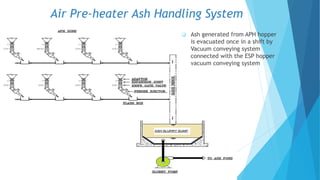
Air Pre-heater Ash Handling System
 Ash generated from APH hopper
is evacuated once in a shift by
Vacuum conveying system
connected with the ESP hopper
vacuum conveying system
Fly Ash handling system
DRY MODE
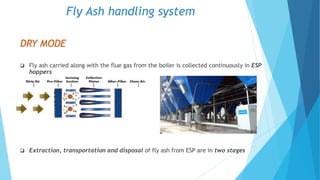
 Fly ash carried along with the flue gas from the boiler is collected continuously in ESP
hoppers
 Extraction, transportation and disposal of fly ash from ESP are in two stages
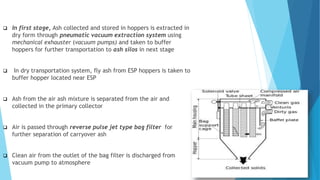
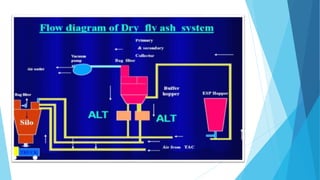
 In first stage, Ash collected and stored in hoppers is extracted in
dry form through pneumatic vacuum extraction system using
mechanical exhauster (vacuum pumps) and taken to buffer
hoppers for further transportation to ash silos in next stage
 In dry transportation system, fly ash from ESP hoppers is taken to
buffer hopper located near ESP
 Ash from the air ash mixture is separated from the air and
collected in the primary collector
 Air is passed through reverse pulse jet type bag filter for
further separation of carryover ash
 Clean air from the outlet of the bag filter is discharged from
vacuum pump to atmosphere
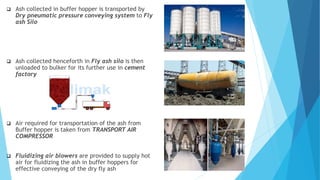
 Ash collected in buffer hopper is transported by
Dry pneumatic pressure conveying system to Fly
ash Silo
 Ash collected henceforth in Fly ash silo is then
unloaded to bulker for its further use in cement
factory
 Air required for transportation of the ash from
Buffer hopper is taken from TRANSPORT AIR
COMPRESSOR
 Fluidizing air blowers are provided to supply hot
air for fluidizing the ash in buffer hoppers for
effective conveying of the dry fly ash
Wet Mode
 Dry ash is taken to wetting unit, mixed with water and slurry is collected in collector tank
 The ash slurry is then taken to ash slurry sump to ash pond thru ash slurry disposal pump
 FAHP water pump provides the high pressure water to wetting unit
Pneumatic conveying system of fly ash
• Pneumatic vacuum conveying system
• Pneumatic pressure conveying system
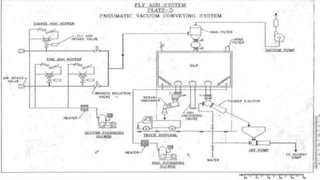
Pneumatic Vacuum Conveying System
Ash is conveyed pneumatically under negative pressure through specially designed valves and pipelines from fly
ash hoppers to –
• Nearby Silo, for eventual disposal in dry or moistened condition
• Intermediate Surge tank, for onward dry transportation by pneumatic pressure conveying system to
remote silo
• Wetting Unit-Collector Tank – Air washer set, for wet disposal in slurry form
The wetting unit system can be a standby for the preceding dry system. The slurry can be mechanical
exhausters/vacuum pumps are generally need for creating the vacuum. Hydraulic exhausters, though
available,are seldom need nowadays.
General Layout
Pneumatic pressure conveying system
• Ash is conveyed pneumatically under positive pressure from Fly ash hoppers or Intermediate
surge tank to Silo for dry ash storage.
• Further, onward disposal is done in dry or semi dry condition through tankers or open trucks
Ash Slurry disposal System
• Bottom Ash slurry, fly Ash slurry and the Coarse Ash slurry shall be pumped
from common ash slurry sump upto the dyke area which is located at a
distance from slurry pump house.
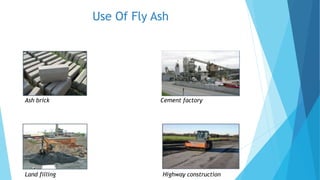
Use Of Fly Ash
Ash brick Cement factory
Land filling Highway construction

ASH HANDLING PLANT

  • 1.
    Ash Handling System Ntpc-BRBCL (250*4) MW Submittedby : Aditya Anand Medha Mehta Abhijeet Bouri Sourav Mondal
  • 2.
    What is ash?  Ash , also known as ember or clinker, is defined as the powdery residue left after something has been burned off Generally, it denotes the mineral content that is mostly left after combustion.
  • 3.
  • 4.
    Bottom Ash  Bottomash is part of the non-combustible residue of combustion in a furnace or incinerator.  It is a Ash generated below furnace of steam generator  In an industrial context, it usually refers to coal combustion and comprises traces of combustibles embedded in forming clinkers and sticking to hot side walls of a coal- burning furnace during its operation  The clinkers are poked or just fall by themselves into the water, cooling down eventually  Can be used in road construction and as a component of concrete
  • 5.
    Fly Ash  Flyash is ash that comprises of fine particles carried alongwith flue gases.  All types of fly ash includes substantial amounts of silicon dioxide and calcium oxide  Particle size from .5µm to 100µm Component Bituminous Subbituminous Lignite SiO2 (%) 20-60 40-60 15-45 Al2O3 (%) 5-35 20-30 20-25 Fe2O3 (%) 10-40 4-10 4-15 CaO (%) 1-12 5-30 15-40 Data credits: fly ash systems , Max Ophulus , version 3
  • 6.
    112 100 75 40 15 10 6 3 2 22 0 20 40 60 80 100 120 Fly-ash production ( millions tons per year) Fly-ash production ( millions tons per year) Data credits: https/:jnfnjj23jkf/fly-ash- production/census/1123hfn
  • 7.
    38 45 50 65 75 85 85 85 100100 100 0 20 40 60 80 100 120 Fly-ash utilization ( % ) Fly-ash utilization ( % ) Data credits:https:/ggrfjdjsn23/fly- ash-utlilization//countrywise//data census/334?bf
  • 8.
    What is AshHandling System ? • The ash handling system handles the ash by Bottom ash handling system, coarse ash handling system , fly ash handling system, ash disposal system up to the ash disposal area and water recovery system from ash pond and bottom ash overflow
  • 9.
    Parts of Ashhandling System • Bottom Ash handling system • Coarse Ash (Economizer Ash) handling system • Air Preheater ash handling system • Fly Ash handling system • Ash Slurry disposal system
  • 11.
    Challenges of Ashhandling  Indian coal has high and inconsistent amounts of ash  Ash handling is legally required to be environmentally friendly  System has to be reliable with minimum maintenance problems  System must be energy efficient
  • 12.
    Ash Handling Systems Ash BottomAsh Wet handling system Dry Handling system Fly Ash Dry Mode Wet Mode
  • 13.
    Wet handling System Bottom Ashhandling System Scrapper system ‘W’ Shaped System
  • 14.
    Wet Ash handlingSystem  The free falling Ash from boiler furnace is collected and stored in a ‘W’ shaped water impounded bottom ash hopper provided below boiler furnace for its periodic removal twice in a shift of eight (8) hours per unit.  The Hot Ash from the furnace gets quenched as it enters into the water minimizing the clinker formation  The mixture of Ash and Water (SLURRY) stored in the hopper is discharged through feed gate to clinker grinder to crush the over size clinkers to 25mm and below  The crushed clinker along with water, which forms bottom ash slurry is conveyed to Ash Slurry sump  Water required for jet pumps is supplied from high pressure (HP) ash water pumps located in Ash water pump house clinker grinder
  • 15.
  • 16.
    W Shaped System General layout Water Impounded hopper Pic: NTPC-BRBCL • Generally water requirement is 3 times that of ash removed • The water requirement is reduced greatly in scrapper chain type system (water:Ash = 10:90)
  • 17.
    Scrapper Chain ConveyingSystem  Belt conveyors are used to dispose the bottom ash from scraper chain conveyor to bottom ash silo.  Employ continuously operating or submerged belt conveyor running below boiler furnace.  SCC system receives hot clinkers, slag and ash falling from the boiler, through a transition chute to water filled trough.  The trough containing the conveyor is filled with water for quenching of bottom ash.  Bottom ash is discharged onto scraper chain conveyor, where it is fed to grinder that crushes it to 25mm size.  The crushed bottom ash conveyed to bottom ash silo by belt conveyors.
  • 18.
  • 19.
    Coarse Ash (EconomizerAsh) handling System  Coarse Ash from Economizer hoppers is extracted continuously and mixed with water in flushing box provided below each hopper.  It is then discharged in to the Ash Slurry Sump.  Water required for mixing economizer Ash is provided through separate FAHP Water Pumps.  Continuous generated Economizer slurry is fed by gravity into respective bottom ash hopper pipes with necessary slopes
  • 20.
    Air Pre-heater AshHandling System  Ash generated from APH hopper is evacuated once in a shift by Vacuum conveying system connected with the ESP hopper vacuum conveying system
  • 21.
    Fly Ash handlingsystem DRY MODE  Fly ash carried along with the flue gas from the boiler is collected continuously in ESP hoppers  Extraction, transportation and disposal of fly ash from ESP are in two stages
  • 22.
     In firststage, Ash collected and stored in hoppers is extracted in dry form through pneumatic vacuum extraction system using mechanical exhauster (vacuum pumps) and taken to buffer hoppers for further transportation to ash silos in next stage  In dry transportation system, fly ash from ESP hoppers is taken to buffer hopper located near ESP  Ash from the air ash mixture is separated from the air and collected in the primary collector  Air is passed through reverse pulse jet type bag filter for further separation of carryover ash  Clean air from the outlet of the bag filter is discharged from vacuum pump to atmosphere
  • 24.
     Ash collectedin buffer hopper is transported by Dry pneumatic pressure conveying system to Fly ash Silo  Ash collected henceforth in Fly ash silo is then unloaded to bulker for its further use in cement factory  Air required for transportation of the ash from Buffer hopper is taken from TRANSPORT AIR COMPRESSOR  Fluidizing air blowers are provided to supply hot air for fluidizing the ash in buffer hoppers for effective conveying of the dry fly ash
  • 25.
    Wet Mode  Dryash is taken to wetting unit, mixed with water and slurry is collected in collector tank  The ash slurry is then taken to ash slurry sump to ash pond thru ash slurry disposal pump  FAHP water pump provides the high pressure water to wetting unit
  • 26.
    Pneumatic conveying systemof fly ash • Pneumatic vacuum conveying system • Pneumatic pressure conveying system
  • 27.
    Pneumatic Vacuum ConveyingSystem Ash is conveyed pneumatically under negative pressure through specially designed valves and pipelines from fly ash hoppers to – • Nearby Silo, for eventual disposal in dry or moistened condition • Intermediate Surge tank, for onward dry transportation by pneumatic pressure conveying system to remote silo • Wetting Unit-Collector Tank – Air washer set, for wet disposal in slurry form The wetting unit system can be a standby for the preceding dry system. The slurry can be mechanical exhausters/vacuum pumps are generally need for creating the vacuum. Hydraulic exhausters, though available,are seldom need nowadays.
  • 28.
  • 29.
    Pneumatic pressure conveyingsystem • Ash is conveyed pneumatically under positive pressure from Fly ash hoppers or Intermediate surge tank to Silo for dry ash storage. • Further, onward disposal is done in dry or semi dry condition through tankers or open trucks
  • 30.
    Ash Slurry disposalSystem • Bottom Ash slurry, fly Ash slurry and the Coarse Ash slurry shall be pumped from common ash slurry sump upto the dyke area which is located at a distance from slurry pump house.
  • 31.
    Use Of FlyAsh Ash brick Cement factory Land filling Highway construction