Brain Tumors
Presenters: Rolex Maklago & Irene Onyango
Moderator: Dr. Lee Ogutha
Date: 12th July 2021
Outline
• Brain anatomy and physiology
• Risk factors
• Classification
• Specific tumors
• Clinical presentations
• Diagnosis
• Treatment
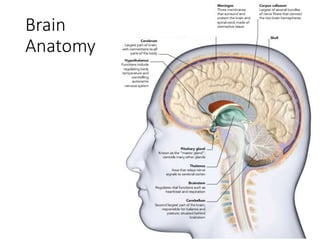
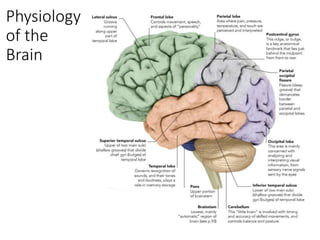
Brain
Anatomy
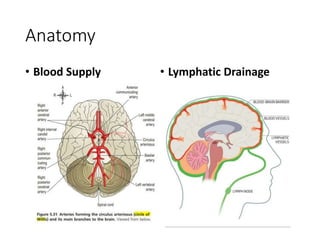
Anatomy
• Blood Supply • Lymphatic Drainage
Physiology
of the
Brain
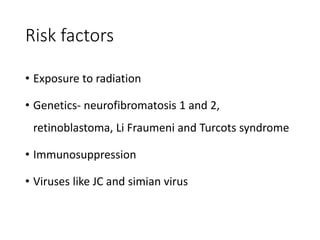
Risk factors
• Exposure to radiation
• Genetics- neurofibromatosis 1 and 2,
retinoblastoma, Li Fraumeni and Turcots syndrome
• Immunosuppression
• Viruses like JC and simian virus
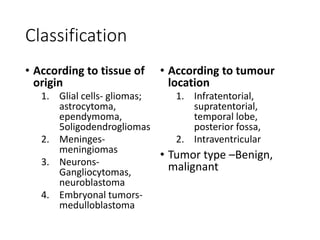
Classification
• According to tissue of
origin
1. Glial cells- gliomas;
astrocytoma,
ependymoma,
5oligodendrogliomas
2. Meninges-
meningiomas
3. Neurons-
Gangliocytomas,
neuroblastoma
4. Embryonal tumors-
medulloblastoma
• According to tumour
location
1. Infratentorial,
supratentorial,
temporal lobe,
posterior fossa,
2. Intraventricular
• Tumor type –Benign,
malignant
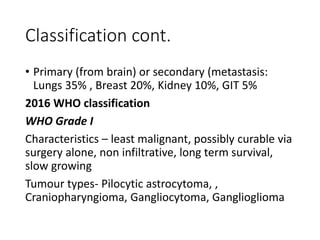
Classification cont.
• Primary (from brain) or secondary (metastasis:
Lungs 35% , Breast 20%, Kidney 10%, GIT 5%
2016 WHO classification
WHO Grade I
Characteristics – least malignant, possibly curable via
surgery alone, non infiltrative, long term survival,
slow growing
Tumour types- Pilocytic astrocytoma, ,
Craniopharyngioma, Gangliocytoma, Ganglioglioma
Classification cont
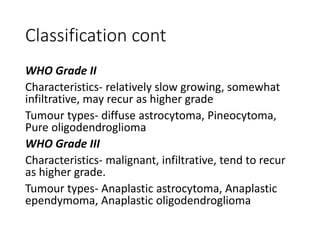
WHO Grade II
Characteristics- relatively slow growing, somewhat
infiltrative, may recur as higher grade
Tumour types- diffuse astrocytoma, Pineocytoma,
Pure oligodendroglioma
WHO Grade III
Characteristics- malignant, infiltrative, tend to recur
as higher grade.
Tumour types- Anaplastic astrocytoma, Anaplastic
ependymoma, Anaplastic oligodendroglioma
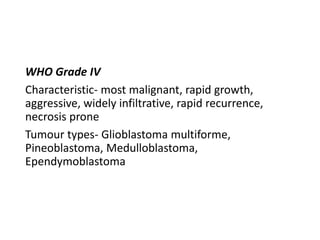
WHO Grade IV
Characteristic- most malignant, rapid growth,
aggressive, widely infiltrative, rapid recurrence,
necrosis prone
Tumour types- Glioblastoma multiforme,
Pineoblastoma, Medulloblastoma,
Ependymoblastoma
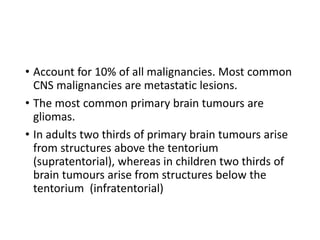
• Account for 10% of all malignancies. Most common
CNS malignancies are metastatic lesions.
• The most common primary brain tumours are
gliomas.
• In adults two thirds of primary brain tumours arise
from structures above the tentorium
(supratentorial), whereas in children two thirds of
brain tumours arise from structures below the
tentorium (infratentorial)
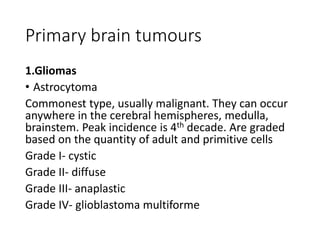
Primary brain tumours
1.Gliomas
• Astrocytoma
Commonest type, usually malignant. They can occur
anywhere in the cerebral hemispheres, medulla,
brainstem. Peak incidence is 4th decade. Are graded
based on the quantity of adult and primitive cells
Grade I- cystic
Grade II- diffuse
Grade III- anaplastic
Grade IV- glioblastoma multiforme
• Glioblastoma multiforme
Most invasive type of glial tumours. Tend to grow
rapidly and spread to other tissues and have poor
prognosis. May be composed of several types of cells
eg astrocytes, oligodendrocytes. More common in
people ages 50-70 and more prevalent in men than
women.
• Oligodendrogliomas
Slow growing tumours, commonly arising from the
frontal lobes, lasts for years and show calcification
• Medulloblastoma
Highly malignant embryonal tumours grouped as PNET
arising from primitive cell nests. Most common brain
tumour in children. It often spreads within the brain itself
and can extend to the spinal canal
• Ependymoma
Here cells resemble the ependymal cells. Can occur
throughout the hemisphere. Arise from cells lining the
ventricles of the brain and central canal of the spinal cord
Meningiomas
• Usually globular, arising from the arachnoids, the
tumour gets attached to the dura and gets its blood
supply from dural arteries and veins. Along these
veins tumour cells invade bone, causing bone
destruction and reactive hyperostosis. 80% are
supratentorial. Common in females of middle aged.
• Classified as fibroblastic, endothelial and
angioblastic.
• Psammoma bodies seen microscopically
Schwannomas
• Common in auditory nerve, also called acoustic
neuromas. Occur in the internal auditory meatus
which projects into the cerebellopontine angle,
compressing 5,6,7,8th nerves.
• Presents with compressive features like unilateral
deafness, trigeminal neuralgia, squint, cerebellar
compression.
Pituitary adenomas
• Large majority are benign and fairly slow growing.
Malignant pituitary tumours rarely spread to other
parts of the body. They commonly affect people in
their 30s or 40s, although can also be diagnosed in
children.
Craniopharyngioma
• Typically benign but are difficult tumours to remove
because of their location near critical deep
structures in the brain.
• Cystic tumour that arises just above the pituitary
gland. Usually diagnosed in childhood or elderly. It
grows relatively slow.
Clinical Features (Nonspecific)
• Asymptomatic initially
• Focal seizures
• Raised ICP – headache,
vomiting, altered vision,
progressive LOC, high BP,
slow pulse, papilledema
• Brain displacement and
conning
• Others
• Altered mental status
• Ataxia
• Weakness
• Gait disturbance
• Speech deficits
• Focal sensory
abnormalities
• Personality & emotional
changes
• Nystagmus
Specific CF
• Frontal lobe tumors:
Personality and
emotional changes,
epilepsy of generalized
type, contralateral facial
weakness.
• Parietal lobe tumors:
Jacksonian epilepsy,
progressive
hemiparesis,
astereognosis, acalculia.
• Occipital lobe tumors:
Aura of flashing of light
in contralateral field,
homonymous
hemianopia.
• Temporal lobe tumors:
Progressive aphasia,
visual, auditory, smell
and taste hallucinations,
hemiparesis, superior
quadratic hemianopia.
Specific CF
• Midline tumors: Produces
bilateral hydrocephalus.
• Tumors of the third ventricle
(colloid cyst is common):
Causes bilateral
hydrocephalus, progressive
cerebral atrophy, dementia,
sexual precocity, endocrine
disturbances.
• Pineal tumors: Causes
precocious puberty.
• Cerebellar vermis tumors:
Usually medulloblastomas,
occur in young children,
presents with progressive
hydrocephalus and features
of herniation of cerebellar
tonsils
through foramen magnum.
• Cerebellar hemisphere
tumors: Commonly are
astrocytomas, produce
cerebellar syndromes,
nystagmus.
Diagnosis
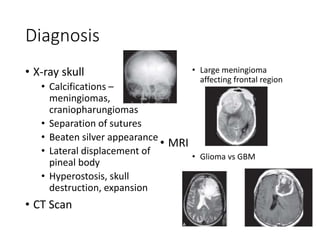
• X-ray skull
• Calcifications –
meningiomas,
craniopharungiomas
• Separation of sutures
• Beaten silver appearance
• Lateral displacement of
pineal body
• Hyperostosis, skull
destruction, expansion
• CT Scan
• Large meningioma
affecting frontal region
• MRI
• Glioma vs GBM
Diagnosis Cont.
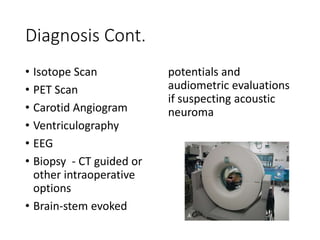
• Isotope Scan
• PET Scan
• Carotid Angiogram
• Ventriculography
• EEG
• Biopsy - CT guided or
other intraoperative
options
• Brain-stem evoked
potentials and
audiometric evaluations
if suspecting acoustic
neuroma
Treatment
• Relief of ↑ICP
• Ventricular tap and
drainage through
posterior parietal burr
hole
• Tapping of cystic
tumor/abscess
• Mannitol
• Emergency
decompression by partial
tumor removal
• Establish pathological Dx
• Burr hole and biopsy
• Craniotomy and biopsy
using brain cannula
• Frozen section biopsy
• CT guided stereotactic
biopsy
• Removal of benign
tumors (*craniotomy
approaches)
• Decompressive surgeries
if malignant
Treatment Cont
• Shunt surgeries to drain
CSF e.g. VP shunt or
ventriculoatrial shunt
• Radiotherapy – ext
radiotherapy can be
used as primary rx or as
an adjuvant therapy
following surgery
• Chemotherapy
occasionally –
Temozolamide
• Corticosteroids e.g
Dexamethasone may be
used for secondary
tumors – reduces
vasogenic edema
• Prognosis – better
prognosis for benign
tumors, and those that
are surgically accessible

Brain tumors

  • 1.
    Brain Tumors Presenters: RolexMaklago & Irene Onyango Moderator: Dr. Lee Ogutha Date: 12th July 2021
  • 2.
    Outline • Brain anatomyand physiology • Risk factors • Classification • Specific tumors • Clinical presentations • Diagnosis • Treatment
  • 3.
  • 4.
    Anatomy • Blood Supply• Lymphatic Drainage
  • 5.
  • 6.
    Risk factors • Exposureto radiation • Genetics- neurofibromatosis 1 and 2, retinoblastoma, Li Fraumeni and Turcots syndrome • Immunosuppression • Viruses like JC and simian virus
  • 7.
    Classification • According totissue of origin 1. Glial cells- gliomas; astrocytoma, ependymoma, 5oligodendrogliomas 2. Meninges- meningiomas 3. Neurons- Gangliocytomas, neuroblastoma 4. Embryonal tumors- medulloblastoma • According to tumour location 1. Infratentorial, supratentorial, temporal lobe, posterior fossa, 2. Intraventricular • Tumor type –Benign, malignant
  • 8.
    Classification cont. • Primary(from brain) or secondary (metastasis: Lungs 35% , Breast 20%, Kidney 10%, GIT 5% 2016 WHO classification WHO Grade I Characteristics – least malignant, possibly curable via surgery alone, non infiltrative, long term survival, slow growing Tumour types- Pilocytic astrocytoma, , Craniopharyngioma, Gangliocytoma, Ganglioglioma
  • 9.
    Classification cont WHO GradeII Characteristics- relatively slow growing, somewhat infiltrative, may recur as higher grade Tumour types- diffuse astrocytoma, Pineocytoma, Pure oligodendroglioma WHO Grade III Characteristics- malignant, infiltrative, tend to recur as higher grade. Tumour types- Anaplastic astrocytoma, Anaplastic ependymoma, Anaplastic oligodendroglioma
  • 10.
    WHO Grade IV Characteristic-most malignant, rapid growth, aggressive, widely infiltrative, rapid recurrence, necrosis prone Tumour types- Glioblastoma multiforme, Pineoblastoma, Medulloblastoma, Ependymoblastoma
  • 11.
    • Account for10% of all malignancies. Most common CNS malignancies are metastatic lesions. • The most common primary brain tumours are gliomas. • In adults two thirds of primary brain tumours arise from structures above the tentorium (supratentorial), whereas in children two thirds of brain tumours arise from structures below the tentorium (infratentorial)
  • 12.
    Primary brain tumours 1.Gliomas •Astrocytoma Commonest type, usually malignant. They can occur anywhere in the cerebral hemispheres, medulla, brainstem. Peak incidence is 4th decade. Are graded based on the quantity of adult and primitive cells Grade I- cystic Grade II- diffuse Grade III- anaplastic Grade IV- glioblastoma multiforme
  • 13.
    • Glioblastoma multiforme Mostinvasive type of glial tumours. Tend to grow rapidly and spread to other tissues and have poor prognosis. May be composed of several types of cells eg astrocytes, oligodendrocytes. More common in people ages 50-70 and more prevalent in men than women.
  • 14.
    • Oligodendrogliomas Slow growingtumours, commonly arising from the frontal lobes, lasts for years and show calcification • Medulloblastoma Highly malignant embryonal tumours grouped as PNET arising from primitive cell nests. Most common brain tumour in children. It often spreads within the brain itself and can extend to the spinal canal • Ependymoma Here cells resemble the ependymal cells. Can occur throughout the hemisphere. Arise from cells lining the ventricles of the brain and central canal of the spinal cord
  • 15.
    Meningiomas • Usually globular,arising from the arachnoids, the tumour gets attached to the dura and gets its blood supply from dural arteries and veins. Along these veins tumour cells invade bone, causing bone destruction and reactive hyperostosis. 80% are supratentorial. Common in females of middle aged. • Classified as fibroblastic, endothelial and angioblastic. • Psammoma bodies seen microscopically
  • 16.
    Schwannomas • Common inauditory nerve, also called acoustic neuromas. Occur in the internal auditory meatus which projects into the cerebellopontine angle, compressing 5,6,7,8th nerves. • Presents with compressive features like unilateral deafness, trigeminal neuralgia, squint, cerebellar compression.
  • 17.
    Pituitary adenomas • Largemajority are benign and fairly slow growing. Malignant pituitary tumours rarely spread to other parts of the body. They commonly affect people in their 30s or 40s, although can also be diagnosed in children.
  • 18.
    Craniopharyngioma • Typically benignbut are difficult tumours to remove because of their location near critical deep structures in the brain. • Cystic tumour that arises just above the pituitary gland. Usually diagnosed in childhood or elderly. It grows relatively slow.
  • 19.
    Clinical Features (Nonspecific) •Asymptomatic initially • Focal seizures • Raised ICP – headache, vomiting, altered vision, progressive LOC, high BP, slow pulse, papilledema • Brain displacement and conning • Others • Altered mental status • Ataxia • Weakness • Gait disturbance • Speech deficits • Focal sensory abnormalities • Personality & emotional changes • Nystagmus
  • 20.
    Specific CF • Frontallobe tumors: Personality and emotional changes, epilepsy of generalized type, contralateral facial weakness. • Parietal lobe tumors: Jacksonian epilepsy, progressive hemiparesis, astereognosis, acalculia. • Occipital lobe tumors: Aura of flashing of light in contralateral field, homonymous hemianopia. • Temporal lobe tumors: Progressive aphasia, visual, auditory, smell and taste hallucinations, hemiparesis, superior quadratic hemianopia.
  • 21.
    Specific CF • Midlinetumors: Produces bilateral hydrocephalus. • Tumors of the third ventricle (colloid cyst is common): Causes bilateral hydrocephalus, progressive cerebral atrophy, dementia, sexual precocity, endocrine disturbances. • Pineal tumors: Causes precocious puberty. • Cerebellar vermis tumors: Usually medulloblastomas, occur in young children, presents with progressive hydrocephalus and features of herniation of cerebellar tonsils through foramen magnum. • Cerebellar hemisphere tumors: Commonly are astrocytomas, produce cerebellar syndromes, nystagmus.
  • 22.
    Diagnosis • X-ray skull •Calcifications – meningiomas, craniopharungiomas • Separation of sutures • Beaten silver appearance • Lateral displacement of pineal body • Hyperostosis, skull destruction, expansion • CT Scan • Large meningioma affecting frontal region • MRI • Glioma vs GBM
  • 23.
    Diagnosis Cont. • IsotopeScan • PET Scan • Carotid Angiogram • Ventriculography • EEG • Biopsy - CT guided or other intraoperative options • Brain-stem evoked potentials and audiometric evaluations if suspecting acoustic neuroma
  • 24.
    Treatment • Relief of↑ICP • Ventricular tap and drainage through posterior parietal burr hole • Tapping of cystic tumor/abscess • Mannitol • Emergency decompression by partial tumor removal • Establish pathological Dx • Burr hole and biopsy • Craniotomy and biopsy using brain cannula • Frozen section biopsy • CT guided stereotactic biopsy • Removal of benign tumors (*craniotomy approaches) • Decompressive surgeries if malignant
  • 25.
    Treatment Cont • Shuntsurgeries to drain CSF e.g. VP shunt or ventriculoatrial shunt • Radiotherapy – ext radiotherapy can be used as primary rx or as an adjuvant therapy following surgery • Chemotherapy occasionally – Temozolamide • Corticosteroids e.g Dexamethasone may be used for secondary tumors – reduces vasogenic edema • Prognosis – better prognosis for benign tumors, and those that are surgically accessible