Translation-oriented text analysis
Christiane Nord
Text Analysis in Translation (1988/91)
Translating as a Purposeful Activity (1997)
FLUP - Elena Zagar GalvãoFLUP - Elena Zagar Galvão
Two basic types
of translation product
DOCUMENTARY TRANSLATION
It ‘serves as a document of a source culture
communication between the author and the
source text (ST) recipient’
e.g., literary translation, word-for-word or literal
translations (business contracts, certificates)
‘foreignizing’ or ‘exoticizing’ translations, etc.
FLUP - Elena Zagar GalvãoFLUP - Elena Zagar Galvão
INSTRUMENTAL TRANSLATION
It ‘serves as an independent message-transmitting
instrument in a new communicative action in the
target culture, and is intended to fulfil its
communicative purpose without the recipient being
conscious of reading or hearing a text which, in a
different form, was used before in a different
communicative situation.’
e.g., ‘function-preserving translations’ (software
manual) or ‘function-changing translations’
(translation of Swift’s Gulliver’s Travels for children
FLUP - Elena Zagar GalvãoFLUP - Elena Zagar Galvão
Nord highlights 3 important aspects:
1. the importance of the translation
commission (or ‘translation brief’) (cf.
Holz-Mänttäri, Vermeer)
2. the importance of text analysis
3. the functional hierarchy or translation
problems
FLUP - Elena Zagar GalvãoFLUP - Elena Zagar Galvão
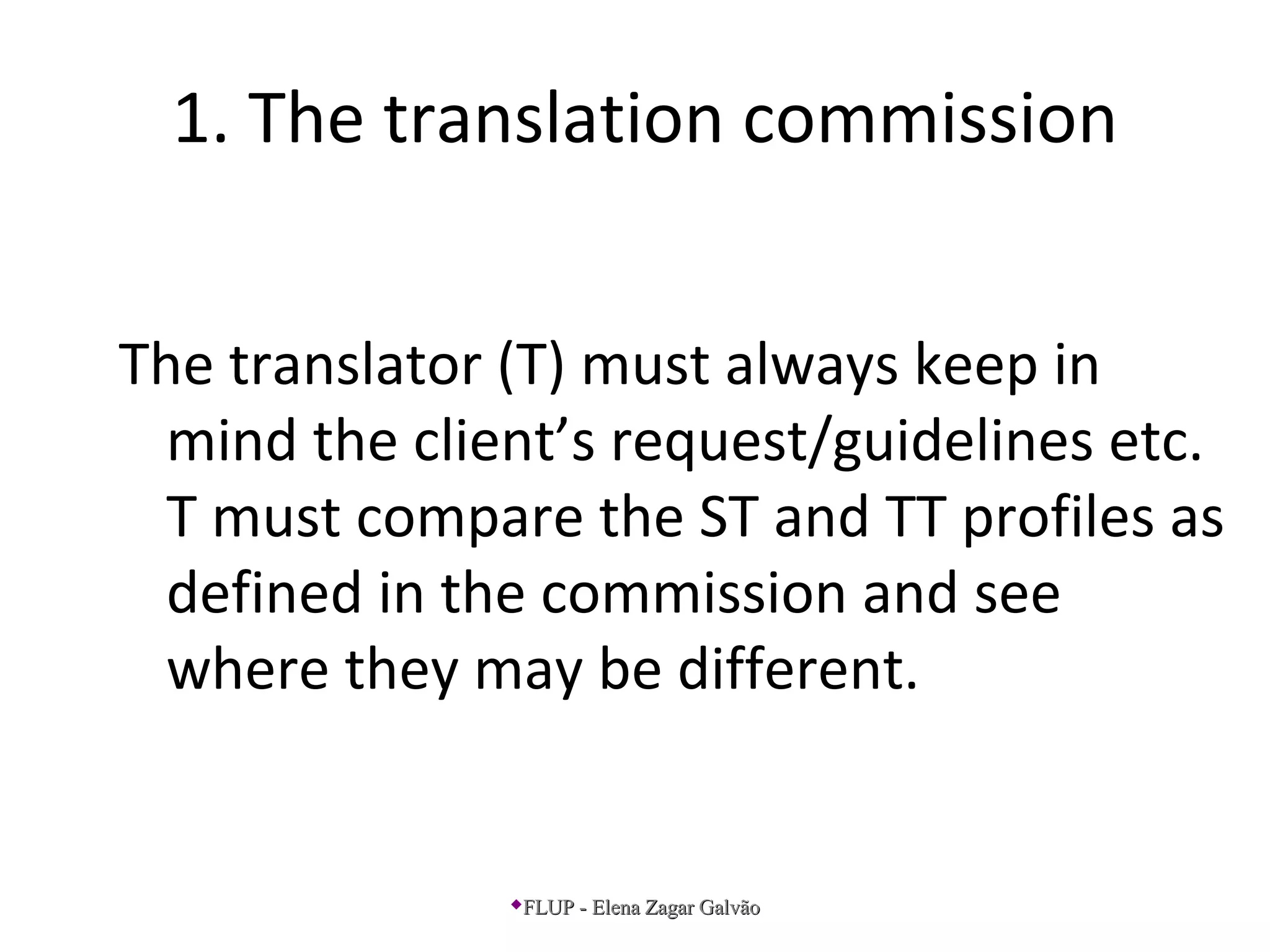
1. The translation commission
The translator (T) must always keep in
mind the client’s request/guidelines etc.
T must compare the ST and TT profiles as
defined in the commission and see
where they may be different.
FLUP - Elena Zagar GalvãoFLUP - Elena Zagar Galvão
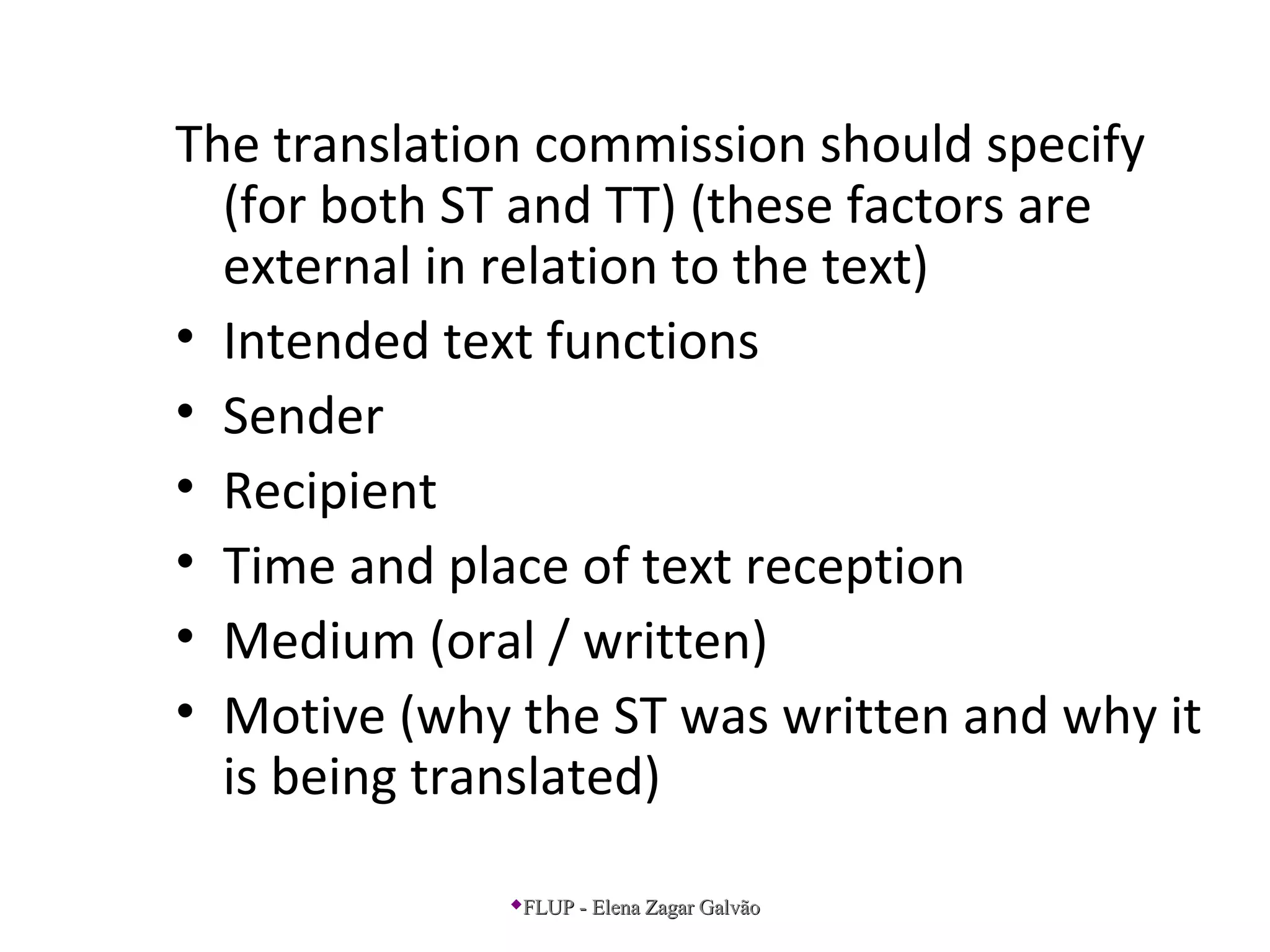
The translation commission should specify
(for both ST and TT) (these factors are
external in relation to the text)
• Intended text functions
• Sender
• Recipient
• Time and place of text reception
• Medium (oral / written)
• Motive (why the ST was written and why it
is being translated)
FLUP - Elena Zagar GalvãoFLUP - Elena Zagar Galvão
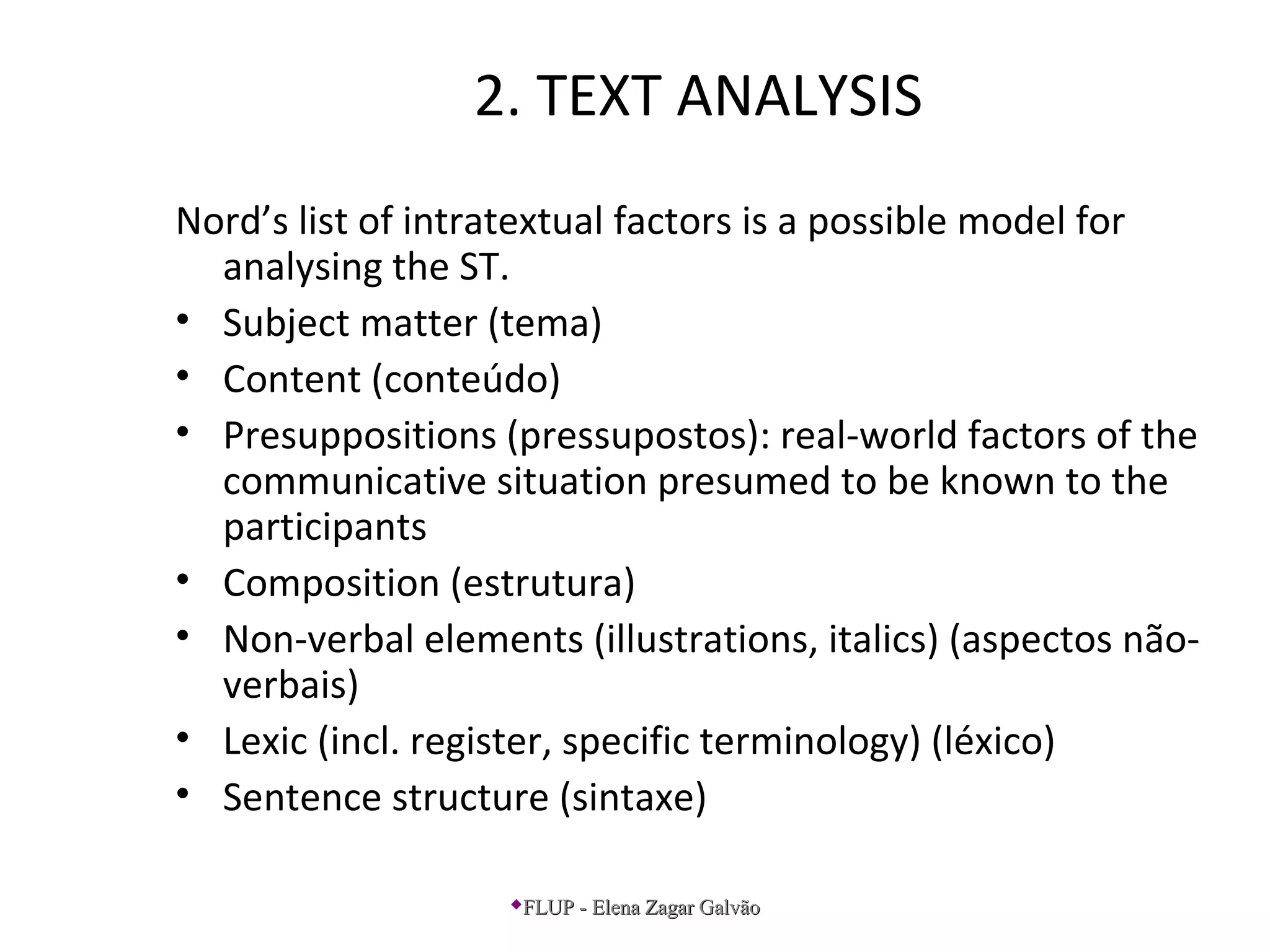
2. TEXT ANALYSIS
Nord’s list of intratextual factors is a possible model for
analysing the ST.
• Subject matter (tema)
• Content (conteúdo)
• Presuppositions (pressupostos): real-world factors of the
communicative situation presumed to be known to the
participants
• Composition (estrutura)
• Non-verbal elements (illustrations, italics) (aspectos não-
verbais)
• Lexic (incl. register, specific terminology) (léxico)
• Sentence structure (sintaxe)
FLUP - Elena Zagar GalvãoFLUP - Elena Zagar Galvão
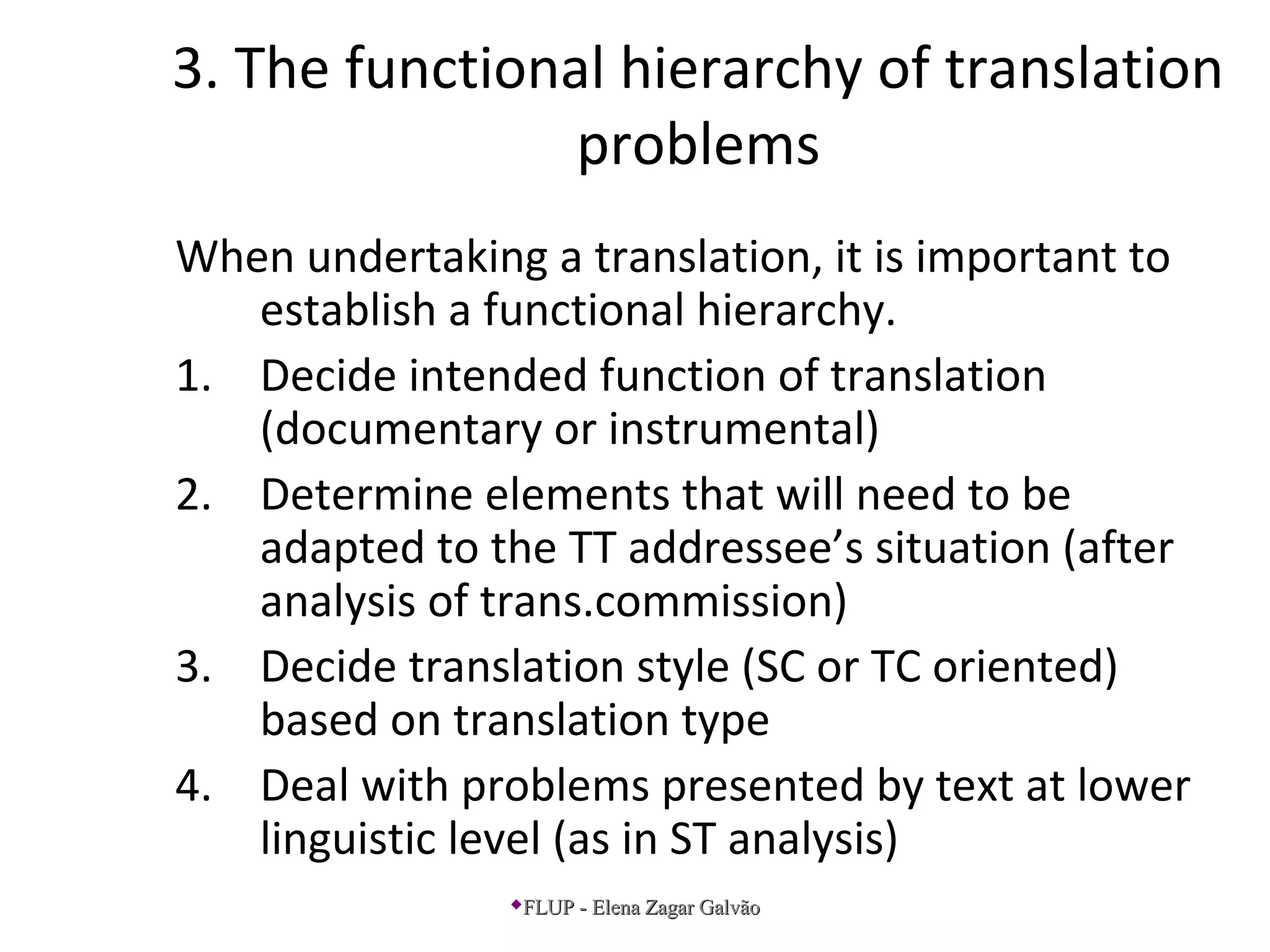
3. The functional hierarchy of translation
problems
When undertaking a translation, it is important to
establish a functional hierarchy.
1. Decide intended function of translation
(documentary or instrumental)
2. Determine elements that will need to be
adapted to the TT addressee’s situation (after
analysis of trans.commission)
3. Decide translation style (SC or TC oriented)
based on translation type
4. Deal with problems presented by text at lower
linguistic level (as in ST analysis)
FLUP - Elena Zagar GalvãoFLUP - Elena Zagar Galvão

C.nord before translating

  • 1.
    Translation-oriented text analysis ChristianeNord Text Analysis in Translation (1988/91) Translating as a Purposeful Activity (1997) FLUP - Elena Zagar GalvãoFLUP - Elena Zagar Galvão
  • 2.
    Two basic types oftranslation product DOCUMENTARY TRANSLATION It ‘serves as a document of a source culture communication between the author and the source text (ST) recipient’ e.g., literary translation, word-for-word or literal translations (business contracts, certificates) ‘foreignizing’ or ‘exoticizing’ translations, etc. FLUP - Elena Zagar GalvãoFLUP - Elena Zagar Galvão
  • 3.
    INSTRUMENTAL TRANSLATION It ‘servesas an independent message-transmitting instrument in a new communicative action in the target culture, and is intended to fulfil its communicative purpose without the recipient being conscious of reading or hearing a text which, in a different form, was used before in a different communicative situation.’ e.g., ‘function-preserving translations’ (software manual) or ‘function-changing translations’ (translation of Swift’s Gulliver’s Travels for children FLUP - Elena Zagar GalvãoFLUP - Elena Zagar Galvão
  • 4.
    Nord highlights 3important aspects: 1. the importance of the translation commission (or ‘translation brief’) (cf. Holz-Mänttäri, Vermeer) 2. the importance of text analysis 3. the functional hierarchy or translation problems FLUP - Elena Zagar GalvãoFLUP - Elena Zagar Galvão
  • 5.
    1. The translationcommission The translator (T) must always keep in mind the client’s request/guidelines etc. T must compare the ST and TT profiles as defined in the commission and see where they may be different. FLUP - Elena Zagar GalvãoFLUP - Elena Zagar Galvão
  • 6.
    The translation commissionshould specify (for both ST and TT) (these factors are external in relation to the text) • Intended text functions • Sender • Recipient • Time and place of text reception • Medium (oral / written) • Motive (why the ST was written and why it is being translated) FLUP - Elena Zagar GalvãoFLUP - Elena Zagar Galvão
  • 7.
    2. TEXT ANALYSIS Nord’slist of intratextual factors is a possible model for analysing the ST. • Subject matter (tema) • Content (conteúdo) • Presuppositions (pressupostos): real-world factors of the communicative situation presumed to be known to the participants • Composition (estrutura) • Non-verbal elements (illustrations, italics) (aspectos não- verbais) • Lexic (incl. register, specific terminology) (léxico) • Sentence structure (sintaxe) FLUP - Elena Zagar GalvãoFLUP - Elena Zagar Galvão
  • 8.
    3. The functionalhierarchy of translation problems When undertaking a translation, it is important to establish a functional hierarchy. 1. Decide intended function of translation (documentary or instrumental) 2. Determine elements that will need to be adapted to the TT addressee’s situation (after analysis of trans.commission) 3. Decide translation style (SC or TC oriented) based on translation type 4. Deal with problems presented by text at lower linguistic level (as in ST analysis) FLUP - Elena Zagar GalvãoFLUP - Elena Zagar Galvão