Relevance Theory
Zeinab Nasrollahi
Table of Contents
Introduction to relevance theory
Inferential nature of communication
Semantic representation
Context and the principle of relevance
Descriptive and Interpretive use
Examples
3
Relevance Theory
Approaches communication from the
point of view of competence rather than
behavior
Gives an explicit account of how the
information-processing faculties of our
mind enable us to communicate
Therefor, we are dealing with mental
faculties rather than text or text
production
4
Relevance Theory
Is not a descriptive-classificatory
approach
Tries to understand complexities of
communication in terms of cause-effect
relationship
Provides a natural basis for an empirical
account of evaluation and decision-
making
5
Relevance Theory in
Translation
Translation is being looked as a part of
communication
Recent models of translation treat
translation as a code model, i.e.
communication as a matter of the
encoding, transmission and decoding of
messages
Translation is best handled as a model of
communication
6
Inferential Nature of
Communication
The crucial mental faculty that enables
human beings to communicate with one
another is the ability to draw inference
from people’s behavior
Verbal and non-verbal communication
Linguistic communication is the strongest
possible form of communication
7
Semantic
Representation
Refers to mental representations that are the
output of language module of the mind
Language module of the mind handles only
linguistic data, thus the produced semantic
representations are not fully truth-conditional
and complete
Once a mental representation has been
processed and completed to become fully truth
conditional, it is said to have a propositional
form
Context determines inference of audiences 8
Context and the Principle
of Relevance
A context is a psychological construct, a subset
of the hearer’s assumptions about the world, i.e.
cognitive environment
Cognitive environment takes into account
various external factors but places the emphasis
on the information they provide and its mental
availability for interpretation
Cognitive environment comprises a very huge
amount of very varied information, thus
misunderstanding may occur.
9
Context and the Principle
of Relevance
The effort one makes in comprehension
will modify the contextual assumptions
brought to the communication act
Context modification or contextual
effects, are of three kinds:
Derivation of contextual implication
Strengthening or confirming of assumptions
Elimination of assumptions
10
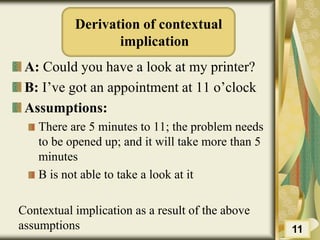
Derivation of contextual
implication
A: Could you have a look at my printer?
B: I’ve got an appointment at 11 o’clock
Assumptions:
There are 5 minutes to 11; the problem needs
to be opened up; and it will take more than 5
minutes
B is not able to take a look at it
Contextual implication as a result of the above
assumptions 11
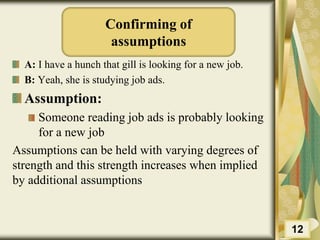
Confirming of
assumptions
A: I have a hunch that gill is looking for a new job.
B: Yeah, she is studying job ads.
Assumption:
Someone reading job ads is probably looking
for a new job
Assumptions can be held with varying degrees of
strength and this strength increases when implied
by additional assumptions
12
Elimination of
assumptions
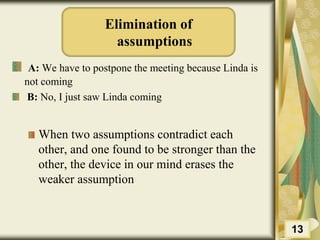
A: We have to postpone the meeting because Linda is
not coming
B: No, I just saw Linda coming
When two assumptions contradict each
other, and one found to be stronger than the
other, the device in our mind erases the
weaker assumption
13
Relevance Condition
Extent condition 1: an assumption is relevant
in a context to the extent that its contextual
effects in this context is large.
Extent condition 2: an assumption is relevant
in a context to the extent that the effort required
to process it is small
Large contextual effect Small effort
These factors are context-dependent
Relevance is context-dependent
14
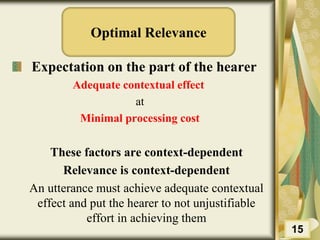
Optimal Relevance
Expectation on the part of the hearer
Adequate contextual effect
at
Minimal processing cost
These factors are context-dependent
Relevance is context-dependent
An utterance must achieve adequate contextual
effect and put the hearer to not unjustifiable
effort in achieving them
15
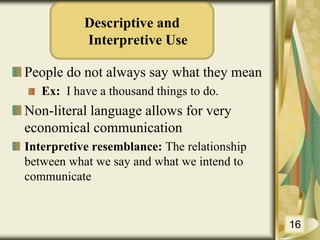
People do not always say what they mean
Ex: I have a thousand things to do.
Non-literal language allows for very
economical communication
Interpretive resemblance: The relationship
between what we say and what we intend to
communicate
16
Descriptive and
Interpretive Use
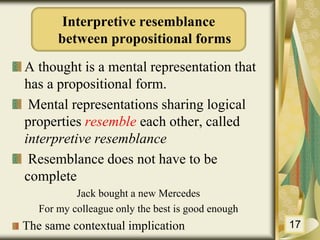
A thought is a mental representation that
has a propositional form.
Mental representations sharing logical
properties resemble each other, called
interpretive resemblance
Resemblance does not have to be
complete
Jack bought a new Mercedes
For my colleague only the best is good enough
The same contextual implication 17
Interpretive resemblance
between propositional forms
To the extent the utterances have
propositional forms, they can be used
either descriptively or interpretively
A: I have poor appetite these days
B: Maybe it’s the Chernobyl accident
A: Do you really think so?
B: Actually, no; but Chernobyl gets blamed for anything these
days
Explicature: Analytic implications which the communicator
intends to convey
Implicature: contextual assumption which the communicator
intends to convey
18
Interpretive resemblance between
thoughts and utterances
Natural language can convey information
non-representationally
Hello or Goodbye
Goodbye and bye bye
Relevance is context-dependent thus
interpretations are context-dependent
The main purpose of utterances is to
convey the set of assumptions which the
communicator intends to convey
19
Interpretive resemblance between
utterances
20
Examples in Translation of DMs
from English into Persian
Translation of Drama
(Gharashi, 2013)
HOWARD: Sh, for God’s sake!
HIS SON: It’s nine o’clock, Bulova watch time. So I have to go to sleep.
‫هوارد‬:‫هیس‬!‫تورو‬‫خدا‬
‫پسر‬‫هوارد‬:‫شده‬ ‫نه‬ ‫ساعت‬.‫بخوابم‬ ‫میرم‬ ‫من‬
Death of a Salesman (p. 55)
Analysis: In the above example, in the ST a cause-and-
result relationship is signaled in the son’s utterance,
stating that ‘Because it is 9:00, I am supposed to go to
sleep’. In fact, the first statement is a premise to the
second statement, that is the ‘conclusion’. Obviously,
the same relation cannot be found in the TT due to the
lack of an equivalent for the DM, so.
21
GUS: […] I hope he's got a shilling, anyway, if he comes. He's
entitled to have. After all, it's his place, he could have seen there
was enough gas for a cup of tea.
‫گاس‬:[...]‫امیدوارم‬‫اگه‬‫میاد‬‫یه‬‫شیلینگ‬‫پول‬‫ته‬‫جیبش‬
‫باشه‬.‫می‬‫گن‬‫که‬‫داره‬.‫از‬‫همه‬‫اینها‬،‫گذشته‬‫اینجا‬‫جای‬
‫اونه‬.‫می‬‫تونست‬‫نگاه‬‫کنه‬‫که‬‫حداقل‬‫واسه‬‫درست‬‫کردن‬‫یه‬
‫فنجون‬‫چایی‬‫گاز‬‫باشه‬
The Dumb Waiter (p. 10)
Analysis: ‘After all’ is here intended to recognize that it
is expected to access a particular set of assumptions. In
fact, ‘after all’ imposes on the intended cognitive effect
and the communicative principle of relevance which
strengthen the assumption that the house is his and he is
expected to act in a certain way. In the same vein, the
TT has followed the same rule and the applied
equivalent strengthens the previous assumption.
22
YOUNG BERNARD: Birnbaum flunked him! They won’t graduate
him!
LINDA: But they have to. He’s gotta go to the university. Where is
he? Biff! Biff!
‫برنارد‬:‫برن‬‫باوم‬‫تجدیدش‬‫کرد‬.‫بیف‬‫نمی‬‫تونه‬‫دیپلم‬
‫بگیره‬
‫ویلی‬:‫باس‬‫بهش‬‫دیپلم‬‫بدن‬.‫بیف‬‫باس‬‫بره‬‫دانشگاه‬.‫بیف‬!
‫بیف‬‫کجاس‬‫؟‬
Death of a Salesman (p. 80)
Analysis: In the ST, a contradiction exist between the
two segment of the utterance through the interpretation
of the DM, but. Such a contradiction cannot be seen in
the TT text since no equivalence is given for this DM.
23
THANKS FOR YOUR
ATTENTION

Relevance theory part 1

  • 2.
  • 3.
    Table of Contents Introductionto relevance theory Inferential nature of communication Semantic representation Context and the principle of relevance Descriptive and Interpretive use Examples 3
  • 4.
    Relevance Theory Approaches communicationfrom the point of view of competence rather than behavior Gives an explicit account of how the information-processing faculties of our mind enable us to communicate Therefor, we are dealing with mental faculties rather than text or text production 4
  • 5.
    Relevance Theory Is nota descriptive-classificatory approach Tries to understand complexities of communication in terms of cause-effect relationship Provides a natural basis for an empirical account of evaluation and decision- making 5
  • 6.
    Relevance Theory in Translation Translationis being looked as a part of communication Recent models of translation treat translation as a code model, i.e. communication as a matter of the encoding, transmission and decoding of messages Translation is best handled as a model of communication 6
  • 7.
    Inferential Nature of Communication Thecrucial mental faculty that enables human beings to communicate with one another is the ability to draw inference from people’s behavior Verbal and non-verbal communication Linguistic communication is the strongest possible form of communication 7
  • 8.
    Semantic Representation Refers to mentalrepresentations that are the output of language module of the mind Language module of the mind handles only linguistic data, thus the produced semantic representations are not fully truth-conditional and complete Once a mental representation has been processed and completed to become fully truth conditional, it is said to have a propositional form Context determines inference of audiences 8
  • 9.
    Context and thePrinciple of Relevance A context is a psychological construct, a subset of the hearer’s assumptions about the world, i.e. cognitive environment Cognitive environment takes into account various external factors but places the emphasis on the information they provide and its mental availability for interpretation Cognitive environment comprises a very huge amount of very varied information, thus misunderstanding may occur. 9
  • 10.
    Context and thePrinciple of Relevance The effort one makes in comprehension will modify the contextual assumptions brought to the communication act Context modification or contextual effects, are of three kinds: Derivation of contextual implication Strengthening or confirming of assumptions Elimination of assumptions 10
  • 11.
    Derivation of contextual implication A:Could you have a look at my printer? B: I’ve got an appointment at 11 o’clock Assumptions: There are 5 minutes to 11; the problem needs to be opened up; and it will take more than 5 minutes B is not able to take a look at it Contextual implication as a result of the above assumptions 11
  • 12.
    Confirming of assumptions A: Ihave a hunch that gill is looking for a new job. B: Yeah, she is studying job ads. Assumption: Someone reading job ads is probably looking for a new job Assumptions can be held with varying degrees of strength and this strength increases when implied by additional assumptions 12
  • 13.
    Elimination of assumptions A: Wehave to postpone the meeting because Linda is not coming B: No, I just saw Linda coming When two assumptions contradict each other, and one found to be stronger than the other, the device in our mind erases the weaker assumption 13
  • 14.
    Relevance Condition Extent condition1: an assumption is relevant in a context to the extent that its contextual effects in this context is large. Extent condition 2: an assumption is relevant in a context to the extent that the effort required to process it is small Large contextual effect Small effort These factors are context-dependent Relevance is context-dependent 14
  • 15.
    Optimal Relevance Expectation onthe part of the hearer Adequate contextual effect at Minimal processing cost These factors are context-dependent Relevance is context-dependent An utterance must achieve adequate contextual effect and put the hearer to not unjustifiable effort in achieving them 15
  • 16.
    People do notalways say what they mean Ex: I have a thousand things to do. Non-literal language allows for very economical communication Interpretive resemblance: The relationship between what we say and what we intend to communicate 16 Descriptive and Interpretive Use
  • 17.
    A thought isa mental representation that has a propositional form. Mental representations sharing logical properties resemble each other, called interpretive resemblance Resemblance does not have to be complete Jack bought a new Mercedes For my colleague only the best is good enough The same contextual implication 17 Interpretive resemblance between propositional forms
  • 18.
    To the extentthe utterances have propositional forms, they can be used either descriptively or interpretively A: I have poor appetite these days B: Maybe it’s the Chernobyl accident A: Do you really think so? B: Actually, no; but Chernobyl gets blamed for anything these days Explicature: Analytic implications which the communicator intends to convey Implicature: contextual assumption which the communicator intends to convey 18 Interpretive resemblance between thoughts and utterances
  • 19.
    Natural language canconvey information non-representationally Hello or Goodbye Goodbye and bye bye Relevance is context-dependent thus interpretations are context-dependent The main purpose of utterances is to convey the set of assumptions which the communicator intends to convey 19 Interpretive resemblance between utterances
  • 20.
    20 Examples in Translationof DMs from English into Persian Translation of Drama (Gharashi, 2013)
  • 21.
    HOWARD: Sh, forGod’s sake! HIS SON: It’s nine o’clock, Bulova watch time. So I have to go to sleep. ‫هوارد‬:‫هیس‬!‫تورو‬‫خدا‬ ‫پسر‬‫هوارد‬:‫شده‬ ‫نه‬ ‫ساعت‬.‫بخوابم‬ ‫میرم‬ ‫من‬ Death of a Salesman (p. 55) Analysis: In the above example, in the ST a cause-and- result relationship is signaled in the son’s utterance, stating that ‘Because it is 9:00, I am supposed to go to sleep’. In fact, the first statement is a premise to the second statement, that is the ‘conclusion’. Obviously, the same relation cannot be found in the TT due to the lack of an equivalent for the DM, so. 21
  • 22.
    GUS: […] Ihope he's got a shilling, anyway, if he comes. He's entitled to have. After all, it's his place, he could have seen there was enough gas for a cup of tea. ‫گاس‬:[...]‫امیدوارم‬‫اگه‬‫میاد‬‫یه‬‫شیلینگ‬‫پول‬‫ته‬‫جیبش‬ ‫باشه‬.‫می‬‫گن‬‫که‬‫داره‬.‫از‬‫همه‬‫اینها‬،‫گذشته‬‫اینجا‬‫جای‬ ‫اونه‬.‫می‬‫تونست‬‫نگاه‬‫کنه‬‫که‬‫حداقل‬‫واسه‬‫درست‬‫کردن‬‫یه‬ ‫فنجون‬‫چایی‬‫گاز‬‫باشه‬ The Dumb Waiter (p. 10) Analysis: ‘After all’ is here intended to recognize that it is expected to access a particular set of assumptions. In fact, ‘after all’ imposes on the intended cognitive effect and the communicative principle of relevance which strengthen the assumption that the house is his and he is expected to act in a certain way. In the same vein, the TT has followed the same rule and the applied equivalent strengthens the previous assumption. 22
  • 23.
    YOUNG BERNARD: Birnbaumflunked him! They won’t graduate him! LINDA: But they have to. He’s gotta go to the university. Where is he? Biff! Biff! ‫برنارد‬:‫برن‬‫باوم‬‫تجدیدش‬‫کرد‬.‫بیف‬‫نمی‬‫تونه‬‫دیپلم‬ ‫بگیره‬ ‫ویلی‬:‫باس‬‫بهش‬‫دیپلم‬‫بدن‬.‫بیف‬‫باس‬‫بره‬‫دانشگاه‬.‫بیف‬! ‫بیف‬‫کجاس‬‫؟‬ Death of a Salesman (p. 80) Analysis: In the ST, a contradiction exist between the two segment of the utterance through the interpretation of the DM, but. Such a contradiction cannot be seen in the TT text since no equivalence is given for this DM. 23
  • 24.