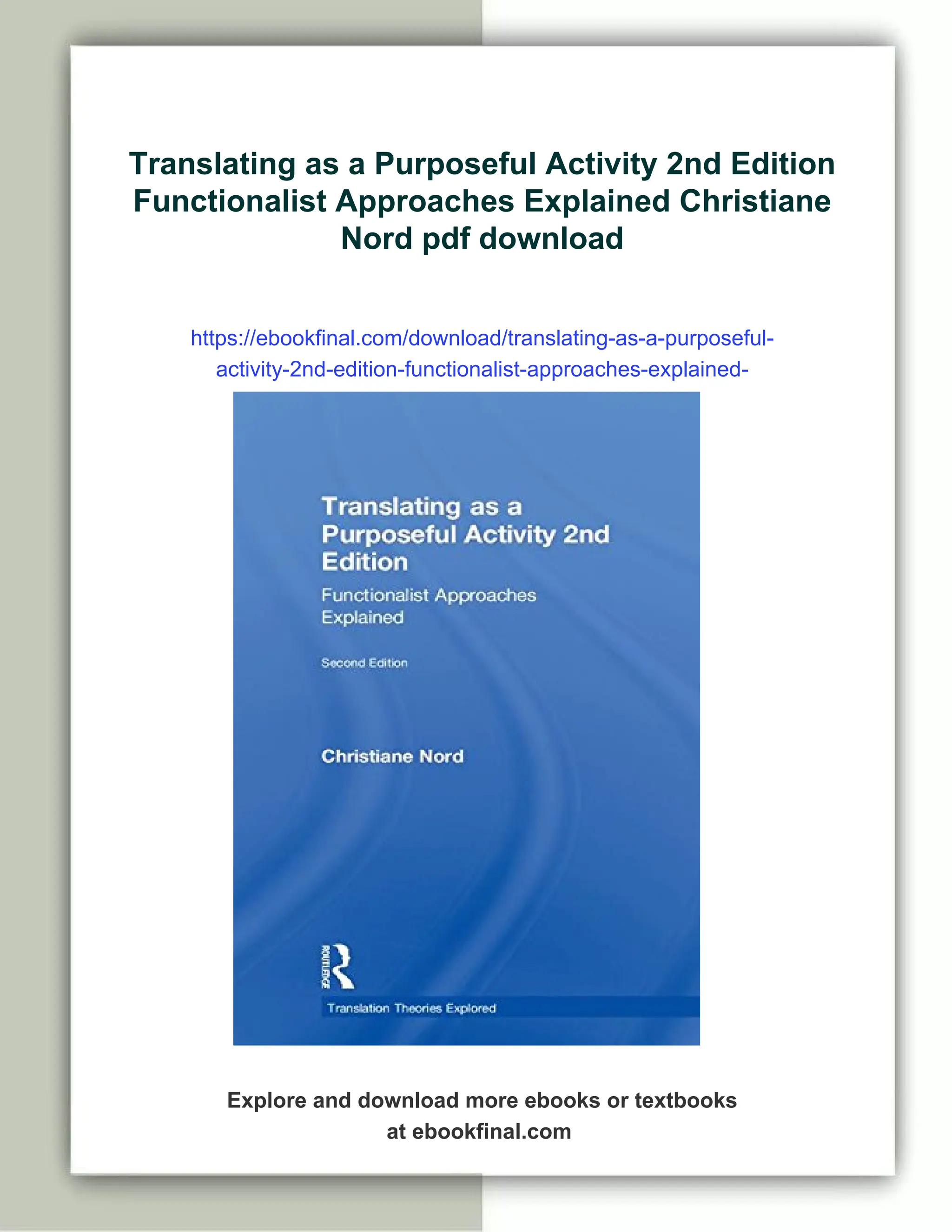
Translating as a Purposeful Activity 2nd Edition
Functionalist Approaches Explained Christiane
Nord pdf download
https://ebookfinal.com/download/translating-as-a-purposeful-
activity-2nd-edition-functionalist-approaches-explained-
christiane-nord/
Explore and download more ebooks or textbooks
at ebookfinal.com
We believe these products will be a great fit for you. Click
the link to download now, or visit ebookfinal
to discover even more!
The Purposeful Argument A Practical Guide 2nd Edition
Harry Phillips
https://ebookfinal.com/download/the-purposeful-argument-a-practical-
guide-2nd-edition-harry-phillips/
Statistics Explained A Guide for Social Science Students
2nd Edition Perry Hinton
https://ebookfinal.com/download/statistics-explained-a-guide-for-
social-science-students-2nd-edition-perry-hinton/
Translating Promotional and Advertising Texts 2nd Edition
Ira Torresi
https://ebookfinal.com/download/translating-promotional-and-
advertising-texts-2nd-edition-ira-torresi/
Promoting physical activity a guide for community action
2nd Edition David R Brown
https://ebookfinal.com/download/promoting-physical-activity-a-guide-
for-community-action-2nd-edition-david-r-brown/
Physical Activity and Health 2nd Edition Claude Bouchard
https://ebookfinal.com/download/physical-activity-and-health-2nd-
edition-claude-bouchard/
OCR AS A level Chemistry A 2nd Edition Sam Holyman
https://ebookfinal.com/download/ocr-as-a-level-chemistry-a-2nd-
edition-sam-holyman/
IPSAS Explained A Summary of International Public Sector
Accounting Standards 2nd Edition Thomas Muller-Marques
Berger
https://ebookfinal.com/download/ipsas-explained-a-summary-of-
international-public-sector-accounting-standards-2nd-edition-thomas-
muller-marques-berger/
Kidney Failure Explained Class Health Class Health 2nd
Edition Andy Stein
https://ebookfinal.com/download/kidney-failure-explained-class-health-
class-health-2nd-edition-andy-stein/
Geometric Mechanics Part II Rotating Translating And
Rolling 2nd Edition Darryl D Holm
https://ebookfinal.com/download/geometric-mechanics-part-ii-rotating-
translating-and-rolling-2nd-edition-darryl-d-holm/
Translating as a Purposeful Activity 2nd Edition
Functionalist Approaches Explained Christiane Nord
Digital Instant Download
Author(s): Christiane Nord
ISBN(s): 9781138573369, 1138573361
Edition: 2
File Details: PDF, 2.07 MB
Year: 2018
Language: english
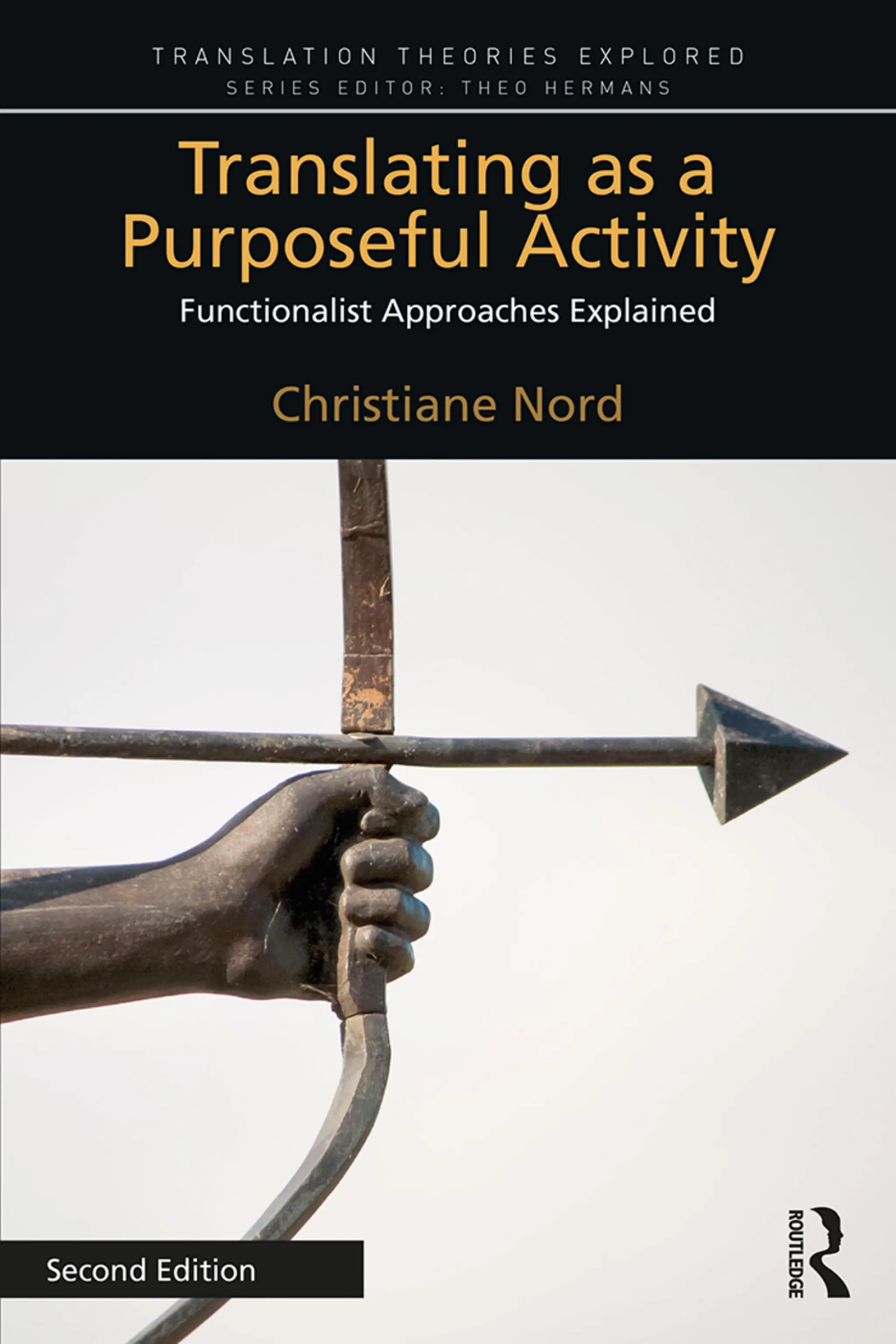
Translating as a
Purposeful Activity
This best-selling text is a comprehensive overview of functionalist approaches
to translation in English. Christiane Nord, one of the leading figures in transla-
tion studies, explains the complexities of theories and terms in simple language
with numerous examples. Covering how the theories developed; illustrations of
the main ideas; and specific applications to translator training, literary transla-
tion, interpreting, and ethics, Translating as a Purposeful Activity concludes with
a concise review of both criticisms and perspectives for the future. Now with a
foreword by Georges Bastin and a new chapter covering the recent developments
and elaborations of the theory, this is an essential text for students of translation
studies and for translator training.
Christiane Nord is Professor Emerita of Translation Studies and Specialized
Communication at the University of Applied Sciences of Magdeburg, Germany,
and Visiting Professor at several universities of the People’s Republic of China.
She also holds the position of Professor Extraordinary and Research Fellow at
the University of the Free State, South Africa. Her homepage can be found at
www.christiane-nord.de.
Translation Theories Explored
Series Editor:Theo Hermans, UCL, UK
TranslationTheories Explored is a series designed to engage with the range and
diversity of contemporary translation studies.Translation itself is as vital and as
charged as ever. If anything, it has become more plural, more varied, and more
complex in today’s world.The study of translation has responded to these chal-
lenges with vigour. In recent decades the field has gained in depth, its scope
continues to expand, and it is increasingly interacting with other disciplines.The
series sets out to reflect and foster these developments. It aims to keep track of
theoretical developments, to explore new areas, approaches, and issues, and gen-
erally to extend and enrich the intellectual horizon of translation studies. Special
attention is paid to innovative ideas that may not as yet be widely known but
deserve wider currency.
Individual volumes explain and assess particular approaches. Each volume com-
bines an overview of the relevant approach with case studies and critical reflec-
tion, placing its subject in a broad intellectual and historical context; illustrating
the key ideas with examples; summarizing the main debates; accounting for spe-
cific methodologies, achievements, and blind spots; and opening up new avenues
for the future.Authors are selected not only on their close familiarity and personal
affinity with a particular approach but also on their capacity for lucid exposition,
critical assessment, and imaginative thought.The series is aimed at researchers and
graduate students who wish to learn about new approaches to translation in a
comprehensive but accessible way.
Translation and Literary Criticism
Marilyn Gaddis Rose
Translation in Systems
Theo Hermans
Deconstruction and Translation
Kathleen Davis
Can Theory Help Translators?
Andrew Chesterman and EmmaWagner
Stylistic Approaches to Translation
Jean Boase Beier
Representing Others
Kate Sturge
Cosmopolitanism and Translation
Esperança Bielsa
https://www.routledge.com/Translation-Theories-Explored/book-series/TTE
Translating as a
Purposeful Activity
Functionalist Approaches Explained
Second edition
Christiane Nord
Second edition published in 2018
by Routledge
2 Park Square, Milton Park, Abingdon, Oxon OX14 4RN
and by Routledge
711 Third Avenue, New York, NY 10017
Routledge is an imprint of the Taylor & Francis Group, an informa business
© 2018 Christiane Nord
The right of Christiane Nord to be identified as author of this work
has been asserted by her in accordance with sections 77 and 78 of the
Copyright, Designs and Patents Act 1988.
All rights reserved. No part of this book may be reprinted or reproduced
or utilised in any form or by any electronic, mechanical, or other
means, now known or hereafter invented, including photocopying and
recording, or in any information storage or retrieval system, without
permission in writing from the publishers.
Trademark notice: Product or corporate names may be trademarks
or registered trademarks, and are used only for identification and
explanation without intent to infringe.
First edition published by St Jerome 1997
British Library Cataloguing-in-Publication Data
A catalogue record for this book is available from the British Library
Library of Congress Cataloging-in-Publication Data
Names: Nord, Christiane.
Title: Translating as a purposeful activity: functionalist approaches
explained / Christiane Nord.
Description: Second edition. | Milton Park, Abingdon, Oxon;
New York: Routledge, 2018. | Series: Translation theories explored |
Includes bibliographical references.
Identifiers: LCCN 2017043268 | ISBN 9781138573369 (hardback) |
ISBN 9781138573345 (pbk.)
Subjects: LCSH: Translating and interpreting.
Classification: LCC P306 .N593 2018 | DDC 418/.02—dc23
LC record available at https://lccn.loc.gov/2017043268
ISBN: 978-1-138-57336-9 (hbk)
ISBN: 978-1-138-57334-5 (pbk)
ISBN: 978-1-351-18935-4 (ebk)
Typeset in Bembo
by codeMantra
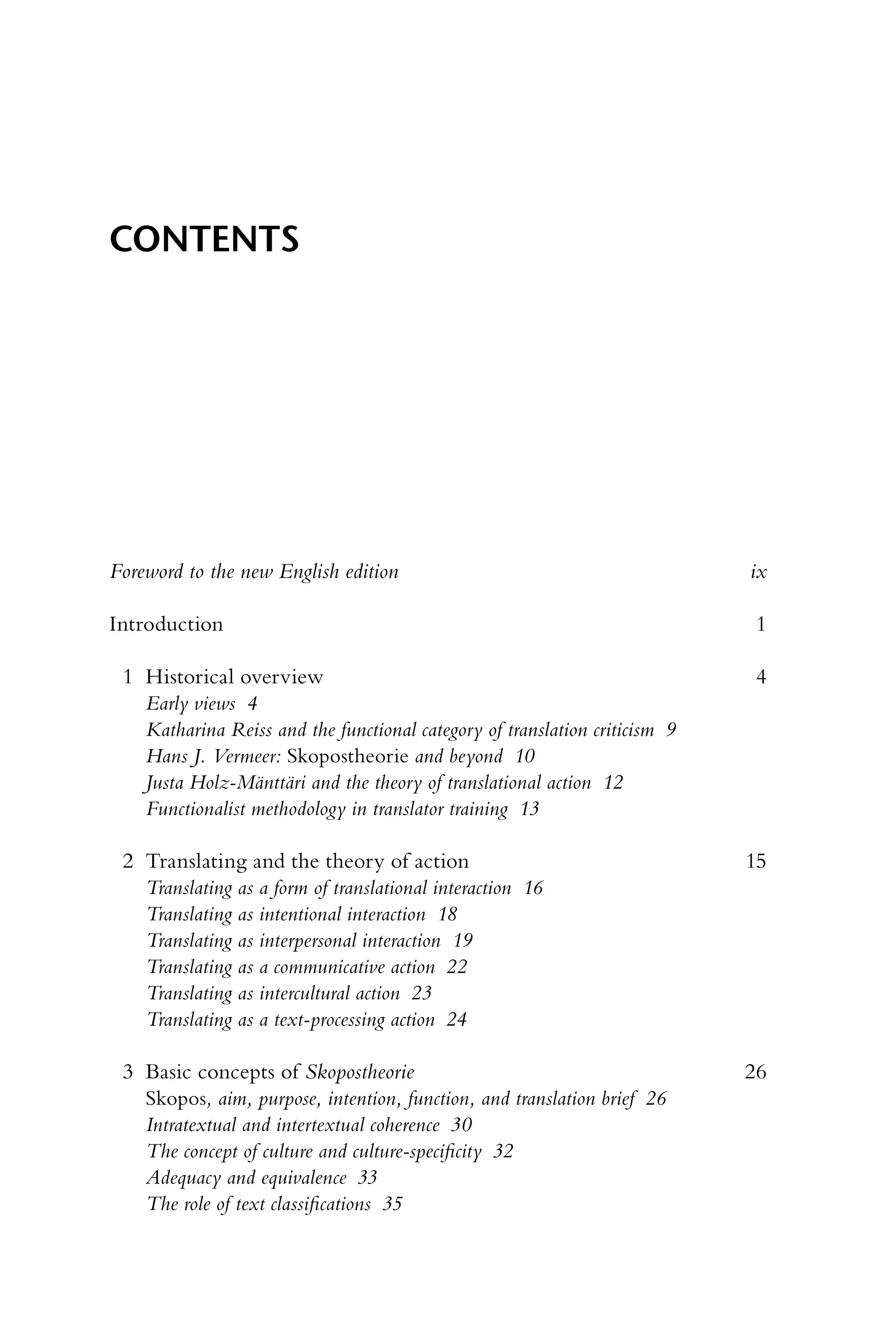
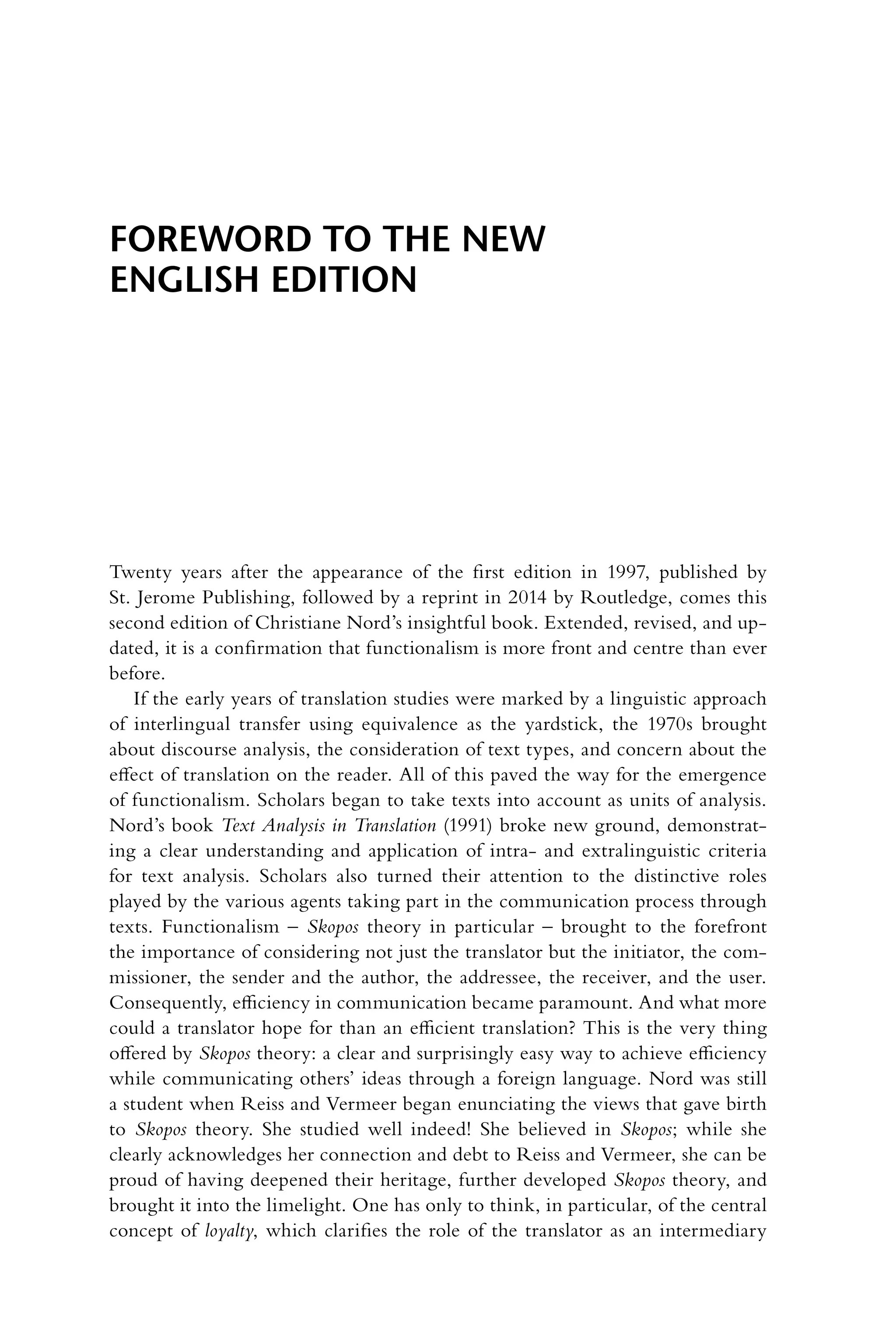
Foreword to the new English edition ix
Introduction 1
1 Historical overview 4
Early views 4
Katharina Reiss and the functional category of translation criticism 9
Hans J. Vermeer: Skopostheorie and beyond 10
Justa Holz-Mänttäri and the theory of translational action 12
Functionalist methodology in translator training 13
2 Translating and the theory of action 15
Translating as a form of translational interaction 16
Translating as intentional interaction 18
Translating as interpersonal interaction 19
Translating as a communicative action 22
Translating as intercultural action 23
Translating as a text-processing action 24
3 Basic concepts of Skopostheorie 26
Skopos, aim, purpose, intention, function, and translation brief 26
Intratextual and intertextual coherence 30
The concept of culture and culture-specificity 32
Adequacy and equivalence 33
The role of text classifications 35
Contents
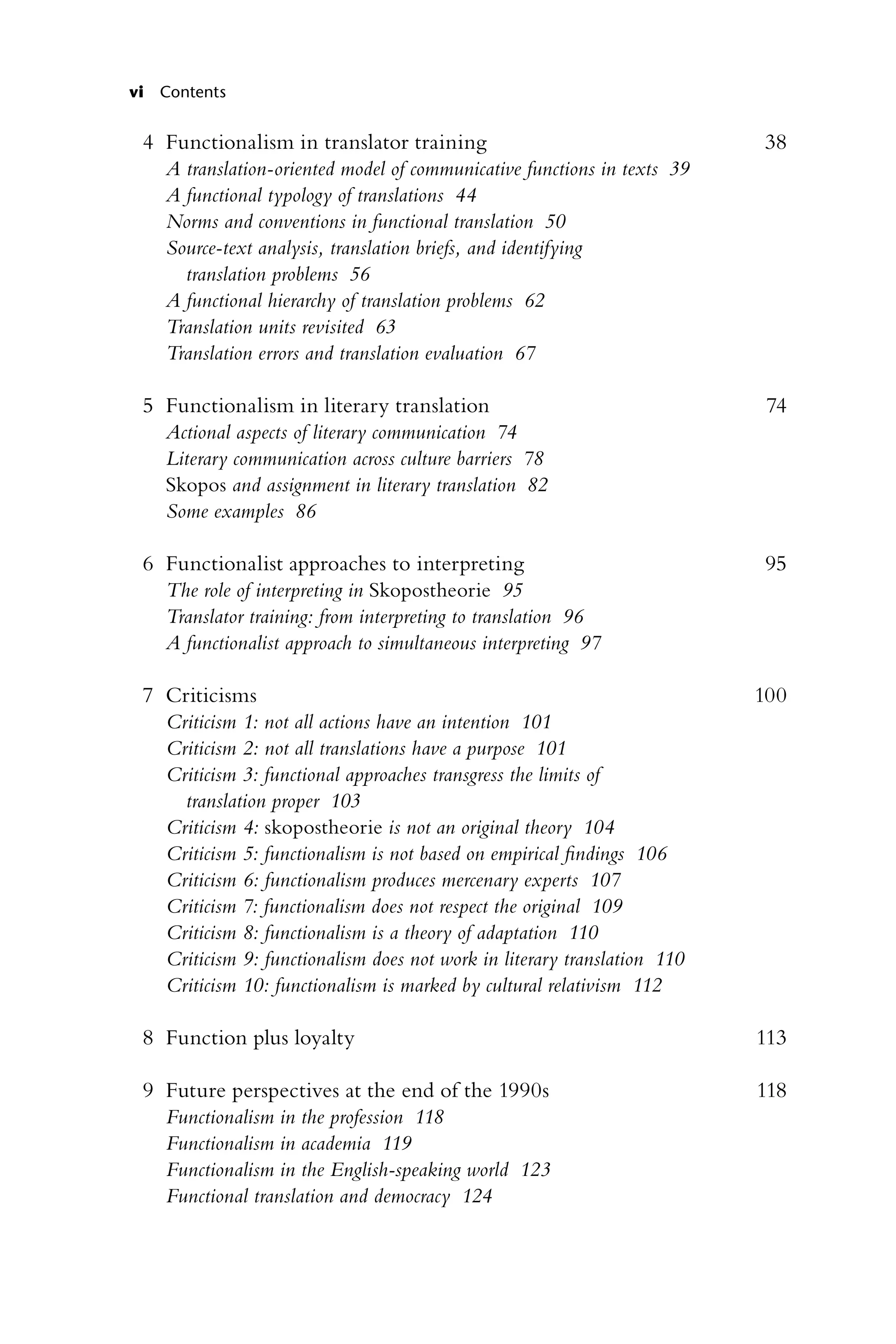
vi Contents
4 Functionalism in translator training 38
A translation-oriented model of communicative functions in texts 39
A functional typology of translations 44
Norms and conventions in functional translation 50
Source-text analysis, translation briefs, and identifying
translation problems 56
A functional hierarchy of translation problems 62
Translation units revisited 63
Translation errors and translation evaluation 67
5 Functionalism in literary translation 74
Actional aspects of literary communication 74
Literary communication across culture barriers 78
Skopos and assignment in literary translation 82
Some examples 86
6 Functionalist approaches to interpreting 95
The role of interpreting in Skopostheorie 95
Translator training: from interpreting to translation 96
A functionalist approach to simultaneous interpreting 97
7 Criticisms 100
Criticism 1: not all actions have an intention 101
Criticism 2: not all translations have a purpose 101
Criticism 3: functional approaches transgress the limits of
translation proper 103
Criticism 4: skopostheorie is not an original theory 104
Criticism 5: functionalism is not based on empirical findings 106
Criticism 6: functionalism produces mercenary experts 107
Criticism 7: functionalism does not respect the original 109
Criticism 8: functionalism is a theory of adaptation 110
Criticism 9: functionalism does not work in literary translation 110
Criticism 10: functionalism is marked by cultural relativism 112
8 Function plus loyalty 113
9 Future perspectives at the end of the 1990s 118
Functionalism in the profession 118
Functionalism in academia 119
Functionalism in the English-speaking world 123
Functional translation and democracy 124
Contents vii
10		 Skopos theory and functionalism in the new millennium 126
The academic world 127
The translator’s workplace 128
Functionalism in legal translation 129
Functionalism in literary and religious texts 131
Adaptation and transfer studies 132
Glossary 134
Bibliographical references 139
Twenty years after the appearance of the first edition in 1997, published by
St. Jerome Publishing, followed by a reprint in 2014 by Routledge, comes this
second edition of Christiane Nord’s insightful book. Extended, revised, and up-
dated, it is a confirmation that functionalism is more front and centre than ever
before.
If the early years of translation studies were marked by a linguistic approach
of interlingual transfer using equivalence as the yardstick, the 1970s brought
about discourse analysis, the consideration of text types, and concern about the
effect of translation on the reader. All of this paved the way for the emergence
of functionalism. Scholars began to take texts into account as units of analysis.
Nord’s book Text Analysis in Translation (1991) broke new ground, demonstrat-
ing a clear understanding and application of intra- and extralinguistic criteria
for text analysis. Scholars also turned their attention to the distinctive roles
played by the various agents taking part in the communication process through
texts. Functionalism – Skopos theory in particular – brought to the forefront
the importance of considering not just the translator but the initiator, the com-
missioner, the sender and the author, the addressee, the receiver, and the user.
Consequently, efficiency in communication became paramount. And what more
could a translator hope for than an efficient translation? This is the very thing
offered by Skopos theory: a clear and surprisingly easy way to achieve efficiency
while communicating others’ ideas through a foreign language. Nord was still
a student when Reiss and Vermeer began enunciating the views that gave birth
to Skopos theory. She studied well indeed! She believed in Skopos; while she
clearly acknowledges her connection and debt to Reiss and Vermeer, she can be
proud of having deepened their heritage, further developed Skopos theory, and
brought it into the limelight. One has only to think, in particular, of the central
concept of loyalty, which clarifies the role of the translator as an intermediary
Foreword to the new
English edition
x Foreword to the new English edition
between cultures and languages. As Nord puts it (1997:123–125), Skopos theory
appears to be the ideal translational model, given its characteristics; it is prag-
matic, ­
culture-oriented, consistent, practical, normative, comprehensive, and
expert. But she sees one main limitation to the radical functionalist model: “the
relationship between the translator and the source-text author”. Nord then in-
troduces the loyalty principle, which governs the “responsibility translators have
toward their partners in translational interaction”.
And it is Nord who proposed the taxonomy of instrumental and documentary
translation, which distinguishes between the functions of the translation process:
in one case, to document a communicative interaction under source-culture
conditions and, in the other, to channel a new communicative interaction using
the source text as a model.
What has been revised? And what is new in this edition, itself the product of
a complex translation and revision process? Well before planning this second edi-
tion, Nord had been eager to have her book translated into French and ­
Spanish. A
French edition (Artois Presses Université), translated by Beverly Adab and revised
by me, came first in 2008. Not only did it benefit from the adoption of a Skopos
­
metalanguage in French and new examples adapted for a French-­
speaking audi-
ence, it also helped to pinpoint any refinements needed in the original. Shortly
thereafter, Nord launched the counterpart project for an edition for Spanish-­
speaking readers. With the collaboration of various translators, this was published
in 2017. The Spanish translation too provided an opportunity for the revision of
the original text: The bibliography has been updated, and a number of both typo-
graphical and content errors have been corrected; a tenth chapter has been added.
The new English edition shares many similarities with the Spanish one.
The all-new Chapter 10, Skopos Theory and Functionalism in the New Millen-
nium, explores the extent and the influence of the functionalist theory in transla-
tion. It first gives an idea of the number of Skopos-related publications in different
languages and by different publishing houses, including the many translations of
functionalist material in Spanish, Chinese, French, Greek, Farsi, and Brazilian
Portuguese. A close look is taken at academic publications exploring particular
aspects of functionalism in various universities and countries around the world:
initially, from a translator training point of view, and then dealing with aspects
such as functionalist axioms, expressive function, ideology, corpus-based studies,
briefs, and practice-oriented material. This additional chapter also delves into
audience orientation, the translator’s workplace, legal translation, literary trans-
lation, and adaptation studies.
This new edition must be welcomed, and Christiane Nord (and Routledge)
thanked for promoting it. It will undoubtedly contribute to further promulgat-
ing functionalism as a way of explaining the implications and constraints of the
translation process, improving translation training methods, and reinforcing that
translation is a human activity that is approachable only from a human point of
view and, more precisely, as a culture-related activity.
Foreword to the new English edition xi
All this does not mean that Skopos theory is a panacea! Fifteen years ago, I
conducted an experiment with first-year university students to measure the ef-
ficiency of my functionalist approach at the end of a 45-hour course (see Bastin
2003, Meta 48(3):347–360). Comparing their Day-One translation with another
done 15 weeks later (of the same text, which they almost did not recall…), I
made a surprising discovery. While there had been a dramatic reduction in lan-
guage errors and meaning mistakes – a success from the teacher’s point of view –
methodological errors had increased, that is to say, over-translation (explicating
what should remain implicit) and under-translation (omitting what should be
amplified or explicated) were rather common to all students. This resulted from
their difficulty in adequately assessing the source and target Skopos. Convinced
by their teacher that they had to deviate from literality and employ creativity, my
students took many “liberties” in an effort to help readers better understand the
translated text or in order to screen out what they considered irrelevant informa-
tion. Skopos theory urges translators to correctly evaluate the shared knowledge
and culture of source and target readers, no easy matter for beginners to grasp or
for instructors to teach.
It is our hope that more research will be carried out into teaching-related
material based on functionalism, to help future translators to understand that in
spite of the omnipresence of translation tools and automated processes, transla-
tion remains, first and foremost, a creative intellectual activity.
Throughout my long acquaintance and extensive email correspondence with
Nord – our professional paths have crossed in Edmonton, Canada; Lima, Peru;
Buenos Aires, Argentina; and, more recently, at a summer school we both at-
tended in Barcelona – I have come to admire her for her energy, congeniality,
and dedication to training. Like her, Translating as a Purposeful Activity will un-
doubtedly reap a long and deserving harvest for its positive contribution to trans-
lation studies scholars and students.
Georges L. Bastin
Université de Montréal
Translating as a purposeful activity… isn’t that stating the obvious? Aren’t all
human activities aimed at some purpose or other? What does it mean to say that
translating (which, here, will always include interpreting unless stated otherwise)
is a purposeful activity?
The title is not meant to tell you something you didn’t know before; it’s simply
stating the aspects of translating that will be focussed on in this book. The main ti-
tle is evaluative rather than referential in function (these terms will be explained in
Chapter 4); the referential part is the subtitle ‘Functionalist Approaches ­
Explained’.
This book thus explains functionalist approaches to translation. ‘Functionalist’
means focussing on the function or functions of texts and translations. Function-
alism is a broad term for various theories that approach translation in this way,
although what we will call Skopostheorie has played a major role in the development
of this trend; a number of scholars subscribe to functionalism and draw inspiration
from Skopostheorie without calling themselves anything like ‘skopists’. We shall thus
be looking at functionalism as a broad approach, trying to distinguish between its
parts wherever possible and necessary.
Our title emphasizes that translating is an activity. This means that a theory
of translation can be embedded in a theory of human action or activity. The
­
parameters of action theory may help to explain some aspects of translation.
Human actions or activities are carried out by ‘agents’: individuals playing
roles. When playing the role of senders in communication, people have commu-
nicative purposes that they try to put into practice by means of texts. Commu-
nicative purposes are aimed at other people who are playing the role of receivers.
Communication takes place through a medium and in situations that are lim-
ited in time and place. Each specific situation determines what and how people
communicate, and it is changed by people communicating. Situations are not
universal but are embedded in a cultural habitat, which, in turn, conditions the
Introduction
2 Introduction
situation. Language is thus to be regarded as part of culture, and communication
is conditioned by the constraints of the situation-in-culture.
Example: If you ask a policeman for a particular street in Jakarta, he will give you
an elaborate and very detailed description, even though he doesn’t have the faint-
est idea where that particular street is. He just cannot say, “Sorry, I don’t know”
because that would mean losing face.
In translation, senders and receivers belong to different cultural groups in that
they speak different languages. Non-verbal forms of behaviour may be different
as well. Senders and receivers thus need help from someone who is familiar with
both languages (and cultures) and who is willing to play the role of translator or
intermediary between them. In professional settings, translators don’t normally
act on their own account; they are asked to intervene by either the sender or
the receiver, or perhaps by a third person. From an observer’s point of view, this
third party will be playing the role of ‘commissioner’ or ‘initiator’; from the
translator’s point of view, they will be the ‘client’ or ‘customer’. Initiators may
have communicative purposes of their own or they may share those of either
the sender or the receiver. Translating thus involves aiming at a particular com-
municative purpose that may or may not be identical with the one that other
participants have in mind.
Example: Suppose you are in Jakarta and you want to know how to find a par-
ticular street. You don’t speak Indonesian; the policeman doesn’t speak your lan-
guage. So, you ask your Indonesian friend to speak for you. Your friend turns
to the policeman, and after listening to his elaborate explanations where to turn
right behind the next bus stop, left at the level crossing, and then right again
opposite the filling station, she tells you, “He doesn’t know the way, we should
ask someone else”. (Your friend is familiar with the culture-specific non-verbal
or verbal markers giving away the policeman’s ignorance.) Or she tells you, “You
have to turn right behind the next bus stop, left at the level crossing, and then
right again opposite the filling station, and there you will be in the street you
are looking for”. (She interprets the policeman’s behaviour as that of somebody
who really knows the way.) In both cases, your friend has clearly interpreted the
policeman’s utterance in situation-in-culture; she has translated the function, not
the wording.
Although functionalist approaches draw on practical experience of the transla-
tion profession, they are not just descriptive; they do not merely describe what
can be observed in the process of translation or the results of this process. As we
will see later on, functionalism makes use of descriptive methods (for example,
parallel text analysis) to locate and compare the communicative norms and con-
ventions valid in various culture communities. Since functionalist approaches
have been developed mainly within university translator-training institutions,
they are normative or evaluative to the extent that they include the evaluation
of translations with regard to their functionality in a given situation-in-culture;
Introduction 3
future professional translators must be trained not only to produce ‘good’ (that
is, functional) translations satisfying their customers’ needs, but also to find good
arguments to defend their products against unjustified criticism from clients and
users. For example, your Indonesian friend might be reproached for not having
told you exactly what the policeman said since you have seen the policeman
pointing in some direction and using many more words than would have been
necessary just to say, “I don’t know!” What concepts should your Indonesian
translator use to defend her decision?
This short introduction into the functionalist view of translation has already
touched on the main aspects to be presented in the book. After a brief historical
overview of how Skopostheorie and the general function-oriented concepts came
into being (Chapter 1), we will look at the main ideas of functionalist approaches.
The agents and conditions of translational action will be explained and defined
(Chapter 2). The next step will be an analysis of the basic concepts of ­
Skopostheorie,
such as ‘Skopos’/‘purpose’, ‘function’, ‘culture’, ‘equivalence/­
adequacy’, and ‘text
type’ (Chapter 3). Then, we will look at how the approach is applied in the train-
ing of professional translators, dealing with text functions, a functional typology
of translations, norms and conventions in functional translation, a categorization
of translation problems, functional translation units, and some aspects of evalu-
ation (Chapter 4). Since some critics claim this model is not suited to the trans-
lation of literary texts, a further chapter will look more closely at functionalism
in literary translation (Chapter 5). The last chapter in this ‘main ideas’ part of the
book will deal with functionalism in simultaneous interpreting (Chapter 6).
Although some critical reactions to functionalism will be mentioned as we
look at the main ideas, the main criticisms will be bundled together and discussed
systematically in Chapter 7. Being involved in functional translation teaching
myself, my own attitude towards this approach will probably show through, de-
spite all attempts at objectivity. So as not to hide anything, my personal version
of functionalism will be presented quite briefly (Chapter 8) before dealing with
the current trends and future perspectives in functionalist theory (Chapter 9).
Twenty years after the first publication of this book, the current trends may be
no longer current, and the future perspectives have become, at least in parts,
present or even past. Therefore, an additional chapter will look at what happened
and is happening to Skopostheorie and functionalism since the turn of the century
(Chapter 10).
The book concludes with a glossary of the central concepts and a list of refer-
ences including a commented bibliography of the main functionalist texts.
The following pages describe the development of modern functionalism in trans-
lation studies. Of course, since functionalism didn’t suddenly appear overnight,
a brief description of early functionalist views of translation is needed in order
to sketch the situation from which the more recent theories and methodologies
emerged. We will then outline the landmarks of what is now often referred
to as the ‘German School’ of functionalist translation theory: Katharina Reiss
and functionalist translation criticism, Hans J. Vermeer’s Skopostheorie and its
extensions, Justa Holz-Mänttäri’s theory of translational action, and a number
of works oriented towards the use of functionalist methodology in translator
training. The basic concepts of translational action and Skopostheorie will be an-
alysed in detail later on; this chapter is merely designed to give a chronological
overview of authors and works.
Early views
Functional approaches to translation were not invented in the twentieth century.
Throughout history we find translators – mainly literary or Bible translators –
observing that different situations call for different renderings. However, ‘trans-
lation proper’ is frequently associated with word-for-word fidelity to the source
text, even though the result may not be considered appropriate for the intended
purpose. Cicero (106–43 b.c.e.) described the dilemma as follows:
That is to say I translated the most famous orations of the two most eloquent
Attic orators, Aeschines and Demosthenes, orations which they delivered
against each other. And I did not translate them as an interpreter but as an or-
ator, keeping the same ideas and the forms, or as one might say, the “figures”
of thought, but in language which conforms to our usage. And in so doing I
1
Historical overview
Historical overview 5
did not hold it necessary to render word for word, but I preserved the general
style and force of the language. For I did not think I should count them out
to the reader like coins, but to pay them by weight, as it were.
[46 b.c.e.]1949, De optimo genere oratorum, v. 14
Many Bible translators have felt that the process of translating should involve
both procedures: a faithful reproduction of formal source-text qualities in one
situation and an adjustment to the target audience in another. Jerome (348–420)
and Martin Luther (1483–1546) held the view that there are passages in the Bible
in which the translator must reproduce “the very order of the words” (Jerome,
Letter to Pammachius, [394]2004) or not “depart from the word” (Luther, An Open
Letter on Translating, [1530]2017); in other passages, they believed it was more
important “to render sense for sense” (Jerome) or to adjust the text to the target
audience’s needs and expectations.
In a similar vein, Eugene A. Nida (1964) distinguishes between formal and
dynamic equivalence in translation, with ‘formal equivalence’ referring to a
faithful reproduction of source-text form elements and ‘dynamic equivalence’
denoting equivalence of extralinguistic communicative effect:
A translation of dynamic equivalence aims at complete naturalness of ex-
pression, and tries to relate the receptor to modes of behavior relevant
within the context of his own culture; it does not insist that he understand
the cultural patterns of the source-language context in order to compre-
hend the message.
Nida 1964:159
In ‘A Framework for the Analysis and Evaluation of Theories of Translation’
(1976), Nida places special emphasis on the purpose of the translation, on the
roles of both the translator and the receivers, and on the cultural implications of
the translation process:
When the question of the superiority of one translation over another is raised,
the answer should be looked for in the answer to another question, ‘Best for
whom?’. The relative adequacy of different translations of the same text can
only be determined in terms of the extent to which each translation success-
fully fulfils the purpose for which it was intended. In other words, the relative
validity of each translation is seen in the degree to which the receptors are able
to respond to its message (in terms of both form and content) in comparison
with (1) what the original author evidently intended would be the response
of the original audience and (2) how that audience did, in fact, respond. The
responses can, of course, never be identical, for interlingual communication
always implies some differences in cultural setting, with accompanying diver-
sities in value systems, conceptual presuppositions, and historical antecedents.
1976:64f
6 Historical overview
Nida calls his approach ‘sociolinguistic’. However, when trying to apply it to
translation in general, he suggests a three-stage model of the translation process.
In this model, source-text surface elements (grammar, meaning, connotations)
are analysed as linguistic kernel or near-kernel structures that can be transferred
to the target language and restructured to form target-language surface elements
(cf. Nida 1976:75, also Nida and Taber 1969:202f). This basically linguistic ap-
proach, whose similarity to Noam Chomsky’s theory of syntax and generative
grammar (1957, 1965) is not accidental, had more influence on the development
of translation theory in Europe during the 1960s and 1970s than did the idea of
dynamic equivalence.
A general focus on straight linguistics rather than dynamic functionalism is
reflected in the importance Nida’s work has been given in recent surveys of
modern translation theories (as in Larose [1989]1992, Gentzler 1993). For Edwin
Gentzler (1993:46), Nida’s work became “the basis upon which a new field of in-
vestigation in the twentieth century – the ‘science of translation’ – was founded”.
Given this emphasis, it is not surprising to find Gentzler allocating just two small
paragraphs to what he calls ‘the Reiss/Vermeer approach’, which he sums up in
the following way:
Reiss’s work culminates in the co-authored Grundlegung einer allgemeinen
Translationstheorie, written together with Hans J. Vermeer in 1984, in which
they argue that translation should be governed primarily by the one func-
tional aspect which predominates, or, in the new terminology, by the orig-
inal’s ‘Skopos’….
1993:71
One of the aims of the present book is to correct the impression caused by publi-
cations like Gentzler’s, both with regard to authorship details and with respect to
the relationships between text typology (Reiss) and Skopostheorie (Vermeer). But
we will come to this in due course.
The fact that the reception of Nida’s approach focussed on its linguistic im-
plications must be understood in historical terms. Linguistics was perhaps the
dominant humanistic discipline of the 1950s and 1960s. Early experiments with
machine translation had to draw on contrastive representations of languages.
The optimistic view that machine translation was feasible is reflected in Anthony
Oettinger’s definition of translation:
Translating may be defined as the process of transforming signs or rep-
resentations into other signs or representations. If the originals have some
significance, we generally require that their images also have the same
significance, or, more realistically, as nearly the same significance as we
can get. Keeping significance invariant is the central problem in translating
between natural languages.
1960:104
Historical overview 7
At the same time, structuralist linguistics, along with the idea of language as
a code and the conception of language universals, nourished the illusion that
­
language – and translation as a linguistic operation – could be an object of strictly
scientific investigation on a par with any object in the natural sciences. Transla-
tion had previously been regarded as an art or a craft; now, translation scholars
were happy to have their activity recognized as a science and admitted to the in-
ner circle of scholarly pursuits as a branch of applied linguistics. Many definitions
of translation emphasized the linguistic aspect:
Translation may be defined as follows: the replacement of textual material
in one language (SL) by equivalent material in another language (TL).
Catford 1965:20
Translating consists in reproducing in the receptor language the closest
natural equivalent of the source-language message.
Nida and Taber 1969:12
These linguistic approaches basically saw translating as a code-switching opera-
tion. With the more pragmatic reorientation at the beginning of the 1970s, the
focus shifted from the word or phrase to the text as a unit of translation, but the
fundamental linguistic trend was not broken. Equivalence as a basic concept or
even constituent of translation was never really questioned. For Wolfram Wilss,
for example,
Translation leads from a source-language text to a target-language text
which is as close an equivalent as possible and presupposes an understand-
ing of the content and style of the original.
Wilss [1977]1982:62
Equivalence-based linguistic approaches focussed on the source text, the features
of which had to be preserved in the target text. For Werner Koller,
there exists equivalence between a given source text and a given target text
if the target text fulfils certain requirements with respect to these frame
conditions. The relevant conditions are those having to do with such as-
pects as content, style and function. The requirement of equivalence thus has
the following form: quality (or qualities) X in the SL text must be preserved. This
means that the source-language content, form, style, function, etc. must
be preserved, or at least that the translation must seek to preserve them as
far as possible.
[1979]1989:100, emphasis in the original
This is a normative statement. It declares any target text that is not equivalent
(“as far as possible”) to the corresponding source text to be a non-translation.
Discovering Diverse Content Through
Random Scribd Documents
The Project Gutenberg eBook of Jataka tales
This ebook is for the use of anyone anywhere in the United States
and most other parts of the world at no cost and with almost no
restrictions whatsoever. You may copy it, give it away or re-use it
under the terms of the Project Gutenberg License included with this
ebook or online at www.gutenberg.org. If you are not located in the
United States, you will have to check the laws of the country where
you are located before using this eBook.
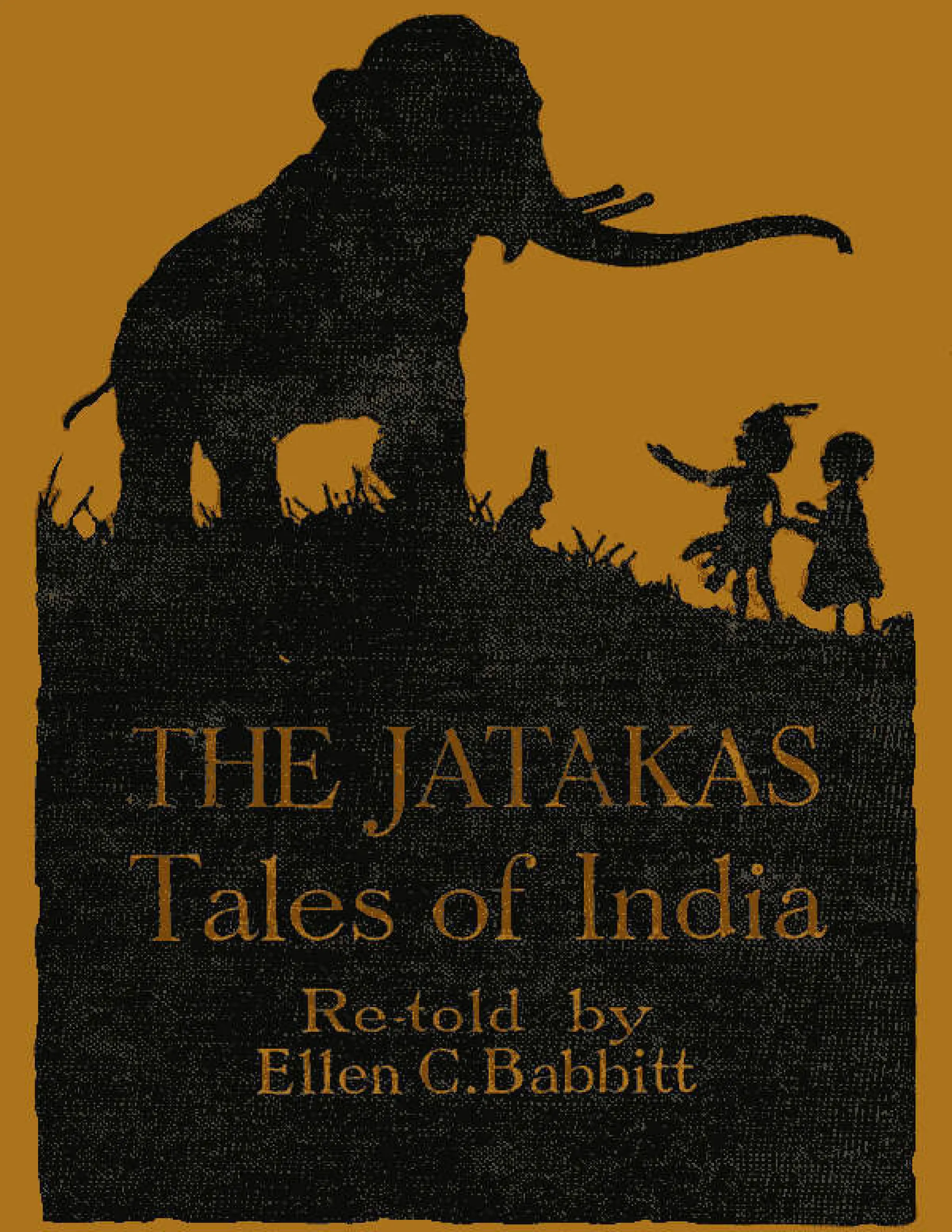
Title: Jataka tales
Author: Ellen C. Babbitt
Illustrator: Ellsworth Young
Release date: June 28, 2020 [eBook #62514]
Most recently updated: October 18, 2024
Language: English
Credits: Produced by Carlos Colón, the University of North Carolina
at Chapel Hill and the Online Distributed Proofreading
Team at https://www.pgdp.net (This file was produced
from
images generously made available by The Internet Archive)
*** START OF THE PROJECT GUTENBERG EBOOK JATAKA TALES
***
Transcriber's Notes:
Blank pages have been eliminated.
Variations in spelling and hyphenation have been left as
in the original.
A few typographical errors have been corrected.
The cover page was created by the transcriber and can
be considered public domain.
Jataka Tales
/
Re-told by
Ellen C. Babbitt
With illustrations by
Ellsworth Young
New York
The Century Co.
1912
Copyright, 1912, by
The Century Co.
Published, September, 1912
Dedicated
to
DOT
FOREWORD
Long ago I was captivated by the charm of the Jataka Tales and
realized the excellent use that might be made of them in the
teaching of children. The obvious lessons are many of them suitable
for little people, and beneath the obvious there are depths and
depths of meaning which they may learn to fathom later on. The
Oriental setting lends an additional fascination. I am glad that Miss
Babbitt has undertaken to put together this collection, and commend
it freely to teachers and parents.
Felix Adler.
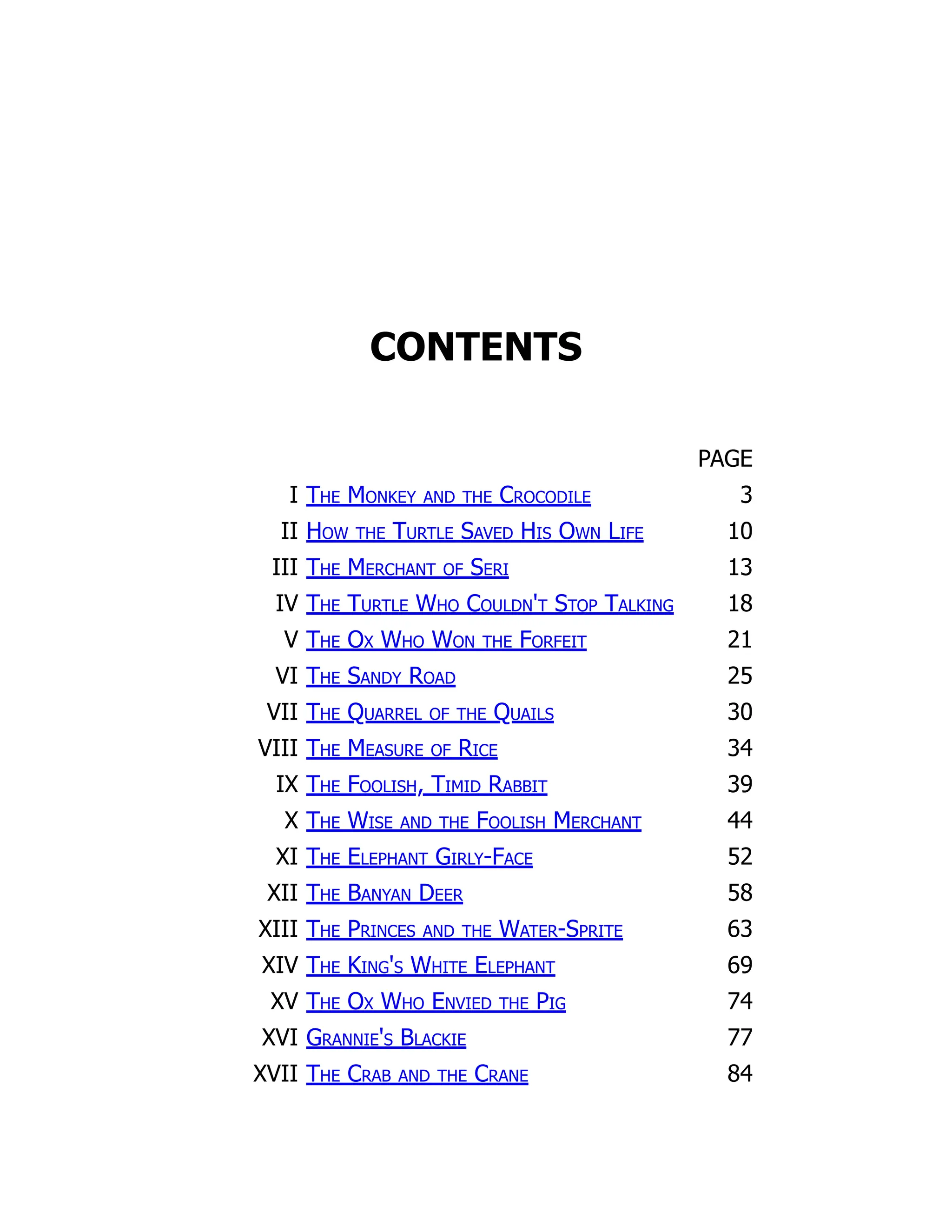
CONTENTS
PAGE
I The Monkey and the Crocodile 3
II How the Turtle Saved His Own Life 10
III The Merchant of Seri 13
IV The Turtle Who Couldn't Stop Talking 18
V The Ox Who Won the Forfeit 21
VI The Sandy Road 25
VII The Quarrel of the Quails 30
VIII The Measure of Rice 34
IX The Foolish, Timid Rabbit 39
X The Wise and the Foolish Merchant 44
XI The Elephant Girly-Face 52
XII The Banyan Deer 58
XIII The Princes and the Water-Sprite 63
XIV The King's White Elephant 69
XV The Ox Who Envied the Pig 74
XVI Grannie's Blackie 77
XVII The Crab and the Crane 84
XVIII Why the Owl Is Not King of the Birds 90
PUBLISHER'S NOTE
The Jatakas, or Birth-stories, form one of the sacred books of the
Buddhists and relate to the adventures of the Buddha in his former
existences, the best character in any story being identified with the
Master.
These legends were continually introduced into the religious
discourses of the Buddhist teachers to illustrate the doctrines of their
faith or to magnify the glory and sanctity of the Buddha, somewhat
as medieval preachers in Europe used to enliven their sermons by
introducing fables and popular tales to rouse the flagging interest of
their hearers.
Sculptured scenes from the Jatakas, found upon the carved railings
around the relic shrines of Sanchi and Amaravati and of Bharhut,
indicate that the Birth-stories were widely known in the third
century B.C., and were then considered as part of the sacred history
of the religion. At first the tales were probably handed down orally,
and it is uncertain when they were put together in systematic form.
While some of the stories are Buddhistic and depend for their point
on some custom or idea peculiar to Buddhism, many are age-old
fables, the flotsam and jetsam of folk-lore, which have appeared
under various guises throughout the centuries, as when they were
used by Boccaccio or Poggio, merely as merry tales, or by Chaucer,
who unwittingly puts a Jataka story into the mouth of his pardoners
when he tells the tale of the Ryotoures three.
Quaint humor and gentle earnestness distinguish these legends and
they teach many wholesome lessons, among them the duty of
kindness to animals.
Dr. Felix Adler in his Moral Instruction of Children, says:
The Jataka Tales contain deep truths, and are calculated to
impress lessons of great moral beauty. The tale of the
Merchant of Seri, who gave up all that he had in exchange
for a golden dish, embodies much the same idea as the
parable of the priceless Pearl, in the New Testament. The
tale of the Measure of Rice illustrates the importance of a
true estimate of values. The tale of the Banyan Deer, which
offered its life to save a doe and her young, illustrates self-
sacrifice of the noblest sort. The tale of the Sandy Road is
one of the finest in the collection.
And he adds that these tales are, as everyone must admit, nobly
conceived, lofty in meaning, and many a helpful sermon might be
preached from them as texts.
Jataka Tales
I.
THE MONKEY AND THE CROCODILE
PART I
A monkey lived in a great tree on a river bank.
In the river there were many Crocodiles.
A Crocodile watched the Monkeys for a long time, and one day she
said to her son: My son, get one of those Monkeys for me. I want
the heart of a Monkey to eat.
How am I to catch a Monkey? asked the little Crocodile. I do not
travel on land, and the Monkey does not go into the water.
Put your wits to work, and you'll find a way, said the mother.
And the little Crocodile thought and thought.
At last he said to himself: I know what I'll do. I'll get that Monkey
that lives in a big tree on the river bank. He wishes to go across the
river to the island where the fruit is so ripe.
So the Crocodile swam to the tree where the Monkey lived. But he
was a stupid Crocodile.
Oh, Monkey, he called, come with me over to the island where the
fruit is so ripe.
How can I go with you? asked the Monkey. I do not swim.
No—but I do. I will take you over on my back, said the Crocodile.
The Monkey was greedy, and wanted the ripe fruit, so he jumped
down on the Crocodile's back.
Off we go! said the Crocodile.
This is a fine ride you are giving me! said the Monkey.
Do you think so? Well, how do you like this? asked the Crocodile,
diving.
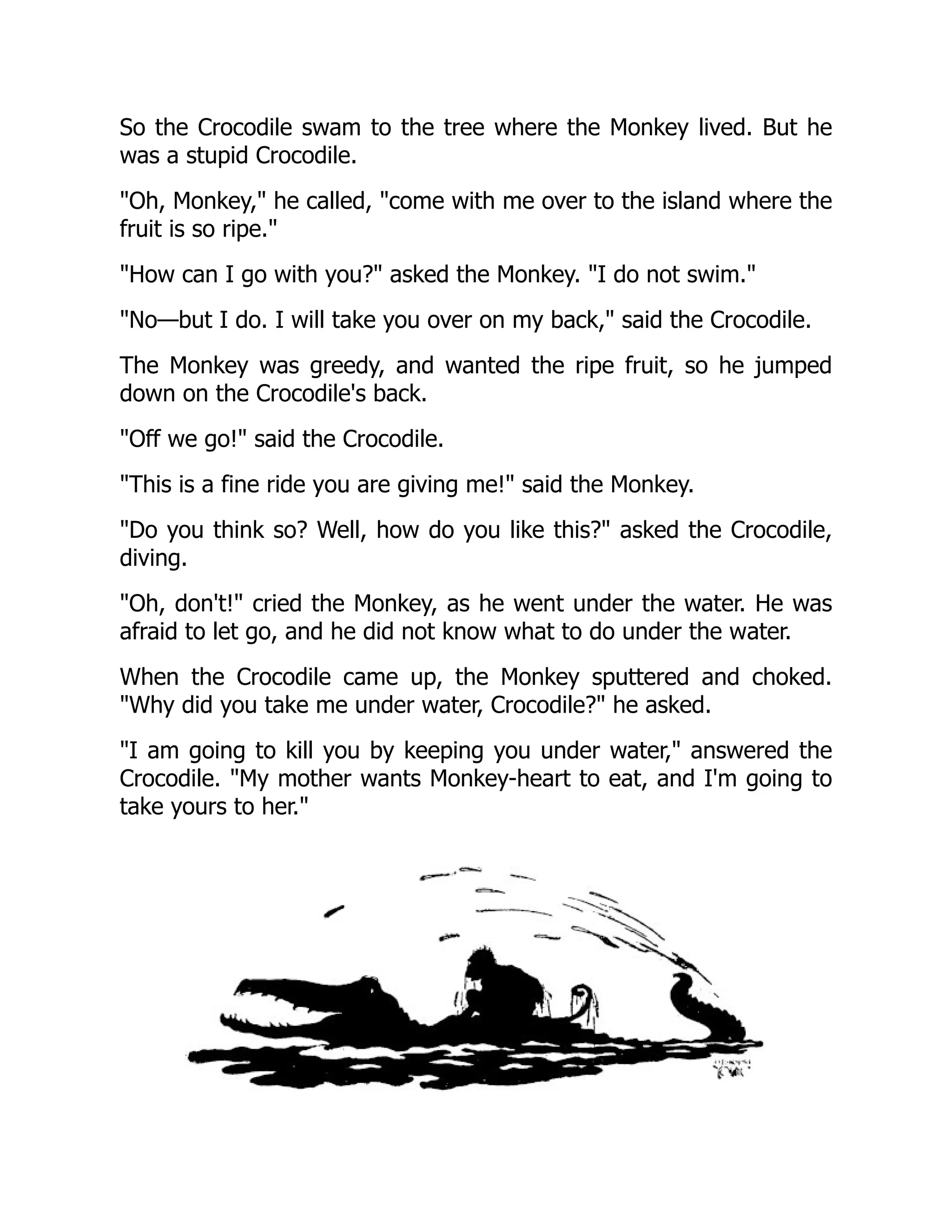
Oh, don't! cried the Monkey, as he went under the water. He was
afraid to let go, and he did not know what to do under the water.
When the Crocodile came up, the Monkey sputtered and choked.
Why did you take me under water, Crocodile? he asked.
I am going to kill you by keeping you under water, answered the
Crocodile. My mother wants Monkey-heart to eat, and I'm going to
take yours to her.
Why did you take me under water, Crocodile? he asked.
I wish you had told me you wanted my heart, said the Monkey,
then I might have brought it with me.
How queer! said the stupid Crocodile. Do you mean to say that
you left your heart back there in the tree?
That is what I mean, said the Monkey. If you want my heart, we
must go back to the tree and get it. But we are so near the island
where the ripe fruit is, please take me there first.
No, Monkey, said the Crocodile, I'll take you straight back to your
tree. Never mind the ripe fruit. Get your heart and bring it to me at
once. Then we'll see about going to the island.
Very well, said the Monkey.
But no sooner had he jumped onto the bank of the river than—
whisk! up he ran into the tree.
From the topmost branches he called down to the Crocodile in the
water below:
My heart is way up here! If you want it, come for it, come for it!
PART II
The monkey soon moved away from that tree.
He wanted to get away from the Crocodile, so that he might live in
peace.
But the Crocodile found him, far down the river, living in another
tree.
Welcome to our website – the ideal destination for book lovers and
knowledge seekers. With a mission to inspire endlessly, we offer a
vast collection of books, ranging from classic literary works to
specialized publications, self-development books, and children's
literature. Each book is a new journey of discovery, expanding
knowledge and enriching the soul of the reade
Our website is not just a platform for buying books, but a bridge
connecting readers to the timeless values of culture and wisdom. With
an elegant, user-friendly interface and an intelligent search system,
we are committed to providing a quick and convenient shopping
experience. Additionally, our special promotions and home delivery
services ensure that you save time and fully enjoy the joy of reading.
Let us accompany you on the journey of exploring knowledge and
personal growth!
ebookfinal.com

Translating as a Purposeful Activity 2nd Edition Functionalist Approaches Explained Christiane Nord
  • 1.
    Translating as aPurposeful Activity 2nd Edition Functionalist Approaches Explained Christiane Nord pdf download https://ebookfinal.com/download/translating-as-a-purposeful- activity-2nd-edition-functionalist-approaches-explained- christiane-nord/ Explore and download more ebooks or textbooks at ebookfinal.com
  • 2.
    We believe theseproducts will be a great fit for you. Click the link to download now, or visit ebookfinal to discover even more! The Purposeful Argument A Practical Guide 2nd Edition Harry Phillips https://ebookfinal.com/download/the-purposeful-argument-a-practical- guide-2nd-edition-harry-phillips/ Statistics Explained A Guide for Social Science Students 2nd Edition Perry Hinton https://ebookfinal.com/download/statistics-explained-a-guide-for- social-science-students-2nd-edition-perry-hinton/ Translating Promotional and Advertising Texts 2nd Edition Ira Torresi https://ebookfinal.com/download/translating-promotional-and- advertising-texts-2nd-edition-ira-torresi/ Promoting physical activity a guide for community action 2nd Edition David R Brown https://ebookfinal.com/download/promoting-physical-activity-a-guide- for-community-action-2nd-edition-david-r-brown/
  • 3.
    Physical Activity andHealth 2nd Edition Claude Bouchard https://ebookfinal.com/download/physical-activity-and-health-2nd- edition-claude-bouchard/ OCR AS A level Chemistry A 2nd Edition Sam Holyman https://ebookfinal.com/download/ocr-as-a-level-chemistry-a-2nd- edition-sam-holyman/ IPSAS Explained A Summary of International Public Sector Accounting Standards 2nd Edition Thomas Muller-Marques Berger https://ebookfinal.com/download/ipsas-explained-a-summary-of- international-public-sector-accounting-standards-2nd-edition-thomas- muller-marques-berger/ Kidney Failure Explained Class Health Class Health 2nd Edition Andy Stein https://ebookfinal.com/download/kidney-failure-explained-class-health- class-health-2nd-edition-andy-stein/ Geometric Mechanics Part II Rotating Translating And Rolling 2nd Edition Darryl D Holm https://ebookfinal.com/download/geometric-mechanics-part-ii-rotating- translating-and-rolling-2nd-edition-darryl-d-holm/
  • 5.
    Translating as aPurposeful Activity 2nd Edition Functionalist Approaches Explained Christiane Nord Digital Instant Download Author(s): Christiane Nord ISBN(s): 9781138573369, 1138573361 Edition: 2 File Details: PDF, 2.07 MB Year: 2018 Language: english

  • 7.
    Translating as a PurposefulActivity This best-selling text is a comprehensive overview of functionalist approaches to translation in English. Christiane Nord, one of the leading figures in transla- tion studies, explains the complexities of theories and terms in simple language with numerous examples. Covering how the theories developed; illustrations of the main ideas; and specific applications to translator training, literary transla- tion, interpreting, and ethics, Translating as a Purposeful Activity concludes with a concise review of both criticisms and perspectives for the future. Now with a foreword by Georges Bastin and a new chapter covering the recent developments and elaborations of the theory, this is an essential text for students of translation studies and for translator training. Christiane Nord is Professor Emerita of Translation Studies and Specialized Communication at the University of Applied Sciences of Magdeburg, Germany, and Visiting Professor at several universities of the People’s Republic of China. She also holds the position of Professor Extraordinary and Research Fellow at the University of the Free State, South Africa. Her homepage can be found at www.christiane-nord.de.
  • 8.
    Translation Theories Explored SeriesEditor:Theo Hermans, UCL, UK TranslationTheories Explored is a series designed to engage with the range and diversity of contemporary translation studies.Translation itself is as vital and as charged as ever. If anything, it has become more plural, more varied, and more complex in today’s world.The study of translation has responded to these chal- lenges with vigour. In recent decades the field has gained in depth, its scope continues to expand, and it is increasingly interacting with other disciplines.The series sets out to reflect and foster these developments. It aims to keep track of theoretical developments, to explore new areas, approaches, and issues, and gen- erally to extend and enrich the intellectual horizon of translation studies. Special attention is paid to innovative ideas that may not as yet be widely known but deserve wider currency. Individual volumes explain and assess particular approaches. Each volume com- bines an overview of the relevant approach with case studies and critical reflec- tion, placing its subject in a broad intellectual and historical context; illustrating the key ideas with examples; summarizing the main debates; accounting for spe- cific methodologies, achievements, and blind spots; and opening up new avenues for the future.Authors are selected not only on their close familiarity and personal affinity with a particular approach but also on their capacity for lucid exposition, critical assessment, and imaginative thought.The series is aimed at researchers and graduate students who wish to learn about new approaches to translation in a comprehensive but accessible way. Translation and Literary Criticism Marilyn Gaddis Rose Translation in Systems Theo Hermans Deconstruction and Translation Kathleen Davis Can Theory Help Translators? Andrew Chesterman and EmmaWagner Stylistic Approaches to Translation Jean Boase Beier Representing Others Kate Sturge Cosmopolitanism and Translation Esperança Bielsa https://www.routledge.com/Translation-Theories-Explored/book-series/TTE
  • 9.
    Translating as a PurposefulActivity Functionalist Approaches Explained Second edition Christiane Nord
  • 10.
    Second edition publishedin 2018 by Routledge 2 Park Square, Milton Park, Abingdon, Oxon OX14 4RN and by Routledge 711 Third Avenue, New York, NY 10017 Routledge is an imprint of the Taylor & Francis Group, an informa business © 2018 Christiane Nord The right of Christiane Nord to be identified as author of this work has been asserted by her in accordance with sections 77 and 78 of the Copyright, Designs and Patents Act 1988. All rights reserved. No part of this book may be reprinted or reproduced or utilised in any form or by any electronic, mechanical, or other means, now known or hereafter invented, including photocopying and recording, or in any information storage or retrieval system, without permission in writing from the publishers. Trademark notice: Product or corporate names may be trademarks or registered trademarks, and are used only for identification and explanation without intent to infringe. First edition published by St Jerome 1997 British Library Cataloguing-in-Publication Data A catalogue record for this book is available from the British Library Library of Congress Cataloging-in-Publication Data Names: Nord, Christiane. Title: Translating as a purposeful activity: functionalist approaches explained / Christiane Nord. Description: Second edition. | Milton Park, Abingdon, Oxon; New York: Routledge, 2018. | Series: Translation theories explored | Includes bibliographical references. Identifiers: LCCN 2017043268 | ISBN 9781138573369 (hardback) | ISBN 9781138573345 (pbk.) Subjects: LCSH: Translating and interpreting. Classification: LCC P306 .N593 2018 | DDC 418/.02—dc23 LC record available at https://lccn.loc.gov/2017043268 ISBN: 978-1-138-57336-9 (hbk) ISBN: 978-1-138-57334-5 (pbk) ISBN: 978-1-351-18935-4 (ebk) Typeset in Bembo by codeMantra
  • 11.
    Foreword to thenew English edition ix Introduction 1 1 Historical overview 4 Early views 4 Katharina Reiss and the functional category of translation criticism 9 Hans J. Vermeer: Skopostheorie and beyond 10 Justa Holz-Mänttäri and the theory of translational action 12 Functionalist methodology in translator training 13 2 Translating and the theory of action 15 Translating as a form of translational interaction 16 Translating as intentional interaction 18 Translating as interpersonal interaction 19 Translating as a communicative action 22 Translating as intercultural action 23 Translating as a text-processing action 24 3 Basic concepts of Skopostheorie 26 Skopos, aim, purpose, intention, function, and translation brief 26 Intratextual and intertextual coherence 30 The concept of culture and culture-specificity 32 Adequacy and equivalence 33 The role of text classifications 35 Contents
  • 12.
    vi Contents 4 Functionalismin translator training 38 A translation-oriented model of communicative functions in texts 39 A functional typology of translations 44 Norms and conventions in functional translation 50 Source-text analysis, translation briefs, and identifying translation problems 56 A functional hierarchy of translation problems 62 Translation units revisited 63 Translation errors and translation evaluation 67 5 Functionalism in literary translation 74 Actional aspects of literary communication 74 Literary communication across culture barriers 78 Skopos and assignment in literary translation 82 Some examples 86 6 Functionalist approaches to interpreting 95 The role of interpreting in Skopostheorie 95 Translator training: from interpreting to translation 96 A functionalist approach to simultaneous interpreting 97 7 Criticisms 100 Criticism 1: not all actions have an intention 101 Criticism 2: not all translations have a purpose 101 Criticism 3: functional approaches transgress the limits of translation proper 103 Criticism 4: skopostheorie is not an original theory 104 Criticism 5: functionalism is not based on empirical findings 106 Criticism 6: functionalism produces mercenary experts 107 Criticism 7: functionalism does not respect the original 109 Criticism 8: functionalism is a theory of adaptation 110 Criticism 9: functionalism does not work in literary translation 110 Criticism 10: functionalism is marked by cultural relativism 112 8 Function plus loyalty 113 9 Future perspectives at the end of the 1990s 118 Functionalism in the profession 118 Functionalism in academia 119 Functionalism in the English-speaking world 123 Functional translation and democracy 124
  • 13.
    Contents vii 10 Skopostheory and functionalism in the new millennium 126 The academic world 127 The translator’s workplace 128 Functionalism in legal translation 129 Functionalism in literary and religious texts 131 Adaptation and transfer studies 132 Glossary 134 Bibliographical references 139
  • 15.
    Twenty years afterthe appearance of the first edition in 1997, published by St. Jerome Publishing, followed by a reprint in 2014 by Routledge, comes this second edition of Christiane Nord’s insightful book. Extended, revised, and up- dated, it is a confirmation that functionalism is more front and centre than ever before. If the early years of translation studies were marked by a linguistic approach of interlingual transfer using equivalence as the yardstick, the 1970s brought about discourse analysis, the consideration of text types, and concern about the effect of translation on the reader. All of this paved the way for the emergence of functionalism. Scholars began to take texts into account as units of analysis. Nord’s book Text Analysis in Translation (1991) broke new ground, demonstrat- ing a clear understanding and application of intra- and extralinguistic criteria for text analysis. Scholars also turned their attention to the distinctive roles played by the various agents taking part in the communication process through texts. Functionalism – Skopos theory in particular – brought to the forefront the importance of considering not just the translator but the initiator, the com- missioner, the sender and the author, the addressee, the receiver, and the user. Consequently, efficiency in communication became paramount. And what more could a translator hope for than an efficient translation? This is the very thing offered by Skopos theory: a clear and surprisingly easy way to achieve efficiency while communicating others’ ideas through a foreign language. Nord was still a student when Reiss and Vermeer began enunciating the views that gave birth to Skopos theory. She studied well indeed! She believed in Skopos; while she clearly acknowledges her connection and debt to Reiss and Vermeer, she can be proud of having deepened their heritage, further developed Skopos theory, and brought it into the limelight. One has only to think, in particular, of the central concept of loyalty, which clarifies the role of the translator as an intermediary Foreword to the new English edition
  • 16.
    x Foreword tothe new English edition between cultures and languages. As Nord puts it (1997:123–125), Skopos theory appears to be the ideal translational model, given its characteristics; it is prag- matic, ­ culture-oriented, consistent, practical, normative, comprehensive, and expert. But she sees one main limitation to the radical functionalist model: “the relationship between the translator and the source-text author”. Nord then in- troduces the loyalty principle, which governs the “responsibility translators have toward their partners in translational interaction”. And it is Nord who proposed the taxonomy of instrumental and documentary translation, which distinguishes between the functions of the translation process: in one case, to document a communicative interaction under source-culture conditions and, in the other, to channel a new communicative interaction using the source text as a model. What has been revised? And what is new in this edition, itself the product of a complex translation and revision process? Well before planning this second edi- tion, Nord had been eager to have her book translated into French and ­ Spanish. A French edition (Artois Presses Université), translated by Beverly Adab and revised by me, came first in 2008. Not only did it benefit from the adoption of a Skopos ­ metalanguage in French and new examples adapted for a French-­ speaking audi- ence, it also helped to pinpoint any refinements needed in the original. Shortly thereafter, Nord launched the counterpart project for an edition for Spanish-­ speaking readers. With the collaboration of various translators, this was published in 2017. The Spanish translation too provided an opportunity for the revision of the original text: The bibliography has been updated, and a number of both typo- graphical and content errors have been corrected; a tenth chapter has been added. The new English edition shares many similarities with the Spanish one. The all-new Chapter 10, Skopos Theory and Functionalism in the New Millen- nium, explores the extent and the influence of the functionalist theory in transla- tion. It first gives an idea of the number of Skopos-related publications in different languages and by different publishing houses, including the many translations of functionalist material in Spanish, Chinese, French, Greek, Farsi, and Brazilian Portuguese. A close look is taken at academic publications exploring particular aspects of functionalism in various universities and countries around the world: initially, from a translator training point of view, and then dealing with aspects such as functionalist axioms, expressive function, ideology, corpus-based studies, briefs, and practice-oriented material. This additional chapter also delves into audience orientation, the translator’s workplace, legal translation, literary trans- lation, and adaptation studies. This new edition must be welcomed, and Christiane Nord (and Routledge) thanked for promoting it. It will undoubtedly contribute to further promulgat- ing functionalism as a way of explaining the implications and constraints of the translation process, improving translation training methods, and reinforcing that translation is a human activity that is approachable only from a human point of view and, more precisely, as a culture-related activity.
  • 17.
    Foreword to thenew English edition xi All this does not mean that Skopos theory is a panacea! Fifteen years ago, I conducted an experiment with first-year university students to measure the ef- ficiency of my functionalist approach at the end of a 45-hour course (see Bastin 2003, Meta 48(3):347–360). Comparing their Day-One translation with another done 15 weeks later (of the same text, which they almost did not recall…), I made a surprising discovery. While there had been a dramatic reduction in lan- guage errors and meaning mistakes – a success from the teacher’s point of view – methodological errors had increased, that is to say, over-translation (explicating what should remain implicit) and under-translation (omitting what should be amplified or explicated) were rather common to all students. This resulted from their difficulty in adequately assessing the source and target Skopos. Convinced by their teacher that they had to deviate from literality and employ creativity, my students took many “liberties” in an effort to help readers better understand the translated text or in order to screen out what they considered irrelevant informa- tion. Skopos theory urges translators to correctly evaluate the shared knowledge and culture of source and target readers, no easy matter for beginners to grasp or for instructors to teach. It is our hope that more research will be carried out into teaching-related material based on functionalism, to help future translators to understand that in spite of the omnipresence of translation tools and automated processes, transla- tion remains, first and foremost, a creative intellectual activity. Throughout my long acquaintance and extensive email correspondence with Nord – our professional paths have crossed in Edmonton, Canada; Lima, Peru; Buenos Aires, Argentina; and, more recently, at a summer school we both at- tended in Barcelona – I have come to admire her for her energy, congeniality, and dedication to training. Like her, Translating as a Purposeful Activity will un- doubtedly reap a long and deserving harvest for its positive contribution to trans- lation studies scholars and students. Georges L. Bastin Université de Montréal
  • 19.
    Translating as apurposeful activity… isn’t that stating the obvious? Aren’t all human activities aimed at some purpose or other? What does it mean to say that translating (which, here, will always include interpreting unless stated otherwise) is a purposeful activity? The title is not meant to tell you something you didn’t know before; it’s simply stating the aspects of translating that will be focussed on in this book. The main ti- tle is evaluative rather than referential in function (these terms will be explained in Chapter 4); the referential part is the subtitle ‘Functionalist Approaches ­ Explained’. This book thus explains functionalist approaches to translation. ‘Functionalist’ means focussing on the function or functions of texts and translations. Function- alism is a broad term for various theories that approach translation in this way, although what we will call Skopostheorie has played a major role in the development of this trend; a number of scholars subscribe to functionalism and draw inspiration from Skopostheorie without calling themselves anything like ‘skopists’. We shall thus be looking at functionalism as a broad approach, trying to distinguish between its parts wherever possible and necessary. Our title emphasizes that translating is an activity. This means that a theory of translation can be embedded in a theory of human action or activity. The ­ parameters of action theory may help to explain some aspects of translation. Human actions or activities are carried out by ‘agents’: individuals playing roles. When playing the role of senders in communication, people have commu- nicative purposes that they try to put into practice by means of texts. Commu- nicative purposes are aimed at other people who are playing the role of receivers. Communication takes place through a medium and in situations that are lim- ited in time and place. Each specific situation determines what and how people communicate, and it is changed by people communicating. Situations are not universal but are embedded in a cultural habitat, which, in turn, conditions the Introduction
  • 20.
    2 Introduction situation. Languageis thus to be regarded as part of culture, and communication is conditioned by the constraints of the situation-in-culture. Example: If you ask a policeman for a particular street in Jakarta, he will give you an elaborate and very detailed description, even though he doesn’t have the faint- est idea where that particular street is. He just cannot say, “Sorry, I don’t know” because that would mean losing face. In translation, senders and receivers belong to different cultural groups in that they speak different languages. Non-verbal forms of behaviour may be different as well. Senders and receivers thus need help from someone who is familiar with both languages (and cultures) and who is willing to play the role of translator or intermediary between them. In professional settings, translators don’t normally act on their own account; they are asked to intervene by either the sender or the receiver, or perhaps by a third person. From an observer’s point of view, this third party will be playing the role of ‘commissioner’ or ‘initiator’; from the translator’s point of view, they will be the ‘client’ or ‘customer’. Initiators may have communicative purposes of their own or they may share those of either the sender or the receiver. Translating thus involves aiming at a particular com- municative purpose that may or may not be identical with the one that other participants have in mind. Example: Suppose you are in Jakarta and you want to know how to find a par- ticular street. You don’t speak Indonesian; the policeman doesn’t speak your lan- guage. So, you ask your Indonesian friend to speak for you. Your friend turns to the policeman, and after listening to his elaborate explanations where to turn right behind the next bus stop, left at the level crossing, and then right again opposite the filling station, she tells you, “He doesn’t know the way, we should ask someone else”. (Your friend is familiar with the culture-specific non-verbal or verbal markers giving away the policeman’s ignorance.) Or she tells you, “You have to turn right behind the next bus stop, left at the level crossing, and then right again opposite the filling station, and there you will be in the street you are looking for”. (She interprets the policeman’s behaviour as that of somebody who really knows the way.) In both cases, your friend has clearly interpreted the policeman’s utterance in situation-in-culture; she has translated the function, not the wording. Although functionalist approaches draw on practical experience of the transla- tion profession, they are not just descriptive; they do not merely describe what can be observed in the process of translation or the results of this process. As we will see later on, functionalism makes use of descriptive methods (for example, parallel text analysis) to locate and compare the communicative norms and con- ventions valid in various culture communities. Since functionalist approaches have been developed mainly within university translator-training institutions, they are normative or evaluative to the extent that they include the evaluation of translations with regard to their functionality in a given situation-in-culture;
  • 21.
    Introduction 3 future professionaltranslators must be trained not only to produce ‘good’ (that is, functional) translations satisfying their customers’ needs, but also to find good arguments to defend their products against unjustified criticism from clients and users. For example, your Indonesian friend might be reproached for not having told you exactly what the policeman said since you have seen the policeman pointing in some direction and using many more words than would have been necessary just to say, “I don’t know!” What concepts should your Indonesian translator use to defend her decision? This short introduction into the functionalist view of translation has already touched on the main aspects to be presented in the book. After a brief historical overview of how Skopostheorie and the general function-oriented concepts came into being (Chapter 1), we will look at the main ideas of functionalist approaches. The agents and conditions of translational action will be explained and defined (Chapter 2). The next step will be an analysis of the basic concepts of ­ Skopostheorie, such as ‘Skopos’/‘purpose’, ‘function’, ‘culture’, ‘equivalence/­ adequacy’, and ‘text type’ (Chapter 3). Then, we will look at how the approach is applied in the train- ing of professional translators, dealing with text functions, a functional typology of translations, norms and conventions in functional translation, a categorization of translation problems, functional translation units, and some aspects of evalu- ation (Chapter 4). Since some critics claim this model is not suited to the trans- lation of literary texts, a further chapter will look more closely at functionalism in literary translation (Chapter 5). The last chapter in this ‘main ideas’ part of the book will deal with functionalism in simultaneous interpreting (Chapter 6). Although some critical reactions to functionalism will be mentioned as we look at the main ideas, the main criticisms will be bundled together and discussed systematically in Chapter 7. Being involved in functional translation teaching myself, my own attitude towards this approach will probably show through, de- spite all attempts at objectivity. So as not to hide anything, my personal version of functionalism will be presented quite briefly (Chapter 8) before dealing with the current trends and future perspectives in functionalist theory (Chapter 9). Twenty years after the first publication of this book, the current trends may be no longer current, and the future perspectives have become, at least in parts, present or even past. Therefore, an additional chapter will look at what happened and is happening to Skopostheorie and functionalism since the turn of the century (Chapter 10). The book concludes with a glossary of the central concepts and a list of refer- ences including a commented bibliography of the main functionalist texts.
  • 22.
    The following pagesdescribe the development of modern functionalism in trans- lation studies. Of course, since functionalism didn’t suddenly appear overnight, a brief description of early functionalist views of translation is needed in order to sketch the situation from which the more recent theories and methodologies emerged. We will then outline the landmarks of what is now often referred to as the ‘German School’ of functionalist translation theory: Katharina Reiss and functionalist translation criticism, Hans J. Vermeer’s Skopostheorie and its extensions, Justa Holz-Mänttäri’s theory of translational action, and a number of works oriented towards the use of functionalist methodology in translator training. The basic concepts of translational action and Skopostheorie will be an- alysed in detail later on; this chapter is merely designed to give a chronological overview of authors and works. Early views Functional approaches to translation were not invented in the twentieth century. Throughout history we find translators – mainly literary or Bible translators – observing that different situations call for different renderings. However, ‘trans- lation proper’ is frequently associated with word-for-word fidelity to the source text, even though the result may not be considered appropriate for the intended purpose. Cicero (106–43 b.c.e.) described the dilemma as follows: That is to say I translated the most famous orations of the two most eloquent Attic orators, Aeschines and Demosthenes, orations which they delivered against each other. And I did not translate them as an interpreter but as an or- ator, keeping the same ideas and the forms, or as one might say, the “figures” of thought, but in language which conforms to our usage. And in so doing I 1 Historical overview
  • 23.
    Historical overview 5 didnot hold it necessary to render word for word, but I preserved the general style and force of the language. For I did not think I should count them out to the reader like coins, but to pay them by weight, as it were. [46 b.c.e.]1949, De optimo genere oratorum, v. 14 Many Bible translators have felt that the process of translating should involve both procedures: a faithful reproduction of formal source-text qualities in one situation and an adjustment to the target audience in another. Jerome (348–420) and Martin Luther (1483–1546) held the view that there are passages in the Bible in which the translator must reproduce “the very order of the words” (Jerome, Letter to Pammachius, [394]2004) or not “depart from the word” (Luther, An Open Letter on Translating, [1530]2017); in other passages, they believed it was more important “to render sense for sense” (Jerome) or to adjust the text to the target audience’s needs and expectations. In a similar vein, Eugene A. Nida (1964) distinguishes between formal and dynamic equivalence in translation, with ‘formal equivalence’ referring to a faithful reproduction of source-text form elements and ‘dynamic equivalence’ denoting equivalence of extralinguistic communicative effect: A translation of dynamic equivalence aims at complete naturalness of ex- pression, and tries to relate the receptor to modes of behavior relevant within the context of his own culture; it does not insist that he understand the cultural patterns of the source-language context in order to compre- hend the message. Nida 1964:159 In ‘A Framework for the Analysis and Evaluation of Theories of Translation’ (1976), Nida places special emphasis on the purpose of the translation, on the roles of both the translator and the receivers, and on the cultural implications of the translation process: When the question of the superiority of one translation over another is raised, the answer should be looked for in the answer to another question, ‘Best for whom?’. The relative adequacy of different translations of the same text can only be determined in terms of the extent to which each translation success- fully fulfils the purpose for which it was intended. In other words, the relative validity of each translation is seen in the degree to which the receptors are able to respond to its message (in terms of both form and content) in comparison with (1) what the original author evidently intended would be the response of the original audience and (2) how that audience did, in fact, respond. The responses can, of course, never be identical, for interlingual communication always implies some differences in cultural setting, with accompanying diver- sities in value systems, conceptual presuppositions, and historical antecedents. 1976:64f
  • 24.
    6 Historical overview Nidacalls his approach ‘sociolinguistic’. However, when trying to apply it to translation in general, he suggests a three-stage model of the translation process. In this model, source-text surface elements (grammar, meaning, connotations) are analysed as linguistic kernel or near-kernel structures that can be transferred to the target language and restructured to form target-language surface elements (cf. Nida 1976:75, also Nida and Taber 1969:202f). This basically linguistic ap- proach, whose similarity to Noam Chomsky’s theory of syntax and generative grammar (1957, 1965) is not accidental, had more influence on the development of translation theory in Europe during the 1960s and 1970s than did the idea of dynamic equivalence. A general focus on straight linguistics rather than dynamic functionalism is reflected in the importance Nida’s work has been given in recent surveys of modern translation theories (as in Larose [1989]1992, Gentzler 1993). For Edwin Gentzler (1993:46), Nida’s work became “the basis upon which a new field of in- vestigation in the twentieth century – the ‘science of translation’ – was founded”. Given this emphasis, it is not surprising to find Gentzler allocating just two small paragraphs to what he calls ‘the Reiss/Vermeer approach’, which he sums up in the following way: Reiss’s work culminates in the co-authored Grundlegung einer allgemeinen Translationstheorie, written together with Hans J. Vermeer in 1984, in which they argue that translation should be governed primarily by the one func- tional aspect which predominates, or, in the new terminology, by the orig- inal’s ‘Skopos’…. 1993:71 One of the aims of the present book is to correct the impression caused by publi- cations like Gentzler’s, both with regard to authorship details and with respect to the relationships between text typology (Reiss) and Skopostheorie (Vermeer). But we will come to this in due course. The fact that the reception of Nida’s approach focussed on its linguistic im- plications must be understood in historical terms. Linguistics was perhaps the dominant humanistic discipline of the 1950s and 1960s. Early experiments with machine translation had to draw on contrastive representations of languages. The optimistic view that machine translation was feasible is reflected in Anthony Oettinger’s definition of translation: Translating may be defined as the process of transforming signs or rep- resentations into other signs or representations. If the originals have some significance, we generally require that their images also have the same significance, or, more realistically, as nearly the same significance as we can get. Keeping significance invariant is the central problem in translating between natural languages. 1960:104
  • 25.
    Historical overview 7 Atthe same time, structuralist linguistics, along with the idea of language as a code and the conception of language universals, nourished the illusion that ­ language – and translation as a linguistic operation – could be an object of strictly scientific investigation on a par with any object in the natural sciences. Transla- tion had previously been regarded as an art or a craft; now, translation scholars were happy to have their activity recognized as a science and admitted to the in- ner circle of scholarly pursuits as a branch of applied linguistics. Many definitions of translation emphasized the linguistic aspect: Translation may be defined as follows: the replacement of textual material in one language (SL) by equivalent material in another language (TL). Catford 1965:20 Translating consists in reproducing in the receptor language the closest natural equivalent of the source-language message. Nida and Taber 1969:12 These linguistic approaches basically saw translating as a code-switching opera- tion. With the more pragmatic reorientation at the beginning of the 1970s, the focus shifted from the word or phrase to the text as a unit of translation, but the fundamental linguistic trend was not broken. Equivalence as a basic concept or even constituent of translation was never really questioned. For Wolfram Wilss, for example, Translation leads from a source-language text to a target-language text which is as close an equivalent as possible and presupposes an understand- ing of the content and style of the original. Wilss [1977]1982:62 Equivalence-based linguistic approaches focussed on the source text, the features of which had to be preserved in the target text. For Werner Koller, there exists equivalence between a given source text and a given target text if the target text fulfils certain requirements with respect to these frame conditions. The relevant conditions are those having to do with such as- pects as content, style and function. The requirement of equivalence thus has the following form: quality (or qualities) X in the SL text must be preserved. This means that the source-language content, form, style, function, etc. must be preserved, or at least that the translation must seek to preserve them as far as possible. [1979]1989:100, emphasis in the original This is a normative statement. It declares any target text that is not equivalent (“as far as possible”) to the corresponding source text to be a non-translation.
  • 26.
    Discovering Diverse ContentThrough Random Scribd Documents
  • 30.
    The Project GutenbergeBook of Jataka tales
  • 31.
    This ebook isfor the use of anyone anywhere in the United States and most other parts of the world at no cost and with almost no restrictions whatsoever. You may copy it, give it away or re-use it under the terms of the Project Gutenberg License included with this ebook or online at www.gutenberg.org. If you are not located in the United States, you will have to check the laws of the country where you are located before using this eBook. Title: Jataka tales Author: Ellen C. Babbitt Illustrator: Ellsworth Young Release date: June 28, 2020 [eBook #62514] Most recently updated: October 18, 2024 Language: English Credits: Produced by Carlos Colón, the University of North Carolina at Chapel Hill and the Online Distributed Proofreading Team at https://www.pgdp.net (This file was produced from images generously made available by The Internet Archive) *** START OF THE PROJECT GUTENBERG EBOOK JATAKA TALES ***
  • 33.
    Transcriber's Notes: Blank pageshave been eliminated. Variations in spelling and hyphenation have been left as in the original. A few typographical errors have been corrected. The cover page was created by the transcriber and can be considered public domain.
  • 34.
    Jataka Tales / Re-told by EllenC. Babbitt With illustrations by Ellsworth Young
  • 35.
  • 36.
    Copyright, 1912, by TheCentury Co. Published, September, 1912
  • 37.
  • 38.
    FOREWORD Long ago Iwas captivated by the charm of the Jataka Tales and realized the excellent use that might be made of them in the teaching of children. The obvious lessons are many of them suitable for little people, and beneath the obvious there are depths and depths of meaning which they may learn to fathom later on. The Oriental setting lends an additional fascination. I am glad that Miss Babbitt has undertaken to put together this collection, and commend it freely to teachers and parents. Felix Adler.
  • 40.
    CONTENTS PAGE I The Monkeyand the Crocodile 3 II How the Turtle Saved His Own Life 10 III The Merchant of Seri 13 IV The Turtle Who Couldn't Stop Talking 18 V The Ox Who Won the Forfeit 21 VI The Sandy Road 25 VII The Quarrel of the Quails 30 VIII The Measure of Rice 34 IX The Foolish, Timid Rabbit 39 X The Wise and the Foolish Merchant 44 XI The Elephant Girly-Face 52 XII The Banyan Deer 58 XIII The Princes and the Water-Sprite 63 XIV The King's White Elephant 69 XV The Ox Who Envied the Pig 74 XVI Grannie's Blackie 77 XVII The Crab and the Crane 84
  • 41.
    XVIII Why theOwl Is Not King of the Birds 90
  • 43.
    PUBLISHER'S NOTE The Jatakas,or Birth-stories, form one of the sacred books of the Buddhists and relate to the adventures of the Buddha in his former existences, the best character in any story being identified with the Master. These legends were continually introduced into the religious discourses of the Buddhist teachers to illustrate the doctrines of their faith or to magnify the glory and sanctity of the Buddha, somewhat as medieval preachers in Europe used to enliven their sermons by introducing fables and popular tales to rouse the flagging interest of their hearers. Sculptured scenes from the Jatakas, found upon the carved railings around the relic shrines of Sanchi and Amaravati and of Bharhut, indicate that the Birth-stories were widely known in the third century B.C., and were then considered as part of the sacred history of the religion. At first the tales were probably handed down orally, and it is uncertain when they were put together in systematic form. While some of the stories are Buddhistic and depend for their point on some custom or idea peculiar to Buddhism, many are age-old fables, the flotsam and jetsam of folk-lore, which have appeared under various guises throughout the centuries, as when they were used by Boccaccio or Poggio, merely as merry tales, or by Chaucer, who unwittingly puts a Jataka story into the mouth of his pardoners when he tells the tale of the Ryotoures three.
  • 44.
    Quaint humor andgentle earnestness distinguish these legends and they teach many wholesome lessons, among them the duty of kindness to animals. Dr. Felix Adler in his Moral Instruction of Children, says: The Jataka Tales contain deep truths, and are calculated to impress lessons of great moral beauty. The tale of the Merchant of Seri, who gave up all that he had in exchange for a golden dish, embodies much the same idea as the parable of the priceless Pearl, in the New Testament. The tale of the Measure of Rice illustrates the importance of a true estimate of values. The tale of the Banyan Deer, which offered its life to save a doe and her young, illustrates self- sacrifice of the noblest sort. The tale of the Sandy Road is one of the finest in the collection. And he adds that these tales are, as everyone must admit, nobly conceived, lofty in meaning, and many a helpful sermon might be preached from them as texts.
  • 46.
  • 47.
    I. THE MONKEY ANDTHE CROCODILE PART I A monkey lived in a great tree on a river bank. In the river there were many Crocodiles. A Crocodile watched the Monkeys for a long time, and one day she said to her son: My son, get one of those Monkeys for me. I want the heart of a Monkey to eat. How am I to catch a Monkey? asked the little Crocodile. I do not travel on land, and the Monkey does not go into the water. Put your wits to work, and you'll find a way, said the mother. And the little Crocodile thought and thought. At last he said to himself: I know what I'll do. I'll get that Monkey that lives in a big tree on the river bank. He wishes to go across the river to the island where the fruit is so ripe.
  • 48.
    So the Crocodileswam to the tree where the Monkey lived. But he was a stupid Crocodile. Oh, Monkey, he called, come with me over to the island where the fruit is so ripe. How can I go with you? asked the Monkey. I do not swim. No—but I do. I will take you over on my back, said the Crocodile. The Monkey was greedy, and wanted the ripe fruit, so he jumped down on the Crocodile's back. Off we go! said the Crocodile. This is a fine ride you are giving me! said the Monkey. Do you think so? Well, how do you like this? asked the Crocodile, diving. Oh, don't! cried the Monkey, as he went under the water. He was afraid to let go, and he did not know what to do under the water. When the Crocodile came up, the Monkey sputtered and choked. Why did you take me under water, Crocodile? he asked. I am going to kill you by keeping you under water, answered the Crocodile. My mother wants Monkey-heart to eat, and I'm going to take yours to her.
  • 49.
    Why did youtake me under water, Crocodile? he asked. I wish you had told me you wanted my heart, said the Monkey, then I might have brought it with me. How queer! said the stupid Crocodile. Do you mean to say that you left your heart back there in the tree? That is what I mean, said the Monkey. If you want my heart, we must go back to the tree and get it. But we are so near the island where the ripe fruit is, please take me there first. No, Monkey, said the Crocodile, I'll take you straight back to your tree. Never mind the ripe fruit. Get your heart and bring it to me at once. Then we'll see about going to the island. Very well, said the Monkey. But no sooner had he jumped onto the bank of the river than— whisk! up he ran into the tree. From the topmost branches he called down to the Crocodile in the water below: My heart is way up here! If you want it, come for it, come for it! PART II The monkey soon moved away from that tree. He wanted to get away from the Crocodile, so that he might live in peace. But the Crocodile found him, far down the river, living in another tree.
  • 50.
    Welcome to ourwebsite – the ideal destination for book lovers and knowledge seekers. With a mission to inspire endlessly, we offer a vast collection of books, ranging from classic literary works to specialized publications, self-development books, and children's literature. Each book is a new journey of discovery, expanding knowledge and enriching the soul of the reade Our website is not just a platform for buying books, but a bridge connecting readers to the timeless values of culture and wisdom. With an elegant, user-friendly interface and an intelligent search system, we are committed to providing a quick and convenient shopping experience. Additionally, our special promotions and home delivery services ensure that you save time and fully enjoy the joy of reading. Let us accompany you on the journey of exploring knowledge and personal growth! ebookfinal.com