Dialogue is a fundamental principle of all discourse, whether between multiple people or appearing as a single person's thoughts. Early human communication developed from turn-taking dialogue before evolving to include monologues. There are two main types of discourse: reciprocal, which allows interaction; and non-reciprocal with no opportunity for feedback. While monologues seem non-reciprocal, they are often structured with an imagined audience in mind. Information within a text can be classified as either given, which the author assumes the reader already knows; or new information the reader is learning. Communicating effectively depends on properly assessing and presenting information as given or new.
OUTLINE
5.1 Introduction
5.2 Dialoguein communicative development
5.3 Discourse typology: reciprocity
5.4 Reciprocity, dialogue, and word order
5.5 Information structure in discourse
3.
INTRODUCTION
Dialogue is oneof the fundamental structuring principles of all discourse,
written and spoken alike.
Paradoxically, this is true in discourse which appears to be created by one
person alone (monologue) as in discourse which is created by two or more
(dialogue).
4.
DIALOGUE IN COMMUNICATIVEDEVELOPMENT
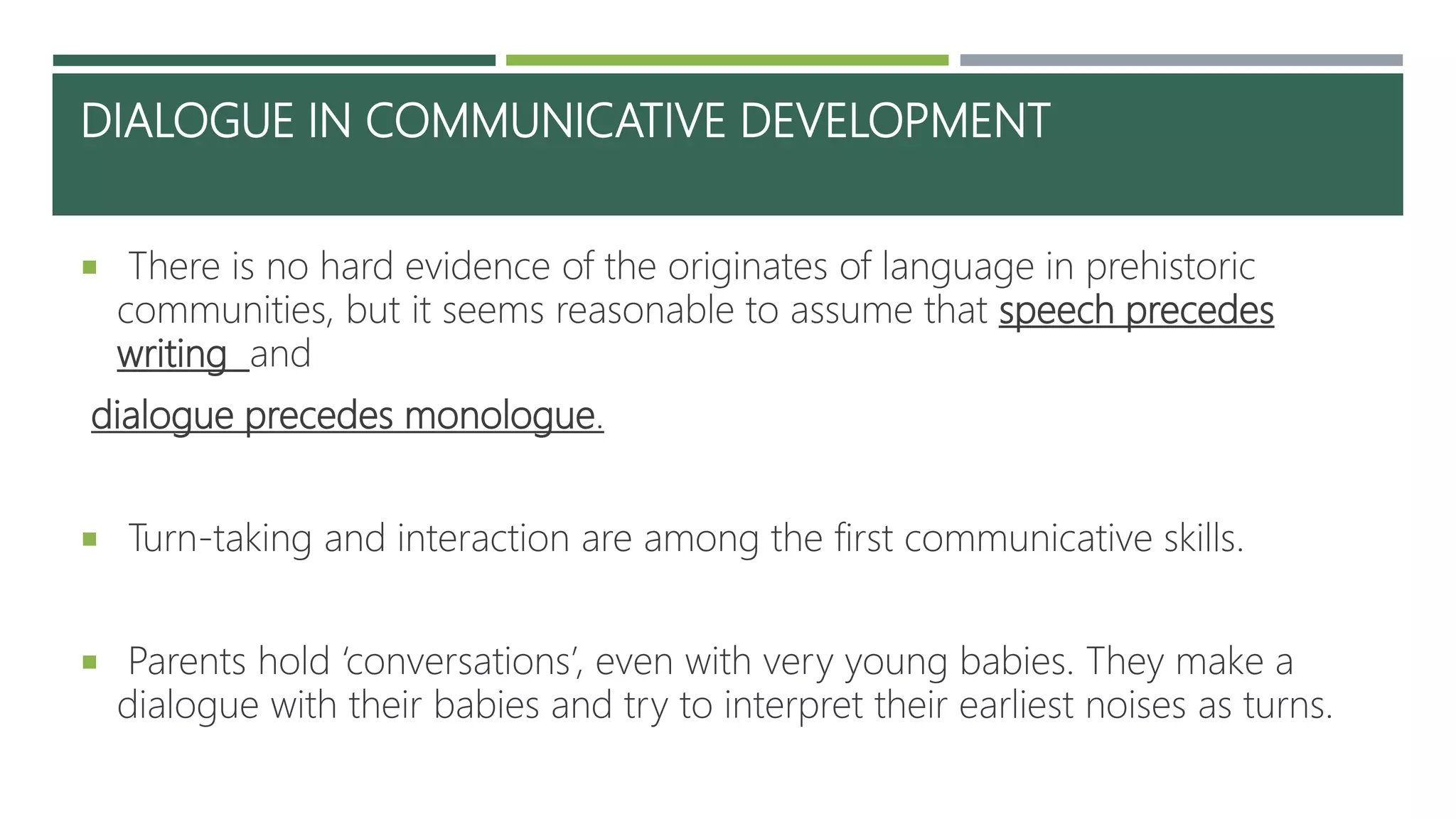
There is no hard evidence of the originates of language in prehistoric
communities, but it seems reasonable to assume that speech precedes
writing and
dialogue precedes monologue.
Turn-taking and interaction are among the first communicative skills.
Parents hold ‘conversations’, even with very young babies. They make a
dialogue with their babies and try to interpret their earliest noises as turns.
5.
DISCOURSE TYPOLOGY: RECIPROCITY
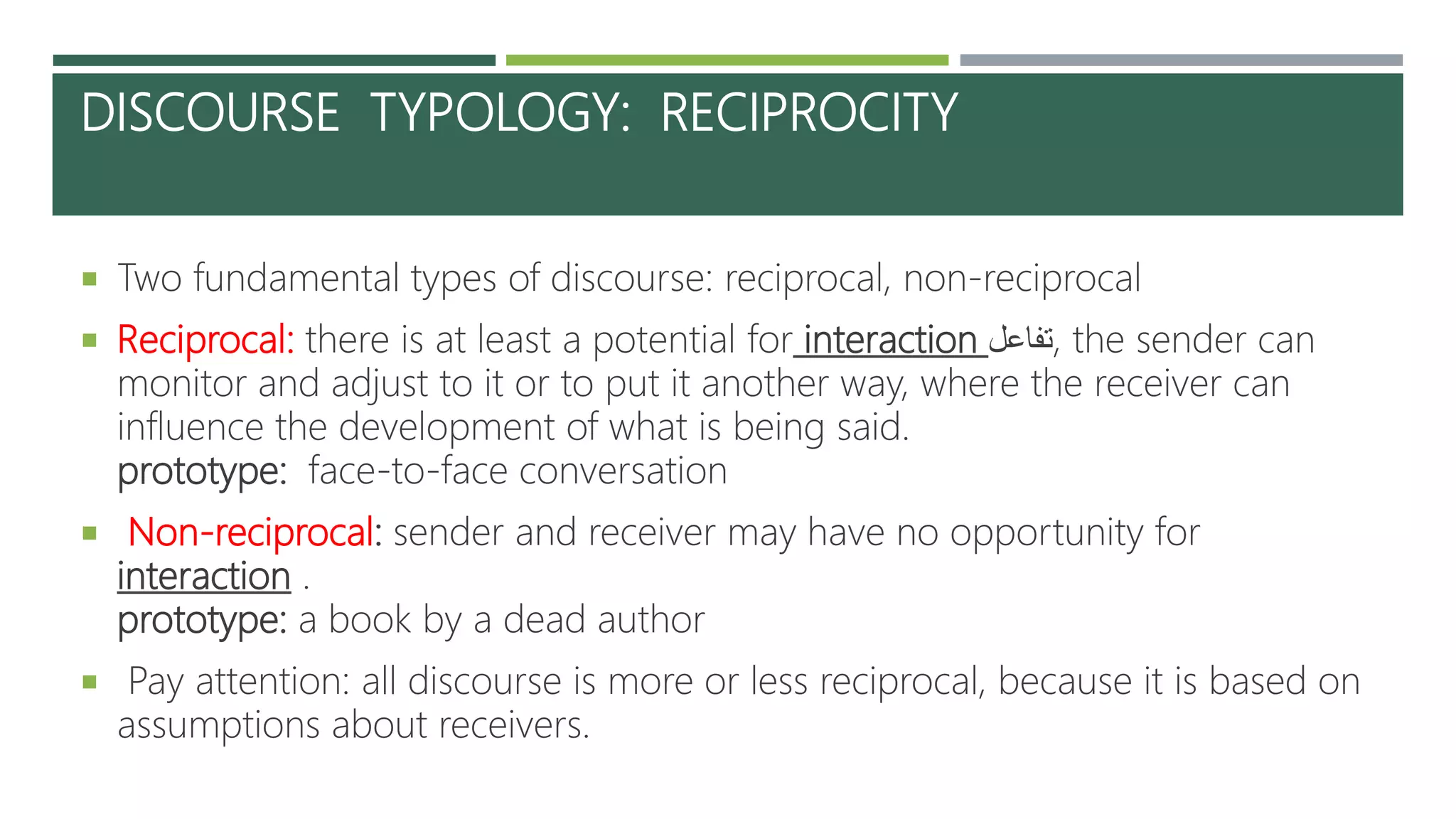
Two fundamental types of discourse: reciprocal, non-reciprocal
Reciprocal: there is at least a potential for interaction ,تفاعل the sender can
monitor and adjust to it or to put it another way, where the receiver can
influence the development of what is being said.
prototype: face-to-face conversation
Non-reciprocal: sender and receiver may have no opportunity for
interaction .
prototype: a book by a dead author
Pay attention: all discourse is more or less reciprocal, because it is based on
assumptions about receivers.
6.
RECIPROCITY, DIALOGUE, ANDWORD ORDER
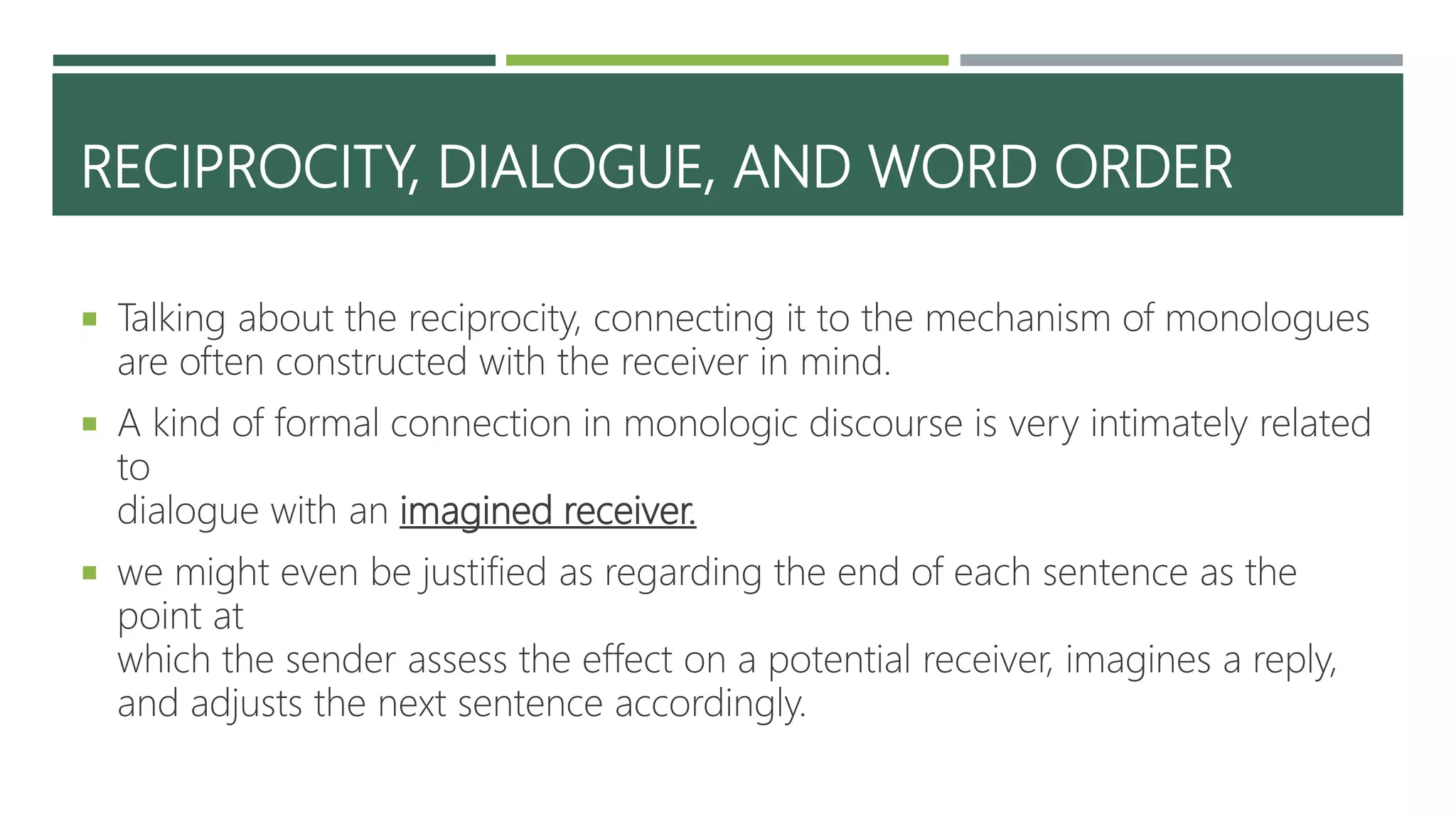
Talking about the reciprocity, connecting it to the mechanism of monologues
are often constructed with the receiver in mind.
A kind of formal connection in monologic discourse is very intimately related
to
dialogue with an imagined receiver.
we might even be justified as regarding the end of each sentence as the
point at
which the sender assess the effect on a potential receiver, imagines a reply,
and adjusts the next sentence accordingly.
7.
WORD ORDER
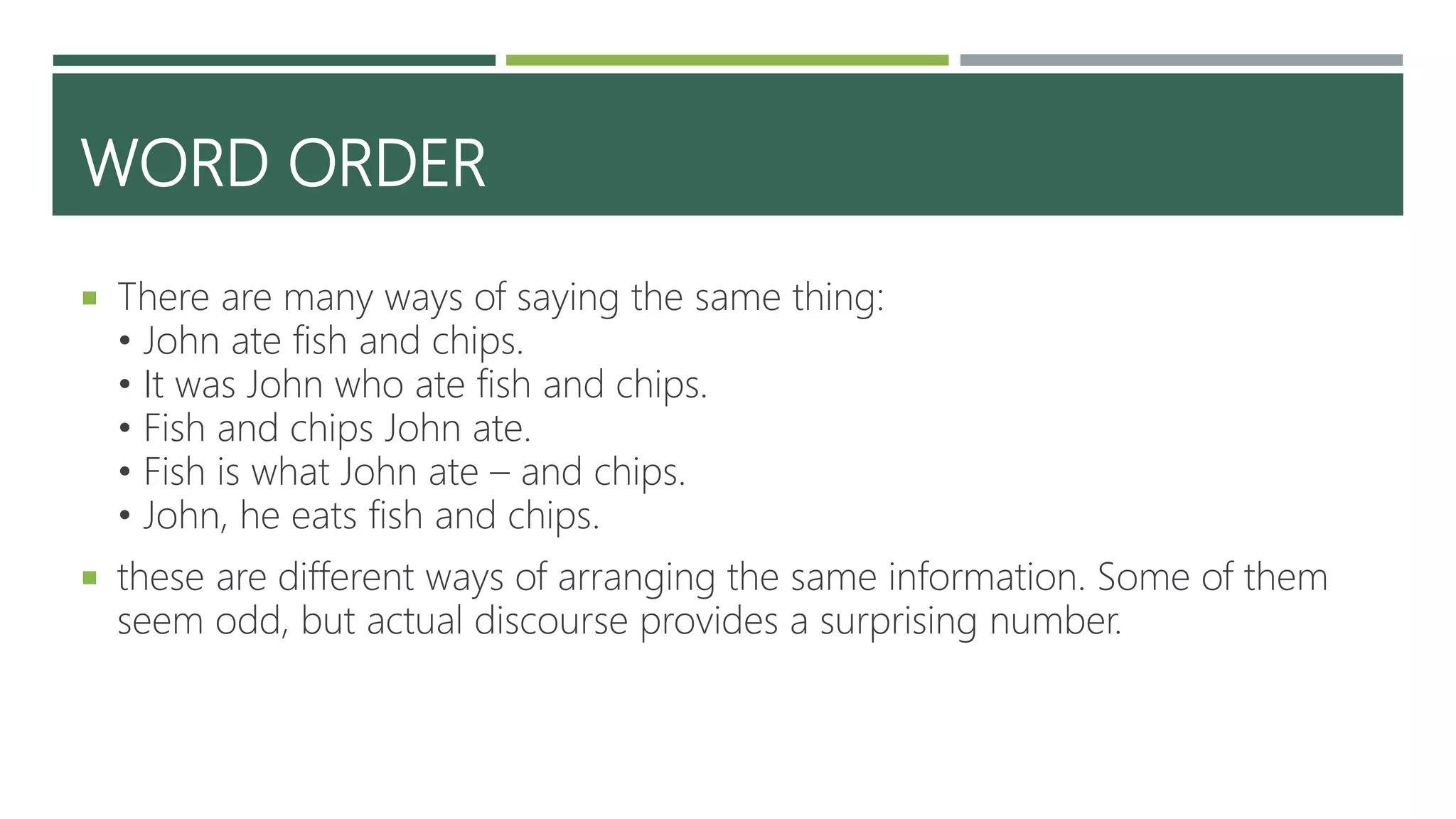
Thereare many ways of saying the same thing:
• John ate fish and chips.
• It was John who ate fish and chips.
• Fish and chips John ate.
• Fish is what John ate – and chips.
• John, he eats fish and chips.
these are different ways of arranging the same information. Some of them
seem odd, but actual discourse provides a surprising number.
8.
INFORMATION STRUCTURE INDISCOURSE
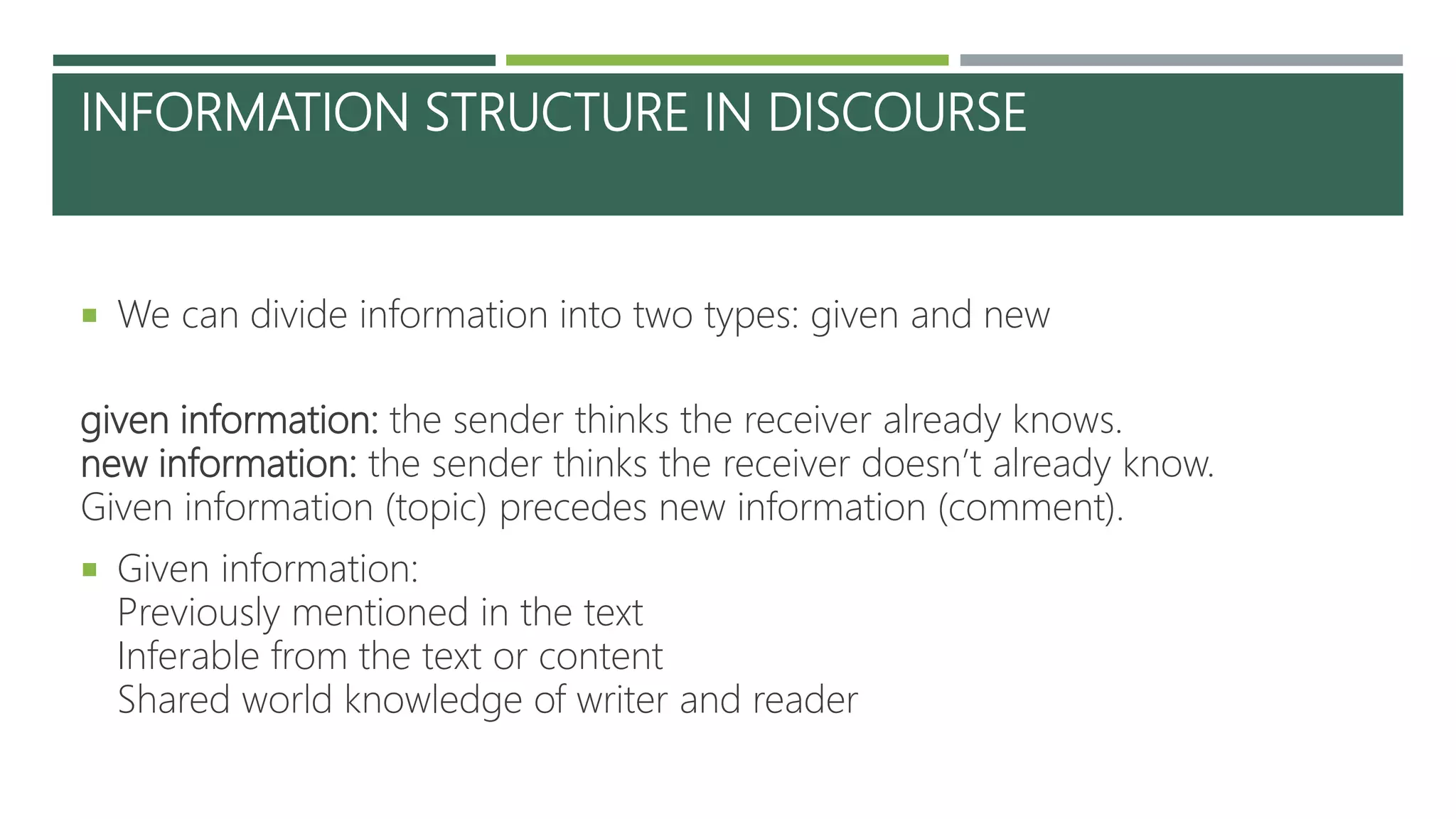
We can divide information into two types: given and new
given information: the sender thinks the receiver already knows.
new information: the sender thinks the receiver doesn’t already know.
Given information (topic) precedes new information (comment).
Given information:
Previously mentioned in the text
Inferable from the text or content
Shared world knowledge of writer and reader
9.
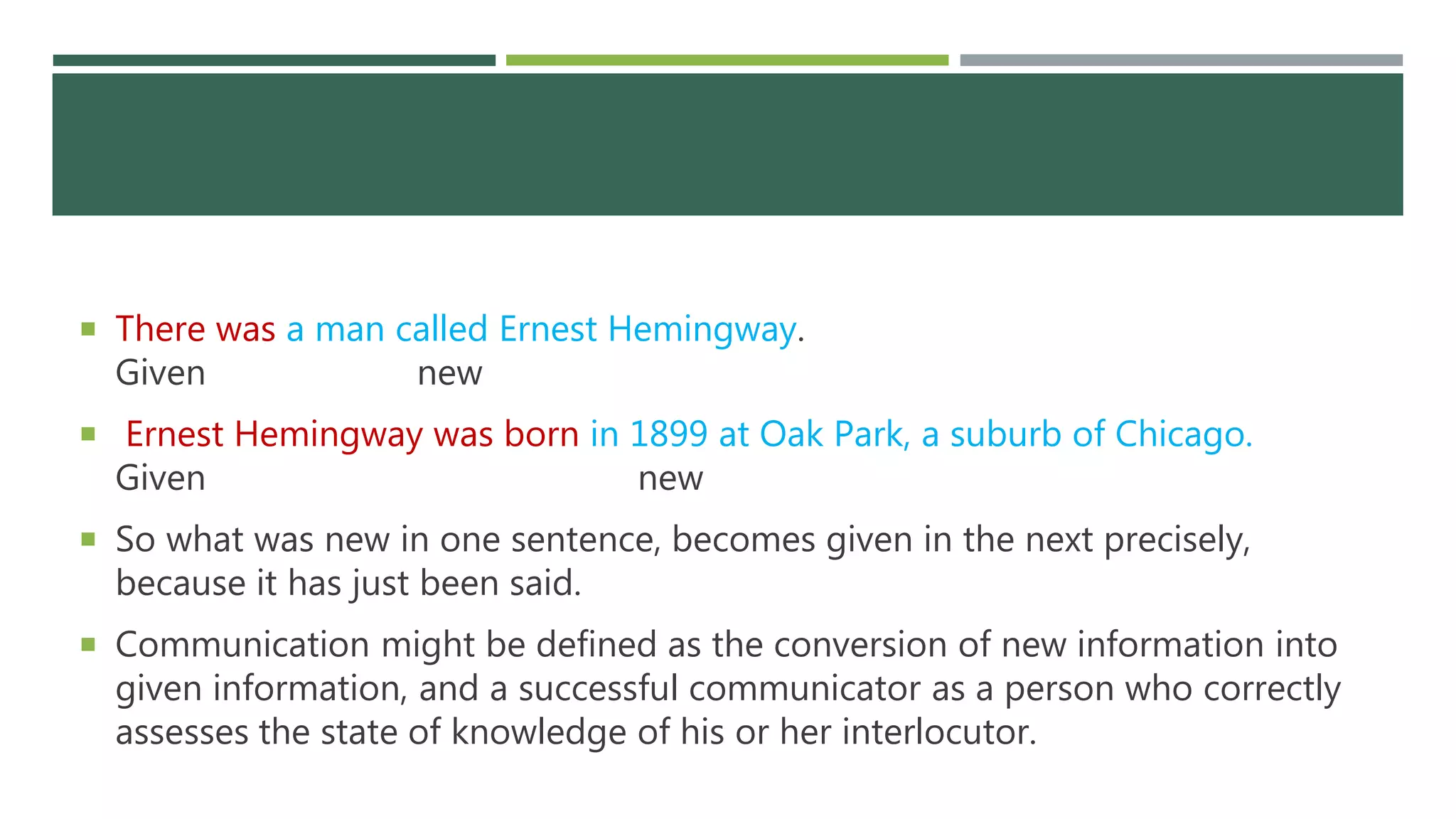
There wasa man called Ernest Hemingway.
Given new
Ernest Hemingway was born in 1899 at Oak Park, a suburb of Chicago.
Given new
So what was new in one sentence, becomes given in the next precisely,
because it has just been said.
Communication might be defined as the conversion of new information into
given information, and a successful communicator as a person who correctly
assesses the state of knowledge of his or her interlocutor.
10.
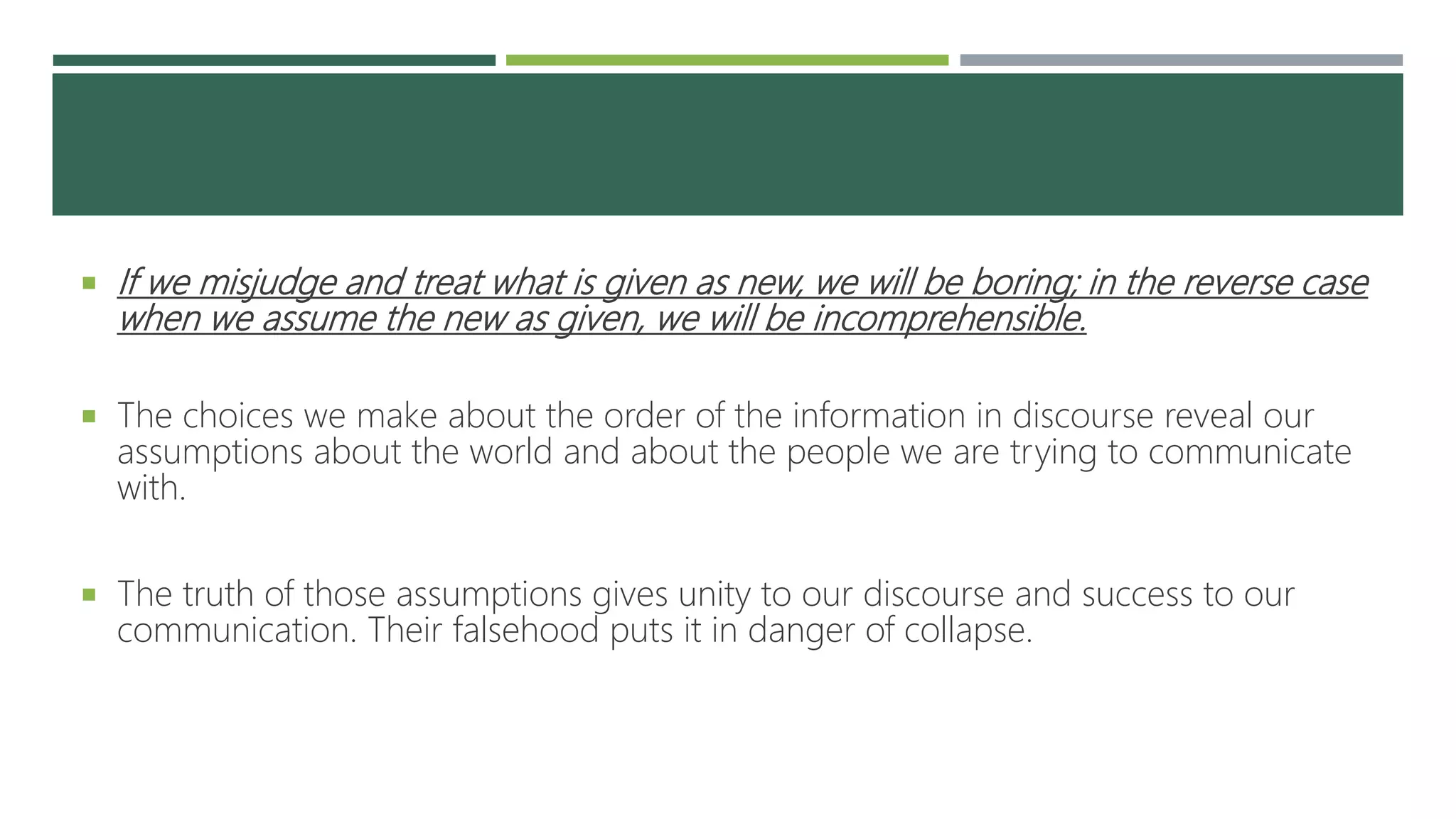
If wemisjudge and treat what is given as new, we will be boring; in the reverse case
when we assume the new as given, we will be incomprehensible.
The choices we make about the order of the information in discourse reveal our
assumptions about the world and about the people we are trying to communicate
with.
The truth of those assumptions gives unity to our discourse and success to our
communication. Their falsehood puts it in danger of collapse.