

CNIT 160:
Cybersecurity
Responsibilities
4. Information Security
Program Development

Part 1

Pages 190 - 202
Chapter Topics
• Information Security Programs
• Security Program Management
• Security Program Operations
• IT Service Management
• Controls
• Metrics and Monitoring
• Continuous Improvement
Information Security
Programs
Information Security
Programs
• Outcomes
• Charter
• Scope
• Information Security Management Frameworks
• Defining a Road Map
• Information Security Architecture
• The Open Group Architecture Framework
• The Zachman Framework
• Implementing a Security Architecture
Developing an Information
Security Program
• Four steps
• Developing a security strategy
• Gap analysis
• Developing a road map
• Developing a security program
Information Security
Programs
• The collection of activities to identify,
communicate, and address risks
• Consists of controls, processes, and
practices
• To increase resilience of computing
environment, and
• Ensure that risks are known and handled
effectively
Enabling Business
• Security program acts as a business enabler
• Allowing it to consider new business
ventures
• While being aware of risks that can be
mitigated
• Like the brakes on a race car
• Allowing it to move faster and stay on the
road
Outcomes
• Strategic alignment
• Risk management
• Value delivery
• Resource management
• Performance management
• Assurance process integration
Strategic Alignment
• Program must work in harmony with the rest
of the organization
• Being aware of new initiatives
• Developing risk tolerance criteria that
business leaders agree with
• Establishing mutual trust
• Use a security council or governance
committee
• With stakeholders across the business
Risk Management and
Value Delivery
• Risk Management
• Identifies risks
• Facilitates desired outcomes
• Through appropriate risk treatment
• Value Delivery
• Reducing risk in critical activities
• To an acceptable level
Resource Management
• Permanent and temporary staff, external
service providers, and tools
• Must be managed so they are effectively used
• To reduce risks in alignment with the risk
management program
• "Rightsizing" information security program
budget
• Assist with resource requests from security
manager
Performance Management
• Measure key activities
• To ensure the are operating as planned
• Security metrics
Assurance Process
Integration
• Information security program aligns with
other assurance programs and processes
• HR, finance, legal, audit, enterprise risk
management, IT, and operations
• Influences those activities to protect
them from harm
Charter
• Formal written definition of
• Objectives of the program
• Main timelines
• Sources of funding
• Names of principal leaders and managers
• Business executives who are sponsoring the
program
• Gives security manager authority, shows
support from leadership team
Security Manager Functions
• Develop and
• Enforce security policy
• Risk management process
• Security governance
• Controls across business unit boundaries
Security Manager Functions
• Develop and direct implementation of key
security processes
• Vulnerability management
• Incident management
• Third-party risk
• Security architecture
• Business continuity planning
• Security awareness training
Team Sport
• Security charter is ratified by executive
management
• Security manager can't dictate the program to
others
• Must lead and guide program through
collaboration and consensus by stakeholders
• Executive leaders and board of directors hold
the ultimate responsibility or ownership for
protecting information 

Scope
• Define departments, business units,
affiliates, and locations
• Included in information security program
• More relevant in larger organizations
Information Security
Management Frameworks
• Business process models
• Include essential processes and activities
• Needed by most organizations
• Risk-centric
Three Most Popular Security
Management Frameworks
• ISO/IEC 27001:2013
• COBIT 5
• NIST CSF
ISO/IEC 27001:2013
• International standard
• "Information technology - Security techniques -
Information security management systems -
Requirements"
• Processes used to
• Assess risk
• Develop controls
• Manage typical processes such as vulnerability
management and incident management
COBIT 5
• From ISACA
• Controls and governance framework
• For managing an IT organization
• COBIT 5 for Information Security
• Additional standard to extend COBIT 5
NIST CSF
• US National Institute of Standards and
Technology (NIST)
• Cyber Security Framework (CSF)
• Developed in 2014 to address rampant
security breaches and identity theft in the
US
Ch 4a-1
Defining a Road Map
• Required steps to achieve an objective
• In support of the business vision and
mission
• Consists of various tasks and projects
• Creating and implementing capabilities
• Reducing information risk
Enterprise Architecture
• Both a business function and a technical
model
• Business function
• Activities ensuring that important
business needs are met by IT systems
• Model
• Mapping business systems into IT
environment and systems
Information Security
Architecture
• A subset within Enterprise Architecture
• Concerned with two things
• Protective characteristics in components
in the enterprise architecture
• Specific components n the enterprise
architecture that provide preventive or
detective security functions
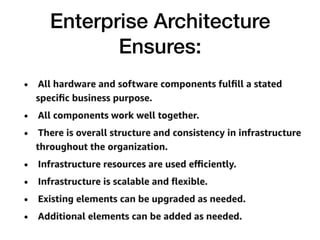
Enterprise Architecture
Ensures:
Two Layers of Information
Security Architecture
• Policy
• Necessary characteristics of overall
environment
• Ex: centralized authentication, 

endpoint-based web filtering
• Standards
• Vendor standards
• Protocol standards
• Configuration or hardening standards
Centralized Functions
• Operate more effectively than isolated,
local instances
• Amplify workforce
• So a small staff can manage hundreds or
thousands of devices
• Authentication
• Microsoft Active Directory (AD)
• Lightweight Directory Access Protocol
(LDAP)
• Monitoring
• SIEMs like Splunk
• Device Management
• Consistency for servers, workstations,
mobile devices, and network devices
Centralized Functions
Two Enterprise Architecture
Frameworks
• The Open Group Architecture Framework
(TOGAF)
• Zachman Framework
• These are Enterprise Architecture models,
not Enterprise Security Architecture
models
The Open Group Architecture
Framework (TOGAF)
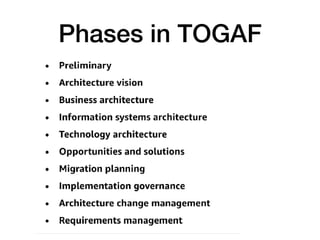
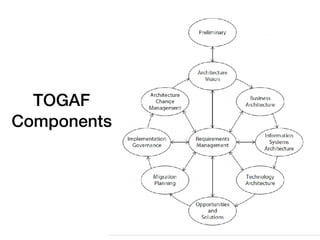
• Life-cycle enterprise architecture
framework
• For designing, planning, implementing,
and governing
• An enterprise technology architecture
• A high-level approach
Phases in TOGAF
TOGAF
Components
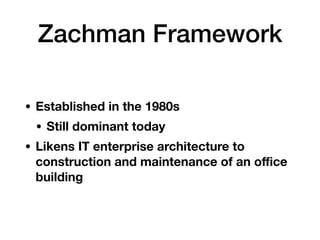
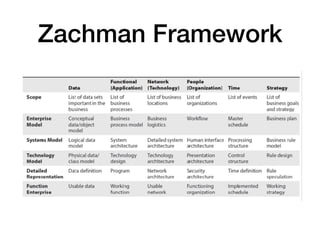
Zachman Framework
• Established in the 1980s
• Still dominant today
• Likens IT enterprise architecture to
construction and maintenance of an office
building
Zachman Framework
Implementing a Security
Architecture
• Both a big-picture and a detailed plan
• At enterprise level
• Policy and governance
• Decisions about major aspects
• Such as brands of servers, workstations,
and network devices
• At detail level
• Configuration and change management
on devices or groups of devices
• Ex: Upgrade to DNS infrastructure
• Might increase number of name servers
• Requiring updates to most or all
devices
Implementing a Security
Architecture
Changes to Architecture
Models
• Software-Defined Networking (SDN)
• Virtualization
• Microservices
• Small, independent services that
communicate over networks
• Often in containers
Security Program
Management
Security Program
Management Topics
• Security Governance (in this lecture)
• Activities and Results
• For later lectures:
• Risk Management
• The Risk Management Program
• The Risk Management Process
• Identifying and Grouping Assets
• Risk Analysis
• Risk Treatment
Security Program Management
Topics (continued)
• For later lectures
• Audits and Reviews
• Control Self-Assessment
• Security Reviews
• Policy Development
• Third-Party Risk Management
• Administrative Activities
Security Governance
• Assemblage of management activities that
• Identify, analyze and treat risks to key
assets
• Establish key roles and responsibilities
• Measure key security processes
• Board of Directors
• Establishes tone for risk appetite and risk
management
• Information Steering Committee
• Chief Information Security Officer (CISO)
• Audit
• Chief Information Officer (CIO)
• Management
• All employees
Security Governance
Personnel
Information Steering
Committee
• Establishes operational strategy
• For security and risk management
• Sets strategic and operational roles and
responsibilities
• Security strategy should align with strategy
for IT and the business overall
Chief Information Security
Officer (CISO)
• Responsible for
• Developing security policy
• Conducting risk assessments
• Developing processes for
• Vulnerability management
• Incident management
• Identity and access management
• Security awareness and training
• Compliance management
Audit
• Responsible for examining selected
business processes and information
systems
• To verify that they are designed and
operating properly
Chief Information Officer
(CIO)
• Responsible for overall management of the
IT organization, including
• IT strategy
• Development
• Operations
• Service desk
Management
• Every manager should be at least partially
responsible for the conduct of their
employees
• This establishes a chain of accountability
All Employees
• Required to comply with
• Security policy
• Security requirements and processes
• All other policies
• Compliance with policy is a condition of
employment
Reasons for Security
Governance
• Organizations are completely dependent
on their information systems
• Ineffective security governance can lead to
negligence, and breaches
Security Governance
Activities and Results
• Risk management
• Process improvement
• incident response
• Improved compliance
• Business continuity and disaster recovery
planning
• Effectiveness measurement
• Resource management
• Improved IT governance
Results of Security
Governance
• Increased trust
• From customers, suppliers, and partners
• Improved reputation
Ch 4a-2

CNIT 160 Ch 4a: Information Security Programs

  • 1.
    CNIT 160: Cybersecurity Responsibilities 4. InformationSecurity Program Development Part 1 Pages 190 - 202
  • 2.
    Chapter Topics • InformationSecurity Programs • Security Program Management • Security Program Operations • IT Service Management • Controls • Metrics and Monitoring • Continuous Improvement
  • 3.
  • 4.
    Information Security Programs • Outcomes •Charter • Scope • Information Security Management Frameworks • Defining a Road Map • Information Security Architecture • The Open Group Architecture Framework • The Zachman Framework • Implementing a Security Architecture
  • 5.
    Developing an Information SecurityProgram • Four steps • Developing a security strategy • Gap analysis • Developing a road map • Developing a security program
  • 6.
    Information Security Programs • Thecollection of activities to identify, communicate, and address risks • Consists of controls, processes, and practices • To increase resilience of computing environment, and • Ensure that risks are known and handled effectively
  • 7.
    Enabling Business • Securityprogram acts as a business enabler • Allowing it to consider new business ventures • While being aware of risks that can be mitigated • Like the brakes on a race car • Allowing it to move faster and stay on the road
  • 8.
    Outcomes • Strategic alignment •Risk management • Value delivery • Resource management • Performance management • Assurance process integration
  • 9.
    Strategic Alignment • Programmust work in harmony with the rest of the organization • Being aware of new initiatives • Developing risk tolerance criteria that business leaders agree with • Establishing mutual trust • Use a security council or governance committee • With stakeholders across the business
  • 10.
    Risk Management and ValueDelivery • Risk Management • Identifies risks • Facilitates desired outcomes • Through appropriate risk treatment • Value Delivery • Reducing risk in critical activities • To an acceptable level
  • 11.
    Resource Management • Permanentand temporary staff, external service providers, and tools • Must be managed so they are effectively used • To reduce risks in alignment with the risk management program • "Rightsizing" information security program budget • Assist with resource requests from security manager
  • 12.
    Performance Management • Measurekey activities • To ensure the are operating as planned • Security metrics
  • 13.
    Assurance Process Integration • Informationsecurity program aligns with other assurance programs and processes • HR, finance, legal, audit, enterprise risk management, IT, and operations • Influences those activities to protect them from harm
  • 14.
    Charter • Formal writtendefinition of • Objectives of the program • Main timelines • Sources of funding • Names of principal leaders and managers • Business executives who are sponsoring the program • Gives security manager authority, shows support from leadership team
  • 15.
    Security Manager Functions •Develop and • Enforce security policy • Risk management process • Security governance • Controls across business unit boundaries
  • 16.
    Security Manager Functions •Develop and direct implementation of key security processes • Vulnerability management • Incident management • Third-party risk • Security architecture • Business continuity planning • Security awareness training
  • 17.
    Team Sport • Securitycharter is ratified by executive management • Security manager can't dictate the program to others • Must lead and guide program through collaboration and consensus by stakeholders • Executive leaders and board of directors hold the ultimate responsibility or ownership for protecting information 

  • 18.
    Scope • Define departments,business units, affiliates, and locations • Included in information security program • More relevant in larger organizations
  • 19.
    Information Security Management Frameworks •Business process models • Include essential processes and activities • Needed by most organizations • Risk-centric
  • 20.
    Three Most PopularSecurity Management Frameworks • ISO/IEC 27001:2013 • COBIT 5 • NIST CSF
  • 21.
    ISO/IEC 27001:2013 • Internationalstandard • "Information technology - Security techniques - Information security management systems - Requirements" • Processes used to • Assess risk • Develop controls • Manage typical processes such as vulnerability management and incident management
  • 22.
    COBIT 5 • FromISACA • Controls and governance framework • For managing an IT organization • COBIT 5 for Information Security • Additional standard to extend COBIT 5
  • 23.
    NIST CSF • USNational Institute of Standards and Technology (NIST) • Cyber Security Framework (CSF) • Developed in 2014 to address rampant security breaches and identity theft in the US
  • 24.
  • 25.
    Defining a RoadMap • Required steps to achieve an objective • In support of the business vision and mission • Consists of various tasks and projects • Creating and implementing capabilities • Reducing information risk
  • 26.
    Enterprise Architecture • Botha business function and a technical model • Business function • Activities ensuring that important business needs are met by IT systems • Model • Mapping business systems into IT environment and systems
  • 27.
    Information Security Architecture • Asubset within Enterprise Architecture • Concerned with two things • Protective characteristics in components in the enterprise architecture • Specific components n the enterprise architecture that provide preventive or detective security functions
  • 28.
  • 29.
    Two Layers ofInformation Security Architecture • Policy • Necessary characteristics of overall environment • Ex: centralized authentication, 
 endpoint-based web filtering • Standards • Vendor standards • Protocol standards • Configuration or hardening standards
  • 30.
    Centralized Functions • Operatemore effectively than isolated, local instances • Amplify workforce • So a small staff can manage hundreds or thousands of devices
  • 31.
    • Authentication • MicrosoftActive Directory (AD) • Lightweight Directory Access Protocol (LDAP) • Monitoring • SIEMs like Splunk • Device Management • Consistency for servers, workstations, mobile devices, and network devices Centralized Functions
  • 32.
    Two Enterprise Architecture Frameworks •The Open Group Architecture Framework (TOGAF) • Zachman Framework • These are Enterprise Architecture models, not Enterprise Security Architecture models
  • 33.
    The Open GroupArchitecture Framework (TOGAF) • Life-cycle enterprise architecture framework • For designing, planning, implementing, and governing • An enterprise technology architecture • A high-level approach
  • 34.
  • 35.
  • 36.
    Zachman Framework • Establishedin the 1980s • Still dominant today • Likens IT enterprise architecture to construction and maintenance of an office building
  • 37.
  • 38.
    Implementing a Security Architecture •Both a big-picture and a detailed plan • At enterprise level • Policy and governance • Decisions about major aspects • Such as brands of servers, workstations, and network devices
  • 39.
    • At detaillevel • Configuration and change management on devices or groups of devices • Ex: Upgrade to DNS infrastructure • Might increase number of name servers • Requiring updates to most or all devices Implementing a Security Architecture
  • 40.
    Changes to Architecture Models •Software-Defined Networking (SDN) • Virtualization • Microservices • Small, independent services that communicate over networks • Often in containers
  • 41.
  • 42.
    Security Program Management Topics •Security Governance (in this lecture) • Activities and Results • For later lectures: • Risk Management • The Risk Management Program • The Risk Management Process • Identifying and Grouping Assets • Risk Analysis • Risk Treatment
  • 43.
    Security Program Management Topics(continued) • For later lectures • Audits and Reviews • Control Self-Assessment • Security Reviews • Policy Development • Third-Party Risk Management • Administrative Activities
  • 44.
    Security Governance • Assemblageof management activities that • Identify, analyze and treat risks to key assets • Establish key roles and responsibilities • Measure key security processes
  • 45.
    • Board ofDirectors • Establishes tone for risk appetite and risk management • Information Steering Committee • Chief Information Security Officer (CISO) • Audit • Chief Information Officer (CIO) • Management • All employees Security Governance Personnel
  • 46.
    Information Steering Committee • Establishesoperational strategy • For security and risk management • Sets strategic and operational roles and responsibilities • Security strategy should align with strategy for IT and the business overall
  • 47.
    Chief Information Security Officer(CISO) • Responsible for • Developing security policy • Conducting risk assessments • Developing processes for • Vulnerability management • Incident management • Identity and access management • Security awareness and training • Compliance management
  • 48.
    Audit • Responsible forexamining selected business processes and information systems • To verify that they are designed and operating properly
  • 49.
    Chief Information Officer (CIO) •Responsible for overall management of the IT organization, including • IT strategy • Development • Operations • Service desk
  • 50.
    Management • Every managershould be at least partially responsible for the conduct of their employees • This establishes a chain of accountability
  • 51.
    All Employees • Requiredto comply with • Security policy • Security requirements and processes • All other policies • Compliance with policy is a condition of employment
  • 52.
    Reasons for Security Governance •Organizations are completely dependent on their information systems • Ineffective security governance can lead to negligence, and breaches
  • 53.
    Security Governance Activities andResults • Risk management • Process improvement • incident response • Improved compliance • Business continuity and disaster recovery planning • Effectiveness measurement • Resource management • Improved IT governance
  • 54.
    Results of Security Governance •Increased trust • From customers, suppliers, and partners • Improved reputation
  • 55.