CNIT 125:
Information Security
Professional
(CISSP
Preparation)
Ch 1. Security and Risk
Management (Part 1)
Topics
• Security Terms
• Security Governance Principles
• Compliance
• Legal and Regulatory Issues
• Professional Ethics
• Security Documentation
• Business Continuity
Topics
• Personnel Security Policies and Procedures
• Risk Management Concepts
• Geographical Threats
• Threat Modeling
• Security Risks in the Supply Chain
4
Security Terms
The CIA Triad
The CIA Triad
Confidentiality
• Keeps data secret
• Prevents unauthorized read access
• An attack: theft of Personally Identifiable
Information (PII) such as credit card
information
• Health Insurance Portability and
Accountability Act (HIPAA)
• Requires medical providers to keep
patient information private
Confidentiality
• Data should only be available to users who
have
• Clearance
• Formal access approval
• Need to know
Integrity
• Assures that data has not been modified,
tampered with, or corrupted
• Three perspectives
• Prevent unauthorized subjects from making
modifications
• Prevent authorized subjects from making
unauthorized modifications, such as mistakes
• Maintaining consistency of objects so data is
correct and maintains its proper relationships
with child, peer, or parent objects
Integrity Controls and
Countermeasures
• Access controls
• Authentication
• Intrusion Detection Systems
• Activity logging
• Maintaining and validating object integrity
• Encryption
• Hashing
Integrity Attacks
• Viruses
• Logic bombs
• Unauthorized access
• Errors in coding
• Malicious modification
• System back doors
Availability
• Data and services are available when
needed by authorized subjects
– Remove SPOF (Single Point of Failure)
– Prevent Denial of Service attacks
Threats to Availability
• Device failure
• Software errors
• Environmental issues (heat, static,
flooding, power loss, etc.)
• Denial of Service attacks
• Human errors (deleting important files,
under allocating resources,
mislabeling objects)
Availability Controls
• Intermediary delivery systems design
(routers, proxies, etc.)
• Access controls
• Monitoring performance and traffic
• Redundant systems
• Backups
• Business Continuity Planning
• Fault-tolerant systems
Balancing CIA
• You can never have perfect security
• Increasing one item lowers others
• Increasing confidentiality generally lowers
availability
– Example: long ,complex passwords that are easily
forgotten
Auditing and Accounting
• Auditing
• Measurable technical assessment of a
system or application
• Accounting
• Logging access and use of information
resources
Five Elements
• Identification claiming to be someone
• Authentication proving that you are that
person
• Authorization allows you to access
resources
• Auditing records a log of what you do
• Accounting reviews log files and holds
subjects accountable for their actions
AAA Services
• Authentication
• Authorization
• Accounting
19
• Link Ch 2a
Example of Accounting
2a-1
Non-Repudiation
• Prevents entities from denying that they took
an action
• Examples: signing a home loan, making a
credit card purchase
• Techniques
– Digital signatures
– Audit logs
Least Privilege and Need to Know
• Least privilege
• Users have the minimum authorization to
do their jobs
• Need to know
• More granular than least privilege
• Users must have a need to access that
particular information before accessing it
23
Example: Need to Know
• In the 1990's US
intelligence agencies did
not share information
with one another
• "Information Silos"
• Failed to predict the 9/11
attacks, arguably for this
reason
• Links Ch 2b, 2c
24
Example: Need to Know
• The silos were
removed
• So Bradley
Manning (now
Chelsea), gave
750,000 classified
or sensitive
documents to
Wikileaks
• Links Ch 2d, 2e, 2f
Subjects and Objects
• Subject is an active entity
• Such as a person accessing data
• Or a computer program
• Object is a passive entity
• Such as paper records or data files
Subjects and Objects
• Internet Explorer
• A Subject when running in memory
• Accessing data
• iexplore.exe
• An object when not running
• A file sitting on a disk
Defense in Depth
• Multiple defenses in series
• If one fails, another may succeed
• Example:
• Palo Alto firewall protects whole LAN
• Windows firewall runs on each workstation
Due Care and Due Diligence
• Due Care
• Doing what a reasonable person would do
• The "prudent man" rule
• Informal
• Due Diligence
• Management of due care
• Follows a process
• A step beyond due care
Gross Negligence
• The opposite of due care
• If you suffer loss of PII
• Legal consequences will depend on
whether you can demonstrate due care or
not
Abstraction
• Group similar elements together
• Assign security controls, restrictions, or
permissions to the groups
• Such as Administrators, Sales, Help Desk,
Managers
Data Hiding
• Placing data in a logical storage
compartment that is not seen by the subject
• Ex:
• Keeping a database inaccessible to
unauthorized users
• Restricting a subject at a low classification
level from accessing data at a higher
classification level
Encryption
• Hiding the meaning of a communication
from unintended recipients
2a-2
34
Security Governance
Principles
Security Governance Principles
• The collection of practices
• Supporting, defining and directing
• The security efforts of an organization
• Goal is to maintain business processes while
striving towards growth and resiliency
• Some aspects are imposed on organizations
• Regulatory compliance
• Industry guidelines
• License requirements
Security Governance Principles
• Must be assessed and verified
• Security is not just an IT issue
• Affects every aspect of an organization
Alignment of Security Function
to Strategy, Goals, Mission, and Objectives
• Base security planning on a business case
• A documented argument to define a need
• Justifies the expense
CSO (Chief Security Officer)
• Security management is a responsibility of
upper management, not IT staff
• InfoSec team should be led by a CSO
• CSO reports directly to senior management
• CSO and InfoSec team are outside the
typical hierarchical structure
Strategic, Tactical, and Operational
Plans
Strategic, Tactical, and Operational
Plans
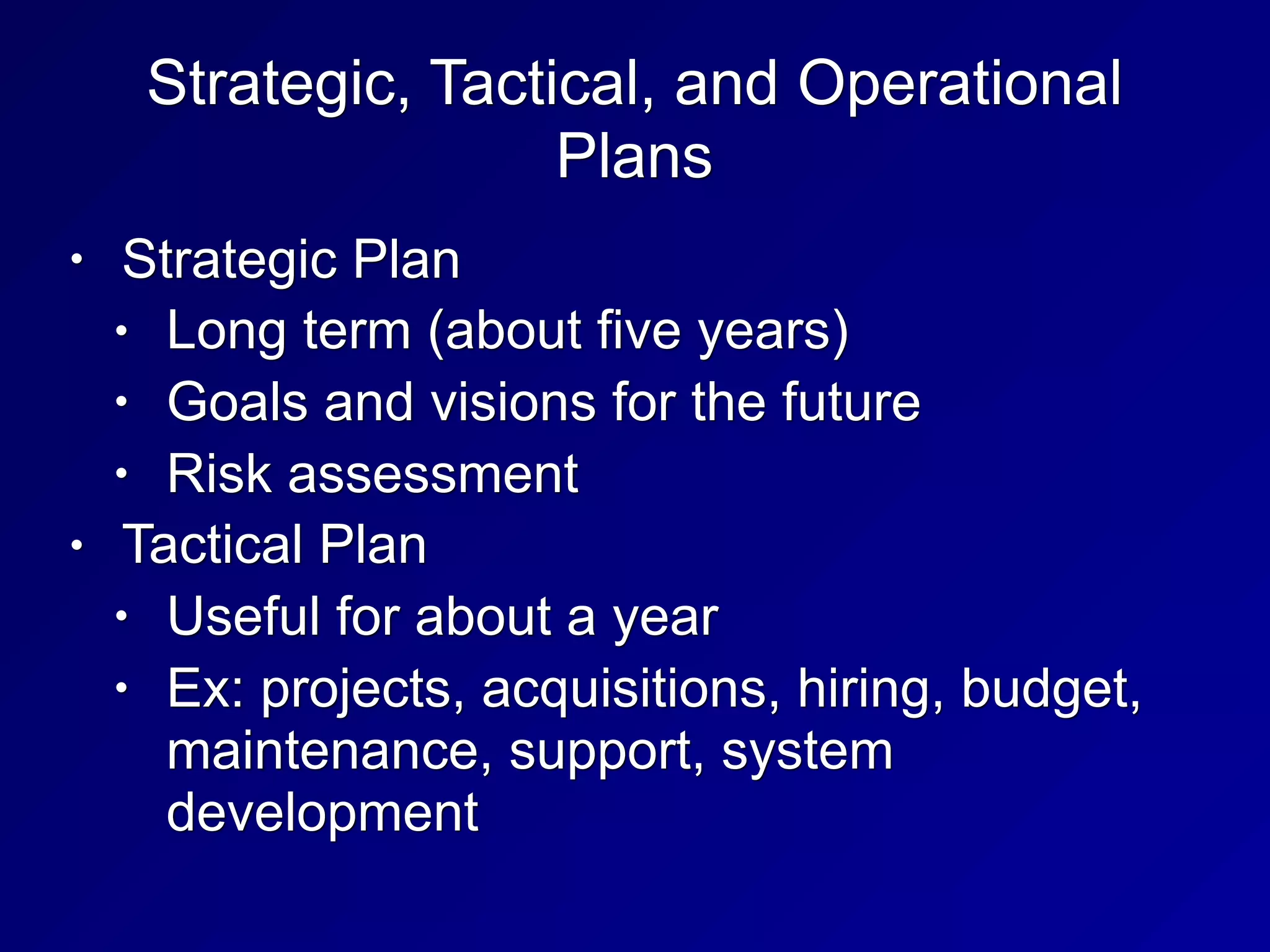
• Strategic Plan
• Long term (about five years)
• Goals and visions for the future
• Risk assessment
• Tactical Plan
• Useful for about a year
• Ex: projects, acquisitions, hiring, budget,
maintenance, support, system
development
Strategic, Tactical, and Operational
Plans
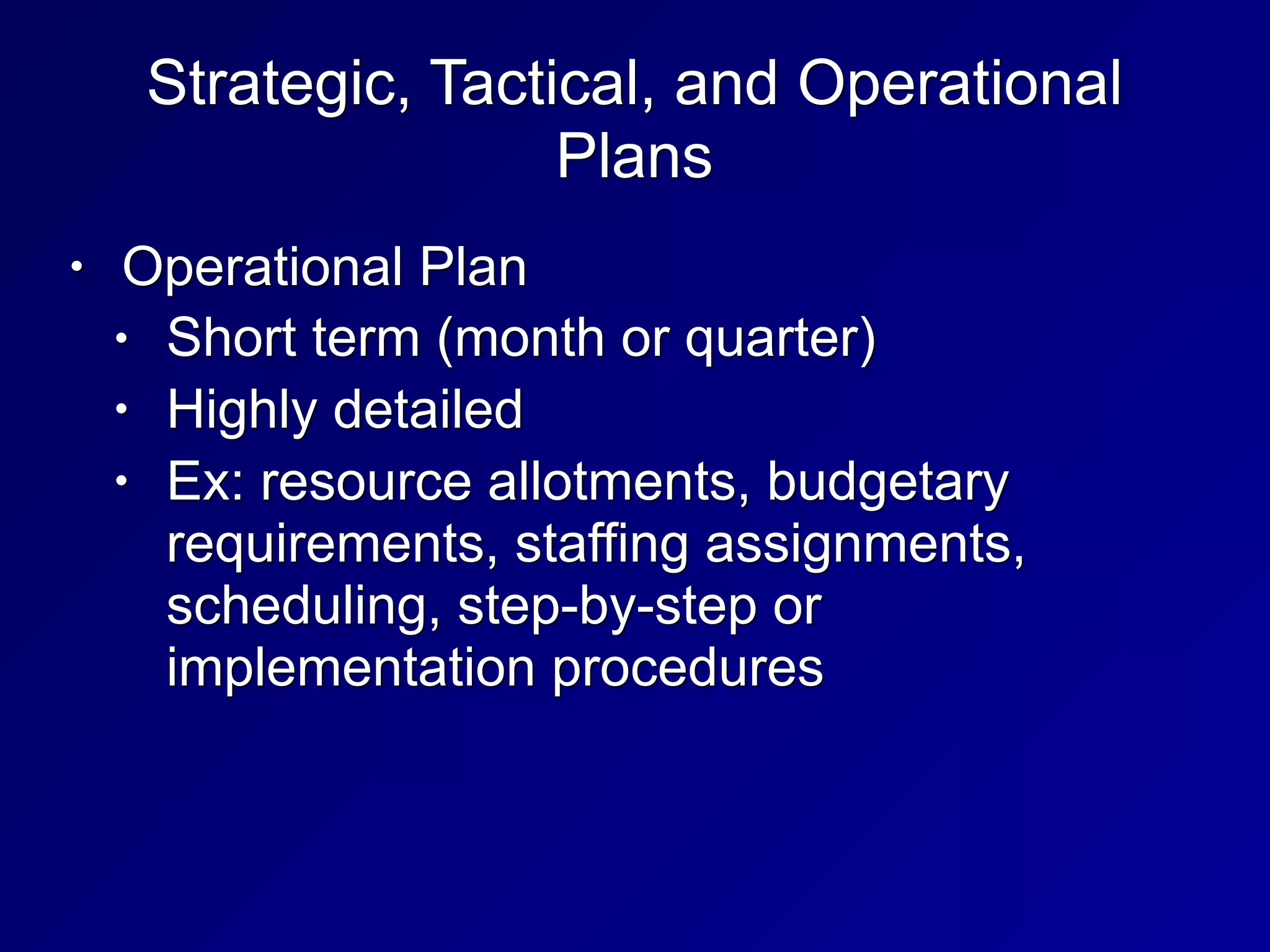
• Operational Plan
• Short term (month or quarter)
• Highly detailed
• Ex: resource allotments, budgetary
requirements, staffing assignments,
scheduling, step-by-step or
implementation procedures
Change Control/Management
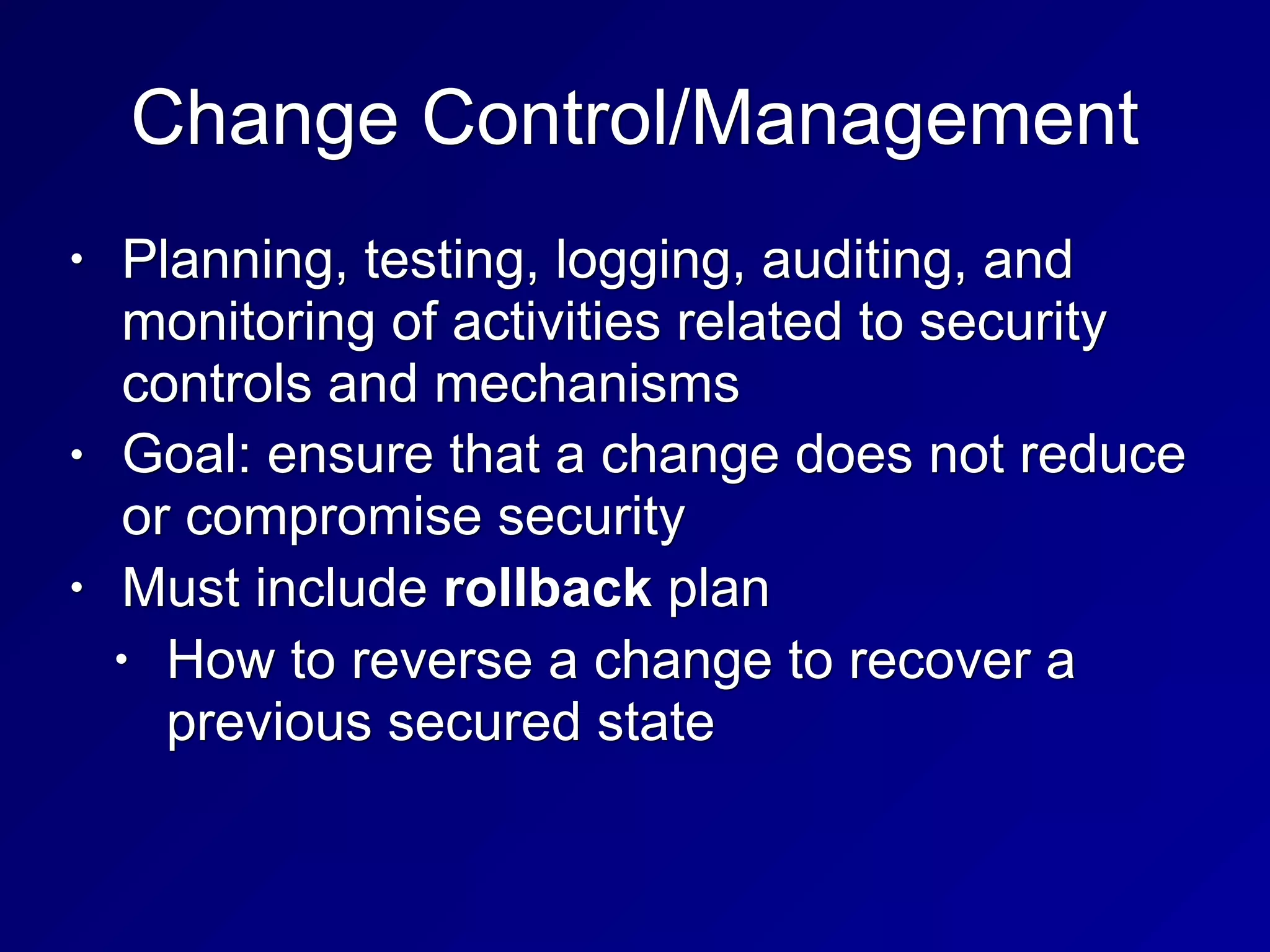
• Planning, testing, logging, auditing, and
monitoring of activities related to security
controls and mechanisms
• Goal: ensure that a change does not reduce
or compromise security
• Must include rollback plan
• How to reverse a change to recover a
previous secured state
Change Control/Management
• Required fir ITSEC classifications of B2, B3,
and A1
• Information Technology Security
Evaluation and Criteria
Change Control Process
• Implement change in a monitored and orderly
manner
• Formalized testing process to very expected
results
• Rollback plan
• Users are informed of change before it occurs
• Effects of change are systematically analyzed
• Negative impact of change is minimized
• Changes are reviewed and approved by CAB
(Change Approval Board)
Data Classification
• Some data needs more security than others
• Criteria:
• Usefulness, timeliness, value, age, data
disclosure damage assessment, national
security implications
• Authorized access, restrictions,
maintenance, monitoring, and storage
To Implement a Classification Scheme
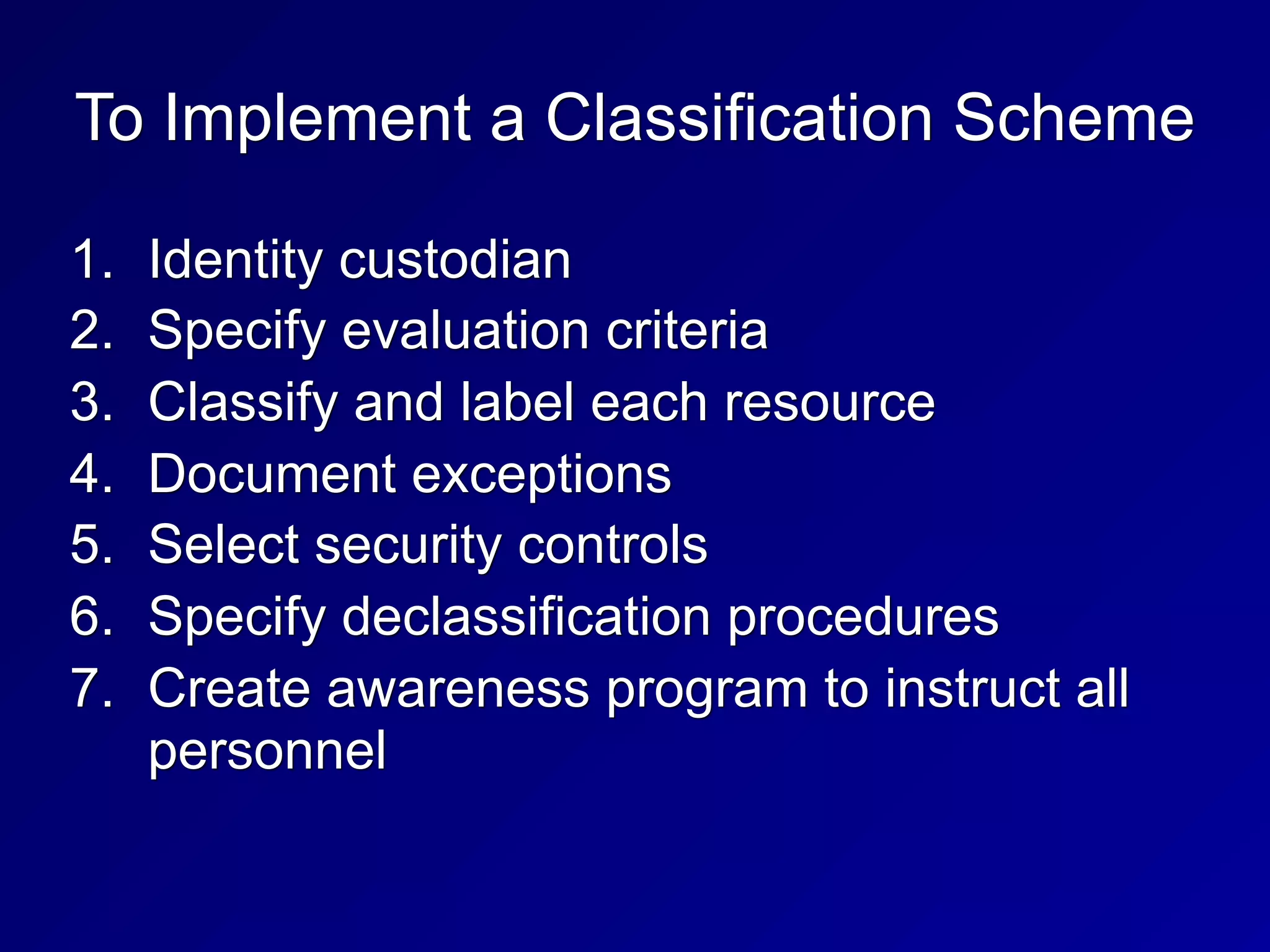
1. Identity custodian
2. Specify evaluation criteria
3. Classify and label each resource
4. Document exceptions
5. Select security controls
6. Specify declassification procedures
7. Create awareness program to instruct all
personnel
Classification Levels
• Government / Military
• Top Secret
• Secret
• Confidential
• Unclassified
• Business / Private Sector
• Confidential or Private
• Sensitive
• Public
Security Roles and Responsibilities
• Senior Manager
• Ultimately responsible for the security of an
organization
• Must sign off on all activities
• Security Professional
• Writes security policy and implements it
• Follows directives from senior management
• Data Owner
• Responsible for classifying information
Security Roles and Responsibilities
• Data Custodian
• Implements protections defined by security
policy
• Ex: Making and testing backups, managing
data storage based on classification
• User
• Anyone with access to the secured system
• Auditor
• Produces compliance and effectiveness
reports for the senior manager
2a-3
51
Security Control 

Frameworks
52
ISO/IEC 27000 Series
• International Organization for
Standardization (ISO)
• With the International Electrotechnical
Commission
• A lengthy list of standards for developing
and maintaining an Information Security
Management System (ISMS)
Zachman Framework
• Two-dimensional classification system
• Based on six communication questions
• What, Where, When, Why, Who, How
• Intersecting with perspectives
• Executive, Business Management,
Architect, Engineer, Technician, Enterprise
• Not security oriented
• Helps to relay information in language useful
to personnel
The Open Group Architecture
Framework (TOGAF)
• Another enterprise architecture framework
• Helps organizations design, plan,
implement, and govern
• An enterprise information architecture
• Four domains:
• Technology, Applications, Data, Business
Dept of Defense Architecture
Framework (DoDAF)
• Organizes a set of products under eight views
• All Viewpoint (AV)
• Capability Viewpoint (CV)
• Data and Information Viewpoint (DIV)
• Operation Viewpoint (OV)
• Project Viewpoint (PV)
• Services Viewpoint (SvcV)
• Standards Viewpoint (STDV)
• Systems Viewpoint (SV)
British Ministry of Defense Architecture
Framework (MODAF)
• Divides information into seven viewpoints
• Strategic Viewpoint (StV)
• Operational Viewpoint (OV)
• Service-Oriented Viewpoint (SOV)
• Systems Viewpoint (SC)
• Acquisition Viewpoint (AcV)
• Technical Viewpoint (TV)
• All Viewpoint (AV)
Sherwood Applied Business Security
Architecture (SABSA)
Control Objectives for Information and
Related Technology (COBIT)
• A set of IT best practices
• From ISACA (Information Systems Audit and
Control Association)
• Five key principles
1. Meeting stakeholder needs
2. Covering the enterprise end-to-end
3. Applying a single, integrated framework
4. Enabling a holistic approach
5. Separating governance from management
National Institute of Standards and Technology
(NIST) Special Publications (SP) 800 Series
• Describe US Federal Gov't computer
security policies, procedures, and guidelines
63
64
HITRUST CSF
• Privately held US company
• Works with healthcare, technology, and
information security leaders
• Establishes Common Security Framework
(CSF)
• To address requirements of multiple
regulations and standards
• Primarily used in healthcare industry
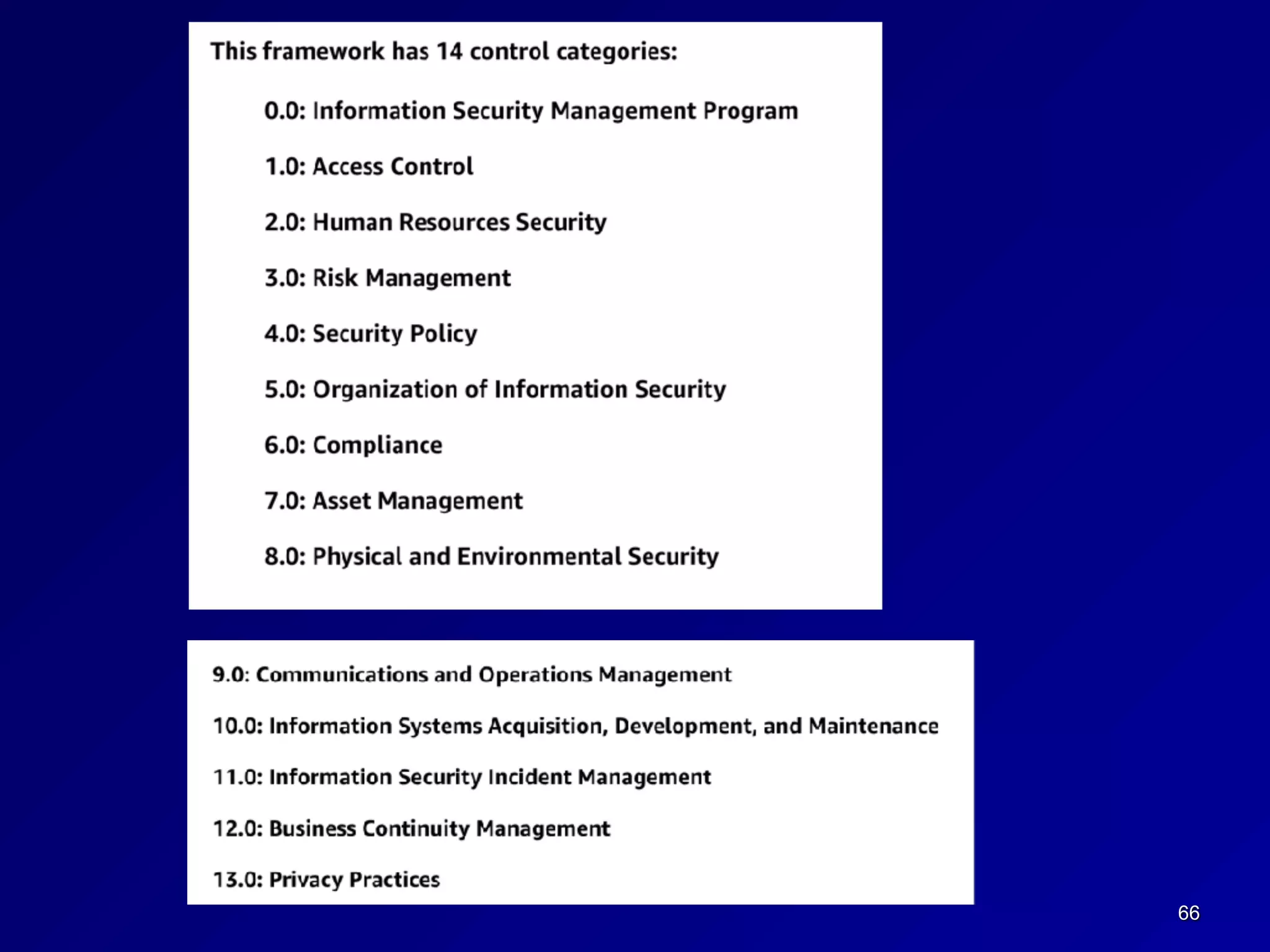
66
CIS Critical Security Controls
• From Center for Internet Security
• The first 5 controls eliminate most vulns
68
69
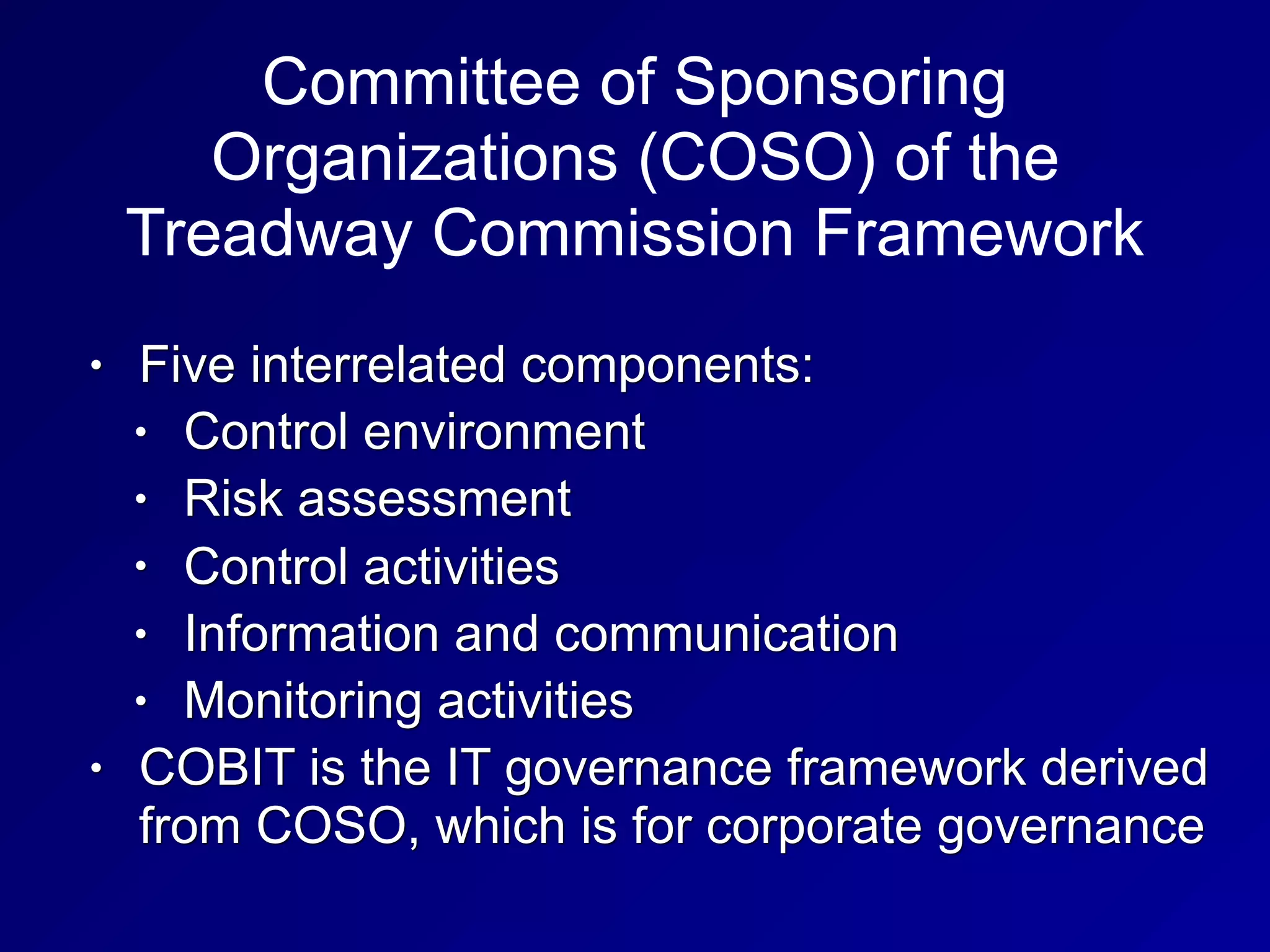
Committee of Sponsoring
Organizations (COSO) of the
Treadway Commission Framework
• Five interrelated components:
• Control environment
• Risk assessment
• Control activities
• Information and communication
• Monitoring activities
• COBIT is the IT governance framework derived
from COSO, which is for corporate governance
Operationally Critical Threat, Asset
and Vulnerability Evaluation (OCTAVE)
• Developed at Carnegie Mellon
• An organization implements small teams
that work together to address security needs
• Most recent version is OCTAVE Allegro
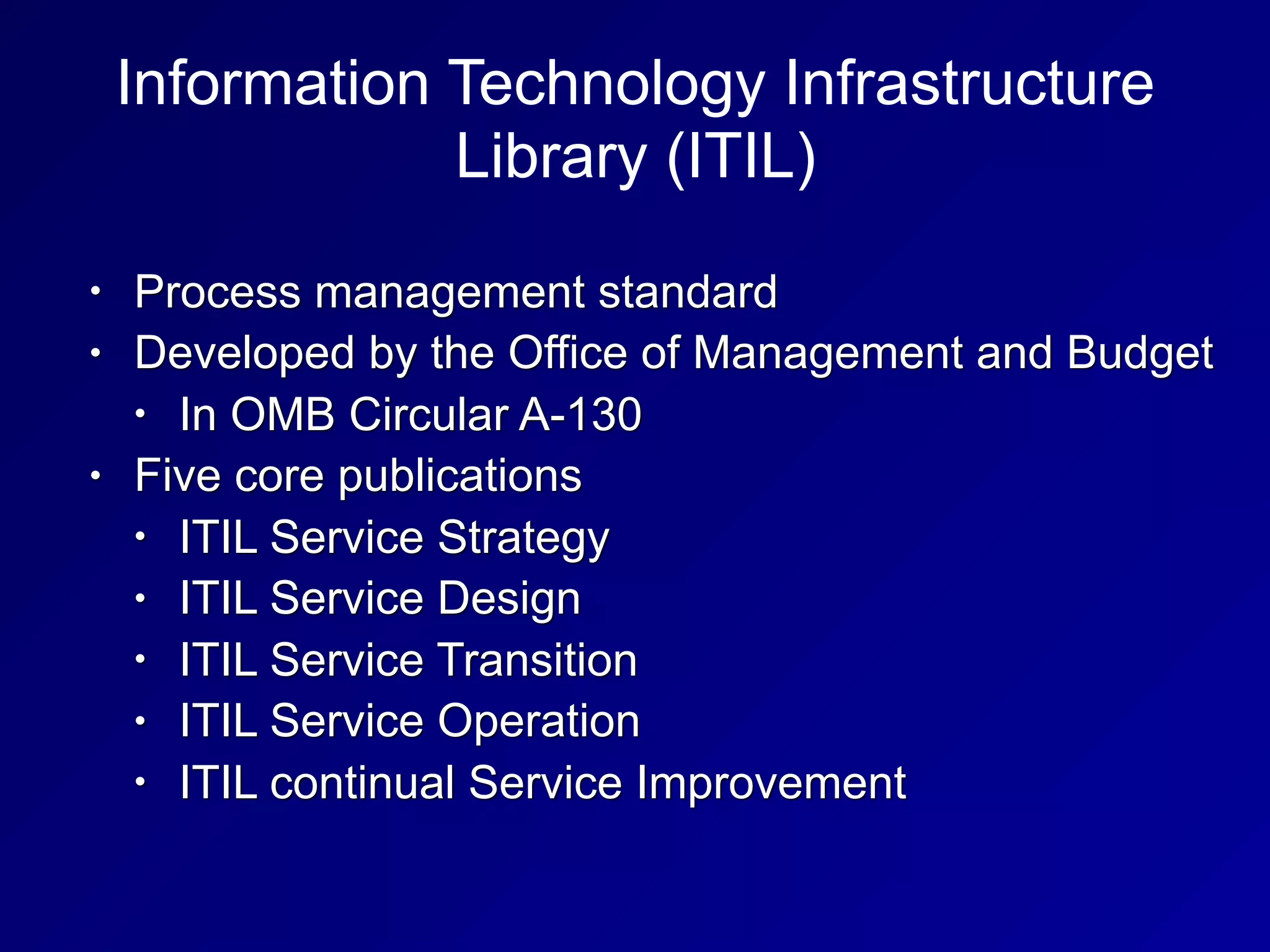
Information Technology Infrastructure
Library (ITIL)
• Process management standard
• Developed by the Office of Management and Budget
• In OMB Circular A-130
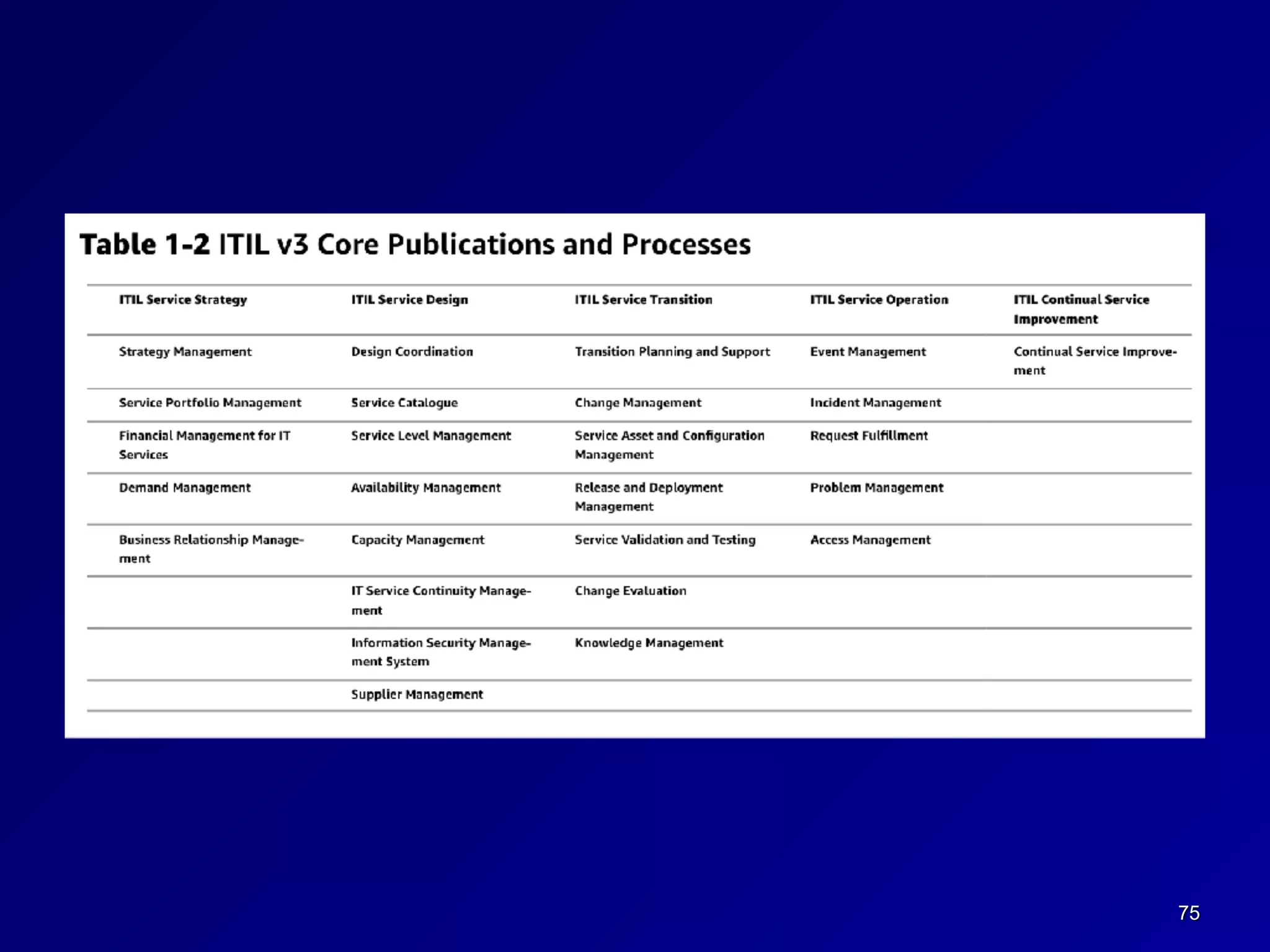
• Five core publications
• ITIL Service Strategy
• ITIL Service Design
• ITIL Service Transition
• ITIL Service Operation
• ITIL continual Service Improvement
ITIL
• Has a security component
• Primarily concerned with managing service-
level agreements (SLAs)
• Between an IT organization or department
• And its customers
• Independent review of security controls
should be performed every three years
75
Six Sigma
• Process improvement standard
77
Capability Maturity Model
Integration (CMMI)
• Process improvement approach
• Three areas of interest
• Product and service development
• CMMI for development
• Service establishment and management
• CMMI for services
• Product service and acquisition
• CMMI for acquisitions
CMMI Maturity Levels
• Level 1 Initial
• Level 2 Managed
• Level 3 Defined
• Level 4 Quantitatively Managed
• Level 5 Optimizing
CCTA Risk Analysis and Management
Method (CRAMM)
• Risk analysis and management tool
• Developed by the UK Gov't's Central
Computer and Telecommunications Agency
(CCTA)
• CRAMM review has three steps
Top-Down Approach
• Upper management initiates and defines
security policy
• Recommended
• Bottom-Up Approach
• IT staff makes security decisions without
input from senior management
• Rarely used and problematic
• Security plans are useless without approval
from senior management
1d
84
85
Compliance
• Alignment with standards, guidelines,
regulations, and/or legislation
• Usually industry-specific
• PCI-DSS (Payment Card Industry Data
Security Standard) for merchants who
accept credit card payments
• HIPAA (Health Insurance Portability and
Accountability Act) for healthcare
Governance, Risk Management, and
Compliance (GRC)
Contractual, Legal, Industry Standards,
and Regulatory Compliance
• Laws vary; work with legal team
• Privacy Requirements Compliance
• Regulates confidentiality of Personally
Identifiable Information (PII)
• The General Data Protection Regulation
(GDPR) is the new European standard
89
90
Legal and Regulatory Issues
Computer Crime
• Computer as target
• DoS, installing malware to send spam
• Computer as a tool
• Stealing secrets from a database
• Stealing credit card numbers
• Espionage
• Harassment
• Attribution
• Difficult to prove who did a crime
Major Legal Systems
• Civil Law
• Laws and statutes determine what is allowed
• Precedents and particular case rulings carry
less weight than under common law
• Common Law
• Used in the USA, Canada, the UK, and former
British colonies
• Significant emphasis on particular cases and
precedents as determinants of laws
• The major legal system in the CISSP exam
Religious and Customary Law
• Religious Law
• Mainly Sharia (Islamic religious law)
• Customary Law
• Customs or practices that are commonly
accepted and treated as law
• Closely related to Best Practices
• Less important
Criminal and Civil Law
• Criminal Law
• Victim is society itself
• Enforced by police
• Punishment is often prison time
• Proof must be beyond a reasonable doubt
• Civil Law (Tort Law)
• Injury resulting from failure to provide due care
• Victim is an individual
• Enforced by lawsuits
• Result is financial damages paid to victim
• Burden of proof: preponderance of the evidence
(more likely than not)
Administrative Law
• Also called Regulatory Law
• Specify rules and punishments for regulated
industries
• Examples
• FCC regulations
• HIPAA security mandates
• FDS regulations
• FAA regulations
Liability
• Due Care
• Also called Duty of Care
• Prudent Man Rule
• Businesses should do what a prudent
man would do
• Best Practices
• Due Diligence
• The management of due care
• Follows a formal process
Intellectual Property
• Trademark
• Name, logo, or symbol used for marketing
• Unregistered ™ or Registered ®
• Patent
• Grants a monopoly for an invention
• Copyright ©
• Restricts copying creative work
• Software typically covered by copyright
• Fair sale & fair use are allowed
Intellectual Property
• Licenses
• End-User License Agreement (EULA)
• Trade secrets
• Special sauce
• Protected by non-disclosure agreements
(NDAs) & non-compete agreements
(NCAs)
Intellectual Property Attacks
• Software piracy
• Copyright infringement
• Corporate espionage
• Cybersquatting & Typosquatting
• Using a domain close to a company's
domain, like yahoo.net or yahooo.com
Digital Rights Management (DRM)
• Controls use of digital content
• Digital Millennium Copyright Act (DMCA) of
1998
• Imposes penalties on those who make
available technologies to circumvent copy
protection
Import / Export Restrictions
• USA restricted exports of cryptographic
technology in the 1990s
• Restrictions have been relaxed since then
• But cryptography is still regulated
• https://www.bis.doc.gov/index.php/
documents/regulation-docs/2255-
supplement-no-1-to-part-740-country-
groups-1/file
103
Example Countries
• Group B (Relaxed)
• Canada, Israel, Japan, Jordan, Saudi
Arabia, Singapore
• Group D-1 (Stricter)
• China, Iraq, N Korea, Russia
Cyber Crimes and Data Breaches
• Data Breach
• Confidential information is exposed to
unauthorized parties
• Cyber Crime
• Any criminal act carried out with computers
or the Internet
• Going Dark
• Inability of law enforcement to access
evidence
Privacy
• Confidentiality of personal information
• EU Data Protection Directive
• Individuals must be notified how their data
is used & allowed to opt out
• OECD Privacy Guidelines
• Organization for Economic Cooperation
and Development
• Includes EU, USA, Mexico, AU & more
EU-US Safe Harbor
• Part of EU Data Protection Directive
• Sending personal data from EU to other
countries is forbidden
• Unless the receiving country adequately
protects its data
• The USA lost this privilege in Oct. 2015
because of the Snowden leaks
Privacy Shield
• Replaced Safe Harbor
• Approved by the EU in 2016 and
Switzerland in 2017
International Cooperation
• Council of Europe Convention on
Cybercrime
• Includes most EU countries and the USA
• Promotes cooperation
Important Laws and Regulations
HIPAA
• Health Insurance Portability and
Accountability Act
• Guidance on Administrative, Physical, and
Technical safeguards
• For Protected Health Information (PHI)
CFAA
• Computer Fraud and Abuse Act
• Protects government and financial
computers
• Including every computer on the Internet
(probably not the law's original intent)
• It's a crime to exceed your authorization to
use such a computer
ECPA & The PATRIOT Act
• Electronic Communications Privacy Act
• Protected electronic communications from
warrantless wiretapping
• Weakened by the PATRIOT Act
• The PATRIOT Act
• A response to 9/11 attacks
• Greatly expanded law enforcement's
electronic monitoring capabilities
GLBA & SOX
• Gramm-Leach-Bailey Act
• Forces financial institutions to protect
customer financial information
• Sarbanes-Oxley Act
• Response to ENRON scandal
• Regulatory compliance mandates for
publicly traded companies
• Ensures financial disclosure and auditor
independence
PCI-DSS
• Payment Card Industry Data Security
Standard
• Self-regulation by major vendors
• Mandates security policy, devices, controls,
and monitoring to protect cardholder data
US Breach Notification Laws
• 47 states require notification
• No federal law yet
• Safe harbor for data that was encrypted at
time of compromise
117
Professional Ethics
(ISC)^2 Code of Ethics
• Four Canons
• Protect society, the commonwealth, and
the infrastructure
• Act honorably, honestly, justly, responsibly,
and legally
• Provide diligent and competent service to
principals
• Advance and protect the profession
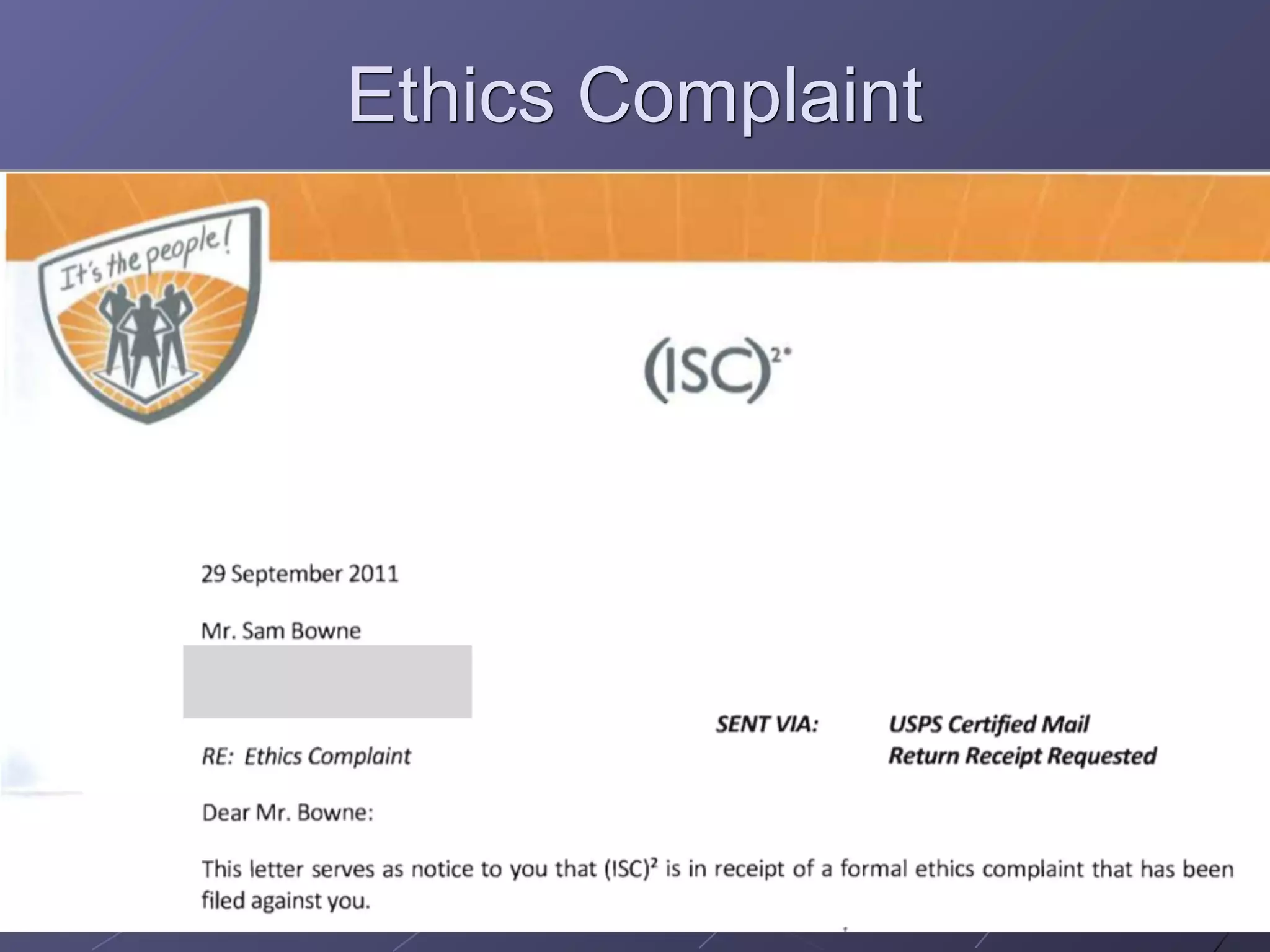
Ethics Complaint
Accusation
Verdict
1e
123
Security Documentation
x
Security Structure Components
• Policies
• Processes
• Procedures
• Standards
• Guidelines
• Baselines
Security Policies
• Overview or generalization of security needs
• A strategic plan for implementing security
• Assigns responsibilities
• Specifies audit and compliance
requirements
• Outlines enforcement processes
• Defines acceptable risk levels
• Used as proof that senior management has
exercised due care
• Must contain an exception area
127
Types of Security Policies
• Organizational
• Issues relevant to every aspect of an
organization
• Issue-specific
• Such as a specific network service
• Like email, privacy, employee termination
• System-specific
• Such as a firewall policy
Categories of Security Policies
• Regulatory
• Compliance with industry or legal
standards
• Advisory
• Discusses acceptable activities and
consequences of violations
• Most policies are advisory
• Informative
• Provides background information
Processes
• Series of steps or actions to achieve a
particular end
• Examples
• Process to enter an online order
• Process to process a payment
• Processes then lead to procedures
Security Procedures
• Detailed step-by-step instructions
• System- and software-specific
• Must be updated as hardware and software
evolve
Standards
• Compulsory requirements for homogenous
use of software, technology, and security
controls
• Course of action to implement technology
and procedures uniformly thought an
organization
• Tactical documents
Guidelines
• Recommendation on how to meet standards
and baselines
• Flexible; can be customized
• Not compulsory
Baselines
• Reference point
• Defined and captured for future reference
• Should be captured when the system is
properly configured and fully updated
135
2a-4
Business Continuity
Business Continuity Planning (BCP)
• Ensures that business will continue to
operate before, throughout, and during a
disaster
• Ensures that critical services can be carried
out
• Strategic, long-term: focuses on business
as a whole
• An umbrella plan that includes multiple
plans, most importantly the Disaster
Recovery Plan (DRP)
Disaster Recovery Planning (DRP)
• Tactical, short-term
• Plan to deal with specific disruptions,
such as a malware infection
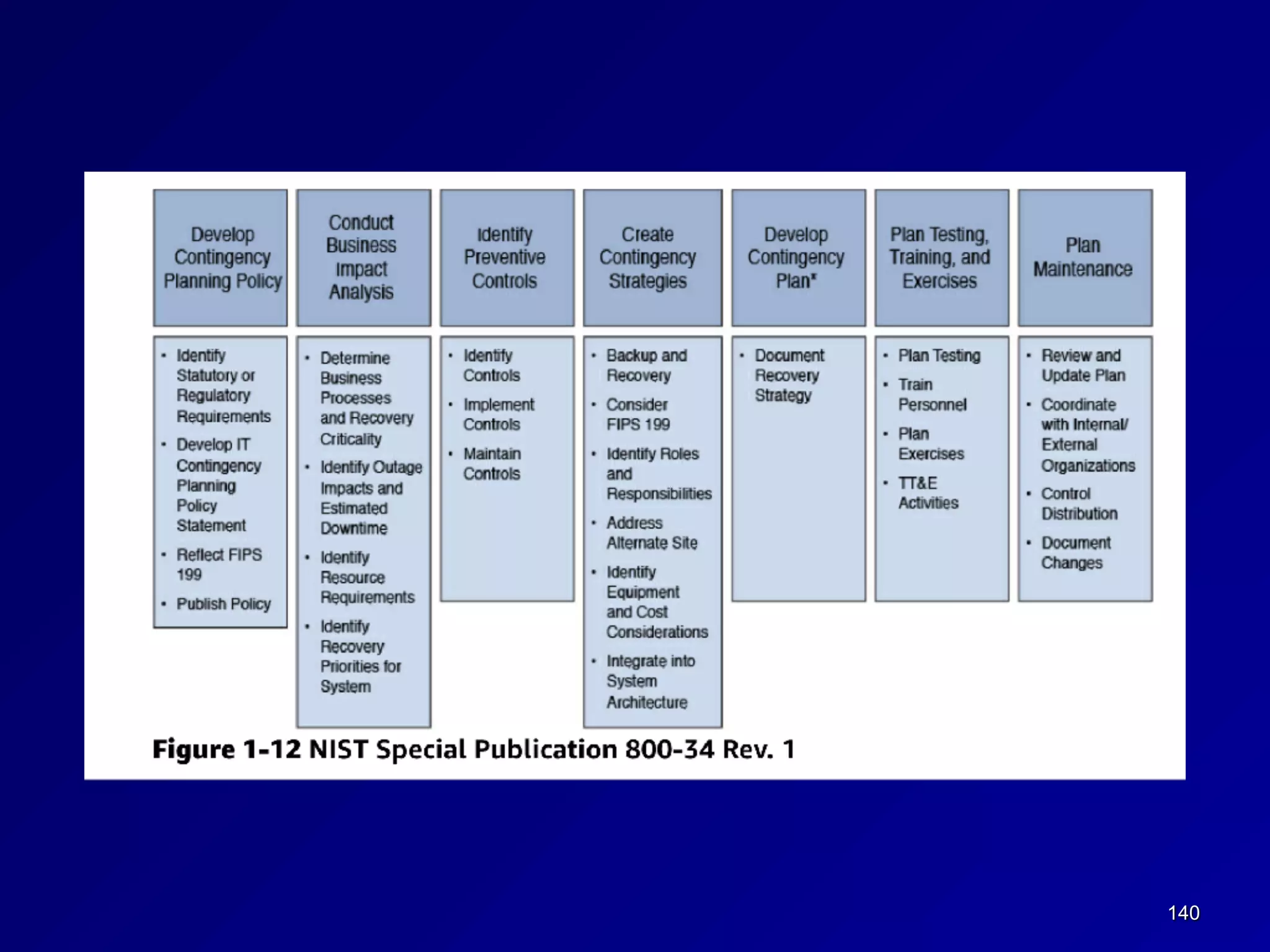
Business Impact Analysis (BIA)
• Determine Maximum Tolerable Downtime
(MTD) for specific IT assets
• First, identify critical assets
• Second, comprehensive risk analysis
• Including vulnerability analysis
140
Personnel Security Policies and
Procedures
• Candidate Screening
• Employment Agreements and Policies
• Non-Disclosure Agreement (NDA)
• Acceptable Use Policy (AUP)
• Code of Conduct
• Conflict of Interest
• Ethics
Employee Onboarding and Offboarding
• Onboarding
• Orientation and provisioning
• Offboarding (Termination)
• Knowledge transfer
• Exit interview
Job Rotation and Separation of Duties
• Job Rotation
• Moves personnel from one job to another
periodically
• Prevents one person from being irreplaceable
• Helps to detect fraud
• Separation of Duties requires two or more
people to work on portions of a task
• Prevents fraud without collusion
144
Risk Management Concepts
145
146
Risk Analysis
Risk Analysis
• Assets
• Valuable resources to protect
• Threat
• A potentially harmful occurrence
• Vulnerability
• A weakness
Risk = Threat x Vulnerability
• Earthquake risk is the same in Boston and
San Francisco
• Boston
• Earthquakes are rare, but buildings are old
and vulnerable
• San Francisco
• Earthquakes are common, but buildings
are newer and safer
Impact
• Severity of the damage in dollars
• Risk = Threat x Vulnerability x Impact
• Human life is considered near-infinite impact
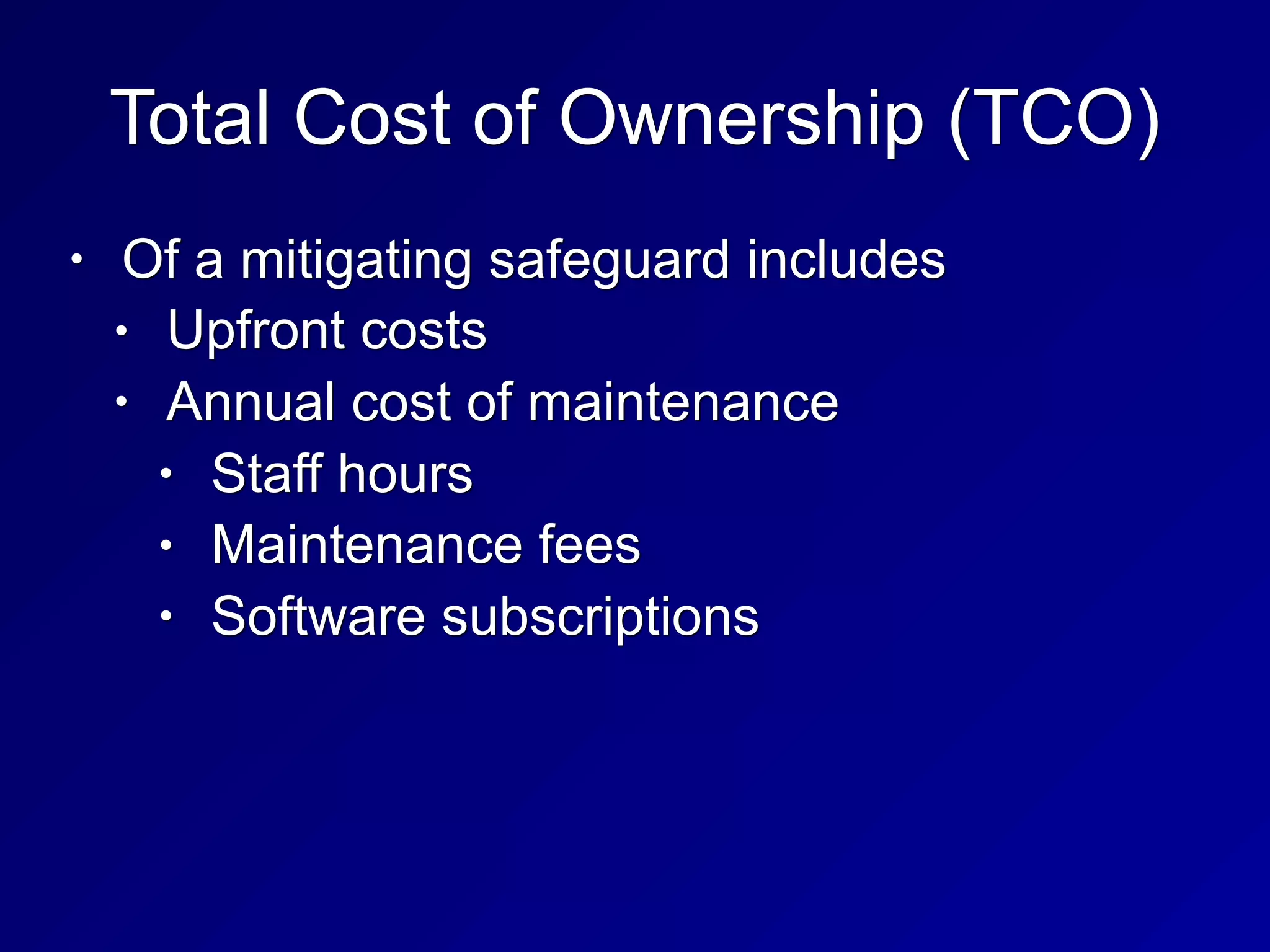
Total Cost of Ownership (TCO)
• Of a mitigating safeguard includes
• Upfront costs
• Annual cost of maintenance
• Staff hours
• Maintenance fees
• Software subscriptions
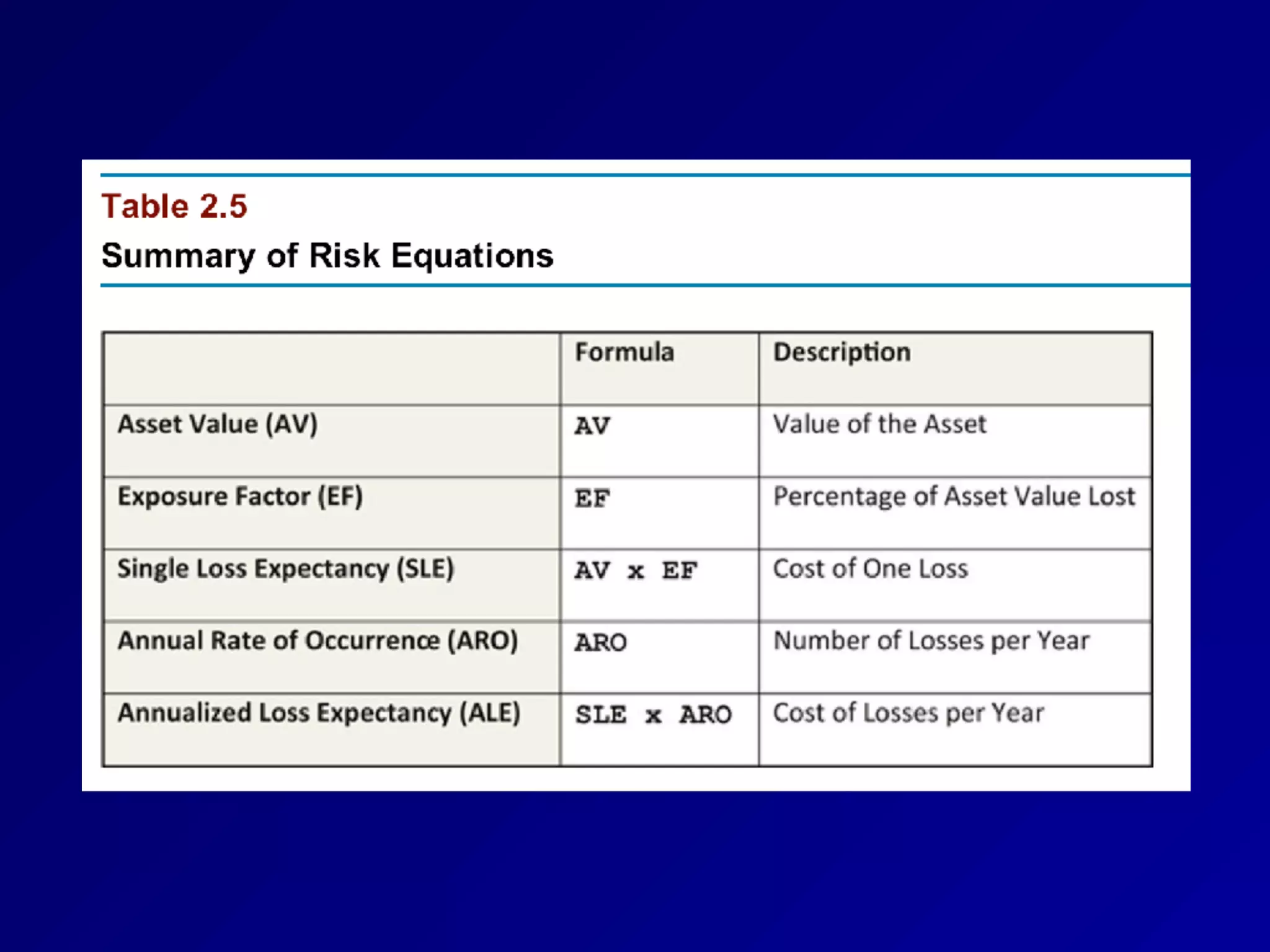
Return on Investment (ROI)
• Amount of money saved by implementing a
safeguard
• If Total Cost of Ownership is less than
Annualized Loss Expectancy, you have a
positive ROI
Risk Choices
• Accept the risk
• Mitigate the risk
• Transfer the risk
• Risk avoidance
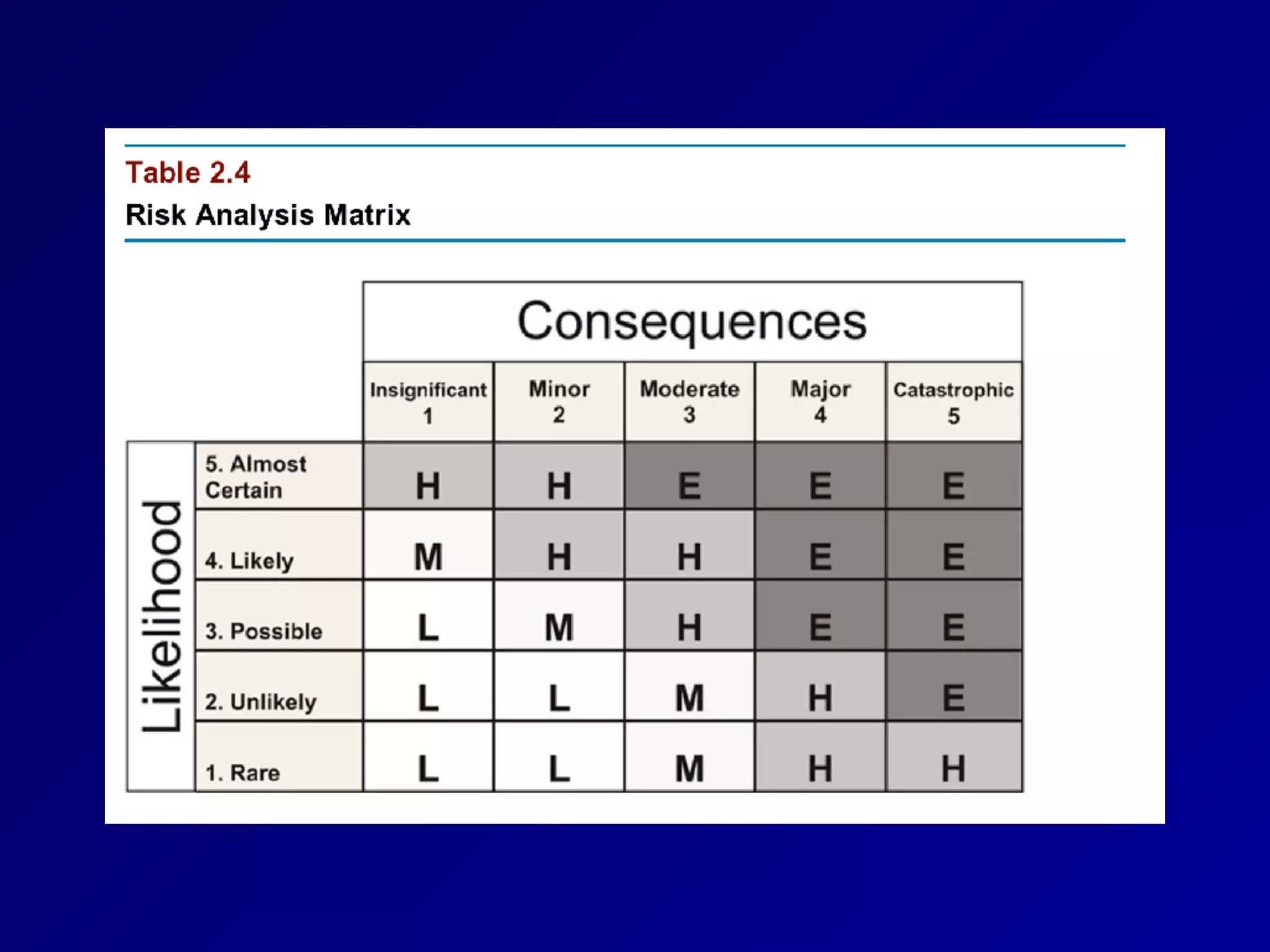
Quantitative and Qualitative Risk
Analysis
• Quantitative
• Uses hard metrics, like dollars
• Qualitative
• Use simple approximate values
• Or categories like High, Medium, Low
156
157
Access Control Defensive
Categories and Types
Access Control Types
• Preventive
• Detective
• Corrective
• Recovery
• Deterrent
• Compensating
Access Control Types
• Preventive
• Prevents actions, such as limited
privileges
• Detective
• Alerts during or after an attack, like video
surveillance
• Corrective
• Corrects a damaged system or process,
like antivirus removing a suspicious file
Access Control Types
• Recovery
• Restores functionality after a security incident, such
as restoring from backups
• Deterrent
• Scares away attackers, like a "Beware of Dog" sign
• Compensating
• Additional control to compensate for weakness in
other controls
• e. g. reviewing server logs to detect violations of the
Computer Use Policy (an administrative control)
Access Control Categories
• Administrative
• Policy, procedure, or regulation
• Technical
• Software, hardware, or firmware
• Physical
• Locks, security guards, etc.
162
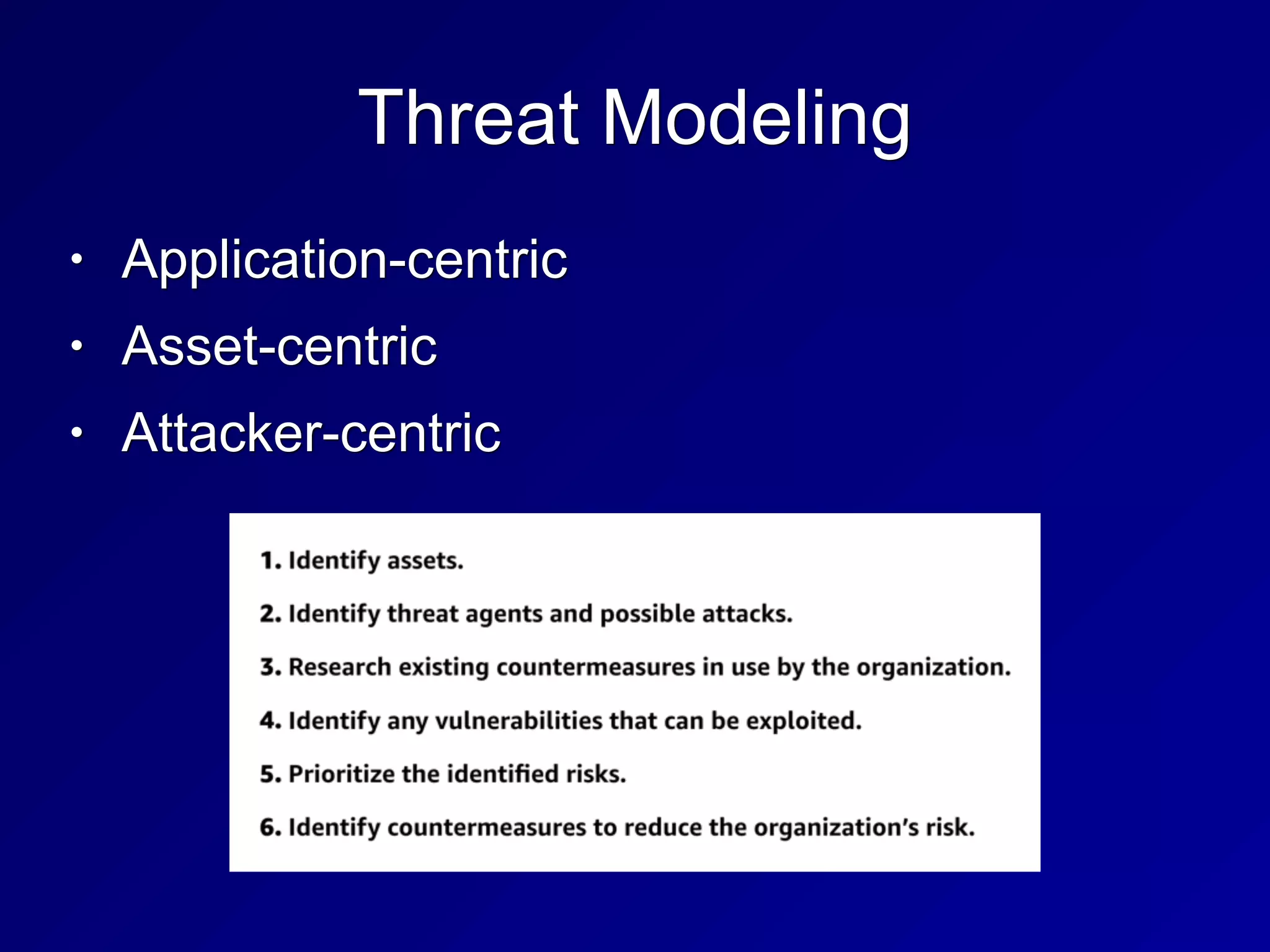
Threat Modeling
Threat Modeling
• Application-centric
• Asset-centric
• Attacker-centric
Microsoft STRIDE Threat Categorization
• Spoofing
• Tampering
• Repudiation
• Information disclosure
• Denial of service
• Elevation of privilege
• Other modeling tools: PASTA, Trike, VAST
165
Risks in the Supply Chain
• Hardware, Software, Services
• Third-Party Assessment and Monitoring
• Service Level Agreements
2b Part 3

1. Security and Risk Management

  • 1.
  • 2.
    Topics • Security Terms •Security Governance Principles • Compliance • Legal and Regulatory Issues • Professional Ethics • Security Documentation • Business Continuity
  • 3.
    Topics • Personnel SecurityPolicies and Procedures • Risk Management Concepts • Geographical Threats • Threat Modeling • Security Risks in the Supply Chain
  • 4.
  • 5.
  • 6.
  • 7.
    Confidentiality • Keeps datasecret • Prevents unauthorized read access • An attack: theft of Personally Identifiable Information (PII) such as credit card information • Health Insurance Portability and Accountability Act (HIPAA) • Requires medical providers to keep patient information private
  • 8.
    Confidentiality • Data shouldonly be available to users who have • Clearance • Formal access approval • Need to know
  • 9.
    Integrity • Assures thatdata has not been modified, tampered with, or corrupted • Three perspectives • Prevent unauthorized subjects from making modifications • Prevent authorized subjects from making unauthorized modifications, such as mistakes • Maintaining consistency of objects so data is correct and maintains its proper relationships with child, peer, or parent objects
  • 10.
    Integrity Controls and Countermeasures •Access controls • Authentication • Intrusion Detection Systems • Activity logging • Maintaining and validating object integrity • Encryption • Hashing
  • 11.
    Integrity Attacks • Viruses •Logic bombs • Unauthorized access • Errors in coding • Malicious modification • System back doors
  • 12.
    Availability • Data andservices are available when needed by authorized subjects – Remove SPOF (Single Point of Failure) – Prevent Denial of Service attacks
  • 13.
    Threats to Availability •Device failure • Software errors • Environmental issues (heat, static, flooding, power loss, etc.) • Denial of Service attacks • Human errors (deleting important files, under allocating resources, mislabeling objects)
  • 14.
    Availability Controls • Intermediarydelivery systems design (routers, proxies, etc.) • Access controls • Monitoring performance and traffic • Redundant systems • Backups • Business Continuity Planning • Fault-tolerant systems
  • 15.
    Balancing CIA • Youcan never have perfect security • Increasing one item lowers others • Increasing confidentiality generally lowers availability – Example: long ,complex passwords that are easily forgotten
  • 16.
    Auditing and Accounting •Auditing • Measurable technical assessment of a system or application • Accounting • Logging access and use of information resources
  • 17.
    Five Elements • Identificationclaiming to be someone • Authentication proving that you are that person • Authorization allows you to access resources • Auditing records a log of what you do • Accounting reviews log files and holds subjects accountable for their actions
  • 18.
    AAA Services • Authentication •Authorization • Accounting
  • 19.
    19 • Link Ch2a Example of Accounting
  • 20.
  • 21.
    Non-Repudiation • Prevents entitiesfrom denying that they took an action • Examples: signing a home loan, making a credit card purchase • Techniques – Digital signatures – Audit logs
  • 22.
    Least Privilege andNeed to Know • Least privilege • Users have the minimum authorization to do their jobs • Need to know • More granular than least privilege • Users must have a need to access that particular information before accessing it
  • 23.
    23 Example: Need toKnow • In the 1990's US intelligence agencies did not share information with one another • "Information Silos" • Failed to predict the 9/11 attacks, arguably for this reason • Links Ch 2b, 2c
  • 24.
    24 Example: Need toKnow • The silos were removed • So Bradley Manning (now Chelsea), gave 750,000 classified or sensitive documents to Wikileaks • Links Ch 2d, 2e, 2f
  • 25.
    Subjects and Objects •Subject is an active entity • Such as a person accessing data • Or a computer program • Object is a passive entity • Such as paper records or data files
  • 26.
    Subjects and Objects •Internet Explorer • A Subject when running in memory • Accessing data • iexplore.exe • An object when not running • A file sitting on a disk
  • 27.
    Defense in Depth •Multiple defenses in series • If one fails, another may succeed • Example: • Palo Alto firewall protects whole LAN • Windows firewall runs on each workstation
  • 28.
    Due Care andDue Diligence • Due Care • Doing what a reasonable person would do • The "prudent man" rule • Informal • Due Diligence • Management of due care • Follows a process • A step beyond due care
  • 29.
    Gross Negligence • Theopposite of due care • If you suffer loss of PII • Legal consequences will depend on whether you can demonstrate due care or not
  • 30.
    Abstraction • Group similarelements together • Assign security controls, restrictions, or permissions to the groups • Such as Administrators, Sales, Help Desk, Managers
  • 31.
    Data Hiding • Placingdata in a logical storage compartment that is not seen by the subject • Ex: • Keeping a database inaccessible to unauthorized users • Restricting a subject at a low classification level from accessing data at a higher classification level
  • 32.
    Encryption • Hiding themeaning of a communication from unintended recipients
  • 33.
  • 34.
  • 35.
    Security Governance Principles •The collection of practices • Supporting, defining and directing • The security efforts of an organization • Goal is to maintain business processes while striving towards growth and resiliency • Some aspects are imposed on organizations • Regulatory compliance • Industry guidelines • License requirements
  • 36.
    Security Governance Principles •Must be assessed and verified • Security is not just an IT issue • Affects every aspect of an organization
  • 37.
    Alignment of SecurityFunction to Strategy, Goals, Mission, and Objectives • Base security planning on a business case • A documented argument to define a need • Justifies the expense
  • 38.
    CSO (Chief SecurityOfficer) • Security management is a responsibility of upper management, not IT staff • InfoSec team should be led by a CSO • CSO reports directly to senior management • CSO and InfoSec team are outside the typical hierarchical structure
  • 39.
    Strategic, Tactical, andOperational Plans
  • 40.
    Strategic, Tactical, andOperational Plans • Strategic Plan • Long term (about five years) • Goals and visions for the future • Risk assessment • Tactical Plan • Useful for about a year • Ex: projects, acquisitions, hiring, budget, maintenance, support, system development
  • 41.
    Strategic, Tactical, andOperational Plans • Operational Plan • Short term (month or quarter) • Highly detailed • Ex: resource allotments, budgetary requirements, staffing assignments, scheduling, step-by-step or implementation procedures
  • 42.
    Change Control/Management • Planning,testing, logging, auditing, and monitoring of activities related to security controls and mechanisms • Goal: ensure that a change does not reduce or compromise security • Must include rollback plan • How to reverse a change to recover a previous secured state
  • 43.
    Change Control/Management • Requiredfir ITSEC classifications of B2, B3, and A1 • Information Technology Security Evaluation and Criteria
  • 44.
    Change Control Process •Implement change in a monitored and orderly manner • Formalized testing process to very expected results • Rollback plan • Users are informed of change before it occurs • Effects of change are systematically analyzed • Negative impact of change is minimized • Changes are reviewed and approved by CAB (Change Approval Board)
  • 45.
    Data Classification • Somedata needs more security than others • Criteria: • Usefulness, timeliness, value, age, data disclosure damage assessment, national security implications • Authorized access, restrictions, maintenance, monitoring, and storage
  • 46.
    To Implement aClassification Scheme 1. Identity custodian 2. Specify evaluation criteria 3. Classify and label each resource 4. Document exceptions 5. Select security controls 6. Specify declassification procedures 7. Create awareness program to instruct all personnel
  • 47.
    Classification Levels • Government/ Military • Top Secret • Secret • Confidential • Unclassified • Business / Private Sector • Confidential or Private • Sensitive • Public
  • 48.
    Security Roles andResponsibilities • Senior Manager • Ultimately responsible for the security of an organization • Must sign off on all activities • Security Professional • Writes security policy and implements it • Follows directives from senior management • Data Owner • Responsible for classifying information
  • 49.
    Security Roles andResponsibilities • Data Custodian • Implements protections defined by security policy • Ex: Making and testing backups, managing data storage based on classification • User • Anyone with access to the secured system • Auditor • Produces compliance and effectiveness reports for the senior manager
  • 50.
  • 51.
  • 52.
  • 53.
    ISO/IEC 27000 Series •International Organization for Standardization (ISO) • With the International Electrotechnical Commission • A lengthy list of standards for developing and maintaining an Information Security Management System (ISMS)
  • 55.
    Zachman Framework • Two-dimensionalclassification system • Based on six communication questions • What, Where, When, Why, Who, How • Intersecting with perspectives • Executive, Business Management, Architect, Engineer, Technician, Enterprise • Not security oriented • Helps to relay information in language useful to personnel
  • 56.
    The Open GroupArchitecture Framework (TOGAF) • Another enterprise architecture framework • Helps organizations design, plan, implement, and govern • An enterprise information architecture • Four domains: • Technology, Applications, Data, Business
  • 57.
    Dept of DefenseArchitecture Framework (DoDAF) • Organizes a set of products under eight views • All Viewpoint (AV) • Capability Viewpoint (CV) • Data and Information Viewpoint (DIV) • Operation Viewpoint (OV) • Project Viewpoint (PV) • Services Viewpoint (SvcV) • Standards Viewpoint (STDV) • Systems Viewpoint (SV)
  • 58.
    British Ministry ofDefense Architecture Framework (MODAF) • Divides information into seven viewpoints • Strategic Viewpoint (StV) • Operational Viewpoint (OV) • Service-Oriented Viewpoint (SOV) • Systems Viewpoint (SC) • Acquisition Viewpoint (AcV) • Technical Viewpoint (TV) • All Viewpoint (AV)
  • 59.
    Sherwood Applied BusinessSecurity Architecture (SABSA)
  • 60.
    Control Objectives forInformation and Related Technology (COBIT) • A set of IT best practices • From ISACA (Information Systems Audit and Control Association) • Five key principles 1. Meeting stakeholder needs 2. Covering the enterprise end-to-end 3. Applying a single, integrated framework 4. Enabling a holistic approach 5. Separating governance from management
  • 62.
    National Institute ofStandards and Technology (NIST) Special Publications (SP) 800 Series • Describe US Federal Gov't computer security policies, procedures, and guidelines
  • 63.
  • 64.
  • 65.
    HITRUST CSF • Privatelyheld US company • Works with healthcare, technology, and information security leaders • Establishes Common Security Framework (CSF) • To address requirements of multiple regulations and standards • Primarily used in healthcare industry
  • 66.
  • 67.
    CIS Critical SecurityControls • From Center for Internet Security • The first 5 controls eliminate most vulns
  • 68.
  • 69.
  • 70.
    Committee of Sponsoring Organizations(COSO) of the Treadway Commission Framework • Five interrelated components: • Control environment • Risk assessment • Control activities • Information and communication • Monitoring activities • COBIT is the IT governance framework derived from COSO, which is for corporate governance
  • 71.
    Operationally Critical Threat,Asset and Vulnerability Evaluation (OCTAVE) • Developed at Carnegie Mellon • An organization implements small teams that work together to address security needs • Most recent version is OCTAVE Allegro
  • 73.
    Information Technology Infrastructure Library(ITIL) • Process management standard • Developed by the Office of Management and Budget • In OMB Circular A-130 • Five core publications • ITIL Service Strategy • ITIL Service Design • ITIL Service Transition • ITIL Service Operation • ITIL continual Service Improvement
  • 74.
    ITIL • Has asecurity component • Primarily concerned with managing service- level agreements (SLAs) • Between an IT organization or department • And its customers • Independent review of security controls should be performed every three years
  • 75.
  • 76.
    Six Sigma • Processimprovement standard
  • 77.
  • 78.
    Capability Maturity Model Integration(CMMI) • Process improvement approach • Three areas of interest • Product and service development • CMMI for development • Service establishment and management • CMMI for services • Product service and acquisition • CMMI for acquisitions
  • 79.
    CMMI Maturity Levels •Level 1 Initial • Level 2 Managed • Level 3 Defined • Level 4 Quantitatively Managed • Level 5 Optimizing
  • 80.
    CCTA Risk Analysisand Management Method (CRAMM) • Risk analysis and management tool • Developed by the UK Gov't's Central Computer and Telecommunications Agency (CCTA) • CRAMM review has three steps
  • 82.
    Top-Down Approach • Uppermanagement initiates and defines security policy • Recommended • Bottom-Up Approach • IT staff makes security decisions without input from senior management • Rarely used and problematic • Security plans are useless without approval from senior management
  • 83.
  • 84.
  • 85.
  • 86.
    Compliance • Alignment withstandards, guidelines, regulations, and/or legislation • Usually industry-specific • PCI-DSS (Payment Card Industry Data Security Standard) for merchants who accept credit card payments • HIPAA (Health Insurance Portability and Accountability Act) for healthcare
  • 87.
    Governance, Risk Management,and Compliance (GRC)
  • 88.
    Contractual, Legal, IndustryStandards, and Regulatory Compliance • Laws vary; work with legal team • Privacy Requirements Compliance • Regulates confidentiality of Personally Identifiable Information (PII) • The General Data Protection Regulation (GDPR) is the new European standard
  • 89.
  • 90.
  • 91.
    Computer Crime • Computeras target • DoS, installing malware to send spam • Computer as a tool • Stealing secrets from a database • Stealing credit card numbers • Espionage • Harassment • Attribution • Difficult to prove who did a crime
  • 92.
    Major Legal Systems •Civil Law • Laws and statutes determine what is allowed • Precedents and particular case rulings carry less weight than under common law • Common Law • Used in the USA, Canada, the UK, and former British colonies • Significant emphasis on particular cases and precedents as determinants of laws • The major legal system in the CISSP exam
  • 93.
    Religious and CustomaryLaw • Religious Law • Mainly Sharia (Islamic religious law) • Customary Law • Customs or practices that are commonly accepted and treated as law • Closely related to Best Practices • Less important
  • 94.
    Criminal and CivilLaw • Criminal Law • Victim is society itself • Enforced by police • Punishment is often prison time • Proof must be beyond a reasonable doubt • Civil Law (Tort Law) • Injury resulting from failure to provide due care • Victim is an individual • Enforced by lawsuits • Result is financial damages paid to victim • Burden of proof: preponderance of the evidence (more likely than not)
  • 96.
    Administrative Law • Alsocalled Regulatory Law • Specify rules and punishments for regulated industries • Examples • FCC regulations • HIPAA security mandates • FDS regulations • FAA regulations
  • 97.
    Liability • Due Care •Also called Duty of Care • Prudent Man Rule • Businesses should do what a prudent man would do • Best Practices • Due Diligence • The management of due care • Follows a formal process
  • 98.
    Intellectual Property • Trademark •Name, logo, or symbol used for marketing • Unregistered ™ or Registered ® • Patent • Grants a monopoly for an invention • Copyright © • Restricts copying creative work • Software typically covered by copyright • Fair sale & fair use are allowed
  • 99.
    Intellectual Property • Licenses •End-User License Agreement (EULA) • Trade secrets • Special sauce • Protected by non-disclosure agreements (NDAs) & non-compete agreements (NCAs)
  • 100.
    Intellectual Property Attacks •Software piracy • Copyright infringement • Corporate espionage • Cybersquatting & Typosquatting • Using a domain close to a company's domain, like yahoo.net or yahooo.com
  • 101.
    Digital Rights Management(DRM) • Controls use of digital content • Digital Millennium Copyright Act (DMCA) of 1998 • Imposes penalties on those who make available technologies to circumvent copy protection
  • 102.
    Import / ExportRestrictions • USA restricted exports of cryptographic technology in the 1990s • Restrictions have been relaxed since then • But cryptography is still regulated • https://www.bis.doc.gov/index.php/ documents/regulation-docs/2255- supplement-no-1-to-part-740-country- groups-1/file
  • 103.
  • 104.
    Example Countries • GroupB (Relaxed) • Canada, Israel, Japan, Jordan, Saudi Arabia, Singapore • Group D-1 (Stricter) • China, Iraq, N Korea, Russia
  • 105.
    Cyber Crimes andData Breaches • Data Breach • Confidential information is exposed to unauthorized parties • Cyber Crime • Any criminal act carried out with computers or the Internet • Going Dark • Inability of law enforcement to access evidence
  • 106.
    Privacy • Confidentiality ofpersonal information • EU Data Protection Directive • Individuals must be notified how their data is used & allowed to opt out • OECD Privacy Guidelines • Organization for Economic Cooperation and Development • Includes EU, USA, Mexico, AU & more
  • 107.
    EU-US Safe Harbor •Part of EU Data Protection Directive • Sending personal data from EU to other countries is forbidden • Unless the receiving country adequately protects its data • The USA lost this privilege in Oct. 2015 because of the Snowden leaks
  • 108.
    Privacy Shield • ReplacedSafe Harbor • Approved by the EU in 2016 and Switzerland in 2017
  • 109.
    International Cooperation • Councilof Europe Convention on Cybercrime • Includes most EU countries and the USA • Promotes cooperation
  • 110.
    Important Laws andRegulations
  • 111.
    HIPAA • Health InsurancePortability and Accountability Act • Guidance on Administrative, Physical, and Technical safeguards • For Protected Health Information (PHI)
  • 112.
    CFAA • Computer Fraudand Abuse Act • Protects government and financial computers • Including every computer on the Internet (probably not the law's original intent) • It's a crime to exceed your authorization to use such a computer
  • 113.
    ECPA & ThePATRIOT Act • Electronic Communications Privacy Act • Protected electronic communications from warrantless wiretapping • Weakened by the PATRIOT Act • The PATRIOT Act • A response to 9/11 attacks • Greatly expanded law enforcement's electronic monitoring capabilities
  • 114.
    GLBA & SOX •Gramm-Leach-Bailey Act • Forces financial institutions to protect customer financial information • Sarbanes-Oxley Act • Response to ENRON scandal • Regulatory compliance mandates for publicly traded companies • Ensures financial disclosure and auditor independence
  • 115.
    PCI-DSS • Payment CardIndustry Data Security Standard • Self-regulation by major vendors • Mandates security policy, devices, controls, and monitoring to protect cardholder data
  • 116.
    US Breach NotificationLaws • 47 states require notification • No federal law yet • Safe harbor for data that was encrypted at time of compromise
  • 117.
  • 118.
    (ISC)^2 Code ofEthics • Four Canons • Protect society, the commonwealth, and the infrastructure • Act honorably, honestly, justly, responsibly, and legally • Provide diligent and competent service to principals • Advance and protect the profession
  • 119.
  • 120.
  • 121.
  • 122.
  • 123.
  • 124.
  • 125.
    Security Structure Components •Policies • Processes • Procedures • Standards • Guidelines • Baselines
  • 126.
    Security Policies • Overviewor generalization of security needs • A strategic plan for implementing security • Assigns responsibilities • Specifies audit and compliance requirements • Outlines enforcement processes • Defines acceptable risk levels • Used as proof that senior management has exercised due care • Must contain an exception area
  • 127.
  • 128.
    Types of SecurityPolicies • Organizational • Issues relevant to every aspect of an organization • Issue-specific • Such as a specific network service • Like email, privacy, employee termination • System-specific • Such as a firewall policy
  • 129.
    Categories of SecurityPolicies • Regulatory • Compliance with industry or legal standards • Advisory • Discusses acceptable activities and consequences of violations • Most policies are advisory • Informative • Provides background information
  • 130.
    Processes • Series ofsteps or actions to achieve a particular end • Examples • Process to enter an online order • Process to process a payment • Processes then lead to procedures
  • 131.
    Security Procedures • Detailedstep-by-step instructions • System- and software-specific • Must be updated as hardware and software evolve
  • 132.
    Standards • Compulsory requirementsfor homogenous use of software, technology, and security controls • Course of action to implement technology and procedures uniformly thought an organization • Tactical documents
  • 133.
    Guidelines • Recommendation onhow to meet standards and baselines • Flexible; can be customized • Not compulsory
  • 134.
    Baselines • Reference point •Defined and captured for future reference • Should be captured when the system is properly configured and fully updated
  • 135.
  • 136.
  • 137.
    Business Continuity Planning(BCP) • Ensures that business will continue to operate before, throughout, and during a disaster • Ensures that critical services can be carried out • Strategic, long-term: focuses on business as a whole • An umbrella plan that includes multiple plans, most importantly the Disaster Recovery Plan (DRP)
  • 138.
    Disaster Recovery Planning(DRP) • Tactical, short-term • Plan to deal with specific disruptions, such as a malware infection
  • 139.
    Business Impact Analysis(BIA) • Determine Maximum Tolerable Downtime (MTD) for specific IT assets • First, identify critical assets • Second, comprehensive risk analysis • Including vulnerability analysis
  • 140.
  • 141.
    Personnel Security Policiesand Procedures • Candidate Screening • Employment Agreements and Policies • Non-Disclosure Agreement (NDA) • Acceptable Use Policy (AUP) • Code of Conduct • Conflict of Interest • Ethics
  • 142.
    Employee Onboarding andOffboarding • Onboarding • Orientation and provisioning • Offboarding (Termination) • Knowledge transfer • Exit interview
  • 143.
    Job Rotation andSeparation of Duties • Job Rotation • Moves personnel from one job to another periodically • Prevents one person from being irreplaceable • Helps to detect fraud • Separation of Duties requires two or more people to work on portions of a task • Prevents fraud without collusion
  • 144.
  • 145.
  • 146.
  • 147.
    Risk Analysis • Assets •Valuable resources to protect • Threat • A potentially harmful occurrence • Vulnerability • A weakness
  • 148.
    Risk = Threatx Vulnerability • Earthquake risk is the same in Boston and San Francisco • Boston • Earthquakes are rare, but buildings are old and vulnerable • San Francisco • Earthquakes are common, but buildings are newer and safer
  • 149.
    Impact • Severity ofthe damage in dollars • Risk = Threat x Vulnerability x Impact • Human life is considered near-infinite impact
  • 152.
    Total Cost ofOwnership (TCO) • Of a mitigating safeguard includes • Upfront costs • Annual cost of maintenance • Staff hours • Maintenance fees • Software subscriptions
  • 153.
    Return on Investment(ROI) • Amount of money saved by implementing a safeguard • If Total Cost of Ownership is less than Annualized Loss Expectancy, you have a positive ROI
  • 154.
    Risk Choices • Acceptthe risk • Mitigate the risk • Transfer the risk • Risk avoidance
  • 155.
    Quantitative and QualitativeRisk Analysis • Quantitative • Uses hard metrics, like dollars • Qualitative • Use simple approximate values • Or categories like High, Medium, Low
  • 156.
  • 157.
  • 158.
    Access Control Types •Preventive • Detective • Corrective • Recovery • Deterrent • Compensating
  • 159.
    Access Control Types •Preventive • Prevents actions, such as limited privileges • Detective • Alerts during or after an attack, like video surveillance • Corrective • Corrects a damaged system or process, like antivirus removing a suspicious file
  • 160.
    Access Control Types •Recovery • Restores functionality after a security incident, such as restoring from backups • Deterrent • Scares away attackers, like a "Beware of Dog" sign • Compensating • Additional control to compensate for weakness in other controls • e. g. reviewing server logs to detect violations of the Computer Use Policy (an administrative control)
  • 161.
    Access Control Categories •Administrative • Policy, procedure, or regulation • Technical • Software, hardware, or firmware • Physical • Locks, security guards, etc.
  • 162.
  • 163.
    Threat Modeling • Application-centric •Asset-centric • Attacker-centric
  • 164.
    Microsoft STRIDE ThreatCategorization • Spoofing • Tampering • Repudiation • Information disclosure • Denial of service • Elevation of privilege • Other modeling tools: PASTA, Trike, VAST
  • 165.
  • 166.
    Risks in theSupply Chain • Hardware, Software, Services • Third-Party Assessment and Monitoring • Service Level Agreements
  • 167.