(eBook PDF) Effective Cybersecurity: A Guide to Using Best Practices and Standards
(eBook PDF) Effective Cybersecurity: A Guide to Using Best Practices and Standards
(eBook PDF) Effective Cybersecurity: A Guide to Using Best Practices and Standards
(eBook PDF) Effective Cybersecurity: A Guide to Using Best Practices and Standards
(eBook PDF) Effective Cybersecurity: A Guide to Using Best Practices and Standards
1.
(eBook PDF) EffectiveCybersecurity: A Guide to
Using Best Practices and Standards download
https://ebooksecure.com/product/ebook-pdf-effective-
cybersecurity-a-guide-to-using-best-practices-and-standards/
Download more ebook instantly today - get yours now at ebooksecure.com
2.
Recommended digital products(PDF, EPUB, MOBI) that
you can download immediately if you are interested.
(eBook PDF) A Risk Professional's Survival Guide: Applied
Best Practices in Risk Management
https://ebooksecure.com/product/ebook-pdf-a-risk-professionals-
survival-guide-applied-best-practices-in-risk-management/
ebooksecure.com
(eBook PDF) Information Governance: Concepts, Strategies,
and Best Practices
https://ebooksecure.com/product/ebook-pdf-information-governance-
concepts-strategies-and-best-practices/
ebooksecure.com
(eBook PDF) Change Management: A Guide to Effective
Implementation 4th Edition
https://ebooksecure.com/product/ebook-pdf-change-management-a-guide-
to-effective-implementation-4th-edition/
ebooksecure.com
Successful Project Management 7th Edition Jack Gido -
eBook PDF
https://ebooksecure.com/download/successful-project-management-ebook-
pdf/
ebooksecure.com
3.
(eBook PDF) Processes,Systems, and Information: An
Introduction to MIS 3rd Edition
https://ebooksecure.com/product/ebook-pdf-processes-systems-and-
information-an-introduction-to-mis-3rd-edition/
ebooksecure.com
Customer Service Skills for Success 8th Edition Robert W.
Lucas - eBook PDF
https://ebooksecure.com/download/customer-service-skills-for-success-
ebook-pdf/
ebooksecure.com
(Original PDF) Human Resource Management 15th Edition by
Joseph
https://ebooksecure.com/product/original-pdf-human-resource-
management-15th-edition-by-joseph/
ebooksecure.com
(eBook PDF) Advances in Sport and Exercise Psychology 4th
Edition
https://ebooksecure.com/product/ebook-pdf-advances-in-sport-and-
exercise-psychology-4th-edition/
ebooksecure.com
(eBook PDF) Child Psychopathology by Jeffrey Haugaard
https://ebooksecure.com/product/ebook-pdf-child-psychopathology-by-
jeffrey-haugaard/
ebooksecure.com
4.
Morgan & Mikhail’sClinical Anesthesiology Cases 1st
Edition John F. Butterworth - eBook PDF
https://ebooksecure.com/download/morgan-mikhails-clinical-
anesthesiology-cases-ebook-pdf/
ebooksecure.com
6.
7
Appendix A: Referencesand Standards
Appendix B: Glossary
Index
Appendix C (Online Only): Answers to Review Questions
You can find Appendix C at informit.com/title/9780134772806.
Click the Downloads tab to access the PDF file.
7.
8
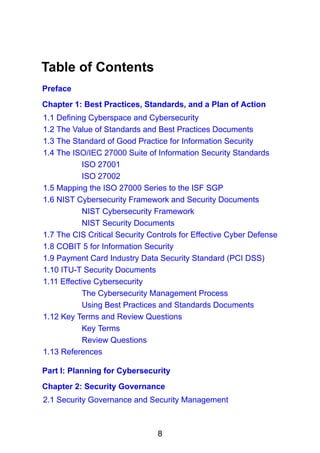
Table of Contents
Preface
Chapter1: Best Practices, Standards, and a Plan of Action
1.1 Defining Cyberspace and Cybersecurity
1.2 The Value of Standards and Best Practices Documents
1.3 The Standard of Good Practice for Information Security
1.4 The ISO/IEC 27000 Suite of Information Security Standards
ISO 27001
ISO 27002
1.5 Mapping the ISO 27000 Series to the ISF SGP
1.6 NIST Cybersecurity Framework and Security Documents
NIST Cybersecurity Framework
NIST Security Documents
1.7 The CIS Critical Security Controls for Effective Cyber Defense
1.8 COBIT 5 for Information Security
1.9 Payment Card Industry Data Security Standard (PCI DSS)
1.10 ITU-T Security Documents
1.11 Effective Cybersecurity
The Cybersecurity Management Process
Using Best Practices and Standards Documents
1.12 Key Terms and Review Questions
Key Terms
Review Questions
1.13 References
Part I: Planning for Cybersecurity
Chapter 2: Security Governance
2.1 Security Governance and Security Management
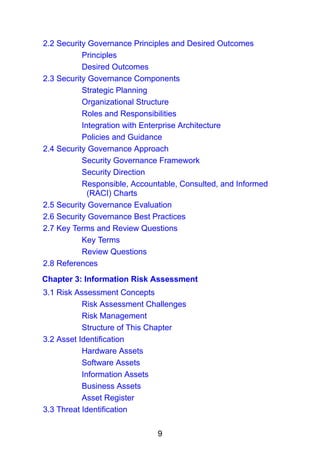
8.
9
2.2 Security GovernancePrinciples and Desired Outcomes
Principles
Desired Outcomes
2.3 Security Governance Components
Strategic Planning
Organizational Structure
Roles and Responsibilities
Integration with Enterprise Architecture
Policies and Guidance
2.4 Security Governance Approach
Security Governance Framework
Security Direction
Responsible, Accountable, Consulted, and Informed
(RACI) Charts
2.5 Security Governance Evaluation
2.6 Security Governance Best Practices
2.7 Key Terms and Review Questions
Key Terms
Review Questions
2.8 References
Chapter 3: Information Risk Assessment
3.1 Risk Assessment Concepts
Risk Assessment Challenges
Risk Management
Structure of This Chapter
3.2 Asset Identification
Hardware Assets
Software Assets
Information Assets
Business Assets
Asset Register
3.3 Threat Identification
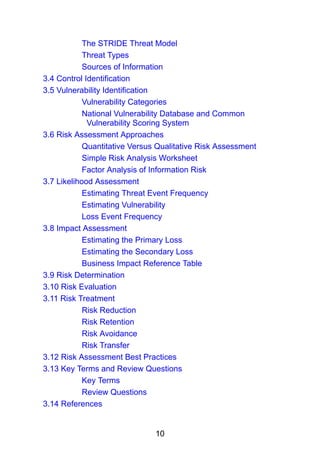
9.
10
The STRIDE ThreatModel
Threat Types
Sources of Information
3.4 Control Identification
3.5 Vulnerability Identification
Vulnerability Categories
National Vulnerability Database and Common
Vulnerability Scoring System
3.6 Risk Assessment Approaches
Quantitative Versus Qualitative Risk Assessment
Simple Risk Analysis Worksheet
Factor Analysis of Information Risk
3.7 Likelihood Assessment
Estimating Threat Event Frequency
Estimating Vulnerability
Loss Event Frequency
3.8 Impact Assessment
Estimating the Primary Loss
Estimating the Secondary Loss
Business Impact Reference Table
3.9 Risk Determination
3.10 Risk Evaluation
3.11 Risk Treatment
Risk Reduction
Risk Retention
Risk Avoidance
Risk Transfer
3.12 Risk Assessment Best Practices
3.13 Key Terms and Review Questions
Key Terms
Review Questions
3.14 References
10.
11
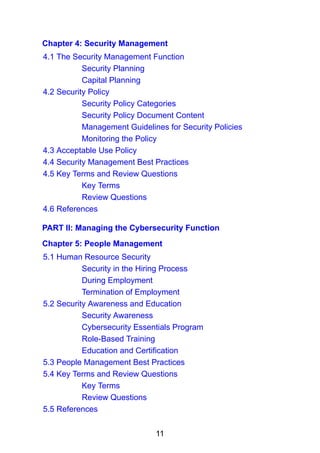
Chapter 4: SecurityManagement
4.1 The Security Management Function
Security Planning
Capital Planning
4.2 Security Policy
Security Policy Categories
Security Policy Document Content
Management Guidelines for Security Policies
Monitoring the Policy
4.3 Acceptable Use Policy
4.4 Security Management Best Practices
4.5 Key Terms and Review Questions
Key Terms
Review Questions
4.6 References
PART II: Managing the Cybersecurity Function
Chapter 5: People Management
5.1 Human Resource Security
Security in the Hiring Process
During Employment
Termination of Employment
5.2 Security Awareness and Education
Security Awareness
Cybersecurity Essentials Program
Role-Based Training
Education and Certification
5.3 People Management Best Practices
5.4 Key Terms and Review Questions
Key Terms
Review Questions
5.5 References
11.
12
Chapter 6: InformationManagement
6.1 Information Classification and Handling
Information Classification
Information Labeling
Information Handling
6.2 Privacy
Privacy Threats
Privacy Principles and Policies
Privacy Controls
6.3 Document and Records Management
Document Management
Records Management
6.4 Sensitive Physical Information
6.5 Information Management Best Practices
6.6 Key Terms and Review Questions
Key Terms
Review Questions
6.7 References
Chapter 7: Physical Asset Management
7.1 Hardware Life Cycle Management
Planning
Acquisition
Deployment
Management
Disposition
7.2 Office Equipment
Threats and Vulnerabilities
Security Controls
Equipment Disposal
7.3 Industrial Control Systems
12.
13
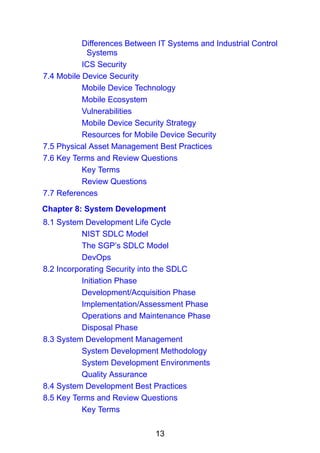
Differences Between ITSystems and Industrial Control
Systems
ICS Security
7.4 Mobile Device Security
Mobile Device Technology
Mobile Ecosystem
Vulnerabilities
Mobile Device Security Strategy
Resources for Mobile Device Security
7.5 Physical Asset Management Best Practices
7.6 Key Terms and Review Questions
Key Terms
Review Questions
7.7 References
Chapter 8: System Development
8.1 System Development Life Cycle
NIST SDLC Model
The SGP’s SDLC Model
DevOps
8.2 Incorporating Security into the SDLC
Initiation Phase
Development/Acquisition Phase
Implementation/Assessment Phase
Operations and Maintenance Phase
Disposal Phase
8.3 System Development Management
System Development Methodology
System Development Environments
Quality Assurance
8.4 System Development Best Practices
8.5 Key Terms and Review Questions
Key Terms
13.
14
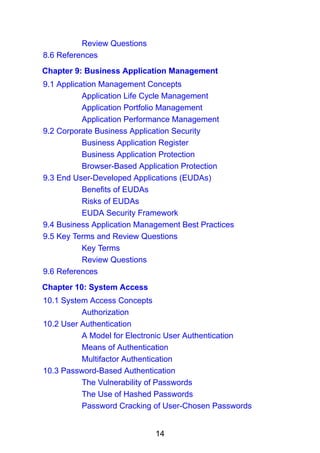
Review Questions
8.6 References
Chapter9: Business Application Management
9.1 Application Management Concepts
Application Life Cycle Management
Application Portfolio Management
Application Performance Management
9.2 Corporate Business Application Security
Business Application Register
Business Application Protection
Browser-Based Application Protection
9.3 End User-Developed Applications (EUDAs)
Benefits of EUDAs
Risks of EUDAs
EUDA Security Framework
9.4 Business Application Management Best Practices
9.5 Key Terms and Review Questions
Key Terms
Review Questions
9.6 References
Chapter 10: System Access
10.1 System Access Concepts
Authorization
10.2 User Authentication
A Model for Electronic User Authentication
Means of Authentication
Multifactor Authentication
10.3 Password-Based Authentication
The Vulnerability of Passwords
The Use of Hashed Passwords
Password Cracking of User-Chosen Passwords
14.
15
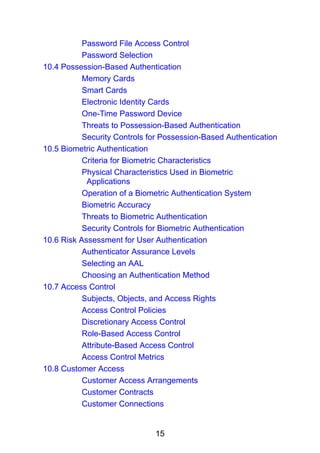
Password File AccessControl
Password Selection
10.4 Possession-Based Authentication
Memory Cards
Smart Cards
Electronic Identity Cards
One-Time Password Device
Threats to Possession-Based Authentication
Security Controls for Possession-Based Authentication
10.5 Biometric Authentication
Criteria for Biometric Characteristics
Physical Characteristics Used in Biometric
Applications
Operation of a Biometric Authentication System
Biometric Accuracy
Threats to Biometric Authentication
Security Controls for Biometric Authentication
10.6 Risk Assessment for User Authentication
Authenticator Assurance Levels
Selecting an AAL
Choosing an Authentication Method
10.7 Access Control
Subjects, Objects, and Access Rights
Access Control Policies
Discretionary Access Control
Role-Based Access Control
Attribute-Based Access Control
Access Control Metrics
10.8 Customer Access
Customer Access Arrangements
Customer Contracts
Customer Connections
15.
16
Protecting Customer Data
10.9System Access Best Practices
10.10 Key Terms and Review Questions
Key Terms
Review Questions
10.11 References
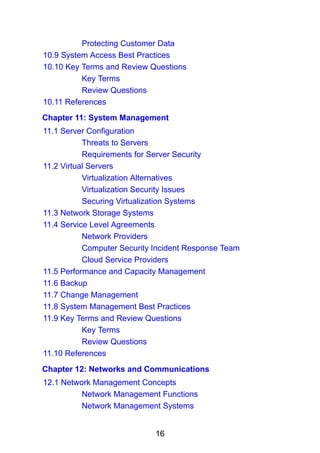
Chapter 11: System Management
11.1 Server Configuration
Threats to Servers
Requirements for Server Security
11.2 Virtual Servers
Virtualization Alternatives
Virtualization Security Issues
Securing Virtualization Systems
11.3 Network Storage Systems
11.4 Service Level Agreements
Network Providers
Computer Security Incident Response Team
Cloud Service Providers
11.5 Performance and Capacity Management
11.6 Backup
11.7 Change Management
11.8 System Management Best Practices
11.9 Key Terms and Review Questions
Key Terms
Review Questions
11.10 References
Chapter 12: Networks and Communications
12.1 Network Management Concepts
Network Management Functions
Network Management Systems
16.
17
Network Management Architecture
12.2Firewalls
Firewall Characteristics
Types of Firewalls
Next-Generation Firewalls
DMZ Networks
The Modern IT Perimeter
12.3 Virtual Private Networks and IP Security
Virtual Private Networks
IPsec
Firewall-Based VPNs
12.4 Security Considerations for Network Management
Network Device Configuration
Physical Network Management
Wireless Access
External Network Connections
Firewalls
Remote Maintenance
12.5 Electronic Communications
Email
Instant Messaging
Voice over IP (VoIP) Networks
Telephony and Conferencing
12.6 Networks and Communications Best Practices
12.7 Key Terms and Review Questions
Key Terms
Review Questions
12.8 References
Chapter 13: Supply Chain Management and Cloud Security
13.1 Supply Chain Management Concepts
The Supply Chain
17.
18
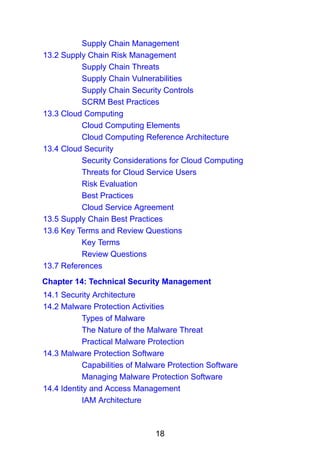
Supply Chain Management
13.2Supply Chain Risk Management
Supply Chain Threats
Supply Chain Vulnerabilities
Supply Chain Security Controls
SCRM Best Practices
13.3 Cloud Computing
Cloud Computing Elements
Cloud Computing Reference Architecture
13.4 Cloud Security
Security Considerations for Cloud Computing
Threats for Cloud Service Users
Risk Evaluation
Best Practices
Cloud Service Agreement
13.5 Supply Chain Best Practices
13.6 Key Terms and Review Questions
Key Terms
Review Questions
13.7 References
Chapter 14: Technical Security Management
14.1 Security Architecture
14.2 Malware Protection Activities
Types of Malware
The Nature of the Malware Threat
Practical Malware Protection
14.3 Malware Protection Software
Capabilities of Malware Protection Software
Managing Malware Protection Software
14.4 Identity and Access Management
IAM Architecture
18.
19
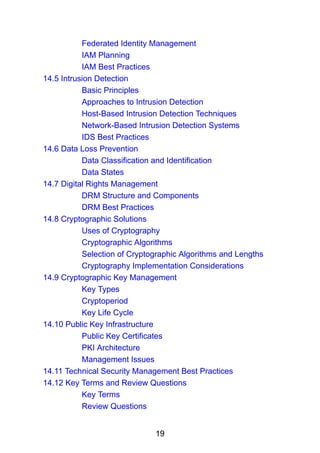
Federated Identity Management
IAMPlanning
IAM Best Practices
14.5 Intrusion Detection
Basic Principles
Approaches to Intrusion Detection
Host-Based Intrusion Detection Techniques
Network-Based Intrusion Detection Systems
IDS Best Practices
14.6 Data Loss Prevention
Data Classification and Identification
Data States
14.7 Digital Rights Management
DRM Structure and Components
DRM Best Practices
14.8 Cryptographic Solutions
Uses of Cryptography
Cryptographic Algorithms
Selection of Cryptographic Algorithms and Lengths
Cryptography Implementation Considerations
14.9 Cryptographic Key Management
Key Types
Cryptoperiod
Key Life Cycle
14.10 Public Key Infrastructure
Public Key Certificates
PKI Architecture
Management Issues
14.11 Technical Security Management Best Practices
14.12 Key Terms and Review Questions
Key Terms
Review Questions
19.
20
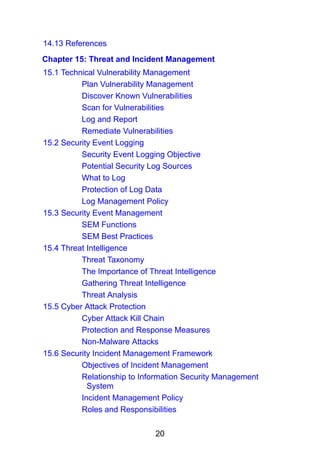
14.13 References
Chapter 15:Threat and Incident Management
15.1 Technical Vulnerability Management
Plan Vulnerability Management
Discover Known Vulnerabilities
Scan for Vulnerabilities
Log and Report
Remediate Vulnerabilities
15.2 Security Event Logging
Security Event Logging Objective
Potential Security Log Sources
What to Log
Protection of Log Data
Log Management Policy
15.3 Security Event Management
SEM Functions
SEM Best Practices
15.4 Threat Intelligence
Threat Taxonomy
The Importance of Threat Intelligence
Gathering Threat Intelligence
Threat Analysis
15.5 Cyber Attack Protection
Cyber Attack Kill Chain
Protection and Response Measures
Non-Malware Attacks
15.6 Security Incident Management Framework
Objectives of Incident Management
Relationship to Information Security Management
System
Incident Management Policy
Roles and Responsibilities
20.
21
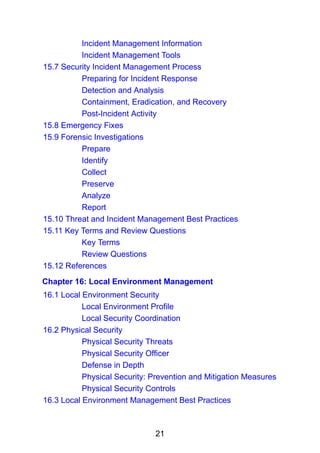
Incident Management Information
IncidentManagement Tools
15.7 Security Incident Management Process
Preparing for Incident Response
Detection and Analysis
Containment, Eradication, and Recovery
Post-Incident Activity
15.8 Emergency Fixes
15.9 Forensic Investigations
Prepare
Identify
Collect
Preserve
Analyze
Report
15.10 Threat and Incident Management Best Practices
15.11 Key Terms and Review Questions
Key Terms
Review Questions
15.12 References
Chapter 16: Local Environment Management
16.1 Local Environment Security
Local Environment Profile
Local Security Coordination
16.2 Physical Security
Physical Security Threats
Physical Security Officer
Defense in Depth
Physical Security: Prevention and Mitigation Measures
Physical Security Controls
16.3 Local Environment Management Best Practices
21.
22
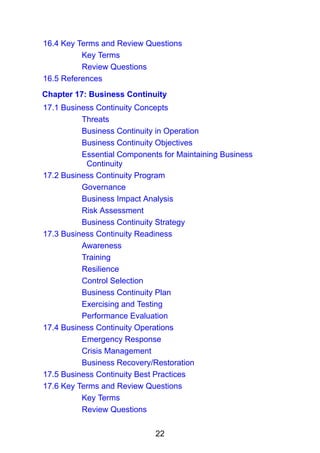
16.4 Key Termsand Review Questions
Key Terms
Review Questions
16.5 References
Chapter 17: Business Continuity
17.1 Business Continuity Concepts
Threats
Business Continuity in Operation
Business Continuity Objectives
Essential Components for Maintaining Business
Continuity
17.2 Business Continuity Program
Governance
Business Impact Analysis
Risk Assessment
Business Continuity Strategy
17.3 Business Continuity Readiness
Awareness
Training
Resilience
Control Selection
Business Continuity Plan
Exercising and Testing
Performance Evaluation
17.4 Business Continuity Operations
Emergency Response
Crisis Management
Business Recovery/Restoration
17.5 Business Continuity Best Practices
17.6 Key Terms and Review Questions
Key Terms
Review Questions
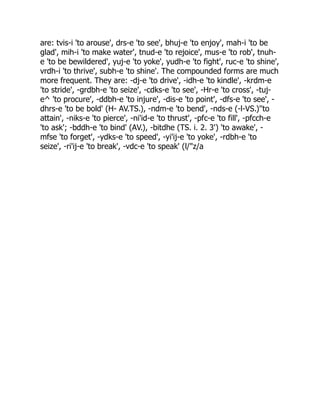
Vn. Verb. Infinitive.409 0. One infinitive is also formed
from a reduplicated root: Hmdth-e (in. 31^3) 'to attack'; but
according to Grassmann' it is the locative of a substantive meaning
'attack'. 585. The remaining dative infinitives are formed from verbal
nouns derived with nine different suffixes. 1. Some 25 of these are
datives of stems in -as^. They are the following: ayas-e (i. 5 7 3) 'to
go', arhds-e 'to be worthy of, rcds-e 'to praise', rnjds-e 'to strive
after', ksddas-e^ 'to partake of, cdksas-e 'to see', cards-e 'to fare',
javds-e'- (iii. 50^) 'to speed', jivds-e 'to live', tujds-e 'to hurl', dohds-
e 'to milk', dh&yas-e 'to cherish', dhruvds-e 'to sit firmly', pusyds-e
'to thrive', bhdras-e^ 'to bear', bhiyds-e 'to fear', bhojds-e 'to enjoy',
rajds-e 'to shine', vrnjds-e 'to turn aside', vrdhds-e 'to further',
sobhds-e 'to shine', sriyds-e 'to be resplendent', sdhyas-e^ 'to
conquer', spdras-e 'to help to', spurdhds-e 'to strive after', hards-e
'to seize'. a. Three roots form an infinitive stem with -S only instead
of -as: ji-s-i 'to conquer', upa-prak-s-i^ (v. 476) 'to unite', stu-s-i 'to
praise' '. 2. Some half dozen are formed firom stems in -/': is-dy-e^
(vi. 52''S) 'to refresh', tuj-dy-e (v. 46^) 'to breed', drs-dy-e 'to see',
mah-dy-e 'to rejoice', yudh-dy-e 'to fight', san-dy-e 'to win'; cit-dy-
e^ (VS.) 'to understand'. 3. Four or five are formed from stems in -
ti: is-tdy-e 'to refresh', pi-tdy-e 'to drink', vT-tdy-e 'to enjoy', sa-tdy-e
'to win'; perhaps also u-tdy-e (nfn) 'to help (his men)'. 4. Over 30
dative infinitives are formed from stems in -tu (added to the gunated
root, in some instances with connecting vowel), from which ace. and
abl. gen. infinitives are also formed: o. dt-tav-e 'to eat', ds-tav-e 'to
attain', ds-tav-e (VS.; TS. iv. 5. i^) 'to shoot', e-tav-e 'to go', 6-tav-e
'to weave' {fva-), kdr-tav-e 'to make', gdn-tav-e and gd-tav-e 'to
go', da-tav-e 'to give', prdti-dha-tav-e 'to place upon', dhd-tav-e 'to
suck', pdk-tave (AV.) 'to cook', pdt-tav-e 'to fall', pd-tav-e 'to drink',
bhdrtav-e 'to bear away', mdn-tav-e 'to think', ydn-tav-e 'to present',
yds-tav-e 'to sacrifice', ys-tav-e 'to go', yo-tav-e 'to ward off'', vdk-
tav-e 'to speak', prd-vantav-e 'to win' (y^z/aw-), vdr-tav-e 'to
restrain', vds-tav-e 'to shine', vd-tav-e (AV.) 'to weave', v^t-tav-e
(AV.) 'to find', v6-lhav-e 'to convey', pdri-iak-tav-e 'to overcome', sdr-
tav-e 'to flow', sU-iav-e 'to bring forth', se-tav-e (AV.) 'to bind',
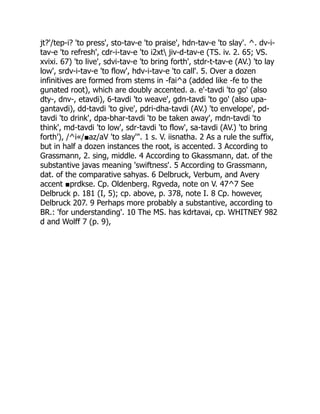
25.
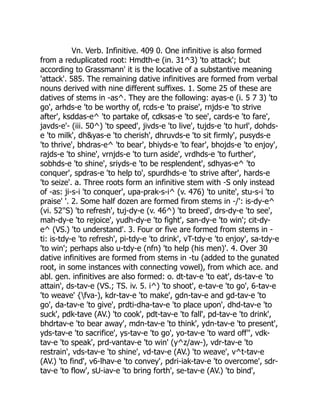
jt?'/tep-i? 'to press',sto-tav-e 'to praise', hdn-tav-e 'to slay'. ^. dv-i-
tav-e 'to refresh', cdr-i-tav-e 'to i2xt jiv-d-tav-e (TS. iv. 2. 65; VS.
xvixi. 67) 'to live', sdvi-tav-e 'to bring forth', stdr-t-tav-e (AV.) 'to lay
low', srdv-i-tav-e 'to flow', hdv-i-tav-e 'to call'. 5. Over a dozen
infinitives are formed from stems in -fai^a (added like -fe to the
gunated root), which are doubly accented. a. e'-tavdi 'to go' (also
dty-, dnv-, etavdi), 6-tavdi 'to weave', gdn-tavdi 'to go' (also upa-
gantavdi), dd-tavdi 'to give', pdri-dha-tavdi (AV.) 'to envelope', pd-
tavdi 'to drink', dpa-bhar-tavdi 'to be taken away', mdn-tavdi 'to
think', md-tavdi 'to low', sdr-tavdi 'to flow', sa-tavdi (AV.) 'to bring
forth'), /^i«/■az/aV 'to slay'". 1 s. V. iisnatha. 2 As a rule the suffix,
but in half a dozen instances the root, is accented. 3 According to
Grassmann, 2. sing, middle. 4 According to Gkassmann, dat. of the
substantive javas meaning 'swiftness'. 5 According to Grassmann,
dat. of the comparative sahyas. 6 Delbruck, Verbum, and Avery
accent ■prdkse. Cp. Oldenberg. Rgveda, note on V. 47^7 See
Delbruck p. 181 (I, 5); cp. above, p. 378, note I. 8 Cp. however,
Delbruck 207. 9 Perhaps more probably a substantive, according to
BR.: 'for understanding'. 10 The MS. has kdrtavai, cp. WHITNEY 982
d and Wolff 7 (p. 9),
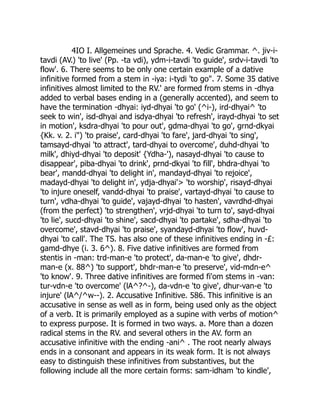
26.
4IO I. Allgemeinesund Sprache. 4. Vedic Grammar. ^. jiv-i-
tavdi (AV.) 'to live' (Pp. -ta vdi), ydm-i-tavdi 'to guide', srdv-i-tavdi 'to
flow'. 6. There seems to be only one certain example of a dative
infinitive formed from a stem in -iya: i-tydi 'to go". 7. Some 35 dative
infinitives almost limited to the RV.' are formed from stems in -dhya
added to verbal bases ending in a (generally accented), and seem to
have the termination -dhyai: iyd-dhyai 'to go' (^i-), ird-dhyai^ 'to
seek to win', isd-dhyai and isdya-dhyai 'to refresh', irayd-dhyai 'to set
in motion', ksdra-dhyai 'to pour out', gdma-dhyai 'to go', grnd-dkyai
{Kk. v. 2. i") 'to praise', card-dhyai 'to fare', jard-dhyai 'to sing',
tamsayd-dhyai 'to attract', tard-dhyai to overcome', duhd-dhyai 'to
milk', dhiyd-dhyai 'to deposit' {Ydha-'), nasayd-dhyai 'to cause to
disappear', piba-dhyai 'to drink', prnd-dkyai 'to fill', bhdra-dhyai 'to
bear', mandd-dhyai 'to delight in', mandayd-dhyai 'to rejoice',
madayd-dhyai 'to delight in', ydja-dhyai'> 'to worship', risayd-dhyai
'to injure oneself, vandd-dhyai 'to praise', vartayd-dhyai 'to cause to
turn', vdha-dhyai 'to guide', vajayd-dhyai 'to hasten', vavrdhd-dhyai
(from the perfect) 'to strengthen', vrjd-dhyai 'to turn to', sayd-dhyai
'to lie', sucd-dhyai 'to shine', sacd-dhyai 'to partake', sdha-dhyai 'to
overcome', stavd-dhyai 'to praise', syandayd-dhyai 'to flow', huvd-
dhyai 'to call'. The TS. has also one of these infinitives ending in -£:
gamd-dhye (i. 3. 6^). 8. Five dative infinitives are formed from
stentis in -man: trd-man-e 'to protect', da-man-e 'to give', dhdr-
man-e (x. 88^) 'to support', bhdr-man-e 'to preserve', vid-mdn-e^
'to know'. 9. Three dative infinitives are formed fi'om stems in -van:
tur-vdn-e 'to overcome' (lA^?^-), da-vdn-e 'to give', dhur-van-e 'to
injure' (lA^/^w--). 2. Accusative Infinitive. 586. This infinitive is an
accusative in sense as well as in form, being used only as the object
of a verb. It is primarily employed as a supine with verbs of motion^
to express purpose. It is formed in two ways. a. More than a dozen
radical stems in the RV. and several others in the AV. form an
accusative infinitive with the ending -ani^ . The root nearly always
ends in a consonant and appears in its weak form. It is not always
easy to distinguish these infinitives from substantives, but the
following include all the more certain forms: sam-idham 'to kindle',
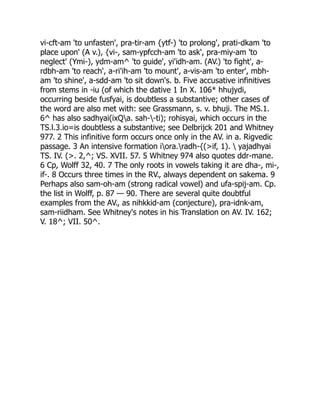
27.
vi-cft-am 'to unfasten',pra-tir-am {ytf-) 'to prolong', prati-dkam 'to
place upon' (A v.), {vi-, sam-ypfcch-am 'to ask', pra-miy-am 'to
neglect' (Ymi-), ydm-am^ 'to guide', yi'idh-am. (AV.) 'to fight', a-
rdbh-am 'to reach', a-ri'ih-am 'to mount', a-vis-am 'to enter', mbh-
am 'to shine', a-sdd-am 'to sit down's. b. Five accusative infinitives
from stems in -iu (of which the dative 1 In X. 106* hhujydi,
occurring beside fusfyai, is doubtless a substantive; other cases of
the word are also met with: see Grassmann, s. v. bhuji. The MS.1.
6^ has also sadhyai(ixQa. sah--ti); rohisyai, which occurs in the
TS.l.3.io=is doubtless a substantive; see Delbrijck 201 and Whitney
977. 2 This infinitive form occurs once only in the AV. in a. Rigvedic
passage. 3 An intensive formation iora.radh-{(>if, 1). yajadhyai
TS. IV. (>. 2,^; VS. XVII. 57. 5 Whitney 974 also quotes ddr-mane.
6 Cp, Wolff 32, 40. 7 The only roots in vowels taking it are dha-, mi-,
if-. 8 Occurs three times in the RV., always dependent on sakema. 9
Perhaps also sam-oh-am (strong radical vowel) and ufa-spij-am. Cp.
the list in Wolff, p. 87 — 90. There are several quite doubtful
examples from the AV., as nihkkid-am (conjecture), pra-idnk-am,
sam-riidham. See Whitney's notes in his Translation on AV. IV. 162;
V. 18^; VII. 50^.
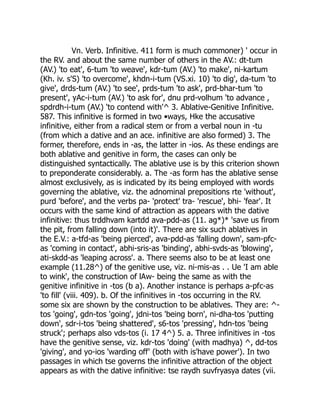
28.
Vn. Verb. Infinitive.411 form is much commoner) ' occur in
the RV. and about the same number of others in the AV.: dt-tum
(AV.) 'to eat', 6-tum 'to weave', kdr-tum (AV.) 'to make', ni-kartum
(Kh. iv. s'S) 'to overcome', khdn-i-tum (VS.xi. 10) 'to dig', da-tum 'to
give', drds-tum (AV.) 'to see', prds-tum 'to ask', prd-bhar-tum 'to
present', yAc-i-tum (AV.) 'to ask for', dnu prd-volhum 'to advance ,
spdrdh-i-tum (AV.) 'to contend with'^ 3. Ablative-Genitive Infinitive.
587. This infinitive is formed in two •ways, Hke the accusative
infinitive, either from a radical stem or from a verbal noun in -tu
(from which a dative and an ace. infinitive are also formed) 3. The
former, therefore, ends in -as, the latter in -ios. As these endings are
both ablative and genitive in form, the cases can only be
distinguished syntactically. The ablative use is by this criterion shown
to preponderate considerably. a. The -as form has the ablative sense
almost exclusively, as is indicated by its being employed with words
governing the ablative, viz. the adnominal prepositions rte 'without',
purd 'before', and the verbs pa- 'protect' tra- 'rescue', bhi- 'fear'. It
occurs with the same kind of attraction as appears with the dative
infinitive: thus trddhvam kartdd ava-pdd-as (11. ag*)* 'save us firom
the pit, from falling down (into it)'. There are six such ablatives in
the E.V.: a-tfd-as 'being pierced', ava-pdd-as 'falling down', sam-pfc-
as 'coming in contact', abhi-sris-as 'binding', abhi-svds-as 'blowing',
ati-skdd-as 'leaping across'. a. There seems also to be at least one
example (11.28^) of the genitive use, viz. ni-mis-as . . Ue 'I am able
to wink', the construction of lAw- being the same as with the
genitive infinitive in -tos (b a). Another instance is perhaps a-pfc-as
'to fill' (viii. 409). b. Of the infinitives in -tos occurring in the RV.
some six are shown by the construction to be ablatives. They are: ^-
tos 'going', gdn-tos 'going', jdni-tos 'being born', ni-dha-tos 'putting
down', sdr-i-tos 'being shattered', s6-tos 'pressing', hdn-tos 'being
struck'; perhaps also vds-tos (i. 17 4^) 5. a. Three infinitives in -tos
have the genitive sense, viz. kdr-tos 'doing' (with madhya) ^, dd-tos
'giving', and yo-ios 'warding off' (both with is'have power'). In two
passages in which tse governs the infinitive attraction of the object
appears as with the dative infinitive: tse raydh suvfryasya dates (vii.
29.
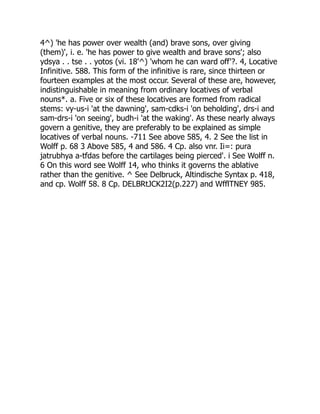
4^) 'he haspower over wealth (and) brave sons, over giving
(them)', i. e. 'he has power to give wealth and brave sons'; also
ydsya . . tse . . yotos (vi. 18'^) 'whom he can ward off'?. 4, Locative
Infinitive. 588. This form of the infinitive is rare, since thirteen or
fourteen examples at the most occur. Several of these are, however,
indistinguishable in meaning from ordinary locatives of verbal
nouns*. a. Five or six of these locatives are formed from radical
stems: vy-us-i 'at the dawning', sam-cdks-i 'on beholding', drs-i and
sam-drs-i 'on seeing', budh-i 'at the waking'. As these nearly always
govern a genitive, they are preferably to be explained as simple
locatives of verbal nouns. -711 See above 585, 4. 2 See the list in
Wolff p. 68 3 Above 585, 4 and 586. 4 Cp. also vnr. Ii=: pura
jatrubhya a-tfdas before the cartilages being pierced'. i See Wolff n.
6 On this word see Wolff 14, who thinks it governs the ablative
rather than the genitive. ^ See Delbruck, Altindische Syntax p. 418,
and cp. Wolff 58. 8 Cp. DELBRtJCK2I2(p.227) and WfflTNEY 985.
30.
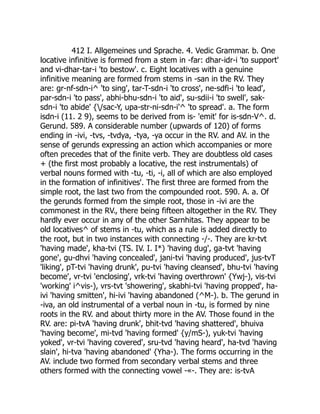
412 I. Allgemeinesund Sprache. 4. Vedic Grammar. b. One
locative infinitive is formed from a stem in -far: dhar-idr-i 'to support'
and vi-dhar-tar-i 'to bestow'. c. Eight locatives with a genuine
infinitive meaning are formed from stems in -san in the RV. They
are: gr-nf-sdn-i^ 'to sing', tar-T-sdn-i 'to cross', ne-sdfi-i 'to lead',
par-sdn-i 'to pass', abhi-bhu-sdn-i 'to aid', su-sdii-i 'to swell', sak-
sdn-i 'to abide' {/sac-Y, upa-str-ni-sdn-i'^ 'to spread'. a. The form
isdn-i (11. 2 9), seems to be derived from is- 'emit' for is-sdn-V^. d.
Gerund. 589. A considerable number (upwards of 120) of forms
ending in -ivi, -tvs, -tvdya, -tya, -ya occur in the RV. and AV. in the
sense of gerunds expressing an action which accompanies or more
often precedes that of the finite verb. They are doubtless old cases
+ (the first most probably a locative, the rest instrumentals) of
verbal nouns formed with -tu, -ti, -i, all of which are also employed
in the formation of infinitives'. The first three are formed from the
simple root, the last two from the compounded root. 590. A. a. Of
the gerunds formed from the simple root, those in -ivi are the
commonest in the RV., there being fifteen altogether in the RV. They
hardly ever occur in any of the other Sarnhitas. They appear to be
old locatives^ of stems in -tu, which as a rule is added directly to
the root, but in two instances with connecting -/-. They are kr-tvt
'having made', kha-tvi (TS. IV. I. I*) 'having dug', ga-tvt 'having
gone', gu-dhvi 'having concealed', jani-tvi 'having produced', jus-tvT
'liking', pT-tvi 'having drunk', pu-tvi 'having cleansed', bhu-tvi 'having
become', vr-tvi 'enclosing', vrk-tvi 'having overthrown' {Ywj-), vis-tvi
'working' i^vis-), vrs-tvt 'showering', skabhi-tvi 'having propped', ha-
ivi 'having smitten', hi-ivi 'having abandoned (^M-). b. The gerund in
-iva, an old instrumental of a verbal noun in -tu, is formed by nine
roots in the RV. and about thirty more in the AV. Those found in the
RV. are: pi-tvA 'having drunk', bhit-tvd 'having shattered', bhuiva
'having become', mi-tvd 'having formed' {y/mS-), yuk-tvi 'having
yoked', vr-tvi 'having covered', sru-tvd 'having heard', ha-tvd 'having
slain', hi-tva 'having abandoned' {Yha-). The forms occurring in the
AV. include two formed from secondary verbal stems and three
others formed with the connecting vowel -«-. They are: is-tvA
31.
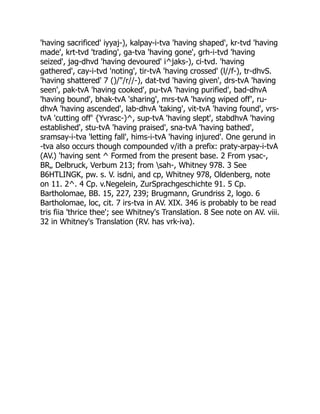
'having sacrificed' iyyaj-),kalpay-i-tva 'having shaped', kr-tvd 'having
made', krt-tvd 'trading', ga-tva 'having gone', grh-i-tvd 'having
seized', jag-dhvd 'having devoured' i^jaks-), ci-tvd. 'having
gathered', cay-i-tvd 'noting', tir-tvA 'having crossed' (l//f-), tr-dhvS.
'having shattered' 7 ()/"/r//-), dat-tvd 'having given', drs-tvA 'having
seen', pak-tvA 'having cooked', pu-tvA 'having purified', bad-dhvA
'having bound', bhak-tvA 'sharing', mrs-tvA 'having wiped off', ru-
dhvA 'having ascended', lab-dhvA 'taking', vit-tvA 'having found', vrs-
tvA 'cutting off' {Yvrasc-)^, sup-tvA 'having slept', stabdhvA 'having
established', stu-tvA 'having praised', sna-tvA 'having bathed',
sramsay-i-tva 'letting fall', hims-i-tvA 'having injured'. One gerund in
-tva also occurs though compounded v/ith a prefix: praty-arpay-i-tvA
(AV.) 'having sent ^ Formed from the present base. 2 From ysac-,
BR„ Delbruck, Verbum 213; from sah-, Whitney 978. 3 See
B6HTLINGK, pw. s. V. isdni, and cp, Whitney 978, Oldenberg, note
on 11. 2^. 4 Cp. v.Negelein, ZurSprachgeschichte 91. 5 Cp.
Bartholomae, BB. 15, 227, 239; Brugmann, Grundriss 2, logo. 6
Bartholomae, loc, cit. 7 irs-tva in AV. XIX. 346 is probably to be read
tris fiia 'thrice thee'; see Whitney's Translation. 8 See note on AV. viii.
32 in Whitney's Translation (RV. has vrk-iva).
32.
Vn. Verb. Gerunds.413 in opposition'. From the KMas :
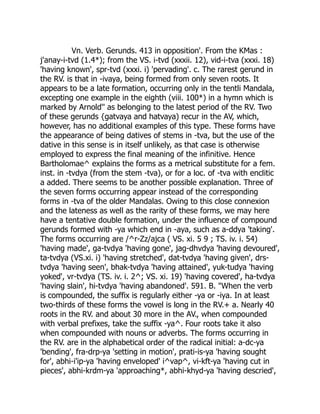
j'anay-i-tvd (1.4*); from the VS. i-tvd (xxxii. 12), vid-i-tva (xxxi. 18)
'having known', spr-tvd (xxxi. i) 'pervading'. c. The rarest gerund in
the RV. is that in -ivaya, being formed from only seven roots. It
appears to be a late formation, occurring only in the tentli Mandala,
excepting one example in the eighth (viii. 100*) in a hymn which is
marked by Arnold'' as belonging to the latest period of the RV. Two
of these gerunds {gatvaya and hatvaya) recur in the AV, which,
however, has no additional examples of this type. These forms have
the appearance of being datives of stems in -tva, but the use of the
dative in this sense is in itself unlikely, as that case is otherwise
employed to express the final meaning of the infinitive. Hence
Bartholomae^ explains the forms as a metrical substitute for a fem.
inst. in -tvdya (from the stem -tva), or for a loc. of -tva with enclitic
a added. There seems to be another possible explanation. Three of
the seven forms occurring appear instead of the corresponding
forms in -tva of the older Mandalas. Owing to this close connexion
and the lateness as well as the rarity of these forms, we may here
have a tentative double formation, under the influence of compound
gerunds formed with -ya which end in -aya, such as a-ddya 'taking'.
The forms occurring are /^r-Zz/ajca ( VS. xi. 5 9 ; TS. iv. i. 54)
'having made', ga-tvdya 'having gone', jag-dhvdya 'having devoured',
ta-tvdya (VS.xi. i) 'having stretched', dat-tvdya 'having given', drs-
tvdya 'having seen', bhak-tvdya 'having attained', yuk-tudya 'having
yoked', vr-tvdya (TS. iv. i. 2^; VS. xi. 19) 'having covered', ha-tvdya
'having slain', hi-tvdya 'having abandoned'. 591. B. "When the verb
is compounded, the suffix is regularly either -ya or -iya. In at least
two-thirds of these forms the vowel is long in the RV.+ a. Nearly 40
roots in the RV. and about 30 more in the AV., when compounded
with verbal prefixes, take the suffix -ya^. Four roots take it also
when compounded with nouns or adverbs. The forms occurring in
the RV. are in the alphabetical order of the radical initial: a-dc-ya
'bending', fra-drp-ya 'setting in motion', prati-is-ya 'having sought
for', abhi-i'ip-ya 'having enveloped' i^vap^, vi-kft-ya 'having cut in
pieces', abhi-krdm-ya 'approaching*, abhi-khyd-ya 'having descried',
33.
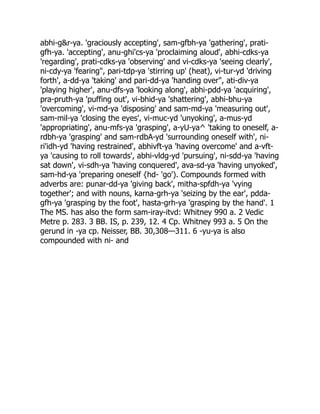
abhi-g&r-ya. 'graciously accepting',sam-gfbh-ya 'gathering', prati-
gfh-ya. 'accepting', anu-ghi'cs-ya 'proclaiming aloud', abhi-cdks-ya
'regarding', prati-cdks-ya 'observing' and vi-cdks-ya 'seeing clearly',
ni-cdy-ya 'fearing", pari-tdp-ya 'stirring up' (heat), vi-tur-yd 'driving
forth', a-dd-ya 'taking' and pari-dd-ya 'handing over", ati-div-ya
'playing higher', anu-dfs-ya 'looking along', abhi-pdd-ya 'acquiring',
pra-pruth-ya 'puffing out', vi-bhid-ya 'shattering', abhi-bhu-ya
'overcoming', vi-md-ya 'disposing' and sam-md-ya 'measuring out',
sam-mil-ya 'closing the eyes', vi-muc-yd 'unyoking', a-mus-yd
'appropriating', anu-mfs-ya 'grasping', a-yU-ya^ 'taking to oneself, a-
rdbh-ya 'grasping' and sam-rdbA-yd 'surrounding oneself with', ni-
ri'idh-yd 'having restrained', abhivft-ya 'having overcome' and a-vft-
ya 'causing to roll towards', abhi-vldg-yd 'pursuing', ni-sdd-ya 'having
sat down', vi-sdh-ya 'having conquered', ava-sd-ya 'having unyoked',
sam-hd-ya 'preparing oneself {hd- 'go'). Compounds formed with
adverbs are: punar-dd-ya 'giving back', mitha-spfdh-ya 'vying
together'; and with nouns, karna-grh-ya 'seizing by the ear', pdda-
gfh-ya 'grasping by the foot', hasta-grh-ya 'grasping by the hand'. 1
The MS. has also the form sam-iray-itvd: Whitney 990 a. 2 Vedic
Metre p. 283. 3 BB. IS, p. 239, 12. 4 Cp. Whitney 993 a. 5 On the
gerund in -ya cp. Neisser, BB. 30,308—311. 6 -yu-ya is also
compounded with ni- and
34.
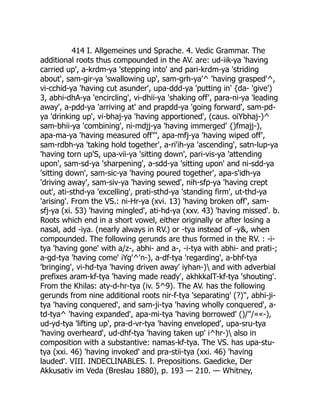
414 I. Allgemeinesund Sprache. 4. Vedic Grammar. The
additional roots thus compounded in the AV. are: ud-iik-ya 'having
carried up', a-krdm-ya 'stepping into' and pari-krdm-ya 'striding
about', sam-gir-ya 'swallowing up', sam-grh-ya'^ 'having grasped'^,
vi-cchid-ya 'having cut asunder', upa-ddd-ya 'putting in' {da- 'give')
3, abhi-dhA-ya 'encircling', vi-dhii-ya 'shaking off', para-ni-ya 'leading
away', a-pdd-ya 'arriving at' and prapdd-ya 'going forward', sam-pd-
ya 'drinking up', vi-bhaj-ya 'having apportioned', (caus. oiYbhaj-)^
sam-bhii-ya 'combining', ni-mdjj-ya 'having immerged' {)fmajj-),
apa-ma-ya 'having measured off''', apa-mfj-ya 'having wiped off',
sam-rdbh-ya 'taking hold together', a-ri'ih-ya 'ascending', satn-lup-ya
'having torn up'S, upa-vii-ya 'sitting down', pari-vis-ya 'attending
upon', sam-sd-ya 'sharpening', a-sdd-ya 'sitting upon' and ni-sdd-ya
'sitting down', sam-sic-ya 'having poured together', apa-s'idh-ya
'driving away', sam-siv-ya 'having sewed', nih-sfp-ya 'having crept
out', ati-sthd-ya 'excelling', prati-sthd-ya 'standing firm', ut-thd-ya
'arising'. From the VS.: ni-Hr-ya (xvi. 13) 'having broken off', sam-
sfj-ya (xi. 53) 'having mingled', ati-hd-ya (xxv. 43) 'having missed'. b.
Roots which end in a short vowel, either originally or after losing a
nasal, add -iya. (nearly always in RV.) or -tya instead of -y&, when
compounded. The following gerunds are thus formed in the RV. : -i-
tya 'having gone' with a/z-, abhi- and a-, -i-tya with abhi- and prati-;
a-gd-tya 'having come' iYg'^'n-), a-df-tya 'regarding', a-bhf-tya
'bringing', vi-hd-tya 'having driven away' iyhan-) and with adverbial
prefixes aram-kf-tya 'having made ready', akhkkalT-kf-tya 'shouting'.
From the Khilas: aty-d-hr-tya (iv. 5^9). The AV. has the following
gerunds from nine additional roots nir-f-tya 'separating' (?)'', abhi-ji-
tya 'having conquered', and sam-ji-tya 'having wholly conquered', a-
td-tya^ 'having expanded', apa-mi-tya 'having borrowed' ()/"/««-),
ud-yd-tya 'lifting up', pra-d-vr-tya 'having enveloped', upa-sru-tya
'having overheard', ud-dhf-tya 'having taken up' i^hr-) also in
composition with a substantive: namas-kf-tya. The VS. has upa-stu-
tya (xxi. 46) 'having invoked' and pra-stii-tya (xxi. 46) 'having
lauded'. VIII. INDECLINABLES. I. Prepositions. Gaedicke, Der
Akkusativ im Veda (Breslau 1880), p. 193 — 210. — Whitney,
35.
Sanskrit Grammar 1077— 1089, H23— 1130. —
DELBRUCK.Altindisclie Syntax p. 440 — 47 1. — Cp. Benfey,
VoUstandige Grammatik 241 and 784. — Brugmann, KG. p. 457 —
480, — J. S. Speijer, Vedische und Sanskrit-Syntax, Grundriss i. 6,
87. 592. Two classes of prepositions are to be distinguished. The first
class embraces the genuine or adverbial prepositions. These are
words with a local sense which, being primarily used to modify the
meaning of verbs, came to be connected independently with the
cases governed by the verbs thus modified. They show no signs of
derivation from inflexional forms or (except tirds and purds) forms
made with adverbial suffixes. The second class embraces what may
be called adnominal prepositions. These are words which are not
compounded with verbs, but govern cases only. As regards form,
they almost invariably end in case terminations or adverbial suffixes.
1 -grhya also appears compounded with 1 5 v. Negelein 92 gives -
vidh-ya (]/vyadh-] ni-, vi- and prati-. 2 The gerund d-ghra-ya (AV.
xix. 8^), the reading of the text, is not found in the Mss. and is
doubtless wrong ; cp. WfflTNEY's Index Verborum. i From the
present base of ydd-, cp, Whitney 992 a. 4 afa-ma-ya is a
conjectural reading. and -sus-ya as occurring in the AV., but they are
not to be found in Whitney's Index verborum. 6 See note on AV. x.
2^ in Whitney's Translation. 7 Conjectural reading in AV. XX. 136-';
see Whitney's Index Verborum
36.
VIII. Indeclinables. AdverbialPrepositions. 415 A. Adverbial
Prepositions. 593. Of the twenty-two included in this class', eight are
never used adnominally, viz. dpa^ 'away'; ud 'up', 'out'; ni 'down',
'into'; nis 'out'; /ara 'away'; pra 'forth'; vi 'asunder' (often = 'dis-',
'away'); sdm^ 'together'*. Three others, for the most part employed
adnominally, are restricted in their adverbial use to combination with
particular verbs, viz. dccha 'towards', tirds 'across', purds 'before'.
The remaining eleven, being employed both adverbially and
adnominally, are: dti 'beyond'; ddhi 'upon'; dnu 'after'; antdr 'within';
dpi 'on'; abhi 'against'; dva 'down'; a, 'near'; upa 'up to'; pari
'around'; prdti 'towards'. a. When combined with verbs ^ these
prepositions are not compounded in the principal sentence^.
Generally speaking, they immediately precede the verb; but they are
also often separated from it, e. g. s. tva visantu (i. s') 'may they
enter thee'. Occasionally the preposition follows the verb, e. g. indro
gS. avrnod dpa (viii. 633) 'Indra disclosed the cows'. Two
prepositions are not infrequently combined with the verb''; no
certain instances of three being thus used can be quoted from the
RV., though a few such instances occur in the AV. ^ On the other
hand, a preposition sometimes appears quite alone 9; the verb
'to'^be', or some other verb commonly connected with it, can then
be supplied without difficulty; e. g. d, ta na indra (i. 10") 'hither,
pray, (come) to us, Indra'. Or the preposition appears without the
verb in one part of the sentence, but with it in another; e. g. pari
mdm, pdri me prajdtn, pdri nah pahi ydd dhdnam (AV. 11. yt)
'protect me, protect my projeny, protect what wealth (is) ours'. As
the verb normally stands at the end of the sentence, the preposition
would naturally come after the object. Hence as a rule it follows the
noun governed by the verb (though it is also often found preceding
the noun). Primarily used to define the local direction expressed by
the verb which governs a case, prepositions gradually became
connected with particular cases. In the RV. it is still often uncertain
whether the adverbial or the adnominal sense is intended. Thus
das'vimsam upa gacchatam (i. 4 7 3) may mean either 'do ye two
go-to the pious man' or 'do ye two go to-the pious man'. When used
37.
adnominally the prepositiononly I On the relative frequency of these
prepositions in the RV. and AV. see WmTNEY, Sanskrit Grammar
1077 a. ' On the relation of dpa, api, upa, ni, pdri to corresponding
Greek prepositions see J. Schmidt, KZ. 26, 21 flf. 3 sdm seems in a
few passages to have attained an independent prepositional use with
the instrumental: sdm usddbhih (I. (> sdm pdifiibhih (n. 16'), sdm
fkvabhih _(vm^ 9712), sdm jyotisa jyotih (VS.11.9), sdm ayusa (TS.
I. I. 102); iDUt in all these examples the case perhaps depends on
the compound sense of the verb, BR, do not recognize the
prepositional use, cp, Delbruck p. 459; on the other hand, see
Grassmann s. v. sdm and WHITNEY 1127. sdm is used with the inst.
in Kh. I. 47. 4 The adverbs avis and pradur 'in view' are used with
^as-, ybkii- and kr- only, 5 Though a certain number of verbs are
never actually met with in the RV. and AV. in combination with
prepositions (cp. Delbruck p. 433), there can be litte doubt that
practically all verbs except denominatives were capable of combining
with prepositions. On the other hand, some verbs occur only in
combination with prepositions (Delbruck, loc. cit.). 6 dccha, tirds,
purds seem never to be compounded with the verb even in
dependent clauses ; see Delbruck p. 469 (mid.). 7 When there are
two, pdrd always immediately precedes the verb; a and dva nearly
always; ud, ni, prd usually. On the other hand, abhi is all but
invariably the first of the two; ddhi and dnu are nearly always so,
upa and prdti usually; cp. Delbruck 234. 8 Cp. Delbruck 235. Three
prepositions combined with a verb are common in B.; the last is then
almost invariably a or dva. 9 On the elliptical imperative use of
prepositions cp. PiscHEL, VS. I. 13, igf.; BrugMANN, IF. 18, 128;
Delbruck, Vergleichende Syntax 3, 1 22 f.
38.
4i6 I. Allgemeinesxotd Sprache. 4. Vedic Grammar. defines
the local meaning of the case. It cannot be said to 'govern' the case,
except perhaps when a 'up to' or purds 'before' are connected with
the ablative. 594. The fourteen genuine prepositions which are used
adnominally are almost entirely restricted to employment with the
accusative, locative, and ablative. Six are used with the accusative
only, viz. dccha, dti, dtiu, abhi, prdti and tirds; one (dpi) with the
locative only; one iava) with the ablative only (and that very rarely).
The remaining six take the accusative and one or both of the other
two cases: pdri takes the ablative also; upa the locative also; ddhi,
antdr, d, purds take both the locative and the ablative also. The first
two^ of these six belong primarily to the sphere of the accusative,
the last four to that of the locative. Thus it appears that the genuine
prepositions were at the outset practically associated with these two
cases only. The ablative came to be used secondarily with pdri in the
sense of 'from (around)'; and similarly with locative prepositions,
ddki = 'from (upon)', antdr = 'from (within)', s = 'from (on)'. In all
these, the sense of the ablative case combined with the original
meaning of the preposition to form a new double notion. But in
purds 'before' and in s, when it meays 'up to', which are both used
before the case, the ablative sense has completely disappeared. The
following is a detailed account of the genuine prepositions in their
alphabetical order. accha 'towards'. 595. In combination with verbs
of motion and of speaking "^ dccka^ expresses direction in the
sense of '(all the way) to'*. Used adnominally with the same
meaning, it takes the accusative, which either precedes or follows. It
is rare except in the RV. ^ Examples of its use are: prd yatana
sdkhimr dccAa (1.16^^^) 'proceed hither to your friends'; I'cpa
pragat . . dccha pitdram matdram ca (i. i63'3) 'he has come forward
hither to his father and mother'; kdm dccha yunjathe rdtham (v.
74^) 'to (go to) whom do ye two yoke your car?'; dccha ca tva^ena
ndmasa vddamasi (viii. 21^) 'and to thee we speak with this
devotion'; prey dm agad dhisdna barhir dccha (TS. 1.1.2' = MS. I. i^
== K. I. 2) 'this bowl has come forward hither to the litter'. aii
'beyond'. 596. Adverbially dti is frequently used in the sense of
39.
'beyond', 'over', 'through',with verbs of motion. Whether it is used
adnominally with these and cognate verbs is somewhat uncertain.
There are, however, a few distinct instances of such use^ of dti in
other connexions with the accusative; e. g. satdm dasam dti srdjah
(vni. 56^) 'a hundred slaves (beyond =) in addition to garlands';
purvtr dti ksdpah (x. 77=) 'through many nights'; kdd asya^dti
vratdm cakrma (x. i25) 'what have we done (beyond =) contrarv 1
In regard to iifa the sense of 'motion to' seems to be the primary
one; for it is used twice as often with the ace, and its position before
the loc. is less primitive. 2 It is once (vm. 3313) also used with iru-
'hear' in the sense of 'listen to'. 3 The final a is short only at the end
of a Pada and in I. 3117 and ix. 106'; otherwise always dccha, 4 In
the SV. it is once used with the locative in the v. r. sadanesu accha
iaz sddanani accha (RV. IX. gn), 5 It is used with over twenty roots
in the RV. and with only two in the AV. (Whitney 1078). In the TS. it
occurs with i'go' (IV. 1. 81; 11.2. 1 2^) and with vad- 'speak' (IV. s.
i» = VS. XVI. 4). 6 The adnominal use survives through the
Brahmanas into the Mahabharata.
40.
VIII. Indeclinables. AdverbialPrepositions. 417 to his
ordinance?'; y6 devo mdrtyam dti (AV. xx. 1277) 'the god who (is)
beyond mortals'. adhi 'upon'. 597. The general meaning of ddhi in its
adverbial use is 'upon', e. g. ddhi gam 'come upon', then 'find out',
'learn'. In adnominal use the proper sphere of ddhi is the locative,
with which it is almost always connected. Here, however, there is
sometimes an uncertainty whether the preposition belongs to the
verb or the noun; e. g. nakasya prsthd ddhi tisthati (i. 1255) 'he
stands upon the ridge of the firmament'. When referring to a person
ddhi means 'beside', 'with' (from the notion of wielding sway over);
e. g. ydn, nasaiya, paravdti ydd va stho ddhi turvdse (i. 47?) 'when,
O Nasatyas, ye are at a distance or with Turvasa'. a. From the
locative the use of ddhi extended to the ablative, with which it is less
frequently connected. It then primarily has the compound sense
'from upon'; e. g. dtah ... d gahi divd va rocandd ddhi (i.69) 'thence
come, or from the bright realm of heaven'. Often, however, the
simple ablative meaning alone remains; e. g. hfdaydd ddhi (x. 1633)
'from the heart'; pi'irusad ddhi (VS.xxxii. 2) 'from Purusa'. A
somewhat extended sense is occasionally found; e. g. ydm . . .
kdiiva idhd rtsd ddhi (i. 36") 'whom Kanva kindled (proceeding from
=) in accordance with sacred order'; md panir bhur asmdd ddhi (1.
333) 'be not niggardly with regard to us'. b. From the locative the
use of ddhi further spread to the accusative, though in a very hmited
way, to express the sphere on or over which an action extends; e. g.
prthu prdtikam ddhy Mhe agnih (vii. 36') 'Agni has been kindled over
the broad surface'. Otherwise, when taking the accusative in the
sense of 'upon' with verbs of motion, ddhi nearly always belongs to
the verb. a. In the RV. only, adhi is used seven times with the
(following) instrumental singular or plural of snCl- 'height', to
express motion along and over = 'across'; e. g. cakrdm . , . ddhi
snund brhatd vdrtavianajti (iv, 282J 'the wheel rolling across the
mighty height'. This is probably to be explained as the instrumental
of the space (by =) through which motion takes place (e. g. vdto
an:driksena yaii 'the wind goes through the air', I. 16114), the
preposition that regularly means 'upon' being added to define the
41.
action as takingplace 'over' as well as 'along'. The VS. has the
regular locative of snU' with ddhi -.Jifihivyd ddhi snusu (xvu. 14) 'on
the heights of the earth'. anu 'after'. 598. In its adverbial use dnu
primarily means 'after', e. g. dnu i- 'go after', 'follow'; from this
fundamental sense are developed various modifications such as
'along', 'through'. In its adnominal use dnu takes the accusative only.
When the influence of the verb is still felt, it means 'after', 'along',
'throughout'; e. g. pdra me yanti dhitdyo gSvo nd gdvyUtir dnu (i. 2
5 '*) 'my prayers go abroad like kine (seeking) after pastures'; t'cpa
prd yanti dhitdyah rtdsya pathya dnu (m. 12 7) 'forth go my prayers
along the paths of sacred order'; ydt pdnca mdnusam dnu nrtnndm
(viii. 9^) 'the might which (exists) throughout the five peoples';
similarly prthivtm dnu (VS. xiii. 6) 'throughout the earth',
vdnaspdtimr dnu (VS. xiii. 7) 'in all trees', pradiso 'nu (VS. xxxii. 4)
'throughout the regions'. When used in closer connexion with nouns
dnu expresses: a. sequence in time: 'after' or (with plurals)
'throughout'; t.g.parvam dnu pray atim (i. 12 65) 'after the first
presentment'; dnu dyUn 'throughout the days' = 'day after day'. b.
conformity: 'after' = 'in accordance with'; e. g. svdm dnu vratdm (i.
128") 'according to his own ordinance'; amftath dnu (VS.iv. 28) 'after
the Indo-arische Fhilologie. I. 1. 27
42.
4i8 I. Allgemeinesund Sprache. 4. Vedic Grammar. manner
of immortals'; dnu josam (TS. i. i. 13^ = VS. 11. 17) 'for (= thy
enjoyment'. This is the commoner independent use. to suit) aniif
'between'. 599. In its adverbial use, which is not frequent, antdr
means 'between', 'within', 'into'; e. g. ant as car- 'move between or
within'; antdh pas- 'look, into'; antdr ga- 'go between', 'separate';
antar-vidvSn 'knowing (the difference) between', 'distinguishing'. The
fundamental and by for the most frequent adnominal use of antdr is
connected with the locative in the sense of 'within', 'among'; e. g.
antdh samudre 'within the ocean'; apsu^antdr 'within the waters';
antdr devhu 'among the gods'; gdrbhe antdh (VS.xxxii.4) 'within the
womb'; matrtamasu^ antdh (TS. i. 8. 12" = VS. x. 7) 'in the best of
mothers'. a. From the locative its use extends in a few instances to
the ablative in the sense of 'from within'; e. g. antdr dsmanah 'from
within the rock'; esii yayau paramad aittdh ddreh (ix. 87*) 'it has
come from the highest stone'. b. From the locative its use further
extends, in several instances, to the accusative, in the sense of
'between' (expressing both motion and rest), generally in connexion
with duals or two classes of objects; e. g. mahan sadhdsthe dhruvd i
nisatto 'ntdr dydva (in. 6*) 'the great one who has sat down in the
firm seat between the two worlds'; indfa it somapA e'kah . . antdr
devan mdrtyams ca (viiLat) 'Indra is the one Soma-drinker (between
=) among gods and mortals' 'dpi 'upon'. 600. In its adverbial use
with verbs of motion dpi generally means 'into', e. g. dpi gam- 'go
into', 'enter'; but this sense assumes various modifications which
may be expressed by 'on', 'over', 'up' ; e. g. dpi dha- 'put upon',
'close up'; dpi nah- 'tie up'; dpi-ripta- 'smeared over' = 'blind'. In its
adnominal use, which is rare, dpi is connected with the locative only.
It then has the sense of 'on'; e. g. ay dm, agne, tve dpi yam yajndm
cakrma. vaydm (11. 5^) 'this (is), O Agni, the sacrifice which we
have offered on thee'^. abhi 'towards'. 601. In its adverbial use abhi
means 'towards' with verbs of motion, e. g. abhi dru- 'run towards';
it further commonly makes verbs of action transitive, e.g. krand-
'roar' : abhi krand- 'roar at'; it also sometimes, especially with bhii-
'be', comes to have the sense of superiority: abhi bhu- 'overcome'.
43.
The adnominal useof abhi is fairly frequent, though in many
individual instances difficult to distinguish from its adverbial use. It is
connected with the accusative only, in the sense of 'to'; e.g. ud irsva
nari^abhi jXvalokdm (x. r8*) 'Arise, 0 woman, to the world of the
living'. The sense of 'over' (implying dominion), abstracted from one
of its secondary adverbial uses, is occasionally found; e. g. visva yds
carsaiiir abhi (i. 86^) 'who (is) over all men'. I In the later language
antdr is not infrequently used with the genitive (as well as the
locative). An example of this occurs as early as VS. XL. £ (= Ha
Upanisad5): tad antdr asya sdrvasyaf tdd u sdrvasya ^asya
bdhyatdh 'it is within this all and it is without this all'. 2 The adverb
dpi begins to be employed secondarily in the RV. (though rarely) as a
conjunctional particle meaning 'also'; cp. Brugmann, kg. 588, 5.
44.
VIII. Indeclinables. AdverbialPrepositions. 419 dva 'down'.
602. In its adverbial use, dva generally means 'down', e. g. dva
gam'come down'; but is has also the extended sense of 'away', 'off',
e. g. dva srj- 'discharge'. In its adnominal use, which is very rare and
doubtful, it is connected with the ablative in the sense of 'down
from'. In the following two examples, especially the second, the case
seems to be directly dependent on the preposition: vrstim dva divd
invatam (vn. 64^) 'send rain down from heaven'; ye te panthano
dva divdh (AV. vii. 55') 'which (are) thy paths down from the sky". a
'near'. 603. The adverbial use of a with verbs expressing either
physical or mental motion is very common in the sense of 'near',
'hither', 'towards', 'to', 'upon'; e. g. d aj- 'drive hither'; d krand- 'cry
to'; d dhi- 'think upon', 'attend to'. Less commonly, when used with
verbs expressing rest or occurrence, it means 'in' or 'at'; e. g. a ksi-
'dwell in', d Jan- 'be born at' a place. When used adnominally, a
regularly follows the case, excepting only one sense of the ablative.
It is primarily and most commonly connected with the locative, when
it has the sense of 'on', 'in', 'at', 'to'; e.g. updstha d 'on the lap';
dadhus tva bhfgavo mdnusesu^d (i. 58^) 'the Bhrgus brought thee
to men'. a. From the locative its use extended to the ablative, with
which it is used fairly often. It is generally used after this case, when
it primarily has the compound sense of 'from on' (cp. ddhi); e. g.
parvatdd d 'from (on) the mountain'. It also means, secondarily,
'away from'; e. g. yds cid dhi tva bahiibhya a sutdvam avlvasati (i.
849) 'who entices thee away from many (others) with his Soma
draught'. This secondary meaning is sometimes further extended to
express preference; e. g. yds te sdkhibhya d vdram (i. 4*) 'who is a
boon to thee (in distinction) from friends', i. e. 'who is better to thee
than friends'. o. In about a dozen instances in the RV., d is used
before the ablative to express 'up to''; e. g. yatt girlbhya d samudrdt
(vii. 95^) 'going from the mountains up to the sea'; d nimrucah (i.
161 '°) 'till sunset' 3. This reversal of meaning is probably due to the
reversal of the natural order of the words: samudrdd a 'from the sea'
thus becoming a samudrdt 'to the sea'. b. The use of d is further
extended to the accusative, with which it is least frequently
45.
connected, generally meaning'to', 'upon', to express the goal with
verbs of motion; e. g. antdr lyase . . yusmdms ca devdn visa d ca
mdrtan (iv. 2^ 'thou goest mediating to you, the gods, and to the
people, the mortals'; matdra sidatatn barhir d (i. 142?) 'may the two
mothers seat themselves upon the htter'; ehy a nah (AY. 11. 5*)
'come hither to us'; devdndm vaksi priydm a sadhdstham (TS. v. i.
11' = VS. xxix. i) 'bring (it) to the dear abode of the gods'. In closer
connexion with nouns, d is used to express purpose in the phrases
josam d 'for enjoyment', and vdram a 'for pleasure'. upa 'up to'. 604.
In its adverbial use upa is in sense akin to abhi and a, expressing
'near to'; e. g. upa gam- 'go near to'. The fundamental meaning of
close 1 Cp. Delbruck p. 451. 2 With very few exceptions this is the
only use of a to be found in B. ; in C. also a is found only before the
ablative, but with the old sense of 'from' as well as 'up to'. 3 It. is
occasionally found after the ablative in this sense; see Grassmann s.
v. a. 27*
46.
420 1. Allgemeinesund Sprache. 4. Vedic Grammar.
contiguity is often coupled with the idea of subordination or
inferiority; e. g. upa sad- 'sit down close to', 'approach reverentially';
upa as- 'sit under',' adore'. In its adnominal use upa is most
frequently connected with the accusative (which it more often
precedes than follows) in the sense of 'to'; e. g. d yahi . . I'lpa
brdhtnani vaghdtah (i. 35) 'come to the prayers of the worshipper'.
a. It is also used (about half as frequently in the RV.) before the
locative in the sense of 'beside', 'upon', 'at': yS, I'lpa sfirye (i. 23'?)
'who (are) beside the sun'; upa dydvi '(upon =) up to the sky' (from
below); upa jmdnn upa vetase dva tara (VS. xvii. 6 = MS. II. 10')
'descend upon the earth, upon the reed'. a. Quite exceptionally (only
three times) upa occurs in the RV. with the (following) instrumental.
In two passages it expresses sequence of time in the phrase upa
dyubhis (v. 533; vill. 408) 'day by day'. Once it expresses conformity:
ydsmai vimus trim pada vicakrama upa mitrdsya dharmabhih (Val.
IV'') 'for whom Visnu strode forth his three steps in accordance with
the ordinances of Mitra'. These abnormal senses of upa are parallel
to those of anu (598 a, b), and the construction to that of adki (597
a). iirds 'across'. 605. Adverbially tirds is used in the sense of 'aside',
but only with the two verbs dha- 'put' and bhu- 'be', in the
Sainhitas'; thus tiro dha- 'put aside', 'conceal'; tiro bhu- 'disappear';
e. g. ajakavdnt tiro dadhe (vii. 50 'j 'I put away the scorpion'; ma
tiro 'bhut (AV. via. i') 'may it not disappear'. Adnominally tirds is used
fairly often in the RV., and a few times in the AV., in the sense of
'across', 'over', 'through', 'past', with (nearly always before) the
accusative^; Q.g. d ye tanvdnti rasmibhis tirdh samudrdm {i.ig'^)
'who spread with their rays across the ocean'; ndyanti duritd tirdh (i.
4i3) 'they lead him through (so as to escape) dangers'; tiro visvam
drcato yahy arvdn (x. 89'*) 'come hither past (leaving behind) all
singers'. a. Figuratively tirds occasionally means 'contrary to'; e. g.
devdnSm cit tiro vdsam (x. lyit) 'even against the will of the gods';
yo no .. tirds cittdni jighamsati (vii. 59^) 'who desires to slay us
contrary to expectations' (= 'unawares'), yo no .. tirdh satydni . .
jighamsat (TS. iv. 3. 13^) 'who may desire to slay us contrary to
47.
oaths'. pari 'around'.606. In its adverbial use pari generally means
'around', e. g. pari i'go around^,;^ figuratively it also means
'completely', e. g. pari vid- 'know fully' (op. TTS'^/ oThs). Its
adnominal use starts from the accusative, with which case it is,
however, not very commonly connected. Here, too, it is not always
certain that the preposition does not belong to the verb. It nearly
always immediately precedes the accusative in the sense of 'around',
'about'; e. g. pari dydm anydd lyate (i-so"') 'the other (wheel) goes
around the sky'. The following is one of the two instances in which
/«>/ comes after the accusative 3: havamahe sraddhdm
madhydmdinam pdri{:y^.it,^ 'we invoke Sraddha (about =) at
noon'*. a. Its use then extends to the ablative, with which it is much
more frequently connected. Here it has primarily the compound
sense of 'from around'; e. g. divas pari (i. 47^) 'from the sky (which
is) around'; tdmasas pari (i. 50^°) 'from the surrounding darkness'.
The original meaning (as in I In the SB. and later tirds is used with
sense of 'away from' = 'without the knowkr- 'do' also. ledge of. ^ It
is found at least once in the AV. i Cp. Grassmann, s. v. pari, 784
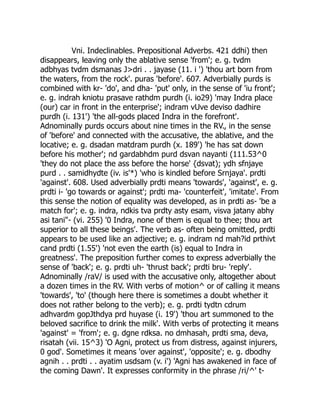
(bottom) (xu. 339) and occasionally in the SB. in the 4 Like the
German preposition 'um'.
48.
Vni. Indeclinables. PrepositionalAdverbs. 421 ddhi) then
disappears, leaving only the ablative sense 'from'; e. g. tvdm
adbhyas tvdm dsmanas J>dri . . jayase (11. i ') 'thou art born from
the waters, from the rock'. puras 'before'. 607. Adverbially purds is
combined with kr- 'do', and dha- 'put' only, in the sense of 'iu front';
e. g. indrah kniotu prasave rathdm purdh (i. io29) 'may Indra place
(our) car in front in the enterprise'; indram vUve deviso dadhire
purdh (i. 131') 'the all-gods placed Indra in the forefront'.
Adnominally purds occurs about nine times in the RV., in the sense
of 'before' and connected with the accusative, the ablative, and the
locative; e. g. dsadan matdram purdh (x. 189') 'he has sat down
before his mother'; nd gardabhdm purd dsvan nayanti (111.53^0
'they do not place the ass before the horse' {dsvat); ydh sfnjaye
purd . . samidhydte (iv. is'*) 'who is kindled before Srnjaya'. prdti
'against'. 608. Used adverbially prdti means 'towards', 'against', e. g.
prdti i- 'go towards or against'; prdti ma- 'counterfeit', 'imitate'. From
this sense the notion of equality was developed, as in prdti as- 'be a
match for'; e. g. indra, ndkis tva prdty asty esam, visva jatany abhy
asi tani"- (vi. 255) '0 Indra, none of them is equal to thee; thou art
superior to all these beings'. The verb as- often being omitted, prdti
appears to be used like an adjective; e. g. indram nd mah?id prthivt
cand prdti (1.55') 'not even the earth (is) equal to Indra in
greatness'. The preposition further comes to express adverbially the
sense of 'back'; e. g. prdti uh- 'thrust back'; prdti bru- 'reply'.
Adnominally /raV/ is used with the accusative only, altogether about
a dozen times in the RV. With verbs of motion^ or of calling it means
'towards', 'to' (though here there is sometimes a doubt whether it
does not rather belong to the verb); e. g. prdti tydtn cdrum
adhvardm gopJthdya prd huyase (i. 19') 'thou art summoned to the
beloved sacrifice to drink the milk'. With verbs of protecting it means
'against' = 'from'; e. g. dgne rdksa. no dmhasah, prdti sma, deva,
risatah (vii. 15^3) 'O Agni, protect us from distress, against injurers,
0 god'. Sometimes it means 'over against', 'opposite'; e. g. dbodhy
agnih . . prdti . . ayatim usdsam (v. i') 'Agni has awakened in face of
the coming Dawn'. It expresses conformity in the phrase /ri/^' t-
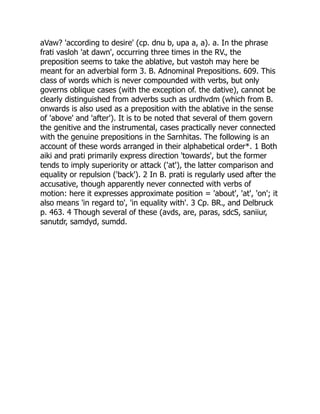
49.
aVaw? 'according todesire' (cp. dnu b, upa a, a). a. In the phrase
frati vasloh 'at dawn', occurring three times in the RV., the
preposition seems to take the ablative, but vastoh may here be
meant for an adverbial form 3. B. Adnominal Prepositions. 609. This
class of words which is never compounded with verbs, but only
governs oblique cases (with the exception of. the dative), cannot be
clearly distinguished from adverbs such as urdhvdm (which from B.
onwards is also used as a preposition with the ablative in the sense
of 'above' and 'after'). It is to be noted that several of them govern
the genitive and the instrumental, cases practically never connected
with the genuine prepositions in the Sarnhitas. The following is an
account of these words arranged in their alphabetical order*. 1 Both
aiki and prati primarily express direction 'towards', but the former
tends to imply superiority or attack ('at'), the latter comparison and
equality or repulsion ('back'). 2 In B. prati is regularly used after the
accusative, though apparently never connected with verbs of
motion: here it expresses approximate position = 'about', 'at', 'on'; it
also means 'in regard to', 'in equality with'. 3 Cp. BR., and Delbruck
p. 463. 4 Though several of these (avds, are, paras, sdcS, saniiur,
sanutdr, samdyd, sumdd.
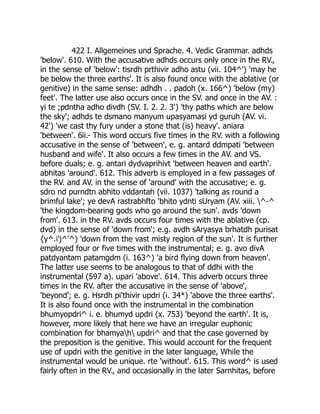
50.
422 I. Allgemeinesund Sprache. 4. Vedic Grammar. adhds
'below'. 610. With the accusative adhds occurs only once in the RV.,
in the sense of 'below': tisrdh prthivir adho astu (vii. 104^') 'may he
be below the three earths'. It is also found once with the ablative (or
genitive) in the same sense: adhdh . . padoh (x. 166^) 'below (my)
feet'. The latter use also occurs once in the SV. and once in the AV. :
yi te ;pdntha adho divdh (SV. I. 2. 2. 3') 'thy paths which are below
the sky'; adhds te dsmano manyum upasyamasi yd guruh (AV. vi.
42') 'we cast thy fury under a stone that (is) heavy'. aniara
'between'. 6ii.- This word occurs five times in the RV. with a following
accusative in the sense of 'between', e. g. antard ddmpati 'between
husband and wife'. It also occurs a few times in the AV. and VS.
before duals; e. g. antari dydvaprihivt 'between heaven and earth'.
abhitas 'around'. 612. This adverb is employed in a few passages of
the RV. and AV. in the sense of 'around' with the accusative; e. g.
sdro nd purndtn abhito vddantah (vii. 1037) 'talking as round a
brimful lake'; ye devA rastrabhfto 'bhito ydnti sUryam (AV. xiii. ^-^
'the kingdom-bearing gods who go around the sun'. avds 'down
from'. 613. in the RV. avds occurs four times with the ablative (cp.
dvd) in the sense of 'down from'; e.g. avdh sAryasya brhatdh purisat
{y^.i'j^'^) 'down from the vast misty region of the sun'. It is further
employed four or five times with the instrumental; e. g. avo divA
patdyantam patamgdm (i. 163^) 'a bird flying down from heaven'.
The latter use seems to be analogous to that of ddhi with the
instrumental (597 a). upari 'above'. 614. This adverb occurs three
times in the RV. after the accusative in the sense of 'above',
'beyond'; e. g. Hsrdh pi'thivir updri (i. 34*) 'above the three earths'.
It is also found once with the instrumental in the combination
bhumyopdri^ i. e. bhumyd updri (x. 753) 'beyond the earth'. It is,
however, more likely that here we have an irregular euphonic
combination for bhamyah updri^ and that the case governed by
the preposition is the genitive. This would account for the frequent
use of updri with the genitive in the later language, While the
instrumental would be unique. rte 'without'. 615. This word^ is used
fairly often in the RV., and occasionally in the later Sarnhitas, before
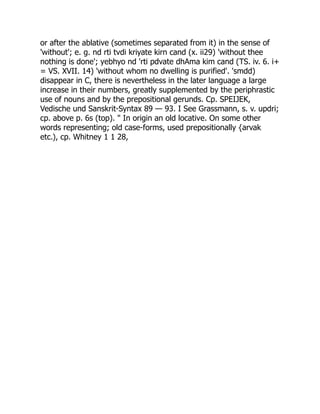
51.
or after theablative (sometimes separated from it) in the sense of
'without'; e. g. nd rti tvdi kriyate kirn cand (x. ii29) 'without thee
nothing is done'; yebhyo nd 'rti pdvate dhAma kim cand (TS. iv. 6. i+
= VS. XVII. 14) 'without whom no dwelling is purified'. 'smdd)
disappear in C, there is nevertheless in the later language a large
increase in their numbers, greatly supplemented by the periphrastic
use of nouns and by the prepositional gerunds. Cp. SPEIJEK,
Vedische und Sanskrit-Syntax 89 — 93. I See Grassmann, s. v. updri;
cp. above p. 6s (top). " In origin an old locative. On some other
words representing; old case-forms, used prepositionally {arvak
etc.), cp. Whitney 1 1 28,
52.
Vin. Indeclinables. PrepositionalAdverbs. 423 paras
'beyond'. 616. In the RV. paras is used with the accusative,
instrumental, ablative, and locative; but in the later Sainhitas it
seems to be found with the ablative only. a. It takes the accusative
six or seven times in the sense of 'beyond', not only locally, but also
to express superiority or excess; e. g. dti s&ryam pardh sakuna iva
paptima (ix. 107^°) 'we have flown away like birds beyond the sun';
nahl deva nd mdrtyo mahds tdva krdtum pardh (i. 19^) 'for neither
god nor mortal (goes) beyond the might of thee, the great'. b. It is
employed nearly three times as frequently with the instrumental, for
the most part in the sense of 'beyond'; e. g. paro mdtraya (vir. 99')
'beyond measure'. In some passages this sense is somewhat
modified. Thus the word twice means 'over' (as opposed to avds); e.
g. yds te amh'cr avds ca yah pardh sruci (x. 1 7 ' j) 'thy juice which
(fell) down firom and over the ladle'. Twice, moreover, it expresses
'without' ; e. g. paro mayabhis (v. 44') 'without wiles'. c. With the
locative it occurs only once in the sense of 'beyond': yi trimsdti
trdyas paro devAso barhir isadan (viii. 28') 'the gods who, three in
excess of thirty, have seated themselves upon the litter'. d. It is
found in three passages of the RV., as well as a few times in the AV.
and the VS., with the ablative in the senses of 'beyond', far 'from',
and 'away from'; e. g. paro divdh (AV. ix. 4") 'beyond the sky'; asmat
. . pardh (viii. 27'^) 'far from him'; tvdt pardh (AV. xii. 3^9) 'apart
from thee'; paro mujavati 'tihi (VS.iii.6i) 'go away beyond (Mount)
Mujavat'. The last example may probably be an instance of the
accusative with/araj = 'beyond (the tribe of) the Mujavants'^
purdsiad 'in front of, 617. This adverb is used two or three times in
the Samhitas with the genitive in the sense of 'before', 'in front of; e.
g. sdmiddhasya purdstat (in. 8^) 'in front of the kindled one'; vdjah
purdstad utd madhyato nah (TS. IV. 7. 12^ = VS. XVIII. 34)
'strength be before us and in the midst of us'. pura 'before' (time).
In the RV. pura is used some twenty times,, and in the later
Samhitas occasionally, before or after the ablative. It has primarily
the sense of 'before' (of time); e. g. pura nu jardsah (viii. 67^°)
'before old age'; puri krurdsya visfpah (TS. I. i. 9^ = VS. i. 28)
53.
Welcome to OurBookstore - The Ultimate Destination for Book Lovers
Are you passionate about testbank and eager to explore new worlds of
knowledge? At our website, we offer a vast collection of books that
cater to every interest and age group. From classic literature to
specialized publications, self-help books, and children’s stories, we
have it all! Each book is a gateway to new adventures, helping you
expand your knowledge and nourish your soul
Experience Convenient and Enjoyable Book Shopping Our website is more
than just an online bookstore—it’s a bridge connecting readers to the
timeless values of culture and wisdom. With a sleek and user-friendly
interface and a smart search system, you can find your favorite books
quickly and easily. Enjoy special promotions, fast home delivery, and
a seamless shopping experience that saves you time and enhances your
love for reading.
Let us accompany you on the journey of exploring knowledge and
personal growth!
ebooksecure.com










![Sanskrit Grammar 1077 — 1089, H23— 1130. —
DELBRUCK.Altindisclie Syntax p. 440 — 47 1. — Cp. Benfey,
VoUstandige Grammatik 241 and 784. — Brugmann, KG. p. 457 —
480, — J. S. Speijer, Vedische und Sanskrit-Syntax, Grundriss i. 6,
87. 592. Two classes of prepositions are to be distinguished. The first
class embraces the genuine or adverbial prepositions. These are
words with a local sense which, being primarily used to modify the
meaning of verbs, came to be connected independently with the
cases governed by the verbs thus modified. They show no signs of
derivation from inflexional forms or (except tirds and purds) forms
made with adverbial suffixes. The second class embraces what may
be called adnominal prepositions. These are words which are not
compounded with verbs, but govern cases only. As regards form,
they almost invariably end in case terminations or adverbial suffixes.
1 -grhya also appears compounded with 1 5 v. Negelein 92 gives -
vidh-ya (]/vyadh-] ni-, vi- and prati-. 2 The gerund d-ghra-ya (AV.
xix. 8^), the reading of the text, is not found in the Mss. and is
doubtless wrong ; cp. WfflTNEY's Index Verborum. i From the
present base of ydd-, cp, Whitney 992 a. 4 afa-ma-ya is a
conjectural reading. and -sus-ya as occurring in the AV., but they are
not to be found in Whitney's Index verborum. 6 See note on AV. x.
2^ in Whitney's Translation. 7 Conjectural reading in AV. XX. 136-';
see Whitney's Index Verborum](https://image.slidesharecdn.com/13932-250727024425-3ccbf65e/85/eBook-PDF-Effective-Cybersecurity-A-Guide-to-Using-Best-Practices-and-Standards-35-320.jpg)